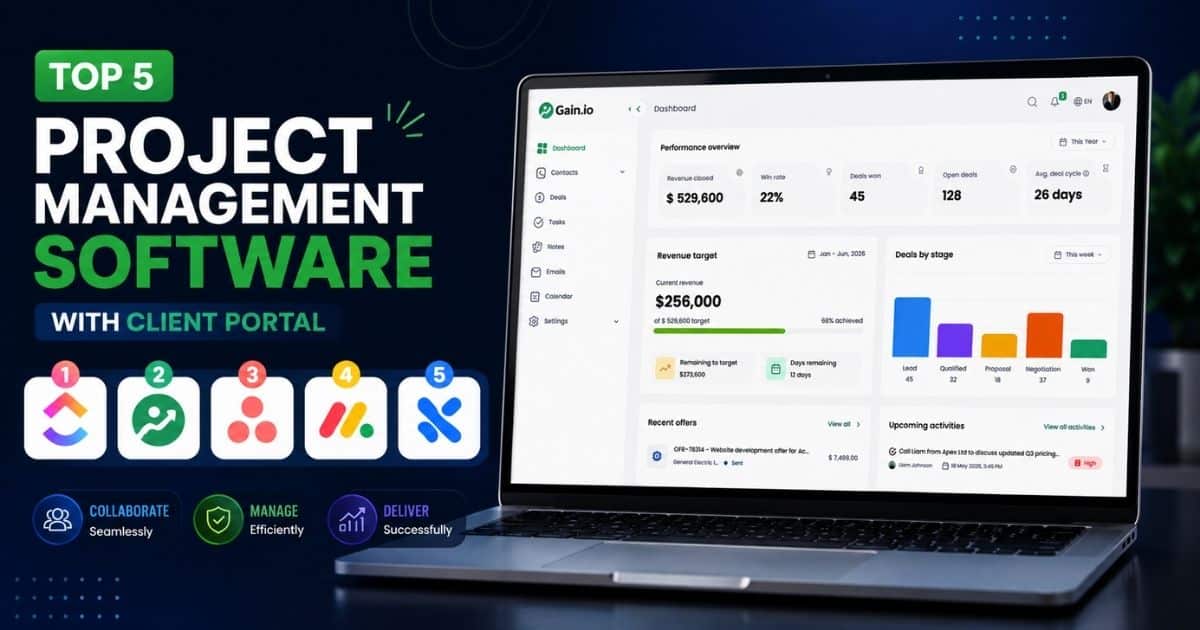
- Industry: B2B SaaS (anonymized)
- Team Size: ~8–12 sales reps
- Challenge: Slow deal cycles and no pipeline visibility
- Solution: Gain.io CRM adoption
- Key Outcome: Deal velocity up ~X%, pipeline visibility improved
1. Executive Summary
A fast-growing B2B startup was struggling to close deals quickly as its sales pipeline expanded. Leads were spread across tools, follow-ups were inconsistent, and managers lacked real-time visibility into deal health. As a result, the average sales cycle had stretched to 35–40 days, and win rates were falling below internal targets.
The team adopted Gain.io as its central CRM to unify contacts and deals, bring structure to the pipeline, and automate follow-ups. Within three months, the sales operation became more disciplined, and data driven. The average sales cycle dropped to 22 days, while win rates improved from 14 percent to 19 percent. Logged sales activities increased by 45 percent and forecast accuracy rose above 90 percent.
By turning scattered sales efforts into a single, visible workflow, the startup accelerated deal velocity, improved team productivity, and built a repeatable process to support continued growth.
2. Company Background and Sales Context
The company is an early-stage B2B SaaS startup building a cloud-based platform for operational teams in mid-sized businesses. Its product addressed a clear market need, and early demand was strong, driven largely by inbound leads and founder-led sales. Within its first year, the startup had grown to more than 500 active trial users and a pipeline of 200 plus qualified opportunities at any given time.
The sales organization consisted of a small but growing team of 10 sales reps, supported by one sales manager. Most deals were handled through email conversations, spreadsheets, and a mix of lightweight tools for tracking leads and follow-ups. While this setup worked in the earliest days, it quickly became strained as lead volume increased by nearly 30 percent quarter over quarter.
Sales cycles were consultative and involved multiple touchpoints with prospects. Reps needed to manage demos, follow-ups, objections, and internal notes across weeks of conversations. Without a central system, important context was often lost between interactions, and handoffs between reps created friction.
3. The Problem: Slow Deal Closures and Disconnected Sales Stack
As inbound demand grew, gaps in the sales process became harder to ignore. What once worked for a small team now slowed deal progress and reduced conversion.
Inconsistent deal prioritization
Leads and opportunities were spread across spreadsheets and inboxes. Each rep followed a different system, making it hard to agree on daily priorities. Reviews showed that nearly 25 percent of active deals missed timely follow-ups due to unclear ownership.
Limited pipeline visibility
Managers lacked a real-time view of deal stages and blockers. Pipeline updates were gathered manually before weekly reviews, often outdated by the time they were discussed. This prevented early intervention on at-risk opportunities.
Manual follow-ups and lost context
Reps tracked conversations in emails and personal notes. Important details were often buried or lost, leading to missed follow-ups and repeated questions. The team estimated 10 to 15 percent of opportunities were affected each quarter by inconsistent engagement.
Long and unpredictable sales cycles
Average sales cycle length had stretched to 35–40 days, compared to an internal target of 20–25 days. Deals stalled without clear next steps, making momentum hard to maintain.
Low forecast confidence
With scattered and inconsistent data, forecast accuracy remained around 70–75 percent. Leadership lacked confidence in projections, complicating planning and growth decisions.
4. Goals and KPIs for Sales Acceleration
To turn growing demand into faster, more predictable revenue, the team defined a small set of measurable goals that would guide every change to the sales process.
- Reduce average sales cycle by at least 30 percent
Baseline deal duration of 35–40 days needed to be brought closer to the internal target of 20–25 days to improve cash flow and deal momentum. - Increase win rate on qualified opportunities to above 18 percent
With current win rates around 14 percent, the goal was to lift conversions by at least 4–5 percentage points through better follow-ups and prioritization. - Improve forecast accuracy to 90 percent or higher
Forecast reliability was critical for hiring and spend decisions. The team aimed to move from 70–75 percent accuracy to a level leadership could confidently plan around. - Ensure 100 percent of deals and activities were logged in one system
Full visibility into pipeline activity was required to eliminate shadow tracking and create a true source of truth. - Cut administrative selling time by 30 percent
Reps were spending up to 35 percent of their time on updates and tracking. The target was to shift that time back to prospect conversations and demos.
These KPIs set a clear benchmark for evaluating success and aligned the sales team around accelerating revenue without adding headcount.
5. Solution Implementation with Gain.io
The team adopted Gain.io as the central system to bring structure, visibility, and discipline to their sales process. Implementation focused on changing daily behavior, not just adding a new tool.
Centralized contacts and deal management
All leads, accounts, and active deals were migrated into a single workspace. Within the first two weeks, 100 percent of new opportunities were being logged in Gain.io, replacing spreadsheets and personal trackers. This created a single source of truth for the entire pipeline.
Visual pipeline with standardized stages
The team defined six clear deal stages aligned to their sales motion. Reps updated stages during daily work, giving managers real-time visibility. Within the first month, over 90 percent of deals had consistent stage data, compared to less than 60 percent before.
Follow-up automation and task discipline
Automated reminders and task rules were introduced for demos, proposals, and inactive deals. Missed follow-ups dropped by an estimated 40 percent, and average time between touches improved from 5–6 days to under 3 days.
Email sync and activity tracking
Sales in boxes were connected so emails and meetings were logged automatically. This increased recorded activities per rep by about 45 percent, giving managers better insight into deal momentum without extra admin work.
Team collaboration and deal context
Shared notes and activity timelines allowed reps and managers to see full deal history in one place. Handoff errors between reps decreased, and internal deal review time was reduced by around 30 percent.
Within six weeks, Gain.io was fully embedded in daily sales workflows, replacing fragmented tools with a structured process that supported faster, more consistent deal execution.
6. Validation, Testing, and Iteration
After rolling out Gain.io, the team treated the first eight weeks as a validation phase to test whether the new sales process was improving deal velocity and consistency. Rather than assuming success, they tracked daily usage and reviewed performance metrics in weekly sales meetings.
During the first month, approximately 180 active opportunities were managed inside Gain.io, covering more than 95 percent of the live pipeline. Reps logged over 1,400 sales activities, including emails, calls, and meetings, a 45 percent increase compared to the previous month. This jump confirmed that automation and inbox sync were reducing friction and encouraging consistent usage.
Early data revealed where improvements were needed. While follow-up reminders reduced missed touches, some deals still sat idle between stages. The team adjusted task rules to trigger alerts when no activity occurred for 48 hours on active opportunities. Within two weeks, the share of deals without recent activity dropped from 22 percent to 9 percent, tightening pipeline discipline.
Pipeline reviews also highlighted stage bottlenecks. Nearly 30 percent of deals were stalling in the proposal stage, often due to unclear next steps. In response, the team introduced a required next-action field before deals could advance. This changes improved proposal-to-close conversion by an estimated 6 percentage points over the next month.
Feedback from reps was collected through weekly retrospectives. The most common request was to simplify data entry and reduce duplicate updates. As a result, several non-essential fields were removed, cutting manual updates per deal by about 25 percent and increasing overall data completeness.
7. Results and Business Impact
Within three months of adopting Gain.io, the startup saw clear improvements across deal velocity, conversion, and sales productivity.
- Sales cycle reduced by 37 percent
Average deal duration dropped from 35–40 days to 22 days, helping the team close revenue faster and improve cash flow predictability. - Win rate increased by 5 percentage points
Conversion on qualified opportunities improved from around 14 percent to 19 percent, driven by better follow-ups and clearer deal prioritization. - Forecast accuracy improved to above 90 percent
With standardized stages and real-time updates, forecast variance narrowed from 25–30 percent to under 10 percent, giving leadership confidence in pipeline projections. - Missed follow-ups reduced by 40 percent
Automated tasks and reminders significantly cut stalled opportunities, keeping deals moving through the pipeline. - Selling time increased by 30 percent
Admin work dropped from roughly 35 percent of rep time to under 25 percent, allowing reps to spend more time on demos and customer conversations. - Pipeline visibility improved across the team
Over 95 percent of active deals had up-to-date stage and activity data, enabling proactive coaching and faster intervention on at-risk opportunities. - Revenue momentum accelerated
The team closed about 25 percent more deals per month without increasing headcount, directly tying operational discipline to top-line growth.
Together, these outcomes transformed the sales operation from a fragmented process into a disciplined, data-driven engine for predictable growth.
8. Key Lessons and Strategic Takeaways
Several clear lessons emerged from the startup’s effort to accelerate deal velocity and bring discipline to its sales process.
- Process clarity drives speed more than volume.
Standardizing six pipeline stages and enforcing next steps reduced deal stagnation and helped cut the sales cycle by over one-third. - Automation prevents revenue leakage.
Follow-up rules and task reminders reduced missed touches by 40 percent, showing that small workflow changes can protect large portions of pipeline value. - Centralized data builds forecast confidence.
With more than 95 percent of deals consistently updated, leadership could rely on forecasts with under 10 percent variance, improving planning decisions. - Behavior changes before outcomes change.
The increase in logged activities by 45 percent came before gains in win rate, highlighting that adoption and discipline are leading indicators of performance. - Simplicity supports adoption.
Removing unnecessary fields cut update effort by 25 percent, helping sustain daily usage across 90 percent of reps.
These lessons reinforced that sales acceleration depends as much on structure and habits as on tools.
9. What Happened After the Impact
With a faster and more predictable sales engine in place, the startup shifted focus from fixing process gaps to scaling growth.
- Pipeline capacity expanded without headcount growth.
Over the next quarter, the team managed 20 percent more active opportunities while maintaining a sales cycle near 22 days. - Revenue planning became more aggressive and accurate.
Improved forecast reliability allowed leadership to set higher quarterly targets with confidence and align marketing spend more closely to pipeline needs. - Sales and marketing alignment improved.
Shared visibility into deal stages and outcomes helped refine lead qualification, reducing low-quality handoffs by an estimated 15 percent. - Foundation set for future expansion.
With a disciplined CRM process in place, the team began preparing for new market segments and a larger sales team without redesigning workflows.
The startup moved forward with a repeatable, data-driven sales operation that supported faster growth while keeping execution risk under control.