Picture this scenario: your B2B SaaS team in 2025 is flooded with demo requests. The inbound engine is humming. Marketing celebrates another record month. But when you check the numbers, only a small fraction of those demos progress to a second meeting. Fewer still become real opportunities. Sound familiar?
Here is the core problem. Sales and marketing efforts generate more leads than ever, yet win rates stay flat. Teams chase volume instead of pursuing leads that fit and convert. The result? Wasted sales capacity, frustrated reps, and forecasts that never quite hold up.
Lead qualification is the process of deciding which leads deserve deeper sales effort based on fit, intent, and timing. It answers a simple question: should we invest real selling time in this prospect right now?
The stakes are higher than they have ever been. Average buying groups now include 6-10 people, and sales reps spend less than one-third of their week in actual selling activities. Everything else gets eaten by admin, research, and chasing prospects who were never going to buy. That makes qualification non-negotiable for any team serious about hitting revenue targets.
This article covers what lead qualification means today, the key types of qualified leads, practical frameworks you can apply immediately, a step-by-step lead qualification process you can roll out this quarter, common mistakes that hurt conversions, best practices to improve accuracy, and how Gain.io helps you see buying intent through content collaboration.
What Is Lead Qualification
Lead qualification is evaluating a prospect against your ideal customer profile, buying intent, and readiness to decide whether they move deeper into your sales process. It functions as a gatekeeping mechanism that keeps low-fit leads out of the pipeline while accelerating high-fit ones through to close.
Think of it this way: lead generation fills the funnel. Lead qualification filters and prioritizes that funnel so your sales reps spend time on deals worth pursuing.
In a modern B2B motion, qualification starts the moment a form is submitted or a trial is created. It continues through discovery calls, demos, and proposal stages. This is not a single checkpoint. It is an ongoing evaluation that happens at every stage of the sales cycle.
Three practical pillars define effective qualification. Fit covers whether the prospect matches your target industry, company size, tech stack, and region. Intent reflects their behavior, engagement signals, and internal urgency to solve a problem. Timing looks at budget cycles, project deadlines, and whether they need to act now or in six months.
Here is a real-world example. A marketing agency qualifies a lead from a January 2025 webinar. The company has 200 employees, a CMO attended the session, they visited the pricing page three times in a week, and they mentioned urgency to replace their current vendor by Q3 2025. That combination of fit, intent, and timing signals a lead worth pursuing immediately.
Why Lead Qualification Matters For Modern B2B Teams
In 2025-2026, customer acquisition cost is rising, inbound is noisier, and outbound reply rates continue to decline. Every sales hour must point at the right accounts. Chasing unqualified leads burns budget and demoralizes your team. Let me break down why lead qualification helps teams win more deals with less wasted effort.
Higher Conversion Rates. Sales reps who consistently work well-qualified opportunities close far more deals from fewer conversations. Teams with a strong lead qualification process typically see conversion improvements in the 20-40% range. That is not marginal. That is the difference between hitting quota and missing by a mile.
Shorter Sales Cycles. Weeding out poor-fit leads early reduces no-decision outcomes and repeated demos for the wrong buyers. When your pipeline is filled with potential customers who have real budget, authority, and urgency, deals close faster. This matters especially in complex sales cycles that often stretch 6-9 months.
Better Forecasting. When your sales pipeline contains leads that passed consistent qualification checks, win-rate assumptions and revenue projections become reliable. Your Q4 2025 forecast holds up because you know the quality of what sits in your pipeline.
Stronger Sales And Marketing Alignment. Shared qualification rules and clear definitions for marketing qualified leads MQLs, sales accepted leads, and sales qualified leads SQLs reduce friction over lead quality. Marketing teams can refine campaigns based on closed-won data instead of guessing. Sales and marketing teams finally speak the same language.
Common Types Of Qualified Leads
Why does naming different lead types matter? It gives sales and marketing a shared map of where a prospect is on their journey. Without clear definitions, handoffs become messy, accountability disappears, and promising leads fall through the cracks.
Four core types define the modern B2B qualification landscape: Marketing Qualified Leads, Sales Accepted Leads, Sales Qualified Leads, and Product Qualified Leads.
These definitions should be tailored by each company but must be documented in your CRM and playbooks. When every rep handles leads consistently, pipeline accuracy improves dramatically.
Marketing Qualified Leads
Marketing qualified leads are prospects who match basic ideal customer criteria and have shown marketing engagement strong enough to deserve closer attention. They are not ready for full sales cycles yet, but they have raised their hand in some meaningful way.
What behaviors define an MQL in 2025 for a B2B SaaS company? Attending a live webinar signals active interest. Downloading a detailed guide or report shows research intent. Returning to the pricing page several times in a week suggests they are evaluating options. Subscribing with a corporate email and engaging with nurture emails indicates ongoing consideration.
Consider someone who signs up for a February 2025 “Content Approval Workflow” webinar and then views multiple case studies afterward. That pattern of engagement, combined with the right job title and company size, would trigger MQL status in most lead scoring models.
Marketing uses lead scoring and engagement data inside a CRM to promote contacts to MQL status. The threshold should be high enough to filter noise but low enough to capture leads generated with genuine interest.
Sales Accepted Leads
A sales accepted lead is an MQL that a sales rep or SDR has reviewed, agreed meets quality standards, and committed to working within a defined time frame. This intermediate stage creates a clear handoff moment between marketing and sales.
Why does this matter? Without an acceptance step, marketing sends leads over the wall and sales ignores them. With a sales accepted lead stage, there is a documented “yes, we own this” moment. Accountability is clear.
Practical acceptance criteria might include correct region, company size within target band, and a confirmed email or LinkedIn presence for the primary contact. SDRs typically review new MQLs in daily or weekly queues. They accept leads that meet criteria, request enrichment for promising but incomplete records, or recycle poor-fit leads back to nurturing.
Sales Qualified Leads
Sales qualified leads SQLs have passed discovery, shown a clear problem your product can solve, and have confirmed or probable budget, authority, and timeframe. These are the leads your sales representative should prioritize.
Signals that a lead has reached SQL status include requesting a demo, inviting multiple stakeholders to a call, or sharing internal deadlines like “we need a solution live before September 2025.” These behaviors indicate real buying intent, not just curiosity.
SQLs typically trigger opportunity creation in the CRM and enter formal forecast and pipeline reports. Your qualification criteria should be strict enough that a meaningful percentage of SQLs become real opportunities, but not so strict that reps miss promising leads earlier in the sales process.
Product Qualified Lead
A product qualified lead is a user who has already touched your product through a free trial, freemium plan, or sandbox environment and reached specific usage thresholds that suggest readiness to buy.
For a collaboration platform like Gain.io, concrete PQL criteria might include a workspace owner inviting three or more colleagues, approving multiple pieces of content in a week, or integrating with another tool like Slack within the first 14 days.
Product analytics in 2024-2026 make it feasible to trigger sales outreach the moment usage hints at a buying conversation. You do not have to wait for form fills or demo requests. The product usage data tells you who is engaged.
PQLs often close faster than MQLs because they have already experienced real value. The buying decision becomes easier when a prospect has seen your product solve their problem firsthand.
MQL Vs SQL: Where The Line Sits
Every qualified lead sits somewhere between two stages. A marketing qualified lead has shown interest but isn't ready for a sales conversation yet. A sales qualified lead has shown real buying intent and is ready to talk. Mixing these up is one of the most common reasons marketing and sales teams disagree about lead quality.
Factor | MQL | SQL |
|---|---|---|
Lead Intent | Initial interest through marketing content | Clear buying intent, ready to talk to sales |
Funnel Stage | Early to mid funnel | Late stage, near a buying decision |
Owned By | Marketing team, nurtured | Sales team, engaged directly |
Typical Behavior | Content downloads, blog visits, webinar signups | Pricing page visits, demo requests, direct contact |
The gap between the two stages is wider than most teams assume. Demand Gen Report found the median MQL-to-SQL conversion rate fell to 9.8% in 2026, down from 13.1% in 2024, while programs that add behavioral or intent signals to their scoring report 16.4%, nearly 70% higher than the unfiltered median. A tighter definition of "sales qualified" pays off directly in that conversion rate.
Lead Qualification Frameworks You Can Use
Frameworks give your team structured question sets that help reps run consistent discovery rather than improvising on every call. Not every lead conversation follows the same path, but having a shared approach improves results.
No single lead qualification framework fits every team. Most B2B companies mix elements of several depending on deal size and complexity. A high-velocity inbound motion needs different questions than a complex enterprise sale with multiple stakeholders.
BANT Framework
BANT stands for Budget, Authority, Need, and Timeline. Each dimension covers a critical aspect of qualification.
Budget asks whether the prospect has allocated funds or can secure them. Authority identifies who makes the buying decision and who influences it. Need confirms the prospect has a problem your product solves. Timeline establishes when they plan to make a decision.
Example questions a rep might use on a discovery call:
- “How have you budgeted for content operations this year?”
- “Who else will be involved in the final sign-off for a platform like this?”
- “What happens if you do not solve this problem by Q3?”
BANT works well for shorter sales cycles and inbound leads where you need to qualify quickly. Trial signups from Q1 2025 campaigns are good candidates for BANT qualification.
The limitation is that BANT can feel too vendor-centric if reps lead with budget and timeline before understanding the prospect’s pain points. Smart reps adapt the order based on the conversation flow.
CHAMP Framework
CHAMP stands for Challenges, Authority, Money, and Prioritization. The key difference from BANT is that CHAMP starts from the prospect’s problems rather than your solution.
Example prompts for CHAMP discovery:
- “What is the hardest part of getting content approved across all your clients?”
- “Where does this project sit among your team’s top priorities for 2025?”
- “Walk me through what happens when an approval gets stuck.”
CHAMP works well in consultative sales where reps act as advisors and often need multiple conversations to shape a project. It blends well with account-based motions where you target a small number of high-value accounts and invest time in deeper discovery.
The framework is sometimes called CHAMP Challenges Authority Money Prioritization in full documentation.
MEDDIC Framework
MEDDIC stands for Metrics, Economic Buyer, Decision Criteria, Decision Process, Identify Pain, and Champion. Some teams use variants like MEDDPIC that include Paper Process for contract and procurement steps.
MEDDIC is typically used for enterprise sales with multiple departments, legal review, security assessments, and longer sales cycles running six months or longer.
For a collaboration platform sale, identifying metrics might focus on “time to approve campaigns” or “number of revision cycles per asset” as the core before-and-after story. The decision process identifies how the buying committee evaluates options and what decision criteria they use.
The framework is sometimes referenced as MEDDIC Metrics Economic Buyer Decision Criteria Decision Process, and Identify Pain Champion in sales training materials.
Reps gradually fill in each MEDDIC component over several calls and emails. You cannot ask everything on a first discovery call without overwhelming the prospect.
Step By Step Lead Qualification Process
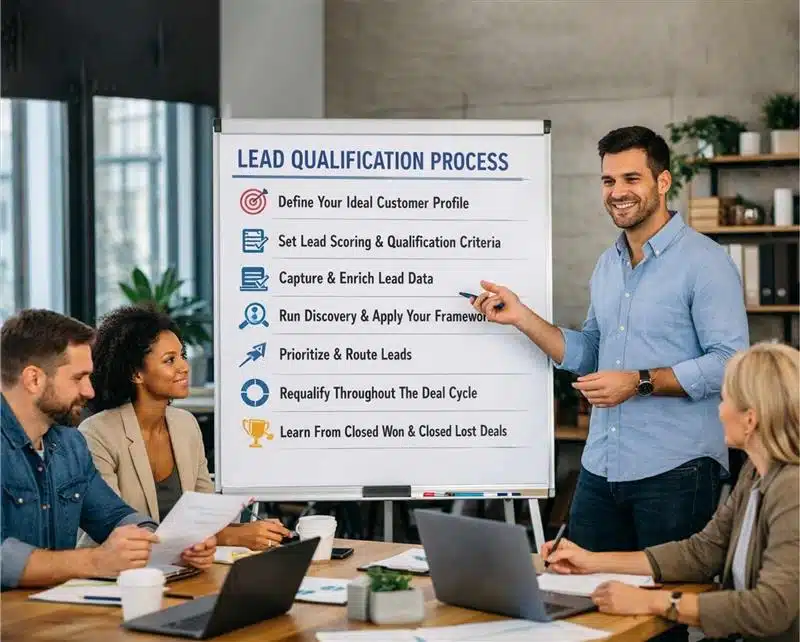
While every company’s stages differ, the most effective qualification processes cover a repeatable set of steps from first touch through opportunity creation and beyond. Here is a practical seven-step flow that a B2B team could implement in their CRM and playbooks within a quarter.
Use this lead qualifying process to train new SDRs and AEs. Call recordings and examples from real deals in 2024-2025 bring each step to life.
Step One- Define Your Ideal Customer Profile
The lead qualification process starts by documenting your ideal customer based on your best customers over the past 12-24 months. Include revenue size, industry, region, tech stack, and buying committee structure.
Run a simple analysis: export closed-won deals from 2024, look at annual contract value, time to close, and retention. Identify common patterns among your strongest accounts. What do they share?
Create at least one negative ideal customer profile as well. Highlight company traits that tend to fail onboarding or churn quickly. Knowing who not to pursue saves as much time as knowing who to chase.
Keep the ICP short enough that sales reps can remember and use it on calls. A ten-page document that nobody reads is worthless.
Step Two- Set Lead Scoring And Qualification Criteria
Lead scoring criteria differentiate between fit scores and behavioral scores. Fit scores cover firmographic and demographic attributes like industry and company size. Behavioral scores track website visits, trial usage, email engagement, content approvals, and meeting attendance.
A simple scoring model might work like this:
Signal | Points |
|---|---|
Job title: Head of Marketing | +20 |
Company size: 50-500 employees | +15 |
Attended product tour | +10 |
Viewed case studies multiple times | +10 |
Downloaded pricing guide | +15 |
Corporate email domain | +5 |
Set a threshold score that automatically promotes a record to MQL. For example, 40 points might be the cutoff.
Review and adjust scores quarterly. You will learn which traits correlate with deals that close as you gather more data.
Step- Three Capture And Enrich Lead Data
Leads enter your system through forms, chat, events, referrals, or product trials. Consistent lead capture into a CRM matters because it creates a single source of truth for your sales funnel.
Data enrichment tools automatically add details like industry, employee count, and tech stack based on a corporate email domain. This information helps SDRs have informed conversations in the first 24-48 hours after a hand-raiser action.
Validate critical fields like region and job title during the first live interaction. Enrichment data is useful but not always accurate. Trust but verify.
Step Four- Run Discovery And Apply Your Framework
The first substantial conversation is where reps apply frameworks like BANT or CHAMP. Whether it is a 20-minute discovery call or an in-depth demo, this step separates high quality leads from the rest.
A good discovery call includes a clear agenda, thoughtful open-ended questions, and space for the buyer to explain their current workflow and constraints.
Example questions tailored to collaborative content workflows:
- “Walk me through how your team gets campaign assets from first draft to final approval today.”
- “How do you currently track feedback across different stakeholders?”
- “What happens when revisions pile up and deadlines get tight?”
By the end of this step, reps should have enough information to decide if the lead is a true opportunity, needs nurturing, or should be politely disqualified. The goal is to identify pain points clearly and assess buying intent honestly.
Step Five- Prioritize And Route Leads
Qualified leads should be prioritized in queues based on score, urgency, and strategic value. The order they appeared is not enough information to prioritize leads effectively.
Routing rules might send high-value accounts in North America to specific AEs or route PQLs to a specialized team trained on trial-to-paid conversions.
Set service-level expectations. New SQLs should be contacted within a specific number of business hours to keep momentum high. Document routing rules in a shared playbook and review with sales operations at least twice a year.
Step Six- Requalify Throughout The Deal Cycle
Qualification is not a one-time gate at the top of the funnel. Budgets can be frozen. Sponsors can leave. Priorities shift during a multi-month sales cycle.
Reps should revisit key questions about budget, authority, and timing at milestones like proposal delivery, security review, or contract redlining. This ongoing assessment keeps the decision process visible.
Requalification triggers include stalled approval workflows, long gaps in communication, or last-minute scope changes. Honest requalification can lead to either progressing the opportunity with confidence or mutually agreeing to revisit later instead of dragging dead deals through your forecast.
Step Seven- Learn From Closed Won And Closed Lost Deals
After opportunities close, teams should review why they won or lost and update qualification criteria based on these insights.
Run monthly win-loss sessions where AEs share patterns. What were common reasons for “no decision” in late 2024? What objections came up in specific industries? This analysis feeds back into ICP definitions, lead scoring process, and discovery questions.
The feedback loop becomes more powerful when combined with structured data from tools that track engagement on shared content and approvals. Understanding what worked helps you score leads based on signals that predict sales success.
Common Lead Qualification Mistakes That Hurt Conversions
Even teams with solid processes make qualification errors that hurt conversion rates. Recognizing these mistakes helps you avoid wasting time on low quality leads and missing promising leads that deserve attention. Research shows that companies lose up to 80% of leads generated due to poor qualification and follow-up practices.
Chasing Unqualified Prospects
One of the most expensive mistakes sales teams make is pursuing leads that were never a good fit. Studies indicate that 61% of B2B marketers send all leads directly to sales, yet only 27% of those leads turn out to be qualified. Sales reps spending time on unqualified leads cannot focus on prospects worth pursuing. The result is bloated pipelines, frustrated reps, and missed quotas. Before investing discovery time, verify that the lead meets basic fit criteria around company size, industry, and decision-making authority.
Ignoring Behavioral And Intent Data
Demographic data alone does not tell you whether a prospect is ready to buy. Engagement signals like pricing page visits, content downloads, and email interactions reveal intent. Companies that use behavioral data in qualification see 9% higher sales win rates on average. Ignoring these signals means you might prioritize a cold lead with the right job title over a warm lead showing clear buying behavior. Your lead scoring model should weight actions, not just attributes.
Delayed Lead Follow Up
Speed matters in the lead generation process. Research shows that responding to leads within five minutes makes you 21 times more likely to qualify them compared to waiting 30 minutes. Yet the average B2B company takes 42 hours to respond to a new lead. By then, prospects have moved on to competitors or lost their initial urgency. Build routing rules that get high-scoring leads to reps immediately, and set clear SLAs for response times.
Lack Of Alignment Between Teams
When sales and marketing teams disagree on what makes a qualified lead, friction multiplies. Marketing celebrates MQL volume while sales complains about lead quality. Studies show that companies with strong sales and marketing alignment achieve 38% higher sales win rates. The fix is simple but requires discipline: document shared definitions for MQL, SAL, and SQL, and review them quarterly with both teams present.
Poor Lead Documentation Practices
Without proper documentation, valuable qualification insights disappear. When a rep leaves or hands off a deal, the next person starts from scratch. CRM data shows that incomplete lead records correlate with 23% longer sales cycles. Every discovery call should result in updated notes capturing budget discussions, stakeholder names, timeline expectations, and identified pain points. Lead qualification tools integrated with your CRM make this documentation automatic rather than optional.
Best Practices To Improve Lead Qualification Accuracy
Avoiding mistakes is the first step. Building a systematic approach to scoring leads and identifying the most promising leads requires deliberate practices. Here is how to strengthen your lead qualification efforts with methods that actually improve accuracy.
Define Clear Qualification Criteria
Start with specific, documented criteria that every rep can apply consistently. Vague standards like “seems interested” lead to inconsistent results. Effective qualification criteria include firmographic requirements like minimum company size and target industries, behavioral thresholds like engagement signals, and discovery requirements like confirmed budget range and identified champion. Companies with documented qualification criteria report 30% higher forecast accuracy because their pipelines contain consistently evaluated opportunities.
Use Data Driven Lead Scoring
Predictive lead scoring removes guesswork from prioritization. Instead of relying on gut instinct, use historical data to identify which attributes and behaviors correlate with closed deals. Marketing automation platforms can assign point values automatically based on actions like demo requests, content engagement, and website visits. Companies using data-driven lead scoring see 77% higher lead generation ROI because they focus effort on high-probability opportunities.
Automate Lead Tracking Workflows
Manual tracking creates gaps where leads fall through the cracks. Automated workflows in your CRM can trigger tasks when leads reach score thresholds, alert reps when engagement signals spike, and route leads to the right owners based on territory or segment. This automation ensures that sales leadsget attention at the right moment. Teams with automated lead tracking report 14.5% shorter sales cycle length on average.
Maintain Continuous Sales Feedback Loops
Qualification is not a one-way process from marketing to sales. Sales reps provide essential feedback on which leads convert and which fall flat. Monthly reviews of closed-won and closed-lost deals reveal patterns that improve lead qualification questions and scoring weights. Companies that run regular feedback sessions between sales operations and marketing teams see 67% better lead quality over time.
Monitor Qualification Performance Metrics
What gets measured gets improved. Track metrics like MQL-to-SQL conversion rate, SQL-to-opportunity conversion rate, average deal size by lead source, and sales cycle length by qualification score. These numbers reveal where your qualification process identify pain points and where adjustments are needed. Set benchmarks and review monthly. Teams that monitor qualification performance systematically improve conversion rates by 20-25% within two quarters.
How Gain.io Strengthens Lead Qualification
Gain.io reveals how real buying teams work together on campaigns and content before they ever sign a contract. This collaboration behavior provides qualification and intent signals that traditional CRM data cannot capture.
Centralized content feedback and approvals inside Gain.io show who in a prospect’s organization is involved, how fast they move, and how invested they are in solving their marketing operations challenges. When a lead invites teammates, moves quickly through approval workflows, and engages deeply with your materials, you see genuine buying intent in action.
Consider this scenario: a brand team in April 2025 runs multiple campaigns through Gain.io during a trial. They invite legal, compliance, and regional marketers to collaborate. They consistently meet internal deadlines. They leave detailed feedback on shared assets. This behavior signals strong fit and urgency far better than a simple demo request form.
Gain.io data refines qualification in several meaningful ways. You can identify true champions based on who drives approvals and initiates collaboration. You can detect slow or stalled workflows that may signal low priority or internal roadblocks. You can see which content types resonate most with a buyer’s organization. You can spot expanding buying committees as more stakeholders join workspaces.
When marketing and sales both have access to this collaboration data, they align better on what “qualified” truly looks like for content-heavy teams. Instead of debating lead quality based on form fills and email opens, you see how prospects engage with the actual work they would do as customers.
Customer success starts with properly qualified customers. Gain.io gives you the signals to find them.
FAQs
What Is The Goal Of Lead Qualification In Sales?
The primary goal of lead qualification is to ensure sales teams spend time on prospects who fit your ideal customer profile and have genuine intent to purchase. This process filters out low-probability opportunities early, allowing reps to focus on deals worth pursuing. Effective qualification improves conversion rates, shortens sales cycles, and increases forecast reliability. Without qualification, teams waste resources generating leads that never convert.
How Do Sales Teams Identify Qualified Leads?
Sales teams identify qualified leads through a combination of fit assessment and intent signals. Fit factors include company size, industry, region, and job title of the contact. Intent signals come from behavioral data like website visits, content downloads, demo requests, and product usage. Discovery conversations verify budget, authority, need, and timeline. The process identify pain points that your product can solve and confirms the prospect’s decision making process.
Which Framework Works Best For Lead Qualification?
The best framework depends on your sales motion and deal complexity. BANT works well for high-velocity inbound sales with shorter sales cycles. CHAMP suits consultative sales where understanding challenges comes before discussing budget. MEDDIC fits enterprise sales with complex sales cycles involving a buying committee and longer evaluation periods. Most teams combine elements from multiple frameworks based on their specific needs.
How Often Should Lead Qualification Criteria Be Updated?
Teams should formally review lead scoring criteria and qualification rules at least once per quarter. Additionally, update criteria after major business changes like entering a new market, launching new products, or significant shifts in average deal size. Analyze closed-won and closed-lost deals from the past 3-6 months to identify which attributes and behaviors best predicted success, then adjust your model accordingly.
What Metrics Measure Lead Qualification Success?
Key metrics include MQL-to-SQL conversion rate, SQL-to-opportunity conversion rate, opportunity-to-close rate, average deal size by lead source, and sales cycle length segmented by qualification score. Track the percentage of unqualified leads that slip into the pipeline and time-to-first-contact for new leads. These measurements reveal whether your qualification process effectively separates high quality leads from poor-fit prospects.