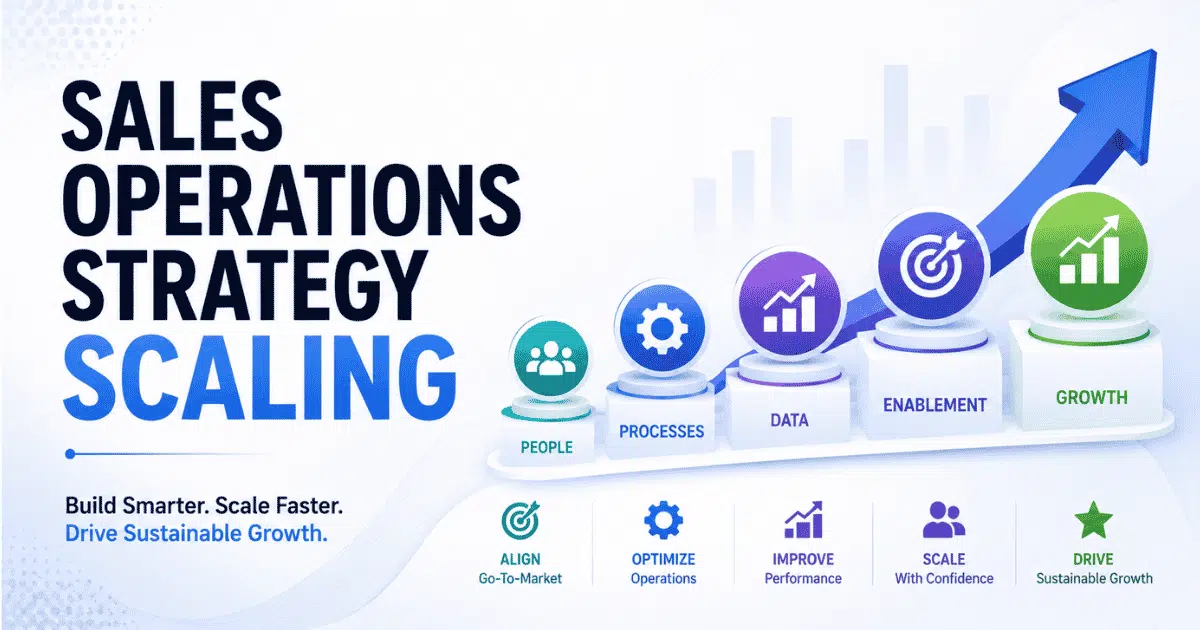
Sales growth often creates new operational challenges. As the sales team expands, manual processes, disconnected systems, and inconsistent workflows can reduce productivity. A strong sales operations function helps businesses maintain efficiency while supporting long-term growth.
An effective sales ops strategy allows the sales operations team to standardize the sales process, improve data visibility, and reduce operational bottlenecks. The sales operations manager and sales ops team play a critical role in aligning technology, processes, and performance metrics. Organizations that build a successful sales operations team can improve forecasting, increase productivity, and create scalable systems that support revenue growth as the business expands.
What Is Sales Operations Strategy Scaling
Sales operations strategy scaling is the process of improving the sales ops function as a company grows. It focuses on optimizing processes, technology, and workflows to support revenue growth without increasing operational complexity. A successful sales ops team helps sales reps work more efficiently by reducing administrative tasks and improving data visibility. Sales enablement, automation, and standardized workflows allow the sales team to maintain productivity as the business expands. Modern revenue operations strategies also align the sales strategy with marketing and customer success teams, helping organizations build scalable systems that support long-term growth.
Why Does Sales Efficiency Decline As Revenue Teams Scale
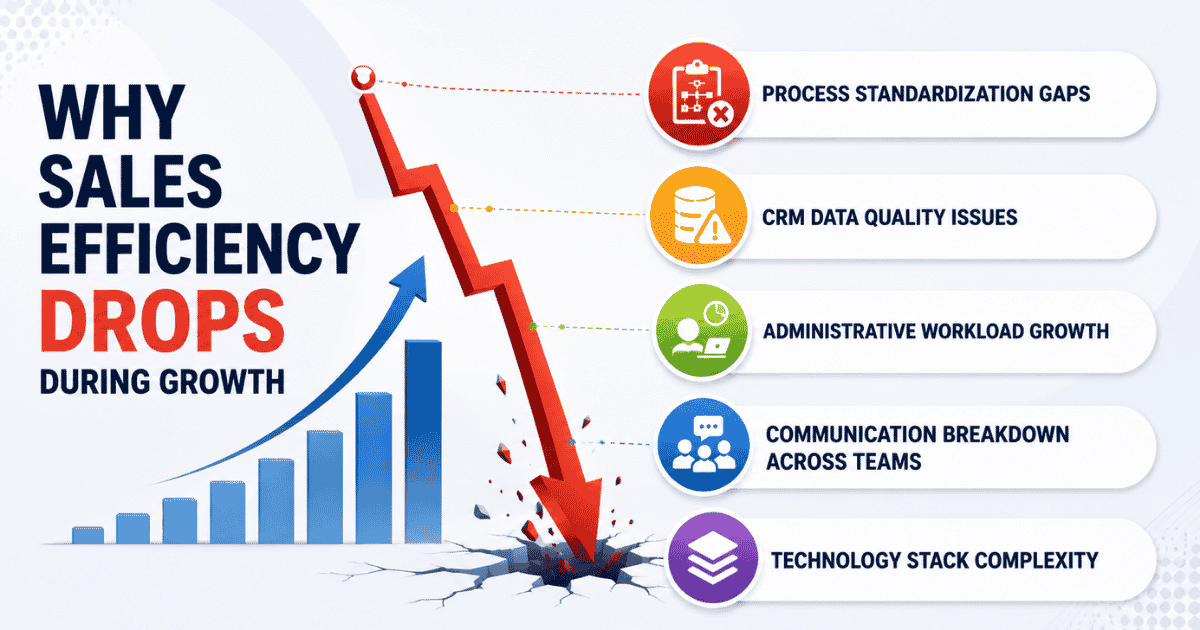
Sales efficiency often declines as revenue teams expand and operational demands increase. Growing organizations face challenges related to processes, communication, and technology. Without scalable sales operations processes, productivity decreases, and the sales team struggles to maintain consistent performance.
Process Standardization Gaps
As organizations grow, different teams often follow different workflows. Sales representatives may use separate methods for qualification, follow-ups, and reporting. Inconsistent sales operations processes create confusion, reduce visibility, and make it difficult for sales operations leaders to maintain performance standards.
CRM Data Quality Issues
Poor data quality becomes a major challenge as the sales force expands. Duplicate records, incomplete information, and outdated opportunities affect forecasting and reporting accuracy. Sales operations analysts spend more time cleaning data instead of supporting strategic initiatives, which reduces operational efficiency.
Administrative Workload Growth
Growing teams generate additional reporting, approvals, and documentation tasks. Sales ops managers and sales operations professionals often spend valuable time managing administrative work rather than optimizing the sales function. Increasing workloads also reduce the time sales representatives spend selling.
Communication Breakdown Across Teams
Larger teams create more communication challenges between sales, marketing, and customer success. Delayed information sharing can create bottlenecks within the sales funnel and affect customer experiences. Poor communication also makes it difficult for sales operations leaders to maintain alignment across departments.
Technology Stack Complexity
New tools are often introduced as companies scale. Multiple systems for reporting, automation, and customer management can create operational complexity. Sales operations analysts may struggle to manage disconnected platforms, while sales representatives face additional administrative tasks. Implementing a purpose-built B2B sales CRM can help simplify the stack and reduce duplicate work. Complex systems can increase the average sales cycle length and reduce overall productivity.
Operational Debt That Slows Down Sales Organizations
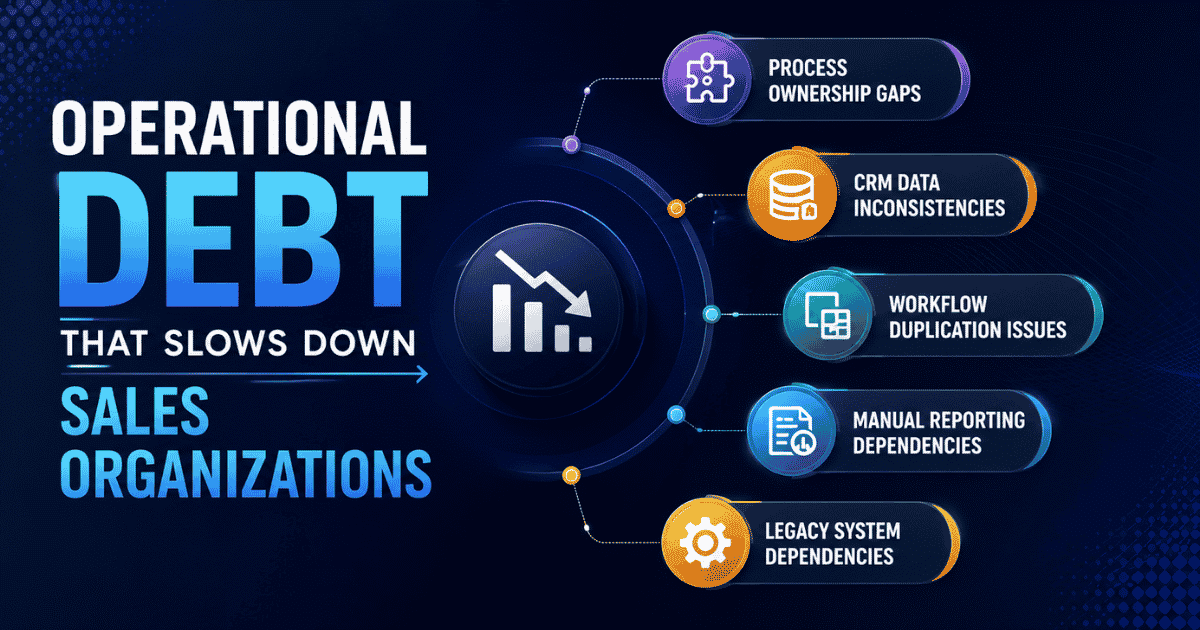
Operational debt develops when sales organizations add new tools, processes, and people without improving their operational foundation. Over time, inefficiencies accumulate, reducing the sales team's efficiency and making it difficult to support growth.
Process Ownership Gaps
Many organizations launch sales operations initiatives without assigning clear ownership. Sales ops leaders, managers, and department heads often share responsibilities, which creates confusion. Teams become uncertain about who manages reporting, forecasting, workflow improvements, or process changes.
Without accountability, problems remain unresolved. Sales ops professionals spend time fixing issues instead of improving performance. Clear ownership helps teams maintain consistent execution and supports better operational decision-making.
CRM Data Inconsistencies
Poor data management becomes a major source of operational debt. Duplicate records, incomplete opportunities, and outdated customer information reduce forecasting accuracy and limit visibility across the organization.
Customer relationship management systems depend on reliable information. When data quality declines, sales teams lose trust in reports and dashboards. Sales ops professionals often spend significant time correcting errors instead of supporting strategic initiatives. Better data management practices improve reporting accuracy and operational performance.
Workflow Duplication Issues
As teams grow, departments frequently create their own processes for lead generation, opportunity tracking, and pipeline management. Different teams may follow different qualification methods, reporting procedures, and approval workflows.
Duplicate workflows increase complexity and reduce collaboration. Sales representatives often receive conflicting instructions, while managers struggle to maintain consistency. Standardized workflows help improve coordination and support the sales team's efficiency across departments.
Manual Reporting Dependencies
Many organizations still rely heavily on spreadsheets and manual reports. Sales ops leaders and analysts often spend hours collecting data from multiple systems before creating performance reports.
Manual reporting slows decision-making and limits visibility. Delayed reporting can affect forecasting accuracy, pipeline management, and revenue planning. It may also increase sales cycle length because managers cannot identify bottlenecks quickly. Automating reporting processes allows teams to focus on analysis instead of data collection.
Legacy System Dependencies
Older technologies often become barriers to growth. Legacy systems may not support modern customer relationship management platforms, advanced reporting tools, or automation capabilities.
Disconnected systems create additional work for sales teams and reduce operational visibility. Data may exist in multiple locations, creating inconsistencies and increasing administrative tasks. Organizations get more value when they pair a modern CRM with a simpler sales workflow instead of layering new tools on top of legacy systems. Sales operations initiatives frequently fail when organizations continue relying on outdated technology.
When Should Companies Redesign Their Sales Workflows
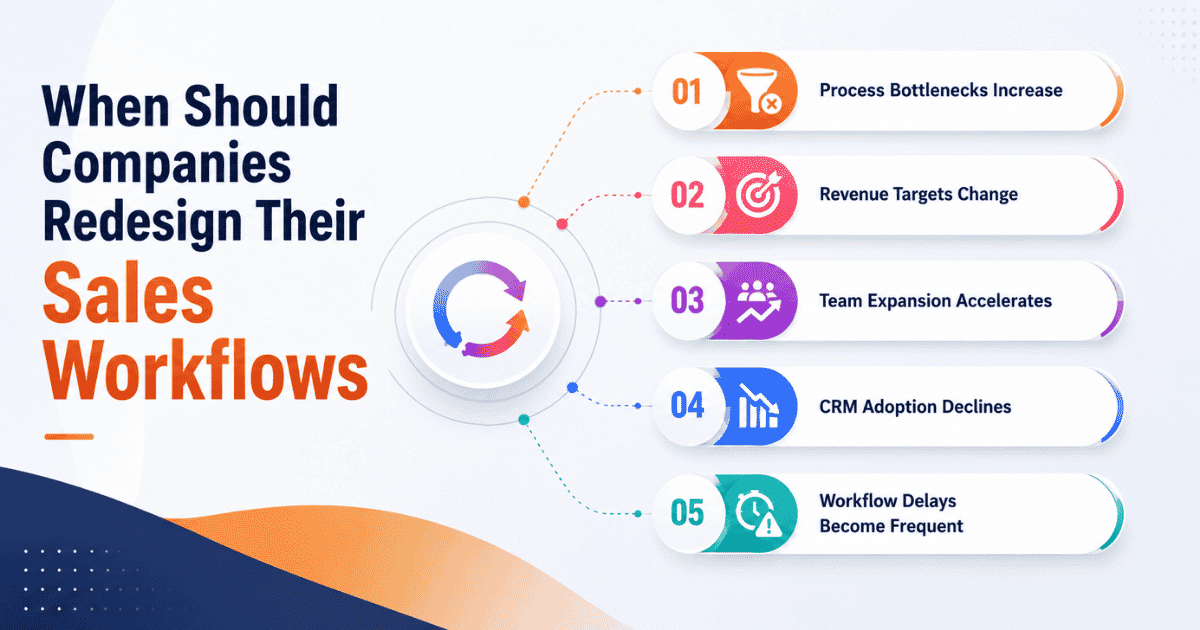
Growing sales teams often reach a point where existing workflows no longer support business goals. Delays, poor visibility, and operational inefficiencies can reduce performance. Recognizing these signals helps companies redesign workflows before productivity and revenue begin to decline.
Process Bottlenecks Increase
Sales workflows should be redesigned when approval delays, manual handoffs, and reporting bottlenecks begin affecting daily operations. Bottlenecks often reduce sales productivity and create friction across the sales pipeline. Teams may struggle to move opportunities between stages, causing slower responses and reduced efficiency.
As organizations grow, sales teams depend on consistent processes to maintain performance. Bottlenecks can also limit collaboration between departments and make it difficult to manage increasing workloads. Monitoring process delays helps organizations identify areas that require immediate improvement.
Revenue Targets Change
New revenue goals often require different operational strategies. Higher targets demand stronger forecast accuracy, improved resource allocation, and more effective pipeline management. Existing workflows that supported smaller teams may no longer meet new performance expectations.
Companies pursuing predictable revenue frequently redesign their sales processes to support growth. Changes in business goals often require updated reporting methods, stronger sales analytics, and better visibility into performance metrics.
Team Expansion Accelerates
Rapid hiring can create operational challenges. New employees may follow different processes, use different tools, or interpret workflows differently. Without standardized processes, productivity declines and collaboration becomes difficult.
Growing organizations often introduce project management tools and new sales technologies to support larger teams. However, adding tools without updating workflows can create additional complexity. Applying structured sales workflow automation strategies alongside process redesign helps teams maintain consistency and improve onboarding experiences.
CRM Adoption Declines
Declining CRM usage is often an early warning sign. Sales representatives may avoid updating records if workflows become too complicated or time-consuming. Poor adoption reduces the quality of sales data and limits the effectiveness of sales analytics.
When data quality declines, forecast accuracy suffers and managers lose visibility into the sales pipeline. Organizations should simplify processes, reduce administrative work, and improve user experiences to increase adoption rates.
Workflow Delays Become Frequent
Repeated delays in reporting, approvals, lead assignments, and customer follow-ups indicate that existing workflows no longer support business needs. These issues often increase the sales cycle and reduce operational efficiency.
Delayed workflows can also affect customer experiences and revenue performance. Longer sales cycle durations make it difficult to achieve predictable revenue goals. Organizations should evaluate process efficiency regularly and redesign workflows when delays become common across multiple teams.
How Should CRM Architecture Evolve During Sales Operations Scaling
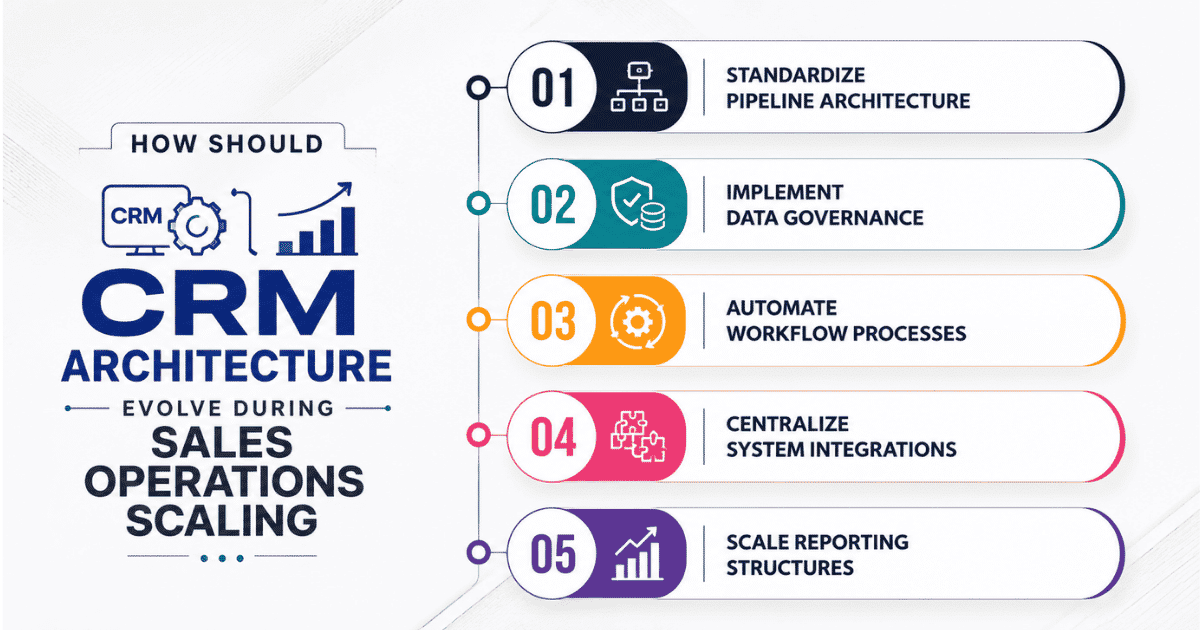
As sales organizations grow, CRM architecture must evolve to support larger teams, increasing data volumes, and more complex processes. A scalable CRM improves business operations, strengthens reporting, and helps sales leadership maintain efficiency across the organization.
Standardize Pipeline Architecture
Growing companies often develop different sales processes across teams. Sales managers may create separate pipelines, stages, and qualification methods that reduce consistency. Standardized pipeline architecture allows sales professionals to follow the same process, improving sales performance and making sales forecasting more accurate.
A unified structure also supports territory planning and provides better visibility into key metrics across departments.
Implement Data Governance
Data quality becomes increasingly important as organizations scale. Without clear governance rules, duplicate records, outdated opportunities, and incomplete information can affect decision-making.
Sales leadership should establish standards for data entry, ownership, and maintenance. Strong governance improves reporting accuracy and allows sales managers to trust the information used for forecasting and performance analysis.
Automate Workflow Processes
Manual tasks often slow growing sales organizations. Workflow automation reduces repetitive activities such as lead assignments, follow-up reminders, approvals, and status updates.
Automation helps sales professionals spend more time selling and less time performing administrative work. Modern sales task automation tools also support sales training by creating consistent processes that new employees can easily follow. Automated workflows improve efficiency and strengthen overall business operations.
Centralize System Integrations
Modern sales teams rely on multiple applications, including marketing platforms, communication tools, and customer support systems. A disconnected tech stack creates data silos and limits operational visibility.
CRM systems should integrate with existing tools to create a centralized environment. Integrated systems improve collaboration, support customer satisfaction, and provide sales leadership with complete visibility into customer interactions and revenue activities.
Scale Reporting Structures
Reporting requirements become more complex as organizations grow. Sales managers need visibility into team performance, while executives require strategic insights into revenue performance and forecasting.
Scalable reporting structures allow organizations to monitor key metrics, evaluate sales performance, and improve sales forecasting accuracy. Customized dashboards can support territory planning, performance management, and strategic decision-making.
Sales Activities For Teams To Automate First
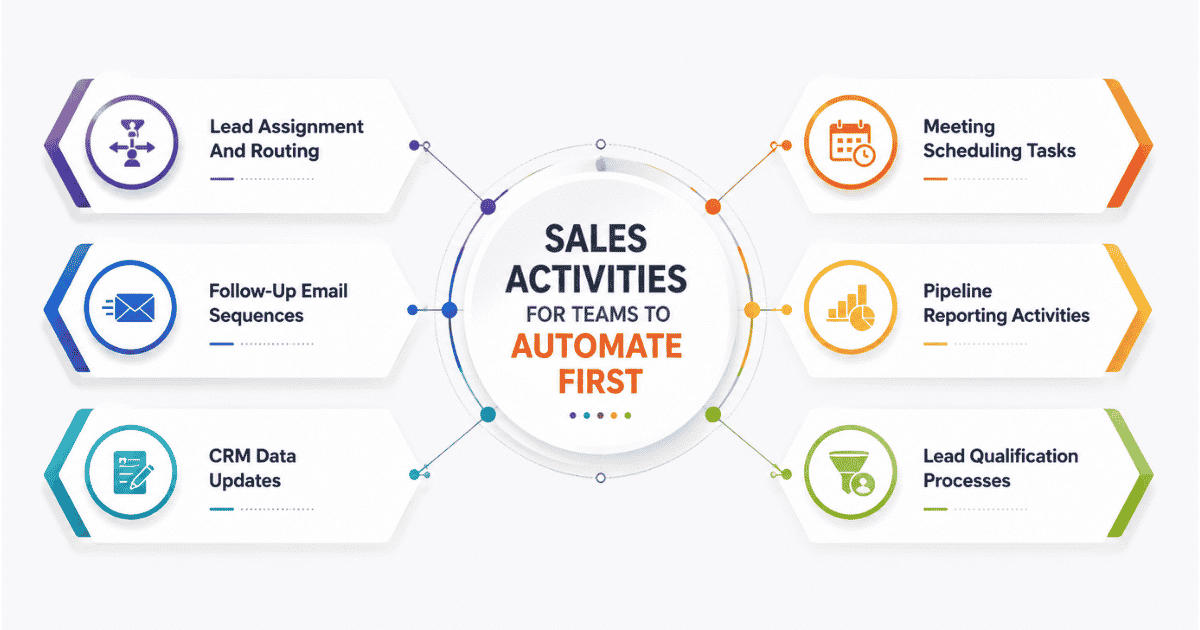
Sales teams often spend too much time on repetitive administrative work instead of selling. Automating the right activities improves efficiency, increases productivity, and allows sales teams to focus on revenue-generating tasks. Purpose-built tools for automating sales tasks make scaling easier by removing manual work and creating consistent processes.
Lead Assignment And Routing
Lead assignment is one of the first activities organizations should automate. Manual lead distribution often creates delays and causes opportunities to be overlooked. Automated routing ensures that leads reach the right sales representatives based on territory, product type, or customer profile.
Allowing sales teams to receive qualified leads instantly improves response times and increases conversion opportunities. Sales leaders also gain better visibility into workload distribution and team performance.
Follow-Up Email Sequences
Consistent follow-up plays an important role in driving revenue growth. However, manual email outreach requires significant effort from sales representatives. Automated email sequences help maintain communication with prospects throughout the buying journey.
Sales leaders can create standardized messaging for different stages of the sales process. This approach improves engagement while allowing sales teams to focus on high-value conversations rather than repetitive communication tasks.
CRM Data Updates
Many sales professionals spend valuable time entering information into CRM systems. A well-structured CRM explains exactly how CRM helps sales teams manage leads so that manual updates do not create errors, incomplete records, and inconsistent reporting.
Automating CRM updates improves data accuracy and reduces administrative work. Modern CRM systems can automatically capture activities, update records, and synchronize information across platforms, especially when paired with disciplined sales deal tracking. Better data quality supports key performance indicators and helps operations teams make informed decisions.
Meeting Scheduling Tasks
Scheduling meetings often requires multiple emails and calendar coordination. Automated scheduling tools simplify this process by allowing prospects to select available time slots.
Sales representatives spend less time managing calendars and more time engaging with customers. Faster scheduling also reduces delays within the sales cycle and improves customer experiences, similar to how dedicated tools can close deals faster with Gain.io by reducing friction throughout the buying process.
Pipeline Reporting Activities
Reporting remains one of the most time-consuming activities for many teams. Sales leaders frequently rely on operations teams to collect information from multiple systems and generate reports.
Automated reporting provides real-time visibility into actual revenue, pipeline health, and performance trends. Purpose-built sales pipeline CRM dashboards help managers monitor key performance indicators without manual data collection. Better reporting also allows organizations to identify risks and opportunities more quickly.
Lead Qualification Processes
Lead qualification often involves repetitive questions and manual assessments. Automation can score leads based on behavior, demographics, and engagement levels.
Qualified opportunities can move directly to sales representatives while lower-priority leads enter nurturing programs. This process helps create a great sales force by ensuring that teams focus on opportunities with the highest potential.
How Can Cross-Functional Alignment Improve Sales Efficiency
Cross-functional alignment helps revenue teams work toward shared goals. When sales, marketing, customer success, and operations collaborate effectively, organizations improve efficiency, strengthen communication, and create consistent processes that support long-term growth.
Align Processes And Tools
Different departments often use separate processes and tools to manage their responsibilities. Sales teams may use CRM platforms, while marketing and customer success teams work with other applications. This separation creates data silos and communication gaps.
Sales ops brings teams together by creating standardized workflows and improving integration between existing systems. Unified processes help teams share information more efficiently and support better revenue execution across departments.
Improve Pipeline And Lead Management
Misalignment between departments frequently creates problems in lead management and pipeline management. Marketing teams may generate leads that do not match sales requirements, while customer success teams may lack visibility into customer history.
Cross-functional collaboration improves qualification standards and handoff processes. Better coordination allows teams to manage opportunities more effectively and create smoother customer experiences throughout the buying journey.
Share Valuable Insights Across Teams
Every department collects different types of information. Sales teams understand customer objections, marketing teams track market trends, and customer success teams monitor customer behavior.
Sharing these valuable insights helps organizations make better decisions. Teams can identify changing customer needs, respond to market trends, and improve strategic planning. Collaborative decision-making also supports process optimization across the organization.
Support Technology And Operational Alignment
Organizations often invest in multiple platforms to support revenue activities. Without alignment, technology investments may create duplicate work and disconnected workflows.
Cross-functional teams can evaluate existing systems and identify opportunities to improve integrations. Better alignment allows organizations to maximize technology investments while reducing operational complexity. Sales operations teams also help departments adopt consistent workflows and reporting methods.
Increase Customer Value And Revenue Performance
Collaboration between departments directly affects customer experiences and long-term revenue performance. Sales teams, marketing teams, and customer success teams all contribute to customer lifetime value.
Improved communication creates more consistent customer interactions and supports stronger relationships. Organizations with aligned teams often achieve better revenue execution because departments work toward shared objectives. Cross-functional alignment also allows businesses to respond more quickly to market changes and customer needs.
What Does A Scalable Sales Operations Model Look Like
A scalable sales operations model provides the structure, processes, and technology required to support growth. As organizations expand, sales operations must evolve to improve efficiency, maintain visibility, and support predictable revenue generation.
Standardized Processes And Workflows
Scalable sales organizations rely on consistent workflows across the entire revenue team. Sales activities, qualification methods, approvals, and reporting processes should follow clear standards.
Standardization reduces confusion and allows teams to work more efficiently. Sales managers can monitor performance more effectively, while new employees adapt quickly to established processes. Consistent workflows also improve forecasting accuracy and operational visibility.
Integrated Technology Infrastructure
Technology plays a major role in scalable operations. CRM platforms, communication tools, automation systems, and analytics platforms should work together within a connected environment.
Integrated systems eliminate duplicate work and improve data accuracy. Sales teams gain access to reliable information, while managers receive better visibility into performance. A unified technology environment supports growth without increasing operational complexity.
Data-Driven Decision Making
Modern sales operations depend on accurate data and measurable outcomes. Organizations should track performance metrics, pipeline health, conversion rates, and forecasting accuracy.
Sales leaders use these insights to identify opportunities, resolve problems, and improve operational efficiency. Real-time reporting allows managers to make faster decisions and adjust strategies as business conditions change.
Cross-Functional Revenue Alignment
Scalable sales operations extend beyond the sales department. Marketing, customer success, operations, and leadership teams should work toward common goals and share information regularly.
Cross-functional collaboration improves communication and strengthens revenue performance. Shared visibility through strong sales pipeline management also helps teams align priorities, improve customer experiences, and respond more effectively to changing market conditions.
Continuous Optimization And Improvement
A scalable model requires ongoing evaluation and improvement. Organizations should review processes, technology, reporting structures, and operational performance regularly.
Sales operations teams can identify inefficiencies, improve workflows, and support changing business requirements. Continuous optimization allows organizations to maintain productivity as teams grow and market conditions evolve.
Strong sales operations models provide clear processes, integrated systems, reliable data, and collaborative teams. These elements help organizations build predictable revenue, improve operational efficiency, and support long-term business growth.
How Gain.io Supports Sales Operations Efficiency And Growth
Gain.io helps growing sales teams improve operational efficiency by bringing contacts, deals, tasks, and pipeline activities into a single workspace. The all-in-one CRM to grow your sales and team offers visual pipeline management, contact management, task tracking, email integration, and follow-up capabilities that support daily sales activities.
Sales teams can track deal progress, manage activities, and maintain visibility across the pipeline without relying on multiple tools. Gain.io also supports workflow consistency through smart CRM tools for sales teams, task management, communication tracking, and centralized customer information that strengthen task management for sales teams.
For organizations focused on sales operations efficiency, Gain.io provides a straightforward CRM environment that helps teams stay organized, improve pipeline visibility, and support scalable sales processes as the business grows. This is especially valuable as a CRM for startups and small sales teams that need a simpler sales workflow without enterprise-level complexity.
FAQs
When Should Companies Invest In Dedicated Sales Operations Teams?
Companies usually invest in dedicated sales operations teams when manual processes begin affecting productivity, forecasting accuracy, and revenue performance. Rapid growth, larger teams, and increasing operational complexity often create the need for specialized support.
How Can Sales Operations Improve Forecast Accuracy?
Sales operations improve forecast accuracy through standardized processes, reliable data, consistent reporting, and better pipeline visibility. Accurate forecasting helps organizations allocate resources effectively and make informed revenue decisions.
What Causes Sales Operations Bottlenecks During Growth?
Common bottlenecks include disconnected systems, inconsistent workflows, poor CRM adoption, manual reporting, and unclear ownership. These issues often reduce productivity and create operational debt as organizations scale.
How Does Sales Operations Affect Revenue Performance?
Effective sales operations improve pipeline management, sales productivity, conversion rates, and forecasting. Strong operational processes help teams identify opportunities faster and support more predictable revenue growth.
What Metrics Should Sales Operations Leaders Monitor?
Sales operations leaders typically monitor sales cycle length, forecast accuracy, pipeline velocity, win rates, rep productivity, and revenue attainment. These metrics help identify operational issues and measure team performance.
How Can Companies Reduce Operational Debt In Sales Teams?
Organizations can reduce operational debt by standardizing workflows, improving CRM data quality, automating repetitive tasks, and clearly defining process ownership. Continuous optimization helps prevent inefficiencies from accumulating.
Why Does CRM Architecture Matter During Sales Growth?
CRM architecture influences reporting, automation, data quality, and user adoption. A scalable CRM structure allows organizations to support larger teams, improve visibility, and maintain operational efficiency as the business grows.