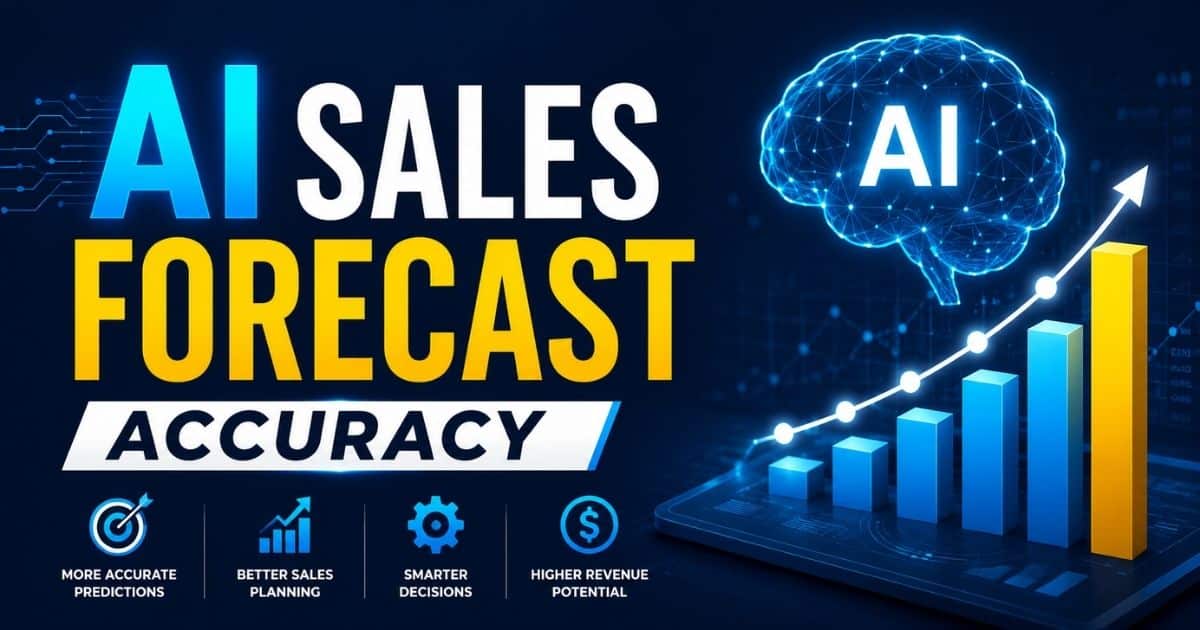
Accurate revenue predictions are critical for growing teams, yet many organizations still struggle with inconsistent forecasts, missed targets, and unreliable pipeline projections. AI sales forecasting accuracy has become a major focus for sales leaders because modern forecasting tools can analyze historical sales data, buyer behavior, pipeline activity, market trends, and CRM insights far beyond what traditional sales forecasting methods can handle.
Unlike manual forecasting that often relies on assumptions, AI sales forecasting software continuously evaluates data quality, deal progress, engagement signals, and historical data patterns to produce more accurate forecasts. As businesses scale, reliable sales forecasting software helps teams allocate resources, set realistic goals, and identify revenue risks before they affect performance.
Understanding how AI forecasting works and what factors influence forecast accuracy can help growing companies make smarter decisions and build a more predictable path to revenue growth.
What Is AI Sales Forecasting?
AI sales forecasting is the process of using artificial intelligence and machine learning to predict future revenue based on historical sales data, pipeline activity, customer interactions, and external factors such as market shifts. Unlike traditional forecasting methods that depend heavily on manual estimates from sales reps, sales forecasting AI analyzes large volumes of data to identify patterns, trends, and revenue risks.
Modern sales forecasting tools continuously evaluate sales performance, deal progress, and buying signals to generate more accurate forecasts. As a result, sales teams can make data-driven decisions, improve planning, allocate resources effectively, and respond faster to changing market conditions.
Importance Of Accurate AI Sales Forecasting Data
Accurate AI sales forecasting depends on more than advanced algorithms. High-quality data, consistent sales processes, and reliable forecasting methods are essential for generating predictions that teams can trust and act on confidently.
Better Data Leads To More Accurate Forecasts
AI powered sales forecasting systems rely on reliable data to identify patterns and predict future revenue. When CRM records contain outdated information, duplicate entries, or missing fields from manual data entry, forecast accuracy declines. Clean and consistent data allows AI tools to analyze customer behavior, pipeline movement, and deal progression more effectively, resulting in more accurate forecasts.
Reliable Forecasts Improve Resource Allocation
Growing companies must decide where to invest time, budget, and talent. Accurate predictions help leaders allocate resources to the right opportunities, hire at the right pace, and manage operational costs more efficiently. Reliable forecasts also reduce uncertainty and support strategic planning across sales, finance, and operations teams.
AI Helps Teams Respond To Market Trends Faster
Traditional methods often rely heavily on historical data and subjective judgment from sales teams. AI forecasting continuously evaluates market trends, customer interactions, and pipeline activity to identify changes as they occur. Faster insights allow businesses to adjust their sales strategy before market shifts impact revenue performance.
Strong Forecasting Supports Better Sales And Marketing Decisions
Accurately forecast sales outcomes requires alignment between sales and marketing efforts. Forecast data helps teams evaluate the impact of marketing campaigns, identify high-converting channels, and prioritize opportunities with the greatest revenue potential. Better visibility into future demand enables more informed decision-making throughout the sales forecasting process.
Forecast Accuracy Creates Predictable Revenue Growth
Reliable forecasting provides a clearer picture of future revenue and business performance. Sales leaders can track progress against targets, identify risks earlier, and improve forecasting process consistency across teams. When organizations combine AI forecasting with quality data and structured sales processes, they gain greater confidence in revenue planning and long-term growth projections.
How Does AI Boost Sales Forecasting
AI in sales forecasting helps businesses generate more accurate forecasts by analyzing large volumes of historical performance data, pipeline activity, customer interactions, and market signals. Unlike traditional sales forecasting methods that rely heavily on assumptions and manual judgment, an AI model continuously learns from clean historical sales data and compares predictions against actual sales outcomes. As new information enters the system, AI adjusts forecasts in real time and identifies patterns that humans may overlook. This deeper analysis helps sales teams predict revenue more accurately, identify risks earlier, and optimize sales strategies based on data rather than intuition. The result is a more reliable forecasting process that supports better planning and business growth.
How To Improve AI Sales Forecasting Accuracy
Accurate AI forecasts do not happen automatically. Even the most advanced AI forecasting tools depend on data quality, process consistency, and continuous optimization. Growing teams that focus on the following areas can create accurate forecasts and make better business decisions.
1. Build Forecasts On High-Quality CRM Data
AI models are only as reliable as the sales data they analyze. Missing close dates, duplicate records, outdated opportunities, and inconsistent pipeline updates can reduce forecast accuracy significantly. Sales operations leaders should establish CRM governance standards and require teams to maintain complete records, using CRM systems that improve sales productivity to make accurate data entry and updates easier for reps. High-quality data helps AI forecasting tools identify meaningful patterns, reduce human error, and generate more accurate predictions. Clean CRM data also improves demand forecasting and future sales projections.
2. Monitor Pipeline Health Instead Of Pipeline Size
Many teams focus on the total value of their pipeline, but pipeline health is often a stronger forecasting indicator. AI forecasting tools analyze deal velocity, buyer engagement, stalled opportunities, and stage progression to assess the likelihood of conversion. A large pipeline filled with inactive deals can create misleading forecasts. Regular pipeline reviews help teams identify risks earlier and improve the accuracy of future revenue predictions, especially when managers use a visual sales pipeline to improve deal clarity and spot bottlenecks quickly.
3. Combine Historical Data With Current Market Conditions
Historical performance provides valuable forecasting insights, but relying on past results alone can create blind spots. Market conditions, competitive activity, seasonal demand, and economic indicators often influence purchasing decisions, so teams should choose sales forecasting methods for accurate revenue planning that balance historical trends with current signals. Modern AI forecasting systems continuously evaluate both historical trends and real-time market signals. This combination allows organizations to create accurate forecasts that reflect current business realities rather than outdated assumptions.
4. Standardize Sales Processes Across The Team
Forecast accuracy often suffers when sales representatives follow different qualification methods, sales stages, or opportunity management practices. Consistent sales processes create cleaner data and improve model reliability. AI forecasting tools perform better when every opportunity follows the same workflow and reporting standards. Standardization also makes forecasting methods more predictable and easier to scale as the business grows.
5. Use AI Agents To Detect Forecast Risks Early
Modern AI agents can identify warning signs long before they appear in traditional forecasting reports. Reduced buyer engagement, prolonged sales cycle complexity, missed follow-ups, and declining deal momentum can all indicate future revenue risk, which an AI sales assistant for pipeline efficiency can flag early through real-time monitoring. Instead of waiting for quarterly reviews, teams can use AI-powered alerts to take corrective action earlier. Early intervention often improves both sales outcomes and forecast accuracy.
6. Measure Forecast Accuracy And Refine Models Continuously
Many organizations generate forecasts but never evaluate their accuracy. Comparing predictions against actual results helps teams identify weaknesses in their forecasting process. Sales leaders should track forecast variance, win rates, stage conversion rates, and forecast consistency over time, along with other sales performance metrics for SaaS teams that highlight where forecasts and execution diverge. Continuous analysis allows organizations to refine forecasting methods, improve AI model performance, optimize sales strategies, and produce increasingly reliable forecasts as market conditions evolve.
Challenges That Reduce AI Sales Forecast Accuracy
AI forecasting can improve revenue planning, but several challenges can reduce prediction accuracy. Identifying and addressing these issues is essential for building forecasts that sales leaders can trust and act on confidently.
Poor CRM Data Quality
AI forecasting models depend on accurate and complete data. Missing close dates, outdated opportunities, duplicate records, and inconsistent deal updates can distort predictions. When sales teams fail to maintain CRM hygiene, the system learns from flawed information and produces unreliable forecasts. Even advanced forecasting platforms cannot compensate for poor-quality data. Reliable forecasting starts with clean, standardized records across the entire sales pipeline.
Inconsistent Sales Processes Across Teams
Forecast accuracy often declines when different sales representatives follow different qualification criteria, sales stages, or reporting methods. One rep may update opportunities regularly, while another delays updates until deals progress further. Such inconsistencies create gaps in forecasting data and make it difficult for AI models to identify meaningful patterns. Standardized sales processes help ensure forecast inputs remain consistent and comparable.
Overreliance On Historical Data
Historical performance provides valuable forecasting insights, but past results do not always predict future outcomes. Market conditions, customer preferences, competitor activity, and industry changes can quickly alter buying behavior. Organizations that rely too heavily on historical trends may overlook emerging risks and opportunities. Accurate forecasting requires a balance between historical analysis and current market intelligence.
Limited Visibility Into Pipeline Health
Pipeline size alone does not indicate future revenue potential. Deals that remain inactive for extended periods, lack stakeholder engagement, or show declining momentum can create an inflated forecast. Without visibility into pipeline health, AI models may overestimate revenue opportunities, which is why sales visibility matters more than ever for aligning forecasts with what is actually happening in the field. Monitoring buyer activity, deal velocity, and engagement levels helps improve prediction accuracy and provides a more realistic view of future performance.
Human Bias And Forecast Manipulation
Human judgment still influences many forecasting processes. Sales representatives may overestimate deal probability, delay reporting risks, or adjust forecasts based on targets rather than actual conditions. Such behavior introduces bias into forecasting data and reduces model accuracy. AI can reduce some human bias, but it cannot eliminate inaccurate inputs. Organizations that combine AI forecasting with objective data governance and regular forecast reviews typically achieve more reliable results.
Best Ways To Implement AI Sales Forecasting
Effective AI sales forecasting requires more than deploying new technology. Organizations that combine quality data, structured processes, and AI-driven insights are far more likely to achieve accurate and actionable revenue forecasts.
Use High-Quality Customer And Sales Data
Every forecasting model depends on the quality of the information it analyzes. Incomplete CRM records, duplicate accounts, and outdated opportunities reduce forecast reliability. AI based predictive analytics performs best when customer data, deal history, and sales activities are consistently updated, and modern CRMs with smart CRM tools for sales teams make these updates far easier to maintain. Clean data helps forecasting systems identify patterns more accurately and generate stronger revenue forecasting insights.
Combine Historical Forecasting With Real-Time Signals
Historical forecasting provides valuable context, but it should not be the only source of prediction. Customer purchase history, current pipeline activity, buyer engagement, and market changes all influence future revenue. Modern AI systems evaluate both historical trends and real-time signals to provide a more complete forecasting picture. This approach helps organizations adapt more quickly to changing sales conditions.
Align Sales Processes Before Deploying AI
Forecasting accuracy often suffers when sales teams follow inconsistent qualification methods or opportunity stages. Standardized sales processes create cleaner data and improve model performance, as shown when teams implement sales acceleration with Gain.io to close deals faster by unifying pipeline stages and follow-up rules. Sales managers should establish clear pipeline definitions, reporting standards, and opportunity management practices before implementing AI forecasting tools, starting with a shared understanding of what a sales pipeline is and how to build one that works. Consistency across teams creates a stronger foundation for predictive analysis.
Integrate Forecasting Into Strategic Planning
Forecasts become more valuable when they influence business decisions. Organizations should use AI forecasting insights to support strategic planning, budgeting, hiring, territory management, and resource allocation. Revenue forecasts should not exist in isolation from business operations. Connecting forecasting outputs to decision-making processes helps teams act on insights rather than simply monitor them.
Continuously Review Forecast Performance
AI forecasting models require ongoing evaluation and improvement. Sales operations teams should regularly compare forecast predictions against actual results, identify sources of variance, and refine forecasting inputs. Customer behavior, market conditions, and sales strategies evolve over time. Continuous optimization ensures forecasting models remain relevant and capable of delivering valuable insights that support long-term business growth.
Future Trends In AI Sales Forecasting In 2026
AI sales forecasting is evolving rapidly as businesses seek faster, smarter, and more reliable ways to predict revenue. Several emerging trends are expected to shape the future of forecasting in 2026 and beyond.
AI Agents Will Take A Larger Role In Revenue Forecasting
Traditional forecasting often requires manual reviews and spreadsheet analysis. In 2026, AI agents are expected to automate many forecasting tasks by continuously monitoring pipeline activity, customer engagement, and deal progression. Instead of simply generating reports, AI agents will provide proactive recommendations, identify revenue risks, and suggest actions that improve forecast accuracy. Sales teams will spend less time collecting data and more time acting on insights.
Real-Time Market Intelligence Will Improve Forecast Accuracy
Future forecasting systems will move beyond internal CRM data and incorporate external signals such as market conditions, industry trends, competitor activity, and economic indicators, while drawing on sales pipeline CRM platforms to keep internal deal data accurate and up to date. AI models will analyze these factors alongside customer behavior to create more responsive forecasts. As market conditions change, forecasting platforms will adjust predictions automatically, helping businesses react faster to emerging opportunities and risks.
Predictive Analytics Will Become More Personalized
AI based predictive analytics will increasingly focus on customer-level forecasting rather than broad revenue projections. Advanced models will analyze customer purchase history, engagement patterns, buying preferences, and account activity to predict future purchasing behavior more accurately, especially when paired with robust sales pipeline management that tracks every stage of deal movement. This deeper level of analysis will help organizations identify expansion opportunities, improve retention strategies, and create more precise revenue forecasts.
Forecasting Will Become A Core Part Of Strategic Planning
Forecasting will no longer operate as a standalone sales function. Revenue forecasting insights will play a larger role in strategic planning across finance, operations, marketing, and executive leadership teams. Businesses will use AI-driven forecasts to guide hiring decisions, budget allocation, inventory planning, and growth initiatives. As forecasting accuracy improves, organizations will gain greater confidence in long-term business planning and decision-making.
How Gain.io Helps Teams Build More Accurate Sales Forecasts
Gain.io helps sales teams centralize customer information with an all-in-one CRM, manage opportunities, track deal progress, and maintain organized pipeline data in one place. Accurate sales forecasting depends heavily on data quality, and a CRM system plays a key role in keeping sales records consistent and up to date by helping sales teams manage leads more effectively. By providing visibility into customer interactions, sales activities, and pipeline movement, Gain.io helps teams build a stronger foundation for forecasting and offers a compelling alternative in the Gain.io vs Salesforce CRM comparison. Sales managers can review deal progress, monitor pipeline health, and identify potential revenue opportunities more effectively by applying proven sales deal tracking practices for modern teams. When combined with structured sales processes and reliable CRM data, Gain.io supports better decision-making, improved sales planning, and more informed revenue forecasting for growing teams.
FAQs
What Is The Difference Between AI Sales Forecasting And Traditional Forecasting?
Traditional forecasting relies heavily on manual estimates, spreadsheets, and sales rep judgment. AI sales forecasting analyzes large volumes of data, identifies patterns automatically, and adjusts predictions as new information becomes available. This approach helps businesses generate more accurate and data-driven revenue forecasts.
How Much Historical Data Is Needed For AI Sales Forecasting?
Most AI forecasting systems perform best when they have access to at least 12 to 24 months of historical sales data. Larger datasets provide more context about seasonality, buying patterns, and sales trends, allowing forecasting models to produce more reliable predictions.
Can AI Forecast Sales During Market Changes?
Yes. Modern AI forecasting platforms can evaluate real-time pipeline activity, customer behavior, market trends, and external business conditions alongside historical data. This allows forecasts to adapt more quickly to changing market conditions than traditional forecasting methods that rely primarily on past performance.
What Metrics Should Teams Track To Improve Forecast Accuracy?
Teams should monitor forecast variance, win rates, deal velocity, pipeline coverage, stage conversion rates, and sales cycle length, then use task management for sales teams to turn those insights into focused daily actions. Tracking these metrics helps identify forecasting weaknesses and provides insights that can improve both forecast reliability and overall sales performance, particularly when teams support those improvements with a simpler sales workflow in their CRM.
Is AI Sales Forecasting Suitable For Small And Growing Businesses?
Yes. Growing businesses often benefit significantly from AI forecasting because it helps improve planning, resource allocation, and revenue visibility, especially when paired with a structured B2B sales CRM for revenue teams that keeps deal data accurate. Even smaller sales teams can use forecasting insights to identify risks earlier, prioritize opportunities, and make more informed business decisions as they scale, especially when they automate sales tasks to stay focused and organized.