Quick Answer: Choosing the right CRM matters because most failures come from the selection and rollout process, not the software. Analysts put CRM implementation failure between 30% and 63%, and over 60% of that failure traces back to poor adoption and training rather than the platform itself.
By 2026, over half of small businesses have adopted customer relationship management systems, up from just 11% in 2018. The shift happened because spreadsheets and scattered inboxes cause real damage. Research shows 29% of leads get forgotten when teams rely on fragmented tools. Choosing a crm for small business is no longer optional for companies serious about growth.
This guide walks you through everything from understanding what a modern crm solution actually does to implementing it without the common pitfalls that cause 37% of CRM projects to fail. Whether you run a 5-person agency or a 40-person service firm, you will find a practical framework for selecting and deploying the right crm system for your business needs.
What A Small Business CRM Really Is In 2026
Most small businesses start the same way. Customer information lives in personal Gmail accounts, deal notes are scattered across sticky notes and messaging apps, and everyone has their own version of the contact database in separate spreadsheets. This setup works until it does not. When a salesperson leaves, or a key account slips through the cracks, the cost of disorganization becomes painfully clear.
This page walks through the full evaluation and rollout process. For a broader look at features across all-in-one platforms, see all-in-one CRM for small business, or for cloud-specific setup, see cloud CRM for small business.
Picking the wrong CRM, or picking the right one badly, is a documented risk. Industry analysis puts CRM implementation failure rates between 30% and 63% depending on how strictly "success" gets defined. Over 60% of those failures trace back to people problems, poor user adoption, unclear ownership, and thin training, rather than the software itself. Small business rollouts actually fare better than enterprise ones, with roughly a 22% failure rate against 38% for large companies, which makes the evaluation steps below worth taking seriously from day one.
A modern small business crm replaces this chaos with a single source of truth. Inside the platform, you find unified contact profiles showing every email, call, and meeting with each customer. Deal pipelines visualize opportunities from the first conversation to the closed contract. Tasks and reminders keep follow-ups on schedule, while basic analytics reveal win rates and pipeline velocity.
In 2026, 95% of crm platforms for small teams are cloud-based subscription tools running in browsers and mobile crm apps. All-in-one solutions like Gain.io crm for small businesses provide contact management, visual pipelines, and collaboration tools in one place. There is no installed desktop software or IT maintenance required. Monthly costs typically range from $10 to $50 per user, making crm software accessible even for businesses with tight budgets.
CRM is not only for sales teams. Marketing teams use it for lead scoring and campaign tracking. Account managers rely on it for customer history and relationship health. Support teams access it for context during service interactions. Even founders use dashboards to monitor pipeline health and forecast revenue.
Consider a 10-person digital agency using Pipedrive. Website form submissions automatically populate as leads. Emails sync bidirectionally, reducing manual entry by 70%. Calendar meetings log automatically. The result is contracts closing 22% faster because nothing falls through the cracks, similar to how Gain.io accelerates sales cycles in real-world case studies.
How A CRM Works Day To Day Inside A Small Business
Daily CRM operations begin the moment a new lead appears. That lead might come from a web form, an inbound email, a LinkedIn message, or a phone call logged through a mobile app. The system captures the contact automatically and routes it to the appropriate owner based on rules you define.
The typical flow looks like this. A lead enters your sales pipeline at a stage like “New Lead” where it sits for initial outreach. After a discovery call, you drag the deal to “Qualified.” Once you send pricing, it moves to “Proposal Sent.” Negotiations happen, and eventually the deal lands at “Won” or “Lost” with notes explaining the outcome.
Every interaction logs natively within the crm tools you choose. Emails show open and reply rates. Calls timestamp duration and can include transcription. The complete timeline appears on each contact profile, eliminating the need to search through inboxes or ask colleagues for context.
Sales automation rules multiply your efficiency. After a discovery call, the system can automatically create a follow-up task due in 48 hours. Cold leads can enter nurture sequences that send 3-5 emails over two weeks, boosting response rates by 34% according to industry benchmarks.
Managers and founders typically start and end each day reviewing dashboards. These show open deals across the sales funnel, average response times, upcoming renewals, and team activity. The crm integrates with calendars like Google Workspace and offers email integration to streamline sales communication, ensuring scheduled calls and demos appear alongside your pipeline data.
Biggest Benefits Of Using A CRM For Small Businesses
A CRM requires investment in both money and time, so understanding the concrete returns matters before you commit. Most businesses see measurable results within 6-12 months of proper implementation, with research from Nucleus showing an average ROI of 8.71x, including 29% sales productivity gains when they build simpler sales workflows around their CRM.
Fewer Missed Opportunities
Shared visibility across your team prevents leads from slipping away during busy periods. When everyone can see reminders for pending follow-ups and upcoming touchpoints, the 79% follow-up failure rate common among spreadsheet users drops dramatically. Remote teams especially benefit from this clarity since no one needs to wonder what happened with a particular prospect.
Faster Sales Cycles
Standardized pipeline stages, email templates, and automated task lists remove friction between conversations. A B2B service firm reduced the time from first contact to proposal from 14 days to 7 days by using consistent workflows. That 28% reduction in cycle time translates directly to more deals closed per quarter.
More Predictable Revenue
Sales forecasts become reliable when you track deal probability against expected close dates. Instead of guessing monthly revenue based on gut feeling (which carries 40% variance), weighted pipeline values help small businesses project results within 10% accuracy. Understanding how CRM helps sales teams manage leads is key to turning that visibility into predictable revenue, better hiring decisions, and smarter cash flow management.
Better Collaboration Across Your Team
Centralized notes and interaction histories slash onboarding time for new hires from weeks to days. When a salesperson goes on vacation or leaves the company, customer relationships do not walk out the door. Handoff errors between sales and delivery teams drop by 45% when everyone accesses the same customer communication history.
Cleaner Reporting Without Manual Work
Dashboards replace Sunday night spreadsheet sessions. Instead of piecing together data from multiple files (which 62% of owners report doing), you pull instant reports showing channel performance, team activity, and pipeline health. These customer insights inform strategy without requiring hours of manual exports.
Clear Signs Your Small Business Is Ready For A CRM
Many owners delay CRM adoption until data chaos becomes unmanageable. This makes cleanup and change management significantly harder. According to Gartner, costs for getting organized triple once a company grows past 50 employees. Starting early with structured systems prevents painful corrections later.
If you cannot see all active deals on one screen, you have outgrown manual tracking. A small B2B firm handling 80-120 quarterly opportunities simply cannot maintain visibility through spreadsheets. At that volume, 25% pipeline leakage from lost visibility becomes inevitable, and adopting a simple CRM for small teams in 2026 becomes one of the most effective fixes.
When new team members spend weeks asking for customer context, fragmentation has become costly. Contacts split across personal inboxes averaging 5,000 emails per user, Slack threads, and various notebooks create knowledge silos. When staff depart, 15-20% of critical customer information typically leaves with them.
Report piecing from multiple files wastes 4-6 hours weekly that could go toward revenue-generating activities. If your Sunday nights involve consolidating data from different sources, the time savings from crm implementation alone justify the cost.
Regulation pressure in 2025 and 2026 adds urgency. GDPR and CCPA enforcement means even 10-person firms face audit requirements for how they store and manage customer data. Structured crm data with proper access controls and audit trails reduces compliance risk versus scattered personal storage.
Response delays exceeding 48 hours erode trust with prospects. If your team struggles to reply quickly because context lives in multiple places, a centralized system directly improves customer experience and conversion rates.
Essential CRM Features Small Businesses Should Focus On First
Ignore advanced features at the beginning. Concentrate on the core capabilities that drive 80% of value for small teams. Feature overload causes analysis paralysis and leads to choosing tools too complex for your actual needs.
Contact and account management forms the foundation of any crm for small business. You need unified profiles showing chronological timelines of emails, calls, and meetings. Tags like “VIP” or “Q1 Prospect” help with segmentation. The ability to filter 500 contacts down to 50 prospects in a specific industry should take seconds, not minutes of manual sorting, which is exactly what strong contact management for building stronger relationships is designed to support.
Sales pipeline and pipeline tracking give your team visual clarity on deal progress. Simple stage names work best for small teams. New Lead, Qualified, Proposal Sent, Negotiation, Won, Lost. Drag-and-drop Kanban boards showing 20-30 active deals outperform list views by 40% in user adoption according to G2 research, especially when paired with dynamic contact management for smarter relationship tracking.
Task management and reminders prevent double-contacting clients and missed follow-ups. Managers should see at a glance who owns which tasks this week. Dashboards showing owner workload help distribute leads fairly and identify bottlenecks before they hurt the sales cycle.
Basic automation and templates accelerate routine tasks without requiring technical setup. Reusable email snippets boost send rates by 50%. Scheduled follow-ups and consistent onboarding sequences for new customers reduce manual work and improve consistency, particularly when you automate sales tasks to stay focused and organized.
Integration capabilities matter more than integration quantity. Prioritize two-way email sync with Gmail or Outlook, calendar event logging, and connections to collaboration tools you already use. HubSpot crm offers 1,000+ integrations in free tiers, while Pipedrive provides 300+ with simpler configuration. Platforms like Gain.io smart CRM tools for sales teams focus on the integrations that streamline daily work. Choose based on what you will actually use.
Advanced Features To Consider As Your Business Scales
Businesses rarely need everything on day one. Understanding what becomes valuable after 12 months helps you choose a crm provider with room to grow without requiring a complete platform switch, and a structured CRM implementation guide for successful deployment can help you plan for that evolution.
Advanced analytics evolve beyond simple dashboards to include cohort reports tracking customer retention over time, win or loss analysis revealing why deals close or fail, and channel activity comparisons showing which sources produce the highest-converting leads. Forecast accuracy typically improves from 60% to 85% over several quarters as your crm data accumulates, provided you also address CRM adoption challenges, mistakes, and best practices so the data going into the system is reliable.
Marketing automation and journey building capabilities help teams by 2026 with multi-touch email sequences, lead scoring based on customer behavior, and audience syncing to advertising platforms for retargeting. These features become valuable once your basic sales processes are stable.
Team based features like role-based access, territories, quotas, and shared views across sales, support, and finance become relevant as headcount grows. A 5-person team may not need complex permissions, but a 25-person organization does, especially in environments where a CRM for startups and small sales teams must balance simplicity with shared visibility.
Security and compliance capabilities include audit trails logging all system changes, two-factor authentication reducing breach risk by 99%, and regional data hosting options for EU or UK data residency requirements. Zoho crm, Salesforce crm, and other established platforms offer enterprise-grade security even in mid-tier pricing.
Evaluate these advanced crm features only after core workflows are running smoothly and adoption exceeds 80% across your team. Over-customizing too early bloats setup time and creates maintenance burden.
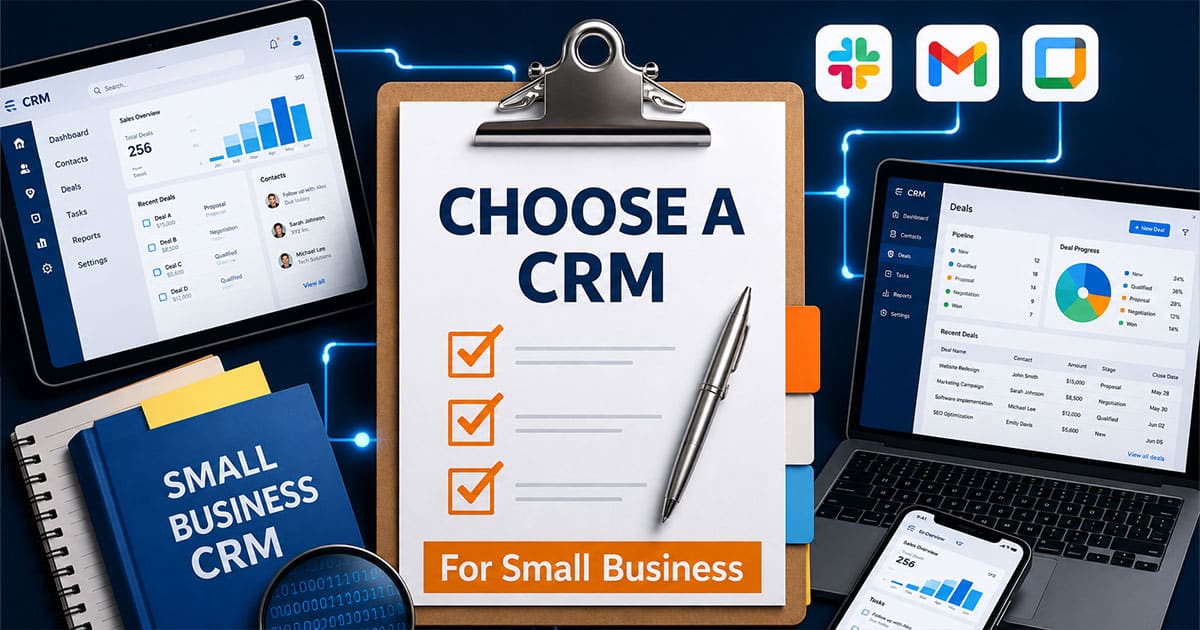
Step-by-Step Process For Choosing A CRM For Your Small Business
Choosing a CRM for your small business requires aligning contact management, business processes, and workflow automation with your goals to find the best CRM software that fits your CRM journey.
Define Your Business Needs
Start with a clear view of your business model, sales flow, and service structure. Identify how teams handle managing sales, managing customer information, and daily operations. Small teams often need a simple system, while growing companies require scalable small business CRM software.
Evaluate whether your business operates in niche industries, as specialized requirements may influence your decision. A CRM that matches your exact business processes ensures long-term efficiency and avoids unnecessary complexity later.
Identify Key Features
Focus on essential CRM features that directly impact performance. Contact management should remain a priority, as it organizes customer data and interactions in one place. Look for workflow automation to reduce repetitive work and improve efficiency.
Other key features include pipeline tracking, communication tools, and marketing tools that support lead nurturing. Email marketing capability is especially useful for engaging prospects and maintaining consistent outreach.
Evaluate Customization And Flexibility
Every business operates differently, so a customizable CRM becomes critical. The system should adapt to your workflows rather than forcing rigid structures. Custom fields, dashboards, and reporting options help align the CRM with your operations.
Advanced CRM features such as automation rules and tailored workflows allow teams to manage tasks efficiently while maintaining flexibility as the business grows.
Check Integration And Mobile Access
A CRM rarely works in isolation. Ensure the platform integrates with your existing tools like accounting software, marketing platforms, and support systems. Strong integration reduces manual data entry and improves data accuracy.
Mobile access is equally important. Sales reps and service teams often work outside the office, so a mobile-friendly CRM supports real-time updates, faster responses, and better customer experience.
Compare CRM Providers
Research different CRM platforms to find the best CRM for small businesses. Compare pricing, scalability, and usability across multiple providers. Look for reliable options that offer both essential and advanced capabilities, and consider shortlists like the 10 best CRM software for small sales teams as a starting point.
Popular tools like Salesforce CRM and HubSpot CRM provide strong ecosystems, while many CRM providers also offer affordable CRM solutions tailored for smaller teams. A Gain.io vs Salesforce CRM comparison illustrates the tradeoff between enterprise depth and small-team simplicity.
Test And Choose The Right CRM
Before making a final decision, test the CRM through free trials or demos. Evaluate how well the system supports your daily operations, from managing sales pipelines to handling customer communication, and follow tips for choosing CRM tools that fit your workflow rather than just feature checklists.
The right CRM should simplify your CRM journey, support service teams, and improve overall efficiency. A well-chosen system not only helps manage tasks but also strengthens customer relationships and drives sustainable growth, especially for startups that prioritize CRM tools that help them grow smarter.
Practical Evaluation Criteria When Comparing CRM Options
Vendor feature pages list hundreds of capabilities, making comparison overwhelming. A structured evaluation approach keeps your selection grounded in practical requirements.
Ease of use ranks as the primary evaluation category. Look for intuitive interfaces requiring fewer than 3 clicks to log an interaction. Gather feedback from less technical staff after a few days of testing. If adoption does not reach 80% during the pilot, the tool is too complex regardless of features.
Reliability and performance directly impact daily productivity. Page load times under 2 seconds, 99.9% uptime guarantees, and full mobile responsiveness for field reps matter when your team relies on the system constantly.
Vendor support quality varies dramatically between crm providers. Evaluate availability of chat or email assistance, regional coverage hours, and response times. HubSpot achieves 90% response rate under 1 hour. Clear documentation and video tutorials indicate a vendor committed to customer success.
Pricing transparency prevents budget surprises. Understand what each tier includes, how contact and user limits work, and how upgrade paths affect costs. Avoid vendors requiring 2x price jumps to access basic functionality.
Create a simple scorecard with categories like usability, process fit, integration strength, cost, and support quality. Rate each CRM after hands-on testing rather than relying on marketing materials. This systematic approach produces data-driven decisions.
Implementation Roadmap After You Choose Your CRM
Choosing software is only half the work. Thoughtful implementation determines whether your CRM becomes a daily habit or expensive shelfware. Research shows 63% success rates with proper planning versus 37% with rushed deployment.
Initial configuration should mirror the process map you created earlier. Define custom fields limited to 5-10 essentials like deal value and status. Create pipelines with no more than 5 stages. Set up user roles distinguishing admin, sales, and viewer access. Configure 3-5 automation rules for automating routine tasks like follow-up creation.
Data migration starts with cleaning your spreadsheet contacts. Use deduplication tools like OpenRefine to remove the 20-30% duplicate records typical in unmanaged contact databases. Import a pilot dataset of recent 6-month records first, verify 95% accuracy, then migrate full history.
Training sessions should differ by role. Sales teams need 2 hours on live deal logging and pipeline management. Marketing teams need 1 hour on sequences and lead management tools. Leaders need dashboard training focused on metrics they will review daily. Using real customer data during training improves retention versus generic examples.
Set measurable adoption goals from day one. All new opportunities logged within the first week. All customer touchpoints recorded by end of month one. These targets establish accountability and make success visible.
Schedule 30-day and 90-day reviews to adjust fields, reports, and automation based on actual usage patterns. Teams that iterate on their CRM setup achieve 20% higher efficiency gains than those who treat configuration as one-time work.
Common CRM Mistakes Small Businesses Should Avoid
Most CRM failures trace to process and change management problems rather than software limitations. Understanding CRM implementation mistakes to avoid helps you navigate around them.
Choosing a tool too complex for your team leads to abandonment. Full Salesforce implementations overwhelm many small businesses, with 50% reverting to email and spreadsheets within months. Match tool sophistication to team capability. An affordable crm that gets used beats a powerful platform that collects dust.
Skipping process mapping causes 40% misalignment between how the CRM is configured and how work actually happens. When workflows do not match reality, staff ignore the system entirely.
Importing messy data without cleanup creates 30% error rates and unreliable reporting. Duplicate contacts, outdated emails, and incomplete records poison your customer insights from day one.
Operating without a clear internal owner results in stale maintenance and unused fields. Designate a CRM champion who dedicates 10 hours weekly to system health, user support, and ongoing optimization.
Consequences of these mistakes include 25% lower ROI and shadow IT where staff create workarounds defeating the purpose of centralization. Prevention requires minimal initial setup, dedicated ownership, quarterly data cleanup sessions, and patience to let adoption build naturally before adding complexity.
How Gain.io Supports Small Businesses With CRM Adoption
Gain.io serves as a modern collaboration platform that helps teams centralize conversations, requests, and client-related work in one place. For small businesses implementing their first CRM, Gain.io bridges the gap between structured crm data and the daily interactions that drive customer relationships, using the same smart CRM tools for sales teams that power its core product.
Where your CRM stores contacts, deals, and pipeline stages, Gain.io organizes the actual communication threads that advance those deals. Client feedback routes into shared spaces instead of scattered email chains. Sales-to-service handoffs standardize with clear accountability, reducing delays by 30% according to internal usage metrics. Stakeholders stay updated without endless email forwards.
Small teams can use Gain.io alongside their CRM choice in practical ways. Link CRM deals to Gain.io rooms where approvals, content review, and client conversations happen. Archive meeting notes back to CRM timelines automatically. Keep all customer communication visible to relevant team members without manual forwarding.
Gain.io is built specifically for small and midsize teams, focusing on clarity, accountability, and ease of use. These priorities align directly with what makes CRM adoption successful. Rather than adding complexity, Gain.io reduces the friction of managing leads and track customer interactions across multiple tools, fulfilling the role of a flexible CRM for startups and small sales teams.
Frequently Asked Questions
Should A Solo Founder Invest In A CRM Before Hiring A Sales Team?
Lightweight free tiers from platforms like HubSpot crm make sense once you handle 50+ leads monthly. At that volume, manual tracking in spreadsheets causes measurable lead loss. The $5,000 monthly revenue mark often signals when crm for your small business becomes worthwhile. Starting early builds good habits and ensures clean data when you eventually hire sales reps.
How Much Historical Data Should We Import Into Our First CRM?
Start with 6-12 months of high-quality recent records rather than importing everything. Focus on active contacts representing 80% of current opportunities. Deduplicate and validate data before importing even a pilot set of 200 records. Verify 95% accuracy before migrating full history. Overloading the system with outdated or incomplete data undermines trust in reports from the beginning.
Which Metrics Show That Our CRM Implementation Is Working?
Watch follow-up time drop from 72 hours toward 24 hours. Monitor close rates improving 15% or more from baseline. Track forecast accuracy rising from 60% toward 85% over two quarters. Dashboard visibility into pipeline velocity and nurture leads through stages confirms the system delivers value. Revenue attribution by channel shows which marketing campaigns produce qualified opportunities.
How Many Custom Fields And Automations Should We Create At The Start?
Keep configuration lean for the first 60-90 days. Limit custom fields to 5-8 essentials covering deal value, status, source, and key dates. Create no more than 3-5 automation rules handling common scenarios like follow-up task creation and welcome sequences. Expanding automation before achieving strong adoption creates complexity that slows rather than accelerates your workflow automation journey.
What Makes A CRM Provider Trustworthy For A Growing Business?
Look for transparent pricing without hidden feature locks, documented uptime guarantees exceeding 99.9%, responsive support with clear regional coverage, and evidence of serving businesses your size successfully. Many crm providers focus on enterprise clients, making their small business offerings afterthoughts. Prioritize vendors where small teams represent core customers rather than an upsell target.