CRM analytics strategy has evolved dramatically over the past decade. In the early 2010s, most organizations relied on static, periodic reports generated from basic CRM databases. These reports focused on simple metrics such as total leads or closed deals, often requiring manual exports to Excel for analysis. This approach limited real-time insights and led to delayed decision-making that cost sales teams valuable opportunities.
By 2018, advancements in cloud computing and big data tools introduced interactive dashboards via platforms like Tableau and Power BI. Sales teams could finally drill down into customer interactions, though analytics remained largely descriptive without predictive capabilities. The real transformation accelerated around 2020 with the integration of machine learning in CRM systems, exemplified by Salesforce Einstein, which began automating pattern recognition in opportunity data.
This article covers foundational concepts of CRM analytics within customer relationship management, expected business outcomes, a step-by-step guide to building your strategy, essential metrics across the customer lifecycle, recommended technology stacks and CRM analytics tools, proven use cases with best practices, and how Gain.io supports CRM strategies.
CRM Analytics And Customer Relationship Management
CRM analytics involves systematically analyzing data stored in CRM platforms to uncover patterns in customer behavior, optimize relationship management processes, and direct resources toward high-impact activities. In practical terms, it transforms scattered records of emails, calls, deals, and tickets into valuable insights that reveal which customer segments respond best to email nurturing or where sales cycles lengthen due to specific objections.
Core Components And Distinctions
Traditional CRM strategy emphasizes operational efficiency through contact management and task automation, while CRM analytics layers analytical depth to predict outcomes. For instance, a basic contact record lists name and email, but analytics adds churn risk scores derived from declining activity logs, enabling proactive retention. This distinguishes it from broader business intelligence, which might aggregate CRM data with supply chain metrics, whereas CRM analytics maintains a customer-centric focus.
Data Building Blocks For 360-Degree Views
Primary elements include contacts with demographic and behavioral attributes, accounts grouping related contacts for B2B hierarchies, opportunities detailing deal stages and amounts, products linked to purchases for upsell analysis, activities encompassing calls and meetings with timestamps, and digital engagement events like website visits synced from marketing tools. Comprehensive data collection aims to create a unified, 360-degree customer profile that reveals the complete customer journey from lead acquisition to customer lifetime value.
Strategic Integration Across Lenses
CRM analytics supports three core business lenses: revenue growth via sales forecasting from pipeline velocity calculations, marketing effectiveness through attribution models linking marketing campaigns to closed-won deals, and customer satisfaction by correlating support resolution times with renewal probabilities. A 2024 Deloitte report highlights that firms achieving a true 360-degree view via CRM analytics experience 28% faster deal closures.
Business Outcomes A CRM Analytics Strategy Should Deliver
A robust CRM analytics strategy functions as a targeted business outcomes program, not just a dashboard project. Success metrics should include 10 to 20% improvements in key performance indicators, tracked via pre and post-implementation baselines within 6 to 12 months.
CRM analytics helps businesses make data-driven decisions, allowing them to validate strategies, spot opportunities, and allocate resources more effectively, ultimately driving growth. Revenue outcomes feature elevated win rates through opportunity scoring that prioritizes high-probability deals, enhanced forecasting accuracy reducing revenue surprises by 15 to 25% per Gartner 2024 benchmarks, and boosted average customer lifetime value via data-driven upsell identification.
By leveraging CRM analytics, companies can create personalized customer experiences, which have been shown to increase customer satisfaction and loyalty. Over 75% of business leaders believe that personalization is crucial for their business success, highlighting the importance of tailored customer interactions in driving engagement and loyalty.
Marketing gains encompass superior campaign ROI from attribution insights, with McKinsey 2024 data showing 21% higher lead-to-opportunity conversions and precise channel allocation cutting wasted spend by 18%. Marketing teams benefit from clearer attribution of which channels influence opportunities, enabling more informed decisions about budget allocation.
Customer experience improvements yield higher CSAT scores, elevated Net Promoter Scores averaging plus 12 points in Forrester’s 2023 analytics study, improved renewal rates up to 92% in high-adoption firms, and churn reductions of 10 to 15%, as validated by Salesforce’s 2024 State of Sales report.
Consider a mid-sized SaaS provider in 2023 struggling with 22% quarterly churn. After centralizing CRM data for predictive retention models combining usage drops and ticket volumes, they flagged at-risk accounts early, deployed personalized re-engagement campaigns, and cut churn to 14% within nine months. This added $2.4 million in preserved annual recurring revenue, demonstrating how analyzing customer data creates compounding gains across interconnected outcomes.
How To Build Your CRM Analytics Strategy-Step By Step
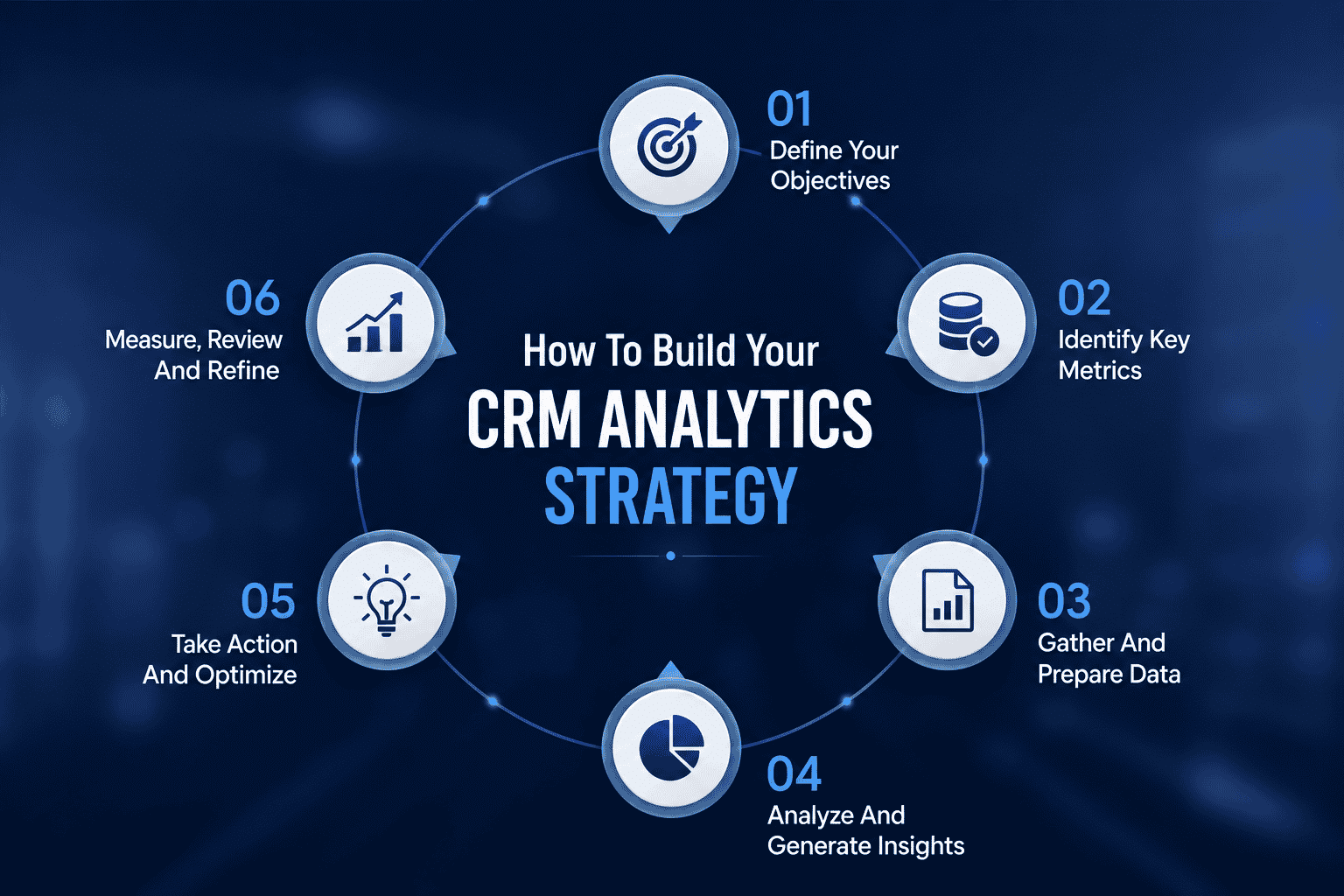
This core section outlines a structured 60 to 90 day sequence to evolve from raw data to reliable CRM analytics. A successful CRM analytics strategy aligns data collection with specific business outcomes and embeds insights into daily workflows rather than creating isolated reports that gather dust.
Although the steps are presented linearly, organizations can iterate. However, avoid skipping foundational stages such as data quality and KPI definition. Each phase builds on the previous one, so shortcuts early in the process create compounding problems later.
Strategy Alignment With Revenue, Marketing, And Service Goals
The first step is aligning CRM analytics with 3 to 5 specific business decisions rather than generic reporting requests. Think weekly pipeline calls, monthly marketing ROI reviews, and quarterly renewal planning. Defining clear objectives before selecting technology is essential for a successful CRM analytics strategy.
Document a small set of North Star metrics that serve as your guiding indicators:
Metric | Target | Owner |
|---|---|---|
Pipeline Coverage Ratio | 3x quota | VP Sales |
Win Rate | Above 25% | Sales Director |
Customer Lifetime Value | 15% YoY growth | Customer Success |
Net Revenue Retention | Over 110% | Revenue Operations |
Customer Satisfaction Score | 85%+ | Service Manager |
Data Foundations And CRM Analytics Architecture
Audit the existing CRM data model by reviewing objects like opportunities and accounts, mandatory fields, picklists, and integrations. Common gaps include 30% duplicate contacts or missing segments in 40% of accounts per 2024 CRM benchmarks from Nucleus Research. Establishing data governance ensures data quality and accuracy through regular maintenance and processes for handling information.
Architect your system with CRM as the customer data hub, augmented by marketing automation for leads, product telemetry for usage, billing for revenue, and support systems for tickets, following a structured CRM implementation guide for scalable business growth. Mapping the customer journey involves identifying every touchpoint to pinpoint where data is generated and where insights are needed.
Enforce quality thresholds to ensure reliable analytics:
- 95% of opportunities must have close date and stage populated
- 90% of accounts must have industry and segment defined
- Implement monthly data health checks with assigned stewards per department
Aberdeen Group’s 2023 study shows data quality above 90% correlates with 22% higher forecast accuracy. Role-based access should tie to CRM permissions so sales reps see their own deals while managers gain insights into team performance.
Metric Design, Dashboards, And Sales Forecasting
Convert business questions into concrete CRM analytics metrics. The question “Where do deals stall?” becomes stage conversion rates and average days-in-stage from opportunity histories. Sales managers can then identify patterns and coach reps on moving deals through the sales funnel more efficiently.
Craft role-based dashboards that serve specific needs:
Role | Dashboard Focus |
|---|---|
Executive | Pipeline coverage, CLV trends, forecast accuracy |
Sales Manager | Velocity by rep, stage conversion, activity metrics |
Marketer | Attribution, campaign performance, channel ROI |
Customer Success | Health scores, renewal probability, engagement signals |
Operationalizing Insights In Day-to-Day Workflows
Embed analytics directly into CRM interfaces rather than forcing users to switch between systems. Homepage widgets should surface next actions for sales reps, opportunity pages should display churn risk, and account timelines should summarize customer engagement patterns.
Concrete examples of operationalized insights include:
- Surfacing “contact now” leads for sales teams based on engagement signals
- Displaying at-risk alerts for customer success to trigger proactive outreach
- Flagging low-ROI marketing campaigns weekly for budget reallocation
Automate alerts for CSAT drops below 80% or campaign engagement spikes, feeding recurring meetings like pipeline scrubs and quarterly business reviews. Forrester 2024 research shows this embedding increases user adoption by 35% and response times by 28%, enhancing customer experiences through timely, relevant interventions. This approach helps sales reps and sales managers make informed decisions without leaving their primary workspace.
Change Management, Training, And Continuous Improvement
Training and adoption efforts are key to ensuring employees effectively use CRM analytics tools and adhere to accurate data entry practices, which can lead to higher adoption rates among employees; understanding common CRM adoption challenges and best practices for sales teams helps shape these programs. Role-specific training works better than generic sessions because a sales playbook on pipeline dashboards differs from marketing training on attribution models.
Establish a 30-60-90 day adoption plan:
Day | Milestone |
|---|---|
30 | Executive dashboard walkthrough completed |
60 | First team meeting fully driven by CRM analytics |
90 | First iteration of KPI refinements based on feedback |
Key CRM Analytics Metrics And Customer Value Indicators
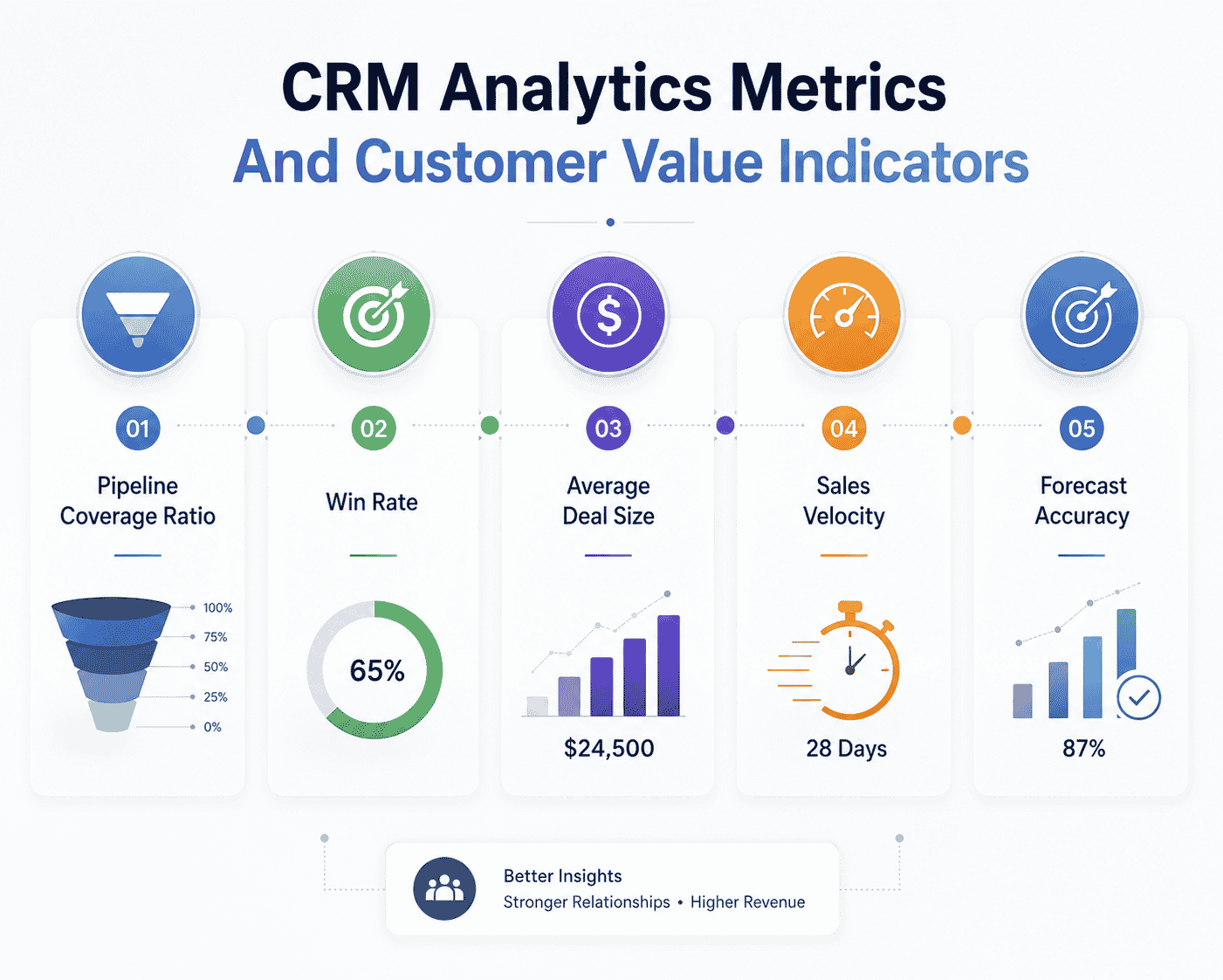
Metrics are the language of CRM analytics. A focused set of indicators creates clarity for sales teams, marketing teams, and service functions across acquisition, conversion, retention, and customer lifetime value. Performance metrics like customer satisfaction score, retention rate, and lifetime value gauge CRM success and provide the foundation for continuous improvement.
Revenue And Sales Performance Metrics
Key sales metrics that every CRM analytics strategy should track include:
Metric | Definition | Benchmark |
|---|---|---|
Pipeline Coverage Ratio | Total pipeline value divided by quota | 3-4x quota |
Win Rate | Closed-won divided by total opportunities | 25-30% B2B average |
Average Deal Size | Average value of closed deals | Varies by segment |
Sales Velocity | (Opportunities x Win Rate x Deal Size) / Cycle Days | Track trend over time |
Forecast Accuracy | Predicted vs actual revenue | Aim for 80%+ |
A European B2B firm in 2024 improved win rates by 8% by focusing on opportunities with high activity levels and strong marketing engagement signals, supported by disciplined sales reporting in a CRM that highlighted these patterns. AI-powered scoring models can enhance customer relationships and augment traditional sales metrics by 5 to 10% without supplanting human judgment, according to Salesforce 2024 data.
Marketing Campaign And Channel Performance Metrics
Crucial marketing analytics metrics in the CRM context include lead-to-opportunity conversion with a 20 to 30% benchmark, opportunity influence by campaign measuring revenue share, cost per qualified lead targeting under $200, and multi-touch attribution that weights all touchpoints. Customer segmentation based on purchase history and behavioral signals can enhance marketing campaign relevance.
Marketing and sales alignment on definitions matters significantly. What counts as an MQL or SQL must be agreed upon for trustworthy CRM data analysis. Advanced segmentation categorizes customers based on demographics, behavioral patterns, and psychographics, enabling more precise targeting.
Real-time analysis enabled one brand to pause underperforming campaigns and reinvest budget, boosting ROAS by 25%. Tie marketing metrics back to opportunity and revenue data directly in the CRM to improve accountability, using email tracking CRM capabilities where appropriate to understand engagement. Review weekly channel performance summaries and conduct monthly deep dives on campaign cohorts to identify trends and optimize marketing strategies.
Customer Satisfaction, Retention, And Loyalty Metrics
Understanding these metrics helps teams uncover actionable insights about customer health:
- CSAT averages post-interaction satisfaction scores
- Net Promoter Score measures customer satisfaction and their likelihood to recommend the business to others, providing predictive insights into customer loyalty and areas for improvement
- Customer Effort Score reflects the difficulty customers face when obtaining answers and lodging queries, with a lower CES indicating higher customer satisfaction and loyalty
- Customer retention rate measures the percentage of existing customers retained over a given period, providing insights into customer loyalty and business performance
- Customer turnover rate, or churn, is the percentage of customers lost over a certain period, which can be calculated monthly, quarterly, or yearly, and is essential for understanding customer satisfaction and product quality
Centralize survey data in CRM systems so service and success teams can see satisfaction trends at the account and segment level. Flag at-risk customers using combinations of low CSAT, decreased product usage, and fewer customer interactions. A subscription business reduced churn by 12% by targeting customers whose product usage fell 30% over a quarter, demonstrating how proactive retention strategies enhance customer loyalty.
Customer Lifetime Value And Profitability Metrics
Customer lifetime value measures the total revenue a company can expect to earn over the lifetime of a given customer relationship, linking customer success efforts to revenue. A practical formula multiplies average revenue by expected lifespan and gross margin. For example, $10k ARR multiplied by 3 years multiplied by 70% margin equals $21k CLV.
Create CLV segments of high, medium, and low in CRM analytics tools to prioritize account management, cross-sell, and retention programs. Pair CLV with customer acquisition cost for a clearer picture of customer profitability across segments or channels.
Effective CRM data analysis enables businesses to create personalized experiences by analyzing customer purchasing patterns and engagement levels, leading to increased customer retention and satisfaction, particularly when powered by dynamic contact management for smarter relationship tracking. A 2024 focus on high-CLV segments yielded a 22% marketing ROI lift for one organization. Update CLV calculations quarterly from CRM and billing data rather than relying on static assumptions to ensure accuracy.
Operational And Process Quality Metrics
Internal process metrics that support CRM analytics success include data completeness scores targeting 95%, time to first response for new leads under 24 hours, case resolution time under 5 days, and SLA adherence above 90%. Track these in dashboards to maintain service quality and sales execution discipline, and use CRM automation for sales and growth to keep these processes consistent at scale.
Improving these metrics indirectly enhances customer experience, revenue, and team efficiency even though they may not be directly visible to customers. These operational metrics inform business processes and help automate repetitive tasks where possible.
Set realistic targets based on company size, region, or industry benchmarks. For SaaS companies, a 2-day lead response time serves as a reasonable starting point. Review operational metrics weekly to maintain discipline and identify quick wins for CRM strategy improvement, particularly for verticals like retail where CRM tools that help retail teams stay organized can make these targets achievable.
Technology Stack And CRM Analytics Tools To Support Your Strategy
A successful CRM analytics strategy relies on the right mix of CRM software, data infrastructure, and analytics tooling rather than one isolated platform. Implementing CRM analytics involves assessing business needs and setting a budget to select a CRM tool that fits financial constraints and enhances user adoption.
Role Of The Core CRM Platform
The core CRM platform stores structured data about contacts, accounts, opportunities, campaigns, and service cases, making it the natural foundation for analytics. CRM tools like Salesforce, HubSpot, and Gain.io smart CRM tools for sales teams provide the bedrock for all customer relationship data.
Best practices for configuring the CRM to support analytics include consistent stage definitions with 6 to 8 standardized stages, mandatory fields for critical data points, and thoughtful use of custom objects. Activity tracking, CRM email integration, and call logging enrich the dataset available for CRM data analysis.
Cloud-based CRM deployment benefits analytics through real-time data access and easier integration with external data analytics tools. Salesforce CRM analytics and similar platforms enable Salesforce data to flow seamlessly into reporting systems. The principles covered here apply regardless of vendor, assuming a modern, API-enabled CRM platform, and reinforce the value of choosing CRM tools that fit your workflow.
Analytics, BI, And AI Layers On Top Of CRM Data
Business intelligence tools, embedded analytics modules, and AI services consume CRM data to deliver dashboards, visualizations, and predictions back to business users. CRM analytics can be categorized into three primary types: descriptive, predictive, and prescriptive analytics, each serving distinct functions within the CRM framework.
Descriptive analytics focuses on historical data to provide insights into past sales trends and customer behavior, helping businesses understand the effectiveness of their previous activities. Predictive analytics uses historical data to forecast future customer behaviors and market trends, enabling businesses to anticipate customer needs and plan marketing efforts accordingly. Prescriptive analytics provides actionable recommendations based on predictive models, helping businesses optimize strategies and achieve desired outcomes.
Modern CRM analytics tools allow non-technical users to explore datasets with drag-and-drop interfaces while enabling more advanced modeling for data teams, building on solid sales reporting practices in a CRM. Monitor models quarterly as customer behavior and market conditions change over time, recalibrating predictions to maintain accuracy in your data analysis process.
Data Integration And Single Customer View
Integration with existing systems is crucial for overcoming data silos and enabling centralized customer data management, which enhances overall business processes and decision-making, especially when robust customer interaction tracking in CRM is in place. Technical steps to combine CRM data with marketing platforms, web analytics, product usage tracking, and billing systems create a unified customer profile.
Common integration patterns include:
Pattern | Best For |
|---|---|
Native Connectors | Simple integrations like Marketo-Salesforce |
iPaaS Middleware | Mid-market with tools like Zapier |
Event Streaming | An enterprise with high data volume using Kafka |
Governance, Security, And Compliance In CRM Analytics
Data governance, privacy, and compliance grow increasingly important when designing CRM analytics strategies. GDPR in Europe and CCPA/CPRA in California impose strict requirements on how organizations handle customer data and customer preferences.
Role-based access control, field-level security, and data masking approaches protect sensitive information while still enabling rich analytics. Set clear policies around data retention, consent tracking, and usage of personal data for targeted marketing campaigns and personalized marketing campaigns.
Periodic access reviews and audit logs help ensure regulatory compliance and maintain customer trust. Governance should be positioned not as a blocker but as a critical enabler of scalable, trustworthy CRM analytics that supports business growth and underpins a data-driven customer engagement CRM strategy.
Buy Versus Build Considerations For Mid-Market And Enterprise
Trade-offs exist between relying on out-of-the-box CRM analytics tools and building custom data pipelines with a full BI stack:
Approach | Pros | Cons |
|---|---|---|
Out-of-box | Lower cost, faster deployment | Less flexibility |
Custom Build | Full flexibility, 20-30% more insight | Higher cost, longer timeline |
Hybrid | Balance of both | Requires careful architecture |
Cost considerations extend beyond licensing to include implementation, maintenance, and ongoing optimization. Gain.io typically recommends a pragmatic hybrid strategy, using prebuilt components where possible and custom work where it delivers clear strategic advantage.
Use Cases And Best Practices For CRM Analytics Strategy Execution
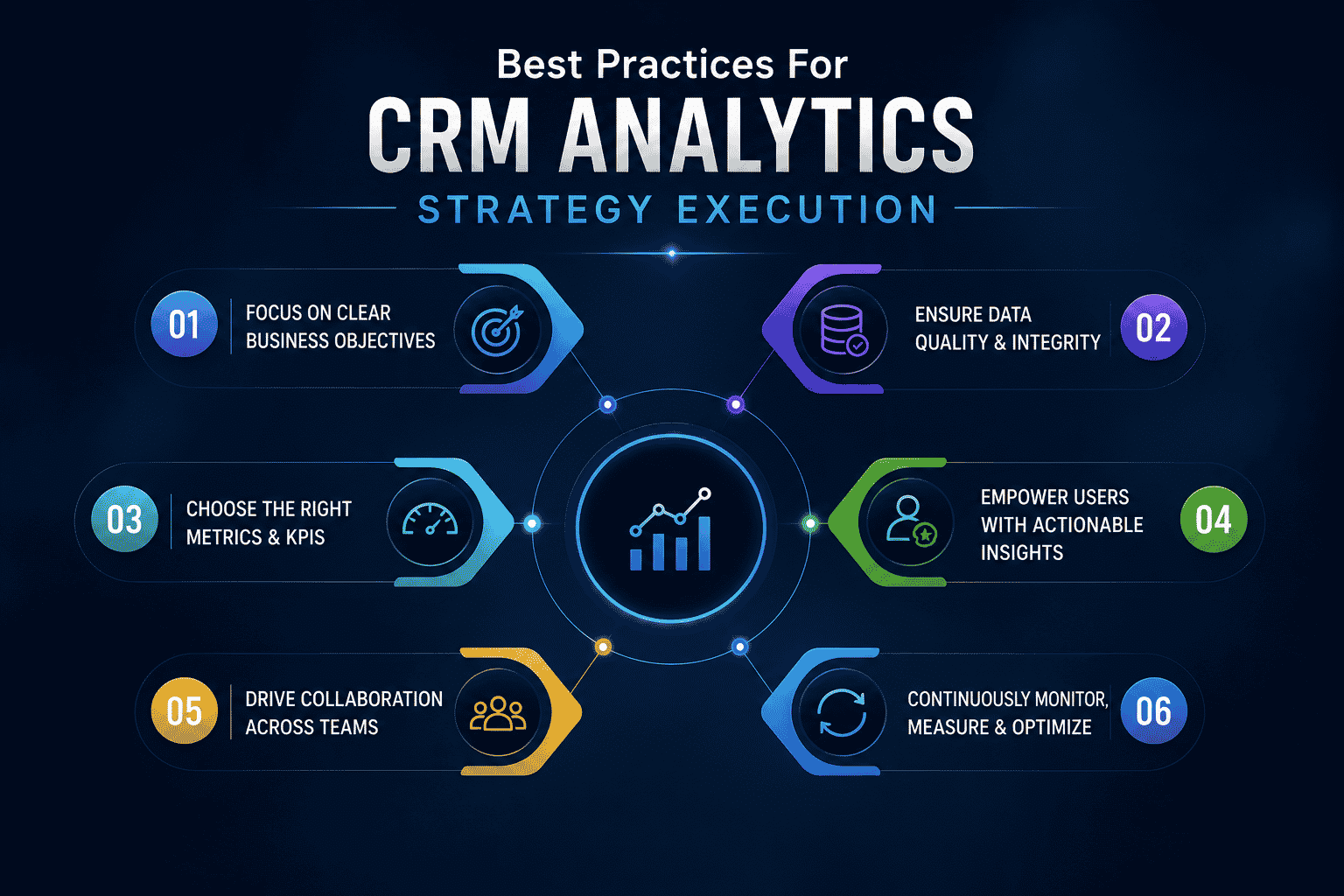
This section translates theory into concrete use cases across sales, marketing, and service functions. Each use case demonstrates how a consistent CRM analytics strategy helps enhance customer outcomes and internal efficiency simultaneously.
Sales Forecasting And Pipeline Health Improvement
A tech firm improved forecast accuracy by 18% using stage-weighted pipelines and spotting stalls via activity dips across segments. Analyzing CRM data revealed that opportunities with fewer than three activities in 14 days had a 60% higher chance of slipping.
Organizations using data-driven forecasting have been shown to grow revenues 1.5x faster than peers relying on gut feel, according to Gartner 2024 research. Best practices include weekly standardized pipeline reviews, clear definition of exit criteria for each stage, and consistent logging of key activities in the CRM to support disciplined CRM-based lead management for sales teams.
Sales managers can coach sales reps using dashboard insights rather than anecdotal updates, focusing conversations on sales pipeline status and specific deal blockers. This approach transforms pipeline meetings from status updates into coaching sessions that drive results through the entire sales process.
Marketing Campaign Optimization And Attribution
A B2B brand shifted budgets mid-quarter using multi-touch attribution, lifting influenced revenue by 27%. CRM analytics linked marketing campaigns to actual revenue, enabling budget shifts from low-performing to high-performing channels in real time.
Marketing teams can trigger automated, personalized campaigns using insights based on customer behavior, especially when leveraging CRM automation benefits for sales and growth. Advanced marketing analytics provide a more accurate view than last-click attribution from web analytics alone. Best practices include mandatory campaign association for opportunities, regular campaign hygiene, and standardized naming conventions.
Continuous measurement and experimentation through A/B testing and creative variants remain central to a high-performing CRM analytics strategy for marketing. These marketing efforts compound over time as teams learn what resonates with different customer segments.
Customer Satisfaction, Support, And Proactive Retention
Service and success teams can use CRM analytics to identify common drivers of dissatisfaction, such as recurring product issues or long resolution times, mirroring how modern CRM adoption is transforming sales teams into more proactive, insight-led organizations. Personalization through CRM analytics can significantly enhance customer satisfaction and loyalty, as it allows businesses to tailor their offerings based on individual customer preferences and behaviors, which is central to any effective customer engagement CRM strategy.
Combining ticket data, product usage metrics, and satisfaction surveys in the CRM allows teams to run targeted outreach and education programs. Predictive models flag customers with increased risk of churn, prompting high-touch interventions that improve renewal rates and customer loyalty.
Best practices include segmenting customers by health score, implementing proactive check-ins for high-value accounts, and tracking outcomes in the CRM. Better service experiences reduce churn while also driving referrals and higher customer lifetime value over time, helping teams enhance customer relationships systematically.
Account Growth, Cross Sell, And Upsell Strategy
CRM analytics can surface accounts with strong product adoption, high satisfaction scores, and untapped product lines, making them ideal targets for cross-sell and upsell campaigns, especially when paired with focused CRM adoption strategies to improve CRM ROI. Account teams can use opportunity history, contract data, and engagement signals to time offers for renewal or expansion cycles based on customer needs.
One SaaS company increased ARPU by 22% using data-driven “next product to buy” models that identified purchase history patterns. Track the impact of upsell plays within the CRM, including win rates, deal size uplift, and incremental customer lifetime value.
Aligning compensation and incentives with data-backed account growth metrics reinforces use of CRM analytics insights and drives adoption among sales reps who see direct benefits from using the system.
New Market Expansion And Strategic Planning
Leadership can use CRM analytics to evaluate performance by region, segment, or vertical when deciding where to invest in new sales headcount or marketing campaigns. Analyzing CRM data reveals product-market fit patterns and informs geographic or vertical expansion plans.
One company used CRM analytics to identify an unexpectedly strong niche segment within their existing data and built a targeted go-to-market motion around it. Best practices include building scenario models in analytics tools, testing in pilot markets, and monitoring key metrics closely during the first 6 to 12 months of expansion.
Anchor strategic planning in CRM data to avoid overreliance on anecdotal feedback. Data insights from historical patterns provide a more reliable foundation for expansion business strategies than gut instinct alone.
Gain.io Approach To Building CRM Analytics Strategy
Gain.io partners with organizations to design, implement, and scale CRM analytics strategies that align with their growth goals. The typical engagement pattern includes discovery and KPI alignment, data and platform assessment, pilot dashboard and forecasting build, user training, and ongoing optimization cycles.
Gain.io works with clients’ existing CRM software and analytics tools, helping orchestrate an integrated stack instead of forcing a rip-and-replace approach, and can also act as an all-in-one CRM to grow your sales and team where appropriate. Comprehensive training programs ensure teams understand customer behavior through their new analytics capabilities and can analyze customer data effectively, applying principles from the broader CRM implementation guide for scalable business growth.
Organizations can work with Gain.io to assess their current CRM analytics maturity and build a roadmap that delivers value within the next 90 days. Whether you need help with data processing foundations, building predictive insights capabilities, or operationalizing analytics into frontline workflows, the partnership approach ensures sustainable results that support long-term business growth.
Frequently Asked Questions
Who Should Own CRM Analytics Strategy Inside The Organization?
Ownership typically sits with a senior revenue or operations leader such as Head of Revenue Operations, VP Sales Operations, or Chief Customer Officer, supported by data and IT teams. While IT manages infrastructure and integrations, the business side should own KPI definitions, priorities, and adoption, ensuring analytics directly support frontline decisions. Establishing a cross-functional steering group with representatives from sales, marketing, customer success, finance, and IT that meets monthly helps review progress and adjust the roadmap based on evolving business needs.
How Long Does It Take To See Value From A New CRM Analytics Strategy?
Realistic timeframes suggest 4 to 8 weeks to launch an initial set of trusted dashboards and reports for core KPIs, with 3 to 6 months needed to see measurable improvements in forecasting, campaign ROI, or retention. Factors influencing timing include current data quality, number of systems requiring integration, and availability of internal resources. Starting with one or two high-impact use cases like sales forecasting and churn risk demonstrates early wins before scaling more broadly, similar to how a sales acceleration case study on closing deals faster with Gain.io shows impact within a few months.
How Can We Improve Data Quality Before Investing Heavily In CRM Analytics Tools?
Practical steps include cleaning duplicates, standardizing picklists, making critical fields mandatory, and training users on accurate data entry habits. Set clear data quality targets such as 95% completeness for key fields and track them on a simple internal data health dashboard. Investing in data quality early reduces rework later and makes advanced analytics like predictive scoring more reliable for sales teams and marketing teams alike.
Is CRM Analytics Only Useful For Large Enterprises With Big Data Teams?
Small and mid-sized organizations can benefit significantly from even basic CRM analytics, such as simple pipeline dashboards, cohort retention views, and campaign performance tracking, especially when paired with a CRM for startups and small sales teams that keeps processes lightweight. Many modern CRM platforms now offer built-in analytics features that non-technical users can configure without data engineering expertise. Smaller businesses should start with a lightweight setup, focusing on the few metrics that most directly affect revenue and customer satisfaction to gain insights quickly and pairing that with a tool that helps them get more from their CRM with a simpler sales workflow.
How Often Should We Update And Review Our CRM Analytics Strategy?
A quarterly strategic review helps reassess KPIs, priorities, and new use cases, along with more frequent monthly reviews of data quality and dashboard usage. Significant business changes such as entering a new region, launching a new product line, or shifting pricing models should trigger a dedicated CRM analytics review, ideally supported by a platform that enables you to get more from your CRM with a simpler sales workflow. Treat CRM analytics strategy as a living program that evolves alongside your customer relationship management practices rather than a one-time project.