TL;DR: Modern CRM software should centralize contacts, automate pipeline updates, and surface AI-driven insights. This guide compares Salesforce, HubSpot, Zoho, and Gain.io on the features that matter most for growing sales teams.
Modern sales teams operate in fast-moving environments where visibility, speed, and accuracy directly impact results. Managing customer data across emails, calls, and follow-ups becomes difficult without a structured system in place. This is where a well-designed sales CRM plays a critical role. It brings clarity to the sales process by organizing information, tracking progress, and helping teams focus on the right opportunities at the right time.
Beyond basic record-keeping, the right platform offers features that support sales teams in collaboration, consistency, and smarter decision-making. This guide breaks down how CRM software fits into today’s selling environment and what to look for when choosing a solution that supports growth without adding unnecessary complexity.
Why Sales Teams Need a CRM
Sales teams juggle leads, conversations, follow-ups, and forecasts every day. Without a structured system, important details slip through the cracks. A CRM brings clarity, consistency, and control to how sales actually get done.
Centralized customer data creates a single source of truth
Sales conversations happen across calls, emails, demos, and meetings. When customer data is scattered across inboxes, notes, and spreadsheets, context gets lost quickly. A CRM system centralizes all customer information in one place, making it easier for sales teams to understand history, preferences, and next steps at a glance. This shared visibility ensures that every rep works with the same up-to-date information, reduces duplication of effort, and prevents missed opportunities caused by incomplete records.
Clear pipeline management improves forecasting and focus
Strong pipeline management is one of the biggest reasons sales teams rely on CRM software. A visual sales pipeline shows exactly where each deal stands, what actions are pending, and which opportunities need attention. Instead of guessing or relying on manual updates, managers can review pipeline health in real time. This clarity helps teams prioritize high-impact deals, identify stalled opportunities early, and forecast revenue with greater confidence. Over time, a structured pipeline also reveals patterns that improve decision-making.
Structured sales processes reduce inconsistency
Without a defined sales process, each rep develops their own way of working. While flexibility has value, inconsistency creates confusion and makes performance harder to measure. CRM systems help standardize workflows by guiding reps through defined stages, required actions, and follow-ups. This structure supports onboarding, ensures best practices are followed, and makes it easier to coach underperforming reps. A consistent process also helps leadership identify what works and refine it over time.
Better tracking of customer interactions builds trust
Every call, email, meeting, and note matters in customer relationship management. When interactions are logged automatically or easily within a CRM, sales teams gain a complete picture of engagement. This prevents awkward situations such as duplicate outreach or forgotten follow-ups. More importantly, it enables more relevant conversations because reps understand past discussions and customer expectations. Consistent interaction tracking strengthens relationships and supports a more professional, reliable sales experience.
CRM connects sales with marketing tools
Sales do not operate in isolation. Modern teams depend on alignment with marketing tools that generate and nurture leads. CRM software acts as the bridge between marketing campaigns and sales execution. Leads flow directly into the system, activity is tracked, and outcomes are visible to both teams. This connection reduces friction, improves lead quality, and helps sales teams focus on prospects who are actually ready to engage. Alignment also improves reporting across the entire revenue funnel.
Insightful reporting drives better decisions
Beyond day-to-day execution, CRM systems provide valuable insights into performance. Managers can track conversion rates, deal velocity, activity levels, and win patterns without manual reporting. These insights help identify strengths, weaknesses, and areas for coaching across the team. Over time, data-driven decisions replace assumptions. This is one reason many teams opt for the best CRM software tailored to their specific needs, rather than relying on generic tools or intuition alone.
Scalability matters as teams grow
As sales teams expand, manual methods stop working. More reps, more deals, and more customers increase complexity quickly. A CRM scales with growth by supporting collaboration, access control, and shared visibility. New hires ramp faster because information is already organized. Managers maintain oversight without micromanaging. Many teams evaluate platforms like Zoho CRM or other solutions when they reach this stage, but the underlying need is the same. Scalable systems ensure growth does not compromise efficiency or customer experience.
CRM for Startups & Small Sales Teams
Startups and small sales teams operate under constant pressure to move fast, stay organized, and prove traction early. Limited resources make it essential to use tools that support growth without adding complexity. A well-chosen CRM can provide structure while keeping teams agile.
Simpler sales CRM software reduces friction
For startups, ease of use matters more than feature depth. Sales CRM software designed for small teams focuses on clarity and speed rather than heavy configuration. Reps can log activity, update deals, and track progress without long training sessions. When tools feel intuitive, adoption improves naturally. This reduces resistance and ensures the CRM becomes part of daily workflows rather than an extra task.
Key features that matter most at an early stage
Startups do not need everything on day one. Key features such as contact management, pipeline visibility, task reminders, and basic reporting deliver immediate value. These CRM features help teams prioritize leads, follow up on time, and understand where deals stand. By focusing on essentials, small teams avoid paying for functionality they are not ready to use while still building a solid foundation.
How CRM helps streamline sales processes
A CRM brings consistency to how deals move forward. Defined stages, clear next steps, and visible ownership help streamline sales processes across the team. Instead of each rep inventing their own method, everyone follows the same structure. This consistency improves forecasting, simplifies coaching, and makes it easier to identify bottlenecks. Over time, these structured processes support repeatable growth.
Managing customer relationships with limited resources
Startups often compete on responsiveness and personal connection. Managing customer relationships effectively requires remembering conversations, preferences, and commitments. A CRM captures this context so reps can have informed conversations without relying on notes or memory. This helps small teams appear professional and reliable even as volumes increase. Strong relationship management also supports retention and referrals, which are critical in early growth stages.
Supporting sales reps with mobility and flexibility
Many startups work remotely or on the move. Mobile access ensures sales reps can update deals, check customer details, and follow up from anywhere. This flexibility keeps data current and reduces delays caused by waiting to return to a desk. When updates happen in real time, managers gain better visibility and teams stay aligned without constant check-ins.
Laying the foundation for long-term customer relationships
Early interactions shape how customer relationships develop over time. A CRM helps startups capture early engagement data that remains valuable as the company grows. When teams expand, this history prevents knowledge loss and supports continuity. Starting with the right system ensures that growth does not come at the cost of losing customer insight or consistency in communication.
By choosing a CRM that matches their current stage while allowing room to grow, startups and small sales teams can build discipline, clarity, and confidence without sacrificing speed.
Cloud CRM vs Spreadsheet-Based Sales Tracking
Sales teams often start with spreadsheets because they feel simple and familiar. However, as pipelines grow and coordination increases, limitations surface quickly. Understanding how cloud-based systems differ helps teams decide when it is time to move to a more scalable approach.
Real-time visibility replaces manual deal tracking
Spreadsheets depend on manual updates, which are often delayed or inconsistent. Cloud CRM tools provide live deal tracking, ensuring everyone sees the same information at the same time. This visibility helps sales representatives prioritize opportunities accurately and avoid missed follow-ups caused by outdated data.
Structured systems support growing business processes
Basic spreadsheets struggle to support evolving business processes. Cloud CRM platforms introduce structure through defined stages, ownership, and workflows. This structure becomes essential when teams manage multiple accounts simultaneously and need consistency across activities and reporting.
Purpose-built sales features improve execution
Spreadsheets were not designed for selling. Cloud solutions include dedicated sales features such as activity tracking, reminders, and reporting dashboards. These tools reduce manual effort and help teams focus on execution rather than administration, especially as deal volume increases.
Better lead management and automation
Managing leads in spreadsheets becomes risky as volumes grow. Cloud systems support organized lead management and connect easily with marketing automation tools. This connection ensures smoother handoffs between marketing and sales and helps teams respond faster to qualified prospects.
Scalability for longer and more complex sales cycles
As sales cycles lengthen and become more involved, spreadsheets become harder to maintain. Cloud platforms are designed to handle complex sales processes and support seamless integration with other tools. Many teams exploring the best crm for sales often evaluate options like HubSpot CRM before selecting the right crm for sales that fits their growth stage.
Common CRM Challenges and How to Avoid Them
Implementing a CRM promises better visibility and control, but many teams struggle to realize its full value. These challenges usually come from process gaps, adoption issues, or misaligned expectations rather than the tool itself.
Low user adoption across the sales team
One of the most common CRM challenges is low adoption. Sales teams often see CRM updates as extra work rather than support for selling. When reps do not log sales activities consistently, the system loses value quickly. To avoid this, workflows must reflect how teams already work. Keep data entry minimal, automate where possible, and show reps how CRM usage directly helps them close deals faster.
Poor data quality and incomplete records
CRMs are only as good as the data inside them. Missing fields, duplicate records, and outdated information make reporting unreliable and frustrate users. Poor data quality also breaks visibility across the entire customer lifecycle. Teams should define clear data standards early, automate validation rules, and schedule regular cleanups. Assigning ownership for data accuracy prevents long-term decay.
Overcomplicated workflows that slow teams down
Many organizations overconfigure their CRM in an attempt to cover every scenario. This leads to complex workflows that slow users instead of helping them. Excessive workflow automation can create friction when rules no longer match reality. The solution is to start simple. Build only the workflows that support core selling motions and refine them over time based on actual usage.
Lack of clear pipeline visibility
Without a clear visual sales pipeline, managers struggle to understand deal health and forecasting becomes guesswork. This often happens when stages are poorly defined or inconsistently used. Teams should design pipeline stages that reflect real buyer behavior, not internal wishful thinking. Regular pipeline reviews reinforce correct usage and improve accuracy over time.
CRM not aligned with daily sales activities
A CRM fails when it does not align with how reps sell. If logging calls, emails, or meetings feels disconnected from daily sales activities, adoption drops. Integration with email, calendars, and calling tools helps capture activity automatically. The goal is to make the CRM a natural part of selling rather than a reporting burden.
Overreliance on reports without actionable insight
Many teams collect large amounts of data but struggle to turn it into action. Basic reports show what happened, but without context, they do not drive improvement. Teams often expect predictive analytics to fix this instantly, but advanced insights require clean data and clear goals first. Start with simple metrics tied to behavior, then layer in advanced analysis as maturity grows.
Lack of ongoing ownership and optimization
CRM implementation is often treated as a one-time project. Over time, processes change, but the system does not. This leads to misalignment and frustration. To avoid this, assign clear ownership for CRM health. Regular reviews of fields, stages, and automation ensure the system continues to support how the business operates as it evolves.
Addressing these challenges early helps teams turn their CRM into a system that supports execution, visibility, and growth rather than an administrative burden.
How CRM Improves Sales Productivity
Sales productivity is not just about working harder. It is about reducing friction, improving focus, and enabling teams to spend more time selling. A well-implemented CRM supports sales management by bringing structure, visibility, and intelligence to the entire sales process.
Creates clarity across the entire sales process
Without a CRM, the entire sales process often lives in scattered tools, emails, and individual notes. This lack of structure forces reps to constantly switch contexts and remember details manually. A CRM brings every stage, activity, and interaction into one system. This clarity helps sales teams understand what needs attention next, which deals are active, and where follow-ups are required. When the process is visible and predictable, productivity improves naturally.
Reduces time lost to manual data entry
One of the biggest productivity killers in sales is manual data entry. Logging calls, updating deal stages, and tracking notes consume time that could be spent engaging prospects. Modern CRM tools reduce this burden through automation and integrations with email, calendars, and calling tools. By minimizing manual updates, reps can focus on conversations and relationship building rather than administrative work.
Enables structured sales processes at scale
High-performing teams rely on structured sales processes rather than individual habits. CRM platforms help define stages, required actions, and success criteria at each step. This structure ensures consistency across reps and makes outcomes more predictable. For small teams, this structure is especially valuable because it prevents chaos as deal volume grows. Instead of reinventing workflows, teams follow a proven path that supports efficiency.
Improves sales management and coaching
CRMs give managers visibility into activities, pipelines, and performance without micromanaging. Sales management becomes data-driven rather than anecdotal. Managers can identify stalled deals, uneven workloads, or gaps in follow-up quickly. This insight supports targeted coaching rather than generic feedback. Over time, better coaching leads to improved individual performance and stronger team output.
Supports productivity for small and growing teams
Small teams often assume CRMs are too complex or require deep technical expertise. In reality, the right system simplifies work by centralizing information and reducing coordination overhead. As teams grow, the CRM absorbs complexity instead of pushing it onto people. This allows startups and lean teams to scale output without adding unnecessary layers of process or management.
Delivers predictive insights for better prioritization
Beyond reporting, modern CRMs provide predictive insights that help reps focus on what matters most. These insights highlight deals likely to close, prospects needing attention, and activities that correlate with success. While leading CRM platforms differ in sophistication, the core value remains the same. Data-driven prioritization replaces guesswork, allowing teams to allocate time more effectively.
Proven impact across leading CRM platforms
Many organizations adopt tools such as Salesforce Sales Cloud or similar solutions because of their measurable impact on productivity. These platforms demonstrate how automation, visibility, and insights translate into faster deal cycles and higher win rates. The technology itself is only part of the equation, but when aligned with real workflows, the productivity gains are significant.
By reducing friction, adding structure, and supporting smarter decisions, CRM systems help sales teams spend less time managing work and more time closing deals.
Gain.io CRM Overview & Core Features
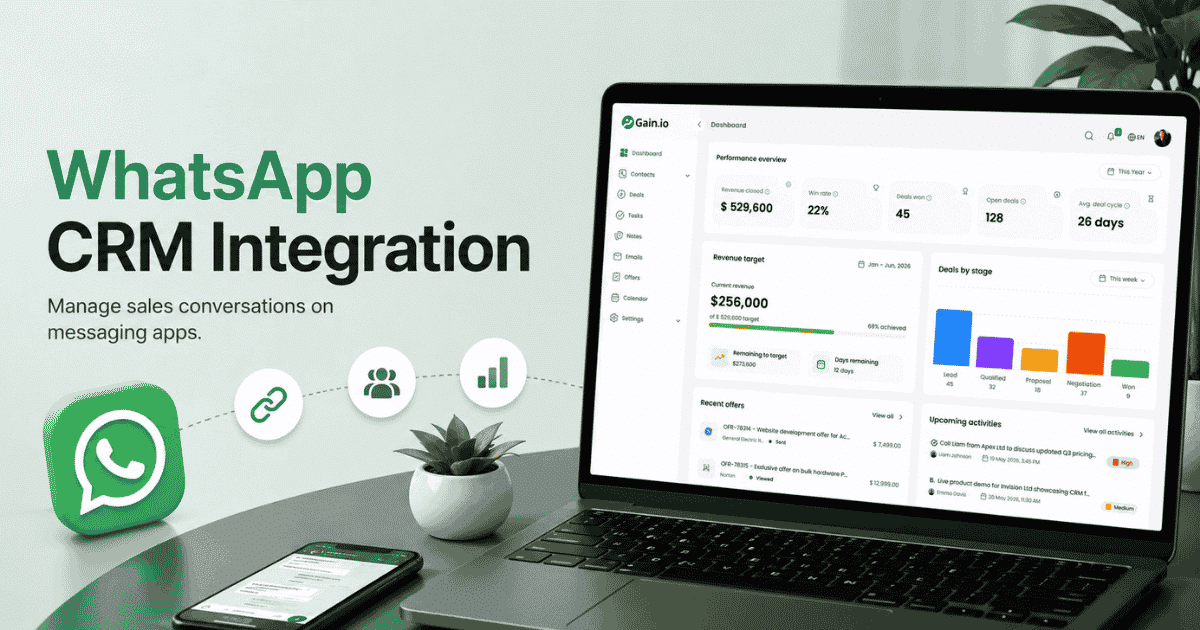
Gain.io CRM is designed to help sales teams manage customer relationships, deals, and activities in one central platform. It brings structure to how teams track opportunities and interact with prospects so that sales reps can spend less time on manual tasks and more time closing deals.
Unified contact and deal management
Gain.io organizes customer records, interaction history, and deal information in one place. Sales teams can view all relevant context for a contact or account without switching tools. This structure ensures that every interaction is connected to the opportunity it affects, reducing redundant work and improving continuity across the sales cycle.
Visual pipeline for real-time deal tracking
A clear sales pipeline shows the status of every deal from first contact to close. Reps can move deals through stages intuitively, helping them see which opportunities need attention next. This visual pipeline improves prioritization and keeps everyone aligned around progress and next steps.
Seamless Google Workspace integration
Gain.io connects with Google Workspace so that email conversations and calendar events surface directly within the CRM. This reduces the need for manual data entry and helps reps maintain context without switching between platforms. As a result, communication feels more fluid and less fragmented.
Built-in sales tools for daily execution
The platform includes task reminders, activity tracking, and follow-up notifications that support sales reps throughout the day. These tools reduce repetitive administrative work and help teams focus on actions that advance deals rather than routine updates.
Flexible sales forecasting and insights
Gain.io offers reporting tools that help teams understand performance trends, pipeline health, and revenue expectations. These insights support better decision-making and help sales managers plan resources and strategies based on real data.
Designed for teams of all sizes
Whether for small teams or larger groups, Gain.io adapts without unnecessary complexity. It balances useful features with an intuitive interface, making it a strong choice for teams looking for a practical, best sales CRM that supports growth and productivity.
Best CRM Software for Sales Teams
Selecting the right CRM is critical for sales teams dealing with complex business processes, growing pipelines, and increasing expectations around speed and accuracy. Modern CRM solutions help teams reduce repetitive tasks, maintain clean CRM data, and manage the complete customer journey from first touch to close. Below are five of the best options used by sales teams today, each suited to different stages and needs.
1. Salesforce Sales Cloud – Best for Enterprise and Complex Sales Operations
Salesforce Sales Cloud is widely used by large organizations that manage high deal volumes and long sales cycles. It supports advanced customization, automation tools, and detailed reporting that help enterprises handle complex business processes. Features like visual pipeline management, forecasting, and AI-driven insights make it suitable for teams that require deep control and scalability. However, it often demands significant setup time and technical expertise, which may be excessive for smaller or fast-moving teams.
2. Gain.io – Best for Modern and Growing Sales Teams
Gain.io is designed for teams that want clarity and efficiency without heavy complexity. It focuses on practical sales workflows, helping teams manage deals, activities, and CRM data with minimal manual effort. Visual pipeline management keeps opportunities organized, while built-in automation tools reduce repetitive tasks for sales reps. Gain.io fits well for growing sales teams that need the right CRM to support productivity today while remaining flexible as processes mature.
3. HubSpot CRM – Best for Small Sales Teams and Fast Adoption
HubSpot CRM is often chosen by small sales teams due to its ease of use and quick onboarding. It covers essential needs like contact management, deal tracking, and activity logging without overwhelming users. Its intuitive interface helps teams adopt CRM practices quickly, making it a good entry point for companies moving away from spreadsheets. While advanced customization is limited, it works well for teams prioritizing simplicity and speed.
4. Zoho CRM – Best Balance of Features and Cost
Zoho CRM offers a broad feature set that includes automation, reporting, and customization at competitive pricing. It supports sales teams managing structured pipelines and multiple workflows without enterprise-level costs. Zoho is often used by teams that want more flexibility than basic tools provide, while still keeping budgets under control. It suits organizations that need solid functionality across sales and marketing alignment.
5. Microsoft Dynamics 365 – Best for Integrated Business Environments
Microsoft Dynamics 365 is ideal for organizations that want CRM tightly connected with broader business systems. It supports advanced sales features, data management, and customization across departments. This platform works well for teams already operating within Microsoft ecosystems and managing large datasets. While powerful, it is better suited for mature organizations with dedicated resources.
Each of these CRM platforms addresses different priorities. The best choice depends on team size, sales complexity, growth plans, and how much structure or flexibility the sales organization requires.
Future Trends in CRM for Sales Teams
Sales teams continue to evolve as buyer behavior, technology, and expectations change. CRM platforms are no longer simple record-keeping tools. They are becoming intelligent systems that actively support decision-making, efficiency, and relationship-building. The following trends are shaping how CRMs will support sales teams in the coming years.
AI-driven insights and recommendations
Artificial intelligence is moving beyond basic automation and into decision support. Modern CRMs are beginning to analyze patterns in deal movement, customer behavior, and sales activity to surface recommendations. These insights help reps focus on the right opportunities, identify risks earlier, and understand which actions increase the likelihood of closing. As data quality improves, AI-driven guidance will play a larger role in day-to-day selling.
Automation across the sales workflow
Automation is expanding from simple reminders to broader workflow support. Future CRM systems will automate more of the repetitive tasks that slow sales teams down, such as follow-ups, status updates, and internal notifications. This shift allows reps to spend more time engaging with prospects and less time managing tools. The focus will be on automation that feels natural and supports productivity rather than replacing human judgment.
Deeper integration across revenue teams
CRMs are increasingly becoming the central hub for revenue operations. Integration between sales, marketing, and customer success tools is improving, enabling teams to share context across the customer lifecycle. This alignment helps sales teams engage prospects more effectively and hand off customers smoothly after closing. As integrations deepen, CRMs will support more consistent experiences across every stage of the relationship.
Personalization powered by real-time data
Buyers expect relevant, timely communication. Future CRM platforms will use real-time data to support more personalized outreach. Reps will have better visibility into engagement signals, content interactions, and timing preferences. This enables more meaningful conversations that reflect customer intent rather than generic outreach. Personalization will become a standard expectation rather than a competitive advantage.
Simpler, more intuitive user experiences
As CRM adoption remains a challenge, usability is becoming a priority. Future platforms will focus on cleaner interfaces, fewer clicks, and smarter defaults. The goal is to make CRMs easier to use without extensive training. This trend supports higher adoption, especially among growing teams, and ensures the CRM remains a tool that helps sales rather than one that adds friction.
How to Choose and Implement a CRM
Choosing and implementing the right CRM is one of the most impactful decisions a sales organization can make. A successful CRM rollout improves productivity, strengthens customer engagement, and supports long-term growth. However, selecting a platform and adopting it across teams requires thoughtful planning, clear criteria, and disciplined execution. Below are actionable steps that help sales leaders evaluate options, plan effectively, and implement a CRM that aligns with both present and future needs.
Define clear business goals and requirements
Before evaluating CRM vendors, sales leaders must articulate the business problems they want the system to solve. This includes understanding current pain points in contact management, meeting scheduling, reporting, or visibility into pipelines. Defining requirements around essential capabilities like deal tracking, forecasting, and sales activity logging helps narrow down choices. Aligning these goals with broader company strategy ensures the CRM becomes a tool for growth rather than a tactical add-on.
Prioritize must-have features for your team
Not all CRM platforms offer the same depth or focus in functionality. Teams should list features that are critical to their workflow. Core expectations often include robust contact management, ease of scheduling meetings and follow-ups, and a visual sales pipeline that mirrors real processes. Additionally, teams increasingly look for a robust mobile app to ensure reps can update activities on the go. Prioritization helps avoid feature overload while ensuring essential capabilities are covered.
Evaluate scalability and flexibility
A CRM should support evolving needs without forcing costly migrations later. Sales teams evaluating enterprise solutions must consider whether the platform accommodates multi-stage pipelines, custom fields, user roles, and team hierarchies. Growing teams need systems that allow segmentation of data and granular access control. Scalability also means anticipating future needs like advanced analytics or integration with support and marketing systems as operations expand.
Consider integration and ease of adoption
Integration with existing systems such as email platforms, calendars, and marketing automation tools is critical for reducing manual work and ensuring seamless data flow. Teams should assess how easily the CRM connects with tools already in use. Ease of adoption also depends on intuitive design, user training, and support. Systems that require minimal training and offer clear guidance improve onboarding success and long-term engagement.
Include AI-powered automation and analytics
Modern CRM platforms increasingly offer AI-powered automation that supports repetitive tasks, predictive insights, and smart recommendations. Teams should evaluate how these capabilities enhance efficiency without overwhelming users. AI features can automate data capture, score leads, and suggest next best actions, helping reps work smarter and reducing administrative burden.
Run structured trials and gather feedback
Before fully committing, teams should run structured trials with real workflows. A pilot implementation with a subset of sales reps helps reveal usability, integration issues, and feature gaps. Collecting feedback during trials informs the final decision and builds early buy-in from users who will ultimately rely on the CRM daily.
Plan rollout with clear project management
Implementing a CRM should follow a planned project management approach. This includes setting milestones, assigning roles, communicating changes, and scheduling training sessions. Regular checkpoints help ensure the project stays on track, and designated CRM champions can support adoption within teams.
Measure success and iterate
Post-implementation, teams must define metrics that gauge CRM success. This includes adoption rates, data completeness, pipeline velocity, and user satisfaction. Regularly reviewing these metrics ensures the CRM continues to support team objectives and identifies areas for improvement.
By following these structured steps, sales organizations can select a CRM that not only meets current needs but also supports sustainable growth and operational excellence.
FAQs
What is a CRM and why do sales teams need it?
A CRM, or customer relationship management system, helps sales teams organize contacts, track deals, and manage interactions in one place. It improves visibility, reduces manual work, and helps teams follow a consistent sales process. Without a CRM, important information often gets lost across emails, spreadsheets, and individual notes.
Is a CRM only useful for large sales teams?
No. CRM systems are valuable for teams of all sizes. Small teams benefit from structure, visibility, and better follow-ups, while larger teams rely on CRMs for coordination, reporting, and forecasting. The key is choosing a CRM that matches the team’s current size and complexity.
How long does it take to implement a CRM?
Implementation timelines vary based on team size, data complexity, and integrations. Simple setups can take a few days or weeks, while more advanced implementations may take longer. Clear planning, defined goals, and proper training help reduce delays and improve adoption.
What features should sales teams prioritize in a CRM?
Sales teams should focus on contact management, deal tracking, activity logging, reporting, and ease of use. Automation, mobile access, and integrations become more important as teams grow. Choosing features based on real workflows prevents unnecessary complexity.
Can a CRM improve sales productivity?
Yes. A CRM reduces time spent on manual updates, helps reps prioritize the right deals, and provides visibility into next steps. By centralizing information and automating routine tasks, sales teams can focus more on selling and relationship building.
How does a CRM support collaboration between teams?
CRMs act as a shared system of record. Sales, marketing, and customer success teams can access the same data, improving handoffs and alignment. This shared visibility reduces miscommunication and ensures customers receive consistent experiences.
How should a business choose the right CRM?
The right CRM depends on business goals, team size, budget, and growth plans. Teams should define requirements, test shortlisted tools, gather feedback from users, and evaluate long-term scalability. A CRM should support how teams actually work, not force major behavior changes. CRM adoption keeps climbing: Grand View Research estimates the global CRM software market at over $70 billion, and Salesforce's own Small Business Trends research has found that a majority of small businesses now consider CRM software central to managing customer relationships, not optional overhead.