Quick Answer: Sales collaboration CRM tools matter because deals rarely close solo anymore. Gartner puts the average B2B buying committee at 8 to 13 stakeholders, and Gong's analysis of over a million sales calls found deals are 258% more likely to close when a second team member joins the call.
A sales collaboration CRM plays a central role in how modern sales teams manage customer data, align team members, and move deals forward. Unlike a basic CRM system, a collaborative CRM connects sales and service teams, marketing teams, and other customer-facing teams on the same page with shared customer information, CRM records, and communication history. Centralized contact management, interaction management, and visibility across multiple channels help serve customers better throughout the customer journey.
As customer relationship management software evolves, collaborative CRM platforms combine operational CRM, analytical CRM, and strategic CRM capabilities inside one modern CRM solution. Sales reps reduce data entry, automate routine tasks, manage the sales pipeline, and track customer interactions across communication channels. Strong team collaboration, shared knowledge base access, document management, and cross-department workflows boost productivity, improve customer retention, and support revenue growth as the business grows.
What Is Sales Collaboration CRM
A sales collaboration CRM is a customer relationship management system designed to unify sales teams, service teams, and marketing teams around shared customer data and communication history. Unlike traditional CRM software, a collaborative CRM system centralizes all your customer data, CRM records, customer interactions, and contact management across multiple channels. Sales and service teams gain a single customer record that supports managing customer relationships, interaction management, and consistent follow-ups throughout the customer journey.
A collaborative CRM platform combines operational CRM, analytical CRM, and strategic CRM capabilities to support effective team collaboration. Sales reps reduce data entry, automate routine tasks, manage the sales pipeline, and track sales calls and customer conversations. Shared CRM tools, document management, file sharing, and cross-department workflows help customer-facing teams serve customers better, boost productivity, improve customer retention, and drive more deals and revenue growth as the business grows.
Core Features Of A Sales Collaboration CRM
A sales collaboration CRM brings sales teams, service teams, and marketing teams onto the same page by centralizing customer data, CRM records, and communication history. The right CRM solution strengthens team collaboration, improves visibility across multiple departments, and supports consistent customer interactions across the entire customer journey.
Shared Customer Data
Shared customer data forms the foundation of a collaborative CRM system. All your customer data, including customer records, purchase history, contact management details, and communication history, stays accessible to every relevant team member. Sales reps, service teams, and marketing teams rely on the same customer information to avoid duplication, errors, and missed follow-ups.
A unified customer record supports managing customer relationships across sales and service teams. Clear visibility into customer conversations, sales calls, and previous interactions helps customer-facing teams serve customers with context. Strong data access also improves customer retention, team performance, and trust across multiple departments.
Unified Communication Channels
Unified communication channels allow sales and service teams to manage customer interactions from email tracking, chat, and other multiple channels inside one CRM platform. A sales collaboration CRM keeps all customer conversations tied to the correct CRM records, ensuring no message or follow-up slips through the cracks.
Centralized channel management strengthens team communication and collaboration. Sales marketing efforts, service management, and support tools work together without switching systems. Better visibility across communication tools improves response quality, supports better customer support, and helps teams move deals forward faster.
Sales And Service Alignment
Sales and service alignment defines the value of collaborative CRM platforms. A shared CRM system connects sales teams and service teams around the same customer journey, customer interactions, and service case routing data. Each team understands prior actions and current priorities.
Aligned sales and service teams improve customer relationships and long-term retention. Clear handoffs, shared CRM data, and coordinated workflows reduce friction across business processes. Strong alignment also supports revenue growth by keeping current and potential customers engaged beyond the initial sales process.
Workflow And Task Automation
Workflow and task automation reduce manual data entry and repetitive routine tasks inside a modern CRM. A sales collaboration CRM automates follow-ups, service case routing, and cross-department workflows across customer-facing teams. Sales automation keeps CRM data accurate and timely.
Automate processes for free sales reps and service teams to focus on customer conversations and sales calls. Efficient automation boosts productivity, supports consistent customer interactions, and helps teams manage more deals without increasing workload as business grows.
Pipeline And Deal Visibility
Pipeline and deal visibility help sales teams track progress across every stage of the sales pipeline. A collaborative CRM system provides real-time access to deal tracking, customer interactions, and sales activities tracking for all team members involved.
Clear visibility supports better forecasting, faster decisions, and smoother collaboration between sales and service teams. Shared access to CRM records ensures deals move forward with confidence, accountability, and clear ownership, which directly improves team performance and revenue outcomes.
Document And Knowledge Sharing
Document management and file sharing support effective team collaboration across sales, marketing, service management, and support workflows. A sales collaboration CRM stores proposals, contracts, and shared knowledge base content directly within customer records.
Easy access to documents helps teams stay aligned and respond faster to customer needs. Centralized document management reduces delays, supports consistent messaging, and strengthens customer relationships by ensuring every team member works from accurate and up-to-date information.
Analytics And Performance Insights
Analytics and performance insights transform CRM data into actionable intelligence. A collaborative CRM combines analytical CRM and strategic CRM capabilities to support data analysis across customer interactions, marketing campaigns, and service performance.
Clear reporting helps sales and service teams evaluate team performance, customer retention trends, and interaction management quality. Data-driven insights guide smarter decisions, optimize business processes, and help small businesses and growing teams scale revenue growth with confidence.
Benefits Of Using A Sales Collaboration CRM
A sales collaboration CRM delivers measurable value by aligning sales teams, service teams, and marketing teams around shared customer data and workflows. Strong CRM collaboration improves team communication, streamlines business processes, and supports consistent customer interactions across the full customer journey.
Stronger Team Alignment
Stronger alignment across sales and service teams stands as a primary benefit of a collaborative CRM system. Shared access to CRM records, customer conversations, and communication history keeps every team member on the same page. Sales reps and service teams understand prior actions, open deals, and customer expectations without gaps.
Clear alignment reduces internal friction across multiple departments. Customer-facing teams coordinate sales calls, automated follow-ups, and service management with confidence. Unified team communication improves managing customer relationships, supports better customer support, and strengthens overall team performance.
Improved Customer Experience
Improved customer experience results from complete visibility into all your customer data. A sales collaboration CRM centralizes customer information, purchase history, and interaction management across multiple channels. Teams respond with context instead of assumptions.
Consistent access to customer records helps serve customers faster and more accurately. Sales and service teams personalize responses, avoid repetitive questions, and guide customers smoothly through the customer journey. Better experiences increase customer retention and long-term customer relationships.
Higher Productivity Across Teams
Higher productivity comes from reduced data entry and fewer manual routine task management. A modern CRM solution automates processes such as follow-ups, service case routing, and cross-department workflows. Sales reps and service teams focus on meaningful customer interactions instead of administrative work.
Automation and shared CRM tools help boost productivity across sales, marketing, and service management. Efficient workflows allow teams to manage more deals, support more customers, and maintain accuracy as the business grows.
Faster Deal Progression
Faster deal progression occurs when teams share real-time sales pipeline visibility. A sales collaboration CRM shows deal status, communication history, and next actions inside one CRM system. Every team member understands priorities and responsibilities.
Clear pipeline access helps sales teams move deals forward without delays. Service teams support sales efforts with timely assistance and better customer support. Faster execution leads to more deals closed and consistent revenue growth.
Better Data Accuracy And Insights
Better data accuracy emerges when one collaborative CRM platform replaces disconnected CRM tools. Centralized customer data, CRM records, and customer interactions reduce errors caused by duplicate entries or data migration issues.
Accurate data supports analytical CRM and strategic CRM initiatives. Data analysis reveals trends across customer interactions, marketing campaigns, and service performance. Reliable insights guide smarter decisions and improve the management of customer relationships at scale.
Scalable Collaboration As Business Grows
Scalable collaboration supports small businesses and growing teams as operations expand. A sales collaboration CRM adapts to multiple departments, communication channels, and customer-facing teams without complexity.
Shared workflows, document management, and a unified CRM platform help teams stay aligned as volume increases. Scalable CRM collaboration protects customer relationships, improves customer retention, and ensures consistent service quality while the business grows.
Sales Collaboration CRM Use Cases
Sales collaboration CRM supports real-world workflows where sales teams, service teams, and marketing teams rely on shared customer data and coordinated actions. These use cases show how collaborative CRM platforms improve team communication, customer interactions, and revenue outcomes across multiple departments.
Sales And Support Coordination
Sales and support coordination improve when both teams work from the same CRM system. A sales collaboration CRM connects customer conversations, service case routing, and communication history inside one customer record. Sales reps gain visibility into open issues before sales calls.
Service teams understand deal context, purchase history, and customer expectations. Shared CRM data reduces friction during handoffs and supports managing customer relationships beyond the initial sale. Strong coordination improves customer retention, better customer support, and long-term customer relationships.
Cross Department Account Management
Cross-department account management becomes easier with a collaborative CRM system. Sales teams, marketing teams, and service teams access all your customer data from a unified CRM solution. Customer interactions, marketing campaigns, and service management activities stay aligned.
Shared access to CRM records supports strategic CRM initiatives. Teams plan outreach, follow-ups, and account growth with confidence. Coordinated workflows across multiple departments improve team performance, strengthen customer relationships, and drive revenue growth.
Multi-Channel Customer Communication
Multi-channel customer communication relies on centralized channel management. A sales collaboration CRM captures customer interactions across email platforms like Gmail or Outlook, chat, and other channels within one CRM platform. Every team member sees the full communication history.
Clear visibility prevents duplicate responses and missed messages. Sales and service teams respond with context, accuracy, and speed. Unified communication channels improve interaction management, customer experience, and effective team collaboration across customer-facing teams.
Pipeline Management And Deal Support
Pipeline management benefits from shared visibility across sales and service teams. A sales collaboration CRM displays the sales pipeline, deal stages, and next actions using accurate CRM data. Team members understand priorities without manual updates.
Service teams support deals with timely assistance and customer information. Clear pipeline access helps move deals forward, reduce delays, and close more deals. Strong collaboration improves sales process efficiency and predictable revenue growth.
Customer Retention And Expansion
Customer retention and expansion depend on consistent customer information and shared ownership. A collaborative CRM platform tracks purchase history, customer journey data, and customer interactions across teams. Sales and service teams identify opportunities early.
Proactive follow-ups and personalized outreach strengthen the management of customer relationships. Unified CRM tools help customer-facing teams serve customers with relevance and care. Improved retention, upsell opportunities, and long-term loyalty support sustainable business growth.
How To Choose The Right Sales Collaboration CRM
The right sales collaboration CRM supports effective team collaboration, centralizes customer data, and fits existing business processes. A smart choice balances CRM features, usability, scalability, and alignment across sales teams, service teams, and marketing teams without adding complexity.
Team Collaboration Needs
Clear collaboration needs should guide CRM selection. Sales teams, service teams, and marketing teams require shared access to customer information, communication history, and CRM records. A collaborative CRM system must support smooth team communication across customer-facing teams.
Strong CRM collaboration keeps team members on the same page during sales calls, follow-ups, and service management tasks. Evaluate how well the CRM solution supports shared workflows, internal notes, and visibility across multiple departments to avoid silos and misalignment.
Customer Data Management
Customer data management defines CRM effectiveness. A sales collaboration CRM should centralize all your customer data, including contact management, customer interactions, purchase history, and communication channels. One accurate customer record prevents duplication and data gaps.
Reliable CRM data improves the management of customer relationships and customer retention. Assess how easily teams can access, update, and trust customer information without excessive data entry. Clean data supports better decisions across sales, service, and sales marketing teams.
Workflow And Automation Capabilities
Workflow and automation capabilities reduce manual routine tasks. A modern CRM platform should automate processes such as follow-ups, service case routing, and cross-department workflows. Automation supports consistent execution across the sales process.
Automate routine tasks, free sales reps and service teams to focus on customer conversations. Evaluate automation flexibility to ensure workflows adapt asthe business grows and new business processes emerge.
Multi-Channel Communication Support
Multi-channel communication support ensures complete interaction management. A collaborative CRM platform should capture customer interactions across email, chat, and other channels within one system. Unified channel management improves response accuracy.
Centralized communication history prevents missed messages and duplicate replies. Strong support for multiple channels helps serve customers efficiently and improves effective team collaboration across customer-facing teams.
Reporting And Analytics Value
Reporting and analytics value help teams measure success. A sales collaboration CRM should include analytical CRM features that support data analysis across the sales pipeline CRM, customer interactions, and marketing campaigns.
Clear insights improve team performance, customer retention strategies, and strategic CRM planning. Evaluate reporting depth, customization options, and data visibility for both current and potential customers.
Scalability And Ease Of Adoption
Scalability and adoption impact long-term CRM success. A CRM solution must support small businesses today and expand as teams, users, and data volume increase. Easy onboarding reduces friction during data migration.
User-friendly CRM tools encourage consistent usage across multiple departments. High adoption ensures CRM platforms deliver value as the business grows without overwhelming team members.
Integration And Tool Compatibility
Integration and compatibility ensure smooth operations. A sales collaboration CRM should connect easily with support tools, document management systems, and marketing platforms already in use.
Strong CRM integrations reduce manual work and streamline processes across sales, marketing, and service management. Evaluate compatibility with existing CRM software and future technology needs to protect long-term efficiency and collaboration.
Future Of Sales Collaboration CRM In Remote And Hybrid Teams
Remote and hybrid teams depend on sales collaboration CRM to maintain alignment, visibility, and consistent customer relationships. As distributed work expands, collaborative CRM platforms evolve to centralize customer data, strengthen team communication, and support seamless collaboration across sales and service teams.
Remote Team Alignment
Remote team alignment relies on shared access to customer information and CRM records. A sales collaboration CRM keeps sales teams, service teams, and marketing teams connected around the same customer conversations, communication workflow, and sales pipeline data. Clear visibility replaces hallway updates and manual reporting.
Strong alignment improves the management of customer relationships across time zones. Team members coordinate follow-ups, sales calls, and service management with confidence. Unified CRM platforms help remote teams stay on the same page and maintain consistent customer interactions.
Centralized Customer Context
Centralized customer context becomes critical for remote customer-facing teams. A collaborative CRM system stores all your customer data, including purchase history, contact management details, and interaction management records, inside one customer record.
Access to complete context helps teams serve customers with accuracy and speed. Sales reps and service teams understand the full customer journey without switching tools. Centralized context supports customer retention and stronger long-term customer relationships.
Asynchronous Collaboration Support
Asynchronous collaboration defines remote work success. A sales collaboration CRM enables teams to share updates, internal notes, documents, and CRM data without real-time dependency. Team communication stays clear even when schedules differ.
Shared workflows and CRM collaboration reduce delays in decision-making. Sales and service teams move deals forward while maintaining accountability. Asynchronous support improves team performance and boosts productivity across multiple departments.
Automation For Distributed Teams
Automation supports efficiency for distributed teams. A modern CRM solution automates routine tasks such as follow-ups, service case routing, and cross-department workflows. Automation reduces reliance on manual coordination.
Automating processes helps sales reps focus on customer conversations and sales process execution. Consistent automation improves accuracy across CRM data and supports predictable outcomes as remote teams scale operations.
Data Driven Remote Performance
Data-driven performance management grows in importance for hybrid teams. Analytical CRM and strategic CRM features provide data analysis across customer interactions, sales activity management, and marketing campaigns.
Clear insights help leaders evaluate team performance without micromanagement. Reliable reporting supports better decisions, revenue growth planning, and long-term success for remote and hybrid sales and service teams.
How Gain.io Powers Sales Collaboration CRM For High-Performance Teams
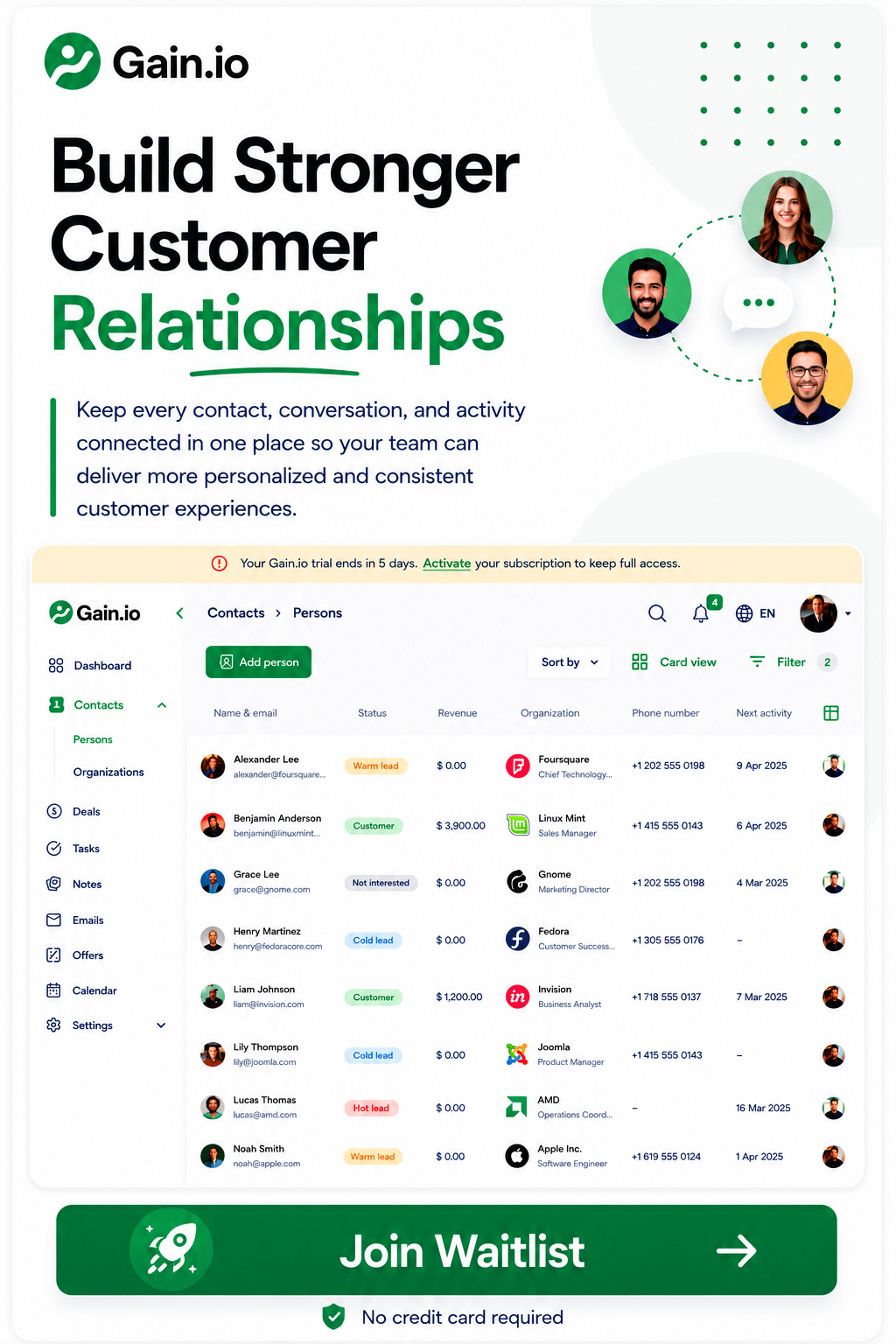
Gain.io powers sales collaboration CRM by centralizing customer data, communication history, and CRM records across sales and service teams. Instead of scattered inboxes and disconnected CRM tools, Gain.io brings all customer conversations, contact management, and interaction management into one collaborative CRM system. Sales reps, service teams, and marketing teams work from the same customer record, which keeps every team member on the same page throughout the customer journey.
With strong CRM collaboration features, Gain.io supports effective team collaboration through shared inboxes, internal notes, file sharing, and clear ownership. Automation reduces data entry and routine tasks, while visibility across multiple channels helps teams serve customers better. As business grows, Gain.io streamlines processes, improves customer retention, boosts productivity, and helps high-performance teams move deals forward with confidence.
FAQs
Does A Sales Collaboration CRM Replace Traditional CRM Software?
Yes, a sales collaboration CRM can replace traditional CRM software when team collaboration and shared customer data matter. It combines customer relationship management, interaction management, and team communication inside one collaborative CRM system for sales and service teams.
Can A Sales Collaboration CRM Work For Small Businesses?
Yes, many sales collaboration CRM platforms suit small businesses that need better team collaboration and customer data visibility. A scalable CRM solution helps small teams manage customer relationships, sales pipeline activity, and follow-ups as the business grows.
Does A Sales Collaboration CRM Support Marketing Teams Too?
Yes, marketing teams benefit from access to customer interactions, CRM records, and communication history. Shared CRM data improves sales marketing alignment, campaign targeting, and coordination across multiple departments.
Can A Sales Collaboration CRM Improve Customer Retention?
Yes, improved customer retention comes from complete customer information and consistent customer interactions. Sales and service teams serve customers better when CRM data, purchase history, and communication channels stay unified.
How Does A Sales Collaboration CRM Handle Data Migration?
A modern sales collaboration CRM supports structured data migration from existing CRM platforms. Clean migration protects customer records, communication history, and customer data accuracy across business processes.
What Security Features Matter In A Collaborative CRM System?
Security features should protect all your customer data, CRM records, and customer conversations. Role-based access, data controls, and audit trails ensure safe collaboration across customer-facing teams.
Is A Free Trial Important When Choosing A Sales Collaboration CRM?
A free trial helps sales teams and service teams evaluate CRM tools before commitment. Hands-on testing shows how the CRM solution supports team collaboration, automates routine tasks, and manages customer interactions across multiple channels.
The numbers back up why collaboration tools earn their place in the stack. Harvard Business Review found the average B2B purchase now involves 6.8 decision-makers, and Gartner puts more complex deals at 8 to 13 stakeholders. Gong's analysis of over a million recorded sales calls found deals were 258% more likely to close when at least one other team member joined the call. Outreach Insights Group also found coordinated, multi-person deals shortened sales cycles by roughly 51 days compared to single-owner deals. A CRM that keeps everyone on the same page isn't a nice-to-have against numbers like that.