TL;DR: Companies with a formally defined sales process see an 18% difference in revenue growth compared to those without one (Vantage Point Performance / Harvard Business Review). This guide defines what a sales process is, its core stages, how it differs from a sales funnel, and how it improves conversion.
A sales process is the structured path sales teams follow to turn interest into revenue. It defines how leads are approached, qualified, guided, and ultimately converted into customers. Without a clear process, sales efforts often rely on guesswork, personal habits, or inconsistent follow-ups, which makes results unpredictable.
A well-defined sales process brings clarity and focus to every stage of the buyer journey. It helps sales teams understand what actions to take, when to take them, and why each step matters. More importantly, it creates a repeatable system that supports growth as teams expand and deal volume increases.
In this guide, you will learn what a sales process really means, the key steps involved, and how a structured approach improves conversions, forecasting, and long-term revenue performance.
What Is A Sales Process
A sales process is a structured series of steps that sales teams follow to move a prospective customer from initial awareness to a closed deal. It provides a clear roadmap for every stage of the sales journey, from the first sales calls to post-sale handoffs.
Unlike a loose checklist or random outreach, a well defined sales process includes specific objectives, activities, and exit criteria for each stage. For example, a lead must meet certain qualification standards before moving from discovery to proposal. This structure allows sales managers to track progress, identify bottlenecks, and coach reps effectively.
The sales process also connects directly to your CRM. When stages are clearly defined, sales reps can log sales activities accurately, and sales leaders gain visibility into the entire sales pipeline. This makes forecasting reliable and highlights where deals tend to stall.
For B2B companies, a defined sales process ensures consistency across the entire team. Whether a new hire or a seasoned account executive is working a deal, the approach stays aligned with your company’s sales process and buyer expectations.
Why A Clear Sales Process Matters
Ad-hoc selling does not scale. When sales professionals operate without a structured process, deals slip through the cracks, forecasting becomes unreliable, and new reps take longer to ramp up. A clear sales process solves these problems by creating predictability across the entire sales cycle.
The data supports this directly: research cited by Harvard Business Review found an 18% difference in revenue growth between companies that defined a formal sales process and those that did not.
Clear Direction For Sales Teams
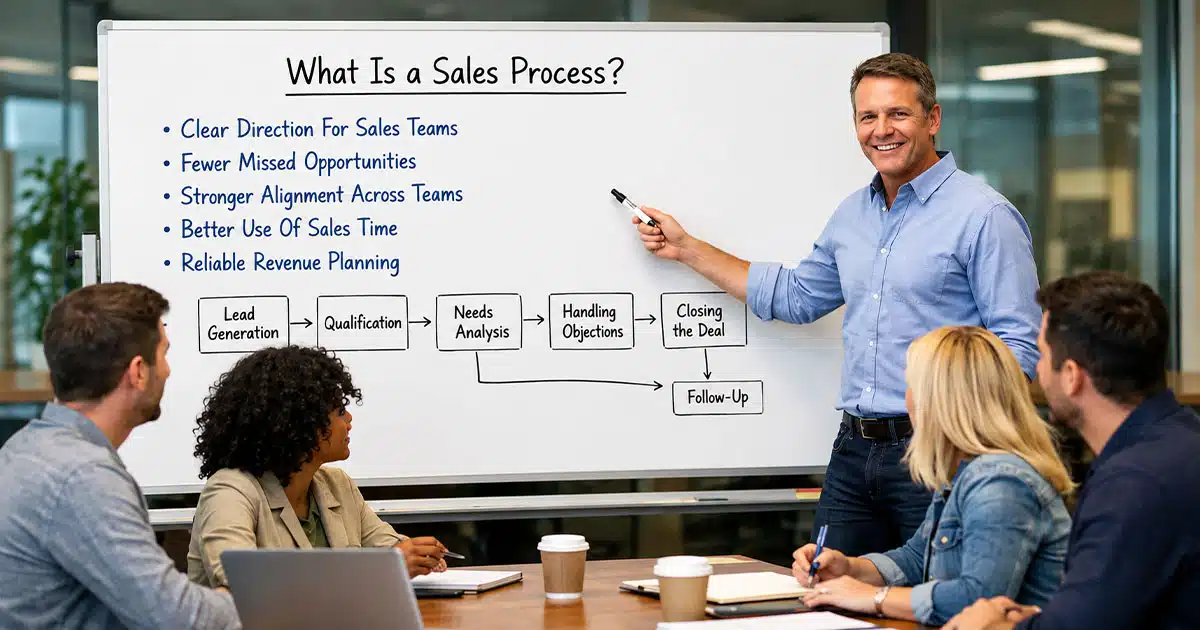
A standardized sales process gives every sales rep a clear understanding of what to do at each step of the sales journey. Instead of guessing which actions move deals forward, reps follow defined sales process steps with specific goals. This clarity reduces wasted time on unqualified leads and keeps the entire team focused on high-value activities. Sales development reps know exactly when to hand off leads. Account executives understand what qualifies as a sales qualified lead. The result is a more effective sales process where everyone moves in the same direction.
Fewer Missed Opportunities
Without a basic sales process, opportunities fall through the cracks. Reps forget to follow up, skip qualification steps, or lose track of where a deal stands. A structured sales process creates accountability at every sales stages. Each stage has exit criteria that must be met before moving forward. This discipline means fewer qualified leads get lost and more potential customers receive timely attention. Sales managers can quickly spot stalled deals and intervene before they go cold.
Stronger Alignment Across Teams
A successful sales process connects sales teams, marketing teams, and customer success under a shared framework. When everyone agrees on definitions for marketing qualified leads versus sales qualified leads, handoffs become smoother. Marketing knows what content supports each stage. Customer success understands what was promised during sales conversations. This alignment reduces friction in the buying process and creates a better experience for the prospective customer.
Faster And More Confident Decisions
Sales leaders make better decisions when they have visibility into the sales pipeline. A typical sales process with defined stages allows leadership to forecast accurately, allocate resources wisely, and identify training gaps. Instead of relying on gut feelings, managers use sales metrics to understand performance. They can see conversion rates between stages, average time in each phase, and where deals commonly stall. This data-driven approach leads to faster, more confident decisions about sales strategy.
Better Use Of Sales Time
A good sales process eliminates guesswork and reduces manual tasks. Reps spend less time figuring out next steps and more time on sales calls and closing deals. When combined with sales automation, repetitive activities like task creation, follow up reminders, and data entry happen automatically. This frees up sales professionals to focus on building relationships and moving deals through the sales funnel.
Reliable Revenue Planning
Predictable revenue requires a predictable process. When the entire sales process is mapped and followed consistently, sales operations can forecast with confidence. Leadership knows how many deals at each stage are needed to hit targets. Finance can plan budgets based on reliable projections. A strong sales process transforms selling from an unpredictable activity into a measurable engine for revenue growth.

Core Stages Of A Sales Process
Most effective sales processes share a common structure, even if the specific labels vary by organization. Understanding these core sales process stages helps sales teams build a framework that fits their unique sales process while maintaining consistency for measurement and coaching.
Prospect Identification
The selling process begins with finding potential customers who match your target market. This stage involves researching and reaching out to companies or individuals who fit your buyer personas. Common channels include LinkedIn outreach, industry events, referrals, inbound demo requests, and website sign-ups.
Effective prospecting requires clear documentation of your ideal customer profile. Sales development reps should understand which industries, company sizes, and pain points indicate a strong fit. Without this clarity, sales efforts get wasted on accounts that will never close. Track metrics like new accounts added per week and reply rates to measure prospecting effectiveness.
Lead Qualification
Not every prospect deserves a full sales pitch. Qualification determines whether a lead has genuine potential based on criteria like budget, authority, need, and timeline. This stage protects your sales organization from investing time in deals that will not close.
Use frameworks like BANT or MEDDIC to standardize how reps assess fit. A qualified lead should have a defined problem, budget authority, and willingness to engage in deeper conversations. Record qualification details in your CRM to ensure the entire team works from the same information. Conversion rate from lead to opportunity is a key metric here.
Discovery Conversations
Discovery goes deeper than qualification. This is where sales reps truly understand the prospective customer’s challenges, workflows, goals, and decision process. A strong discovery conversation typically runs 30 to 45 minutes and focuses on listening rather than selling.
Ask questions about their current process, the costs of maintaining the status quo, what success looks like, and who else is involved in decisions. Document everything in your CRM so downstream activities like demos and proposals stay aligned with what the buyer actually needs. The goal is to confirm the problem, quantify its impact, and agree on next steps.
Solution Positioning
Once discovery is complete, reps present how their products or services solve the buyer’s specific problems. This is not a feature dump. Effective solution positioning connects capabilities directly to the pains and goals uncovered in discovery.
Tailor your sales presentation to the audience. Operational users care about workflow improvements. Executives care about cost, risk, and strategic impact. Use concrete examples and case studies relevant to their industry. End with a clear next step, such as sending a proposal or scheduling a follow-up with additional stakeholders.
Objection Resolution
Objections are a natural part of any sales cycle. This stage involves listening carefully to concerns and addressing them without immediately offering discounts or concessions. Common objections relate to price, timing, competition, or internal priorities.
Ask clarifying questions like “What’s behind that hesitation?” to understand the real issue. Use frameworks like MEDDIC to map out the decision criteria and process. Document objection patterns across deals to improve your sales training materials and refine your sales methodology over time.
Deal Closure
Closing is the stage where verbal agreement becomes a signed contract. Activities include confirming final terms, coordinating e-signatures, answering last-minute questions, and clarifying implementation timelines.
Proactive communication prevents deals from stalling silently. Schedule check-ins, send recap emails, and create shared close plans for larger deals. Clean data in your CRM at this stage supports accurate forecasting and smooth handoffs to customer success teams.
Sales Process Vs Sales Funnel
Sales teams often use “sales process” and “sales funnel” interchangeably, but they represent different concepts. Understanding the distinction helps sales managers design better systems and gives sales leaders clearer visibility into performance.
Process Focus And Control
A sales process describes the specific actions that sales reps take to move deals forward. It focuses on what the seller does at each stage, from initial contact through closing deals. The process is internally controlled. Sales teams can define, adjust, and improve each step based on what works.
The sales funnel, in contrast, describes how potential customers move through stages of awareness, consideration, and decision. It visualizes the buyer’s journey rather than the seller’s actions.
Funnel As Buyer Journey
The sales funnel represents the customer journey from the buyer’s perspective. At the top, many prospects become aware of your products or services. As they move through the funnel, some drop off while others progress toward a purchase decision.
A sales funnel helps marketing teams and sales teams understand where leads enter, how they evaluate options, and what influences their decisions. It is a model for tracking buyer movement rather than seller activity.
Internal Actions Vs Buyer Movement
The sales process is about internal discipline. Sales process steps define what happens at qualification, discovery, presentation, and negotiation. These steps are repeatable and coachable.
The sales funnel tracks external behavior. It shows how many prospects moved from awareness to evaluation, from evaluation to decision. Funnel analysis reveals where buyers drop off, while process analysis reveals where reps struggle.
Measurement And Tracking Differences
Sales metrics differ between process and funnel views. Process metrics include activities like calls made, meetings held, and proposals sent. Funnel metrics include conversion rates between stages and overall win rates.
A modern sales process tracks both. Sales managers monitor rep activity to ensure process adherence. Sales leaders analyze funnel metrics to understand pipeline health and predict revenue.
Role Of Sales Teams
In the process view, sales teams are active drivers. They control outreach cadences, discovery questions, and negotiation tactics. Training materials and sales playbooks focus on improving rep execution at each stage.
In the funnel view, sales teams are facilitators. They guide potential customers through a buying process the customer already owns. The emphasis shifts to removing friction and providing value at decision points.
Impact On Forecasting
Both concepts affect forecasting differently. A strong sales process improves forecast accuracy by ensuring consistent stage definitions and exit criteria. When every rep follows the same process, pipeline data becomes reliable.
Funnel analysis reveals patterns in buyer behavior. If prospects consistently stall at a particular stage, it signals a need to adjust messaging or offer structure. Together, process and funnel insights give sales operations a complete picture of pipeline health.
How A Sales Process Improves Conversion Rates
A more effective sales process directly impacts how many prospects become customers. By creating structure around every interaction, sales teams reduce friction and build trust throughout the customer journey.
Clear Next Steps For Prospects
Buyers want clarity. When a sales rep knows exactly what comes next, they can communicate that confidence to the prospective customer. A defined sales process ensures every meeting ends with a scheduled follow up or agreed action. This momentum keeps deals moving forward instead of stalling in ambiguity.
Better Fit Between Leads And Offers
Qualification stages exist to match the right offers with the right buyers. When sales teams properly assess budget, authority, need, and timing, they avoid wasting resources on poor-fit accounts. This improves conversion rates because reps focus on prospects who genuinely benefit from the solution.
Research suggests that up to 79% of leads not fitting the ideal customer profile are unqualified. A structured sales process catches this early, protecting rep time and improving overall pipeline quality.
Consistent Communication At Every Stage
Inconsistency confuses buyers. A standardized sales process ensures every prospective customer receives similar information at similar stages. Whether a prospect speaks with sales development reps or account executives, the messaging stays aligned.
This consistency builds confidence. Buyers trust organizations that appear organized and professional. A clear sales process delivers that impression at every touchpoint.
Faster Response To Buyer Signals
When reps follow a defined sales process, they recognize buying signals more quickly. They know which questions indicate genuine interest and which objections signal deal risk. This awareness allows faster, more appropriate responses.
Speed matters in competitive sales scenarios. The first rep to address a concern or provide relevant information often wins the deal. A good sales process prepares reps to act decisively.
Reduced Friction In Decision Making
Complex buying processes involve multiple stakeholders, internal reviews, and competing priorities. An effective sales process anticipates these hurdles and builds in activities to address them. Reps share relevant customer data, connect buyers with references, and provide ROI documentation proactively.
By reducing friction before it becomes a blocker, sales teams keep deals on track and shorten the entire sales cycle.
Higher Trust Through Structure
Buyers increasingly prefer working with partners rather than being treated as just a vendor transaction. A strong sales process demonstrates professionalism and reliability. When a prospective customer sees that their rep has a clear plan, they feel confident the relationship will be managed well post-sale.
This trust accelerates decisions and increases the likelihood of referrals and expansion opportunities.
Common Sales Process Mistakes To Avoid
Even well-designed sales processes fail when implementation goes wrong. Recognizing common sales process mistakes helps sales leaders course-correct before problems impact revenue.
Skipped Qualification Steps
Rushing past qualification is one of the most damaging sales process mistakes. When reps skip proper assessment of budget, authority, need, and timeline, they waste resources on deals that will never close. The result is bloated pipelines, inaccurate forecasts, and frustrated sales teams.
Fix this by making qualification criteria explicit. Define what qualifies a lead to move forward and enforce those standards in your CRM. Sales managers should review qualification notes during pipeline reviews.
Undefined Sales Stages
Vague stage definitions create chaos. If one rep considers a deal “qualified” after a brief email exchange while another requires a completed discovery call, pipeline data becomes meaningless. Forecasting breaks down and coaching becomes impossible.
Every sales stage needs clear entry and exit criteria. Document these in your sales playbook and train the entire team on what each stage requires. This discipline creates the foundation for reliable sales metrics.
Inconsistent Follow-Up Practices
Inconsistent follow up kills deals. Some reps follow up aggressively while others let opportunities go cold. Without standardized practices, customer feedback goes uncaptured and potential customers drift to competitors.
Build follow up cadences into your sales process. Define how quickly reps should respond after meetings, how many touchpoints are appropriate, and what content to share at each stage. Sales automation can help ensure nothing falls through the cracks.
Overcomplicated Sales Workflows
Complexity is the enemy of adoption. When a sales process includes too many stages, required fields, or approval gates, reps find workarounds. They skip steps, enter inaccurate data, or abandon the process entirely.
Start with a basic sales process and add complexity only where it improves outcomes. Test new steps before making them mandatory. The goal is to guide behavior, not overwhelm the entire team with bureaucracy.
Poor CRM Usage
A sales process only works if it lives in your CRM. When reps track deals in spreadsheets, notes apps, or their heads, visibility disappears. Sales managers cannot coach what they cannot see.
Make CRM usage non-negotiable. Design your CRM workflows to mirror your sales process stages. Reduce data entry burden through automation and integrations. When the CRM makes selling easier, adoption follows.
Ignored Performance Insights
Data without action is useless. Many sales organizations collect sales metrics but never analyze them. They miss patterns like consistently stalled stages, low conversion rates, or extended sales cycles.
Schedule regular process reviews using actual data. Compare conversion rates between stages, average deal velocity, and win/loss reasons. Use these insights to improve your sales process incrementally rather than waiting for a complete overhaul.
How To Build A Sales Process That Scales
Building a sales process that grows with your organization requires thoughtful design and continuous refinement. These elements create the foundation for a scalable, repeatable system.
Well Defined Sales Stages
Start with clear stage definitions. Each stage should have a name, objective, required activities, and exit criteria. For example, the qualification stage might require a completed discovery call, budget confirmation, and identified decision-maker before a deal can advance.
Document these definitions in a central location accessible to the entire team. Review them quarterly to ensure they still match how deals actually progress. Clarity at this level enables everything else.
Documented Sales Playbooks
Playbooks translate process into action. They include scripts, email templates, objection responses, and guidance for different sales scenarios. New reps use playbooks to ramp quickly while experienced reps use them as reference.
Keep playbooks current. Update them as you learn what works and what does not. Include real examples from successful deals and incorporate customer feedback into messaging recommendations.
CRM Based Workflow Design
Your CRM should reflect your sales process exactly. Build stages, required fields, and automated tasks that guide reps through each step. When a deal moves from discovery to proposal, the CRM should prompt next actions and capture relevant data.
Avoid separate systems for pipeline tracking. When the CRM is the single source of truth, sales leaders gain reliable visibility, and sales operations can analyze performance accurately.
Automation For Repetitive Tasks
Sales automation removes manual sales tasks that drain rep productivity. Automate lead assignment, task creation after stage changes, follow-up reminders, and data syncing between systems.
Start with the highest-impact automations. If reps spend significant time on administrative work, prioritize those areas. The goal is to free up time for sales calls, relationship building, and closing deals.
Regular Process Review
A current sales process may not work next year. Markets change, products evolve, and buyer behavior shifts. Schedule process reviews at least twice annually to assess performance and identify improvement opportunities.
Use quantitative data like conversion rates and cycle length alongside qualitative feedback from reps. Ask what is working, what is frustrating, and where deals commonly stall. Small adjustments often produce significant results.
Continuous Team Training
A process is only as effective as the people executing it. Ongoing sales training ensures reps understand each stage, use proper sales techniques, and adapt to new situations. Training should cover both process mechanics and the sales methodology your team uses.
Make training practical. Use role-plays, deal reviews, and peer coaching rather than lecture-only formats. Recognize reps who exemplify process adherence and share their approaches with the broader team.
How Gain.io Supports A Structured Sales Process
Gain.io is built specifically for sales teams that need a reliable CRM to manage their entire sales process. The platform provides visual sales pipelines that mirror your sales stages, making it easy to track deals from prospect identification through deal closure.
Contact management keeps leads, prospects, and customers organized throughout the sales lifecycle. Task management supports sales follow-ups, reminders, and deal-related actions so nothing falls through the cracks. Notes capture sales conversations and decision history for every account.
Email integration connects your outreach and follow up directly to each deal, creating a complete record of buyer engagement. Calendar features help schedule demos, meetings, and pipeline planning activities.
For sales teams looking to improve your sales process without unnecessary complexity, Gain.io provides the structure and visibility needed for predictable revenue growth.
FAQs
What Is The Purpose Of A Sales Process?
The purpose of a sales process is to create a repeatable, structured approach to moving potential customers from initial awareness to a closed deal. It provides sales teams with clear guidance on what actions to take at each stage, reduces guesswork, and enables accurate forecasting. An important factor is its ability to align the entire sales organization around consistent practices.
How Many Stages Should A Sales Process Have?
Most effective sales processes include five to seven stages. A typical sales process covers prospect identification, qualification, discovery, solution positioning, objection handling, closing, and post-sale follow-up. The exact number depends on your sales cycle complexity and target market. Keep stages meaningful but avoid overcomplicating the process with unnecessary subdivisions.
Can A Sales Process Change Over Time?
Yes. A sales process should evolve as your business grows, products change, and buyer behavior shifts. Review your current sales process at least twice annually to identify improvement opportunities. Different sales processes work for different markets and deal sizes. What matters is maintaining consistent stage definitions so you can measure improvement over time.
How Does CRM Improve Sales Processes?
A CRM makes your sales process visible and actionable. It tracks deals through each stage, captures customer data, automates manual tasks, and provides the sales metrics needed for coaching and forecasting. Without CRM integration, pipeline information scatters across spreadsheets and individual notes, making reliable analysis impossible.
What Makes A Sales Process Effective?
An effective sales process requires clear stage definitions, documented activities for each step, measurable exit criteria, and consistent adoption across the team. It should align with the customer journey rather than force buyers through arbitrary gates. Regular review using performance data ensures the process stays relevant and continues driving revenue growth.