The meddic sales methodology remains one of the most reliable qualification frameworks for B2B sales professionals navigating complex sales environments. Developed at Parametric Technology Corporation during the mid-1990s, this structured approach helped a software company scale from $300 million to over $1 billion in revenue. The framework addresses a persistent problem: sales organizations forecasting deals that never close.
Research shows that unqualified pipelines carry 30-50% forecast errors. Teams implementing MEDDIC consistently bring that number below 10%. For sales leaders managing enterprise sales with buying committees averaging 6-10 stakeholders, this level of predictability changes everything. The meddic sales process gives your sales team a shared language for evaluating opportunities and allocating resources where they matter most.
What Is MEDDIC Sales Methodology
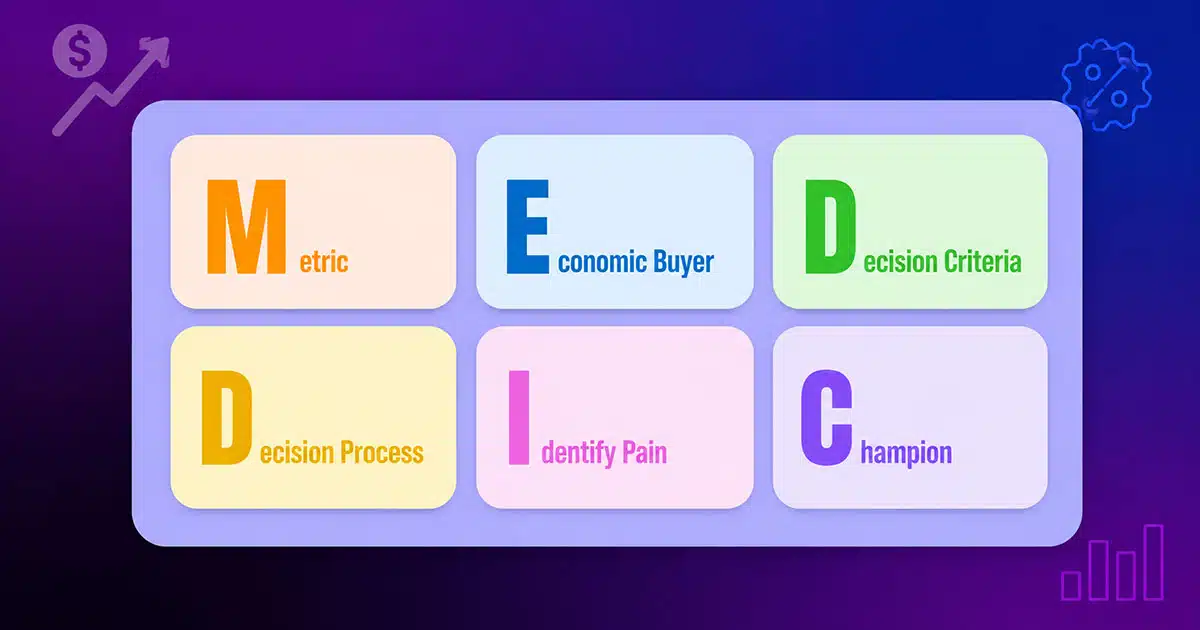
MEDDIC stands for six interconnected qualification elements: Metrics, Economic Buyer, Decision Criteria, Decision Process, Identify Pain, and Champion. Unlike simple checklists, these components work together throughout the sales cycle rather than as sequential gates.
The meddic framework differs from other sales methodologies because it demands continuous validation. Sales reps revisit each element during discovery, evaluation, proposal, and negotiation phases. This iterative approach catches changes in stakeholder priorities, budget shifts, or decision criteria updates before they derail deals.
Top performing sales organizations have adopted MEDDIC variants at remarkable rates. Industry surveys indicate that 70% of leading revenue operations teams now use some version of this qualification process. The meddic methodology particularly excels in complex sales cycles where the buying process involves multiple stakeholders and extended approval timelines.
The Six Core Elements Of MEDDIC
The six MEDDIC elements work together as an interconnected system. Sales reps should revisit each component multiple times across discovery, evaluation, proposal, and negotiation stages. This section provides practical guidance for each element with examples tailored to modern SaaS and B2B tech sales environments. Keep the focus on concrete outcomes with real numbers like “cut response times by 35%” or “freeing 15 hours per week” rather than vague benefits.
Metrics
Metrics quantify the business outcomes your potential customer cares about most. These include revenue growth, cost reduction, efficiency gains, risk mitigation, and customer experience improvements. Strong metrics transform your sales pitch from feature discussion to investment conversation.
Consider examples a SaaS vendor might explore: support ticket resolution time, cost per lead, system uptime percentage, churn rate, or hours saved per team each month. The goal is translating generic goals into specific targets. When a prospect says “improve productivity,” sales professionals dig deeper to uncover something like “reduce average handling time by 25% in Q3 2026” or “save 20% of current vendor spend.”
During discovery, use customer stories and ROI calculators to co-create a simple before and after business case. This approach helps leadership and finance view the deal as an investment with measurable payback rather than discretionary expense.
Economic Buyer
The economic buyer controls budget and can approve a purchase even when others hesitate. In mid-market or enterprise accounts, this role typically belongs to a VP or C-level executive depending on deal size and problem area.
In a typical B2B SaaS deal, the economic buyer might be a VP of Revenue Operations, CIO, CMO, or CFO. End users rarely hold this authority. Sales reps uncover this role through targeted questions like “Who signs off on budgets of this size?” or “Who else needs to feel confident about this project’s return?”
Once identified, tailor conversations with this person around high-level outcomes, risk, and return on investment. Use the metrics work rather than detailed product walkthroughs. Build relationships by sharing concise executive-ready summaries and avoiding overly technical language.
Decision Criteria
Decision criteria are the explicit and implicit rules buyers use to compare solutions. These include technical fit, price, security requirements, implementation effort, vendor reputation, and long-term roadmap alignment.
In a large SaaS evaluation, criteria might include single sign-on support, SOC 2 Type II compliance, integrations with Salesforce or HubSpot, onboarding timeline, and total cost of ownership over three years. Uncover these through open questions like “What must be true for this to be a success?” and “How will your team score different options?”
You can ethically influence criteria by helping buyers consider factors where your solution excels. Criteria often vary by stakeholder, so document differences between IT, security, finance, and functional leaders to avoid late-cycle surprises.
Decision Process
The decision process maps the path from “exploring options” to “contract signed and live.” This includes who participates, what approvals are required, and timing for each step.
A realistic mid to late stage process for a $50,000-$250,000 annual SaaS agreement might include internal validation, shortlisting, security review, legal review process, procurement, executive sign-off, and administrative onboarding. Questions that map this include “What does your internal approval path usually look like?” and “When legal gets involved, what else tends to slow things down?”
Understanding the process up front helps set mutual timelines, prevents month-end surprises, and feeds accurate forecasting. Document the decision process as a simple timeline inside your CRM so the whole account team stays aligned.
Identify Pain
Identify pain goes beyond surface complaints to understand root business problems, their impact, and who feels them most. This element connects directly back to metrics and eventually shapes your proposal.
Consider a customer success team drowning in manual updates, a sales team spending hours weekly on disconnected tools, or marketing struggling to prove pipeline influence to finance. Good discovery quantifies pain: “We lose about 10 deals per quarter because we cannot respond fast enough” or “Our operational overhead is approximately $120,000 annually on manual processes.”
Documenting customer pain points clearly allows champions and economic buyers to retell the story internally when securing support from other leaders.
Champion
A champion is someone inside the customer’s organization who wants your solution to win, has organizational influence, and advocates for you when you leave the room. Champions drive approximately 60% of internal approvals according to industry research.
Strong champions own the problem operationally, connect well across departments, have track records getting projects approved, and volunteer information without constant prompting. Test whether someone qualifies as a champion by asking them to sponsor a meeting with the economic buyer, circulate an internal summary, or share real evaluation documents.
In complex buying groups, multiple champions reduce risk. If one person leaves or priorities shift, others maintain momentum.
Pros And Cons Of Using MEDDIC In Your Sales Process
MEDDIC stands as one of the most widely adopted qualification frameworks in enterprise B2B sales. However, no single methodology fits every situation perfectly.
Advantages:
Benefit | Impact |
|---|---|
Improved forecast accuracy | From 30-50% error to under 10% |
Stronger sales and leadership alignment | Shared language for deal evaluation |
Better resource allocation | Focus on high-quality opportunities |
Common framework across revenue teams | Consistent qualification standards |
Limitations:
Challenge | Consideration |
|---|---|
Can feel heavy for smaller deals | $10K self-serve deals may not need full framework |
Risk of checklist mentality | Reps may treat it rigidly rather than conversationally |
Requires ongoing support | 40-50% methodology drift occurs within six months without coaching |
Demands CRM discipline | Data quality depends on consistent updates |
Consider a $10,000 annual self-serve deal where full MEDDIC might add friction versus a $200,000 multi-stakeholder opportunity where the framework reduces risk and guesswork significantly. Treat MEDDIC as a flexible scaffold adapted to your stages. Platforms like Gain.io simplify capturing and using MEDDIC insights at scale without overwhelming smaller opportunities.
Revenue Operations Alignment With MEDDIC Framework
The meddic sales framework becomes significantly more powerful when revenue operations teams integrate qualification data into their workflows and reporting systems.
Sales And RevOps Collaboration Around Pipeline Data
Sales reps and RevOps professionals benefit when MEDDIC data flows seamlessly between deal execution and pipeline analysis. RevOps teams can design CRM fields that capture each MEDDIC element, then build dashboards reflecting qualification completeness. This collaboration ensures sales leaders see which opportunities have strong champions versus those missing economic buyer access. Weekly deal reviews become more productive when both teams speak the same qualification language.
Data Visibility Across Revenue Teams
MEDDIC creates a common vocabulary that marketing, sales, and customer success all understand. When marketing knows which metrics resonate with closed-won deals, they create more targeted content. Customer success inherits documented pain points and success criteria, enabling smoother handoffs. Research indicates 70% of top revenue ops teams use MEDDIC variants precisely because this visibility reduces silos between departments.
Pipeline Health Monitoring Through CRM Data
Pipeline health extends beyond deal count and value. RevOps teams monitoring MEDDIC completeness identify at-risk opportunities before they stall. A deal missing champion information or unclear decision criteria signals investigation, not just pipeline hopes. Teams that tie deal health scoring to MEDDIC elements catch problems weeks earlier than those relying on stage alone.
Forecast Planning With Deal Qualification Insights
Forecast accuracy improves dramatically when qualification data informs predictions. Instead of asking “What will close this quarter?”, leaders ask “Which deals have validated metrics, identified economic buyers, and mapped decision processes?” Companies using MEDDIC report forecast accuracy under 10% variance compared to 30-50% industry averages. This precision supports better headcount planning, resource allocation, and board reporting.
Cross Team Alignment Around Revenue Signals
Revenue signals from MEDDIC data help align sales managers, marketing leaders, and customer success executives around shared goals. When everyone sees which pain points drive urgency and which decision criteria matter most, teams coordinate more effectively. Sales enablement efforts improve because training focuses on gaps revealed by MEDDIC analysis rather than generic skill building.
Continuous Pipeline Optimization With Data
MEDDIC data enables ongoing pipeline refinement. RevOps can analyze which elements correlate most strongly with wins in specific segments or deal sizes. Perhaps deals with two champions close 40% faster. Maybe unclear decision criteria predict 60% of losses. These insights guide coaching, process changes, and even product positioning over time.
When To Use The MEDDIC Sales Framework
MEDDIC proves most effective when deal value, risk, and complexity run high. Several people influencing the final purchasing decision makes this framework invaluable.
Companies and motions where MEDDIC fits well include enterprise SaaS, infrastructure or security platforms, data and analytics tools, and consulting services with multi-month sales cycles. Organizations with long approval chains involving IT, security, legal, and finance benefit because MEDDIC surfaces gaps early and prevents ghost opportunities lingering in the sales pipeline.
Consider a 12-month digital transformation project where failure would prove expensive. MEDDIC helps leadership decide which deals deserve extra resources and executive sponsorship. Even smaller teams can apply lightweight MEDDIC by focusing on pain, metrics, and economic buyer for deals in the $20,000-$50,000 range while reserving the full framework for largest opportunities.
Selling Complex SaaS Platforms
Enterprise SaaS sales in 2025 involve revenue leaders, operations, end users, security, and finance. Each group brings different needs and decision criteria to evaluation.
MEDDIC helps map this landscape by clarifying the economic buyer, identifying which metrics matter most (pipeline velocity, time to value, automation rates), and documenting the approval process from evaluation to signed contract. Tailor discovery for different departments: revenue teams focus on faster execution and lower tool sprawl while IT emphasizes reliability, APIs, and security standards.
Keeping MEDDIC fields current in your CRM and collaborative workspaces makes coordination easier for account executives, sales engineers, and customer success on big opportunities.
Large Scale Consulting Or Services Engagements
Services and consulting engagements like multi-year transformation programs mirror enterprise SaaS complexity but emphasize proof of capability and stakeholder alignment even more heavily.
MEDDIC applies through metrics around project ROI and risk reduction, economic buyers at C-suite level, and decision criteria focused on methodology, track record, and cultural fit. A consulting firm might use MEDDIC to uncover that real pain involves fragmented processes across regions leading to inconsistent customer experience and higher operational costs.
Mapping the decision process often uncovers steering committees, RFP steps, regional sign-offs, and legal frameworks across countries. All these influence realistic timelines and resource planning.
How To Implement The MEDDIC Sales Methodology With Your Team
Implementation represents a change in how teams think about deals, not just a new form to complete. Leadership sponsorship and simple tools make the difference between adoption and abandonment.
A phased rollout works best: pilot MEDDIC with a small group of senior sales reps, refine the process, then expand once templates, examples, and CRM fields are ready. Training should combine short workshops, deal reviews, and ongoing coaching embedded into opportunity work rather than one-time classroom sessions.
RevOps plays a critical role designing MEDDIC fields in the CRM, building aligned dashboards, and integrating them into forecast calls and pipeline reviews. Teams that understand CRM adoption challenges and best practices are better equipped to embed MEDDIC into daily workflows rather than treat it as a side project. Digital workspaces and collaboration tools including Gain.io centralize MEDDIC notes, customer documents, and next steps so every stakeholder sees the same picture.
Rolling Out MEDDIC Training
Start with a practical half-day or full-day workshop where sales reps bring real opportunities and apply each MEDDIC element live. Theory and slides alone fail to create lasting change.
Role-plays based on specific situations make training feel real. Practice approaching an economic buyer for the first time or probing for missing decision criteria in late-stage deals. Enable sales managers to coach MEDDIC by providing simple checklists or questioning frameworks for weekly one-on-ones and pipeline meetings.
Create a short internal playbook summarizing MEDDIC definitions, sample questions for each element, and anonymized gold standard opportunity examples. Refresher sessions every quarter help new hires ramp faster and keep experienced sales representatives from slipping back into gut-feel qualification. Training investments range from $100,000 to $500,000 annually through specialists, but adherence drops 40-50% in six months without technology support.
Integrating MEDDIC Into Your CRM And Review Rhythm
Successful adoption requires making MEDDIC part of existing tools and routines. Start with clear fields or sections in the CRM for metrics, economic buyer, pain, and decision process details, ideally inside a sales pipeline CRM that improves visibility and performance.
Reframe forecast calls to focus on missing MEDDIC elements rather than just stage and amount. Ask “Who is the champion and what have they done for us this week?” instead of only “What is your close date?” Link MEDDIC completeness to deal health scoring so leaders quickly see which big opportunities risk missing champions, unclear criteria, or unvalidated metrics, and combine this with modern sales forecasting methods for accurate revenue planning to improve overall predictability.
Platforms like Gain.io pull together documents, notes, and stakeholder information around each opportunity. This simplifies updating MEDDIC information without bouncing between multiple sales tools. Automation like sales task workflows that keep reps focused and organized—prompts to fill missing fields after calls or alerts when no new MEDDIC notes exist for a period—reduces admin burden on sellers.
Keeping MEDDIC Data Current Over Time
MEDDIC snapshots go stale quickly. People change roles, priorities shift with new quarters, and decision processes evolve. Sales reps need habits keeping information fresh.
Practical triggers for updates include after each significant meeting, when an email reveals a new stakeholder, or when customers mention changes in budget or timelines. Managers should review one or two deals in depth each week, focusing on how well MEDDIC data reflects reality and coaching reps on better questions.
Centralizing call notes, email threads, and documents inside a workspace like Gain.io—with CRM email integration that streamlines sales communication—makes updating MEDDIC fields easier without retyping. Syncing with your CRM ensures consistent, accurate data that improves not only win rates but also strategic decisions like headcount planning and quota setting.
MEDDIC Compared To Other Popular Sales Methodologies
Most teams do not use MEDDIC in isolation. They blend it with discovery frameworks and broader methodologies tailored to their business needs, often as part of a broader lead qualification strategy for sales teams that defines how and when prospects move through the funnel.
This section compares MEDDIC with common alternatives and extensions like MEDDICC, MEDDPICC, and BANT. The focus is on when each proves most helpful rather than declaring a universal winner. Whichever framework a company chooses, consistency in how data is captured and shared through tools like Gain.io and the CRM often matters more than the label used, especially when paired with disciplined sales deal tracking practices for modern teams.
MEDDIC Vs MEDDICC Vs MEDDPICC
MEDDICC adds “Competition” to the original MEDDIC framework. MEDDPICC further adds “Paper Process” covering procurement and legal workflows.
Framework | Elements | Best For |
|---|---|---|
MEDDIC | 6 core elements | Deals $50K-$250K |
MEDDICC | Adds Competition | RFPs over $250K |
MEDDPICC | Adds Paper Process | Enterprise deals over $1M |
The Competition element proves critical in three-vendor shortlists where understanding rival strengths, pricing models, and political capital inside accounts changes strategy. Paper Process covers vendor registration, security questionnaires, data processing agreements, and master service agreements.
Teams selling into industries with heavy compliance requirements like financial services, healthcare, or public sector benefit from MEDDPICC because it prevents late-stage surprises pushing deals out by months. Many companies start with MEDDIC and selectively add Competition or Paper Process elements where most needed rather than fully rebranding their framework.
MEDDIC Vs BANT And Other Qualification Frameworks
BANT checks Budget, Authority, Need, and Timeline. It works as a classic, lightweight qualification model useful in higher-volume sales motions.
MEDDIC digs deeper into multiple stakeholders, detailed decision paths, and specific metrics. BANT centers on quick checks about budget availability, decision authority, and timing. Research suggests BANT leads to 30-50% forecast errors compared to under 10% for MEDDIC in complex sales.
An inside sales team handling dozens of inbound product-led leads weekly might filter prospects fast with BANT. A strategic accounts team handling a small number of six-figure deals needs MEDDIC for more value. Some teams hybridize approaches, using BANT-style questions for initial lead qualification then applying MEDDIC once opportunities pass certain value or complexity thresholds.
How Gain.io Helps Teams Operationalize The MEDDIC Sales Methodology
Revenue teams often struggle to apply MEDDIC consistently across complex sales environments. An all-in-one CRM to grow your sales and team like Gain.io helps teams operationalize the meddic sales methodology by connecting product usage signals with sales intelligence so teams improve sales qualification and strengthen pipeline execution.
Stronger Sales Qualification
Gain.io strengthens the sales qualification process by helping sales teams identify qualified prospects based on product engagement and real usage signals. Instead of relying only on CRM notes, sales professionals use CRM to manage leads more effectively across the sales team and analyze product activity from a prospect's organization to understand how the solution supports the customer's business.
These insights improve the meddic sales qualification process because sales representatives can connect product activity with customer pain points and decision criteria. As a result, sales teams prioritize opportunities that move through the sales funnel faster and focus sales efforts on deals with stronger intent, mirroring the gains seen in case studies where teams close deals faster with a centralized CRM like Gain.io.
Decision Maker Visibility
Enterprise sales environments often involve several key stakeholders and complex decision making processes. Gain.io helps sales executives and sales managers understand how key stakeholders involved in the buying decision interact with the product.
Product insights reveal engagement from key decision makers within the prospect's organization. This level of sales visibility into deals and activities helps sales conversations become more relevant because teams align product value with the customer's business goals and overall business direction.
Workflow Alignment
Many sales organizations struggle to apply the meddic process within their current sales qualification process. Gain.io integrates with the existing tech stack and current tech stack used by sales teams so MEDDIC insights become part of existing workflows.
Integration with CRM systems, sales enablement tools, and existing systems helps sales representatives follow a consistent sales qualification methodology without changing how they work. Teams continue using familiar tools while benefiting from a simpler sales workflow inside their CRM, improving meddic sales qualification and pipeline visibility.
Faster Deal Progress
Complex sales environments often involve long sales cycles and multiple buying stages. Gain.io helps teams monitor product engagement signals and apply disciplined sales deal tracking that indicate progress in the business decision making process.
Sales teams identify when potential customers reach critical milestones in the buying decision or purchasing decision. Product signals combined with CRM-driven sales productivity improvements help sales leaders guide deals forward more effectively and close more deals. Improved insight into customer behavior ultimately helps revenue teams win more deals while managing complex sales cycles more efficiently.
FAQs
Is MEDDIC Only Useful For Large Enterprise Deals
MEDDIC was designed for complex, high-value sales but many mid-market teams now use a lighter version for deals as low as $20,000-$50,000 annual contract value when multiple stakeholders and approvals are involved.
For very small, transactional purchases the full framework can slow things down. Focus on just a few core elements like pain, rough metrics, and the true decision maker. Leaders should set clear internal thresholds like “full MEDDIC for any deal over $75,000 or involving security review” so sales representatives know when to use the complete framework.
How Long Does It Take A Team To Adopt MEDDIC Effectively
Most teams start seeing consistent MEDDIC usage within one to three months if training, manager coaching, and CRM changes happen in parallel.
Deeper cultural adoption where sales reps naturally think and talk in MEDDIC terms during calls and reviews often takes six to twelve months depending on team size and turnover. Reinforce the framework through deal reviews, call coaching, and tools like Gain.io so using MEDDIC feels like part of normal work rather than an extra task.
Can MEDDIC Work Alongside Other Sales Methodologies We Already Use
MEDDIC complements most sales methodologies because it focuses on qualification and deal health while other frameworks may focus on conversation structure or value messaging.
A team might use a questioning framework for discovery calls but still update MEDDIC fields after each significant interaction to keep leadership informed about opportunity quality. Leaders should map where MEDDIC fits into current stages rather than rebuilding the entire sales process, then reflect that structure inside shared tools and templates.
How Do We Know If Our MEDDIC Adoption Is Working
Track leading indicators such as higher MEDDIC field completion in the CRM, more precise close dates, and richer notes on economic buyers and champions inside deal workspaces.
Monitor outcome metrics over several quarters including win rate on large deals, accuracy of late-stage forecast, and reduction in “no decision” outcomes to see if MEDDIC improves pipeline quality. Structured deal reviews using a MEDDIC lens supported by shared spaces in Gain.io can quickly reveal whether sales reps are just filling fields or truly using the framework to shape strategy.
Do Customer Success Teams Benefit From MEDDIC Too
Customer success teams can use MEDDIC insights, especially pain, metrics, and champions, to plan onboarding, leverage better contact management to build stronger relationships, track success against original goals, and proactively manage renewals and expansions.
Understanding the original economic buyer and decision criteria helps CS anticipate who needs to see results and what “value” looked like when the deal was signed. Centralizing MEDDIC information in a shared platform like Gain.io, with smart CRM tools designed for sales teams, gives CS a full view of the promise made during the sales cycle so they can deliver on it more effectively.