Hiring a great sales rep is only the first step. What happens after the offer letter often determines how quickly that person starts closing deals. Without a structured onboarding plan, new reps take longer to build confidence, struggle to follow the sales process, and miss valuable opportunities. A well-planned onboarding experience helps them ramp faster and perform more consistently.
A strong sales rep onboarding plan goes beyond product training and company introductions. It gives every new hire a clear roadmap, practical milestones, hands-on coaching, and the right tools to succeed from day one. In this guide, you'll learn how to build an effective onboarding plan, structure a 30-60-90-day framework, track progress with the right KPIs, and use your CRM to create a repeatable onboarding process that supports long-term sales success.
What Is A Sales Rep Onboarding Plan?
A sales rep onboarding plan is a structured roadmap that helps new sales reps learn the skills, knowledge, and tools they need to succeed. It goes far beyond a welcome session or product overview. A strong sales onboarding process introduces your sales methodology, sales process, product knowledge, company culture, and performance expectations in a logical order. The goal is to help every new hire become a confident and productive member of the sales team as quickly as possible.
An effective sales onboarding plan also gives sales managers a clear way to track progress and support new sales hires throughout the onboarding process. It combines sales training, coaching, hands-on practice, and regular feedback instead of relying on one-time sessions. When every rep follows the same structured onboarding process, your sales organization builds consistency, improves employee performance, and creates a stronger foundation for long-term sales onboarding success.
Why A Structured Sales Rep Onboarding Plan Is Important
A sales rep onboarding plan sets the foundation for every new hire's success. Sales managers who invest in a structured onboarding process see faster ramp-up, stronger quota attainment, and lower turnover across the sales organization.
Reduce Sales Ramp-Up Time
New sales reps take weeks to learn product knowledge, sales scripts, and internal tools without a clear onboarding process. A structured sales onboarding program cuts this time by giving reps a defined path from day one. Instead of guessing what to learn next, new hires follow a checklist built around real sales skills.
Sales enablement platforms and a learning management system speed this up further. Reps get access to training materials, sales playbooks, and product training in one place. This structured onboarding process helps new sales hires reach full productivity faster, so they start handling sales calls and prospecting sooner.
Improve Quota Attainment And Win Rates
An effective sales onboarding plan directly affects how fast reps hit quota. Sales training that covers objection handling, the sales process, and company-specific methodology gives new reps the tools to close their first deal with confidence. Without this, reps often struggle through months of trial and error before they understand what actually works.
Sales onboarding best practices include role-playing sales calls and reviewing real scenarios with sales managers. Ongoing coaching sessions reinforce these skills after initial training ends. Reps hitting quota faster becomes the norm, not the exception, when onboarding sales reps includes structured practice tied to actual performance metrics.
Increase New Hire Retention
Sales employees who feel unsupported during their first months are more likely to leave. A seamless onboarding experience builds confidence early, which strengthens employee engagement and reduces costly turnover. New hires who understand expectations, tools, and company culture from the start settle into their role faster.
Sales onboarding success depends on clear onboarding objectives and regular check-ins, not just a single training week. Sales leaders who gather feedback throughout the onboarding process can catch struggles early and adjust support. This kind of structured process signals to new sales employees that the company is invested in their growth.
Build A Consistent Sales Process
Without a structured onboarding process, sales reps develop their own habits, and inconsistency spreads across the team. A good sales onboarding program teaches key sales processes the same way to every new rep. This keeps messaging, sales scripts, and customer interactions aligned across the entire sales organization.
Consistency also makes it easier to track key performance indicators across the sales department. When every rep learns the same sales methodology, sales managers can compare performance fairly and spot gaps faster. A better sales onboarding process turns individual effort into a repeatable system the whole team can rely on.
Drive Long-Term Sales Success
A strong onboarding program does more than prepare reps for their first few deals. It sets the tone for continuous learning throughout their time with the company. Sales professionals who start with solid process training are more likely to grow into strong performers who consistently meet company goals.
Sales enablement teams that support new reps early often see stronger long-term results across the sales team. Reps who understand the sales process, product knowledge, and potential customers from day one build habits that last. This foundation supports onboarding success well beyond the first few months on the job.
What To Prepare Before Your New Sales Rep Starts
Preparation before day one shapes how smoothly a sales rep onboarding plan runs. Sales managers who set up tools, resources, and expectations early give new sales reps a stronger start and fewer early roadblocks.
Define Clear Onboarding Objectives
Every effective sales onboarding program starts with clear onboarding objectives set before the new hire's first day. Sales managers should define what a new rep needs to know by week one, month one, and month three. Without these markers, onboarding becomes unstructured and hard to measure.
Objectives should tie directly to sales skills, product knowledge, and early performance metrics. This gives new sales hires a clear picture of what success looks like early on. A structured onboarding process built around specific goals makes it easier to track progress and adjust support as needed.
Prepare CRM Access And Sales Tools
New sales reps cannot start selling without access to the right sales enablement platforms and CRM. Setting up logins, permissions, and tool access before day one avoids wasted time during the first week. This is one of the most overlooked steps in onboarding sales reps.
Sales onboarding tools should include the CRM, communication platforms, and a learning management system for training materials, especially for teams that need a structured B2B sales CRM system to manage complex deals and longer cycles. Having everything ready in advance lets new sales employees focus on learning the sales process instead of troubleshooting access issues. This small step supports a seamless onboarding experience from the start.
Organize Product Training And Sales Resources
Product training needs to be organized and accessible before a new rep's first day. Sales playbooks, sales scripts, and case studies should be gathered in one place so new hires are not searching for scattered resources. This keeps the sales onboarding checklist simple and easy to follow.
Well-organized product training materials and integrated contact management help new sales hires understand potential customers and product knowledge faster. Sales enablement teams play a key role here, making sure content stays current and relevant. A good sales onboarding program treats these resources as a foundation, not an afterthought added after training starts.
Assign A Mentor And Schedule Manager Check-Ins
Pairing new sales reps with a mentor gives them a go-to person for daily questions. This support system speeds up learning and helps new hires feel connected to the sales team early. Mentorship is a common thread across most effective onboarding programs.
Sales managers should also schedule regular check-ins from the start, not just during the first week. These touchpoints let managers gather feedback, spot early struggles, and offer ongoing coaching before small issues grow. Structured onboarding that includes both mentorship and manager check-ins builds stronger sales onboarding success over time.
Set Performance Expectations From Day One
New sales hires perform better when they know exactly what is expected of them early on. Sales managers should outline key performance indicators, quota timelines, and behavior expectations before the rep's first sales call. Vague expectations lead to confusion and slower ramp-up.
Clear expectations tied to the sales process help new reps understand how their role supports company goals. This also gives sales leaders a fair baseline for evaluating employee performance later. Setting expectations early is one of the simplest sales onboarding best practices, yet it often gets skipped in a rushed onboarding process.
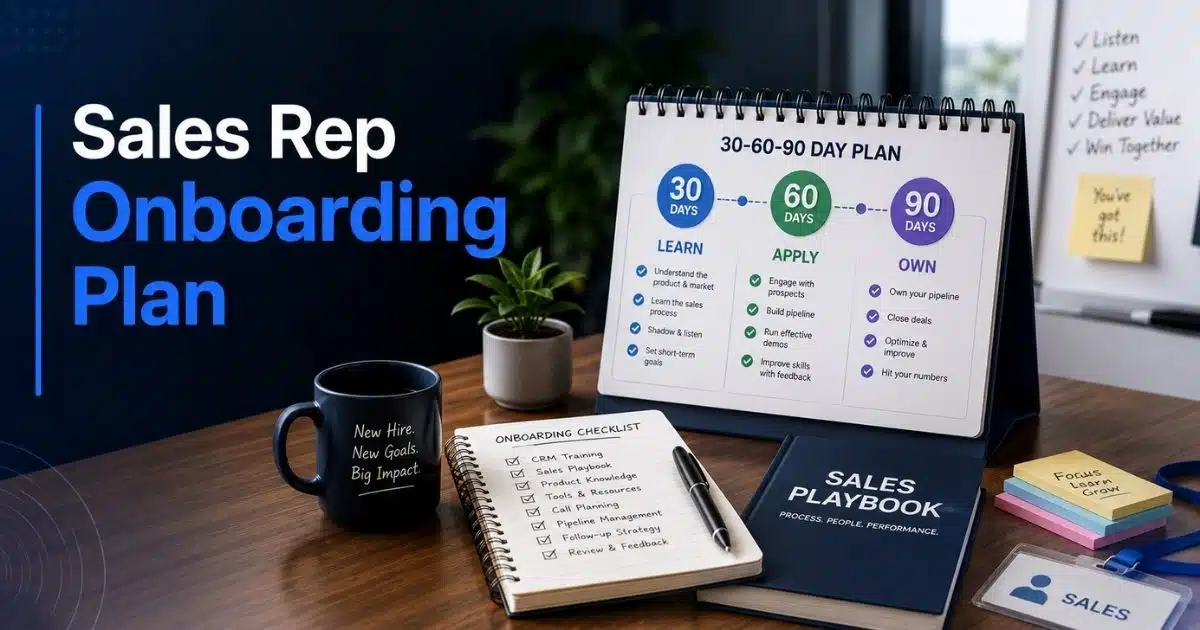
How To Build Your Sales Rep Onboarding Plan With A 30-60-90 Day Framework
A 30-60-90 day framework breaks a sales rep onboarding plan into manageable stages, mirroring many CRM adoption best practices that emphasize behavior change over one-time setup. This structured onboarding process helps new sales reps build skills in order, moving from foundational learning to full sales performance.
Days 1–30: Learn The Business And Sales Foundation
The first 30 days should focus on product knowledge, company culture, and the sales process. New sales reps need time to absorb sales scripts, understand potential customers, and learn how the CRM and other sales tools work. Rushing this stage often creates gaps that show up later in sales calls.
Sales managers should keep early training structured, using a mix of shadowing, product training, and short assessments. This stage sets the tone for the entire sales onboarding program. New hires who build a solid foundation in the first 30 days ramp up faster once they move into live customer conversations.
Days 31–60: Practice Sales Skills And Customer Conversations
By day 31, new sales reps should start applying what they learned through role-play and supervised sales calls. This stage focuses on objection handling, sales methodology, and refining sales scripts based on real feedback. Practice here builds the confidence reps need before handling deals independently.
Sales managers and mentors should stay closely involved, offering coaching sessions after each practice call, since tighter coaching and clearer processes can dramatically accelerate deal cycles. Gathering feedback at this stage helps catch bad habits before they become permanent. Structured onboarding during days 31 to 60 turns theoretical sales training into practical, repeatable sales skills new reps can rely on.
Days 61–90: Manage Your Pipeline And Close Deals
The final stretch of onboarding shifts new sales reps toward full ownership of their pipeline. Reps should be managing their own leads, running sales calls independently, and working toward their first deal. This is where earlier training gets tested under real conditions.
Sales managers should track performance metrics closely during this period, comparing results against the key performance indicators set earlier. Reps hitting quota for the first time often happens in this window. A well-built sales onboarding plan makes days 61 to 90 feel like a natural next step, not a sudden jump in responsibility.
Continue Development Beyond The First 90 Days
Onboarding success does not end at day 90. Continuous learning keeps sales professionals sharp as products, markets, and sales processes evolve. Sales enablement teams should keep training materials updated and available well past the initial onboarding period.
Ongoing coaching, refresher sessions, and ongoing access to a learning management system help reps keep improving, especially when paired with structured CRM adoption strategies to improve ROI. Sales leaders who treat onboarding as a continuous process, not a one-time event, see stronger long-term results across the sales organization. This mindset supports both employee performance and retention well beyond the first 90 days.
Sales Rep Onboarding Checklist
A sales onboarding checklist keeps every stage of the onboarding process organized and easy to follow. Sales managers can use this checklist to make sure no step gets missed as new sales reps move through onboarding.
Preboarding Checklist
Before a new rep's first day, these steps set up a seamless onboarding experience:
- Set up CRM access, email, and sales tools
- Assign a mentor and notify the sales team
- Prepare a welcome message outlining company culture
- Schedule first-week meetings with sales managers
- Gather training materials and product training resources
- Confirm hardware, software, and login credentials are working
First Week Checklist
The first week should introduce new sales hires to the basics without overwhelming them:
- Walk through company culture, mission, and team structure
- Review the sales process and key sales processes end to end
- Introduce sales scripts and core product knowledge
- Set up shadowing sessions with experienced sales reps
- Confirm clear onboarding objectives for the first 30 days
- Check in daily to answer early questions
First Month Checklist
By the end of the first month, new sales reps should be building real sales skills:
- Complete core sales training and product training modules
- Practice objection handling through role-play scenarios
- Begin joining live sales calls in a supervised role
- Review sales playbooks and internal best practices
- Gather feedback from mentors and sales managers
- Track early performance metrics against onboarding objectives
First 90 Days Checklist
Reaching day 90 means new reps should be operating with more independence:
- Manage an active pipeline with minimal supervision
- Work toward or close a first deal
- Demonstrate consistent use of the sales methodology
- Hit early key performance indicators tied to quota
- Participate in ongoing coaching sessions
- Complete a formal 90-day performance review
Manager Review Checklist
Sales managers should use this checklist to evaluate onboarding success and employee performance:
- Compare results against original onboarding objectives
- Review quota attainment and win rates so far
- Gather feedback from the new rep on training gaps
- Assess use of sales tools and CRM proficiency
- Identify areas for continuous learning going forward
- Document lessons to improve the next onboarding program
CRM Best Practices For Sales Rep Onboarding
A CRM is one of the most important sales onboarding tools for new reps to master early, especially if you use an all-in-one CRM to grow your sales and team. Sales managers who build CRM training into the onboarding process help new sales reps work faster and stay organized by taking advantage of smart CRM tools for sales teams.
Standardize Your Sales Pipeline
A standardized sales pipeline CRM gives new sales reps a clear picture of where every deal stands. Without consistent stages, reps interpret the sales process differently, which creates confusion across the sales team. Standardizing pipeline stages in the CRM early in onboarding prevents this from becoming a habit.
New sales hires should learn how to move deals through each stage the same way as the rest of the sales organization. This consistency supports accurate reporting and keeps key sales processes aligned. A structured onboarding process built around one pipeline standard makes performance easier to track across the entire team.
Centralize Customer And Sales Data
Scattered customer data slows new sales reps down and leads to missed details during sales calls. Centralizing all customer and sales data inside the CRM with dynamic contact management gives new hires one place to check before every conversation. This is a core part of any effective sales onboarding program.
When new sales reps rely on centralized data, they spend less time searching and more time selling. Sales managers should walk new hires through where deal history, notes, and contact information live. Onboarding sales reps this way supports faster ramp-up, since reps are not piecing together information from multiple sources.
Automate Routine Sales Activities
Manual data entry and repetitive admin work eat into a new rep's selling time. Automating routine sales activities inside the CRM, like follow-up reminders and data logging, frees new sales reps to focus on customer conversations instead. This is one of the simpler sales onboarding best practices to implement early.
Sales enablement platforms often include simpler sales workflows and automation features that reduce manual work across the sales department. Training new hires on these features during onboarding prevents bad habits from forming later. Automating routine sales activities also supports faster onboarding success, since reps spend more time practicing actual sales skills.
Track Rep Progress With CRM Dashboards
CRM dashboards give sales managers a real-time view of how new sales reps are progressing. Instead of waiting for weekly reports, managers can track activity, pipeline movement, and early performance metrics as they happen. This visibility supports a more structured onboarding process overall and reinforces the value of a dedicated sales pipeline CRM for tracking early-stage performance.
New reps benefit from seeing their own dashboard data too, since it shows progress against onboarding objectives. Effective onboarding reduces sales ramp-up time by 37 percent, and dashboards help managers spot where reps need more coaching sooner. This kind of tracking turns onboarding into a data-informed process, not a guessing game, and aligns closely with how a B2B sales CRM is meant to support revenue teams.
Measure Performance With CRM Reports
CRM reports give sales managers the data needed to evaluate onboarding success beyond gut feeling. Reports on call volume, deal velocity, and quota attainment show whether new sales hires are on track. Salespeople with effective onboarding hit quotas seven weeks faster, and CRM reporting helps confirm that progress early.
Sales leaders can use these reports to compare new rep performance against established benchmarks and tie them back to broader CRM adoption strategies to improve ROI. This makes it easier to identify where the onboarding program is working and where it needs adjustment. Measuring performance through CRM reports keeps the entire sales organization accountable to real employee performance data.
KPIs To Measure Sales Rep Onboarding Success
Key performance indicators turn onboarding success from a feeling into a measurable outcome. Sales managers who track the right KPIs can spot problems early and adjust the onboarding process before small issues become bigger ones.
Time To First Deal
Time to first deal shows how quickly a new sales rep moves from training to actually closing business. A shorter timeline usually signals that the onboarding program is giving reps the right sales skills and support early on. A longer timeline often points to gaps in product training or sales process clarity.
Sales managers should track this metric from day one, not just at the 90-day mark. Comparing time to first deal across new hires helps identify which parts of the sales rep onboarding plan are working. This KPI also gives new sales reps a clear, motivating milestone to work toward.
Sales Ramp-Up Time
Sales ramp-up time measures how long it takes a new rep to reach full productivity and consistent quota performance. Effective onboarding reduces sales ramp-up time by 37 percent, making this one of the clearest indicators of a strong onboarding program. Slow ramp-up often reflects unclear onboarding objectives or inconsistent training.
Sales managers should track ramp-up time against team averages to spot outliers early, especially for fast-moving teams using CRM tools that help startups grow smarter. Salespeople with strong onboarding hit quotas seven weeks faster, which directly affects revenue timelines. Monitoring this KPI helps sales leaders understand whether the current onboarding process needs adjustment or is already performing well.
Quota Attainment Rate
Quota attainment rate shows how many new sales reps are hitting their targets within a set timeframe. Better onboarding can improve win rates by 14 percent, which often shows up directly in quota numbers. This KPI reflects both training quality and how well reps apply what they learned in real sales calls.
Sales managers should track quota attainment separately for new hires versus tenured reps. This comparison highlights whether the onboarding program is preparing reps well enough to compete early. Low attainment rates often point back to gaps in role-play practice or product knowledge during onboarding.
CRM Adoption Rate
CRM adoption rate measures how consistently new sales reps log activities, update deals, and use the CRM as intended. Low adoption usually means reps were not trained thoroughly on sales tools during onboarding. This creates data gaps that make it harder to track performance metrics later.
Sales managers should monitor CRM usage closely during the first 30 to 60 days to be sure reps are actually using the system to manage leads and track interactions. Reps who adopt the CRM early tend to have cleaner pipelines and more accurate reporting down the line. Strong CRM adoption is often a sign that onboarding sales reps included proper training on sales enablement platforms.
Training Completion And Knowledge Retention
Training completion rates show whether new hires are finishing the material in the sales onboarding checklist on time. But completion alone does not guarantee retention. Seventy percent of B2B sales reps forget seventy percent of training information within a week, which makes reinforcement just as important as initial training.
Sales managers should test knowledge retention through quizzes, role-play, and follow-up coaching sessions after formal training ends. Continuous learning and a learning management system help reinforce material over time. Tracking both completion and retention gives a fuller picture of whether onboarding is actually building lasting sales skills.
Common Sales Rep Onboarding Mistakes To Avoid
Even a well-planned sales rep onboarding plan can fail if common mistakes slip through. Sales managers who recognize these pitfalls early can adjust the onboarding process before it affects new hire performance.
Rushing Product And Process Training
Compressing product training and the sales process into a few days leaves new sales reps underprepared. Rushed training often skips context, so reps memorize scripts without understanding why they work. This creates gaps that surface later during real sales calls with potential customers.
One in five employees report their onboarding experience was poor, and rushed training is a common reason why. Sales managers should give new sales hires enough time to absorb product knowledge before moving to the next stage. A slower, more structured onboarding process builds a stronger foundation than a compressed one.
Skipping Hands-On Sales Practice
Some onboarding programs focus entirely on theory and skip live practice altogether. Skipping role-play practice results in unprepared reps during live calls, since reading about objection handling is different from actually handling one. New sales reps need repetition before facing real customer pushback.
Reverse shadowing allows new hires to learn from mentors by watching real calls before taking their own, mirroring practices used in teams that close deals faster with Gain.io. This hands-on approach builds confidence faster than lecture-style training alone. Sales onboarding best practices consistently point to practice, not just instruction, as the difference between prepared and unprepared reps.
Neglecting Coaching And Feedback
Onboarding does not end after initial training, but many programs treat it that way. Without ongoing coaching sessions, new sales reps repeat the same mistakes without knowing it. This gap often shows up months later as inconsistent performance across the sales team.
Sales managers should gather feedback regularly, not just during a final review. Structured onboarding improves new hire retention by 50 percent, and consistent coaching plays a big part in that number. Reps who receive regular feedback tend to correct bad habits faster and reach quota sooner than those left on their own.
Treating CRM As Just Another Tool
Some onboarding programs mention the CRM briefly instead of training reps to use it properly. This mistake leads to inconsistent data entry and messy pipelines down the line. New sales reps who are not confident with sales enablement platforms often avoid using them altogether.
The CRM should be treated as a core part of the sales onboarding checklist, not an afterthought, especially for startups and small sales teams that rely on it as their central system of record. Proper training here supports accurate reporting and better visibility into rep performance, particularly when you rely on structured sales pipeline CRM and sales pipeline management to guide day-to-day execution. Onboarding sales reps with strong CRM habits early prevents data problems that are much harder to fix later.
Measuring Activity Instead Of Outcomes
Tracking calls made or emails sent feels productive, but activity alone does not confirm progress. Some onboarding programs focus on these surface-level numbers while ignoring quota attainment, deal quality, or actual sales skills development. This gives a false sense of onboarding success.
Sales managers should measure outcomes like time to first deal and ramp-up speed instead. Companies with structured onboarding see 50 percent higher retention rates, largely because they track what actually predicts long-term success. Shifting focus from activity to outcomes gives a clearer, more honest view of onboarding performance.
How Gain.io Improves Sales Rep Onboarding
Gain.io gives new sales reps a single place to learn the CRM without feeling overwhelmed, which is especially useful for startups and small sales teams. A clean, simple interface means less time figuring out navigation and more time practicing real sales skills. New hires can start logging activities and managing their pipeline early, without a steep learning curve slowing them down.
Sales managers can use Gain.io to keep customer data centralized, so new reps always have accurate information before every call and benefit from a simpler sales workflow inside their CRM. This supports a more structured onboarding process from day one. As reps grow more comfortable with the platform, Gain.io scales with their needs, supporting the entire sales organization from onboarding through long-term performance, and can be evaluated alongside alternatives in a Gain.io vs HubSpot CRM comparison.
Frequently Asked Questions
How Long Should A Sales Rep Onboarding Plan Last?
Most companies use a 30-60-90 day framework, but the ideal timeline depends on your sales cycle and product complexity. Many sales teams continue coaching and skill development beyond the first 90 days to help new reps reach full productivity faster.
What Should Be Included In A Sales Rep Onboarding Plan?
A complete sales rep onboarding plan should cover product training, company culture, sales methodology, CRM training, buyer personas, sales playbooks, role-playing, coaching sessions, performance goals, and a clear onboarding checklist.
How Can A CRM Improve Sales Rep Onboarding?
A CRM keeps customer data, sales activities, pipelines, and performance metrics in one place. It also helps sales managers monitor progress, provide timely coaching, and ensure every new sales rep follows the same sales process.
Which KPIs Should You Track During Sales Onboarding?
Track metrics such as sales ramp-up time, time to first deal, quota attainment, CRM adoption, activity completion, training progress, and employee performance. These key performance indicators help measure onboarding success and identify areas for improvement.
What Are The Biggest Sales Rep Onboarding Mistakes?
Common mistakes include rushing product training, skipping role-playing, providing limited coaching, overlooking CRM adoption, and failing to gather feedback from new hires. A structured onboarding process with regular manager check-ins helps avoid these issues.