CRM adoption plays a critical role in turning a CRM system into a real revenue driver rather than just another software investment. Many organizations invest heavily in tools but struggle to achieve long term success because users fail to integrate the system into daily workflows. Without a clear approach to CRM development and user engagement, even advanced platforms deliver limited value.
Modern businesses now focus on emerging trends such as automation, data driven workflows, and continuous training to strengthen adoption. Following proven best practices helps teams improve efficiency, reduce manual tasks, and align CRM usage with business objectives. When employees consistently rely on the system for customer data, communication, and performance tracking, organizations experience stronger customer relationships, better decision making, and measurable improvements in CRM ROI.
What Is CRM Adoption
CRM adoption is the process of ensuring your team consistently uses your customer relationship management system after the initial crm implementation phase ends. It is not about having licenses. It is about people logging in daily, updating customer interactions, and running workflows directly from the crm platform. A successful crm adoption means users treat the system as their primary workspace for managing contacts, tracking deals, and analyzing the customer journey. Industry benchmarks suggest that when more than 80 percent of licensed users log in weekly and complete key tasks, organizations achieve 29 percent higher conversion rates and significantly faster sales cycles. Without this level of engagement, even the most advanced crm tools become expensive address books.
Why Businesses Struggle With CRM Adoption
Despite investing heavily in crm technology, many organizations face low adoption rates that undermine their business goals. Research indicates that 47 percent of CRM projects fail due to lack of user buy-in, while another 70 percent of failures trace back to poor change management. Understanding these common challenges is the first step toward building a solid plan for driving adoption across your organization.
Lack Of Clear CRM Implementation Goals
When companies launch a new crm system without specific business objectives, users have no reason to engage. Vague goals like “use the CRM more” do not change behavior. Teams need measurable targets tied to their daily work. Without clear outcomes, the adoption process drifts, and people default to familiar spreadsheets and manual workflows. Organizations that define precise crm adoption metrics from day one see 35 percent higher engagement rates compared to those that skip this step.
Complex User Interface And Workflows
A cluttered interface overwhelms new crm users and slows down experienced ones. When screens display too many fields, buttons, and modules that sales and marketing teams rarely use, frustration builds quickly. Over-customization during the implementation process can reduce adoption by 20 to 40 percent. The best practices involve designing role based dashboards that surface only the essential features each team needs for their specific tasks.
Limited Employee Training And Support
A single kickoff workshop does not create lasting habits. Sales teams and marketing teams need ongoing training that matches their specific roles and daily responsibilities. Without continued support, users forget features, develop workarounds, and eventually stop using the system altogether. Companies that invest in role-based training programs report 25 percent faster onboarding and 60 percent fewer support requests from frustrated users.
Poor Data Quality And Migration Issues
Nothing destroys trust in a crm system faster than duplicate records, outdated contact details, and incomplete customer data. When users search for information and find errors, they stop relying on the system. Data quality problems during migration create lasting skepticism. Organizations that establish clear data standards and run regular cleanup cycles maintain 95 percent accuracy rates, which keeps users engaged and confident in the crm data they access daily.
Weak Leadership And Team Alignment
CRM adoption struggles when executives treat it as a technology project rather than a strategic priority. Without visible leadership support, teams perceive the system as optional. When managers review pipelines outside the CRM or fail to model good usage habits, employees follow their lead. Research shows that executive sponsorship increases voluntary usage by 50 percent, making leadership involvement one of the most significant impact factors for successful adoption.
7 CRM Adoption Strategies To Improve CRM ROI
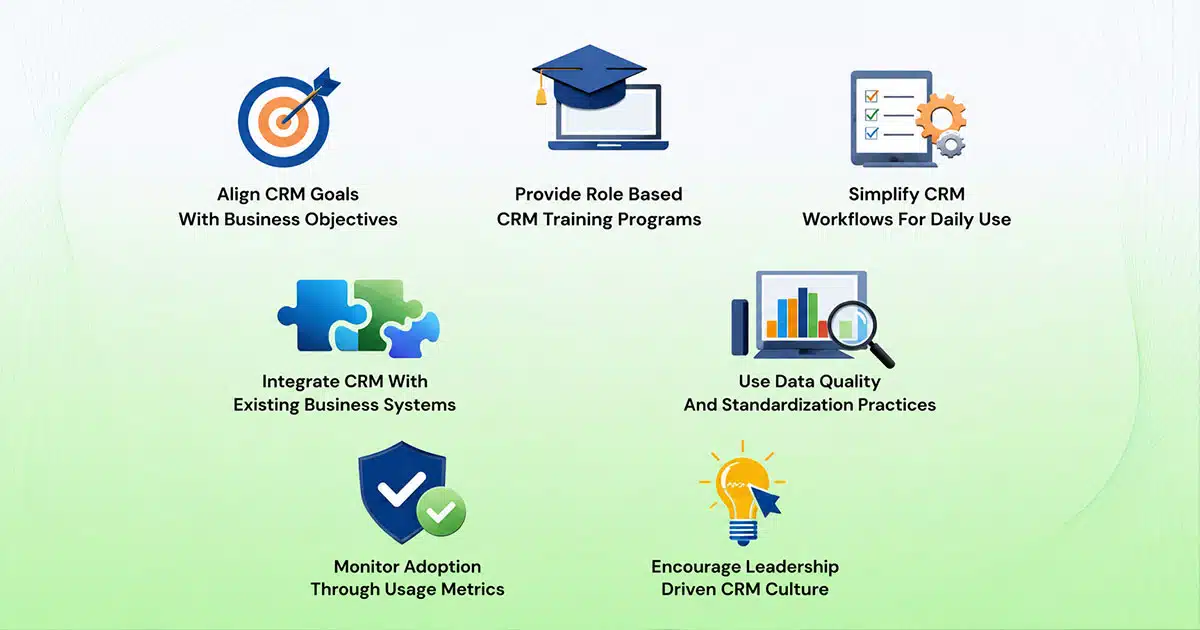
Strong crm adoption rates do not happen by accident. They result from deliberate strategies that align the system with how your teams work. Here are seven approaches that help businesses achieve crm adoption success and ultimately leading to measurable improvements in revenue growth and customer satisfaction.
Align CRM Goals With Business Objectives
Start by connecting your CRM strategy to specific business results. If your organization wants to reduce sales cycles by 20 percent, translate that into crm adoption metrics like opportunity update frequency and next-step documentation. When users understand how their actions in the system connect to company priorities like customer retention or higher conversion rates, they engage more consistently. Create a simple scorecard that tracks login rates, records updated, and notes per deal. Review it monthly with your team so everyone sees how their efforts contribute to shared business goals.
Provide Role Based CRM Training Programs
Different teams use the CRM differently, so training should reflect that reality. Sales reps need deep knowledge of pipeline stages and deal tracking. Marketing teams focus on campaign attribution and lead scoring. Account managers concentrate on customer interactions and renewal workflows. Build separate training paths for each role with scenario-based exercises that mirror real tasks. Organizations that implement role-based training see user adoption rates improve by 25 percent within the first quarter. Include super-users as peer champions who answer questions and reinforce best practices throughout the adoption process.
Simplify CRM Workflows For Daily Use
The fastest way to boost crm adoption is removing friction from everyday tasks. Audit your crm design and eliminate fields that users rarely touch. Create role based dashboards that show only relevant information. When updating a deal or logging a meeting takes under 30 seconds, adoption climbs. Focus on the 80 percent of tasks users perform daily and optimize those first. A user friendly interface that reduces keystrokes and automates data entry transforms your crm platform from a burden into a productivity tool your team prefers using.
Integrate CRM With Existing Business Systems
People abandon CRM tools when using them feels like extra work on top of email, calendar, and chat messages. Seamless integrations eliminate duplicate data entry and keep information flowing automatically. Connect your crm system with email platforms, calendars, and collaboration tools so customer interactions sync without manual effort. Start with high-impact connections first before expanding. Companies with strong integrations report 25 percent productivity gains because teams spend less time copying information between systems and more time closing deals.
Use Data Quality And Standardization Practices
Clean data builds trust. Establish written standards covering naming conventions, required fields, and rules for creating versus updating records. Schedule monthly duplicate cleanup and quarterly audits of key fields like industry and deal stage. Use validation rules to flag incomplete records before they enter the system. When crm data stays accurate, reporting improves, forecasting becomes reliable, and users develop confidence in the information they access. This foundation supports data analytics efforts and ensures your crm technology delivers dependable insights.
Monitor Adoption Through Usage Metrics
You cannot improve what you do not measure. Track a focused set of crm adoption metrics including daily active users, records updated per person, time between meetings and system updates, and notes added per opportunity. Combine hard numbers with user feedback gathered through quarterly surveys. Ask what feels slow, what confuses, and what tasks still happen outside the system. Use these insights to identify areas for improvement and continuously refining your approach. This creates a 90-day adoption cycle of measuring, listening, and optimizing.
Encourage Leadership Driven CRM Culture
Executives must champion CRM usage for adoption to stick. When leaders log their own notes, run pipeline reviews using only crm data, and celebrate wins tracked in the system, they signal that the platform matters. Form steering committees that oversee adoption timelines and tie key performance indicators to manager scorecards. Recognition programs for top users reinforce positive behavior. Organizations with strong executive sponsorship see engagement rise by 35 percent because employees view CRM usage as standard practice rather than an optional task imposed from above.
How CRM Adoption Directly Impacts Revenue Growth
High crm user adoption does more than justify software costs. It transforms how sales teams work and delivers measurable improvements to your bottom line. Here is how successful crm adoption translates directly into better business outcomes across your organization.
Higher Sales Pipeline Visibility
When every team member updates opportunities consistently, leadership gains a complete view of the pipeline. No more guessing which deals are real and which are stale. This visibility allows for accurate forecasting and smarter resource allocation. Companies with strong adoption report up to 34 percent sales growth because managers can spot gaps early and redirect efforts where they matter most.
Faster Deal Cycle Completion
Accurate crm data speeds up deal progression. Reps spend less time searching for customer history and more time moving opportunities forward. Research shows that unified customer views reduce sales cycles by 20 to 30 percent. When next steps, decision makers, and past conversations live in one place, handoffs between team members happen smoothly without lost context.
Improved Customer Retention Rates
Adoption connects directly to customer satisfaction and retention. When teams log every interaction, they build complete profiles that help them anticipate needs and resolve issues faster. This visibility strengthens customer relationships and prevents problems from slipping through cracks. Better retention means more stable revenue and lower acquisition costs over time.
Better Cross Team Collaboration Efficiency
Sales and marketing teams work better together when they share the same system of record. Marketing sees which leads convert into opportunities. Sales understands campaign performance. This alignment eliminates silos, reduces finger-pointing, and creates shared accountability for results. Organizations that break down these barriers through consistent CRM usage report significantly improved customer relationships across the entire customer journey.
Stronger Data Driven Decision Making
High adoption generates the clean customer data needed for meaningful data analytics. Leaders can trust their dashboards because the underlying information reflects reality. This confidence enables faster decisions about territory planning, product positioning, and resource investment. Every strategic choice improves when your crm platform delivers reliable intelligence instead of incomplete snapshots.
Common CRM Adoption Mistakes That Reduce ROI
Even well-intentioned organizations make errors that undermine their CRM investment. Recognizing these patterns helps you avoid costly setbacks and build toward crm adoption success. Here are a few ways teams commonly stumble during the adoption process.
Lack Of Clear Adoption Strategy
Implementing CRM technology without a documented adoption plan leads to confusion and inconsistency. Teams make assumptions about how the system should be used, creating fragmented processes. Without a crm strategy that defines roles, timelines, and success criteria, adoption drifts. Companies that skip strategic planning face ROI shortfalls averaging 1.5 times their license fees in sunk costs and wasted effort.
Overcomplicated CRM Workflows
Adding every possible field and automation during the new system launch overwhelms users. Complex workflows slow adoption by 20 to 40 percent because people cannot complete basic tasks quickly. Resist the urge to customize heavily before understanding how teams will use the system daily. Start simple, observe usage patterns, and add complexity only when user feedback confirms real needs. Keep the focus on essential features that support core sales activities.
Insufficient Employee Training Programs
Training budgets often get cut after initial implementation, leaving users without the skills to maximize the system. Without ongoing education, crm users develop bad habits, forget features, and create workarounds that bypass the platform entirely. Organizations that continue training investments see four times returns through improved productivity. Build quarterly refreshers and always-available resources that keep skills sharp as your existing crm system evolves.
Poor Data Quality Management
Neglecting data hygiene creates a downward spiral. Duplicate records, missing fields, and outdated information erode trust. Users stop relying on the crm data and return to spreadsheets. Without data quality controls like validation rules and regular audits, reporting becomes unreliable and forecasts lose accuracy. Establish governance practices from day one and assign clear ownership for maintaining clean records.
Limited Leadership Involvement
When executives disengage after launch, teams interpret CRM as a low priority. Managers who review pipelines in spreadsheets or skip logging their own activities send signals that the system is optional. This disconnect causes adoption to plateau or decline. Research indicates 15 to 20 percent annual drop-off in engagement when leadership support fades. Keep executives visible and accountable for modeling the behavior they expect from their teams.
Metrics To Measure CRM Adoption Success
Continuously evaluating your adoption efforts requires tracking the right performance metrics. These crm adoption metrics connect user behavior to business outcomes, helping you identify where improvements will have the greatest impact.
Daily Active CRM User Rate
Track the percentage of licensed users logging in and completing meaningful actions each day. Industry benchmarks suggest targeting above 80 percent weekly active users for strong adoption. This metric reveals whether your system has become central to daily workflows or remains a peripheral tool people avoid. Compare rates across departments to spot teams that need additional support or training.
Data Entry Accuracy Levels
Measure the completeness and correctness of critical fields like contact details, deal values, and next steps. Aim for 95 percent accuracy on required fields. Low accuracy signals that manual workflows still dominate or that your crm design creates too much friction. Use validation rules and automated checks to maintain standards without burdening users with extra work.
Sales Activity Tracking Consistency
Monitor how quickly and consistently sales teams log meetings, calls, and emails in the crm platform. The gap between activities occurring and being recorded indicates engagement levels. When reps update within 24 hours, data stays reliable for forecasting. Longer delays suggest the system does not fit naturally into daily routines and may require workflow simplification.
Customer Interaction Logging Frequency
Track how often teams record customer interactions across channels. This metric reveals whether your crm system serves as the true record of customer relationships or if important conversations happen in scattered tools. High logging frequency supports better handoffs, faster issue resolution, and improved customer satisfaction scores over time.
Revenue Growth Linked To CRM Usage
Connect adoption metrics to key performance indicators like deal win rates, average deal size, and sales cycle length. Organizations with high adoption rates see measurable gains including 29 percent higher win rates and 20 to 30 percent shorter sales cycles. Demonstrating this link between behavior and business results reinforces why crm adoption matters and motivates continued engagement across your organization.
How Gain.io Helps Improve CRM Adoption And ROI
Gain.io streamlines crm adoption by unifying revenue operations data into one connected workspace built specifically for sales teams. The platform automates data syncing across tools, eliminating the duplicate entry that drives users away from their crm system. Real-time dashboards give leadership complete pipeline visibility while supporting accurate forecasting tied to key performance indicators.
Mobile access keeps field teams engaged, boosting crm user adoption by making updates fast and intuitive. Companies using Gain.io report 30 to 50 percent faster adoption through simplified interfaces and built-in resources that reduce the learning curve. By connecting your sales pipeline, contacts, and activities in one place, Gain.io helps your team build lasting crm habits that translate directly into revenue growth and improved customer relationships.
FAQs
Why Do CRM Adoption Rates Fail In Many Businesses
Low adoption rates typically stem from poor change management, unclear goals, and insufficient training. Research shows 47 percent of projects fail due to lack of buy-in from users who do not understand how the system benefits their daily work. Without executive sponsorship and ongoing support, teams default to familiar tools like spreadsheets and email threads.
How Long Does CRM Adoption Typically Take
Most organizations see early wins within 60 to 90 days when they focus on adoption from the start. Full benefits including measurable improvements in revenue, retention, and forecast accuracy appear over six to twelve months as more processes move into the crm platform and user habits solidify across teams.
Which Teams Benefit Most From CRM Adoption
Sales teams see immediate gains through pipeline visibility and faster deal tracking. Marketing teams benefit from campaign attribution and lead scoring accuracy. Customer success and account management teams improve retention through complete interaction histories. Strong adoption aligns these groups around shared customer data.
What Metrics Show CRM ROI Improvement
Track daily active user rates, data entry accuracy, activity logging frequency, and revenue metrics like win rate and sales cycle length. Organizations with adoption above 75 percent report 29 percent higher win rates and up to 8.71 dollars returned per dollar invested in their crm technology.
How Can Leadership Support CRM Adoption
Executives should champion the system visibly by logging their own activities, running reviews using only crm data, and tying adoption metrics to manager performance reviews. Recognition programs and steering committees keep adoption on the agenda. Research indicates executive modeling increases voluntary usage by 50 percent across organizations.