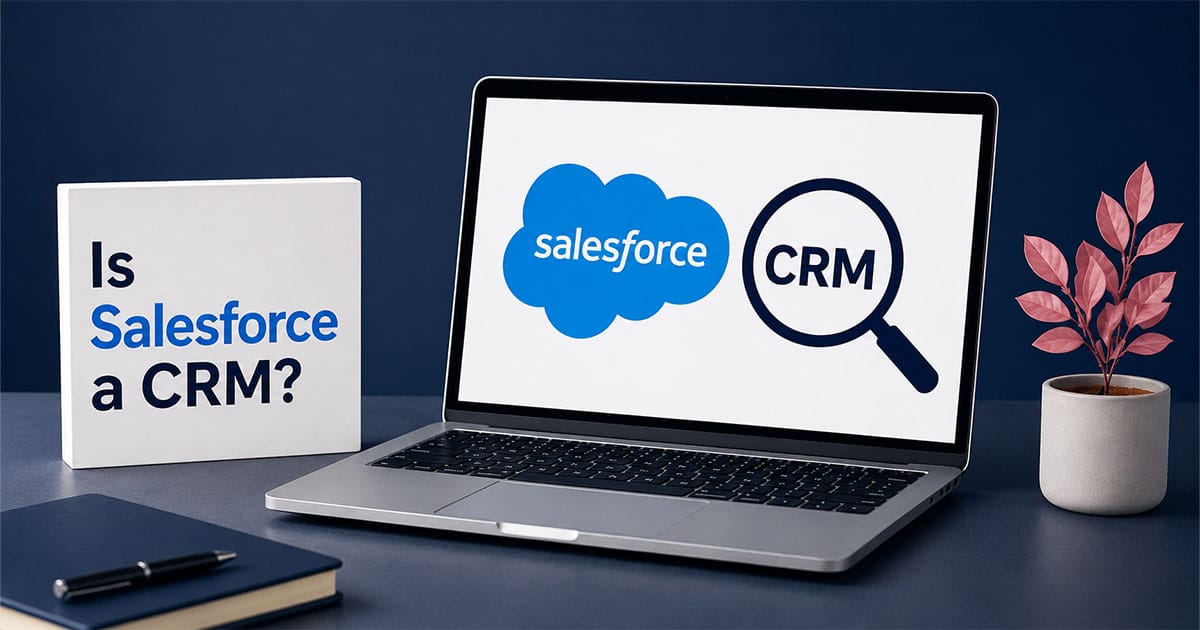
TL;DR: Yes, Salesforce is a CRM at its core — but it has grown into a full business platform spanning sales, service, marketing, and AI (Einstein/Agentforce). This guide covers what Salesforce actually is, its core CRM capabilities, its clouds, and when it's the right choice versus overkill.
Is Salesforce a CRM? The short answer is yes. Salesforce CRM was originally launched as a simple tool for managing customer data, and that core purpose has never changed. What has changed is how much more it can do.
Salesforce launched in 1999 as a pioneering cloud based crm, built in San Francisco with a mission to make customer relationship management accessible through any web browser. Fast forward to 2026, and it remains primarily known as a crm platform. But the story does not stop there. Salesforce has grown into a complete customer platform spanning sales service marketing and analytics, all built on top of that same crm foundation.
Customer relationship management functionality serves as a system of record for customer data and a system of engagement for interaction. Salesforce delivers both. It centralizes every customer touchpoint including email, phone, chat, social, and commerce into a single shared view. Teams across departments work from the same trusted data instead of scattered spreadsheets and disconnected tools.
The platform now includes powerful AI features like Einstein GPT, Einstein Copilot, and autonomous service agents that sit directly on top of crm data. These tools help sales teams prioritize leads, draft emails, and predict deal outcomes without manual guesswork.
So is Salesforce a crm? Absolutely. But it is also much more. The rest of this article will help you understand exactly what Salesforce offers and whether you need it as a core crm or as a broader business platform.
What Salesforce Is In Simple Terms
Salesforce is a cloud based crm that has grown into a full customer platform. It combines crm software with marketing automation, analytics, and app development capabilities on a single integrated platform.
Cloud-based platforms provide real-time access from anywhere. In practical terms, this means you access Salesforce through a web browser or mobile app without needing to install software or maintain servers. Updates roll out automatically, typically quarterly, so you always have the latest features. Mobile CRM allows teams to access and update customer data from any location, whether they are in the office, at a client site, or working remotely.
The salesforce platform supports three delivery models: SaaS (Software as a Service), PaaS (Platform as a Service), and IaaS (Infrastructure as a Service), allowing businesses to choose the best fit for their needs. Most teams start with the SaaS model through products like Sales Cloud or Service Cloud, then expand into building custom apps or integrating other services as requirements grow.
What A CRM Is And How Salesforce Fits The Definition
Customer relationship management means exactly what it sounds like. It is software that helps businesses manage their relationships with customers by organizing every interaction into a single, accessible record. Day to day, this means your team knows who talked to a customer last, what was discussed, what deals are in progress, and what support issues are open.
The purpose of customer relationship management systems is to streamline processes, improve profitability, and enhance customer satisfaction. When everyone works from the same customer information, nothing falls through the cracks.
Standard CRM jobs include:
- Contact management that centralizes all customer details including emails, calls, and social media handles in a shared digital record
- Lead and opportunity management that tracks potential sales from lead to closure
- Activity history logging every email, call, meeting, and task tied to each account
- Pipeline forecasting that predicts revenue based on current deal stages
Salesforce maps directly to each of these functions. Sales Cloud handles lead management and opportunity tracking with customizable stages and probability scoring. Service Cloud extends the same crm data to customer support teams, keeping all cases and resolutions linked to the customer record. Centralized customer data serves as a single source of truth, eliminating the silos that slow teams down.
Salesforce is not just a contact database. It tracks full communication history across email, phone, web forms, integrated tools like Outlook and Gmail, and even social channels. Every activity appears on a timeline so anyone on the team can see exactly what happened and when.
Because Salesforce checks every crm box and then adds marketing automation, process automation, AI-powered insights, and a platform for building custom apps, some people have started calling it a customer operating system. That label makes sense when you see how crm data powers everything else on the platform.
Core Salesforce CRM Capabilities You Should Know
Salesforce CRM delivers structured capabilities that help businesses manage customer relationships, optimize sales processes, and improve service outcomes through data-driven workflows, automation, and unified customer information across teams.
Lead And Opportunity Management
Within Salesforce Sales Cloud, lead and opportunity management structures your sales pipeline with clear stage definitions aligned to your sales processes. Automated routing assigns potential customers to the right reps based on rules, improving conversion speed. Teams gain visibility into deal progress, ensuring consistent pipeline control and predictable revenue outcomes.
Account And Contact Management
Account and contact management centralizes customer data into a unified system. Each record reflects a company’s interactions, including customer activity, purchase history, and communication logs. This approach strengthens customer relationships by giving teams a full context before every interaction, helping build long lasting relationships through informed engagement and accurate customer information.
Salesforce Automation And Process Efficiency
Automation within the Salesforce Platform reduces manual work across business processes. Workflow rules, reminders, and alerts streamline execution without heavy data entry. Teams benefit from consistent operations and better tracking of key performance metrics. This structured automation supports scalable growth while ensuring every process aligns with defined crm systems standards.
Customer Support And Service Cloud
Salesforce Service Cloud enables efficient case management for customer support teams. It routes issues based on priority and agent skills while maintaining visibility across departments. This ensures alignment between sales and service, improving resolution speed and maintaining strong customer relationships through consistent, high-quality support experiences.
AI CRM And Advanced Capabilities
Modern AI CRM capabilities enhance decision-making with predictive insights and automation. Features like intelligent recommendations and analytics improve personalized customer experiences. Integration with platforms such as Microsoft Dynamics 365 highlights competitive crm solutions. Emerging concepts like the agentic enterprise further evolve how businesses use crm features to drive smarter, autonomous operations.
How Salesforce Has Grown Beyond Traditional CRM
While Salesforce began as crm software, it has expanded into a broad platform over the last two decades. The crm foundation remains, but the capabilities built on top of it now serve marketing teams, developers, commerce operations, and more.
In 2005, Salesforce launched the AppExchange, marking a significant step in its evolution as a comprehensive business solution. The Salesforce AppExchange is an online marketplace that allows users to find and install third-party applications and integrations that extend the functionality of Salesforce. Today it hosts over 7,000 pre-built apps covering everything from billing and CPQ to membership management and industry-specific solutions. This means teams can add capabilities without building from scratch.
Salesforce integrates seamlessly with a wide range of software applications, including marketing automation, accounting, and custom-built applications, creating a robust ecosystem for businesses. Major acquisitions expanded the platform further. Tableau joined in 2019 for advanced analytics visualization. Slack came aboard in 2021 for real-time collaboration directly tied to crm workflows. Heroku, acquired in 2010, provides scalable app hosting for custom development.
Salesforce’s ecosystem includes various tools that support app development. The Salesforce Platform, formerly known as Force.com, allows developers to build custom applications on top of Salesforce using tools like Apex for custom logic, Lightning Web Components for modern interfaces, and Flow Builder for workflow automation. Building custom apps does not always require developers either. Many teams use low-code tools to create exactly what their business processes need.
Workflow automation sets up automatic triggers to streamline complex business processes. For example, when a deal closes, automation can create a welcome task for customer success, notify billing to generate an invoice, and add the customer to a nurture journey in Marketing Cloud.
Marketing Cloud and Commerce Cloud layer on top of the same crm data. Marketing campaigns trigger based on lifecycle stage or purchase date stored in the crm. Commerce Cloud syncs storefront behavior back into customer records so sales reps see browsing history alongside support notes. This keeps crm as the core while extending capabilities across the entire customer journey.
Salesforce Clouds And What They Do
Salesforce breaks its capabilities into Clouds, each focused on a different part of the customer lifecycle. Think of them as specialized modules that all share the same crm data underneath.
Sales Cloud
Sales Cloud is the core crm product most companies start with. It handles everything related to managing leads, opportunities, forecasts, territories, and quotes.
Reps work through opportunity stages that mirror their real sales processes. Each opportunity shows probability, expected close date, and next steps. Territory management ensures fair distribution of accounts and prevents overlap.
Real-time analytics provide customizable dashboards and reports for forecasting and performance measurement. Sales leaders see pipeline health instantly without waiting for spreadsheet updates. As of 2026, Sales Cloud includes AI forecasting and Einstein opportunity insights layered directly on crm records. These tools predict which deals will close and flag risks before they become problems.
Service Cloud
Service Cloud is Salesforce’s customer support crm. It handles cases coming from email, phone, chat, and social channels through case management workflows designed for customer support teams.
Features include intelligent case routing based on agent skills, knowledge base integration for quick answers, and field service scheduling for teams that work on-site. Service agents resolve issues faster when they can see the full customer history in one place.
Salesforce has continuously integrated artificial intelligence into its platform, starting with the launch of Salesforce Einstein in 2016, which marked the company’s entry into AI-driven customer relationship management. Newer AI-powered agents like Einstein Service Agent, announced in 2024, can resolve common issues directly from crm data. Internal studies show these service agents handle 30% of routine queries autonomously, freeing human agents for complex problems.
Experience Cloud
Experience Cloud lets you build customer and partner portals connected directly to Salesforce crm records. Customers log in to see their own cases, order history, and account details without calling support.
Imagine reducing email volume because customers update their own requests through a self-service portal. Partners access quotes, deal registration, and training resources from a branded site that pulls data straight from your crm. This extends crm visibility beyond your internal teams while keeping everything linked to the same trusted data.
Marketing Cloud
Marketing Cloud is Salesforce’s suite for email, mobile, social, and journey orchestration. Everything runs on crm data, so marketing campaigns personalize based on fields like lifecycle stage, last purchase date, or open service issues.
Marketing automation allows teams to plan and execute targeted campaigns while scoring leads to identify high-potential prospects. Personalized campaigns reach more customers with relevant messages instead of generic blasts.
Einstein GPT now helps with content suggestions and send-time optimization, achieving higher engagement rates by sending messages when each customer is most likely to respond.
Commerce And Other Add Ons
Commerce Cloud and related solutions connect storefront behavior back into the crm record. This means sales reps see browsing activity, abandoned carts, and purchase data alongside support conversations.
Order management capabilities handle the logistics after a sale, keeping fulfillment status visible within the customer record. These add-ons show the breadth of salesforce products but all rely on the same underlying crm data.
AI In Salesforce And What It Means For CRM
Recent Salesforce innovation has focused heavily on AI built directly on top of crm data. This is not separate technology bolted on as an afterthought. It reads your customer information and delivers actionable insights.
The evolution started with Salesforce Einstein in 2016, bringing predictive analytics to crm records. Einstein GPT arrived in 2023, adding generative AI that drafts emails and summarizes calls. Einstein Copilot launched in 2024 as an AI sidekick that prioritizes leads, suggests next-best actions, and handles routine tasks automatically.
Salesforce CRM incorporates AI through its Einstein feature, which offers predictive analytics and smart recommendations to enhance user experience and optimize customer interactions. Specific developments in 2024 through 2026 include Einstein Copilot for Health Actions with HIPAA-compliant capabilities and ai agents handling common support tasks without human intervention.
In practical terms, AI uses crm data to draft personalized emails, summarize customer calls, prioritize which leads deserve attention, and recommend what reps should do next. Internal studies show reps save two to three hours daily on administrative tasks. Lead prioritization powered by Einstein helps teams identify deals that might otherwise slip through the cracks.
The platform’s built-in analytics capabilities provide real-time data on customer behavior and trends, allowing for data driven decisions instead of gut instincts.
Salesforce CRM helps organizations improve customer service by providing representatives with easy access to complete customer histories, which helps resolve issues more quickly. AI amplifies this by surfacing relevant knowledge articles and suggesting responses based on similar past cases.
You do not need to adopt everything at once. AI features can be enabled gradually and configured with guardrails around sensitive crm data. Start with lead scoring, see the results, then expand to more capabilities as your team gets comfortable.
When Salesforce Is The Right CRM Choice For You
Salesforce is not the only crm option, and fit depends on your size, complexity, and goals. But certain scenarios make it a particularly strong choice.
Salesforce excels when you have multi-team sales processes where sales, service, and marketing need to share customer information. It handles multi-country operations with support for multiple languages and currencies across 200+ countries. Heavy integration needs become manageable through MuleSoft and the thousands of connectors available on AppExchange. Large enterprises benefit from the scalability and enterprise-grade capabilities.
Mobile and cloud access allows teams to access real-time customer data and collaborate from any device or location. This matters for field teams, remote workers, and distributed organizations.
Simpler crm options might suit very small teams without complex workflows. If you only need basic contact management and do not plan to grow beyond a handful of users, lightweight crm solutions could work fine. But they lack the automation depth, reporting, and extensibility that Salesforce provides as your needs expand.
Salesforce CRM consolidates customer data from every channel and department into a shared database, enabling teams to make decisions from the same source of truth. This simplified collaboration matters as teams grow and customer relationships become more complex.
The platform can start small. A five-user sales team on a basic edition gets core lead and opportunity management. That same implementation scales to global deployments with thousands of users and dozens of integrated systems. You do not have to rebuild when you outgrow your crm.
Conclusion
Salesforce is a crm. That statement was true when the software company launched in 1999, and it remains true in 2026. But it has grown into something larger: a complete customer platform spanning sales service marketing commerce and analytics.
The question is not just whether Salesforce is a crm. It is whether you need a crm that can grow into something more. If your answer is yes, or even maybe, exploring Salesforce makes sense. Free trials and demos configured around your own customer journey let you see exactly how salesforce crm fits your business operations.
Whether you start with just Sales Cloud or plan to expand across multiple Clouds, Salesforce connects every piece of your customer experience. Other services layer on over time as your requirements evolve. That flexibility, built on a crm foundation, is what makes Salesforce the choice for organizations serious about customer success.
Frequently Asked Questions
Is Salesforce Only A CRM Or Also An ERP
Salesforce is primarily a crm and customer platform, not a full ERP system. It focuses on front-office functions like sales, service, and marketing rather than back-office operations like accounting, manufacturing, and supply chain management. Many companies integrate Salesforce crm with separate ERP systems so customer data and financial or inventory data can sync. MuleSoft handles these integrations, keeping both systems connected without duplicating functionality.
Can Small Businesses Use Salesforce As Their First CRM
Yes. Salesforce has editions and bundles designed specifically for small business teams with limited users and streamlined features. You do not need enterprise scale to benefit from organized customer data.
Do I Need Developers To Customize Salesforce CRM
Many customizations can be done with point-and-click tools by an admin. Fields, page layouts, validation rules, and simple automation workflows all work through the Setup menu without code. Data entry requirements, approval processes, and user interface adjustments typically need no developers.
How Secure Is Salesforce For Storing Customer Data
Salesforce prioritizes data protection by implementing robust security measures, including role-based access controls, field-level permissions, and audit logs, which are essential for regulated industries like healthcare and finance.
How Is Salesforce Different From Simpler Contact Management Tools
Basic tools store names, phone numbers, and email addresses. Salesforce tracks full customer history including deals, service issues, marketing campaigns, and AI insights in one place. Simple address books or email contact lists do not offer automation, reporting, or multi-team collaboration. Salesforce helps businesses manage the entire customer lifecycle, not just store contact details.