Sales teams often rely on relationship building to close deals. The challenger sales model follows a different path. It focuses on teaching customers something new about their business problems. Research shows high performers are more than twice as likely to use this approach compared with other sales methods.
Challenger reps lead the conversation with insights and clear perspectives. They guide buyers to see problems differently and think about better solutions. Sales conversations then become more valuable for the customer.
Customer experience during the sales process influences loyalty. In fact, sales interactions drive about 53% of customer loyalty. Clear insights and confident guidance can make a big difference. This article explains the challenger sales model, how it works, and how sales teams can apply it in complex B2B deals.
What Is The Challenger Sales Model
The challenger sales model is a modern sales methodology designed for complex sales environments. Researchers Matthew Dixon and Brent Adamson from the Corporate Executive Board introduced the challenger sales approach after studying different sales methodologies and sales behaviors. Their research showed that many star performers succeed by challenging customer assumptions rather than only building relationships like a relationship builder. The challenger sales methodology focuses on helping sales reps teach customers new perspectives about their customer’s business, market trends, and industry changes.
The challenger sales method changes how a sales team manages the sales process and customer conversation. A challenger sales rep leads the sales call with commercial insight and helps prospects rethink the status quo inside the prospect’s business. Through challenger selling, the challenger seller uses commercial teaching and consultative selling to highlight pain points and uncover prospect's challenges. The challenger rep tailors the sales pitch to different stakeholders, including the economic buyer.
Many sales leaders adopt the challenger model as a practical sales strategy for complex sales and crowded markets. Proper challenger sales training, strong sales techniques, and effective sales enablement help sales representatives apply the challenger sales process across the entire team. Strong customer interaction and meaningful conversations improve the sales experience, customer loyalty, and customer retention during long sales cycles, especially when backed by tools that help you manage contacts better and build stronger relationships.
Three Main Capabilities Of Challenger Sales
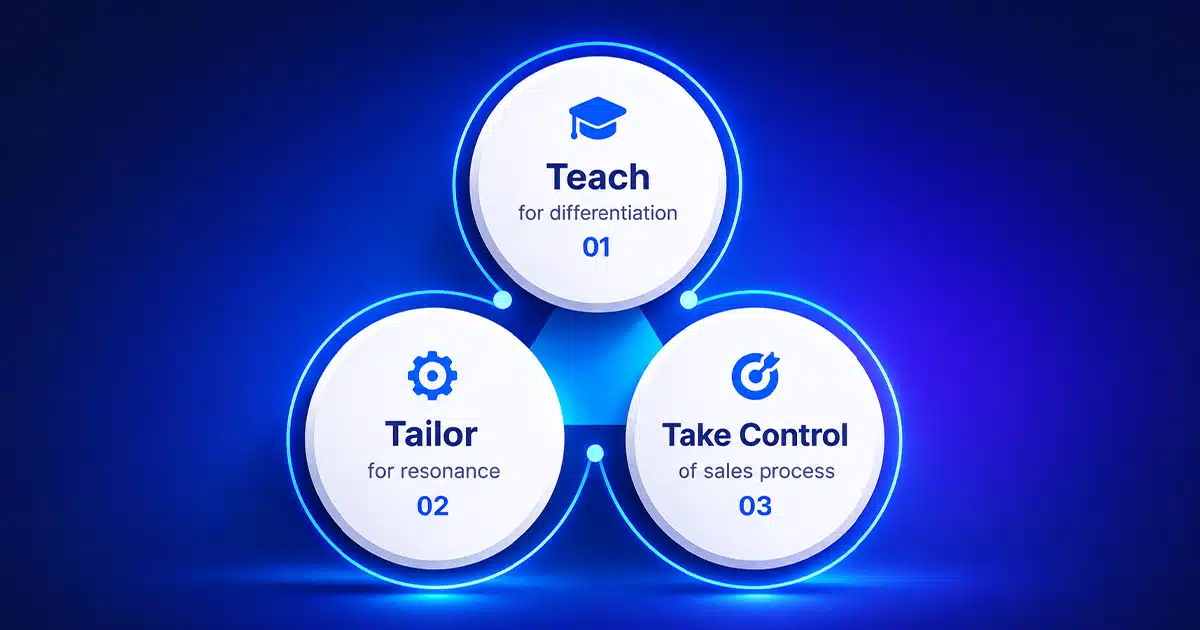
The three core capabilities of the challenger sales model work together like a tightly choreographed dance. You can't master one without the others. Research shows that 53% of customer loyalty stems from the sales experience itself, not the product or price. These capabilities change how sales reps interact with prospects from the first call to close.
Teach Buyers With Commercial Insights
Commercial teaching means you bring insights that reshape how prospects view their business. This isn't about sharing generic industry trends or proving right what customers know. Your job is to tell customers what should be keeping them up at night, not ask them what does.
A commercial insight must follow four rules to drive results. First, it links to your company's unique strengths. You teach prospects about a problem, then position your solution as the answer they need. Second, it challenges customer assumptions and reframes their thinking. Prospects say "I never thought of it that way before" instead of "I totally agree" when done right.
Tailor Your Message To Each Stakeholder
Consensus buying has changed B2B sales. Decision-makers want widespread internal support before meeting with you. They see pitches without consensus as wasting their time. Building stakeholder support matters more than connecting with senior executives.
Tailoring means adapting your core commercial insight to strike a chord with each stakeholder's specific role and interests. The economic buyer focuses on ROI and budget impact. The technical buyer worries about implementation complexity. The user buyer cares about daily workflow improvements. Your champion needs talking points to promote you internally.
Take Control Of The Sales Conversation
Taking control means guiding the conversation rather than responding to customer requests. This demonstrates confidence and helps prospects direct complex buying decisions. 80% of business is lost to no decision at all in the current environment.
Challenger reps stay comfortable with tension and won't acquiesce to every customer demand. They structure meetings with agendas that advance the sale. They ask tough questions that probe into areas customers prefer to avoid, like budget constraints or competing priorities. Questions like "What happens if you don't solve this problem in the next six months?" force prospects to confront the cost of inaction and often lead to shorter cycles, similar to teams that close deals faster with Gain.io.
Five Key Steps To Execute The Challenger Sales Approach
Knowing the three core capabilities is one thing. Executing them in real sales conversations is another. The challenger sales approach follows a specific choreography that guides prospects from original skepticism to confident decision-making.
Step 1: Build Credibility With The Warm-Up
Most sales methodologies start with rapport-building questions. The challenger sales method flips this on its head. You lead with your understanding, not with questions.
The warm-up shows prospects you've done your homework. You demonstrate deep knowledge of their business, industry challenges and market pressures. This isn't about asking "What keeps you up at night?" You tell them what should be keeping them up at night instead.
A challenger sales rep might open with market data showing that companies in the prospect's industry face 30% higher storage costs due to outdated data management practices. You then ask how much storage they maintain and what it costs them both directly and indirectly. This builds credibility fast. Buyers sense right away they aren't wasting their time.
Step 2: Reframe The Customer's Problem
Once you've established credibility, you connect the problems from your warm-up to a bigger issue the customer hasn't thought over. The challenger sales model creates its most powerful effect here.
The reframe challenges how prospects attack their problem at present. You show why their planned solution won't work without mentioning your product yet. Arco Ltd., a UK workplace safety distributor, used this step well. They reframed the conversation around safety compliance instead of competing on price against low-cost alternatives. Those cheaper products weren't always safe and cost customers millions in liabilities.
You introduce surprising insights that reshape the customer's thinking at this point. You want prospects saying "I never thought of it that way" rather than "I totally agree."
Step 3: Create Emotional Effect With Stories
Facts alone don't drive decisions. Emotion sells because it sticks in ways data never will. Challenger sales reps use storytelling to humanize the bigger problem and connect it to pain points customers face every day, while leaders track the impact through sales performance metrics for SaaS teams.
Share case studies of companies like your prospect who suffered because they didn't address the reframed problem. The emotional effect centered on severe workplace injuries for Arco, the effect on employees' families and damage to company reputation. These stories feel familiar to prospects. They see themselves in the narrative.
This step takes customers to a rather dark place before showing them the light. You're creating urgency by illustrating consequences of inaction. Prospects crave a solution as a matter of necessity when done right.
Step 4: Present Your Value Proposition
Resist the temptation to launch into your product pitch. Besides establishing urgency, you need to sell the solution itself before debuting your specific offering, just like you would first design a simpler sales workflow to get more from your CRM before talking tools.
Describe how much better the customer's life would be if they acted differently. Share an overview of the capabilities they'd need to solve the reframed problem. You're still not mentioning your product. You're helping prospects visualize a better future and understand what type of solution makes sense.
Step 5: Position Your Solution As The Answer
The final step feels seamless if you've executed the previous four steps right. You reveal your solution as the only way for customers to solve the dilemma you've laid out.
Explain how your product delivers the capabilities you described in step four better than anyone else. This is where you tailor messaging to appeal to different decision-makers. The economic buyer needs ROI proof informed by solid sales deal tracking for modern teams. The technical buyer wants implementation details and confidence that you support efficient sales task automation to boost productivity and revenue. Your champion needs talking points for internal advocacy.
The prospect should be convinced they need a solution that works exactly like yours. All that's left is showing them you provide it.
How To Train Your Sales Team On The Challenger Model
Training your sales team on the challenger sales model takes more than a single workshop. You need intentional practice, ongoing coaching, and content that scales across your entire team. Sales professionals who role-play as part of their training improve sales performance by up to 30%. Teams that practice discovery role-play report a 20% increase in self-perceived confidence, especially when managers reinforce learning with structured sales deal tracking for modern sales teams.
Develop Commercial Teaching Content
Your sales reps need commercial insights they can teach to prospects. These insights must link to your company's unique strengths and challenge customer assumptions. Marketing teams should work together with sales leaders to develop teaching messages that work across different industries and buyer personas, supported by consistent CRM adoption that’s changing modern sales teams.
Audit your current messaging for generic industry trends or fear-based language. Commercial teaching requires showing customers what they're missing or wasting by not acting on your insight. Segment customers based on common needs rather than geography or industry. You can apply the same powerful teaching message to different organizations facing similar challenges.
Practice Discovery And Reframing Skills
Discovery questioning separates average performers from star performers. Yet seasoned sales pros struggle to develop good open questions. They move past chances to dig deeper and make shallow recommendations instead.
Your sales team needs regular practice with discovery frameworks. Train reps to ask open-ended questions starting with "what," "how," or "why". Follow-up questions like "Can you tell me more about that?" uncover richer insights. Avoid leading questions that suggest desired answers, and make sure every conversation is captured in a system that shows how CRM helps sales teams manage leads.
Coach Reps To Take Control Confidently
Taking control feels risky for sales reps accustomed to relationship building. Sales requires calling on new decision makers, trying new selling skills, and talking to strangers. Confidence comes from ownership, work ethic, and focusing on your own performance rather than comparing yourself to others.
Sales managers should provide weekly call coaching focused on making reps better, not just closing deals. Reps should leave coaching sessions feeling like superheroes, not failures. Let reps choose what they want to work on during coaching conversations, while managers rely on data to understand why sales visibility matters more than ever.
Use Role-Playing To Build Confidence
Role-playing creates a safe environment where sales reps test tactics and make mistakes without losing deals. Short, regular role-play sessions work better than infrequent intensive workshops. Weekly or biweekly practice improves win rates, confidence, and time-to-ramp for new reps.
Structure each role-play session with clear stages: set the buyer context, practice opening techniques, explore challenges through probing questions, handle objections, and close with next steps. Focus on one or two specific skills per session rather than covering everything at once, then reinforce them in live deals using sales task automation tools to stay focused and organized.
Challenger Sales Method Compared To Other Methodologies
Sales methodologies aren't one-size-fits-all. Each approach rewards different seller strengths and buyer behaviors. Sales leaders need to know where the challenger sales model fits so they can choose the right strategy for their specific sales environment, whether they run SaaS, services, or retail teams using CRM tools to stay organized.
Challenger Sales Vs Solution Selling
Solution selling follows the classic find-the-pain-fix-the-pain approach. Sales reps ask discovery questions to uncover problems and then map product features to those needs. This works when buyers understand their challenges.
The challenger sales methodology flips this sequence. Challenger sales reps lead with insights that reframe the issue before discussing solutions rather than waiting for customers to express problems. You're teaching customers about needs they didn't know they had.
Challenger Sales Vs SPIN Selling
SPIN selling revolutionized sales through systematic questioning. Sales professionals ask situation, problem, implication, and need-payoff questions to uncover customer needs. The customer reveals information to the salesperson through this sequence, and integrated tools like a CRM with email integration to streamline communication ensure those insights are captured and acted on.
The challenger sales method delivers insights to customers. SPIN extracts information through questions. Challenger teaches information through commercial insights. The information flow runs in opposite directions.
Both focus on customer needs. SPIN helps customers discover needs through guided questions. Challenger teaches customers about needs through unique viewpoints.
Challenger Sales Vs Consultative Selling
Consultative selling emphasizes empathy, discovery questions, and building trust. Sales reps position themselves as advisors who listen and respond to customer-identified problems.
The challenger approach teaches something new and challenges customer assumptions. Consultative sellers guide customers down a path to uncover problems themselves. Challenger sellers skip that trip and tell customers what their problem is.
The risk with consultative selling is becoming buyer-led. The challenger sales model injects constructive tension that pushes customers toward decisions. Consultative builds relationships. Challenger builds urgency.
When To Use The Challenger Approach
The challenger sales methodology excels in complex B2B sales with informed buyers and longer sales cycles. It works when customers suspect problems exist but don't fully grasp what they're missing.
Use challenger selling when differentiation comes through insights rather than product features. It shines when selling against the status quo or competing with "do nothing". This is especially powerful for founders using a CRM for startups and small sales teams who need every conversation to move deals forward. A clear sales pipeline that actually works helps you see where those insight-led conversations stall and where to apply more pressure.
Tools And Technology To Scale Challenger Sales
Sales reps spend only 28% of their week selling. Research and data entry consume the rest. Technology closes this gap and scales the challenger sales methodology for your whole team by showing how CRM improves sales productivity.
CRM Systems For Tracking Challenger Behaviors
Customer relationship management systems track challenger behaviors immediately. Conversation quality metrics measure call duration and engagement. They identify whether sales reps conduct substantive challenger conversations that teach rather than pitch features. Stakeholder engagement patterns show automated tracking of email opens and meeting attendance among decision-makers. Deal velocity indicators measure how challenger behaviors affect progression, especially when you use a dedicated sales pipeline CRM to improve visibility and performance. Coaching alerts trigger when engagement drops or deals slow.
AI For Generating Commercial Insights
AI analyzes data from implementations and identifies what separates successful customers from struggling ones. Natural language processing summarizes lengthy industry reports into talking points. AI monitors market data for emerging trends immediately. Sales teams can develop commercial insights without dedicated research resources, especially when they combine challenger selling with a modern sales automation CRM for growing teams.
Conversation Intelligence For Coaching
Conversation intelligence analyzes call recordings and gives coaching explanations. The technology creates automatic transcripts, flags keyword mentions, performs sentiment analysis and generates call summaries. Sales performance improved by a lot: 39% understood competition better, 39% gained visibility into rep activity and 40% understood customer needs more when managers paired these tools with disciplined sales activity metrics for a performance-focused engine.
Sales Enablement Platforms For Content
Sales enablement platforms centralize knowledge and adapt recommendations during long deal experiences. They provide playbooks with stage-specific guides that ensure consistency. AI recommends relevant content based on live buyer behavior, similar to how Gain.io’s smart CRM tools features for sales teams surface the right information at the right moment.
Challenger Sales Model Execution With Gain.io
Successful challenger selling requires a strong understanding of a prospect’s business. Gain.io helps sales reps gather account intelligence before every sales call. The platform surfaces market trends, company updates, and key pain points from a customer’s business environment. This information helps a challenger sales rep deliver commercial insight and challenge the status quo during a customer conversation. Sales professionals can prepare meaningful conversations that teach customers something new about their industry and business priorities.
Gain.io also supports the challenger sales process across the entire team. Sales managers and sales leaders use the platform to guide sales strategy and improve sales behaviors. Better data strengthens sales techniques and challenger skills during complex sales cycles. The platform helps sales representatives tailor insights for the economic buyer and other stakeholders. Strong preparation improves sales interactions, builds customer loyalty, and supports customer retention in competitive markets.
FAQs
Can The Challenger Sales Model Work For Small Sales Teams?
Yes. The challenger sales model works well for small sales teams in complex sales environments. A focused sales strategy helps sales reps teach customers with commercial insight. Even a small sales team can run strong challenger sales conversations when sales leaders support challenger sales training and clear sales techniques.
How Does Challenger Selling Improve Customer Retention After The Sale?
Yes. Challenger selling improves customer retention by creating deeper understanding of a customer’s business. Sales reps teach customers about market trends, risks, and opportunities during the sales process. Strong commercial teaching builds trust and strengthens long-term customer relationship management.
Do Sales Reps Need Special Training To Become A Challenger Seller?
Yes. Sales reps need structured challenger sales training to develop challenger skills and commercial teaching ability. Sales managers usually combine sales training, role-play practice, and coaching to help sales representatives take control of sales conversations and challenge the status quo with confidence.
How Does The Challenger Sales Method Help In Crowded Markets?
The challenger sales method helps sales professionals stand out in crowded markets. A challenger sales rep leads the customer conversation with commercial insight instead of a standard sales pitch. Insight-driven sales conversations highlight hidden pain points inside the prospect’s business and create stronger buying urgency.
What Metrics Show Success With The Challenger Sales Approach?
Sales leaders track several indicators to measure the challenger approach. Key signals include shorter sales cycles, stronger engagement during sales calls, and higher win rates in complex sales. Customer feedback, improved sales interactions, and better customer loyalty also show that challenger selling works.