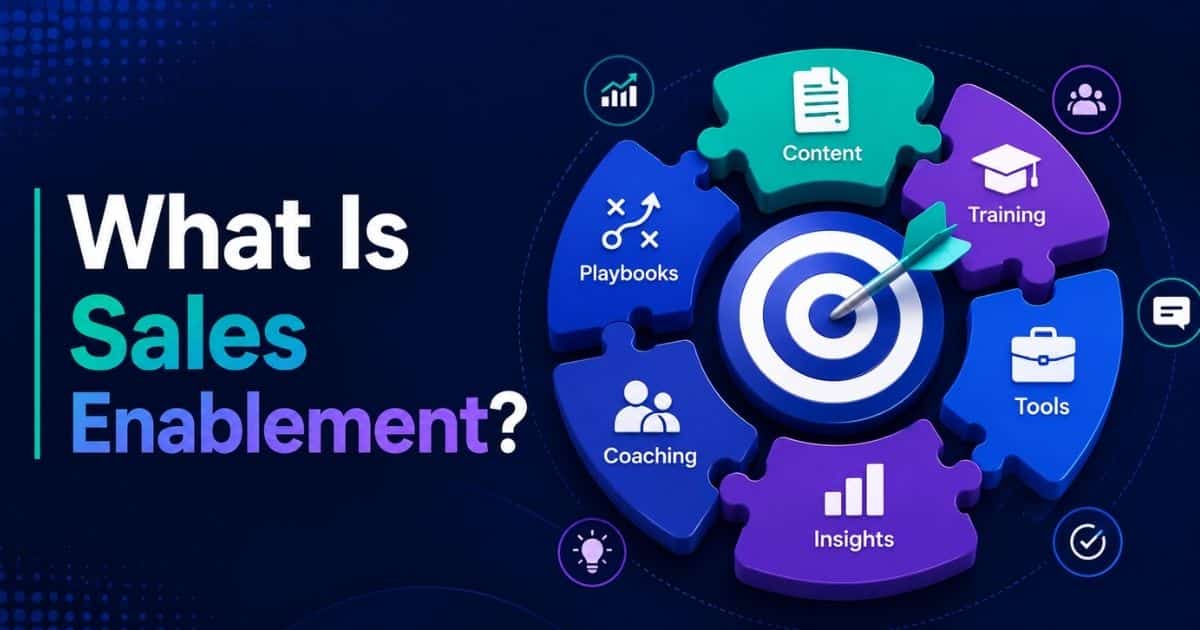
Sales enablement gives sales reps the content, training, and coaching they need to sell effectively. It connects marketing, sales, and product teams around one goal: helping reps close more deals, faster.
A strong sales enablement strategy covers four things. Reps need relevant content for every stage of the deal. They need onboarding and ongoing training. They need coaching based on real calls and real deals, not generic advice. And they need sales enablement tools that keep everything organized instead of scattered across folders and spreadsheets.
Small teams often skip formal sales enablement because it sounds like an enterprise function. It isn't. Any team using a CRM already has the foundation. This guide breaks down what sales enablement actually means and how to build a strategy that works.
What Is Sales Enablement
Sales enablement is the process of giving sales teams the content, training, and coaching they need to sell effectively. It brings sales and marketing together around shared messaging and goals, so reps spend less time searching for answers and more time selling.
A sales enablement program usually includes a mix of tools, workflows, and ongoing support. Some companies hire a dedicated sales enablement manager to run it. Others split ownership across sales and marketing leadership. Either way, sales enablement technology helps keep everything connected in one
Why Sales Enablement Actually Moves The Needle

A strong sales enablement strategy pays off in measurable ways. Reps sell with more clarity, ramp faster, and rely less on guesswork throughout the sales cycle.
Better Sales Conversations
Sales enablement success starts with better conversations. When reps have the right talk tracks, case studies, and objection handling ready, they engage buyers with more confidence and relevance at every stage of the sales process.
A sales enablement platform makes this easier by surfacing the right material at the right moment. Reps pull up what they need instead of digging through old emails or asking a manager, keeping the conversation moving forward naturally.
Consistent Messaging Across Every Rep
Inconsistent messaging confuses buyers and slows deals down. Sales and marketing teams that align on positioning, pricing language, and value props give every rep the same foundation to sell from, regardless of tenure.
Scaling teams feel this most. Revenue enablement efforts break down fast when reps interpret messaging differently, but shared templates and approved content keep everyone speaking the same language, deal after deal.
Faster Onboarding For New Salespeople
New hires take time to ramp, and sales training shapes how quickly that happens. Structured onboarding paths, recorded calls, and clear playbooks cut down the guesswork new reps usually face in their first few months.
Ramp time shortens considerably when sales enablement professionals design these paths on purpose. New reps get a clear sequence of what to learn, practice, and apply, rather than learning through trial and error.
Higher Content Adoption Throughout The Sales Cycle
Content only works if reps actually use it. Sales enablement software tracks which assets get opened, shared, and reused, showing which content genuinely supports deals versus what sits unused in a shared drive.
Refining the library gets easier with that visibility over time. Reps adopt content faster when it's easy to find and clearly tied to a specific deal stage, rather than buried in a generic folder structure.
More Confident, Data-Driven Selling
Confidence grows when reps have real data behind their decisions, not just instinct. Sales enablement gives reps visibility into what's worked in similar deals, so they can make sharper calls in the moment.
Forecasting and coaching both get stronger as a result. Managers gain clearer signals on where deals stand, and reps spend less time second-guessing their next move in the sales cycle.
The Core Building Blocks Of A Strong Enablement Strategy

Sales enablement focuses on six connected pieces, not one single tool. Equipping sales teams properly means getting content, training, technology, and communication working together instead of in isolation.
Sales Content Management
Sales enablement content only helps reps when it's organized and easy to find. Case studies, one-pagers, and pitch decks scattered across drives and inboxes waste time reps could spend actually selling to prospects.
A modern sales enablement platform solves this by centralizing everything in one searchable library. Reps find what fits their current deal stage in seconds, and marketing teams get visibility into what content actually gets used.
Sales Training And Continuous Coaching
Training shouldn't stop after onboarding week. Reps improve fastest when coaching continues throughout their tenure, built around real calls, real objections, and real deals rather than generic scripted scenarios.
A dedicated sales enablement team often owns this cadence, pairing structured training modules with regular one-on-one coaching sessions. Managers spot skill gaps early and adjust their approach before a rep's numbers start slipping.
Standardized Sales Playbooks
Playbooks give reps a repeatable path for common scenarios like discovery calls, objection handling, and competitive deals. Without one, every rep improvises differently, and managers lose any consistent way to coach performance.
Sales enablement initiatives that include clear playbooks tend to ramp new hires faster too. Instead of shadowing a top performer for weeks, new reps get a documented process they can follow from day one.
CRM And Sales Technology Stack
Sales tools only create value when they actually connect. A CRM sitting apart from content, communication, and coaching platforms forces reps to juggle multiple logins just to prep for one call.
Sales operations teams typically own this stack, choosing a unified sales enablement platform that ties pipeline data, content, and coaching notes together. Reps get one place to work instead of five.
Performance Analytics And Feedback Loops
Numbers tell the real story behind any enablement effort. Win rates, ramp time, and content usage data reveal what's actually working, separate from what simply feels productive on a day-to-day basis.
Feedback loops close the gap between data and action. Managers review these metrics regularly, then adjust coaching, content, or training based on what the numbers show, not on assumptions.
Cross-Team Alignment And Communication
Enablement breaks down fast without alignment between sales, marketing, and product. Marketing teams create content assuming reps will use it a certain way, and reps interpret it completely differently without a shared feedback channel.
Regular communication between sales and marketing keeps messaging consistent and content relevant. Shared goals and open channels turn enablement into a two-way conversation instead of content just getting handed off.
Sales Enablement Vs Sales Operations Vs RevOps
These three terms get used interchangeably, but they solve different problems. Sales enablement ensures reps have the content, training, and coaching they need to sell well. It's about people and skill, not process automation.
Sales operations sits closer to the machinery behind sales performance. This function manages CRM administration, territory assignments, quota planning, and the reporting infrastructure that keeps a sales org running smoothly day to day, often tying closely into a broader revenue operations strategy for scalable growth.

RevOps zooms out even further. It aligns sales, marketing, and customer success around one shared data model and one revenue goal, breaking down the silos that usually exist between these teams through a unified sales collaboration CRM approach.
Understanding why sales enablement is important on its own matters here. A sales enablement team focuses on rep readiness. Sales enablement metrics like ramp time and win rate measure that readiness directly. Sales enablement resources like playbooks and coaching only work within that specific lane, separate from what ops or RevOps typically own.
Function | Primary Focus | Key Owner | Example Metrics |
|---|---|---|---|
Sales Enablement | Rep readiness through content, training, and coaching | Sales enablement manager or team | Ramp time, win rate, content usage |
Sales Operations | Process, systems, and CRM infrastructure | Sales ops manager | Data accuracy, quota attainment, forecast accuracy |
RevOps | Cross-functional alignment across sales, marketing, and success | RevOps leader | Pipeline velocity, revenue growth, retention |
Sales VS Marketing VS Dedicated role: Who Owns Sales Enablement

Ownership varies more than most sales enablement definitions suggest. Some companies fold it under sales leadership. Others hand it to marketing. Many eventually build a dedicated function once the sales cycle length and team size justify it.
Sales-owned enablement works well for smaller teams. A sales manager runs training, shares sales content, and adjusts enablement plays based on what's closing and what isn't. The upside is speed. Whoever's closest to the pipeline reacts fastest when something in the sales enablement strategy needs to change.
Marketing-owned enablement leans on content and messaging strength. Marketing teams already produce case studies, competitive positioning, and campaign assets, so extending that into rep-facing content feels like a natural fit. The risk is distance from daily selling. Content built without direct pipeline visibility sometimes misses what reps actually need to engage buyers effectively.
A dedicated sales enablement team becomes worth the investment once measuring sales enablement gets harder to do informally. This function bridges sales and marketing, applies sales enablement best practices consistently, and treats enablement as a full-time discipline instead of a side responsibility. It's also where customer success often connects in, aligning enablement with the full customer lifecycle rather than just the pre-sale motion.
There's no universal right answer. The benefits of sales enablement show up regardless of ownership model, as long as someone owns it clearly and consistently.
Ownership Model | Best Fit For | Strengths | Watch-Outs |
|---|---|---|---|
Sales-Owned | Small teams, early-stage companies | Fast, pipeline-aware decisions | Content and training can lack polish |
Marketing-Owned | Content-heavy sales motions | Strong messaging and asset quality | May lack real-time selling context |
Dedicated Enablement Team | Scaling teams with complex sales cycles | Consistent enablement tools and strategy across reps | Requires budget and clear cross-team buy-in |
Sales Enablement Without A Dedicated Enablement Hire

Small teams don't need enablement teams to see real revenue outcomes. Effective sales enablement often starts with a few simple systems a sales manager can run alongside everyday selling.
Create Simple Sales Playbooks
A sales strategy works better when it's written down. Even a one-page playbook covering discovery questions, common objections, and next steps gives reps a shared starting point across the entire sales cycle.
Sales managers don't need fancy software to build this. A shared doc outlining what works at each stage of the buyer journey is often enough to boost consistency without adding overhead to anyone's day, especially when paired with a clear system for tracking deals from lead to close.
Centralize Sales Resources
Sales content management doesn't require a dedicated platform to matter. A single shared folder or smart CRM with centralized sales organization features keeps case studies, pricing sheets, and templates in one place instead of scattered across inboxes.
This small step alone improves sales productivity. Reps stop hunting for the right file mid-call, and new hires ramp faster when they can find everything they need without asking someone else first.
Standardize CRM Usage
Training and coaching mean little if reps log deals differently. A shared standard for updating stages, notes, and next steps keeps pipeline data clean and gives everyone a reliable view of sales success, while addressing the CRM adoption challenges and best practices that often undermine these standards.
Consistency here also helps customer success teams later. Clean handoff notes and deal history make transitions smoother once a deal closes, setting up a better experience from the very first interaction onward and directly improving CRM adoption strategies and ROI across the customer lifecycle.
Build A Coaching Routine
Coaching doesn't require a formal program to work. A recurring 15-minute call review or pipeline walk-through gives reps regular feedback tied to real deals instead of generic advice delivered once a quarter, and can be amplified by sales admin tasks automation that frees time for these conversations.
Consistency matters more than complexity here. Even light-touch training and coaching, done weekly, moves the needle further than an elaborate program that only happens once or twice a year.
Review And Improve Regularly
No sales strategy stays effective without regular review. Checking what's working every few weeks catches gaps early, before they quietly drag down performance across the team.
This habit is what separates effective sales enablement from a one-time setup. Small, consistent adjustments compound over time, keeping the whole approach aligned with how the team actually sells.
How To Tell If Your Sales Enablement Strategy Is Working

Sales enablement matters most when it's measurable. Tracking the right numbers across five areas shows whether your strategy actually drives more deals, or just looks good on paper.
Sales Productivity Metrics
Sales enablement drives real change when reps spend less time on admin work and more time selling. Time-to-first-call, active selling hours, and deal cycle length all reveal whether your setup is actually saving time, especially when you layer in sales task automation tools.
Comparing these numbers before and after a new tool or process rollout shows real impact. A drop in cycle length or a rise in active selling hours points to enablement efforts working as intended, particularly when you automate sales tasks.
Content Usage Metrics
Content management only proves valuable when reps actually use what's built for them. Track which assets get opened, shared, and reused most often, and which ones sit untouched in your library.
Low usage usually signals a mismatch, not a content problem. Reps skip material that doesn't fit their deal stage or buyer type, so usage data often points straight to what needs rebuilding and where CRM follow-up automation can improve sales conversions by surfacing better-fit assets and avoiding common sales follow-up mistakes.
CRM Adoption Metrics
A CRM only helps the team when reps actually log activity consistently. Check update frequency, note quality, and how often deals move through stages without manual nudging from a manager.
Poor adoption usually traces back to friction, not laziness. Reps skip logging when it feels tedious, so simplifying fields and workflows often fixes adoption faster than more training ever could.
Pipeline Performance Metrics
Digital sales rooms and shared pipeline views make it easier to spot where deals stall. Watch conversion rates between stages and average time spent at each one across the full sales cycle, using a visual sales pipeline to improve deal clarity.
Stalls at a specific stage usually point to a gap in training, content, or process, not the rep. This is where cross-functional collaboration between sales and enablement pays off directly.
Revenue And Win Rate Metrics
Ultimately, every enablement effort should tie back to business priorities like revenue and win rate. These numbers confirm whether better content, coaching, and tools actually help reps engage buyers and close.
Win rate improvements take longer to show up than activity metrics, so track them quarterly. A steady upward trend is the clearest signal that your sales enablement strategy is paying off.
Where CRM And Sales Tools Fit Into Enablement

Every enablement effort eventually runs through the same system. CRM software for modern sales teams and sales tools quietly power sales onboarding, sales coaching, content delivery, and analytics behind the scenes.
CRM As The Enablement Hub
A CRM ties every enablement piece together in one place. Deal history, contact notes, and buyer behavior all live where sales leadership and reps can see them, instead of scattered across separate tools, reflecting how CRM adoption is changing modern sales teams into more data-driven organizations.
This central view supports training programs directly. New hires learn faster when they can see real deal examples inside the CRM, not just theoretical scenarios described in a slide deck during onboarding week, especially when those examples are organized in visual sales pipeline software.
Sales Automation
Automation removes the repetitive work that slows reps down. Follow-up reminders, task creation, and stage updates happen automatically, freeing time for actual selling instead of manual data entry between calls, showcasing core CRM automation benefits for sales and growth.
This matters for revenue growth specifically. Reps who spend less time on admin work move more prospects through the sales funnel, and sales leadership gets cleaner data without chasing reps for updates constantly, which is the core promise of sales automation for higher conversion rates.
Content Management
Relevant content only helps when it reaches reps at the right moment. A CRM-connected content library surfaces the right case study or deck based on deal stage, industry, or buyer type automatically, supporting broader sales workflow automation strategies across the funnel.
This setup also supports sales coaching. Managers can see exactly which content a rep used on a call, then coach around what worked and what didn't during their next one-on-one conversation.
Conversation Intelligence
Sales calls generate more insight than most teams capture manually. AI sales enablement strategies and conversation intelligence tools record and analyze calls, surfacing buyer objections, sentiment, and talk-time ratios a sales enablement pro can act on directly.
These insights sharpen coaching fast. Instead of relying on secondhand summaries, managers review actual moments from calls, giving new reps concrete examples of what strong buyer engagement sounds like in practice.
Analytics And Reporting
Data ties every enablement decision back to results. Analytics dashboards show which reps, content, and training programs actually correlate with stronger performance across the pipeline, not just gut-feel impressions, especially when powered by a modern sales automation CRM.
Sales leadership relies on this reporting to guide future investment. When the numbers show what's working, it's easier to expand successful training programs and cut the ones that aren't moving deals forward, often by doubling down on effective sales automation software.
Best Practices For A Sales Enablement Program That Sticks
Enablement fails less from bad intentions and more from bad habits: content nobody opens, training nobody remembers, onboarding that happens in a vacuum. These five practices keep enablement embedded in how reps actually sell, not bolted on beside it.
Connect Your CRM To Every Enablement Decision
CRM data should drive what training gets built next, not sit disconnected from it. When a manager can see which reps are missing quota and why, from stalled deals to skipped follow-ups, enablement stops guessing and starts targeting the exact gap that's costing revenue.
The same connection works in reverse once training happens. Tie a coaching session or new playbook to a CRM field, like deal stage or objection type, and you can measure whether behavior actually changed instead of assuming the training worked because reps sat through it.
Onboard Reps Inside Their Actual Workflow
New hires ramp faster when they learn by doing real deals, not by finishing a separate onboarding course first and selling second. Pair a new rep's first few calls with light, real-time guidance instead of a slide deck they'll forget by week three.
Gaps also surface faster this way. A manager watching a new rep work an actual pipeline spots confusion in the moment, not two months later during a performance review, which means coaching happens while it's still cheap to fix instead of after a deal's already lost.
Train In Small Doses, Not Big Dumps
Reps forget most of what gets crammed into a single all-day session. Breaking training into short, focused pieces tied to a specific moment, like sending a quote or handling a pricing objection, sticks because the rep applies it immediately instead of storing it for later.
Timing matters more than volume here. A two-minute refresher delivered right before a rep needs it beats an hour-long module delivered a month in advance, since most people retain almost nothing from training they can't immediately put to use in a live conversation.
Build A Content Library Reps Actually Reach For
A content library only works if reps can find the right asset in seconds, sorted by deal stage or buyer type instead of upload date. Case studies, objection-handling scripts, and competitive comparisons all need a home reps trust enough to check before they wing it.
Usage data tells you what's actually working. Track which pieces get opened and reused during real deals, then retire what's ignored. A smaller library of content reps trust beats a bloated one nobody has time to dig through mid-call.
Refresh Your Materials Before They Go Stale
Messaging, pricing, and competitive positioning shift faster than most enablement libraries get updated. A case study built around last year's product roadmap or a battlecard referencing a competitor's old pricing quietly undermines every rep who still trusts it during a live call.
Set a recurring review, not a one-time cleanup. Even a quarterly pass through your top ten most-used assets catches outdated claims before a prospect does, and it keeps reps confident that anything in the library is safe to use without double-checking it first.
How To Build Sales Enablement Around One Real Goal
Most enablement programs try to fix everything at once and end up moving nothing. Picking one measurable goal first, then working backward, turns enablement from a vague initiative into a specific bet you can actually prove out.
Pick The One Metric That's Actually Hurting You
Every team has a number quietly dragging on revenue, whether that's ramp time, win rate, deal size, or how long deals sit in the pipeline before closing. Naming that one metric first keeps enablement from turning into a scattered mix of trainings nobody asked for.
Set a real target, not a vague direction. "Improve win rate" doesn't give anyone something to build toward, but "raise win rate by eight points next quarter" gives the whole team a clear line to measure progress against instead of a feeling that things are getting better.
Find The Behavior Sitting Behind That Number
A metric never moves on its own; some specific thing reps are doing, or not doing, is behind it. If deal size is flat, look at what happens in the calls that led to your biggest wins versus your smallest ones, and find the pattern.
Guesswork needs to stop at this stage. Pull real call transcripts or CRM notes instead of asking reps what they think is happening, since what reps believe they're doing and what they're actually doing in a live conversation are often two very different things.
Build Training Around That Specific Behavior
Once you know the behavior, build training narrow enough to change just that one thing. If reps default to discounting instead of selling on value, the training should target that exact objection, not a general refresher on the entire sales process.
Specific training is easier to measure too. A rep either starts leading with value in objection-handling calls or they don't, and that's a clear behavior a manager can listen for on a call, versus a vague sense that someone "seems more confident" after a workshop.
Bring The Training Into Daily Selling, Not A Separate Session
Training that lives outside a rep's actual workflow gets forgotten the moment the session ends. Deliver guidance inside the tools reps already use for their deals, so the lesson shows up right when it's relevant instead of sitting in a slide deck nobody reopens.
Skipping it also gets harder this way. A reminder inside the CRM at the exact moment a rep is writing a follow-up email gets used, while a training module sitting in a separate portal competes with actual selling time and usually loses.
Review Quarterly And Be Willing To Be Wrong
Check progress on a fixed schedule, not whenever it feels convenient. Did the metric move? Did reps actually adopt the new behavior, or did old habits creep back in once the initial push faded? Both questions matter more than whether the training felt good to sit through.
Sometimes the answer is that the original theory was wrong, and that's fine. Maybe value-selling wasn't actually the lever for deal size, and something else was. Treating enablement as a testable bet instead of a finished program is what makes it improve quarter over quarter.
Final Discussion
Sales enablement isn't a one-time project. It's an ongoing effort to keep reps equipped with the right content, training, and coaching as buyers, products, and markets keep changing.
You don't need a dedicated hire or an expensive platform to get started. A shared playbook, an organized CRM, and a regular coaching habit cover most of what small teams actually need.
What matters most is consistency. Teams that review their approach regularly, track a few clear metrics, and keep sales and marketing aligned tend to see steadier results than teams chasing the latest tool.
Start small, measure what happens, and adjust from there. That's the foundation every strong sales enablement strategy is built on, regardless of team size or budget.
FAQs
Is Sales Enablement The Same As Sales Training?
No. Sales training is one piece of sales enablement, not the whole picture. Training builds skills, but enablement also covers content, coaching, tools, and ongoing support throughout a rep's tenure. Training happens in sessions. Enablement runs continuously, adjusting based on real deals, buyer feedback, and performance data as the sales cycle evolves.
How Long Does It Take To Build A Sales Enablement Strategy?
Basic structure can go live within a few weeks. A simple playbook, organized content, and a coaching routine don't require months of planning. Maturity takes longer. Refining metrics, tightening cross-team alignment, and building a full content library typically develops over several quarters as the team learns what actually moves deals forward.
What's The Biggest Mistake Teams Make With Sales Enablement?
Treating it as a one-time launch instead of an ongoing habit. Teams often build playbooks or buy tools, then stop reviewing whether reps actually use them. Content goes stale, messaging drifts, and adoption quietly drops. Regular check-ins prevent this, keeping the strategy tied to what's currently working in the field.
Can Sales Enablement Work For A Team Of Just Two Or Three Reps?
Yes. Small teams often benefit the most since changes roll out fast. A shared doc, a consistent CRM habit, and a weekly deal review cover the basics. There's no minimum team size required. What matters is consistency, not headcount or a formal enablement department.
Does Sales Enablement Apply After A Deal Closes?
Often overlooked, yes. Handoff notes, deal history, and messaging consistency directly affect how smoothly a new customer transitions to onboarding. Clean CRM data and clear documentation help post-sale teams pick up where sales left off, extending enablement's impact beyond just closing the deal.