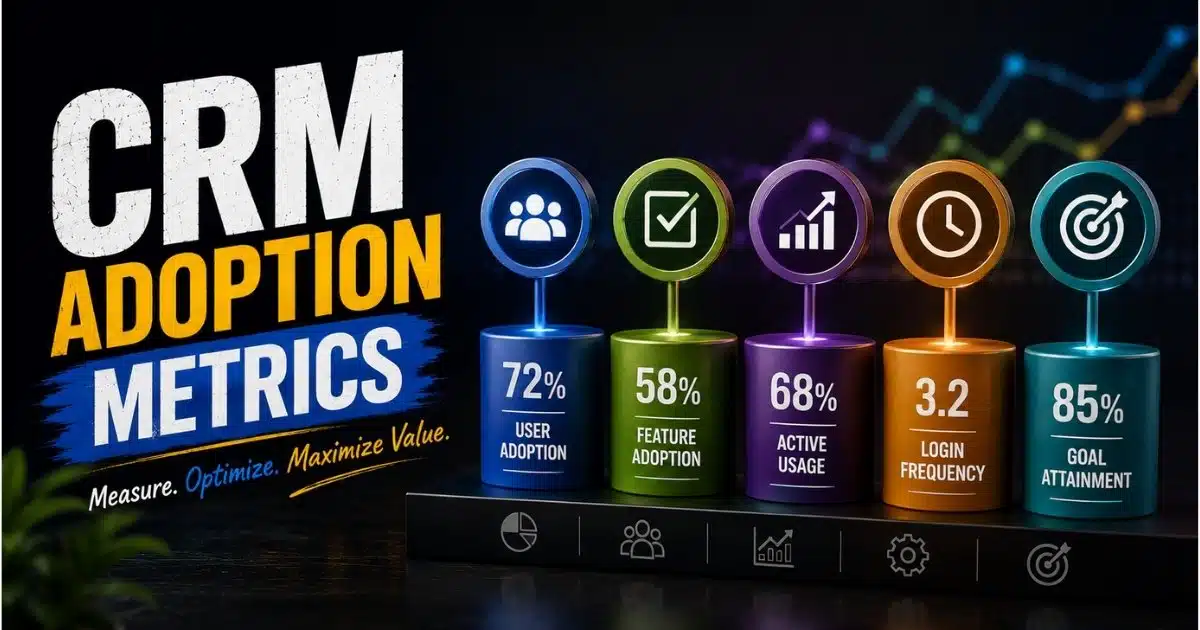
CRM success for sales teams depends on measurable adoption rather than just deploying a CRM system. Installing the software is the easy part. The real challenge is changing daily behavior so every rep, manager, and leader relies on the CRM to manage leads, opportunities, and accounts. Without that shift, your CRM investment becomes an expensive database no one trusts.
This article breaks down seven concrete adoption metrics that reveal whether your sales team actually uses the CRM as the single source of truth. When tracked consistently, these metrics connect system usage to business outcomes like reliable pipeline numbers, improved conversion rates, and better business performance within two quarters. Gain.io serves as a sales performance and revenue platform that helps managers track these metrics from a single place, turning raw CRM data into actionable insights.
What Is CRM Adoption For Modern Sales Teams
CRM adoption refers to how consistently sales teams use a CRM platform to manage customer relationships, sales activities, and internal workflows. Strong crm user adoption helps organizations improve sales visibility, streamline collaboration, and support better decision-making across departments.
Modern businesses often rely on success metrics and performance metrics to evaluate how effectively teams use their CRM systems. Companies monitor engagement metrics, crm engagement, and user behaviour to understand how sales representatives interact with the platform. Tracking user groups also helps identify different usage patterns across departments or roles.
Businesses that identify bottlenecks early can improve effective adoption and reduce operational inefficiencies. Teams that review the system regularly can detect role-specific gaps, improve training strategies, and encourage better platform usage. Higher CRM adoption ultimately supports stronger sales performance, improved forecasting accuracy, and more consistent customer management processes, illustrating how CRM adoption is changing modern sales teams.
7 CRM Adoption Metrics Every Sales Manager Should Track
These seven adoption metrics form a practical scorecard that connects CRM usage to sales outcomes. Together, they help sales managers coach more effectively, spot adoption issues early, and make data driven decisions about training and process changes. To measure CRM adoption effectively, businesses should focus on metrics across three core categories: usage, data quality, and business performance, and pair these with structured CRM adoption best practices and change management strategies to turn metrics into behavior change.
The basic formula for CRM Adoption Rate is (Number of Active CRM Users / Total Potential Users) × 100. But that surface-level number only tells part of the story. The metrics below dig deeper into usage patterns, user engagement, and business impact.
1. Daily And Weekly Active CRM Users
Daily Active Users (DAU) is a key metric that tracks how effectively teams incorporate the CRM into their daily routines, providing insights into user engagement and adoption rates. This metric measures the percentage of licensed users who log into the CRM system and perform at least one meaningful action per day or week.
Active Usage Rate is the percentage of licensed users who log in and perform meaningful actions within a defined period. Passive logins where reps view-only without updating records should be filtered out. Query CRM APIs for actions exceeding 30 seconds to differentiate real engagement from quick check-ins.
Benchmarks for 2026 suggest aiming for at least 85 percent weekly active usage for quota-carrying reps and 70 percent for leadership. Below 70 percent signals the CRM is a compliance checkbox rather than a workflow hub. Sharp usage declines week over week indicate training gaps or process friction that needs immediate attention.
2. Depth Of Feature Usage Across The Sales Team
Measuring feature usage helps identify which CRM tools are most utilized by the team, revealing patterns in adoption and highlighting areas where additional training may be needed. This metric looks at engagement with core modules like opportunity pipelines, task management, CRM with integrated email functionality, and forecasting tools.
A high login rate without meaningful feature usage can hide weak CRM adoption and limited process change. One B2B services firm discovered 60 percent login rate but only 20 percent task completion. After targeted training on sequences and playbooks, win rates improved by 12 percent.
Identify three or four key features tied to your business processes and track system usage for those specifically. For most sales teams, these include opportunity tracking, task management, calendar syncs, and pipeline reviews. Teams that use playbooks regularly show 18 percent higher close rates compared to those who ignore them.
3. CRM Data Completeness For Key Objects
Data Completeness measures the percentage of required fields filled out in records like leads, contacts, accounts, and opportunities. Target 90 to 95 percent completeness for mandatory fields. AI-enabled CRM software can lift this by 40 percent through auto-fill capabilities.
The effectiveness of a CRM system is directly tied to the quality of the data it contains, as poor data quality can lead to incomplete records and missed sales opportunities. Focus on specific fields that matter: contact role, deal stage, close date, next step, and deal value, supported by dynamic contact management for smarter relationship tracking. Tracking every optional field creates unnecessary burden.
High-quality data entry is essential for CRM effectiveness, as it ensures that users can rely on accurate information to make informed decisions and streamline business processes. One team raised opportunity completeness from 65 percent to 95 percent, enabling reliable win-loss analysis that identified pricing objections as a hidden 15 percent drag on close rates. Data Contribution & Quality includes metrics such as Data Completeness Score and Accuracy Rate to monitor data integrity.
4. CRM Data Freshness And Recency Of Activity
Data freshness measures how recently each active opportunity or account has been updated with notes, tasks, or stage changes. Tracking new data entry frequency is essential for understanding CRM adoption, as it indicates how consistently teams are logging critical information into the system.
Stale records create pipeline risk. Flag opportunities with no activity for more than 7 days in short cycles (30 days) or more than 14 days in long cycles (90 days). Dakota Analytics reports that neglected opportunities cost 20 percent of pipeline value.
One sales manager used “days since last activity” reporting to spot 30 percent of Q4 pipeline at risk. Targeted coaching on those deals rescued $2M before quarter end. This kind of visibility turns a few metrics into a key indicator of deal health.
Require meaningful updates on every open deal at least once per week for inside sales teams. Gain.io dashboards auto-surface stale records, reducing inspection time by 80 percent and enabling faster decision making.
5. Pipeline Coverage And Forecast Reliability
Pipeline coverage equals total pipeline value divided by quota for a given period. Common targets suggest maintaining three times quota in early quarters and adjusting based on win rate patterns. Enterprise sales teams often need 4x coverage while SMB teams work with 3x.
Tracking sales pipeline speed is crucial as it measures how quickly deals move through sales stages, helping to identify delays and improve the sales process. If reps do not rely on the CRM system, coverage ratios become misleading and forecast accuracy suffers.
Studies indicate that only 50% of sales teams use CRM data effectively for forecasts and decision-making, highlighting the critical need for accurate data entry. One team improved CRM adoption and saw forecast error drop from 30 percent to under 10 percent, enabling confident planning and resource allocation.
6. Lead To Customer Conversion Rates Driven By CRM
This metric tracks the percentage of leads that become customers and is one of the clearest signals connecting CRM adoption to sales revenue. Benchmarks suggest 15 to 20 percent conversion for well-managed pipelines.
Monitoring lead-to-customer conversion rates is essential for assessing CRM effectiveness, as a well-implemented CRM can significantly boost these rates, with phone calls alone increasing conversion likelihood by 70%. Consistent use of lead statuses, contact fields, and follow-up tasks inside the CRM improves conversion rates over one to two quarters.
One team standardized CRM processes and moved from a 12 percent to a 17 percent lead-to-customer rate. Compare conversion rates for leads fully managed inside the CRM versus those handled outside to quantify adoption impact and demonstrate business value.
7. Time To First Value For New CRM Users
Time-to-Value (TTV) measures how long it takes a new user to complete their first key action, such as logging their first real opportunity or closed deal. Target under 30 days for new reps to fully use core CRM workflows.
Shorter time to first value indicates an intuitive CRM setup, strong onboarding, and clear expectations for adoption success. Low user adoption can result in incomplete data, outdated records, and missed sales opportunities, leading teams to revert to less efficient tools like spreadsheets.
One growing sales team improved onboarding materials and templates, cutting time to first value from 45 to 22 days. This accelerated ramp time by 25 percent and improved user confidence with the system.
How To Validate CRM Adoption Metrics In Your Team
Validation means proving each adoption metric reflects real behavior and real business impact, not vanity numbers. Without validation, you risk making decisions based on metrics that look healthy but hide process bottlenecks or data accuracy problems.
This section walks through a repeatable validation process. The examples assume a modern CRM integrated with analytics capabilities. Managers should revisit and recalibrate these metrics quarterly as sales motions, territories, and product lines evolve.
Define Each Metric And Map It To Business Outcomes
Convert abstract concepts like “engagement” into concrete metrics such as percentage of reps logging activity five days per week. Each adoption metric needs a clear definition that everyone, from Sales to RevOps to leadership, interprets the same way.
Map each metric to a business outcome. Higher Daily Active Users should correlate with shorter sales cycles. Better data completeness should improve forecast accuracy. One team tied user login consistency to a 10 percent improvement in quarterly pipeline accuracy, validating that the metric mattered.
Document definitions in a shared playbook. Clear definitions prevent confusion when comparing adoption success across regions or teams and ensure consistent reporting.
Establish Baselines Using The Last 90 Days Of CRM Data
Establishing baseline metrics immediately after implementation helps track CRM adoption progress over time. Pull at least 90 days of CRM data to understand current adoption reality before setting targets.
Compute baseline figures such as the current percentage of opportunities with a next step field filled in, or the average days since last activity. A hypothetical Q1 2026 baseline might show 72 percent WAU, 82 percent completeness, and 12 days average freshness.
Segment baselines by role and region to see whether adoption gaps concentrate in new hires or specific territories.
Set Clear Thresholds For Healthy Versus At Risk Adoption
Translate baselines into thresholds. A rep might be “healthy” if they log in at least four days per week and update 95 percent of open deals weekly. Use simple traffic-light categories so front-line managers quickly see where coaching is required.
Align thresholds with sales cycle length and deal value rather than copying generic benchmarks. An inside sales team with a 30-day cycle needs 7-day freshness thresholds while a field sales team with 90-day cycles can work with 14-day thresholds.
Review thresholds every six months as the CRM system or sales motion changes. Role-Based Dashboards provide tailored metrics relevant to specific roles to deliver actionable insights.
Verify Data Quality Before Trusting Any Metric
Data Accuracy involves regular audits to ensure the information entered is correct and standardized. Poor CRM data quality, such as missing close dates, duplicate records, or inconsistent stages, makes adoption metrics misleading, and reinforces the need for structured CRM adoption strategies to improve CRM ROI.
Run a simple audit: randomly review a sample of opportunities and contacts to check whether fields match reality based on emails and meetings. Cross-check CRM data with external systems like email integration, calendar, or calling tools to validate that key customer interactions are captured.
Use data quality dashboards to spot patterns. If specific teams leave mandatory fields empty, that creates adoption issues affecting the entire pipeline. Validation should be ongoing, not a one-time clean-up, with monthly spot checks.
Connect Adoption Metrics To Sales Performance Trends
Overlay metrics like Daily Active Users with win rate, revenue per rep, or forecast accuracy for the same time period. Look for directional relationships where teams with higher feature usage show faster lead response times and better conversion rates.
One team improved data completeness from 60 percent to 90 percent and immediately saw more reliable pipeline coverage ratios. Use cohort analysis by hire date or training group to see how changes in onboarding affect both adoption and sales goals.
Use Insights To Adjust Training Processes And Incentives
Validated metrics should drive specific actions. Targeted training on opportunity stages or simplifying required fields that slow reps down addresses adoption gaps directly.
Creating a clear user adoption strategy with measurable goals and deadlines is essential for overcoming resistance and ensuring effective CRM usage across teams. Run small experiments: adjust one process, observe metric movement for 30 to 60 days, then decide whether to roll out more broadly.
One team shortened its stage list and saw both higher adoption and faster pipeline updates within one quarter. Validation succeeds when adoption metrics reliably predict business outcomes managers care about, which is especially important for startups selecting CRM tools that help startups grow smarter.
Best Practices To Improve CRM Adoption Metrics
These strategies help sales managers move key adoption metrics within the next quarter. Each practice ties directly to measurable changes in CRM data so you can track progress and demonstrate business impact. Creating a clear user adoption strategy with measurable goals and deadlines is essential to overcoming CRM adoption challenges and ensuring employees do not revert to previous behaviors.
Align CRM Workflows With Existing Sales Processes
Adoption rises when CRM stages, fields, and tasks mirror how the sales team actually sells rather than forcing an unfamiliar process. Involve top-performing reps in redesigning opportunity stages, required fields, and standard tasks to reduce friction so you can get more from your CRM with a simpler sales workflow.
One team removed redundant fields and cut opportunity update time by 25 percent, boosting data completeness. Re-validate workflows every six to twelve months as products and markets change so the CRM system stays aligned with business processes.
Updated workflows should immediately show improved usage and depth of feature metrics in your adoption dashboards.
Make CRM The Single Source Of Truth For Pipeline Reviews
Run every forecast call and pipeline review directly from the CRM system. This reinforces that if it is not in CRM, it does not exist. Stop accepting offline spreadsheets or slide decks as substitutes for a dedicated sales pipeline CRM view.
One leadership team mandated CRM-based forecasts by a specific quarter, leading to a 40 percent spike in activity logging. Making CRM central for reviews naturally raises users logging daily and improves pipeline coverage metrics. This discipline ensures forecast accuracy improves as adoption improvement takes hold.
Embed CRM Usage In Onboarding And Coaching
Give new reps clear expectations for CRM activity in their first 30, 60, and 90 days, tied to specific usage metrics. Use one-on-one coaching sessions to review both pipeline progress and CRM hygiene side by side.
Implementing Digital Adoption Solutions (DAS) can help employees learn CRM software features gradually, improving their confidence and engagement with the system over time. Role-specific playbooks and scenario-based exercises accelerate basic features mastery. Gain.io tracks whether onboarding cohorts hit adoption milestones faster over time as coaching improves, providing valuable insights for enablement teams.
Simplify Data Entry And Automate Repetitive Work
Reps resist CRM systems when data entry feels slow, duplicative, or disconnected from selling activities. Minimize required fields, use templates for notes, and leverage integrations to capture emails and meetings automatically, using sales task automation to stay focused and organized.
Automating data entry processes can alleviate pressure on employees and ensure that accurate data is consistently entered into the CRM system, enhancing user engagement. One team reduced required lead fields and saw a clear uptick in data completeness within a month.
Use automated reminders carefully so they support intentional updates like next steps and close dates. Improved automation shows measurable gains in both data freshness and depth of feature usage.
Recognize And Reward Strong CRM Adoption Behaviors
Presenting the value of CRM to employees can significantly motivate them to adopt the tool, as it helps them understand how it will reduce their workload and enhance their skills. Public recognition, small rewards, or friendly competition can motivate consistent CRM usage.
Spotlight reps who maintain near-perfect data completeness or consistently update all deals before forecast calls. One region implemented a monthly “clean pipeline” award that led to a 35 percent increase in timely opportunity updates.
Tie at least one quarterly objective to CRM adoption expectations, not just closed revenue. Sales managers can use objective metrics to identify and celebrate adoption champions.
Common Pitfalls When Interpreting CRM Adoption Metrics
These mistakes cause sales managers to misread adoption metrics or draw wrong conclusions. CRM adoption statistics from 2024 and 2025 show many teams overestimate adoption because they focus on surface-level indicators. Resistance to digital transformation is a common challenge in CRM adoption, but demonstrating how CRM improves sales productivity can help overcome these obstacles.
Relying Only On Login Counts To Judge Adoption
High login numbers without activity depth give a false sense of CRM success and hide process gaps. One team had weekly logins near 100 percent, but only half of opportunities had current stages or next steps.
Pair login data with metrics like records updated, task completion rates, and meetings logged per user. Gain.io dashboards display both logins and key action counts together to provide context.
Treat login-only improvements as a first step, not the end goal. Low user adoption rates become visible only when you examine what happens after the login.
Ignoring Data Quality When Tracking Business Performance
Forecasting and conversion metrics become unreliable if underlying pipeline data is incomplete or outdated. One team’s forecast accuracy looked poor, but the real issue was missing close dates and inconsistent stages.
Audit field completeness and last-update dates before basing strategic decisions on CRM-generated reports. Waste resources fixing the wrong problems when you skip this step. Improving data quality often precedes visible gains in conversion rates and revenue metrics.
Failing To Segment Metrics By Role Or Team
Averaging adoption metrics across all users hides whether issues concentrate with SDRs, AEs, or specific regions. One organization saw average adoption while inside sales excelled and field reps lagged significantly.
Always view dashboards segmented by role, team, tenure, and product line where relevant. Configure role-based views so each manager sees the segments they own. Targeted interventions based on segmentation prove more effective than broad programs that treat everyone the same, especially when refining how your CRM helps sales teams manage leads across different roles.
Setting Unrealistic Or Static Adoption Targets
Copying industry benchmarks without accounting for specific sales cycles, deal sizes, or territory complexity creates problems. A team with long enterprise cycles needs different activity and freshness targets than an SMB team.
Revisit targets at least twice per year based on actual performance trends and user feedback from the field. Static targets can discourage teams or hide the need to raise expectations as adoption improves. Year-over-year trend analysis supports informed target adjustments that reflect your actual business objectives, whether you run B2B, SaaS, or retail teams using CRM tools to stay organized.
Overlooking Qualitative Feedback From CRM Users
Metrics show what is happening, but feedback from reps explains why adoption is high or low. Organizations can effectively track CRM adoption by combining quantitative metrics with qualitative feedback.
User Feedback and Surveys provide direct insights into usability and help identify pain points. Pair dashboard reviews with quarterly feedback sessions about CRM workflows.
Encouraging open feedback from employees about their CRM experiences can provide valuable insights into user engagement challenges and help tailor strategies to improve CRM adoption. One team discovered friction with a particular form, leading to a change that boosted both user satisfaction and data entry rates.
How Gain.io Supports Strong CRM Adoption
Gain.io is a platform built to help sales leaders measure, understand, and improve CRM adoption using real-time metrics. It connects to your CRM and surfaces adoption insights like usage depth, data quality, and pipeline accuracy in one place, powered by smart CRM tools for sales teams.
Managers can configure dashboards for Daily Active Users, data completeness by field, and pipeline coverage across teams without heavy technical work. CRM analytics become accessible to front-line managers, not just RevOps specialists. Real-time alerts for stale data reduce inspection time by 80 percent, similar to results in a sales acceleration case study using Gain.io.
Gain.io enables sales leaders to tie adoption metrics directly to business outcomes like revenue growth and conversion rates. One client improved WAU by 25 percent and conversions by 14 percent in a single quarter using Gain.io as an all-in-one CRM to grow sales and teams and its dashboards to guide coaching and process changes.
The platform supports successful CRM implementation by providing the visibility sales teams need to coach effectively and hit targets consistently. Leaders evaluating options can use a B2B sales CRM guide for revenue teams to frame how Gain.io fits into their broader sales strategy. Consider exploring a demo to see how Gain.io could support your own CRM success story.
Frequently Asked Questions
How Often Should Sales Managers Review CRM Adoption Metrics
Review key metrics like Daily Active Users, data freshness, and pipeline coverage weekly to support coaching and hygiene checks. Conduct deeper monthly and quarterly reviews to spot trends and guide process changes. Automated weekly snapshots save managers from manually exporting and merging reports, freeing up 10 or more hours per month for customer relationships and coaching.
What CRM Adoption Metrics Make Sense For A Small Sales Team
Teams with fewer than ten reps should focus on a smaller set of metrics: logins, activity logging, and opportunity data completeness. Small teams can rely on direct observation and quick feedback loops but still benefit from consistent numeric baselines. Even in small teams, tracking lead-to-customer conversion rates tied to CRM usage highlights tangible business impact and justifies the CRM investment, especially when using a CRM for startups and small sales teams that stays simple to manage.
How Can We Track Adoption If Our CRM Reporting Is Limited
Start with whatever basic reports exist, such as user logins and record updates, and export data for further analysis where needed. Connecting the CRM to a specialized analytics platform like Gain.io overcomes native reporting gaps without rebuilding the CRM itself. Prioritize a few high-value metrics rather than trying to replicate a full enterprise dashboard on day one, and follow tips for choosing CRM tools that fit your workflow so reporting evolves smoothly.
Should Marketing And Customer Success Be Included In CRM Adoption Metrics
If marketing teams and customer service teams use the same CRM system, include them in adoption tracking with role-specific metrics. Campaign attribution completeness for marketing and renewal opportunity hygiene for customer success provide relevant benchmarks. Cross-functional adoption improves handoffs and creates a more accurate view of the customer lifecycle when everyone works from shared contact management to build stronger relationships.
How Long Does It Usually Take To See Results From Adoption Improvements
Behavioral changes in CRM usage can appear in metrics within a few weeks, but meaningful business performance shifts often take one to two quarters. Metrics like data completeness and Daily Active Users usually improve first, followed by better forecast accuracy and conversion rates. Using a platform like Gain.io helps teams see incremental wins sooner, which keeps momentum and executive support high for ongoing adoption improvement, particularly for teams comparing Gain.io vs Salesforce CRM when choosing their long-term platform.