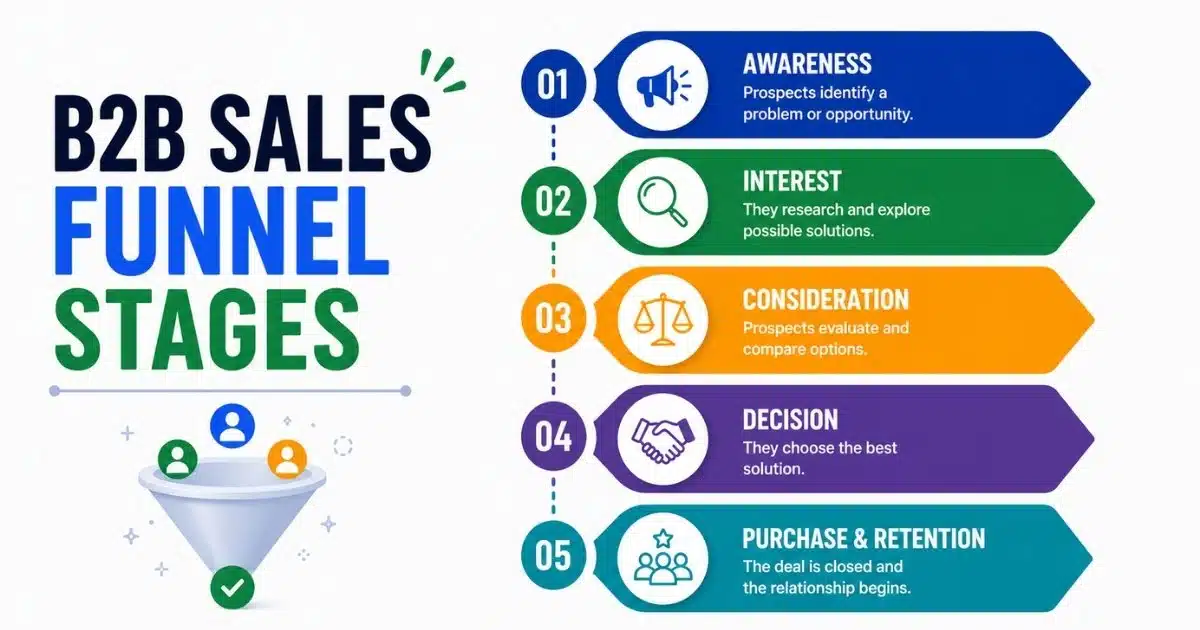
B2B buying has become slower, more committee-driven, and more research-heavy since 2020. B2B sales funnels typically involve longer sales cycles, often ranging from 3 to 12 months, compared to B2C sales funnels, which usually have shorter decision-making processes. In B2B sales, the average buying committee consists of 8 to 13 decision-makers, whereas B2C purchases are generally made by individual consumers or smaller groups. A b2b sales funnel maps the buyer’s journey from initial problem identification, engagement, evaluation, and purchase decision. Most teams use 5 to 6 core sales funnel stages. This article focuses on Awareness, Interest, Consideration, Decision, and Purchase.
B2B Sales Funnel Stages From Awareness To Purchase
Modern funnels evolved from AIDA, but sales leaders and RevOps teams now prefer a structured process that reflects how B2B buyers actually work. Some organizations use six stages, such as Prospecting, Needs Discovery, Solution Crafting, Solution Presentation, Win, and Account Development.
Awareness Stage
The awareness stage begins when potential buyers recognize a business problem or opportunity. They may find your company through search, LinkedIn, events, word of mouth, referrals, or industry reports from firms such as Gartner and McKinsey. During the Prospecting stage, sellers target potential buyers and generate demand through targeted campaigns, which are essential for filling the sales pipeline. Marketing teams usually own demand generation, content, paid search, and social visibility, while sales reps support through thoughtful social selling. Delivering immediate value while addressing industry pain points builds initial brand trust. Since many buyers complete 60 to 70% of their research before contacting sales, educational content is vital at this funnel stage.
Interest Stage
Interest starts when a prospective customer moves from passive research to active engagement. Signals include newsletter signups, repeat blog visits, a second webinar registration, comparison checklist downloads, or visits to a pricing page. Automated lead-nurturing email sequences provide continuous value to prospects, especially when the content is tied to role, industry, or pain point. This is where a marketing-qualified lead often appears, based on fit and behavior. Some teams label high-engagement activity as an intent stage, but the goal is the same: identify the right buyers before sales pressure begins. For many saas companies, buyers move between Awareness and Interest several times before booking a demo.
Consideration Stage
Consideration is the evaluation stage where qualified leads start evaluating solutions, comparing vendors, and involving multiple stakeholders. Buyers may request feature breakdowns, review integration guides, invite IT or finance, or start free trials. The Solution Crafting stage involves sellers analyzing the buyer’s situation to create a customized solution that demonstrates a clear return on investment. Middle-funnel tactics include tailored demos, ROI calculators, proof of concept plans, customer testimonials, and case studies. Providing quantifiable data and proof of concept helps prospects gain internal consensus among their buying committee. This is also where many MQLs become a sales-qualified lead after BANT, MEDDIC, or custom fit checks.
Decision Stage
The decision is where the buying committee has a shortlist and works toward the final purchase decision. Buyers run pilot reviews, security checks, legal review, procurement steps, reference calls, and 3 to 5-year total cost modeling. B2B sales funnels require multiple touchpoints and approvals due to the complexity of the buying process, while B2C funnels often allow for quicker, more impulsive purchases. Sales professionals have the most leverage here through mutual action plans, executive briefings, procurement alignment, and strong business cases. Benchmarks commonly place Opportunity to Closed Won conversion rates around 15 to 30%. A 9-month SaaS deal can stall when a CFO questions risk, but a clear ROI model and customer proof can restore momentum.
Purchase Stage
Purchase begins when the contract is signed, but it is only the beginning of the customer relationship. Implementation, onboarding, data migration, user training, and first-value milestones shape customer satisfaction and renewal confidence. The Account Development stage focuses on ensuring that buyers achieve maximum value from their purchase, which can lead to new opportunities and account growth. Excellent customer success delivery is essential to prevent early churn and identify opportunities for account expansion. Post-sale, B2B growth relies on maintaining client relationships and turning clients into brand advocates. Activities to foster long-term client loyalty include onboarding, customer success management, and requesting referrals from existing clients and existing customers.
Lead Qualification And Conversion Across Funnel Stages
Disciplined lead qualification protects marketing spend, improves conversion rates, and keeps the sales team focused on real opportunities. The lead qualification process is crucial for identifying whether a prospect has the budget, authority, need, and timeline (BANT) to move forward in the sales cycle, and understanding the distinction between marketing qualified leads and sales qualified leads is central to that discipline.
From Lead To Marketing Qualified Lead
The Lead to marketing qualified lead transition is mostly owned by marketing teams and is based on engagement plus ICP fit. A lead might become an MQL after 3 high-intent visits in 7 days, a webinar attendance plus guide download, or a product signup that matches target audience criteria. Well-targeted B2B campaigns often convert 20 to 35% of leads into MQLs, while top performers may reach 45 to 60%. If the rate is far higher, the scoring model may be too loose. If it is far lower, lead generation sources or messaging may need review. Closed-won and closed-lost data should recalibrate lead scoring regularly.
From MQL To Sales Qualified Lead
The MQL to sales qualified lead step is where SDRs, inside sales reps, or field sales teams validate whether a lead has real intent and fit. The questions should cover budget range, authority, urgency, technical requirements, and the business impact of doing nothing. Typical MQL to SQL rates often sit near 10 to 15%, though strong inbound programs can perform higher. Quick follow-up matters because interest cools fast, and many teams now compare AI lead scoring vs manual scoring approaches to decide how to prioritize responses. A unified CRM helps ensure that marketing passes high-quality data to sales when a prospect shows buying intent, reducing duplicate work and improving the quality of sales conversations.
From SQL To Opportunity
SQL to Opportunity means the buyer has an active project, defined scope, clear next steps, and at least one engaged sponsor. Mutual action plans, early ROI cases, and technical feasibility checks turn interest into a real sales process, and disciplined sales deal tracking practices keep these opportunities visible and actionable. Many B2B teams see SQL to Opportunity conversion near 40 to 60%, with higher rates when qualification is strict. If a prospect has no sponsor, no timeline, or no business priority, respectful disqualification protects rep capacity. For example, a SaaS proof of concept with strong usage, multiple team invites, and executive interest is a clear signal to move to the next stage.
From Opportunity To Closed Won
Opportunity to Closed Won depends less on lead volume and more on stakeholder management, negotiation, and risk reduction. Common blockers include security review, legal redlines, procurement delays, budget freezes, and late objections from finance. Complex enterprise deals may close at lower rates but produce much higher revenue generated per win. Better discovery, earlier legal and security engagement, multi-threaded relationships, and executive-ready business cases improve late-stage outcomes. Lost-deal reviews should feed back into messaging, qualification, sales enablement, and competitive analysis, so the same issue does not damage future opportunities.
Lead Quality Throughout The Funnel
Lead quality deteriorates when campaigns chase volume instead of fit. Warning signs include very small budgets, unsupported regions, misaligned industries, incompatible tech stacks, and no clear economic buyer. Shared dashboards help sales and marketing teams see source quality, stage movement, conversion rates, and revenue contribution from the same view. Progressive profiling and intent data improve the picture as potential customers move through the marketing funnel and sales funnel. Consistent win-rate gains usually come from better targeting and qualification, not simply more activity at the top of the funnel.
Key Metrics And Sales Forecasting By Funnel Stage
Good funnel management connects activity to revenue outcomes. The key metrics are lead volume, stage conversion rates, average deal size, sales cycle length, time in stage, win rate, and pipeline coverage. A dedicated sales pipeline CRM makes these metrics easier to track and act on. Regular analysis of the sales funnel helps B2B organizations to increase the close deal ratio, shorten the sales cycle, accelerate sales, and hit revenue quotas more often.
Stage Conversion Rates And Benchmarks
Useful benchmark ranges include Visitor to Lead at 2 to 5%, Lead to MQL at 25 to 35%, MQL to SQL at 10 to 15%, SQL to Opportunity at 40 to 60%, and Opportunity to Closed Won at 20 to 30%, according to current B2B benchmark summaries from sources such as Leadster. Deviations tell a story. Low Lead to MQL may signal poor targeting. Low MQL to SQL may show weak scoring. Low Opportunity to Close may reveal pricing, stakeholder, or proof gaps. Cohort analysis by industry, region, and deal size keeps targets realistic.
Sales Cycle Length And Time In Stage
The average sales cycle for B2B teams typically ranges between 60 to 120 days, though it can vary depending on deal size, segment, and enterprise sales motion complexity. Research on SaaS sales cycles places the median around 84 days, while enterprise deals often stretch 90 to 180 days or more, and cycle length has increased since 2022, according to Optifai. Tracking time in stage helps leaders spot stalled deals, such as an opportunity sitting in evaluation for 45 days without a new stakeholder meeting. Reducing average sales cycle length by 10 to 15% can create meaningful revenue growth without adding more leads.
Deal Size, Pipeline Coverage, And Sales Velocity
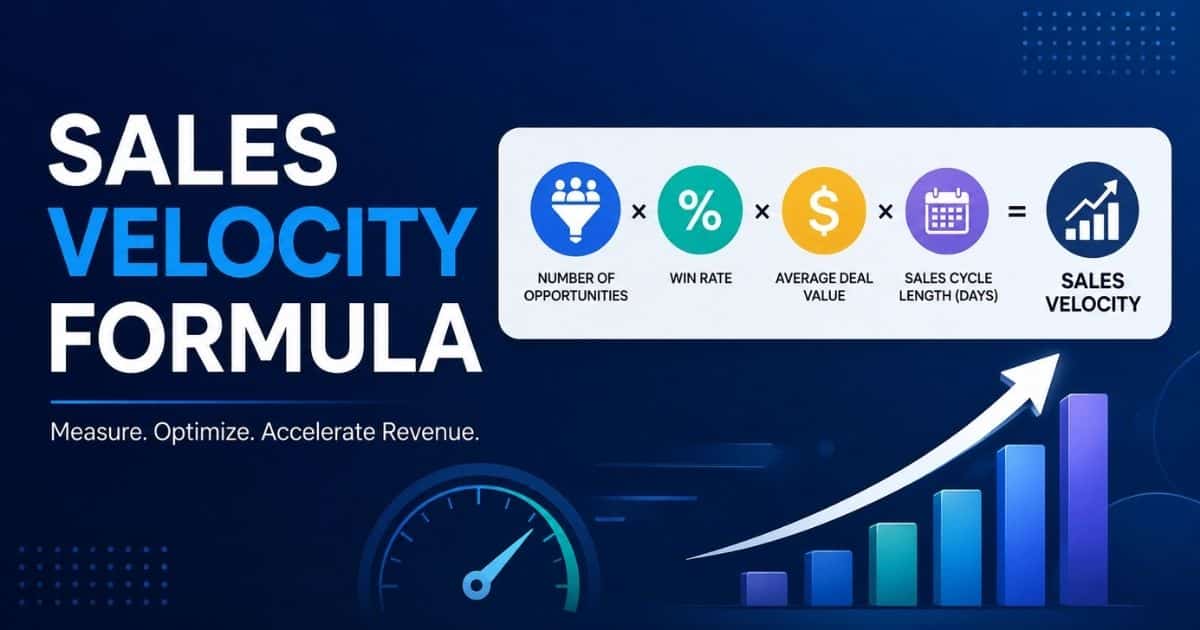
Pipeline coverage gives sales leaders a practical view of whether there is enough active opportunity to hit revenue quota. Many teams target 3 to 4 times quota in pipeline, adjusted for win rate, segment, and deal risk. Sales velocity is simple: number of qualified opportunities multiplied by win rate and average deal size, divided by average sales cycle. A small improvement in win rate or deal size can lift future revenue quickly. For SaaS forecasting, recurring revenue, expansion, renewal risk, and customer lifetime value also matter, even when the core sales funnel stops at Purchase.
Forecasting Methods Based On Funnel Data
Sales forecasting usually combines stage-weighted pipeline, historical conversion modeling, and cohort-based forecasts. Early opportunities receive lower probability weights than late-stage deals because buyer commitment is weaker. Large asymmetric deals should be forecast as separate scenarios because one enterprise contract can distort the full number. Back-testing forecast accuracy every quarter improves assumptions after market shifts, pricing changes, or new competitors enter. Clean CRM data, consistent stage definitions, and rep training are non-negotiable for credible pipeline management, and effective CRM use to improve sales productivity directly supports this rigor.
Funnel Health Over Time
Funnel health should be reviewed monthly and quarterly with rolling averages, not one-off reactions. Dashboards should show stage counts, conversion rates, deal age, time in stage, average deal size, source quality, and revenue generated. Sales organizations that stay ahead of the competition run extensive, ongoing competitive analysis, from features and benefits breakdowns to product positioning and third-party industry analysis. Healthy funnels show stable ratios between stages. Sudden changes in one sales funnel stage deserve investigation, especially when they affect forecast accuracy or close dates.
Buyer Journey Alignment With Funnel Stages
The customer journey is rarely linear. Buyers use websites, email, events, marketplaces, peer communities, analysts, partners, and self service research before speaking with a vendor. The best revenue teams align the b2b sales funnel with real buyer behavior instead of forcing every account through internal steps too rigidly.
Buyer Questions By Funnel Stage
In Awareness, buyers ask whether the problem is real and worth solving. In Interest, they ask which approaches exist. In Consideration, they ask which vendor fits their use case, integrations, budget, and risk tolerance. In Decision, they ask why this vendor now and who must approve. Different stakeholders can sit in different stages at the same time. End users care about usability, IT cares about risk, finance cares about payback, and executives care about strategic value. During the Needs Discovery stage, sellers must understand the buyer’s needs by asking insightful questions and inspiring them with new ideas, which can significantly influence buyer loyalty.
Stage-Specific Touchpoints That Match Buyer Readiness
Touchpoints should match buyer readiness. Awareness needs reports, practical blog content, events, and useful problem framing. Interest needs webinars, nurture sequences, and light discovery. Consideration needs demos, case studies, ROI tools, and technical workshops. Decision needs proposals, references, contract support, and executive alignment. In outbound journeys, sellers create more early momentum. In inbound or product-led journeys, buyer behavior tells the team when to engage. High-performing teams document the sequences that work and train new sales reps to repeat them with judgment.
Nonlinear Journeys And Loopbacks
Buyers often loop back when budgets change, a new stakeholder joins, or risk concerns surface. A prospect revisiting a pricing page, security page, or comparison asset may be showing both interest and concern. The right response is not pressure. It is re-qualification, updated ROI analysis, refreshed stakeholder mapping, and relevant proof. A deal that stalls for months can reactivate when a new champion arrives and needs a clean summary of the original problem, current value case, and agreed next step.
Marketing And Sales Coordination Around The Journey
Shared journey maps align campaign planning, SDR scripts, AE playbooks, and handoff rules. Service level agreements define response times, required qualification fields, and feedback loops on lead quality. For example, sales may commit to contacting new SQLs within one business day, while marketing commits to passing source, content engagement, and ICP data. Strong marketing and sales teams reduce friction around “lead quality” because both teams can see the same signals and outcomes, especially when they use a shared CRM designed to help sales teams manage leads effectively. This alignment improves sales and marketing efforts across the full buying process.
The Journey Beyond Purchase
Although this article focuses on Purchase, real growth continues through onboarding, adoption, renewal, expansion, and advocacy. A 5% increase in customer retention can boost revenue by 25-95%, significantly increasing customer lifetime value (LTV). Post-purchase engagement is essential for building a strong B2B sales pipeline and ensuring customer satisfaction, as dissatisfied customers are quick to churn. Happy customers are more likely to become brand advocates, offer testimonials, and leave positive reviews, which can enhance a company’s reputation and attract new clients. Loyal customers also create referrals and expansion pipeline through word of mouth.
Strategies For Improving Conversion Rates At Each Stage
Better conversion does not come from generic activity. It comes from focused experiments by funnel stage, clear ownership, and consistent follow-through. Sales and marketing teams should improve targeting, messaging, sales enablement, handoffs, and coaching as one system, using smart sales task automation to remove manual work where possible.
Top-Of-Funnel Awareness And Interest
Strong top-of-funnel performance starts with a sharper ICP and clearer value proposition. Segment by vertical, role, pain point, and deal size instead of speaking to everyone. Search, paid social, partner marketing, events, and content syndication can all work, but channel mix should reflect deal economics. For example, enterprise deals may justify account-based programs and executive events, while smaller opportunities may rely more on search and educational content. A campaign tied to a measurable business outcome, such as reducing manual reporting hours, usually attracts better-fit leads than generic product messaging.
Middle-Of-Funnel Consideration Improvements
Consideration improves when buyers see fit, proof, and relevance. Tailored demos, role-specific case studies, consultative discovery, and technical resources help buyers connect the solution to their environment. Personalization by industry, role, and tech stack shows that the seller understands the buyer’s constraints. Dynamic nurture flows based on observed behavior perform better than static email drips because they respond to what the buyer is actually doing. Sales automation can help route leads, trigger tasks, and prevent delays, especially when supported by a CRM with strong email integration, but seller judgment still determines whether the conversation creates trust.
Late-Stage Win Rate Gains
Late-stage losses often come from weak business cases, single-threaded relationships, and objections that should have been addressed earlier. Sellers should build relationships with 3 to 5 stakeholders, prepare executive-ready summaries, and co-create implementation plans with the buyer. Negotiation should protect value while allowing flexibility on timing, packaging, or payment structure. If a CFO challenges risk, an executive sponsor, quantified ROI narrative, and customer proof can keep the deal alive. Win-loss analysis and coaching improve win rates over several quarters.
Friction Between Funnel Stages
Many opportunities are lost between stages, not inside them. Required fields, handoff checklists, next-step agreements, and deal summaries reduce confusion. Automated routing and task reminders ensure no qualified lead waits days for follow-up while interest fades. Clear ownership matters: marketing owns early education, SDRs validate interest, AEs manage opportunities, and customer success prepares for value delivery. A short SDR-to-AE handoff note covering pain, stakeholders, urgency, objections, and next meeting can prevent repeated discovery and improve buyer confidence, especially when supported by a simpler, well-structured sales workflow in your CRM.
Continuous Funnel Improvement Culture
Sustainable gains require monthly funnel reviews, small A/B tests, rep coaching, and regular ICP refinement. Revenue teams should treat funnel metrics as shared scorecards, not management-only reports. Markets shift, competitors reposition, and buyers change expectations, so the sales process must keep improving. The best teams ask where deals slow down, what proof buyers need, which sources create paying customers, and where marketing spend produces revenue. That discipline helps teams close more deals without relying only on higher lead volume.
Role Of Technology And AI In Managing Funnel Stages
By 2026, CRM, marketing automation, sales engagement, revenue analytics, and AI analytics have become common in B2B sales operations. These tools support fundamentals, but they do not replace clear stage definitions, strong qualification, and disciplined follow-up.
Core Technology Foundation For B2B Sales Funnels
The core stack usually starts with CRM as the system of record, marketing automation for nurture, sales engagement for outreach, and analytics for performance visibility. Integrations help stage changes, activities, and outcomes stay accurate. Common problems include duplicate contacts, inconsistent fields, missing next steps, and manual data entry. Tool consolidation can improve reporting on b2b sales funnel stages because leaders can see contact history, activities, pipeline status, and forecast risk in fewer places, especially when they implement a purpose-built B2B sales CRM for revenue teams.
AI For Lead Scoring And Prioritization
AI-based lead scoring evaluates behavior, firmographic fit, engagement, and historical win patterns to prioritize high-value accounts. It can surface an account that visited the pricing page twice, downloaded a technical guide, and matches the ICP, even if that account is buried in a large database. Human oversight remains essential because markets change and models can overvalue the wrong signals. Transparent scoring criteria help sales professionals trust recommendations instead of treating AI as a black box, particularly when those criteria are embedded into smart CRM tools for sales teams.
AI For Personalization And Engagement
AI can personalize outreach timing, email content, website suggestions, and recommended case studies based on buyer behavior. During Consideration and Decision, AI can help suggest the most relevant proof, such as a customer story from the same industry or a video for a specific role. Personalization improves engagement when it is accurate, respectful, and privacy-aware. Over-automation creates robotic outreach and buyer fatigue, so the best results come from combining AI recommendations with human context.
AI For Pipeline Risk Detection And Forecasting
AI can detect risk patterns such as stalled activity, missing stakeholders, shrinking deal value, or close dates that keep slipping. AI-enhanced forecasts use historical conversion, engagement signals, and stage behavior to refine close probability. Real-time alerts allow sales leaders to intervene earlier with coaching, executive support, or a revised mutual action plan. The forecast should still be back-tested against actual results each quarter because trust depends on accuracy, not novelty.
Responsible AI Use In B2B Sales
Responsible AI use requires privacy controls, bias monitoring, access permissions, and clear policies on what data is collected and processed. Reps and managers need training on AI limitations, especially when scoring models influence outreach priority or forecast confidence. AI should augment human decision-making, not replace relationship-building, critical thinking, or direct buyer discovery. Responsible use strengthens trust with buyers and internal teams, which supports long-term funnel performance.
Gain.io And The Future Of B2B Sales Funnel Management
Gain.io is a sales CRM built to help sales teams manage leads, prospects, customers, and opportunities through a clear sales process. For teams refining b2b sales funnel stages, the value is practical: contact management keeps buyer information organized, visual sales pipelines show where deals stand, sales task management keeps follow-ups on track, notes capture sales conversations and decision history, email integration supports outreach, and calendar management helps teams plan demos, follow-ups, and pipeline reviews.
A B2B team can use Gain.io to see that many qualified leads reach Consideration but do not progress. The sales leader can review pipeline stages, notes, follow-up tasks, email activity, and deal history to identify patterns, such as weak discovery, missing technical stakeholders, or no agreed next step. The team can then improve demo preparation, add stronger proof points, and create clearer follow-up tasks for sales reps. As shown in a sales acceleration case study on closing deals faster with Gain.io, the result is a cleaner pipeline, more consistent execution, and better visibility into where deals need attention.
The future of funnel management will keep moving toward clearer data, faster follow-up, and better collaboration across revenue teams. Choosing CRM tools that align with your team’s daily habits and workflow is critical, which is why many leaders use a guide to selecting CRM tools that fit their workflow before committing. Gain.io’s role is to reduce friction in sales workflows, eliminate scattered deal information, and give sales teams a dependable place to manage relationships and close opportunities without unnecessary complexity.
Frequently Asked Questions
How Many Stages Should A B2B Sales Funnel Have?
Most effective B2B funnels use 5 to 7 stages, depending on deal complexity, reporting needs, and the sales motion. If you are asking how many stages to start with, use Awareness, Interest, Consideration, Decision, and Purchase. Add or split stages only when the extra detail improves coaching, forecasting, or handoffs. Too many micro-stages create reporting noise. Too few stages hide important differences in buyer readiness.
How Do B2B Sales Funnels Differ For SaaS Companies?
Many saas companies add product-led signals such as free trials, freemium usage, logins, feature adoption, and team invites. These signals often sit between Consideration and Decision because they show whether users are gaining value before they become paying customers. SaaS funnels also place more weight on onboarding, adoption, renewal, and expansion because recurring revenue depends on long-term usage, not just the first contract.
What Should Sales Leaders Do When Deals Get Stuck In One Funnel Stage?
Stalled deals should trigger a structured review, not random chasing or discounting. Sales leaders should re-check qualification, confirm the business problem, identify missing stakeholders, revisit ROI, and clarify the next step. Time-in-stage thresholds, such as 30 or 45 days with no meaningful activity, help managers spot risk early. Dormant deals should be reclassified or closed out so forecasts stay realistic.
How Can Smaller B2B Teams Track Funnel Stages Without An Enterprise Tech Stack?
Smaller teams can track funnel stages with a lightweight CRM, consistent stage definitions, simple automation, and a shared dashboard. Start with clean data entry, required next steps, lead source tracking, and basic conversion reporting. A monthly review can quickly show leaks, such as MQLs not contacted by sales or opportunities stuck after demos. For startups and small sales teams, a simple CRM built for smaller teams can provide this structure without enterprise complexity. Process discipline matters more than tool complexity at this stage.
How Do Economic Downturns Affect B2B Sales Funnel Stages?
Economic downturns usually lengthen Decision and Purchase because buyers add approvals, scrutinize ROI, and delay budget release. Awareness and Interest may stay active, but deals can pause, shrink, or require stronger cost-saving arguments. Sales leaders should adjust forecast assumptions, prioritize opportunities with clear 12 to 18 month payback, and help buyers build internal consensus. Teams with disciplined funnel visibility are better positioned to accelerate when demand returns.