TL;DR: Enterprise B2B deals move through 6 stages — account selection, discovery, executive buy-in, technical evaluation, negotiation, and onboarding — and typically take 84+ days to close. This guide breaks down each stage, benchmark cycle lengths by segment, and tactics to move deals faster.
Enterprise sales cycle stages often involve far more complexity than standard B2B transactions. Enterprise sales teams usually deal with complex sales environments where multiple stakeholders, longer sales cycles, and detailed evaluations shape every decision. Unlike smaller deals, enterprise sales deals require a structured process that aligns with the needs of enterprise companies and their decision-makers.
From the first discovery call to final negotiations, sales reps must address business pain points, build trust with the customer base, and present relevant company offers backed by CRM insights. Qualified leads also take more time to nurture because buyers expect tailored solutions and long-term value. A clear enterprise sales strategy helps teams stay organized, improve communication, and move deals forward without losing momentum across different sales cycle stages.
If your deals are stalling earlier in the process, see our guide to shortening a long sales cycle. For the sales strategy that sits underneath a well-run enterprise motion, see our B2B sales strategy guide.
Enterprise Sales Cycle Stages In Complex B2B Deals
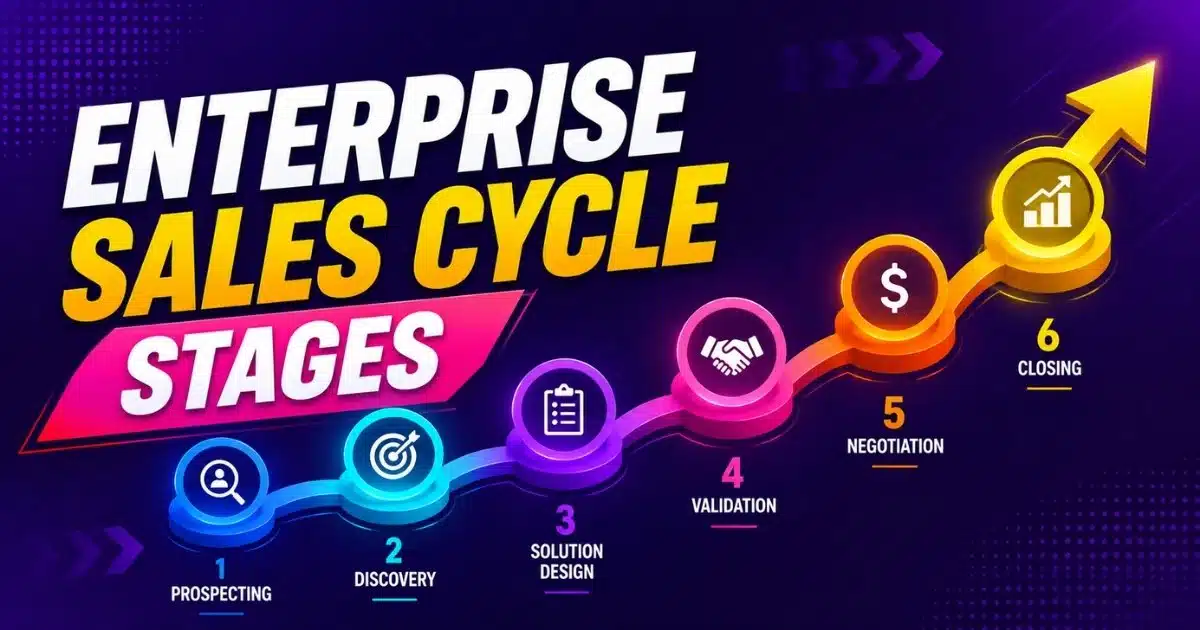
The modern enterprise sales process can be broken down into six core stages: research, prospecting, discovery, solution alignment, procurement/legal, and closing/onboarding. This framework provides enterprise account executives and sales leadership with a repeatable structure for managing deals from initial targeting through long-term expansion.
Account Selection And Ideal Customer Profile Alignment
Enterprise sales start with focused account selection, not random cold outreach. Sales reps build Ideal Customer Profiles using firmographic filters like 1,000+ employees and $1B+ revenue, combined with technographic signals such as current tech stack and intent data from platforms like Bombora.
Enterprise deals typically involve 8 to 12 stakeholders including champions, blockers, and economic buyers. Targeting accounts that match your top 20 percent profiles can accelerate close rates by 2.5x according to Gartner research. Focus Digital’s 2025 benchmarks reveal targeted account-based strategies reduce prospecting time by 40 percent and boost opportunity-to-close rates by 25 percent in enterprise segments versus broad outreach.
Customer relationship management systems integrate territory models at this stage, with account executives typically handling 10 to 20 ideal accounts rather than the 100+ common in SMB sales. A well-designed B2B sales CRM for complex cycles supports this model by centralizing account data, activities, and stakeholder insights. This focused approach ensures adequate attention for the long enterprise sales cycle ahead.
Discovery And Deep Qualification
Discovery is the stage where enterprise sales reps qualify pain, fit, and urgency across multiple stakeholders, not just the first contact. The discovery stage is crucial in the enterprise sales cycle as it helps sales teams understand the prospect’s pain points and specific requirements.
Lead qualification frameworks like MEDDIC (Metrics, Economic Buyer, Decision Criteria, Decision Process, Identify Pain, Champion) adapt well to layered decision processes. Forrester’s 2025 Sales Enablement Report indicates 70 percent of enterprise deals stall due to poor qualification. Understanding the client’s business and mapping successful, long-term solutions is essential in enterprise sales, as it helps demonstrate clear ROI and addresses the nuanced pain points of various stakeholders.
Sales automation tools can help streamline the enterprise sales process by saving time on lead qualification and nurturing, allowing sales teams to focus on high-value activities. Implementing a dedicated sales automation CRM ensures these workflows are consistent, trackable, and tightly connected to pipeline stages. Best practices include confirming the economic buyer early, documenting decision criteria, and qualifying out 50 percent of leads in first discovery calls to protect limited sales engineering capacity. ZoomInfo’s MEDDIC adoption shortened their average discovery phase from 45 to 28 days.
Solution Alignment And Executive Buy In
This phase translates discovery insights into a tailored solution narrative using sales methodology approaches like Challenger Sale or consultative selling. Building strong relationships with key stakeholders within an enterprise is crucial for success in enterprise sales, as it often involves multiple decision makers across various departments.
Sales representatives who excel in relationship-building are more likely to succeed in enterprise sales, as they can establish trust, build consensus, and effectively negotiate with multiple stakeholders. Co-creating a vision with prospects through workshops, ROI models, and mutual action plans significantly improves outcomes for deals over $100K ACV. Utilizing interactive demos rather than traditional presentations can enhance stakeholder engagement in the sales process.
The business case must quantify impact using benchmarks and customer data, not vague promises. Engaging 3+ stakeholders at this stage increases win rates by 28 percent per Gartner research and positions your value proposition effectively across the buying committee.
Technical Evaluation, Security Review, And Proof Of Value
Technical stages often consume 30 to 50 percent of the entire sales cycle due to infosec reviews, data privacy assessments, and integration validations. Enterprises generally require customized solutions that can be scaled to meet their specific demands, while SMBs often seek quick, off-the-shelf solutions. Enterprise sales often require customized solutions that can be scaled to meet specific demands, making the sales process more complex and time-consuming.
Activities include detailed demos, sandbox access, proof of concept deployments, pilot projects, and security documentation for IT and security teams. Deloitte’s 2025 Vendor Risk Management study indicates security reviews add 4 to 8 weeks in regulated sectors, with 62 percent of enterprises requiring SOC 2 and GDPR compliance upfront.
Proactive libraries containing security questionnaires, ISO certifications, and implementation playbooks accelerate this stage by 35 percent. These are core elements of long sales cycle strategies and metrics that keep complex deals moving while maintaining governance. Customer success and solution engineering involvement de-risks complex deployments and builds internal trust with technical evaluators.
Commercial Negotiation, Procurement, And Closing
Enterprise negotiation spans pricing, legal terms, SLAs, procurement processes, and executive approvals across departments. Engaging legal and procurement teams early in the sales process can prevent delays and streamline the deal closure. Rigorous sales deal tracking practices also help leadership spot stalled approvals and intervene before quarter-end. The enterprise sales cycle involves multiple stakeholders and high-value contracts, requiring a consultative, risk-management approach that prioritizes building trust and consensus among stakeholders.
Creating a Mutual Action Plan (MAP) with specific dates and owners can effectively manage the sales cycle by aligning executives on strategic value. Common friction points include redlined contracts, data processing agreements, and procurement queues. Legal reviews average 21 to 45 days, but executive sponsorship can accelerate closes by 70 percent.
Bridge Group research notes an 18 percent win rate drop from excessive discounting over 25 percent, emphasizing the importance of maintaining value during negotiation rather than simply cutting price to close deals.
Onboarding, Adoption, And Expansion
Onboarding functions as a formal stage of the enterprise sales process with clear revenue and retention objectives. Driving a warm handoff to customer success to ensure retention is key to maintaining a long-term partnership after a sale. This handoff includes sharing discovery notes, success metrics, and timelines within the CRM.
Early adoption milestones within 30 to 90 days correlate strongly with renewal likelihood. Gainsight’s 2025 benchmarks show 90 percent renewal rates when time-to-value falls within this window. The customer journey does not end at contract signature.
Expansion, upsell, and cross-sell opportunities become part of the long enterprise sales cycle. Bessemer Venture Partners reports 40 percent of enterprise ARR comes from upsells. This stage treats expansion as a continuation of the same disciplined sales cycle stages, not separate random events.
Enterprise Sales Cycle Length, Benchmarks, And Industry Data
Average sales cycle length varies significantly by deal size, sector, and sales channel. HubSpot’s 2025 data shows an 84-day median B2B SaaS cycle, but enterprise and mid market segments trend materially higher. The enterprise sales cycle typically spans from 6 months to 2 years, involving multiple stakeholders and long procurement processes, which makes mastering long sales cycle strategies and metrics essential for accurate planning.
Cycle Length By Deal Size And Company Segment
Deal size correlates directly with sales cycle length. SMB sales in the $10K to $25K range typically close within 30 to 60 days, while $100K to $500K mid market and enterprise deals extend to 6 to 12 months. Deals exceeding $1M often require 12 to 24 months.
Large companies with 5,000+ employees require more stakeholder alignment and approvals than mid market organizations with 200 to 2,000 employees. Misclassifying deals by segment skews the sales pipeline and creates forecast inaccuracies that damage planning.
Cycle Length By Industry And Buying Complexity
Heavily regulated sectors like financial services, healthcare, and government typically have the longest enterprise sales cycles. Financial services deals often span 9 to 18 months due to compliance requirements, while mid market HR software might close in 4 to 6 months.
Mandatory security audits, legal reviews, and compliance checks add predictable time to each stage. Internal change management on the buyer side acts as a hidden driver of longer timelines, sometimes adding 20 to 30 percent to the total cycle.
Impact Of Sales Channel And Product Complexity
Inbound opportunities with clear intent typically move 20 percent faster than cold outreach. Partner-led sales channels may accelerate trust in certain ecosystems. Product complexity, integration requirements, and implementation scope expand or compress specific sales cycle stages.
Complex, multi-module platforms close slower than narrow point solutions at similar ACV. The tradeoff involves higher lifetime value from complex solutions against longer, more resource-intensive deal cycles that demand greater sales team investment.
Stakeholder Count, Buying Committees, and Multi-Threading
Average buying committees in enterprise accounts have grown from around 5 people to 8 to 12 over the last decade, according to Gartner’s 2024 research. With enterprise sales involving 10 or more stakeholders, the need for consensus among various departments can complicate and prolong the sales process.
Engaging 3 or more contacts in the prospect company can result in closing deals 2.4 times faster. Multi-threaded deals demonstrate 1.7x higher win rates and reduce risk when one contact changes roles or leaves the company. Stakeholder mapping discipline inside the CRM prevents surprises late in the cycle.
Forecasting Accuracy And Revenue Planning
Understanding true enterprise sales cycle stages and lengths improves forecast accuracy and cash flow planning. Typical forecast slippage in enterprise sales runs 25 to 40 percent without proper stage definitions anchored to concrete exit criteria.
Sales managers can use historical opportunity data from CRM software to model realistic close dates for different regions and verticals. A dedicated sales pipeline CRM makes these patterns visible through clear stage views and real-time metrics. Stage definitions cut slippage by 25 percent and enable predictions within 10 percent variance.
Sales Strategy For Enterprise, Mid Market, And SMB Segments
Enterprise sales, mid-market, and SMB sales require distinct strategies based on cycle length, deal size, and stakeholder complexity. A one-size-fits-all sales strategy does not work. Effective enterprise sales management requires a high-velocity, technology-enabled approach that differs fundamentally from SMB velocity plays.
Structuring Enterprise Sales Motions
Enterprise sales motions rely on account-based strategies, dedicated account executives, and often sales engineers due to technical complexity. Strong sales visibility across complex pipelines is critical so leaders can understand which strategic accounts are progressing and which are stuck. Sales reps handle fewer accounts with deeper research and more meetings per opportunity over 6 to 18-month cadences.
Marketing supports enterprise sales strategy through executive events, targeted content, and C-level outreach. Sales training specific to enterprise negotiations and stakeholder alignment becomes essential. Target account lists, executive briefings, and mutual success plans form the foundation.
Designing Mid-Market Sales Plays
Mid-market sales bridges SMB speed and enterprise complexity with typical cycles of 60 to 120 days. These strategies combine volume-oriented tactics with light account-based personalization suited to the target audience.
SDR and BDR teams feed mid-market account executives, often supported by scalable digital content. Effective CRM-based lead management ensures these handoffs are clean and that high-intent prospects receive timely follow-up. Deal sizes and stakeholder counts allow hybrid inside and field models that balance efficiency with the relationship depth needed for paying customers.
Aligning SMB Sales For Velocity
SMB sales focus on speed, self-service elements, and shorter average sales cycle length, often under 30 to 60 days. PLG (product-led growth), free trials, and light-touch sales support dominate SMB playbooks focused on converting potential customers quickly, especially when combined with automated sales task workflows that prevent leads from slipping through the cracks.
Minimal stakeholder involvement, often 1 to 2 decision makers, contrasts sharply with enterprise buying committees. Applying enterprise processes to SMB hurts conversion rates and wastes resources. However, SMB deal data can inform messaging and proof points used later in mid-market and enterprise pursuits.
Cross-Segment Sales Methodology And Enablement
A unifying sales methodology that flexes across SMB, mid-market, and enterprise prevents rep confusion while maintaining consistency. Core concepts like discovery, qualification, and mutual next steps remain consistent while depth varies by segment.
Ongoing sales enablement programs adapt pitches, assets, and tools by deal size and complexity. Aligning enablement content with a simpler, CRM-driven sales workflow makes it easier for reps to apply training in their daily pipeline management. Studies link structured enablement to 22 percent higher quota attainment in complex B2B teams through better sales training and process adherence.
Revenue Operations And Territory Design Across Segments
RevOps teams use data to allocate headcount and territories between SMB, mid-market, and enterprise based on historical performance. Thoughtful CRM automation for revenue teams ensures these strategic decisions are supported by accurate, up-to-date data rather than manual spreadsheets. Misaligned territories or compensation models can skew rep focus away from strategic enterprise accounts toward easier SMB wins.
Historical win rates, average deal size, and sales cycle length inform territory and quota design. Balancing near-term SMB revenue with longer-term enterprise bets requires deliberate planning and continuous improvement of the allocation model.
Customer Relationship Management Across The Enterprise Sales Cycle
CRM software serves as the backbone of enterprise sales execution, not merely a reporting tool. All-in-one platforms like Gain.io CRM for growing sales teams centralize contacts, deals, and activities so each sales cycle stage relies on accurate, shared CRM data to avoid stalled deals and missed stakeholders.
Structuring Sales Cycle Stages Inside CRM
Mapping the six enterprise sales stages into CRM opportunity stages with clear exit criteria enables accurate reporting. Using smart CRM features for stage management makes it easier to standardize these definitions so discovery, technical evaluation, and negotiation mean the same thing across all teams.
Well-structured stages enable accurate reporting on win rates, stage conversion, and sales cycle length. Clarity matters more than granularity. Too many micro-stages without clear criteria create confusion rather than visibility.
Improving Data Quality And Deal Visibility
Incomplete contact records, missing activities, and outdated fields undermine enterprise forecasting. Tactics for improving data hygiene include automated enrichment, required fields, and regular pipeline reviews with sales managers. Keeping an eye on future CRM technology trends helps teams adopt emerging tools that further improve data completeness and accuracy.
Culture and coaching help sales reps view the CRM as a shared operating system rather than administrative overhead. Research shows a correlation between a 40 percent improvement in data completeness and 18 percent higher win rates.
Leveraging Analytics For Sales Cycle Optimization
CRM and BI tools analyze bottlenecks by stage, segment, or region in enterprise deals. Using a robust sales pipeline CRM for visibility makes it easier to track key metrics like stage conversion rates, average days in stage, and variance between top and average performers.
Analytics inform targeted coaching and process changes to accelerate specific stages like technical review or legal negotiation. Dashboards spot 20 to 30 percent of bottlenecks that qualitative reviews miss.
Coordinating Cross Functional Enterprise Deal Teams
Marketing, sales, customer success, legal, finance, and product must collaborate seamlessly in enterprise sales. Centralized contact and relationship management within CRM provides a single view of the account and sales cycle stages for all stakeholders involved in complex deals.
Account plans, shared notes, and tasks manage internal collaboration. Clear internal responsibility using RACI frameworks speeds approvals and responses to buyer requests by 30 percent, according to research.
AI And Automation In Modern CRM Workflows
AI-powered features like automated call summaries, predictive scoring, and next-step recommendations support enterprise sales reps. Purpose-built AI sales assistant tools for pipeline efficiency plug into CRM data to surface risks and next actions in real time. Automation reduces admin work while preserving genuine human relationship building with stakeholders. Implementing a sales engagement platform can enhance the effectiveness of CRM data by enabling personalized communication with customers, which is crucial for building relationships in enterprise sales.
Using AI tools in sales processes can help identify patterns and provide actionable insights, which can optimize decision-making and improve sales forecasting accuracy. AI-assisted teams see improved conversion and reduced ramp time for new enterprise account executives. However, over-automation risks generic outreach that damages a business relationship in high-value environments.
Sales Cycle Optimization Tactics For Complex Enterprise Deals
Sales cycle optimization means shortening time to close without skipping critical steps or harming win rates. This requires diagnosing bottlenecks at each stage and designing targeted interventions rather than generic quick fixes.
Key stages in the enterprise sales cycle include prospecting, discovery, solution design, proposal and presentation, and contract signing. Sustainable improvements come through better qualification, multi-threading, and content strategy, all of which are central themes in modern long sales cycle strategy playbooks.
Refining Lead Qualification And Discovery
Tightening qualification criteria removes low-probability deals from the sales funnel earlier, shortening average sales cycle length and protecting capacity. Best practices for discovery calls produce clear next steps and stakeholder maps, not surface-level needs assessments.
Top performers spend more time with fewer, higher quality opportunities in enterprise environments. Robust CRM-based lead and opportunity management helps enforce these focus decisions. Strong qualification protects limited sales engineering and implementation capacity for deals most likely to close.
Multi Threading And Stakeholder Alignment
Practical multi-threading involves identifying and engaging additional stakeholders early through org chart mapping and asking champions targeted questions about who else needs involvement. Multi-threaded deals survive when one contact changes role or leaves the company.
Regular stakeholder summaries and shared docs keep large buying groups aligned on progress. Coupling this with disciplined deal tracking inside CRM ensures no stakeholder conversations or commitments are lost. Sales teams treating stakeholder alignment as a continuous process rather than a one-time task see measurably faster closes and higher customer satisfaction during the buying journey.
Content, Proof, And Business Case Assets
Tailored case studies, ROI calculators, technical one-pagers, and recorded demos give champions tools to sell internally. Reference stories like a 37 percent cycle-time reduction in a sales acceleration case study provide concrete evidence of impact. Specific, relevant proof points speed decision making versus generic marketing collateral by 2x according to research.
Assets should mirror the sales cycle stages: discovery summaries, evaluation guides, security packets, and implementation outlines. Proof must address both business and technical risk. Reference data from existing customers showing measurable outcomes like 20 to 30 percent efficiency gains when available. Previous customers provide the brand credibility that moves enterprise deals forward.
Process Discipline, Mutual Action Plans, And Timelines
Mutual action plans function as shared timelines with milestones, owners, and dates aligned to the buyer’s internal process. Visualizing these steps in a pipeline-focused CRM makes it easier for teams to monitor progress and anticipate risks. Evidence shows structured mutual plans reduce slippage by 28 percent and clarify expectations.
Introducing mutual action plans after solution alignment or at evaluation start keeps both sides on the same page. Key milestones include stakeholder workshops, security review completion, procurement approval, contract signature, and go-live dates.
Coaching, Deal Reviews, And Continuous Improvement
Regular deal reviews focused on specific sales cycle stages improve both sales pipeline health and rep skills. Structures like weekly forecast calls, stage-based reviews, and win-loss analyses work well for complex B2B deals.
Sales leaders use CRM data and conversation intelligence to coach on discovery depth, negotiation tactics, and stakeholder management. Automating follow-ups and reminders with sales task automation inside CRM reinforces these coaching priorities in day-to-day execution. Research links consistent coaching rhythms to 27 percent higher attainment in enterprise teams. High-quality deal review agendas focus on specific stage risks and required next actions rather than generic status updates.
Gain.io Enterprise Sales Perspective
Gain.io supports revenue teams running complex, multi-stakeholder B2B sales cycles with smart CRM tools for sales teams, helping shorten cycle length and improve stakeholder visibility. It integrates with existing CRM and sales stacks rather than replacing them, so enterprise teams can adopt it without disrupting an already-complex process.
Frequently Asked Questions
How Do Enterprise Sales Cycle Stages Differ From A Simple SMB Sales Funnel?
The enterprise sales process operates non-linearly with 6 to 11 stakeholders, multiple evaluation phases, and extended negotiations. SMB sales funnels move linearly with 1 to 2 decision makers through initial contact to close in 30 to 45 days. Enterprise cycles revisit discovery and alignment multiple times as new stakeholders surface.
When Should Teams Consider Adding Or Removing Sales Cycle Stages?
Deal size thresholds, regulatory requirements, or internal capacity constraints justify modifying stages. Use historical CRM data to identify natural inflection points where deals change status, such as after security review completion. Avoid adding stages purely for reporting granularity without clear exit criteria. Consider splitting evaluation into business and technical review once deals regularly exceed $100K ACV and involve distinct stakeholder groups for each.
How Can Growing Teams Transition From Founder Led To Structured Enterprise Sales Cycles?
Scaling past a handful of large customers or hiring the first dedicated account executives typically triggers this transition. Start by documenting what already works in current customer experiences, define core stages based on actual buyer milestones, then train early hires on the formal process. Keep the first version simple and grounded in real customer journeys.
What Metrics Best Show Whether Enterprise Sales Cycle Optimization Works?
Track overall sales cycle length, days in stage, stage conversion rates, win rate by segment, and forecast accuracy. Improvements should be measured over at least two to three quarters to filter noise from individual large deals. Optimization success means both faster closes and more predictable outcomes.
How Do You Maintain Strong Customer Relationships Across Long Enterprise Sales Cycles?
Consistent, value-adding touchpoints matter more than transactional check-ins during months between major meetings. Share relevant research, invite prospects to customer roundtables, and provide early access to product updates. Strong customer relationship management helps prospects make good decisions even when they are not close to signing. Retail and other industry-specific teams can strengthen this further by using CRM tools built for organized retail sales and aligning them with a simpler CRM-driven sales workflow.