The way businesses score leads has changed dramatically over the past decade. What once required manual spreadsheets and gut instincts now happens in seconds through AI lead scoring tools that process vast amounts of behavioral and firmographic data. According to recent industry surveys, 98% of users report better lead ranking after implementing AI systems, while companies see decision accuracy improve by up to 30%.
This guide covers everything sales and marketing teams need to know about lead scoring in 2026. You will learn how traditional approaches compare to AI methods, understand the key benefits of automation, and discover what factors matter most when choosing a scoring solution. Whether you manage a small team or oversee enterprise operations, the principles here apply to any organization ready to prioritize leads based on real conversion potential rather than assumptions.
What Is Lead Scoring
Lead scoring is the process of assigning numerical values to prospects based on their likelihood to become customers. Marketing and sales teams use these scores to prioritize leads, allocate resources efficiently, and focus outreach on contacts most likely to convert. The lead scoring model typically considers multiple lead attributes including job title, company size, engagement history, and behavioral signals like website visits or content downloads.
Historically, businesses relied on manual scoring where team members assigned points based on predetermined scoring rules. A prospect who downloaded a whitepaper might receive 10 points, while someone who attended a webinar earned 20 points. These scoring criteria helped rank leads based on perceived interest, but the approach had significant limitations. Studies show that traditional lead scoring methods struggle with accuracy as lead volumes grow, often missing subtle intent signals that indicate genuine purchase readiness.
The evolution toward ai lead scoring represents a fundamental shift in how organizations evaluate prospects and modernize their overall lead qualification process for sales teams. Rather than static point assignments, machine learning algorithms analyze patterns from past leads to predict which new contacts share characteristics with previous buyers. This approach to transforming raw data into actionable insights allows teams to score leads at scale without sacrificing precision.
Key Challenges With Traditional Lead Qualification
Every sales organization eventually hits a ceiling with manual lead qualification. The lead qualification process becomes increasingly strained as inbound leads multiply, new data sources emerge, and buyer journeys grow more complex. Here are the core obstacles that push teams toward automated lead scoring.
Inconsistent Lead Evaluation Criteria
Manual scoring relies heavily on individual judgment, which creates variability across teams and regions. One sales rep might consider a mid-level manager at a 500-person company highly qualified, while another prioritizes only C-suite contacts at enterprise accounts. This inconsistency makes forecasting unreliable and pipeline comparisons meaningless.
Research indicates that scoring systems without standardized criteria produce qualification discrepancies of 40% or more between team members. When scoring rules differ by geography or department, marketing teams struggle to optimize campaigns and sales reps waste time debating lead quality rather than selling.
Limited Data Analysis Capabilities
Traditional scoring methodologies examine a handful of explicit attributes like demographic and firmographic data. Typical inputs include company size, industry vertical, and stated budget. While these factors matter, they represent only a fraction of available intent data.
Modern buyers interact across dozens of touchpoints before engaging sales. They read blog posts, compare competitors, attend virtual events, and explore product documentation. Manual methods cannot synthesize these behavioral patterns into meaningful scores. The result is incomplete picture of sales readiness that misses qualified leads hiding in plain sight.
Time Intensive Lead Review Processes
Sales reps spend considerable hours each week manually reviewing and categorizing prospects. Industry benchmarks suggest that manual lead analysis consumes 15 to 20 hours monthly per representative. This time consuming effort pulls attention away from revenue-generating activities like discovery calls and demos.
The problem compounds as organizations scale. A team processing 500 monthly leads might manage with manual reviews, but growth to 5,000 leads makes the same approach unsustainable. Without automated scoring, hiring additional staff becomes the only solution, increasing costs without improving efficiency, especially for organizations that haven’t yet adopted a CRM for startups and small sales teams.
Difficulty Managing Large Lead Volumes
As marketing efforts expand, large lead volumes create backlogs that delay follow-up and reduce conversion rates. Studies show that responding within five minutes makes prospects nine times more likely to engage. Manual qualification cannot deliver this speed at scale.
Teams attempting to handle thousands of leads simultaneously face impossible choices between thoroughness and timeliness. High-potential contacts sit in queues while reps methodically work through lists, allowing competitors to reach decision-makers first.
Lack Of Predictive Insights
Traditional scoring tells you what happened but not what will happen. Knowing that a contact opened three emails provides historical context without indicating future behavior. Sales teams need predictive analytics to anticipate which leads will convert, not just which ones showed past interest.
Without predictive capabilities, organizations cannot optimize the sales process proactively. They react to signals rather than anticipating them, missing opportunities to intervene at critical decision points.
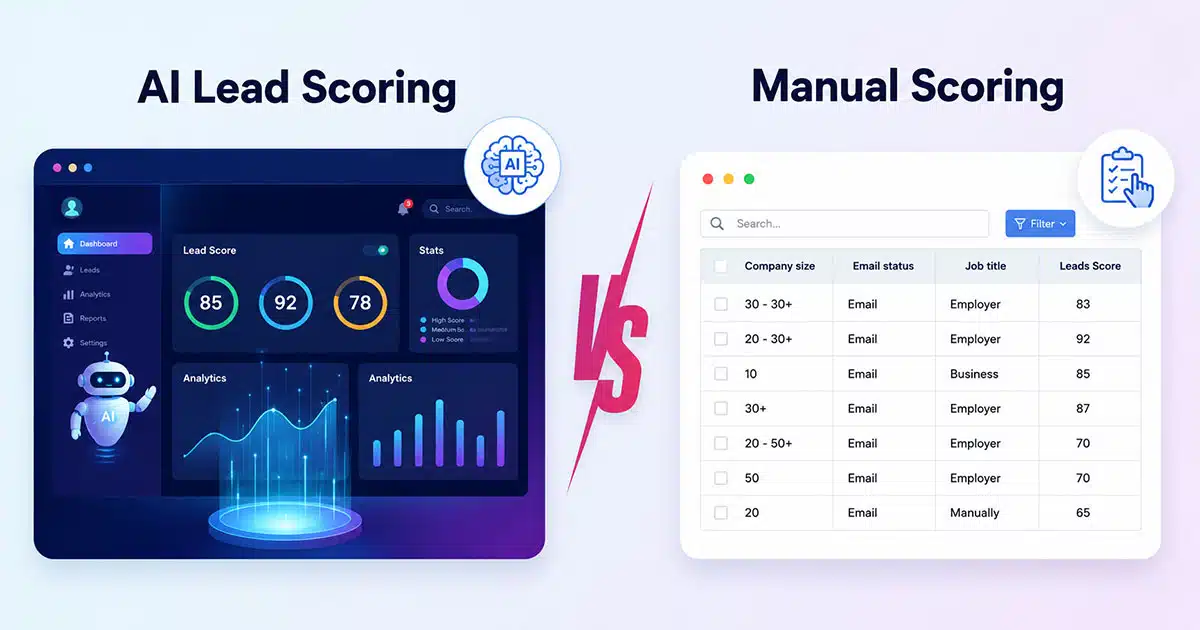
AI Lead Scoring Vs Manual Scoring: Key Difference
Understanding the fundamental differences between these approaches helps organizations make informed decisions about their lead qualification strategy. Both methods aim to identify qualified leads, but they differ dramatically in execution and results.
Key Factor | Manual Lead Scoring | AI Lead Scoring |
Scoring Method | Based on fixed rules created by marketing and sales teams | Uses machine learning models trained on historical conversion data |
Data Processing Capacity | Handles a limited number of variables | Processes hundreds of behavioral and demographic data points |
Update Process | Requires manual updates and rule adjustments | Continuously learns and updates automatically |
Processing Speed | Lead scoring can take hours or days | Lead scoring occurs in seconds |
Scalability | Limited by human resources and rule complexity | Scales easily with growing lead volume |
Accuracy Over Time | Accuracy often declines as market behavior changes | Accuracy improves as models learn from new data |
Predictive Capability | Focuses mainly on past interactions | Predicts likelihood of conversion using predictive analytics |
Sales Productivity Impact | Sales teams spend time reviewing and filtering leads | Sales teams receive prioritized leads ready for outreach |
Adaptability | Requires manual rule changes to adapt to new trends | Automatically adapts to changing customer behavior patterns |
Definition Of AI Lead Scoring
AI lead scoring uses machine learning algorithms to analyze historical conversion data and identify patterns that predict future outcomes. The AI system processes hundreds of variables simultaneously, including explicit attributes like job title alongside implicit signals such as content engagement velocity and session depth.
Unlike rule-based systems, AI lead scoring tools learn continuously from new data. When a lead with unusual characteristics converts, the model adjusts its predictions accordingly. This adaptive quality means scores become more accurate over time rather than degrading as market conditions shift. Organizations report that AI models deliver 30% faster processing while maintaining superior scoring accuracy compared to static approaches.
Definition Of Manual Lead Scoring
Manual lead scoring relies on predetermined rules created by marketing and sales teams. Administrators assign point values to specific actions or attributes based on experience and intuition. A typical manual scoring system might award points for visiting pricing pages, requesting demos, or matching target industry criteria.
While straightforward to implement, manual methods require constant maintenance. Teams must revisit scoring rules quarterly to reflect changing buyer behaviors and market dynamics. This operational effort often gets deprioritized, causing scores to drift from reality over months or years.
Data Processing And Accuracy Differences
The gap between these approaches becomes stark when examining data capabilities. Manual scoring typically handles 10 to 15 variables effectively before complexity overwhelms administrators. AI scoring processes 200 or more data points per lead without additional human oversight.
Aspect | Manual Scoring | AI Lead Scoring |
|---|---|---|
Variables Analyzed | 10-15 | 200+ |
Update Frequency | Quarterly | Real-time |
Accuracy Trend | Degrades over time | Improves over time |
Processing Speed | Hours to days | Seconds |
Scalability | Limited by headcount | Near-unlimited |
Speed And Scalability Comparison
Manual methods cannot keep pace with modern lead generation velocity. A marketing automation platform might capture thousands of form submissions weekly, each requiring evaluation. Human reviewers create bottlenecks that delay routing and reduce conversion rates.
AI lead scoring platforms evaluate leads simultaneously as they enter the system. Whether processing 100 or 100,000 monthly leads, scoring happens instantly without adding staff. Companies scaling rapidly find this capability essential for maintaining lead quality standards during growth phases.
Impact On Sales Productivity
Sales reps using AI-scored leads spend their time more productively. Rather than personally reviewing every contact, they trust prioritized lists that surface high-probability opportunities. Industry data shows teams achieve 25 to 40% efficiency gains after implementing ai driven lead scoring.
The productivity impact extends beyond time savings. When reps consistently work higher-quality leads, win rates improve and morale increases. The frustration of chasing unqualified prospects diminishes, replaced by confidence that the scoring system surfaces genuine opportunities.
Decision Making And Predictive Insights
Perhaps the most significant difference involves forward-looking intelligence. Manual scoring reflects historical engagement without predicting future behavior. AI generates probability estimates based on pattern recognition across thousands of prior conversions.
These predictive lead scoring capabilities transform pipeline planning. Sales managers forecast more accurately because they understand not just current lead scores but expected conversion timelines. Marketing teams optimize campaign spend toward segments with the highest predicted returns. The entire organization benefits from AI insights previously unavailable through manual methods.
Key Benefits Of AI Lead Scoring For Sales Teams
AI lead scoring delivers measurable advantages that directly impact revenue performance. Sales teams adopting these systems report improvements across qualification speed, prioritization accuracy, and conversion outcomes.
Faster Lead Qualification
Speed defines modern sales success. The lead scoring process using AI completes in seconds what manual review requires hours to accomplish. When a prospect fills a form or triggers a behavioral threshold, the AI lead scoring model instantly calculates conversion probability and routes accordingly.
This acceleration matters because buyer attention spans have shortened. Research indicates that prospects contacted within one hour are seven times more likely to qualify compared to those reached after 24 hours. AI eliminates the lag between lead capture and sales engagement, ensuring hot prospects receive immediate attention.
Data Driven Lead Prioritization
Gut feelings no longer suffice for complex sales cycles. AI scoring provides objective rankings based on comprehensive data analysis rather than subjective impressions. Sales reps see exactly which leads deserve attention first, supported by transparent scoring factors they can review.
The prioritization considers dozens of variables weighted by actual predictive value. If historical data shows that prospects from specific industries convert at higher rates, the model adjusts accordingly. This data-driven approach removes debate about lead quality and focuses teams on execution and highlights how CRM helps sales teams manage leads once they are scored.
Improved Sales And Marketing Alignment
Alignment failures between sales and marketing teams cost organizations significant revenue annually. AI scoring bridges this gap by providing shared, objective criteria both groups accept and tying activity targets to sales activity metrics for a performance-focused sales engine. When marketing delivers leads scored by the same AI system sales uses, disputes about quality diminish.
The scoring process becomes a common language. Marketing optimizes campaigns to generate higher-scoring leads while sales provides feedback that refines the model. This collaboration replaces finger-pointing with productive iteration toward shared goals.
Better Conversion Opportunities
Higher conversion rates represent the ultimate measure of scoring effectiveness. Organizations implementing ai lead scoring solution report 25% or greater lifts in conversion from lead to opportunity. These gains compound throughout the funnel, ultimately increasing closed revenue.
The improvement stems from better lead-to-rep matching and timing optimization. AI identifies not just which leads will convert but when they are most receptive. Sales teams engage prospects at peak interest moments rather than arbitrary follow-up schedules.
Scalable Lead Management
Growth creates lead volume challenges that manual methods cannot address. AI scoring tools handle increasing loads without proportional cost increases. A system processing 1,000 monthly leads requires no additional resources to process 10,000.
This scalability proves essential for companies pursuing aggressive growth targets. Rather than hiring qualification staff in lockstep with lead generation, organizations invest in AI once and benefit continuously as volumes expand, particularly when AI scoring is embedded in a sales pipeline CRM that improves visibility and performance.
Limitations Of Manual Lead Scoring Methods
Despite their familiarity, traditional scoring approaches carry significant drawbacks that limit sales effectiveness. Understanding these limitations clarifies why many organizations transition to AI alternatives.
Human Bias In Lead Evaluation
Personal preferences inevitably influence manual scoring decisions. Reps might unconsciously favor leads resembling past successes while undervaluing unfamiliar profiles. This human bias perpetuates existing patterns rather than discovering new opportunities.
Research demonstrates that manual qualification teams overlook 30% of eventually-converted leads due to bias-driven misjudgments. The ai lead scoring approach applies consistent criteria without the cognitive shortcuts that cause humans to miss valuable prospects.
Time Consuming Lead Analysis
Every hour spent evaluating leads represents an hour not spent selling. Manual analysis demands significant time investments that scale poorly. As marketing teams generate more inbound leads, qualification workloads grow proportionally.
Organizations report that manual scoring consumes up to 20% of total sales capacity. This overhead reduces available selling time, ultimately constraining revenue growth regardless of lead volume increases.
Difficulty Handling Large Lead Databases
Legacy databases containing years of accumulated contacts overwhelm manual review capabilities. Teams cannot efficiently re-score historical leads when criteria change or new data becomes available. Valuable prospects remain buried in outdated segments.
AI systems handle large lead volumes effortlessly, rescoring entire databases within hours rather than months. This capability unlocks dormant pipeline value that manual methods leave unrealized and significantly enhances sales visibility across deals and activities.
Limited Predictive Capabilities
Manual scoring describes current state without forecasting future behavior. Knowing a lead engaged three times last month provides context but not prediction. Sales teams need forward-looking intelligence to plan resource allocation effectively.
Without predictive analytics, organizations react rather than anticipate. They chase signals rather than positioning ahead of buyer intent, losing competitive advantage to faster-moving rivals using advanced algorithms.
Higher Operational Effort
Maintaining manual scoring systems requires ongoing administrative investment. Teams must periodically audit rules, adjust point values, and reconcile regional variations. This operational burden diverts attention from strategic initiatives.
The effort compounds as organizations add channels, segments, and product lines. Each complexity increase demands additional scoring rules, creating maintenance spirals that consume ever-larger resource shares.
Key Factors Businesses Should Consider When Choosing A Lead Scoring Method
Selecting the right approach requires honest assessment of organizational readiness, resources, and objectives. These factors guide decisions that align scoring capabilities with business needs.
Business Size And Lead Volume
Company scale influences optimal scoring strategy. Startups processing fewer than 200 monthly leads might succeed with simple manual rules. Growth-stage companies handling thousands of leads weekly almost certainly need AI capabilities.
Consider current volumes alongside projected growth. A scoring solution adequate today might become limiting within 18 months as marketing efforts scale. Planning for future lead volumes grow ensures the chosen approach remains viable long-term.
Data Availability And Quality
AI models require training data to function effectively. Organizations need historical records of converted leads alongside non-converters to teach algorithms distinguishing patterns. Minimum thresholds typically require several hundred closed deals with associated engagement data.
Data quality matters as much as quantity. Inconsistent fields, missing attributes, and duplicate records degrade model performance. Before implementing AI scoring, organizations should assess and remediate data hygiene issues.
Integration With CRM And Sales Tools
Scoring value depends on integration depth with existing systems. Scores locked in separate platforms create workflow friction that reduces adoption. Effective AI lead scoring platforms connect natively with popular CRMs like Salesforce and HubSpot or a CRM with email integration that centralizes communication and engagement data.
Evaluate integration requirements carefully. The ideal solution surfaces scores directly on contact and deal records where sales reps naturally work. Additional logins or context switches reduce practical value regardless of scoring accuracy.
Sales Team Workflow Compatibility
Implementation succeeds when scoring aligns with existing sales process rhythms. Sales reps need scores presented within familiar interfaces using terminology they understand and supported by a simpler sales workflow inside the CRM. Complex scoring outputs requiring interpretation training face adoption resistance.
Involve frontline team members in evaluation processes. Their practical feedback identifies workflow compatibility issues that technical assessments miss. Scoring systems that fit natural working patterns achieve higher adoption and impact.
Scalability For Future Growth
Business trajectories should inform solution selection. Organizations anticipating significant growth need scoring tools that scale without performance degradation or proportional cost increases and pair effectively with a sales pipeline CRM to improve visibility and performance. AI platforms generally offer superior scalability compared to manual approaches.
Consider not just lead volumes but complexity growth. Expanding into new markets, verticals, or product lines introduces scoring variations. Flexible platforms accommodate this evolution without requiring fundamental restructuring.
Cost And Resource Requirements
Total ownership costs extend beyond subscription fees. Manual scoring demands ongoing administrative time while AI solutions require implementation effort and occasional model retraining. Honest assessment reveals true resource commitments and should be evaluated alongside options in a guide to the best CRM software for small sales teams.
Calculate return expectations based on conversion improvement projections. Even modest accuracy gains translate to significant revenue impact at scale. Cost comparisons should weigh investments against anticipated pipeline and revenue benefits.
How AI Improves Lead Qualification Accuracy
Accuracy determines scoring value. AI delivers precision improvements through technical capabilities that manual methods cannot replicate.
Machine Learning For Lead Behavior Analysis
Machine learning excels at pattern recognition across complex behavioral datasets. The algorithms identify correlations between engagement sequences and conversion outcomes that humans would never notice. These insights power predictive scores reflecting actual purchase likelihood.
Modern ai lead scoring model implementations analyze temporal patterns alongside static attributes. The velocity of engagement, sequence of touchpoints, and timing relative to external events all contribute to scores. This multidimensional analysis surpasses surface-level rule matching.
Predictive Modeling For Lead Conversion
Predictive models estimate conversion probability based on historical patterns. Rather than assigning arbitrary points, AI calculates likelihood percentages grounded in statistical analysis. A score of 85 means 85% of historically similar leads converted.
These probability estimates enable sophisticated routing and resource allocation. High-probability leads receive immediate premium attention while moderate scores enter nurturing sequences. The quantified predictions support objective decision-making throughout the sales cycle.
Real Time Data Processing
AI scoring happens instantaneously as new data arrives. Website visits, email opens, content downloads, and form submissions trigger immediate score recalculation. This real-time capability ensures sales teams always see current priority rankings.
The contrast with batch processing approaches is significant. Legacy systems recalculated scores daily or weekly, creating windows where priorities drifted from reality. Real-time scoring eliminates these gaps, maintaining accuracy through continuous updates.
Continuous Model Optimization
AI models improve automatically as they process new outcomes. Every closed deal and lost opportunity provides training data that refines predictions. This self-improving quality means accuracy increases over time rather than degrading.
Organizations typically see steady accuracy gains during the first 12 to 18 months of implementation. The models learn company-specific patterns that generic rules miss, developing institutional knowledge encoded in algorithmic form.
Automated Lead Prioritization
Beyond scoring, AI automates the prioritization logic that determines routing and follow-up timing. High scores trigger immediate alerts while moderate scores initiate sequenced outreach. This automated lead scoring approach removes manual sorting from rep workflows.
The automation extends to re-prioritization as circumstances change. If a previously moderate lead suddenly exhibits high-intent behaviors, scores and routing adjust instantly. Dynamic prioritization keeps sales efforts aligned with current opportunity landscapes.
Why Data Quality Matters In Lead Scoring Systems
Even sophisticated AI cannot overcome poor data foundations. Organizations must address data collection and maintenance to realize scoring benefits.
Accurate Customer Data Collection
Scoring accuracy begins with reliable data capture. Form fields, enrichment services, and CRM entries must consistently populate required attributes. Missing or inaccurate information creates blind spots that degrade predictions.
Establish clear data standards that define required fields, formatting conventions, and validation rules. Marketing automation tools should enforce these standards at capture points, preventing garbage data from entering systems where it corrupts scoring models.
Data Integration Across Sales Platforms
Modern sales operations span multiple platforms generating valuable signals. CRM systems, marketing data repositories, product analytics tools, and intent data providers each contribute unique insights. Effective scoring requires integration that synthesizes these sources, whether you sell B2B software or rely on CRM tools that help retail teams stay organized.
Evaluate integration capabilities when selecting scoring solutions. The best platforms connect across your technology stack, pulling signals from every relevant system into unified lead profiles built on centralized contact management for growing teams. Fragmented data produces fragmented scores.
Eliminating Incomplete Or Duplicate Records
Duplicate contacts and incomplete profiles confuse scoring algorithms. The same person appearing multiple times receives fragmented scores based on partial activity histories. Incomplete records lack attributes necessary for accurate prediction.
Regular data hygiene practices including deduplication and enrichment maintain scoring integrity. Quarterly audits identify quality issues before they significantly impact model performance. Prevention through capture-point validation reduces remediation needs and supports better contact management and stronger relationships.
Consistent Data Updates
Lead data changes constantly as contacts move companies, receive promotions, and shift priorities. Stale information produces scores reflecting outdated realities. Effective scoring requires systematic refresh processes supported by better contact management and relationship tracking.
Implement periodic enrichment cycles that verify and update lead attributes. Monitor engagement signals for indicators suggesting profile changes. Responsive data maintenance ensures scores reflect current circumstances rather than historical snapshots.
Insights For Sales Strategy Optimization
Quality data enables strategic analysis beyond individual scoring. Aggregate patterns reveal which channels, campaigns, and segments generate highest-converting leads. These marketing data insights inform resource allocation and campaign optimization.
Scoring systems should provide reporting that surfaces strategic patterns. Look for platforms offering segment performance analysis, channel attribution, and trend visualization. These capabilities transform scoring from operational tool to strategic intelligence source that complements structured sales deal tracking for modern teams.
How Gain.io Improves AI Powered Lead Scoring
Gain.io provides sales teams with the foundational infrastructure that makes effective lead scoring possible. The platform centralizes contact management for growing teams, giving teams unified visibility into every prospect and customer relationship. Visual sales pipelines show exactly where each deal stands, from initial lead capture through close and reflect the principles of building a sales pipeline that actually works.
Rather than scattering lead information across disconnected tools, Gain.io consolidates engagement history, notes, and communications in one accessible location. Sales reps see complete lead profiles that inform qualification decisions without switching between applications. The integrated email and calendar features ensure all touchpoints feed into comprehensive lead records, mirroring the benefits of a CRM with email integration to streamline communication and the broader smart CRM tools Gain.io offers for sales teams.
For organizations implementing ai lead scoring solution workflows, Gain.io and its smart CRM tools for sales teams serve as the operational layer where scores translate into action. Prioritized leads flow naturally into pipeline stages, tasks trigger appropriate follow-ups, and automated sales task workflows ensure team collaboration captures the human context that complements algorithmic insights. This combination of structured data and workflow automation helps sales teams convert scored leads into closed revenue efficiently, showcasing the value of an all-in-one CRM to grow your sales and team.
Frequently Asked Questions
How Often Should Lead Scoring Models Be Updated
AI scoring models should receive formal review quarterly with continuous background learning active between reviews. Major updates are necessary when product positioning shifts, target markets change, or conversion patterns noticeably diverge from predictions. Most platforms handle incremental learning automatically, but strategic changes require manual recalibration to reflect new organizational priorities.
Which Sales And Marketing Data Sources Improve Lead Scoring Accuracy
The most impactful sources include CRM engagement history, marketing automation interaction data, website behavior analytics, and third-party intent data feeds. Product usage signals prove particularly valuable for SaaS companies. Firmographic enrichment from providers like Clearbit or ZoomInfo adds demographic context. Combining behavioral and firmographic data typically produces superior results compared to either category alone, especially when paired with robust lead management software options in 2026.
How Do Behavioral Signals Influence Lead Scoring Models
Behavioral signals reveal active interest that demographic data cannot capture. Page view patterns, content download sequences, email engagement velocity, and webinar attendance all indicate purchase intent. AI models weight these signals based on historical correlation with conversions. A prospect visiting pricing pages multiple times might receive significant score increases even without perfect firmographic fit.
What Role Does CRM Integration Play In Lead Scoring Systems
CRM integration determines practical scoring utility. Scores must appear where sales reps naturally work, directly on contact and opportunity records. Bidirectional sync ensures outcome data flows back to refine models while scores flow forward to guide prioritization. Without deep CRM integration, even accurate scores fail to influence sales behavior effectively or power CRM follow-up automation for better conversions.
How Can Businesses Measure ROI From Lead Scoring Systems
Track conversion rate changes at each funnel stage after implementation. Compare qualified opportunity creation rates before and after deployment. Measure sales cycle length changes for AI-prioritized leads versus historical baselines. Calculate cost per qualified lead improvements. Most organizations see measurable ROI within three to six months through faster qualification and improved win rates on prioritized opportunities, similar to the results in a Gain.io sales acceleration case study showing faster deal cycles.