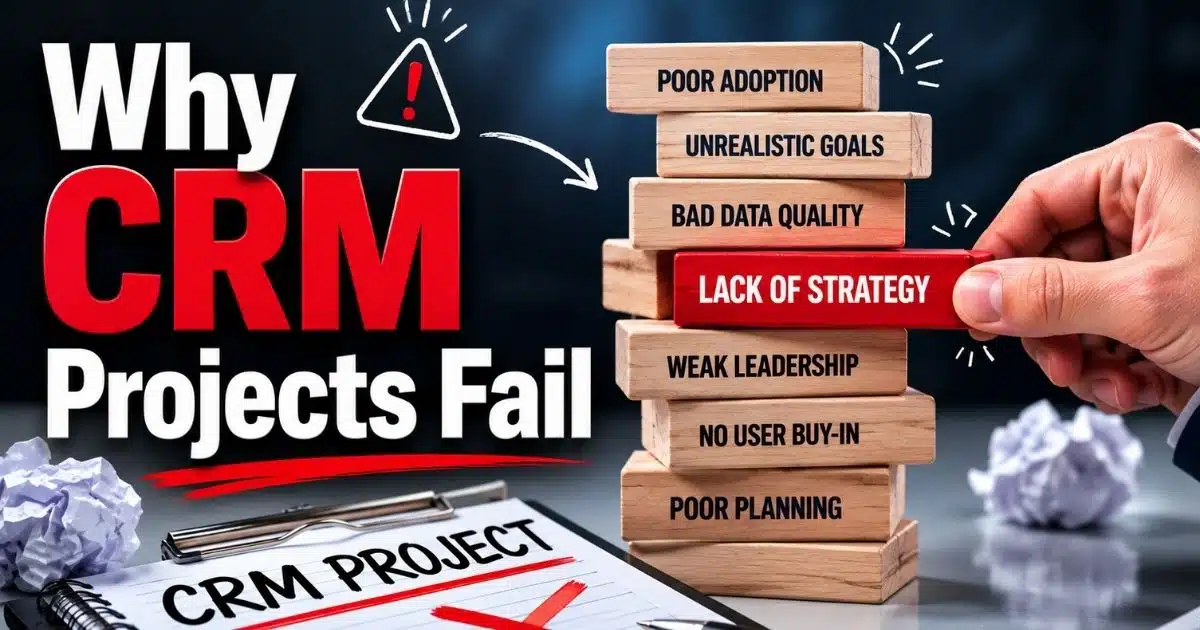
CRM projects promise better customer relationships, higher sales, and smarter decisions. Yet many companies invest heavily in CRM systems and still struggle to see results. Studies show that nearly 70% of CRM projects fail to deliver the value businesses expect. Most failures have little to do with the software itself.
The real problems often come from poor adoption, unclear goals, bad data, and weak leadership. Employees may resist change. Executives may lose focus. Teams may work without a clear strategy. The good news is that most CRM failures are preventable.
By understanding what goes wrong and what drives success, businesses can improve adoption, increase ROI, and build stronger customer relationships.
What Does CRM Project Failure Really Mean?
CRM project failure does not always mean a system stops working. In many cases, the CRM software works exactly as expected, but the business never sees real value. A customer relationship management (CRM) project fails when teams avoid using the tool, data becomes unreliable, or expected revenue growth never happens. According to a dozen analyst reports from firms like Gartner Group and Forrester Research, many CRM projects fail because companies focus on technology instead of people, processes, and change management.
A failed project often shows up as poor CRM usage, low buy in from front-line sales professionals, and user dissatisfaction across the organization. Poor data quality, weak data governance, and inconsistent data entry can also hurt customer relationship management efforts. When executive sponsorship is missing, CRM implementations lose momentum and business units drift away from shared goals, instead of benefiting from modern CRM adoption that transforms sales teams.
Successful CRM implementation requires more than a new system. Companies need clear strategy, strong executive sponsors, support from the C suite, and alignment between the sales team, marketing efforts, and the IT department. When CRM systems fit business processes and customer needs, they create improvement, strengthen management, and help companies increase revenue.
Why Do CRM Projects Fail So Often?
CRM projects promise better customer relationships, smoother operations, and higher revenue. Yet many businesses struggle to achieve those results. Research from Gartner, Forrester, and other analysts shows that CRM failure rates often range from 30% to 70%, depending on how success is measured. Most failures have less to do with technology and more to do with people, processes, and leadership.
Poor User Adoption
Many CRM projects fail because employees simply do not use the system. A CRM tool creates value only when teams use it consistently. Sales teams often return to spreadsheets or old habits when the new system feels complex.
Research shows poor user adoption is one of the biggest reasons for CRM failures. Some studies estimate that adoption-related issues contribute to over half of failed CRM implementations, which is why focused CRM adoption strategies to improve ROI are so important.
Front-line sales professionals need to understand how CRM software helps them close deals and improve customer relationships. Clear training, simple workflows, and strong support increase CRM usage and long-term success.
Lack Of Clear Goals
Many organizations start a CRM project without specific goals. Teams buy CRM systems expecting instant results but never define what success looks like, especially in complex environments that really need a structured B2B sales CRM for revenue teams. That creates confusion across the business.
A lack of strategy often becomes the root cause of project failure. Companies should define measurable outcomes such as revenue growth, faster sales process cycles, or stronger marketing automation before implementation begins. Clear expectations keep CRM projects focused and aligned with business needs.
Weak Executive Support
Executive sponsorship plays a major role in CRM success. When executive sponsors lose interest, project momentum slows down. Employees may see CRM as another IT department initiative instead of a business priority.
Strong support from the C suite encourages buy in across every business unit. Leaders must actively participate, track success metrics, and communicate the real value of customer relationship management CRM efforts, reinforcing the same CRM adoption strategies that improve CRM ROI. CRM initiatives without leadership support rarely succeed.
Poor Data Quality
CRM systems depend on accurate data. Duplicate records, outdated customer details, and inconsistent data entry quickly reduce trust in reports. Managers rarely find useful insights when data quality is poor.
Studies estimate that inaccurate data costs businesses significant revenue each year. Poor data quality also hurts customer service and marketing efforts. Strong data governance, clear ownership, and regular audits help organizations maintain reliable systems, especially when they use dynamic contact management for smarter relationship tracking.
Broken Processes And Change
CRM software cannot fix broken business processes. Undefined workflows create confusion during the implementation process. Teams may struggle when the new CRM does not match how the organization actually works.
Research shows people and process issues account for most CRM failures, while technology problems represent only a small share. Effective change management helps employees adapt to new ways of work and supports successful CRM implementation. A phased approach often delivers more business value and reduces failure risk and helps companies avoid common CRM implementation mistakes.
Lack Of Clear Goals And Strategy
Many CRM projects fail long before the software goes live. The problem often starts with unclear goals and weak planning. Businesses invest in CRM systems expecting quick wins but forget to define what success actually looks like. Without a clear strategy, even the best CRM software can fall short.
Clear Goals Drive Better Results
A CRM project needs a clear purpose from day one. Some companies want faster sales cycles. Others focus on customer retention or better marketing efforts. Without goals, teams lose direction.
Research shows that 50% to 70% of CRM projects fail to meet business objectives. One major reason is the lack of measurable goals. Experts from Gartner and other analysts have highlighted this challenge for years.
Clear objectives help teams track progress and prove ROI. They also align the sales team, management, and leadership around shared outcomes.
Business Needs Must Come First
Many organizations buy a new CRM because competitors use one. That approach often leads to failure. A CRM tool should support the business model, not change it overnight.
Customer relationship management works best when it aligns with existing business processes. The software should solve real problems for sales, marketing, and customer service teams, so organizations need CRM tools that fit their workflow. Studies show that weak strategic alignment remains a top cause of CRM failures.
When companies focus on business needs first, CRM systems create real value and support long-term growth.
Success Metrics Keep Teams Focused
Success cannot depend on feelings or assumptions. Teams need measurable outcomes to know whether a CRM project works. Metrics create accountability across the organization.
Businesses should track lead conversion, customer retention, sales process speed, and revenue growth. Executive sponsors can use these numbers to evaluate progress. Research shows that CRM projects with defined metrics have stronger adoption and better outcomes.
Clear expectations reduce confusion and help every business unit work toward the same goals.
Strategy Reduces Project Risks
Many CRM implementations struggle because teams rush into implementation. A lack of planning often creates scope creep, budget issues, and user frustration.
CRM is not only about technology. It is a business transformation. Experts note that organizations spend too much effort on system configuration and too little on planning and process design.
A strong strategy defines timelines, ownership, and priorities. That approach lowers project risk, helps avoid common CRM implementation mistakes, and increases the chance of CRM success.
Leadership Creates Strategic Alignment
Leadership support shapes the outcome of every CRM initiative. When executives disagree on goals, projects lose momentum. Teams receive mixed messages and adoption slows.
Executive sponsorship ensures alignment across departments. Leaders should define priorities, allocate resources, and communicate the purpose of the CRM system. Studies consistently show that weak leadership remains a major cause of CRM project failure.
Strong leadership turns CRM from an IT project into a business strategy that drives growth and customer value.
Why Employees Resist Using CRM Systems
Even the best CRM system can fail when employees refuse to use it. Many CRM projects struggle because people do not see value in the new tool. Resistance is natural, but businesses can reduce it with the right strategy, support, and communication.
Complex Systems Frustrate Users
Employees want tools that make work easier. A complicated CRM often does the opposite. Too many fields, clicks, and workflows create frustration. As a result, teams return to spreadsheets or old habits.
Research shows that poor user adoption is a leading cause of CRM failure. Experts estimate that up to 50% of CRM implementations struggle because employees do not use the system consistently.
Simple design improves CRM usage. A clean interface helps the sales team complete tasks faster and focus on customers rather than software, which is a core benefit of CRM systems that improve sales productivity.
Lack Of Clear Benefits
Employees resist change when they do not understand why it matters. Many front-line sales professionals see CRM as extra work instead of a helpful tool. That mindset reduces adoption and hurts results.
Teams need to know how CRM supports customer relationship management and improves the sales process. Better visibility, faster follow-ups, and easier data access create real value for users. When employees see personal benefits, buy-in grows naturally.
Businesses that explain the purpose of a new CRM often achieve stronger adoption and better CRM success, especially when they follow proven CRM adoption guidance on challenges, mistakes, and best practices. Clear communication turns resistance into support.
Poor Training Hurts Adoption
A CRM launch is not the finish line. Without proper training, employees struggle to use the system correctly. That often leads to poor data entry and incomplete records.
Studies show that inadequate training remains a major reason why CRM projects fail. Organizations that invest in ongoing support report higher adoption and stronger business outcomes.
Training should match real job tasks. Sales teams need practical examples they can use every day. Continuous learning helps employees build confidence in the system.
Limited User Involvement
Many companies build CRM systems without asking employees for input. Users then receive a tool that does not fit their daily work. That creates frustration and user dissatisfaction.
Experts recommend involving end users early in planning and design. Businesses that collect feedback often create CRM software that better supports business processes. Lack of user involvement remains a common cause of failed CRM projects.
Employee feedback helps organizations create systems people actually want to use. Better alignment leads to stronger adoption and long-term success.
Weak Change Management
Employees rarely reject technology itself. Most resistance comes from uncertainty and fear of change. New workflows can feel disruptive, especially when expectations are unclear.
Research shows that people and process issues account for more than 75% of CRM failures, while technical problems make up a small share. Low adoption and poor change management remain key risk factors.
Strong change management prepares employees for the transition. Executive support, regular communication, and phased rollouts help teams adapt faster and achieve lasting CRM success.
How Poor Data Quality Leads To CRM Failure
A CRM system is only as good as the data inside it. Clean and accurate records help teams make smart decisions. Bad data creates confusion, hurts customer relationships, and reduces trust. Over time, poor data quality can turn a promising CRM project into a costly failure.
Duplicate Records Create Confusion
Duplicate records are one of the biggest problems in CRM systems. When the same customer appears multiple times, sales teams waste time and create inconsistent experiences. Reports become unreliable, and customer data loses value.
Research shows that duplicate and outdated records reduce trust in CRM reporting and analytics. Data experts warn that duplicate entries often lead to missed opportunities and poor customer service.
A single source of truth is critical for CRM success. Regular audits and automated checks help organizations keep records clean and accurate.
Inaccurate Data Hurts Decisions
Bad decisions often start with bad data. Studies estimate that about 32% of business data in U.S. companies is inaccurate. That means many CRM reports may not reflect reality.
Sales leaders depend on CRM data to forecast revenue and plan strategy and to help sales teams manage leads effectively. When customer information is wrong, teams target the wrong audience and lose valuable time. Poor data quality also weakens marketing campaigns and customer service.
Accurate data helps businesses understand customers better. Strong data quality improves trust and supports better decisions across the organization.
Poor Data Entry Reduces Trust
Manual data entry often leads to errors. Employees may skip fields, enter wrong details, or use different formats. Over time, those small mistakes become major problems.
Experts identify data entry errors, incomplete records, and inconsistent standards as leading causes of poor CRM data quality. Outdated information can quickly spread across systems and reports.
Users stop relying on CRM systems when reports look inaccurate. Low trust reduces CRM usage and increases the risk of project failure.
Weak Data Governance Creates Risk
Many organizations focus on implementation but overlook data governance. Without clear rules, employees manage customer data differently. That creates inconsistency across departments.
Data governance should define ownership, standards, and quality checks. Companies with strong governance maintain cleaner CRM data and better reporting accuracy. Experts also stress that ongoing maintenance matters because data naturally changes over time.
Clear ownership helps keep information current. Strong governance protects long-term CRM success and improves business outcomes.
Bad Data Impacts Revenue
Poor data quality affects more than reports. It directly impacts revenue and customer experience. One recent study found that 44% of companies lose more than 10% of annual revenue because of low-quality CRM data.
Sales teams spend valuable hours fixing records instead of building relationships. Customers receive incorrect messages and duplicate emails. That damages trust and weakens brand loyalty, highlighting the need for dynamic contact management for smarter relationship tracking. Studies also show that fragmented customer data contributes to revenue loss for many businesses, making dynamic contact management for smarter relationship tracking especially important.
Clean data supports better service, stronger relationships, and higher business growth, especially when combined with a CRM that includes email integration to streamline communication. When data quality improves, CRM projects have a much greater chance of success.
Common Mistakes Companies Make During CRM Implementation
A CRM system can improve sales, service, and customer relationships and help sales teams manage leads more effectively. But many companies never see the results they expect. Research shows that over half of CRM projects fail to meet expectations because of poor planning, weak adoption, and broken processes. Small mistakes early in the process often become costly problems later.
No Clear Business Goals
Many organizations buy CRM software before deciding what they want to achieve. Some hope for higher revenue. Others want better customer data or faster sales cycles. Without clear goals, teams lose focus.
Research from Gartner and other analysts shows that unclear objectives are a major reason why CRM projects fail. Businesses that define measurable outcomes are more likely to achieve CRM success. Goals such as lead conversion rates, customer retention, and sales growth help teams stay aligned.
Clear expectations also help executive sponsors evaluate progress and prove business value.
Too Much Customization
A CRM should fit business needs, but too many changes can create problems. Companies often customize every field, workflow, and report. Over time, the system becomes difficult to use and maintain.
Experts warn that over-customization increases CRM failure risk. Complex setups also make upgrades harder and raise implementation costs. Users may struggle to learn the system, which lowers CRM usage and adoption.
A simple CRM often performs better than a highly customized one, especially when it supports a simpler sales workflow that gets more from your CRM. Businesses should customize only where it creates real value.
Poor Change Management
Employees often resist a new CRM when they do not understand its purpose. Weak communication creates confusion and lowers adoption. As a result, teams return to old habits and avoid the system.
Studies suggest that people-related challenges contribute to over 60% of CRM failures. Strong change management helps employees adapt to new processes and tools. Training, feedback, and leadership support all play important roles.
Companies that invest in change management usually see better long-term results from CRM implementations.
Rushed Implementation Process
Many businesses want quick results from a CRM project. That pressure often leads to rushed implementation. Teams skip testing, overlook training, or migrate poor-quality data into the new system.
Research shows that phased rollouts reduce risk and improve user adoption. A gradual approach allows organizations to solve issues before company-wide deployment, while CRM automation can automate sales tasks to keep teams focused and organized. Early wins also help build trust in the system.
Successful CRM implementation takes time. A careful process delivers better outcomes than a fast launch.
Weak Executive Support
CRM projects need strong leadership from the start. When executives lose interest, teams lose momentum. Employees may see CRM as an IT project instead of a business priority, missing the benefits that come when CRM adoption reshapes modern sales teams.
Studies consistently show that lack of executive sponsorship is a major cause of CRM failures. Executive sponsors should define success metrics, allocate resources, and actively support adoption. Leadership alignment keeps departments focused on shared goals and reinforces the CRM adoption strategies that improve CRM ROI.
Strong support from the C-suite helps turn CRM into a long-term growth strategy rather than a failed project.
Early Signs That A CRM Project Is Going Off Track
CRM projects rarely fail overnight. Problems usually appear early, but many companies miss the warning signs. Low adoption, poor data, and missed goals often signal trouble ahead. Spotting these issues early gives businesses time to adjust and improve project outcomes.
Low User Adoption
User adoption is one of the clearest signs of CRM trouble. If employees avoid the system or use it inconsistently, the project may already be at risk. A CRM only creates value when people actively use it.
Research shows that poor user adoption remains one of the leading causes of CRM failure. Some studies suggest that people-related issues contribute to over 60% of failed CRM initiatives. When teams return to spreadsheets or old habits, businesses lose visibility into customer relationships.
Regular training, support, and feedback can help increase adoption and improve long-term CRM success.
Poor Data Accuracy
Bad data quickly weakens a CRM system. Duplicate records, missing fields, and outdated information make reports unreliable. Sales teams lose trust when data cannot support decisions.
Research estimates that around 32% of business data is inaccurate. Poor data quality also affects customer service and revenue growth. When users question the accuracy of reports, CRM usage often declines.
Clear data governance rules and regular audits help maintain clean records. Accurate customer data supports better decisions and stronger business outcomes and is essential for CRM systems that improve overall sales productivity.
Missed Business Goals
A CRM project should support clear business objectives. If key metrics do not improve, the project may be drifting off course. Low lead conversion rates and weak customer retention often signal deeper problems.
Experts note that many CRM projects fail because companies never define measurable outcomes. Teams may focus on software features instead of business results. That disconnect creates confusion and weakens ROI.
Regular reviews help leaders measure progress. Clear success metrics keep teams aligned and focused on growth.
Weak Leadership Support
Strong executive sponsorship is critical for CRM success. When leaders stop participating, project momentum slows. Employees may view CRM as another IT project rather than a business priority.
Studies consistently identify leadership gaps as a major cause of CRM failures. Executive sponsors should communicate goals, allocate resources, and support adoption across departments. Active leadership builds trust and accountability.
Businesses with engaged leaders often achieve higher adoption rates and better project outcomes.
Growing User Frustration
User dissatisfaction is an early sign that something is wrong. Employees may complain that the CRM is slow, confusing, or difficult to use. Those concerns should never be ignored.
Complex workflows and poor system design often reduce productivity. Research shows that usability plays a major role in CRM adoption and long-term success. Employees are more likely to use tools that fit their daily work.
Simple interfaces and regular feedback improve the user experience. A system that helps employees work faster is more likely to succeed.
How To Make A CRM Project Successful
A successful CRM project does not happen by chance. Strong planning, leadership, and user adoption all play a role. Businesses that focus on people, processes, and data are far more likely to achieve long-term results and avoid costly CRM failures.
Set Clear Business Goals
Every CRM project should begin with clear objectives. Companies often invest in CRM systems without defining what success looks like. That creates confusion and weakens results. Clear goals keep teams focused and aligned.
Businesses should identify measurable outcomes such as higher revenue, improved customer retention, or shorter sales cycles. Research shows that projects with defined success metrics are more likely to deliver value and meet expectations. Goals also help executive sponsors track progress and justify investment.
When teams know what they are trying to achieve, CRM success becomes much easier to measure.
Secure Leadership Support
Strong executive sponsorship is one of the biggest drivers of CRM success. Leaders set priorities, allocate resources, and keep teams aligned. Without support from the top, projects often lose momentum.
Research shows that leadership challenges contribute to more than 60% of CRM failures. Executive sponsors should actively participate in rollout plans, communicate expectations, and review performance metrics. Employees are more likely to embrace change when leadership stays involved.
A CRM initiative works best when the C-suite treats it as a business strategy rather than an IT project.
Focus On User Adoption
Technology alone cannot guarantee success. Studies suggest that organizations spend nearly 80% of CRM implementation effort on technology, while user adoption receives far less attention. That imbalance often leads to failure.
Employees need training, support, and clear reasons to use the system. Front-line teams should understand how CRM improves their daily work and customer relationships. Simple design and easy workflows also increase adoption rates.
Companies that prioritize people and change management often achieve stronger CRM outcomes and long-term value.
Keep Data Clean And Reliable
Accurate data is essential for every CRM system. Studies estimate that around 32% of business data in U.S. companies is inaccurate. Poor data quality reduces trust, weakens reporting, and affects customer service.
Organizations should establish data governance policies with clear ownership and standards. Regular audits help remove duplicate records and outdated information. Clean data supports better decisions across sales, marketing, and customer support teams.
Reliable customer data increases confidence in the system and improves business performance.
Roll Out CRM In Phases
Large CRM implementations often fail when companies try to change everything at once. A phased approach lowers risk and helps teams adapt gradually, as shown when companies use CRM to close deals faster and accelerate sales cycles. Early wins also build confidence across the organization.
Businesses can start with one department or a limited set of features before expanding further. Research shows that phased implementation improves adoption and reduces project failure rates, especially when paired with a simpler sales workflow that gets more from your CRM. Teams gain time to fix issues before company-wide deployment.
Small steps often lead to bigger long-term success. A steady rollout helps organizations avoid common CRM implementation mistakes, maximize CRM value, and create lasting change.
How Gain.io Helps Businesses Avoid CRM Failure
Many CRM projects fail because companies focus on software while overlooking people, processes, and data. Success requires a clear strategy, strong leadership, and user adoption. Gain.io helps businesses avoid common CRM mistakes and build systems that deliver long-term value with its smart CRM tools for sales teams.
Gain.io works closely with organizations to define goals, improve workflows, and create better customer experiences using its smart CRM tools for sales teams. As an all-in-one CRM to grow your sales and team, it supports everything from data governance and change management to CRM adoption and reporting, and every step is designed to support measurable business outcomes. Teams receive the tools and guidance they need to use CRM systems effectively.
With a focus on usability, scalability, and business alignment, Gain.io helps companies turn their CRM into a growth engine rather than a failed project by acting as an all-in-one CRM to grow sales and teams. The result is stronger customer relationships, better decisions, and higher revenue.
FAQs
Can Small Businesses Benefit From CRM Systems?
Yes, small businesses can benefit greatly from CRM systems. A CRM helps manage customer relationships, manage leads for sales teams, track sales activities, and improve customer service. Even CRM for startups and small sales teams can help businesses increase revenue and streamline daily operations.
Does CRM Failure Always Mean The Software Is Bad?
No, CRM failure rarely happens because of the software alone. Most CRM projects fail due to poor user adoption, weak strategy, lack of executive sponsorship, or poor data quality rather than limitations in the CRM system itself.
Can CRM Improve Customer Retention And Loyalty?
Yes, a well-managed CRM helps businesses understand customer behavior and personalize interactions. Better customer relationship management leads to stronger relationships, improved customer experiences, and higher retention rates over time.
How Long Does A Typical CRM Implementation Take?
CRM implementations can take anywhere from a few weeks to several months. The timeline depends on business size, data migration, integration needs, and process complexity. A phased implementation often leads to better CRM success.
What Is The Best Way To Measure CRM Success?
Businesses should track metrics such as customer retention, sales growth, lead conversion rates, and CRM usage. Clear KPIs help organizations measure real value and determine whether the CRM project supports long-term business goals.
For more on this topic, see our guide on 5 Best Simple CRMs For Small Businesses In 2026 (Ranked).
For more on this topic, see our guide on Customer Interaction Tracking In CRM For Long-Term Business Growth.
For more on this topic, see our guide on How To Organize Sales Leads For A Cleaner Pipeline.
For more on this topic, see our guide on Sales Time Management Ideas To Improve Sales Workflows.


