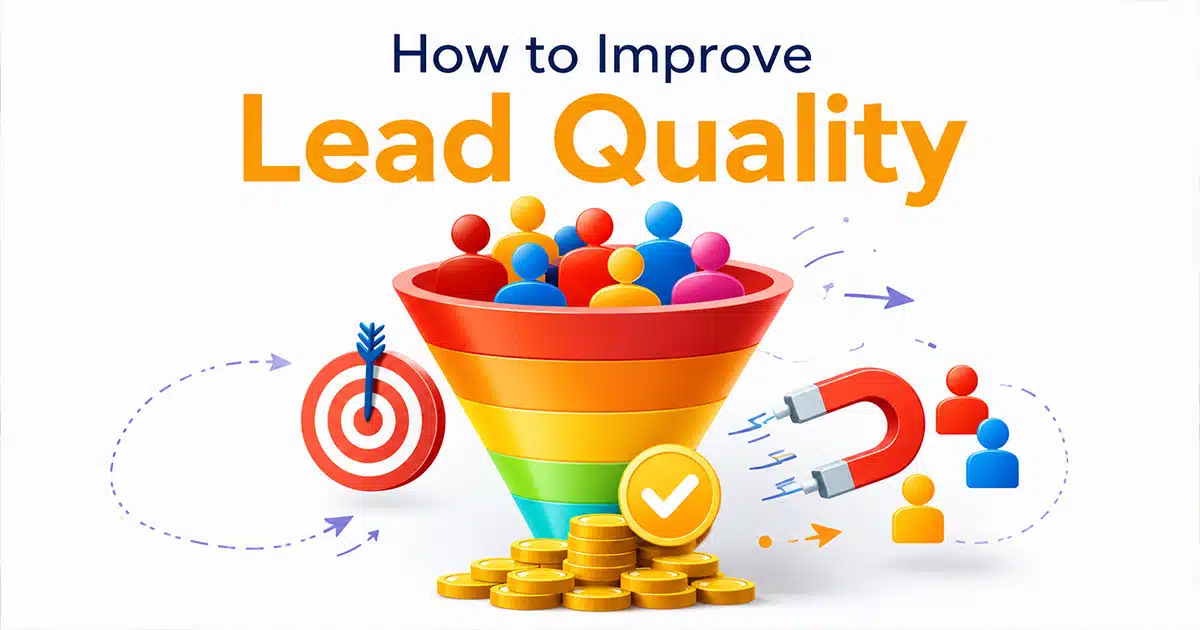
Your sales team is drowning in leads. Marketing hit their numbers. The CRM is full. And yet pipeline keeps shrinking.
This disconnect between lead volume and revenue is the most common problem B2B teams face today. More leads does not mean more deals. The real question is whether your lead generation efforts attract prospects who can and will buy.
This article walks through how to improve lead quality at every stage of your funnel, from targeting and forms to scoring, routing, and nurturing. No theory. Just practical steps you can implement within 30 to 60 days.
Why Lead Quality Beats Lead Quantity Every Time
Picture a B2B SaaS team processing 2,000 leads every month. SDRs work overtime. Pipeline reports look healthy. But close rates hover around 1%. Morale drops. CAC climbs. Revenue flatlines.
Now compare two scenarios with simple numbers. Team A generates 1,000 low quality leads at $50 each. They close 5 deals at 0.5% conversion. Team B generates 200 high quality leads at $100 each. They close 40 deals at 20% conversion. Team B makes 8x the revenue with half the spend.
Low quality leads slow sales cycles by 30-50% on average. They inflate pipeline reports with deals that will never close. They burn out your best sales reps.
Quality is the metric that unlocks better forecasting, cleaner CRM data, and defensible marketing ROI. The rest of this article focuses on how to engineer higher lead quality at every stage, building on a structured B2B lead generation strategy for high-quality leads.
What Lead Quality Means For Your Business
A quality lead fits your ideal customer profile, shows clear intent, and has authority or influence over the buying decision. That definition sounds simple, but most marketing and sales teams struggle to agree on it.
Here is a concrete example. A mid-market HR director at a 300-person company requests a product demo in Q1 2026. They use Workday. They mentioned scaling challenges on the form. They have budget authority. That is a quality lead.
Attributes to evaluate include company size, industry, revenue band, job titles, geography, current tech stack, timing signals, and problem urgency. Not all leads will check every box. But the process of defining and measuring quality must be structured.
Each company’s definition varies based on ACV, sales motion, and market positioning. A $5K deal and a $50K deal require different qualification criteria, and understanding how MQLs and SQLs differ in modern funnels helps keep this qualification consistent across teams.
Core Strategy: Build Lead Quality Into Your System (Not As Cleanup)
This is the framework that drives significant improvement for B2B teams wanting better leads within a quarter. The approach uses six pillars to embed qualification before capture, not after.
Think of this as a roadmap. Each step builds on the previous one. Start taking notes.
Align Sales And Marketing On “Qualified”
Schedule a working session between sales and marketing leaders within the next two weeks. Bring data from the last 6-12 months of closed won and closed lost deals.
Build a shared checklist covering company size, sector, role, pain points, and timing signals. Document it in your CRM so it drives lead scoring and routing rules. Marketing teams and sales teams need to speak the same language here.
Revisit this definition quarterly. Markets shift. Pricing changes. Your ideal buyer persona evolves.
Design Lead Forms And CTAs To Filter Not Just Capture
Lead forms should ask for work email, role, company size, and one or two qualifying questions about current challenges or tools. Questions like “How many sales reps are on your team?” or “What do you use for attribution today?” filter out wrong people fast.
Short forms work for high intent demo requests. Slightly longer multi step forms help filter content downloads and trials.
Test form changes over 30 days. Compare lead to opportunity conversion, not just form fills. CTAs like “Schedule a 20 minute pipeline review” outperform vague “Learn more” buttons by 3x in conversion rates.
Implement Lead Scoring That Reflects Real Buying Signals
Combine demographic scoring with behavioral signals. Assign more points to VP level roles, repeat visits to pricing page, and webinar attendance. Subtract points for personal email domains or student addresses.
Start simple. A basic points model in your CRM works. After 60-90 days, check which scores correlate to closed revenue and adjust, or layer in AI-driven sales automation for smarter lead scoring.
Leads who view pricing pages with “budget approved” signals convert at 25% versus 5% for general form fills. That difference matters.
Route And Respond To High Quality Leads Fast
Response time is part of lead quality. Aim to respond to demo requests within 5-10 minutes. This benchmark alone doubles conversions.
Set up routing rules by territory, industry, or account owner. High intent leads should never wait in a queue, and an AI sales assistant built for pipeline efficiency can flag and prioritize those leads in real time.
Use auto acknowledgement emails with calendar links. A lead from a target account fills a form Wednesday morning and gets a call plus calendar invite that same hour. Track response time and first meeting booked rate on your dashboard.
Clean Standardize And Enrich Lead Data
Bad data accounts for 25-40% of wasted marketing budgets. Unvalidated contacts lead to unreachable potential customers and skewed reporting.
Audit a sample of 100 recent leads. Look for missing or inconsistent fields. Standardize core fields like industry, employee range, and country using controlled picklists rather than free text.
Enrich leads with firmographic and technographic data before the first call. Reps need context. Clean lead data is the foundation for any advanced scoring or analytics, especially when you start layering sales automation software for follow-ups and workflows.
Measure Lead Quality Outcomes Not Just Lead Counts
Track lead to MQL rate (target 40%), MQL to opportunity rate (target 20%), and cost per sales qualified lead monthly by channel.
Create a simple scorecard that marketing and sales review together. Discover which campaigns consistently deliver stronger opportunities. A smaller LinkedIn campaign in Q1 2026 might produce twice the SQLs of a larger Google Ads push when it’s rooted in lead generation strategies that drive high-quality leads.
Budget allocation decisions should flow from these quality based insights. Not raw lead totals.
Refine Targeting And Messaging Around Your Ideal Customers
Even the best lead process fails if campaigns attract the wrong people in the first place. Build or update your ideal customer profile using data from your best customers in 2024 and early 2025. Drop legacy assumptions that no longer match reality.
Use High Intent Keywords And Topics
Search terms like “B2B attribution software for HubSpot” bring better leads than broad terms like “marketing analytics.” High intent keywords signal prospects actively searching for solutions.
Check search terms reports monthly. Add negative keywords to filter irrelevant traffic from your search campaigns. Map blog topics, comparison pages, and case studies to specific use cases your target audience cares about, and regularly review them against common lead generation mistakes that hurt conversions.
Align content with buyer’s journey stages. High intent pages attract leads closer to decision. Expect higher opportunity rates from organic and paid search within one to two quarters.
Tailor Campaigns To Decision Makers And Buying Committees
Identify primary and secondary personas in typical deals. VP Sales cares about forecasting accuracy. Finance stakeholders care about ROI. RevOps leads care about data quality.
Run separate ad sets and automated email sequences for each persona. Use LinkedIn filters like seniority level and function to reach key decision makers instead of broad audiences.
As campaigns mature, the mix of job titles entering your funnel should shift toward people with real buying power, which also sets up stronger lead nurturing programs for sustained B2B growth.
Qualify Out Mismatched Segments Early
Use exclusion criteria in ad platforms. If your product targets mid market and enterprise, exclude micro companies. Add firmographic filters and simple screening questions on landing pages.
Track disqualification reasons in your CRM. This data helps refine audiences based on real patterns. Saying “no” earlier keeps your sales team focused on leads with a realistic path to revenue.
Align Content With The Buyer’s Journey
Map current content assets to awareness, consideration, and decision stages. Identify gaps where buyers drop off.
Awareness stage needs benchmark reports and playbooks. Decision stage needs ROI calculators and case studies. Pair stage specific content with matching CTAs.
Use behavioral triggers. When a lead visits pricing or integration pages repeatedly, serve decision stage content. Update key content pieces annually to reflect current product capabilities, and reflect those same stages in your sales pipeline CRM for better visibility.
Test Offers That Signal Serious Intent
Replace generic lead magnets like newsletters with stronger signals. Offers like “pipeline review workshop” or “ROI assessment” attract fewer leads but higher quality ones.
Run A/B tests for 4-6 weeks comparing opportunity and close rates, not just form fills. Collaborate with sales to design offers that set up productive first conversations.
Once you find a high performing offer, reuse it across multiple channels including paid ads, outbound, and partner campaigns, and pair it with follow-up cadences that avoid common sales follow-up mistakes growing teams make.
Operational Habits That Protect Lead Quality Long Term
Lead quality is not a one time project. These habits keep it improving month after month. Pick two or three to implement within the next 30 days with clear owners and cadences.
Hold Monthly Lead Quality Reviews
Schedule a recurring monthly meeting with sales, marketing, and RevOps. Pull 20-30 leads from key campaigns. Walk through status, quality, and outcomes together. Capture concrete action items like updating exclusions or refining scoring rules. Keep a shared document with insights across months. Patterns become obvious by quarter end. This rhythm builds shared ownership.
A strong lead generation strategy depends on consistent reviews. Teams analyze how marketing qualified lead segments perform, identify gaps in generating high quality leads, and refine how they generate leads aligned with business goals, often by upgrading to a more effective B2B sales CRM purpose-built for revenue teams.
Close The Loop With Sales Feedback
Set up simple feedback fields in your CRM. Let reps quickly tag leads as good fit, wrong fit, or wrong timing. Train them to leave short notes on rejected leads. Marketing should review these notes weekly. A shared Slack channel lets sales highlight standout leads and broken expectations in real time. This loop helps both teams refine understanding without relying on anecdotes.
Sales feedback improves the sales process by identifying what defines a sales ready lead. It ensures leads convert more effectively while helping teams nurture leads based on real insights from frontline interactions, especially when paired with disciplined sales deal tracking practices.
Keep Your Tech Stack And Integrations Tight
Map the full lead flow from form fill through CRM to pipeline. Check integrations between marketing automation, CRM, and enrichment platforms quarterly. Create alerts for sync errors or missing fields. Consolidate redundant tools where possible. A clean tech stack keeps both lead data and reporting trustworthy.
Using the right automation tools ensures accurate data flow and supports generating high quality leads. Clean integrations help teams target the right prospects while aligning campaigns with search intent and measurable outcomes, and a CRM with built-in email integration is often the backbone of that setup.
Document Playbooks For Handling High Intent Leads
Write step by step playbooks for handling demo requests, pricing enquiries, and inbound referrals. Include email templates, call scripts, and follow ups based on your best performing reps. Store playbooks where new SDRs and AEs can access them easily. Standard playbooks ensure high quality leads receive consistent handling. Update twice yearly based on performance data and buyer feedback.
Playbooks help teams build meaningful connections with prospects and improve how leads convert. Structured workflows ensure sales ready lead handling remains consistent while supporting long-term lead generation strategy improvements, especially when reinforced inside a CRM that helps sales teams manage leads.
Protect Compliance And Trust While Qualifying
Respect GDPR, CCPA, and similar regulations. Capture explicit consent on forms with clear language about communication expectations. Keep unsubscribe and preference centers simple. Transparent data practices build credibility with high value prospects. Compliance should be baked into lead workflows, not bolted on as a legal afterthought.
Trust-driven practices help nurture leads while maintaining compliance. Transparent communication builds meaningful connections with the right prospects and ensures campaigns align with search intent and long-term relationship building.
How To Nurture High Quality Leads Without Diluting Them
High quality leads still need thoughtful nurturing. B2B sales cycles often span several months. The goal is keeping promising leads engaged until timing and budget line up, supported by a structured lead nurturing approach for B2B growth.
Segment Nurture Tracks By Fit And Behavior
Build separate nurture streams. High fit but early stage leads need one track. Near term opportunities need another. Use behavior like webinar attendance and content downloads to move leads between tracks.
Send fewer, more relevant emails. A four email series over 21 days for new high fit leads focused on problem framing works better than generic blasts. Review performance monthly by reply rates and meetings booked.
Personalize Outreach Around Real Context
Use details like pages visited, content downloaded, and company news to tailor messages. Reference a specific case study the lead viewed recently.
Give SDRs quick snapshots of each lead’s journey. Even modest personalization dramatically increases response rates. Avoid generic openers. Focus on the specific outcome the prospect likely cares about.
Use Events And Live Sessions To Deepen Interest
Host focused webinars and roundtables around concrete problems your ICP faces. Invite segments of high fit leads to smaller, interactive sessions.
These events give sales a natural reason to follow up with thoughtful conversations. Track which attendees engage most and prioritize them for direct outreach after the session.
Balance Automation With Human Touch
Marketing automation handles timing and basic personalization. Humans handle nuance and objections. Design automation that hands leads to people at key intent moments.
Simple rules work. If a lead interacts with three or more decision stage assets in a week, trigger personal outreach. Review automated flows quarterly to remove stale content and simplify them inside a streamlined CRM sales workflow.
Respect Not Now Without Losing The Relationship
Train reps to treat “not now” as “not yet.” Capture timing notes like budget cycles, contract renewals, or team changes. Set calendar reminders or automated re engagement campaigns around those dates.
Many high quality leads buy months after the first conversation. Log all interests and constraints in the CRM so the full team has context when timing improves, using robust contact management to build stronger relationships.
Common Mistakes That Kill Lead Quality
Avoiding a few common pitfalls often has bigger impact than adding more tools. Pick one or two to correct right away.
Optimizing For Form Fills Instead Of Revenue
Teams celebrate record lead counts while pipeline stays flat. This is wasted effort disguised as success.
Reframe key metrics around sales qualified leads, opportunities, and closed won deals. Revisit dashboards and remove widgets that highlight vanity metrics. Look back at last quarter and identify which lead generation campaigns drove real deals.
Not all leads are created equal, and focusing only on volume hides real performance. Teams must continuously measure outcomes tied to business goals to drive more sales from qualified opportunities.
Over Relying On One Channel Or Tactic
Leaning too heavily on one channel like Google Ads campaigns creates risk. If that channel degrades, your entire funnel suffers.
Diversify into search, social media, outbound, partner, and customer referral sources. Track lead quality by channel. Reduce spend on high volume low quality channels to free budget for better performing efforts.
Relying on one channel limits reach to the right audience. Diversification helps attract new leads, increase more traffic, and identify the best prospects who are more likely to convert.
Ignoring Bad Data Until It Becomes A Crisis
Small data issues grow into serious problems. Inconsistent job titles and missing industries break reporting.
Schedule regular data health checks. Assign clear data ownership to someone in marketing or RevOps. Use data validation at capture to reduce bad entries over time, and make sure your sales pipeline CRM supports accurate data capture and reporting.
Poor data quality impacts engagement levels and prevents accurate targeting. Clean data ensures teams reach key decision makers like a vice president and align campaigns with the right audience.
Treating All Leads The Same In Follow Up
Sending identical follow ups to every lead bores high intent prospects and overwhelms early stage ones. Set clear rules for how different lead scores should be handled.
Give high scoring leads a direct route to senior reps or AEs. Thoughtful differentiation leads to higher meeting acceptance. Listen to call recordings periodically to hear how converted leads experience your outreach.
Personalized follow ups help build relationships with prospects who have shown interest. Tailoring outreach based on intent increases engagement levels and improves chances of converting the best prospects.
Changing Strategy Too Quickly Or Too Slowly
Some teams pivot every few weeks. Others stick with poor tactics for years. Neither works.
Give strategies enough time to gather data. Review on a set cadence like quarterly. Set thresholds for change based on opportunity rates before shifting budgets. Document test plans and outcomes so future decisions draw on real history.
Balanced execution supports long-term success and aligns with business goals. Teams that continuously measure performance and adjust based on data can improve results, generate more sales, and sustain growth.
How Gain.io Helps You Improve Lead Quality Not Just Lead Volume
Gain.io works with B2B teams to define what quality means in their specific context and build that definition into daily operations. The platform unifies data from campaigns, CRM, and product activity so you can see which leads are genuinely likely to convert, combining an all-in-one CRM to grow your sales and team with smart CRM tools tailored for sales teams.
Clients use Gain.io to refine lead scoring, routing, and reporting. Marketing and sales share a single trusted view of the funnel. Teams shift investment toward channels and offers that consistently produce strong opportunities, similar to the results in a recent sales acceleration case study where Gain.io reduced cycle times.
Ready to stop chasing volume and start closing more deals? Book a short call to see how Gain.io could support your lead quality goals this year.
FAQs
How long does it usually take to see better lead quality after making changes?
Small improvements often show up within 30-60 days, especially when adjusting targeting and lead forms. Deeper changes like new scoring models and data cleanup show clearer impact over 2-3 quarters. Set realistic expectations and measure progress with simple before and after comparisons.
What should I do if sales and marketing completely disagree on what a quality lead is?
Start with recent closed won and closed lost opportunities as neutral ground. Use them to build a shared picture of good and bad fits. Agree on a time boxed experiment where both teams test a new shared definition for one quarter. Reviewing results together builds trust and a more objective view.
Can smaller teams with limited tools still improve lead quality?
Yes. Even with a basic CRM and email tool, you can define lead qualification criteria, refine forms, and improve follow ups. Focus first on tightening targeting, adding qualifying questions, and responding quickly to high intent leads. The principles matter more than the software stack.
How do I balance experimenting with new channels and keeping lead quality high?
Run small pilots in any new channel with clear success metrics tied to opportunities, not just cost per lead. Pause or adjust experiments quickly if they bring volumes of unqualified leads. A steady pace of measured experiments keeps the funnel fresh without sacrificing quality.
What metrics should I present to leadership to prove lead quality is improving?
Track trends in lead to MQL rate, MQL to opportunity rate, cost per SQL, and win rate from marketing sourced pipeline. Pair these numbers with a few specific examples of high quality leads that became loyal customers. Leadership responds well to clear metrics combined with short stories showing how the strategy works in real deals.