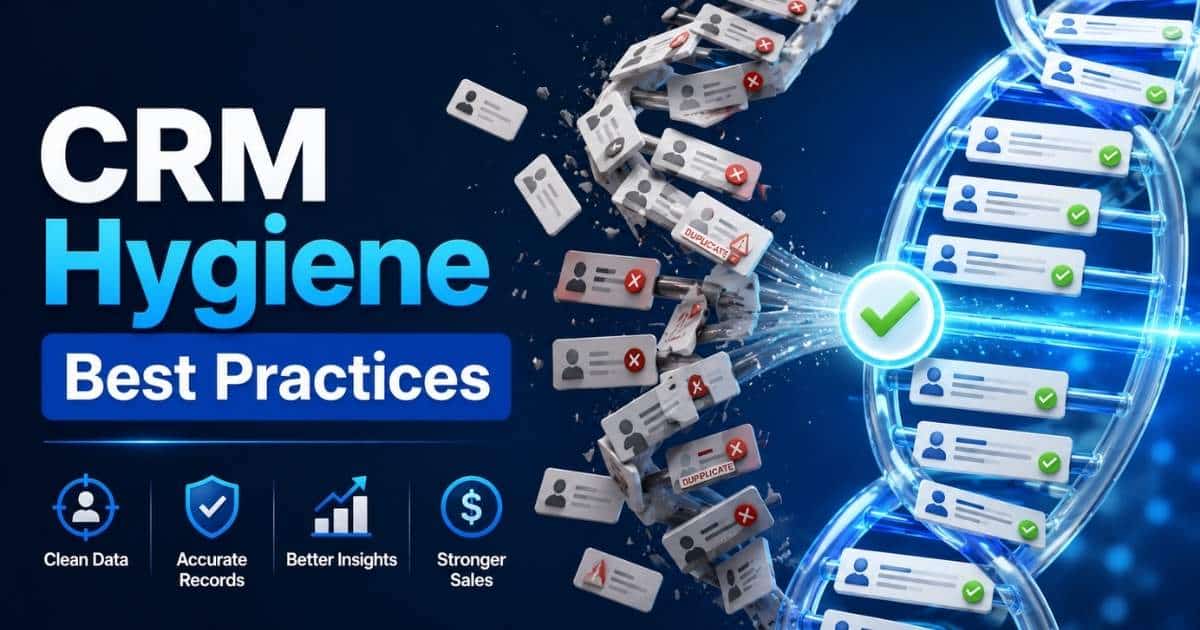
Many companies invest heavily in CRM software but still struggle with bad data. Duplicate contacts, missing information, outdated records, and messy pipelines slowly reduce sales performance. Reports become unreliable. Marketing campaigns miss the right audience. Teams waste time fixing avoidable mistakes.
Clean CRM data is not just an administrative task. It directly affects revenue, forecasting accuracy, customer experience, and team productivity. Strong CRM hygiene helps every department work with reliable information and make faster decisions.
This guide covers the most effective CRM hygiene best practices, from data cleanup and standardization to automation, governance, and long-term maintenance. You will learn how to build a CRM that stays accurate, organized, and useful as your business grows. Recent CRM data quality research shows poor data management remains one of the biggest challenges for sales and marketing teams, making CRM hygiene a critical business priority.
What CRM Hygiene Means
CRM hygiene is the process of keeping CRM data clean, accurate, and useful across the entire customer lifecycle. Every customer relationship management strategy depends on reliable customer data. When a CRM system contains duplicate records, outdated contact details, or incomplete company data, sales teams and marketing teams struggle to make the right decisions. Poor data entry also affects customer interactions, sales forecasting, lead management, and customer segmentation.
Strong CRM hygiene best practices help businesses maintain unified customer data across multiple channels. Modern CRM systems use automation, data analysis, and AI CRM capabilities to improve customer engagement and sales productivity. Clean customer and company data supports marketing campaigns, sales pipeline tracking, customer retention, and better customer experiences. Whether you use cloud-based CRM software, operational CRM, analytical CRM, or collaborative CRM solutions, accurate data helps manage customer relationships, meet customer expectations, and achieve business objectives with greater confidence.
The Biggest CRM Data Quality Problems That Damage Business Performance
Most CRM issues do not start with major system failures. Small data errors create bigger problems over time. Duplicate records, outdated contacts, and incomplete customer data reduce sales productivity and weaken decision-making. Recent research found that 37% of CRM users lost revenue because of poor data quality, while many organizations still struggle with inaccurate CRM records.
Duplicate Records Create Confusion Across Teams
Duplicate records are one of the most common CRM data quality problems. Sales reps often create new contacts instead of updating existing customer profiles. Marketing teams may also import the same lead multiple times from different channels.
Conflicting customer and company data creates reporting errors and weakens customer relationship management efforts. Experian reports that duplicate records make up 15% to 20% of organizational data on average. Poor duplicate control also affects customer interactions, sales pipeline tracking, and customer satisfaction because teams no longer work from a single source of truth.
Outdated Customer Data Reduces Sales Accuracy
Customer data changes constantly. People switch jobs, companies expand, and contact details become outdated. A CRM system filled with old information makes lead management and sales forecasting less reliable.
B2B customer data can decay at very high rates each year. Poor CRM hygiene best practices often leave sales teams chasing inactive contacts or wrong decision-makers. Outdated CRM data also hurts customer engagement because marketing campaigns reach the wrong audience. Revenue teams waste time instead of focusing on qualified opportunities across the entire sales cycle.
Incomplete Records Damage Customer Insights
Missing information limits the value of CRM software. A customer profile without industry details, company size, location, or purchase history creates gaps in customer analysis. Sales marketing and service teams cannot fully understand customer behavior.
Incomplete records also weaken customer segmentation and marketing automation workflows. Lead scoring becomes less accurate. Customer preferences remain unclear. Research shows that poor data quality can cost businesses millions every year because critical business processes depend on complete and reliable customer relationship management CRM data. Better CRM tools require complete records to deliver superior customer experiences.
Poor Data Entry Creates Inconsistent CRM Records
Many CRM data problems start with manual data entry. Different teams use different formats for names, phone numbers, industries, and account details. Small inconsistencies spread across the CRM platform very quickly.
Inconsistent CRM data makes reporting difficult and affects sales operations. Analytical CRM systems depend on structured information to analyze customer data correctly. Poor standardization also creates problems for sales automation, service automation, and predictive analytics. Modern CRM systems work best when every team follows the same data entry rules and governance standards.
Fragmented Data Breaks The Customer Journey
Customer information often lives across spreadsheets, email platforms, support tools, and cloud CRM systems. Teams struggle to access unified customer data when information stays disconnected. Customer relationships become harder to manage across multiple channels.
Recent research found that only a small percentage of businesses fully trust their data for accurate reporting. Fragmented customer data creates gaps across the entire customer journey and prevents businesses from delivering superior customer experiences. Strategic CRM, collaborative CRM, and cloud-based CRM solutions depend on connected data to support customer retention, customer loyalty, and long-term business objectives.
How To Audit Your CRM Data Before Building A Cleanup Strategy
A CRM cleanup strategy works better when teams understand the real problems first. Many businesses clean records without checking where errors come from. A proper audit helps identify weak data, broken workflows, and inaccurate reporting before changes begin. Recent studies show poor data quality costs organizations millions every year.
Check Data Accuracy First
Accurate customer data is the foundation of every CRM system. Wrong phone numbers, outdated emails, and incorrect company details reduce customer engagement and sales productivity. Sales reps often lose time when CRM records contain unreliable information.
A CRM audit should compare customer relationship management data against trusted sources. Teams can review customer interactions, contact management records, and lead details for errors. Gartner reports poor data quality costs organizations an average of $12.9 million annually. Clean CRM data improves customer satisfaction and supports better business objectives.
Review Duplicate And Incomplete Records
Duplicate contacts create confusion across sales marketing and service teams. Incomplete records also weaken customer analysis and sales forecasting. A CRM platform filled with missing information limits decision-making.
Audit reports should identify duplicate customer and company data across all customer relationship management software records. Teams should also check fields like job title, industry, company size, and contact details. Research shows duplicate data remains one of the biggest CRM hygiene challenges for modern CRM systems. Better record quality supports stronger customer relationships and customer retention.
Analyze User Data Entry Habits
Many CRM data problems start with inconsistent data entry. Different teams often use different formats for customer data. Small mistakes spread across the entire customer journey and reduce reporting accuracy.
A CRM audit should review how sales teams, marketing teams, and service teams enter information. Check required fields, naming conventions, and CRM features used during the sales process. Consistent data entry improves unified customer data and helps CRM tools deliver better customer experiences, especially when you address CRM adoption challenges and best practices for your sales team. Strong CRM hygiene best practices start with user accountability.
Audit Pipeline And Forecast Data
Pipeline data directly affects sales operations and revenue planning. Poor CRM data creates inaccurate sales forecasting and weak sales management decisions. Many companies discover forecasting issues only after revenue targets are missed.
Review every stage of the sales pipeline during the audit. Compare deal values, close dates, and opportunity status with real sales activity. Reliable sales pipeline tracking improves sales force automation and helps analyze customer data more effectively. Accurate forecasts also support strategic CRM planning and long-term growth.
Evaluate Integrations And Data Sources
Modern CRM solutions collect information from multiple channels. Marketing automation tools, sales cloud platforms, support software, and cloud-based CRM systems constantly exchange data. Errors often appear when integrations fail or sync rules break.
Audit all customer relationship management CRM connections before starting cleanup work. Check whether customer preferences, customer behavior data, and lead management records sync correctly across systems. Reliable integrations help create unified customer data and support superior customer experiences. Strong CRM technology depends on trusted data across the entire customer lifecycle.
CRM Hygiene Best Practices For Data Entry And Standardization
Clean customer relationship management data starts with strong standards. Many CRM problems appear because teams follow different data entry habits. A clear structure helps maintain accurate customer data, improve sales productivity, and support better decision-making across the entire customer lifecycle. Research shows poor data quality remains one of the biggest barriers to CRM success, especially when implementing modern CRM software for sales teams.
Set Required Fields For Every Record
Required fields help sales teams collect complete customer data from the start. Missing information creates gaps in customer analysis, sales forecasting, and lead management. A CRM system works better when critical details stay consistent across records.
Focus on fields like contact name, company, email, industry, and lead source. Customer relationship management software should prevent users from saving incomplete profiles. Complete records improve customer segmentation and support stronger customer relationships. Reliable CRM data also helps service teams and marketing teams deliver better customer experiences.
Create Clear Naming Rules
Different naming styles create confusion across CRM tools. One sales rep may enter a company as IBM, while another uses International Business Machines. Small differences create duplicate records and inaccurate reports.
A naming convention keeps customer and company data organized. Standard formats improve contact management and sales pipeline tracking. Modern CRM systems rely on structured data for predictive analytics and customer engagement. Consistent naming also supports unified customer data across multiple channels and cloud CRM platforms.
Standardize Dropdown And Picklist Values
Free-text fields often create inconsistent CRM data. Users may enter similar values in different ways, which makes reporting difficult. Customer relationship management CRM platforms perform better when teams use standardized selections.
Dropdown menus help control data entry and improve data analysis. Sales marketing and service teams can analyze customer behavior more accurately when records follow the same structure. Standardized values also improve marketing automation, sales automation, and customer segmentation efforts. Better consistency leads to stronger CRM strategy execution.
Reduce Manual Data Entry
Manual updates increase the risk of human error. Sales reps often work under pressure and may skip fields or enter incorrect information. Small mistakes quickly spread across the CRM platform.
Automation tools help capture customer interactions and customer preferences without manual work. Modern CRM solutions use AI CRM features, sales force automation, and workflow automation to improve accuracy. Research shows automation can significantly reduce data quality issues while improving sales operations and customer satisfaction. Reliable data supports better business objectives and stronger customer loyalty.
Use Data Validation Rules
Validation rules stop incorrect information before it enters the CRM system. A simple typo in an email address can affect marketing campaigns and customer engagement. Small errors often create larger reporting problems later.
Customer relationship management software should validate phone numbers, email formats, and required data fields automatically. Analytical CRM and operational CRM systems depend on accurate information to analyze customer data effectively. Strong validation rules improve customer retention and help deliver superior customer experiences across the entire customer journey.
Document CRM Data Standards
Many companies create CRM rules but fail to document them. New employees often enter customer data based on personal habits instead of company standards. Inconsistency grows quickly without clear guidance.
A written CRM policy helps sales teams, marketing teams, and service teams follow the same processes. Documentation should explain field definitions, naming standards, and approved workflows. Collaborative CRM environments work better when everyone follows the same rules. Clear standards also improve CRM implementation success and long-term data quality.
Train Teams On Data Quality
Technology alone cannot solve CRM data problems. Team behavior plays a major role in customer relationship management success. Strong training helps users understand why accurate CRM data matters.
Employees should learn how clean records support customer satisfaction, sales management, and customer retention. Training sessions can also explain how CRM features affect customer experiences across the entire sales cycle, including how to manage contacts better and build stronger relationships. Businesses that invest in CRM hygiene best practices often see better adoption rates and stronger customer relationships over time. Accurate data helps every department perform more effectively.
Use Of Automation To Maintain CRM Hygiene At Scale
Manual cleanup cannot keep up with growing customer data. Modern businesses collect information across multiple channels every day. CRM automation for sales and growth helps maintain accurate CRM data, reduce human errors, and improve customer relationship management without increasing workload. Recent studies show automation improves data accuracy and operational efficiency across sales marketing and service teams.
Automate Duplicate Record Detection
Duplicate records create major problems in customer relationship management CRM systems. Sales reps may contact the same lead multiple times. Marketing teams may send duplicate emails to potential customers. Customer experiences suffer when records stay disconnected.
Modern CRM software uses automation to detect duplicate customer and company data before it spreads across the CRM platform. AI CRM tools compare names, email addresses, phone numbers, and account details automatically. Faster duplicate detection improves customer satisfaction, sales productivity, and customer retention while keeping unified customer data more reliable.
Use Automated Data Validation Rules
Incorrect customer data often enters CRM systems through manual data entry. Small mistakes in phone numbers, email addresses, or company details affect customer engagement and reporting accuracy. Validation rules help prevent those issues early.
Customer relationship management software can automatically verify required fields and approved formats. Operational CRM and analytical CRM systems depend on clean information for customer analysis and sales forecasting. Strong validation rules reduce CRM costs linked to poor data quality and improve customer interactions across the entire customer journey.
Connect Data Across Every System
Customer information often exists in sales cloud platforms, marketing automation software, support tools, and cloud-based CRM solutions. Disconnected systems create fragmented customer data and weaken customer relationships.
Automation helps sync customer preferences, lead management records, and customer behavior data across all business processes. Collaborative CRM systems perform better when customer relationship management data stays connected, and these capabilities are central to future CRM technology trends and tools. Unified customer data improves customer segmentation, sales management, and customer loyalty while helping businesses deliver superior customer experiences across multiple channels.
Trigger Automatic Record Updates
Customer data changes constantly. People change roles, companies grow, and customer interactions create new information every day. Outdated records reduce sales operations efficiency and create forecasting problems.
CRM tools can automatically update records based on customer activity, email engagement, or website behavior. Strategic CRM and cloud CRM platforms often use workflow automation to keep records current throughout the entire customer lifecycle. Better record accuracy helps sales teams understand customer expectations and improve the entire sales cycle.
Use AI For Smarter Data Management
AI CRM technology plays a larger role in modern CRM hygiene best practices. Businesses now use predictive analytics and machine learning to analyze customer data faster than manual processes. AI helps identify unusual patterns, missing fields, and data quality risks.
Modern CRM solutions use artificial intelligence to improve sales force automation, customer engagement, and customer analysis. Research shows AI adoption in customer relationship management continues to grow as companies focus on stronger business objectives and superior customer experiences. Better automation supports stronger customer relationships and long-term growth.
How To Create A CRM Data Governance Framework With Clear Ownership
Strong CRM hygiene best practices need more than clean records and automation. Every CRM system needs clear ownership, defined responsibilities, and consistent rules. A data governance framework helps protect customer data quality, improve customer relationship management, and support long-term business objectives across teams. Recent studies show organizations with strong governance frameworks achieve better data accuracy and reporting performance.
Assign Data Owners Across Teams
Every customer relationship management CRM platform should have dedicated data owners. Without ownership, CRM data quality problems often remain unresolved. Teams may assume someone else is responsible for fixing errors.
Data owners help monitor customer and company data across sales teams, marketing teams, and service teams. They review data accuracy, enforce standards, and support customer relationship management software governance policies. Clear ownership improves customer engagement and helps maintain unified customer data across the entire customer lifecycle.
Ownership works best when it maps to specific roles, not just a general policy. Executive sponsors set priorities and unblock resourcing. CRM administrators manage the system and enforce configuration standards. Data stewards or a governance team own data quality rules day to day. Business users in sales, marketing, and support are responsible for entering clean data at the source, since that's where most quality problems start. IT and integration specialists keep the data flowing correctly between the CRM and every connected tool. Naming these roles explicitly, rather than leaving ownership implied, is what actually makes a governance policy stick.
Define Team Responsibilities Clearly
CRM governance works best when every department understands its role. Sales operations, marketing automation, and service automation teams often interact with the same customer data. Confusion increases when responsibilities overlap.
A governance framework should explain who manages lead management, customer interactions, contact management, and sales pipeline tracking. Clear accountability reduces duplicate work and improves customer experiences. Strong role definitions also help businesses achieve customer retention and customer loyalty goals more effectively.
Create Written Data Policies
Many businesses rely on verbal instructions for CRM processes. Problems appear when employees follow different standards for data entry and customer relationship management activities. Inconsistent habits quickly reduce CRM data quality.
Written policies create consistency across business processes. Rules should cover record creation, customer preferences, field requirements, and customer analysis standards. Modern CRM systems perform better when users follow documented processes. Clear policies also improve CRM implementation outcomes and support stronger customer relationships.
Control User Access And Permissions
Not every employee needs access to all your customer data. Unrestricted access often creates accidental edits, duplicate records, and security risks. A strong governance framework protects sensitive information while supporting daily operations.
Cloud-based CRM and sales cloud platforms allow businesses to set role-based permissions. Teams can access only the customer data required for their responsibilities. Better access control improves customer satisfaction, protects customer behavior data, and supports compliance requirements. Secure CRM solutions also reduce long-term CRM costs linked to data errors.
Review Data Quality On A Regular Schedule
Governance does not end after setup. Customer data changes constantly across multiple channels. Regular reviews help identify new issues before they affect customer engagement and sales productivity.
A governance team should audit CRM features, sales forecasting reports, customer segmentation accuracy, and customer journey data. Analytical CRM and strategic CRM systems depend on reliable information for predictive analytics and decision-making. Regular reviews help deliver superior customer experiences and keep customer relationship management aligned with changing business objectives.
Clean, Enrich, And Segment CRM Data For Better Customer Intelligence
Customer relationship management works better when businesses trust their data. Clean records, enriched profiles, and accurate customer segmentation help teams understand customer behavior more clearly. Better customer intelligence improves customer engagement, sales productivity, and decision-making across the entire customer lifecycle. Recent research shows data-driven companies are far more likely to improve customer retention and revenue performance.
Remove Duplicate Customer Records
Duplicate records create confusion across customer relationship management CRM platforms. Sales teams may contact the same lead twice, while marketing teams may send duplicate campaign messages. Poor data quality affects customer experiences and weakens customer relationships.
A CRM system should identify and merge duplicate customer and company data regularly. Modern CRM tools use automation and AI CRM features to detect duplicate records faster. Cleaner CRM data improves customer satisfaction, sales forecasting, and customer retention while creating a more reliable customer journey across multiple channels.
Enrich Customer Profiles With Better Data
Basic contact details only show part of the customer story. Sales marketing and service teams need deeper customer data to understand customer preferences, buying habits, and business objectives. Incomplete records limit customer analysis and lead management efforts.
Data enrichment adds valuable details such as company size, industry, location, and purchase history. Modern CRM solutions often connect with external databases to improve customer relationship management software records automatically. Better profile data supports customer segmentation, sales management, and stronger customer engagement throughout the entire sales cycle.
Verify Contact Information Regularly
Customer data changes constantly. People switch jobs, businesses relocate, and phone numbers become outdated. Incorrect contact information reduces sales productivity and affects customer interactions across the CRM platform.
Regular verification helps maintain accurate customer relationship management data. Cloud based CRM systems and sales cloud platforms often use automated validation tools to check email addresses and phone numbers. Reliable contact management improves customer loyalty, customer retention, and marketing automation performance. Accurate records also help deliver superior customer experiences at every stage of the customer journey.
Build Smarter Customer Segments
Customer segmentation helps businesses understand different audience groups. Generic outreach often reduces customer engagement because customer expectations vary across industries, company sizes, and buyer behaviors. Better segmentation improves communication and campaign performance.
Analytical CRM systems use unified customer data to group contacts based on customer behavior, purchase history, and customer preferences. Strong segmentation supports strategic CRM planning, sales automation, and predictive analytics. Businesses can analyze customer data more effectively and create personalized customer experiences across the entire customer lifecycle.
Use Customer Insights To Improve Decisions
Clean CRM data becomes more valuable when teams use it for decision-making. Customer relationship management software collects large amounts of information from customer interactions, marketing campaigns, and sales operations. Raw data alone does not create results.
Customer intelligence helps identify trends, opportunities, and risks across business-to-business and business-to-consumer markets. Modern CRM technology uses data analysis, operational CRM tools, and collaborative CRM features to support better business processes, especially in complex B2B sales CRM environments. Strong customer insights improve sales pipeline tracking, customer satisfaction, and long-term growth while helping businesses achieve important business objectives.
CRM Hygiene Best Practices For Different Teams
Customer relationship management works best when every department follows the same data quality standards. Each team interacts with customer data differently, but all customer interactions affect the CRM system. Strong CRM hygiene best practices help maintain accurate records, improve collaboration, and support better customer experiences across the entire customer lifecycle. Recent studies show companies with aligned teams achieve stronger customer retention and revenue growth.
Sales Teams Need Accurate Pipeline Data
Sales teams depend on reliable CRM data for lead management, sales forecasting, and sales productivity improvements. Outdated records often create forecasting errors and reduce sales productivity. Poor customer relationship management data can also slow the sales process.
Sales reps should update opportunity stages, contact details, and customer interactions regularly. Accurate customer and company data helps sales force automation tools perform better, especially when customer interaction tracking in CRM is automated and comprehensive. Clean records improve customer engagement and help sales management teams make stronger business decisions. Reliable CRM software also supports better customer relationships throughout the entire sales cycle.
Marketing Teams Need Clean Audience Data
Marketing teams rely on customer segmentation and customer behavior data to build successful marketing campaigns. Poor CRM data often leads to inaccurate targeting and lower campaign performance. Customer expectations become harder to meet when audience data lacks accuracy.
Customer relationship management software should maintain complete customer profiles and updated customer preferences. Marketing automation platforms perform better when centralized contact management keeps unified customer data clean across multiple channels. Accurate segmentation improves customer loyalty, customer retention, and customer satisfaction while helping businesses deliver superior customer experiences.
Service Teams Need Complete Customer Histories
Service teams handle customer issues across different communication channels. Missing customer data often creates delays and weak customer experiences. Customers expect support teams to understand previous customer interactions without repeating information.
Operational CRM and collaborative CRM systems help service teams access complete customer journey records. Accurate customer relationship management CRM data improves response times and customer satisfaction. Better visibility also helps service automation tools resolve issues faster. Strong customer support directly strengthens customer relationships and long-term customer retention.
Operations Teams Need Strong Data Governance
Sales operations teams play a major role in CRM hygiene. They manage CRM features, business processes, integrations, and reporting standards. Weak governance often creates inconsistent customer data across cloud-based CRM platforms.
Operations teams should monitor data entry standards, CRM implementation policies, and system integrations. Analytical CRM systems depend on reliable information for predictive analytics and customer analysis. Strong governance supports business objectives, improves data analysis accuracy, and helps modern CRM systems maintain long-term data quality across sales marketing and service functions, especially when organizations focus on choosing CRM tools that fit existing workflows.
How To Manage CRM Integrations And Third-Party Data Without Losing Data Quality
Modern customer relationship management software connects with dozens of tools. Marketing automation platforms, sales cloud systems, support software, and CRM with email integration constantly exchange customer data. Small sync issues can quickly create inaccurate CRM data, duplicate records, and poor customer experiences. Recent studies show data integration challenges remain one of the biggest CRM management problems for growing businesses.
Check CRM Integrations Regularly
Many CRM systems connect with multiple business applications. Customer data moves between sales marketing and service platforms every day. A small integration failure can create missing records or outdated customer information.
Regular audits help identify sync errors before they affect customer relationship management processes. Teams should review data flow between CRM tools, marketing automation systems, and sales force automation platforms. Strong integration monitoring improves customer engagement and helps maintain unified customer data across the entire customer lifecycle.
Fix Sync Errors Before They Spread
Sync errors often create hidden CRM data quality issues. Customer interactions may fail to appear inside the CRM platform. Sales reps can miss important updates when records stop syncing correctly.
Businesses should create alerts for failed data transfers and integration problems. Cloud based CRM systems often provide automated monitoring tools for faster issue detection. Accurate customer relationship management CRM data improves customer satisfaction, sales productivity, and customer retention while reducing operational risks.
Validate Third-Party Data Sources
Third-party databases help enrich customer and company data. However, external data sources can also introduce outdated or inaccurate information. Poor-quality imports often weaken customer analysis and customer segmentation efforts.
Teams should verify customer data before importing it into CRM software. Analytical CRM and strategic CRM platforms depend on reliable information for predictive analytics and sales forecasting. Strong validation processes help maintain accurate customer behavior data and support better business objectives across business-to-business and business-to-consumer markets.
Create Consistent Data Mapping Rules
Different systems often use different field structures. A mismatch between platforms can create incomplete customer profiles and inconsistent customer relationship management records. Data mapping errors frequently affect reporting accuracy.
Clear mapping rules help connect customer preferences, lead management data, and contact management records correctly. Modern CRM solutions perform better when every integration follows standardized formats. Consistent mapping improves customer relationships and supports stronger customer experiences throughout the entire customer journey.
Protect Unified Customer Data Across Platforms
Customer information now exists across multiple channels and cloud CRM environments. Fragmented records make it difficult to analyze customer data and understand customer expectations. Centralized contact management explained for growing teams is especially important in industries like retail, where CRM tools help retail teams stay organized and aligned. Businesses need a single source of truth for decision-making.
Collaborative CRM and operational CRM systems work best when customer relationship management data stays connected across platforms. Unified customer data improves sales management, customer loyalty, and sales pipeline tracking. Better visibility also helps deliver superior customer experiences while supporting long-term CRM strategy and business growth.
Essential CRM Hygiene Metrics Every Team Should Track
Strong CRM hygiene best practices depend on measurable results. Many businesses clean customer data without tracking whether data quality actually improves. CRM metrics help teams identify hidden issues, improve customer relationship management processes, and maintain reliable customer intelligence over time. Recent research shows companies that actively monitor data quality achieve better sales productivity, customer retention, and reporting accuracy.
Measure Data Completeness Rates
Incomplete customer data creates gaps across customer relationship management CRM systems. Missing fields reduce customer analysis accuracy and weaken customer segmentation efforts. Sales teams often struggle when important contact details remain unavailable.
Businesses should track how many records contain complete customer and company data. Metrics should cover email addresses, phone numbers, company details, and customer preferences. Better completeness improves customer engagement, sales forecasting, and marketing automation performance. Accurate CRM data also supports stronger customer relationships across the entire customer lifecycle.
Monitor Duplicate Record Levels
Duplicate records remain one of the biggest CRM data quality challenges. Multiple records for the same contact create confusion across sales marketing and service teams. Customer interactions often become inconsistent when duplicate profiles exist.
A CRM system should track duplicate rates regularly. Modern CRM software and AI CRM tools can automatically identify duplicate customer data across multiple channels. Lower duplicate rates improve customer satisfaction, customer loyalty, and sales pipeline tracking while helping maintain unified customer data throughout the customer journey.
Track Data Accuracy Scores
Accurate customer relationship management data supports better business decisions. Outdated contact details, incorrect company information, and invalid records reduce sales productivity and customer retention. Poor accuracy often affects multiple business processes at once.
Customer relationship management software should measure how much CRM data matches verified sources. Analytical CRM systems rely on accurate information for predictive analytics and customer behavior analysis. Higher accuracy scores improve customer experiences, sales management, and long-term business objectives across business-to-business and business-to-consumer environments.
Review CRM User Adoption Metrics
A CRM platform cannot maintain strong data quality if teams rarely use it. Low adoption often leads to missing records, outdated opportunities, and weak customer relationship management processes. Data quality problems usually increase when employees avoid CRM tools.
Businesses should track login frequency, record updates, and CRM feature usage across sales reps, marketing teams, and service teams. Strong adoption improves sales force automation, contact management, and lead management performance. Better usage also supports collaborative CRM strategies and stronger customer engagement.
Evaluate Sales And Forecast Accuracy
Sales forecasting accuracy reflects the overall health of a CRM system. Poor forecasts often reveal deeper issues with customer data, sales operations, and sales pipeline management. Revenue planning becomes less reliable when CRM records contain errors.
Teams should compare forecasted revenue with actual results on a regular schedule. Operational CRM and strategic CRM systems depend on reliable information across the entire sales cycle. Better forecast accuracy improves customer relationship management CRM performance and helps businesses achieve important business objectives with greater confidence.
CRM Hygiene Checklist For Monthly, Quarterly, And Annual Reviews
CRM hygiene best practices work best when teams review data consistently. Customer data changes every day across sales, marketing, and service platforms. Regular reviews help maintain accurate customer relationship management records, improve customer engagement, and prevent small issues from becoming major business problems. Recent studies show organizations with structured data review processes achieve stronger reporting accuracy and customer retention.
Review Data Quality Every Month
Monthly reviews help identify CRM data problems early. Small issues like duplicate records, incomplete customer data, and outdated contact details can quickly affect customer relationship management performance. Regular checks help maintain clean records across the CRM system.
Sales teams and marketing teams should review customer and company data every month. Customer relationship management software reports can highlight missing fields, inactive contacts, and data entry errors. Better monthly reviews improve customer satisfaction, lead management, and customer experiences throughout the entire customer lifecycle.
Audit Sales Pipeline Every Quarter
Quarterly audits help businesses maintain accurate sales forecasting and sales pipeline tracking. CRM data often becomes outdated when opportunities stay open for long periods without updates. Poor pipeline visibility affects sales productivity and revenue planning.
Teams should review deal stages, close dates, and customer interactions during each quarter. Operational CRM and sales force automation tools perform better when pipeline records stay accurate. Better audits also improve customer relationship management CRM reporting and help sales management teams make stronger business decisions.
Evaluate Customer Segmentation Regularly
Customer behavior changes over time. Segments that worked six months ago may no longer reflect current customer preferences or business objectives. Outdated segmentation reduces customer engagement and marketing campaign performance.
Quarterly reviews should analyze customer segmentation rules and audience quality. Analytical CRM systems use customer data, purchase history, and customer interactions to create stronger customer profiles. Better segmentation improves marketing automation, customer loyalty, and customer retention while helping businesses deliver superior customer experiences.
Check Integrations And Automation Annually
CRM integrations often change as businesses adopt new tools and CRM features. Sync issues can create fragmented customer data across cloud CRM platforms. Small integration problems frequently remain hidden for months.
Annual reviews should evaluate marketing automation systems, sales cloud platforms, service automation tools, and third-party data sources. Collaborative CRM and cloud-based CRM solutions depend on reliable integrations for unified customer data. Strong integration audits improve customer relationship management processes and support long-term business growth.
Measure Long-Term CRM Performance
Annual reviews should focus on overall CRM strategy and business outcomes. Clean data matters, but teams also need to understand how CRM technology supports customer relationships and business objectives. Strong reporting helps identify long-term opportunities.
Businesses should review sales forecasting accuracy, customer retention rates, customer satisfaction scores, and sales operations performance. Strategic CRM systems use customer analysis and predictive analytics to support better decision-making. Long-term measurement helps maintain strong customer relationships and keeps customer relationship management aligned with company goals.
Common CRM Hygiene Mistakes That Keep Returning Even After Cleanup
Many companies clean their CRM system once and expect long-term results. Problems often return because the root causes stay unresolved. Weak processes, poor accountability, and overly complex workflows prevent teams from getting more from their CRM with a simpler sales workflow, and inconsistent customer relationship management habits slowly create new data quality issues. Recent research shows CRM data decay remains one of the biggest challenges for businesses that rely on customer data for sales and marketing decisions.
One-Time Cleanup Without Ongoing Maintenance
A single cleanup project cannot protect CRM data forever. Customer information changes constantly across the entire customer lifecycle. New customer interactions, lead management activities, and sales pipeline updates create fresh records every day.
Businesses often remove duplicate records and outdated contacts once but skip future reviews. Customer relationship management software needs regular monitoring to maintain accurate customer and company data. Strong CRM hygiene best practices require continuous audits, automation, and governance to support customer retention and long-term business objectives.
Lack Of Clear Data Ownership
CRM data quality often declines when nobody owns the process. Sales teams, marketing teams, and service teams may all use the same CRM platform, but responsibility remains unclear. Small errors stay unresolved for long periods.
Customer relationship management CRM strategies work better when data owners monitor record quality and enforce standards. Clear ownership improves customer engagement, sales productivity, and customer satisfaction. Strong accountability also helps maintain unified customer data across multiple channels and cloud-based CRM environments.
Poor Data Entry Habits Across Teams
Many CRM problems begin with inconsistent data entry. Different employees often use different formats for customer data, company names, and customer preferences. Small inconsistencies create larger reporting problems over time.
Modern CRM systems depend on structured information for customer analysis, predictive analytics, and sales forecasting. Poor data entry reduces the value of CRM tools and marketing automation platforms. Better standards help maintain customer relationship management data quality and improve customer experiences across the entire customer journey.
Too Many Unused Fields And Records
CRM software often becomes cluttered with unnecessary fields and outdated records. Businesses frequently add custom fields during CRM implementation but rarely remove unused ones. Complex systems create confusion for sales reps and service teams.
Unused data fields reduce user adoption and weaken customer relationship management processes. Operational CRM and collaborative CRM platforms perform better when records stay organized and relevant. Simpler CRM features improve sales operations, customer loyalty, and customer relationships while reducing long-term CRM costs.
Overreliance On Manual Processes
Manual updates create more opportunities for errors. Sales force automation and AI CRM tools can improve accuracy, but many organizations still depend heavily on manual workflows. Human mistakes often affect customer data quality and reporting accuracy.
Businesses should automate repetitive business processes whenever possible. Automated validation, customer segmentation, and sales automation tools help maintain reliable customer relationship management software records. Better automation supports customer behavior analysis, sales management, and stronger customer experiences across business-to-business and business-to-consumer environments.
How AI And Modern CRM Tools Improve Data Quality Management
Modern CRM systems do more than store customer data. Advanced CRM tools now use automation, predictive analytics, and AI CRM capabilities to improve customer relationship management and reduce manual work. Businesses use smarter CRM technology to maintain cleaner records, improve customer engagement, and support stronger business objectives. Recent reports show AI adoption in CRM software continues to grow across sales, marketing, and service operations.
AI Detects Data Quality Problems Faster
Traditional CRM audits often require manual reviews. Large databases make it difficult for teams to identify duplicate records, missing fields, and inconsistent customer data quickly. Small errors can stay hidden for months.
AI CRM tools analyze customer and company data automatically. Machine learning models detect unusual patterns, duplicate records, and incomplete customer relationship management CRM profiles. Faster detection improves customer satisfaction, sales productivity, and customer retention while helping teams maintain unified customer data across the entire customer lifecycle.
Automation Reduces Manual Data Entry Errors
Manual data entry remains one of the biggest causes of poor CRM data quality. Sales reps and service teams often work with large volumes of customer interactions every day. Human mistakes can affect reporting accuracy and customer experiences.
Modern CRM software uses sales force automation and workflow automation to capture customer data automatically. Operational CRM systems can update records based on emails, website activity, and customer behavior, allowing teams to automate sales tasks to stay focused and organized. Better automation improves contact management, lead management, and customer engagement while reducing long-term CRM costs.
Predictive Analytics Improves Customer Insights
Customer relationship management software collects large amounts of information across multiple channels. Raw customer data becomes more valuable when businesses can identify patterns and future opportunities. Predictive analytics helps turn data into action.
Analytical CRM systems use predictive models to analyze customer preferences, purchase history, and customer interactions. Better forecasting supports sales management, customer segmentation, and customer loyalty strategies. Businesses can also improve marketing campaigns and sales forecasting with more accurate customer analysis.
Smart Enrichment Builds Better Customer Profiles
Incomplete records often reduce the value of customer relationship management systems. Missing company details, industry information, or contact data can weaken customer engagement and sales marketing efforts. Better customer intelligence requires stronger profile data.
Modern CRM solutions use AI and external databases to enrich customer profiles automatically. Cloud-based CRM platforms can add customer preferences, business details, and behavioral insights without manual work, especially when they use dynamic contact management for smarter relationship tracking. Richer profiles improve customer relationships and help deliver superior customer experiences throughout the entire customer journey.
Unified Data Creates Better Business Decisions
Many businesses still struggle with fragmented customer data across cloud CRM systems, marketing automation tools, and sales cloud platforms. Disconnected information limits visibility and weakens customer relationship management strategies.
Collaborative CRM and strategic CRM platforms help connect all your customer data into a single view. Unified customer data improves customer analysis, sales pipeline tracking, and business processes across sales marketing and service teams. Better visibility helps organizations achieve business objectives and build stronger customer relationships over time.
How To Build A Long-Term CRM Hygiene Strategy That Supports Revenue Growth
Strong CRM hygiene best practices should support long-term business growth, not just short-term cleanup goals. Customer data changes constantly across the entire customer lifecycle. A sustainable customer relationship management strategy helps businesses maintain accurate records, improve customer engagement, and increase revenue over time. Recent studies show companies with strong data management practices achieve better sales productivity and customer retention rates.
Align CRM Goals With Business Objectives
A CRM system should support larger business goals. Many organizations focus only on data cleanup without connecting CRM data quality to revenue growth, customer retention, and customer satisfaction. Data becomes more valuable when tied to measurable outcomes.
Customer relationship management CRM strategies should support sales forecasting, customer engagement, and sales pipeline tracking goals. Strategic CRM planning helps sales teams and marketing teams make better decisions. Clear alignment also improves customer relationships and helps organizations achieve long-term business objectives more effectively.
Build Consistent Data Governance Processes
Long-term CRM success depends on strong governance. Customer data quality often declines when businesses lack ownership, standards, and accountability. Small process gaps can create major customer relationship management problems over time.
A governance framework should define responsibilities for customer and company data, data entry standards, and CRM feature usage. Operational CRM and collaborative CRM systems perform better when teams follow the same rules. Strong governance improves customer experiences and helps maintain unified customer data across multiple channels.
Use Automation To Maintain Data Quality
Manual processes cannot support large-scale CRM hygiene efforts for long periods. Customer interactions, lead management activities, and marketing campaigns create new customer data every day. Human reviews alone often miss important issues.
Modern CRM software uses sales automation, marketing automation, and AI CRM tools to maintain cleaner records. Automated workflows improve customer relationship management software accuracy and reduce repetitive work. Better automation supports customer loyalty, sales management, and customer retention throughout the entire sales cycle.
Track CRM Metrics And Performance Trends
Long-term CRM hygiene requires continuous measurement. Businesses cannot improve customer relationship management performance without understanding where problems appear. Data quality metrics help identify risks before they affect revenue growth.
Teams should monitor customer data accuracy, duplicate rates, customer segmentation quality, and sales forecasting performance. Analytical CRM systems use data analysis and predictive analytics to support stronger decision-making, particularly around how CRM helps sales teams manage leads more effectively. Better visibility helps improve customer behavior analysis and customer engagement across business-to-business and business-to-consumer environments.
Train Teams And Improve CRM Adoption
Technology alone cannot maintain strong CRM data quality. Employees play a major role in customer relationship management success. Poor adoption often leads to incomplete records, weak customer analysis, and inaccurate reporting.
Sales reps, service teams, and marketing teams should understand how CRM tools affect customer experiences and business processes. Regular training helps teams follow CRM strategy standards and improve data quality habits, including how to use automation effectively and how CRM tools help real estate agents save time in relationship-heavy workflows. Better adoption strengthens customer relationships, supports superior customer experiences, and helps modern CRM systems deliver long-term value.
How Gain.io Helps Maintain CRM Hygiene And Improve Data Quality At Scale
Gain.io helps businesses maintain cleaner customer relationship management data by centralizing customer information, automating workflows, and improving visibility across sales, marketing, and service operations. A connected CRM system reduces duplicate records, improves customer data accuracy, and supports better customer engagement across the entire customer lifecycle. Strong automation and data management features also help teams maintain CRM hygiene best practices without relying heavily on manual processes.
With better customer relationship management software workflows, teams can improve contact management, lead management, sales pipeline tracking, and customer segmentation. Gain.io’s smart CRM tools for sales teams also help unify customer and company data across multiple channels, which supports stronger customer relationships, more accurate sales forecasting, and better business decisions. Businesses can improve customer satisfaction, customer retention, and sales productivity while keeping customer relationship management CRM data organized, reliable, and scalable as operations grow.
FAQs
How Often Should A Business Audit CRM Data Quality?
Most businesses should review customer relationship management data every month and run deeper CRM audits every quarter. Regular reviews help maintain accurate customer data, improve sales forecasting, and prevent customer relationship management CRM issues before they affect revenue.
Can Poor CRM Data Affect Customer Retention?
Yes. Inaccurate customer data often leads to poor customer interactions, weak customer engagement, and inconsistent customer experiences. Clean CRM software records help businesses understand customer preferences and build stronger customer relationships that improve customer retention.
Does CRM Hygiene Impact Sales Forecasting Accuracy?
Yes. Sales forecasting depends on reliable customer relationship management software data. Outdated opportunities, duplicate records, and incomplete sales pipeline tracking can create inaccurate forecasts and weaken sales management decisions across the entire sales cycle.
Which CRM Features Help Improve Data Quality The Most?
Automation, contact management, duplicate detection, lead management, customer segmentation, and predictive analytics are some of the most valuable CRM features. Modern CRM tools also use AI CRM technology to maintain unified customer data and improve customer analysis.
Can Small Businesses Benefit From CRM Hygiene Best Practices?
Yes. Small businesses often manage customer and company data with limited resources, which makes CRM hygiene best practices even more important. Better customer relationship management processes improve customer satisfaction, sales productivity, and long-term business objectives without increasing CRM costs, especially when using CRM for startups and small sales teams.
For more on this topic, see our guide on Top CRM Implementation Mistakes To Avoid.