Modern revenue teams rely on specialized tools to manage pipelines, organize customer interactions, and maintain strong customer relationships. As sales processes grow more complex, the right sales productivity tools help teams streamline workflows and improve how they connect with prospects. Many organizations now adopt sales productivity software to centralize data, automate routine activities, and improve visibility across the sales cycle.
Sales professionals often lose valuable time on manual data entry and administrative work instead of focusing on meaningful sales efforts such as engaging prospects and closing deals. The top sales productivity tools help reduce these inefficiencies by organizing leads, tracking conversations, and simplifying collaboration across revenue teams. By using the right tools for sales, businesses can improve productivity, manage customer interactions more effectively, and build stronger relationships throughout the entire buying journey.
What Are Sales Productivity Tools
Sales productivity tools are digital platforms that help revenue teams manage daily sales activities, improve sales efficiency, and streamline complex workflows. These tools for sales support functions such as sales pipeline tracking, customer data management, and performance monitoring. By using sales automation tools, teams can reduce repetitive tasks and focus more on high value activities like engaging prospects and handling sales calls.
Modern sales productivity platforms also provide sales analytics that help teams understand pipeline performance and customer behavior. Many tools include features for managing customer relationships, forecasting revenue, and tracking deal progress. Some platforms also offer flexible plans with custom pricing and robust sales automation software capabilities so organizations can choose solutions that match their sales process and team size.
Why Sales Productivity Tools Are Critical For Businesses
Meet Alex, a typical account executive in 2026. Her week looks something like this: 12 hours sifting through emails and updating Salesforce records, 15 hours in internal syncs, 14 hours prospecting with stale data, and just 11 hours of live selling. That is under 28 percent of her workweek on the activity that generates revenue. This pattern shows up across thousands of teams tracked in revenue intelligence reports.
Time Savings Through Smart Automation
Smart automation handles the repetitive tasks that erode selling capacity. Platforms now auto-log calls from Zoom or Google Meet into CRM records, syncing notes and transcripts within seconds. Leading engagement platforms process 95 percent of calls without manual intervention, freeing reps from four hours of weekly logging.
Opportunity stage updates trigger automatically when sentiment shifts. Follow-up sequences generate personalized emails from conversation data, achieving 27 percent higher open rates than manual drafts. Meeting notes from video platforms sync directly into customer relationship management records so reps never have to type the same information twice.
The net gain averages 8 to 12 hours of selling time weekly per rep. That is not about replacing human judgment. Sales professionals still need to read the room, handle objections, and build relationships. Automation just removes the friction that keeps them from doing those things.
Stronger Collaboration Across Revenue Teams
Modern sales productivity tools connect sales and marketing teams, customer success, and finance so everyone sees the same account history and deal context. Shared deal rooms centralize notes, collateral, and pricing approvals. This approach reduces internal email threads by 60 percent as reported by enterprise users.
Approval workflows route legal reviews for strategic deals in under two hours versus days. Communication apps integrated with CRMs create deal-specific channels that surface real-time updates. Sales, marketing, and finance align on buyer signals from multi-channel customer data.
This shared context matters because buyers now expect answers in hours, not days. Research shows 74 percent abandon processes that exceed 24 hours. When your team collaboration breaks down internally, deals slip through the cracks externally.
Better Lead Management And Follow Up
Tools unify signals from website visits, email engagement, product usage telemetry, and past conversations into a clear picture of each account. AI-based lead scoring blends these inputs to help sales teams focus on the right accounts at the right time.
Automated reminders prevent opportunities from going quiet. Without them, 40 percent of opportunities decay simply because no one followed up. Intent data flags accounts researching keywords matching your ideal customer profile and routes them through automated workflows.
Here is a sample journey: A lead from marketing’s webinar shows high engagement. Your lead management software enriches with contact information and scores them 85 out of 100. Your engagement tool sequences initial emails yielding a 22 percent reply rate. Conversation intelligence analyzes the discovery call, revealing budget pain. The lead advances to demo. Your forecasting tool predicts 70 percent close probability. Your e-signature platform handles proposal sign-off in three days. Each phase gets support end-to-end through your integrated sales pipeline management system.
Types Of Sales Productivity Tools You Need In 2026
You do not need dozens of tools. But you do need good coverage across several critical categories. The goal is handling 80 percent of workflows without excess logins or duplicate data entry.
The core categories you need to cover include all-in-one platforms, customer relationship management CRM systems, email and engagement tools, analytics and reporting, content management, project and collaboration tools, and document workflow tools. Let us walk through what to look for in each category and how they fit together.
All-in-One Revenue Platforms
All-in-one platforms combine CRM, engagement, reporting, and workflow automation in one interface. They used to be seen as less powerful than point solutions. That perception has shifted. Today these all-in-one CRM platforms provide robust key features that suit fast-growing teams valuing simplicity.
A single data model cuts integration costs by 40 percent versus point solutions. You get 90 percent uptime, one login, and fewer places where data can break. This setup works well for lean teams that want quick time to value without heavy admin work.
When do these platforms make sense? If your sales team has fewer than 50 reps, if you value simplicity over infinite customization, and if you want to avoid managing multiple integrations, an all-in-one approach deserves serious consideration.
Customer Relationship Management Tools
CRM remains the backbone of a sales stack. It stores contact data, account hierarchies, deal stages, and activity history. Your customer relationship management system is where your sales process lives.
Modern CRM expectations include native AI assistance for sales forecasting accuracy, built-in pipeline views, and tight integrations with email and calendar tools. The best systems require under two hours of admin work weekly and offer mobile apps that field teams praise.
Before committing to a long-term CRM decision, evaluate ease of use for sales reps, admin workload for your operations team, and reporting flexibility for sales managers. These factors determine whether adoption sticks or whether the tool becomes expensive shelfware.
Email And Sales Engagement Platforms
Sales engagement tools orchestrate how reps reach out through email, phone, social, and sometimes in-product messages. Features like sequenced cadences, automated follow-ups, and A/B testing of subject lines are now standard rather than advanced, especially when combined with modern sales communication tools that span internal and external channels.
The best sales engagement tools standardize outreach without making it feel robotic. They track opens, clicks, and replies so reps know which messages resonate. Some platforms boost reply rates by 31 percent through systematic testing.
A quick note on compliance and deliverability: respect sending limits and regional privacy rules. Domain warm-up helps you avoid deliverability issues, and GDPR fines now average $1.2 million for violations. Build compliance into your sales engagement workflow from the start.
Analytics And Revenue Reporting Tools
Analytics tools take raw CRM and engagement data and turn it into dashboards about pipeline coverage, win rates, and sales cycle length. Strong sales visibility ensures a vice president of sales in 2026 checks metrics weekly: meetings-to-opportunity conversion, forecast accuracy by segment, stage conversion rates, and cycle times.
The rise of conversational and AI-assisted analytics means sales leaders can ask natural language questions instead of building every report from scratch. Want to know forecast accuracy by rep? Just ask. Want to see which accounts stalled last week? Type the question.
These reporting tools transform raw sales data into actionable insights that drive decisions. They help you track sales performance across teams, identify where deals get stuck, and understand which sales activities correlate with winning.
Sales Content And Enablement Platforms
Sales enablement tools store and organize decks, one-pagers, proposals, and training materials so reps can find the right asset in seconds. No more hunting through shared drives or asking marketing where the latest case study lives when contact management and relationship tools keep account information and related content in one place.
Key features include content recommendations tied to deal stage, version control, and usage analytics that show which assets influence revenue. Top decks that get viewed five times more often close deals at higher rates. Knowing which content works lets you double down.
Here is a practical example: A rep shares a customized proposal link that notifies them when a buying group views it. Seeing 80 percent of decision-makers have reviewed the document signals it is time to move toward closing deals.
Project Management And Collaboration Hubs
Project management tools help revenue teams track complex account plans, expansion projects, or cross-functional launch campaigns. Boards, timelines, and shared checklists keep everyone aligned on who owns which part of a deal or initiative, especially when paired with dedicated sales calendar software that coordinates meetings and follow-ups.
These tools bridge the gap between winning a deal and delivering on it. When handoffs from sales to delivery stay smooth, customer satisfaction improves and expansion revenue follows. Tight integrations with CRM and communication apps prevent duplicate status reporting.
For teams running complex sales processes with multiple stakeholders, a project management layer keeps everyone honest about timelines and responsibilities.
Document Automation And E Signature Tools
Document workflow tools generate proposals, quotes, and contracts from templates populated directly from CRM data. Built-in e-signature, approval routing, and deal tracking audit trails shorten the time from verbal yes to signed contract.
E-signature tools cut close time by 40 percent and reduce errors by 90 percent. Templates with predefined fields mean less manual typing and fewer mistakes. Automated reminders nudge buyers who have not signed yet.
The buyer experience matters too. Mobile-friendly signing and clear tracking of who has approved each step make closing deals frictionless. When your process feels easy, buyers move faster.
Best 7 Sales Productivity Tools To Consider In 2026
This list represents a curated mix of established platforms and newer AI-powered tools covering key categories. The goal is not to install every tool mentioned. Instead, recognize patterns and pick the combination that fits your company’s motion and budget, then design a simpler sales workflow inside your CRM so reps actually use what you buy.
Some tools work best for outbound-heavy motions. Others suit product-led growth. Still others shine in channel or partner-driven sales. Match the tool to your reality.
1. HubSpot
HubSpot combines CRM, marketing, and sales tools into a single platform useful for companies that want one interface across customer-facing teams. It consistently earns high marks, around 4.6 out of 5 on review platforms, with pricing starting at $18 per month.
Sales-specific features include deal pipelines, email tracking, sequences, and built-in meeting scheduling links. The platform onboards teams in days with 95 percent rep adoption rates. That quick time to value matters when every week of ramp is a week of lost quota.
HubSpot works especially well for small and mid-sized teams that want simplicity without heavy admin work. It helps sales teams manage customer data, track deals, and automate repetitive tasks from one place. Marketing automation features mean your sales and marketing teams can work from shared customer engagement data.
2. Salesforce
Salesforce stands as a deeply customizable CRM and revenue platform widely adopted by larger organizations with complex sales processes. It earns around 4.5 out of 5 on review platforms with pricing starting at $25 per month.
Its strong ecosystem of integrations and add-ons includes revenue intelligence through Einstein, CPQ capabilities, and industry-specific packages. The Sales Cloud offers native AI forecasting accurate to 92 percent. Over 7,000 apps connect to extend functionality.
Teams should weigh its flexibility against the need for dedicated admin resources and onboarding time. Admins invest 20 percent more time managing Salesforce compared to simpler platforms. For enterprise sales operations handling hundreds of reps, that investment often pays off. For smaller teams, the overhead may outweigh the benefits.
3. Gain.io
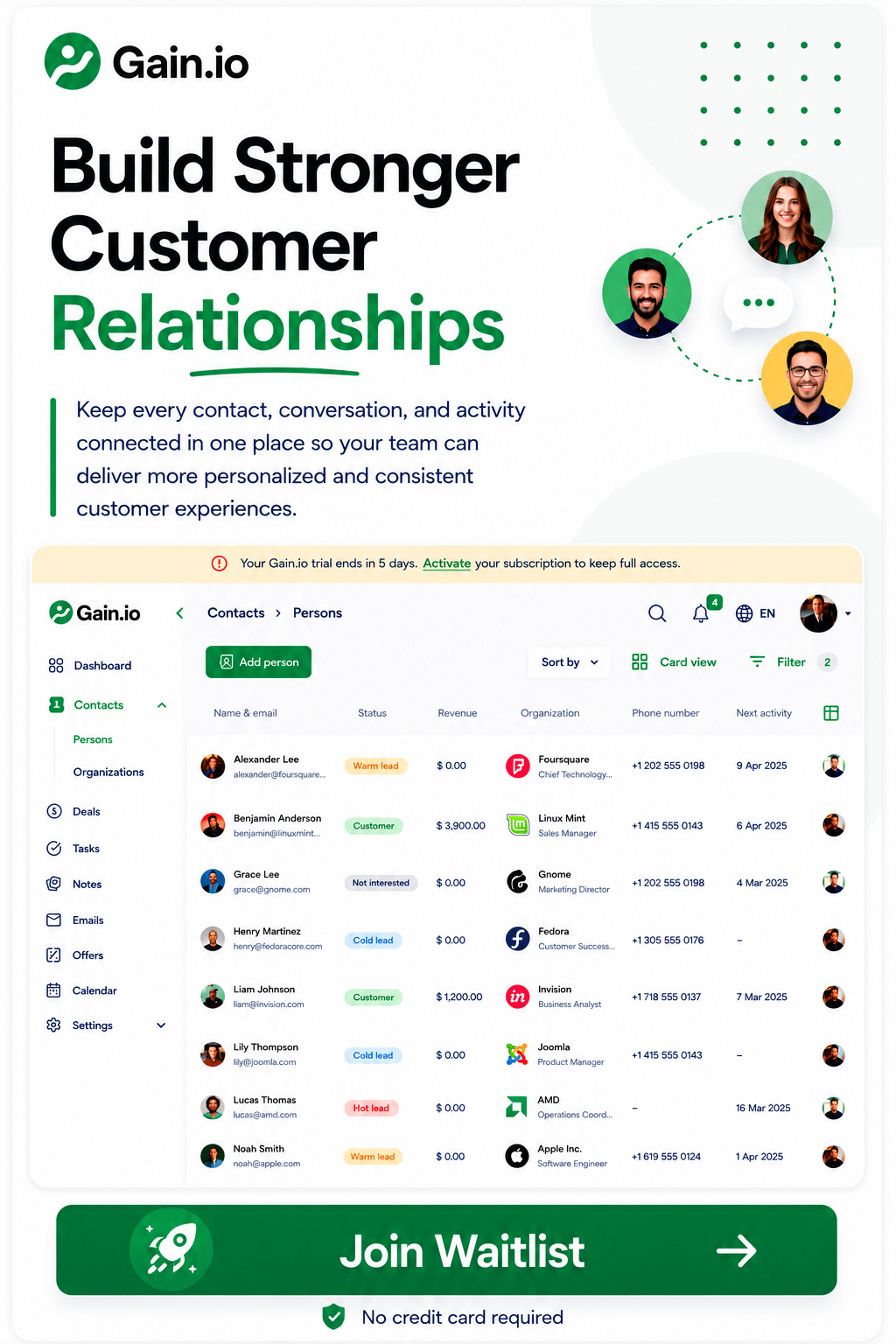
Gain.io captures calls, meetings, and emails to give revenue teams a clear view of conversations, deal risks, and sales coaching moments. It centralizes conversation data from disparate sources, surfacing pipeline risks and insights without requiring new logins or switching between multiple sales tools.
Conversation intelligence features include talk time ratios (optimal around 53 percent customer speak time), topic tracking, and deal warnings based on lack of multi-threading. The platform identifies when deals have fewer than two contacts engaged, flagging single-threaded risk before it becomes a lost opportunity.
Consider how a sales manager might use Gain.io before a forecast meeting. She opens the dashboard and sees three deals with stall diagnostics showing limited buyer engagement in the past two weeks. Another deal shows the rep speaking 70 percent of call time, suggesting they are not uncovering enough customer behavior signals. With this visibility, she coaches her team on specific actions rather than generic advice.
Gain.io enables sales teams to streamline sales processes by unifying sales-marketing silos through shared deal visibility. It quantifies campaign revenue lift, showing which webinars and content pieces convert to pipeline. Automated workflows handle handoffs, slashing reporting time by 50 percent.
4. ZoomInfo
ZoomInfo provides updated company and contact records, buying signals, and segmentation tools for outbound sales. It earns around 4.3 out of 5 on review platforms with pricing starting at $15,000 annually.
Integrating ZoomInfo with CRM and engagement tools helps sales reps build accurate lists, reduce bounce rates by 50 percent, and prioritize accounts showing intent signals. Sales intelligence features flag accounts researching keywords that match your ideal customer profile.
Keep an eye on data privacy and alignment with regional regulations when using large data providers. CCPA compliance requires regular privacy audits. Make sure your usage aligns with how leads expect their data to be handled. When used responsibly, sales intelligence tools like ZoomInfo accelerate lead generation and account targeting.
5. Monday Sales CRM
Monday Sales CRM presents a visually driven tool for managing pipelines, tasks, and workflows on customizable boards. It suits teams that enjoy spreadsheet-like flexibility but want workflow automation and collaboration layered on top.
The platform links sales boards with project boards so handoffs to delivery teams stay smooth after a deal closes. This connection improves post-sale execution and leads to 30 percent smoother transitions, according to user reports, especially when paired with a dedicated sales calendar CRM that keeps tasks and meetings synced.
For teams already familiar with Monday’s project management interface, adding the sales CRM module creates a unified workspace for deal management and customer success activities. Visual pipelines make it easy to see where deals stand at a glance.
6. Slack
Slack serves as a collaboration hub where sales, marketing, and operations teams coordinate around channels, huddles, and shared files. Its role in the sales stack centers on communication and quick decision-making.
Specific sales uses include deal review channels, instant notifications from CRM, and quick approvals from leadership. When integrated with sales activity tracking software, bots can filter 70 percent of irrelevant pings so channels stay focused on what matters.
Well-structured channels and norms help prevent chat tools from becoming noisy instead of productive. Create channels for specific deal stages, accounts, or team functions. Set expectations about response times. Used well, Slack accelerates internal alignment. Used poorly, it becomes another distraction.
7. Docusign
Docusign helps sales teams send, sign, and track contracts securely online. Reusable templates, predefined fields, and automated reminders reduce delays and mistakes in the closing phase, helping revenue teams close deals faster and with greater predictability.
A mid-market team closing quarter-end renewals can process bulk sending in minutes rather than hours. Templates populated from CRM data eliminate manual typing errors. Routing rules ensure the right stakeholders approve in sequence.
Contact management and deal management features in your CRM feed directly into Docusign templates, creating seamless integration between pipeline and paperwork. When the administrative tasks around contracts shrink, reps focus on what they do best: selling.
Key Features To Look For When Choosing Sales Productivity Tools
The most important step is matching features to your specific motion. Outbound-heavy teams need different capabilities than product-led growth companies. Channel sales demand different functionality than direct enterprise sales, and choosing the right sales pipeline CRM is central to supporting those differences.
Buying tools only because they are popular usually leads to low adoption and shelfware. Involve frontline sales representatives in evaluations. They know where friction lives in their daily workflows. Use the following checklist before committing to new tools.
Ease Of Use And Adoption
Reps should be able to perform their daily tasks without deep training. Clear navigation, minimal clicks, and intuitive interfaces matter more than feature lists. If the tool takes weeks to learn, adoption suffers.
Evaluate tools through short pilot programs. Ask early users for honest feedback on friction and time saved. Look for 85 percent productivity on day one as a benchmark. If reps struggle past the first week, the tool may not fit.
Mobile usability matters for sales teams that travel frequently or work in the field. Check whether core functions work on phones and tablets, not just desktops.
Automation And Workflow Flexibility
Tools should support no-code automations for routing, task creation, and notifications rather than forcing constant technical support. Sales managers should be able to configure rules without submitting IT tickets.
Helpful triggers include creating tasks when deals stagnate, escalating approvals above certain amounts, and notifying managers when key metrics change. These sales task automation workflows save time and prevent deals from falling through cracks.
Over-automated workflows can create noise. Teams should regularly prune rules that no longer serve them. Alert fatigue affects 30 percent of teams that automate too aggressively without review.
Integrations And Data Quality
Integrations with CRM, email, calendar, and communication tools are non-negotiable for maintaining a single source of truth. Seamless integration means data flows bidirectionally without manual syncing.
Look for tools with open APIs, documented connectors, and reliable two-way syncs to avoid data silos. The best platforms achieve 99 percent sync reliability and include automated sales task workflows that keep deals and activities up to date. Data that lives in only one system creates blind spots.
Monitor data hygiene with simple rules on ownership, required fields, and deduplication. Enforce fields at key stages so your sales data stays clean. Garbage in equals garbage out, no matter how good your analytics tools are.
Security, Compliance, And Governance
Security certifications, access controls, and audit trails matter when tools store customer data and revenue data. Look for SOC2 compliance as a baseline. Data breaches cost $4.5 million on average.
Teams operating in regions with strict privacy laws should confirm where data is stored and how it can be deleted on request. EU data residency requirements affect many B2B companies.
Involve legal and security teams early rather than at the end of a purchase process. Catching 80 percent of risks in the evaluation phase prevents painful surprises after implementation.
How Gain.io Helps Teams Get More From Their Sales Productivity Stack
Gain.io positions itself as a partner focused on making your existing tools and processes work better. It is not about adding another app to an already crowded stack. It is about creating visibility and reducing friction across the tools you already use.
Revenue teams using Gain.io centralize data from their stack, breaking down silos between marketing and sales while surfacing insights that non-technical users can act on immediately. No SQL queries required. No waiting for ops to build reports. The information you need appears where you need it.
For sales leaders, Gain.io builds clear visibility into pipeline health, campaign impact on revenue, and where deals stall. Health scores show which opportunities need attention. Stall diagnostics identify the specific blockers. A visual sales pipeline plus conversation data reveals whether reps are multi-threading deals or relying on single contacts.
Gain.io workflows reduce manual reporting, standardize handoffs, and keep stakeholders aligned without long email threads. The platform’s smart CRM tools for sales teams quantify which marketing activities drive pipeline, helping sales and marketing teams agree on what works.
If your sales team productivity feels stuck despite investing in tools, start by reviewing your current stack with Gain.io. See where data silos exist, where reps lose time, and where deals slip without clear reasons. Learning what a sales pipeline is and how to build one that actually works gives important context for that review. That visibility becomes your foundation for a leaner, more productive sales organization. Consider starting a free trial to see how Gain.io fits your sales strategies.
Frequently Asked Questions
How Often Should We Review Our Sales Tech Stack?
A structured review at least twice a year makes sense for most teams. Add a lighter quarterly check focused on usage data, renewal dates, and new requirements from the sales team. Involve sales leaders, a few frontline reps, operations, and finance so the review balances usability, performance, and cost. Different perspectives catch different problems.
What Is A Reasonable Budget For Sales Productivity Tools?
Budgets vary widely, but many modern B2B teams spend 1 to 2 percent of annual recurring revenue per rep on software across CRM, engagement, and analytics. That typically works out to $1,800 to $3,600 per rep annually. Calculate your approximate per-rep software cost, then compare it to the additional revenue you expect the tools to support. If a tool demonstrably improves win rates by 5 points, the math usually works in your favor.
How Can Small Teams Avoid Tool Overload?
Start with a strong CRM, basic engagement features, and simple reporting rather than a full enterprise stack. You can add complexity later. Starting complex rarely simplifies. Use all-in-one platforms where possible so early-stage teams do not have to maintain multiple integrations and logins. HubSpot’s free tier, for example, handles CRM, sequences, and basic reporting in one place.
What Metrics Show That Sales Productivity Tools Are Working?
Core indicators include time spent in direct selling activities (target over 35 percent), number of quality meetings per rep (15 or more weekly), conversion rates between stages (25 percent or higher), and sales cycle length (under 84 days for most B2B motions). Track adoption metrics inside each tool: number of logins, sequence usage, and report views. Low usage signals either poor fit or inadequate training.
Do We Need Dedicated Operations Staff To Manage These Tools?
Very small teams can start without full-time sales operations, but as soon as multiple tools and territories are involved, a specialist becomes important. Around 10 reps seems to be the threshold where dedicated ops support pays off. A revenue operations or sales operations role can own integrations, data quality, and process design so sales reps stay focused on selling. They maintain the stack, document processes, and troubleshoot issues before they cascade.