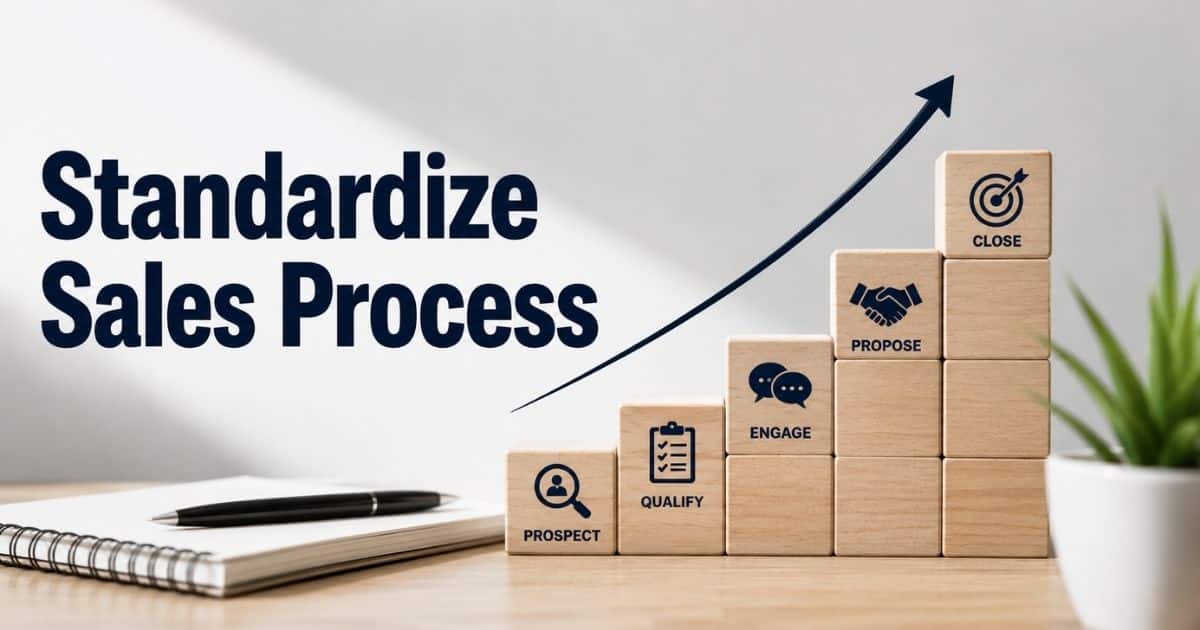
Sales teams often follow different methods for the same task. One rep qualifies leads one way. Another follows a completely different approach. Over time, this creates confusion, missed opportunities, and inconsistent results. Revenue becomes harder to predict, and scaling the team feels messy.
A standardized sales process solves that problem. It gives every sales rep a clear path to follow from lead generation to closing deals. Teams work faster, managers track performance more easily, and customers get a more consistent experience.
In this guide, you will learn how to standardize sales process steps, build repeatable workflows, avoid common mistakes, and improve sales performance with the right strategy, tools, and best practices.
What Is A Standardized Sales Process
A standardized sales process is a structured sales process that helps every sales team follow the same steps during the buyer's journey. It creates a standard approach for sales activities like initial contact, follow-up, objection handling, relationship building, and closing deals. Sales process standardization gives sales reps and sales managers a clear sales workflow with defined success criteria, exit criteria, and decision criteria for each next stage.
When companies standardize sales process steps, every team member understands what actions to take at various stages. CRM systems, sales playbook documentation, proper training, and ongoing coaching help new team members stay on the same page. Sales leaders also use sales data, key performance indicators, and real-time analytics to make data-driven decisions and accurately predict revenue growth.
Standardized sales processes matter because they reduce inconsistent results and repetitive tasks. A standardized process improves conversion rates, win rate, measurable outcomes, and predictable outcomes across the sales force, especially when every team member understands what a sales process is and how its core steps work.
Key Problems Businesses Face Without A Standard Sales Process
A weak sales workflow creates confusion across the sales team. Sales reps follow different methods, managers struggle to track progress, and customers receive mixed experiences. Sales process standardization helps businesses create repeatable steps, improve sales performance, and produce more predictable outcomes across every stage of the customer journey.
Inconsistent Sales Activities
A business without a structured sales process often deals with inconsistent results. One sales rep may qualify leads correctly, while another skips key activities. Customer interactions become uneven, and potential customers receive different experiences from the same company.
HubSpot reports that companies with standardized sales processes see up to 28% higher revenue growth than businesses without one. A standardized process keeps the sales force on the same page. Sales managers can also track performance with greater accuracy. Common language, proper training, and clear success criteria help teams follow the same steps and improve conversion rates.
Poor Visibility Into Sales Data
Sales leaders need accurate sales data to make informed decisions. Without sales process standardization, data silos become a major problem. CRM systems fill up with incomplete information, and sales managers struggle to track qualified leads or forecast revenue.
Salesforce research shows that 79% of business buyers expect consistent customer interactions across departments. A lack of standardized sales workflows makes that difficult. Team members often use different methods for follow-up, objection handling, and deal tracking. Real-time analytics become less reliable, and businesses lose the ability to accurately predict future sales targets or measure win rate effectively.
Slow Onboarding For New Reps
New team members need a clear sales playbook to succeed. Without a standard approach, new reps often rely on guesswork or copy random practices from top performers. That creates confusion and slows down sales activities across the team.
Research from CSO Insights found that nearly 42% of sales reps feel unprepared after onboarding. A new sales process with defined exit criteria, decision criteria, and repeatable steps reduces that problem. Proper training and ongoing coaching help every team member understands the customer journey and buyer's journey faster. Sales leaders also gain measurable outcomes from a more prepared sales force.
Low Conversion And Win Rates
A poor process affects every stage of the sales funnel. Sales reps miss follow-up opportunities, skip relationship building, or move leads into the next stage too early. That creates inconsistent outcomes and lower conversion rates.
Companies with strong sales methodology frameworks often achieve higher sales performance because they focus on specific actions at each stage. Gartner reports that businesses with defined sales processes improve forecast accuracy by up to 15%. Standardizing your sales process also helps sales managers identify the root cause behind failed deals. Teams can then improve objection handling, customer communication, and closing deals with more confidence.
Weak Team Alignment
Sales teams perform better when everyone follows the same process. Without standardization efforts, departments often work separately. Marketing passes leads without clear criteria, while sales reps define qualified leads differently. Misalignment affects the entire business.
A standardized sales process creates shared practices and clear expectations across the team. Sales managers can monitor key performance indicators more effectively and support continuous improvement with feedback loops. Consistent outcomes become easier to achieve because every team member follows the same sales workflow. Businesses also gain stronger buy-in from sales leaders when measurable outcomes support long-term success.
Major Stages Every Company Should Include In A Sales Process
A successful sales process needs clear stages from the first customer interaction to closing deals. Each stage helps sales reps move qualified leads through the buyer's journey with better consistency. A structured sales workflow also improves sales performance, forecasting, and customer experience across the entire sales team.
Lead Qualification
Every sales process starts with lead qualification. Sales reps identify whether potential customers match the company’s target audience, budget, and business needs. A weak qualification stage wastes time and lowers conversion rates later in the process.
HubSpot reports that sales reps spend nearly 40% of their time searching for prospects instead of selling. A standardized sales process solves that problem with clear decision criteria and success criteria. CRM systems also help sales managers track qualified leads more effectively, especially when they follow a structured lead qualification framework for sales teams. Strong qualification improves sales targets, sales data accuracy, and predictable outcomes across the sales force.
Discovery And Initial Contact
The discovery stage helps sales reps understand customer pain points, goals, and buying intent. Initial contact should focus on customer interactions and relationship building instead of aggressive selling. Buyers expect personalized conversations from the first touchpoint.
Salesforce research shows that 73% of customers expect companies to understand their unique needs. A standard approach ensures every team member asks the right questions and follows the same sales methodology. Sales leaders can also review feedback loops and key performance indicators to improve the sales workflow. Better discovery creates stronger trust and smoother movement into the next stage.
Solution Presentation
A solution presentation connects the product or service directly to the customer’s problem. Sales reps should focus on value, measurable outcomes, and business impact instead of generic product features. Clear communication helps buyers make informed decisions faster.
Gartner data shows that modern B2B buyers spend only 17% of their purchase journey meeting suppliers. A structured sales process helps teams maximize that limited time with custom sales stages tailored to different teams and motions. Sales playbook guidelines also give new reps clear repeatable steps during presentations. Real-time analytics and sales data help sales managers measure which presentations improve win rate and revenue growth most effectively.
Objection Handling And Follow-Up
Most deals face objections before customers make a decision. Buyers may question pricing, timing, features, or ROI. Without a standardized process, sales reps handle objections differently, which creates inconsistent results across the sales team.
A strong sales workflow includes specific actions for follow-up and objection handling. Proper training and ongoing coaching help team members respond with confidence. Research from Gong shows that successful sales reps ask more questions and handle objections calmly instead of rushing deals. Sales process standardization also helps companies identify the root cause behind lost opportunities and improve future customer interactions.
Closing And Post-Sale Handoff
The closing stage finalizes the agreement and prepares customers for onboarding or support. A poor handoff between sales and customer success teams often creates confusion after the deal closes. Customers expect a smooth transition at this stage.
A standardized sales process keeps every department on the same page with shared exit criteria and documented processes. Sales managers can also use key activities and CRM systems to track post-sale performance. Businesses that standardize sales process stages often achieve greater accuracy in forecasting and customer retention. Consistent outcomes also strengthen long-term customer relationships and support continuous improvement efforts.
How To Standardize Sales Process Across Sales Teams And Locations
Sales teams often work differently across regions, departments, and offices. That creates inconsistent customer interactions, poor visibility into sales data, and uneven sales performance. A standardized sales process helps every team member follow the same workflow, improve collaboration, and create predictable outcomes across the business.
Create A Shared Sales Playbook
A sales playbook gives every sales rep a clear standard approach for handling different stages of the buyer's journey. It outlines key activities, follow-up methods, objection handling techniques, and exit criteria for each stage of the sales process.
Research from HubSpot shows that companies with documented sales processes are 33% more likely to become high performers. A shared playbook also helps new team members adapt faster across different locations. Sales leaders can maintain common language, measurable outcomes, and consistent outcomes throughout the sales force. Clear documentation reduces confusion and keeps every team on the same page.
Define Clear Process Stages
Every sales process needs clearly defined stages. Sales reps should know when a lead moves from one stage to the next stage. Without decision criteria, teams often create inconsistent results and inaccurate forecasting.
A structured sales process uses repeatable steps for lead qualification, discovery, proposal, follow-up, and closing deals. Gartner reports that organizations with formal sales methodology frameworks improve forecast accuracy significantly. Sales managers can also use key performance indicators to track progress across various stages. Clear process stages support better sales workflow management and form the backbone of a scalable sales process for growing teams that helps businesses accurately predict revenue growth.
Use CRM Systems Across Teams
CRM systems help companies standardize sales process activities across offices and remote teams. A centralized platform stores customer interactions, qualified leads, sales data, and follow-up records in one place. Teams gain better visibility into the customer journey and sales pipeline with smart CRM features that organize sales activities.
Salesforce research found that high-performing sales teams are 2.8 times more likely to use CRM tools effectively. A standardized process within the CRM also reduces data silos and repetitive tasks. Sales reps follow the same steps while sales managers review real-time analytics and measurable outcomes more easily. Better data helps companies make informed decisions faster, showing how CRM adoption is transforming modern sales teams.
Train And Coach Regularly
Proper training keeps sales teams aligned with the company’s sales methodology. New reps often struggle when processes differ between locations or departments. Ongoing coaching helps every team member understands the same practices and success criteria.
CSO Insights research shows that companies with dynamic sales coaching programs achieve higher win rate and quota attainment. Sales leaders should review sales activities regularly and use feedback loops to improve performance. Standardization efforts become stronger when teams receive continuous improvement support instead of one-time training. Coaching also helps sales reps improve relationship-building and objection-handling skills across different customer segments.
Track Performance With Data
Sales process standardization works best when companies measure results consistently. Sales managers need visibility into conversion rates, sales targets, pipeline movement, and customer interactions across all teams. Data helps identify weak areas before they affect revenue growth.
Real-time analytics allow businesses to compare team performance across locations with greater accuracy. Sales leaders can identify the root cause behind inconsistent outcomes and improve specific actions inside the sales workflow using sales workflow automation strategies tied to clear metrics. McKinsey reports that data-driven sales organizations often outperform competitors by up to 15% in productivity. A standardized sales process backed by analytics creates more predictable outcomes and long-term business success.
CRM, Automation, And AI Tools That Help Standardize Sales Operations
Modern sales teams rely on technology to create a structured sales process across every location and department. CRM systems, automation tools, and AI platforms help businesses standardize sales process tasks, improve sales performance, and reduce inconsistent results throughout the customer journey.
CRM Platforms For Process Control
CRM systems help sales teams manage customer interactions, track qualified leads, and organize sales activities in one place. A centralized platform gives sales managers better visibility into pipeline movement, conversion rates, and sales targets across the sales force.
Salesforce reports that CRM adoption can improve sales productivity by up to 34%. A standardized sales process inside the CRM also helps new team members follow the same steps and decision criteria. Sales leaders can monitor measurable outcomes and key performance indicators with greater accuracy. Strong CRM practices, supported by modern CRM software built for sales teams, reduce data silos and support more predictable outcomes across the business.
Automation Tools For Repetitive Tasks
Automation tools remove manual work from the sales workflow. Sales reps can automate follow-up emails, lead assignment, task reminders, and pipeline updates with sales task automation built into CRM. That gives teams more time for relationship building and closing deals.
HubSpot research shows that sales professionals save nearly two hours daily through automation. A standardized process becomes easier to maintain when repetitive tasks follow predefined rules, supported by sales automation software that streamlines follow-ups and data management. Automation also improves response time during the buyer's journey. Sales managers gain more consistent outcomes because every team member follows the same workflow. Better process control, supported by sales automation that boosts conversion rates, helps companies improve win rate and customer experience at scale.
AI Tools For Sales Insights
AI tools help businesses analyze sales data faster and make informed decisions with real-time analytics. Modern AI platforms identify patterns inside customer interactions, qualified leads, and conversion trends. Sales leaders use those insights to improve sales methodology and forecast revenue growth by applying AI sales automation across key workflows.
Gartner predicts that AI will support more than 75% of B2B sales organizations within the next few years. AI tools also help identify the root cause behind inconsistent results across various stages of the sales process and act as AI sales assistants for pipeline efficiency. Sales reps receive recommendations for follow-up timing, objection handling, and next-stage actions. Better insights lead to stronger sales performance and greater accuracy in forecasting.
Communication Tools For Team Alignment
Sales teams often work across multiple offices and time zones. Communication tools help every team stay on the same page during standardization efforts. Shared communication channels improve collaboration between sales reps, sales managers, and customer support teams.
Microsoft research found that employees spend nearly 57% of their workday communicating through meetings, chats, and emails. A standard approach inside modern sales communication tools for internal and external collaboration helps teams share feedback loops, sales playbook updates, and customer information more efficiently. Proper training and ongoing coaching also become easier across locations. Clear communication supports continuous improvement and stronger buy-in from team members.
Analytics Tools For Performance Tracking
Analytics platforms help businesses track key activities across the sales process. Sales managers can monitor win rate, customer journey progress, follow-up consistency, and sales targets in real time. Data-driven decisions become easier when reports stay accurate and centralized.
McKinsey reports that companies using advanced analytics often outperform competitors in sales productivity and revenue growth. Sales activity tracking and analytics software also help sales leaders compare team performance across regions with measurable outcomes. Businesses can identify weak practices, improve success criteria, and optimize specific actions within the sales workflow. A data-focused standardized process creates more reliable and scalable business success.
Sales Process Documentation, KPIs, And Workflow Best Practices
A standardized sales process works better when teams follow clear documentation and measurable goals. Sales managers need visibility into workflows, customer interactions, and sales performance across every stage. Strong documentation and KPI tracking also help businesses create predictable outcomes and continuous improvement opportunities.
Build A Clear Sales Playbook
A sales playbook gives every sales rep a clear guide for handling the sales process. It outlines sales activities, qualification rules, follow-up timing, objection handling methods, and exit criteria for each next stage. Clear documentation keeps the entire sales team aligned.
HubSpot reports that companies with documented sales processes achieve higher revenue growth and better quota attainment. A structured sales process also helps new reps understand the buyer's journey faster. Sales leaders can maintain common language and standard practices across different locations. Strong documentation reduces inconsistent results and improves measurable outcomes across the sales force.
Track The Right KPIs
Key performance indicators help sales managers measure the success of standardization efforts. Businesses should track conversion rates, win rate, follow-up response time, sales targets, and pipeline movement across various stages of the sales workflow.
Salesforce research shows that data-driven sales teams are more likely to exceed revenue goals. KPI tracking also helps sales leaders identify the root cause behind poor sales performance or weak customer interactions, especially when they track deals consistently from lead to close. Real-time analytics improve decision-making and forecasting accuracy. A standardized process supported by reliable sales data creates stronger accountability and more informed decisions across the business.
Standardize Workflow Steps
Every team member should follow the same repeatable steps during the customer journey. A standard approach reduces confusion and creates more predictable outcomes. Sales reps should know what specific actions to take during lead qualification, discovery, follow-up, and closing deals.
Gartner reports that companies with structured sales methodology frameworks often improve forecast accuracy and pipeline visibility. Standardized sales workflows also help CRM systems collect cleaner data across the sales force. Sales managers can compare team performance with greater accuracy when everyone follows the same process. Better workflow consistency supports long-term business success and stronger customer experiences.
Use Feedback Loops Regularly
Feedback loops help companies improve sales process standardization over time. Sales managers should review customer interactions, sales data, and team performance regularly. Feedback from sales reps often reveals gaps inside the current workflow or sales playbook.
McKinsey research shows that businesses focused on continuous improvement often outperform competitors in productivity and customer satisfaction. Ongoing coaching and proper training also become more effective with regular feedback reviews. Sales leaders can refine success criteria, decision criteria, and key activities based on measurable outcomes. Strong feedback systems help businesses maintain buy-in across the team and improve sales performance consistently.
Audit Process Performance Often
Regular audits help businesses identify weak areas in the sales process before problems grow larger. Sales managers should review CRM systems, pipeline stages, follow-up consistency, and sales targets to ensure teams stay aligned with company goals.
CSO Insights found that high-performing companies review sales workflow performance more frequently than average organizations. Audits also help reduce repetitive tasks, data silos, and inconsistent outcomes across departments. Sales leaders can use real-time analytics to improve forecasting and customer journey management. A well-monitored standardized process creates stronger operational control and supports sustainable revenue growth.
Common Mistakes Companies Make While Trying To Standardize Sales Process
Many companies want to standardize sales process steps but fail to execute the strategy correctly. Poor planning, weak communication, and inconsistent workflows often create frustration inside the sales team. A successful standardized process needs clear structure, proper training, and strong alignment across every department.
Lack Of Clear Process Documentation
Many businesses try to improve sales performance without documenting the sales process properly. Sales reps often rely on personal habits instead of repeatable steps. That creates inconsistent outcomes across the sales force and weakens sales workflow consistency.
HubSpot reports that companies with documented sales processes are more likely to achieve revenue growth goals. A clear sales playbook helps every team member understand qualification rules, follow-up timing, objection handling, and next-stage criteria. Sales managers also gain greater accuracy in forecasting when teams follow a structured sales process. Strong documentation reduces confusion and improves customer interactions across the buyer's journey.
Poor Team Buy-In
Sales process standardization often fails when teams do not support the new system. Sales reps may feel the process adds extra work or limits flexibility. Resistance grows faster when sales leaders fail to explain the purpose behind the changes.
McKinsey research shows that employee buy-in plays a major role in operational success. A standard approach works best when sales managers involve team members during planning and feedback loops. Proper training and ongoing coaching also help new reps adapt faster. Sales leaders should focus on measurable outcomes and continuous improvement instead of forcing sudden workflow changes across the business.
Too Many Unnecessary Steps
Some companies create overly complex sales workflows during standardization efforts. Sales reps must complete too many repetitive tasks, forms, or approval steps before moving leads into the next stage. Complex systems slow down customer interactions and reduce sales productivity.
Salesforce research found that sales reps spend only about 28% of their time actively selling. A standardized sales process should simplify key activities instead of creating delays. CRM systems and sales automation CRM platforms for growing teams can reduce manual work and improve efficiency. Businesses achieve more predictable outcomes when sales teams follow simple and clear processes with defined success criteria and exit criteria.
Weak KPI Tracking
A business cannot improve sales performance without reliable sales data. Many companies standardize sales process workflows but fail to track the right key performance indicators. Poor KPI tracking limits visibility into conversion rates, win rate, and customer journey progress.
Gartner reports that data-driven companies often outperform competitors in forecasting and operational accuracy. Sales managers should track follow-up consistency, qualified leads, pipeline movement, and sales targets regularly. Real-time analytics help sales leaders identify the root cause behind inconsistent results. Strong reporting systems also support informed decisions and long-term revenue growth across the sales team.
Ignoring Continuous Improvement
A standardized process should evolve with customer behavior, market trends, and business goals. Some companies treat sales process standardization as a one-time project. Over time, outdated practices create gaps inside the sales workflow and reduce customer satisfaction.
CSO Insights found that high-performing sales organizations review and refine processes more frequently than average companies. Feedback loops help sales managers identify weak areas and improve sales methodology over time. Ongoing coaching also helps team members maintain alignment with changing customer expectations. Businesses that focus on continuous improvement often achieve stronger conversion rates, better customer experiences, and more scalable success.
How Standardized Sales Processes Improve Revenue, Forecasting, And Customer Experience
A standardized sales process creates consistency across the sales team and improves how businesses manage customer interactions. Clear workflows help sales reps follow repeatable steps, track sales data accurately, and improve forecasting. Strong process standardization also supports better revenue growth and long-term customer relationships.
Higher Revenue Growth
Businesses with a structured sales process often achieve stronger sales performance and more predictable outcomes. Sales reps follow the same steps during lead qualification, follow-up, and closing deals. That consistency improves conversion rates and reduces lost opportunities across the customer journey.
Harvard Business Review found that companies with standardized sales processes can see revenue growth increases of up to 15%. A standard approach also helps sales managers identify successful practices from top performers and apply them across the sales force. Better alignment between sales activities and business goals creates stronger measurable outcomes and long-term success.
Better Sales Forecasting
Accurate forecasting depends on reliable sales data and clear pipeline visibility. A standardized process gives sales managers better control over key activities, stage movement, and customer interactions. Teams can track qualified leads and sales targets with greater accuracy.
Gartner reports that organizations with formal sales methodology frameworks improve forecasting reliability significantly. CRM systems and real-time analytics also help sales leaders make informed decisions faster. Defined exit criteria and decision criteria reduce inconsistent results across various stages of the sales workflow. Better forecasting allows businesses to plan resources, budgets, and growth strategies more effectively.
Improved Customer Experience
Customers expect smooth and consistent interactions during the buyer's journey. Without sales process standardization, different sales reps may provide mixed messaging or inconsistent follow-up. That often creates confusion and lowers customer trust.
Salesforce research shows that 88% of customers value the experience a company provides as much as its products or services. A standardized sales process helps every team member deliver a similar experience across locations and departments. Sales playbook guidelines, proper training, and ongoing coaching also improve relationship building. Consistent customer interactions create stronger loyalty and higher customer retention over time.
Stronger Team Alignment
Sales teams perform better when everyone follows the same workflow and common language. A structured sales process helps new team members understand expectations faster and keeps the entire sales force on the same page. Clear documentation reduces confusion between departments.
McKinsey research shows that aligned teams often outperform disconnected organizations in productivity and revenue growth. Sales managers can also use feedback loops and key performance indicators to improve collaboration across the business. Standardization efforts create better communication between marketing, sales, and customer success teams. Strong alignment supports continuous improvement and more scalable business operations.
Faster Decision Making
Sales leaders need fast access to accurate information for better business decisions. A standardized process improves visibility into customer journey progress, sales activities, and pipeline health. Teams spend less time searching through disconnected systems or incomplete reports.
HubSpot reports that sales teams using centralized CRM systems achieve higher efficiency and productivity. Clean sales data and repeatable steps also help businesses identify the root cause behind poor performance quickly. Sales managers can improve objection handling, follow-up timing, and workflow efficiency with data-driven decisions. Faster decision-making supports stronger win rate, revenue growth, and operational success.
Final Thoughts
A standardized sales process helps businesses create consistency across every stage of the customer journey. Sales teams work with clearer goals, better workflows, and stronger alignment. Sales managers gain accurate sales data, predictable outcomes, and better visibility into team performance. Customers also receive more consistent interactions from the first contact to the final deal.
Sales process standardization is not only about structure. It also supports revenue growth, faster onboarding, stronger forecasting, and better customer experience. CRM systems, automation tools, proper training, and continuous improvement all play a major role in long-term success.
Companies that standardize sales process steps often outperform competitors because every team member follows the same proven workflow. Small improvements in sales activities, follow-up, and decision-making can create measurable business results over time. A clear process turns scattered efforts into scalable growth.
FAQs
Can Small Businesses Standardize Sales Process Without Large Teams?
Yes. Small businesses can standardize sales process steps with simple CRM systems, clear sales workflow documentation, and repeatable steps. A structured sales process helps small sales teams improve customer interactions, follow-up consistency, and sales performance without adding unnecessary complexity.
Does Sales Process Standardization Reduce Sales Flexibility?
No. A standardized process creates a standard approach, but sales reps still adjust conversations based on the buyer's journey and customer needs. Strong sales methodology frameworks help teams stay aligned while allowing flexibility during relationship building and objection handling.
How Long Does Sales Process Standardization Usually Take?
Most companies need several weeks or months depending on team size, sales activities, and current workflow issues. Businesses often start with sales playbook creation, CRM systems setup, proper training, and KPI tracking before refining the process through feedback loops and continuous improvement.
Can Remote Sales Teams Follow The Same Sales Process?
Yes. Modern CRM systems, automation tools, and communication platforms help remote sales teams stay on the same page. Sales managers can track sales data, key performance indicators, customer journey stages, and measurable outcomes across multiple locations with greater accuracy.
Which Metrics Best Measure A Standardized Sales Process?
Businesses usually track conversion rates, win rate, sales targets, qualified leads, follow-up response time, and pipeline movement. Real-time analytics and sales data also help sales leaders make informed decisions and identify inconsistent results across various stages of the sales process.