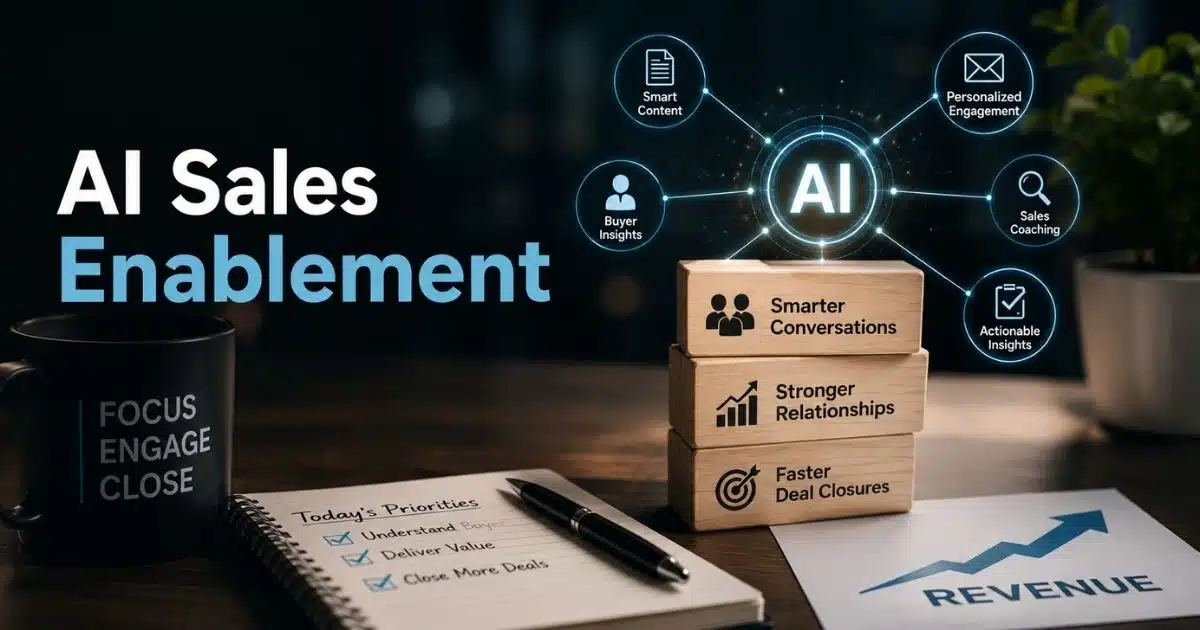
Sales teams face more pressure than ever. Buyers expect quick answers, personalized conversations, and smooth experiences at every stage. At the same time, sales reps spend hours on research, follow-ups, and repetitive tasks. That is where AI sales enablement changes the game.
AI helps sales teams work smarter instead of harder. It can analyze customer behavior, suggest the right content, automate routine work, and help reps focus on real opportunities. Companies now use AI to improve productivity, shorten sales cycles, and close more deals with less effort.
Businesses that ignore this shift may struggle to keep up. Sales teams that use AI effectively can build stronger relationships, make faster decisions, and create better customer experiences.
What Is AI Sales Enablement
AI sales enablement uses artificial intelligence to help sales teams work faster and smarter. It improves the sales process with automation, predictive analytics, natural language processing, and data-driven insights. Modern AI sales enablement tools support sales reps during sales calls, discovery call preparation, buyer engagement, and content management. Sales enablement teams also use AI-powered sales enablement platforms to organize sales content, track buyer behavior, and improve customer engagement.
AI in sales enablement helps sales managers and enablement leaders deliver coaching, improve sales productivity, and shorten sales cycle length. Many sales enablement AI tools automate repetitive tasks and give instant access to talk tracks, competitive intelligence, and performance analytics. Sales professionals can focus more on customer relationships and closing more deals.
AI-powered tools also improve accurate forecasting, sales efficiency, and sales outcomes across revenue teams and go-to-market teams.
Core Components That Build An Effective AI Sales Enablement Strategy
A successful AI sales enablement strategy needs more than just AI tools. Sales teams need the right mix of data, automation, coaching, and content support. Strong sales enablement efforts help revenue teams improve buyer engagement, increase sales productivity, and close deals faster across every deal stage.
Smart Sales Data Management
Clean sales data is the foundation of every AI sales enablement platform. Poor data quality creates weak insights and inaccurate sales forecasts. Sales teams rely on customer interactions, buyer behavior, and sales conversations to make better decisions. AI-powered tools analyze this information and help sales reps focus on the most promising leads.
Recent studies show bad data costs businesses nearly $13 million every year. Strong content management and accurate forecasting improve sales efficiency and shorten sales cycle length. Sales leaders also use predictive analytics to improve sales outcomes and support better sales methodology across the sales organization.
AI-Powered Sales Coaching
Sales managers need better ways to support sales reps. AI-powered sales enablement tools now deliver coaching based on real sales calls and customer engagement. Natural language processing helps AI tools review talk tracks, discovery call performance, and customer relationships in real time.
Research from Gartner shows companies with personalized coaching improve sales performance by over 20%. Sales enablement AI tools help enablement teams identify weak areas quickly. Sales professionals receive instant access to suggestions that help move a deal forward. Better coaching also improves customer satisfaction and buyer engagement across the sales process.
Content And Knowledge Access
Sales enablement content plays a major role in modern AI sales strategies. Sales reps often waste hours searching for sales content before meetings. AI sales enablement software solves this problem with instant access to relevant materials, competitive intelligence, and customer insights.
Reports show sales teams spend almost 30% of their week searching for information. Sales enablement platforms reduce that time and improve sales productivity. AI-powered sales enablement systems also recommend the right sales tools and content based on buyer behavior and deal stage. Faster access helps revenue teams improve customer engagement and close more deals.
Workflow Automation Tools
Repetitive tasks slow down sales teams and reduce sales efficiency. AI sales tools automate scheduling, CRM updates, email follow-ups, and lead scoring. Focused sales task automation helps sales enablement teams use AI-powered tools to simplify daily work and improve the sales cycle.
HubSpot reports sales professionals spend only 28% of their time actively selling. Automation helps sales teams operate more efficiently and focus on customer relationships. Generative AI and ai agents also support personalized outreach and accurate forecasting. Applying sales workflow automation strategies, better automation improves sales productivity and helps sales leadership scale enablement strategy across Go-to-market teams.
Performance Tracking And Analytics
Strong performance analytics help sales leaders understand what drives results. AI in sales enablement tracks sales calls, customer interactions, and buyer engagement across every stage of the sales process. Data-driven insights, supported by well-defined sales activity metrics, help sales managers adjust strategy faster.
Modern AI sales enablement platforms measure sales performance in real time. Enablement leaders can identify winning talk tracks, improve discovery call quality, and optimize sales coaching with dedicated sales activity tracking software. Studies show data-driven sales organizations are 23 times more likely to acquire customers successfully. Better analytics also help revenue teams improve sales outcomes and deliver coaching that supports long-term growth.
AI Tools And Technologies Used In Modern Sales Enablement
Modern sales enablement depends heavily on AI-powered tools and automation. Sales teams now use advanced technologies to improve buyer engagement, automate repetitive tasks, and increase sales productivity. The right sales automation benefits help sales professionals make faster decisions and improve sales outcomes across the entire sales cycle.
Predictive Analytics Platforms
Predictive analytics helps sales teams identify the most promising leads faster. AI sales enablement platforms analyze sales data, customer interactions, and buyer behavior to predict future actions. Sales managers use these insights to improve accurate forecasting and guide sales reps toward better opportunities.
Salesforce reports high-performing sales teams are 4.9 times more likely to use AI-powered sales enablement tools. Better forecasting also improves sales efficiency and helps revenue teams reduce wasted effort. Predictive models support stronger sales methodology and help sales organizations move deals forward with more confidence.
Conversation Intelligence Software
Conversation intelligence tools review sales calls, emails, and sales conversations in real time. Natural language processing helps AI tools understand customer intent, objections, and sentiment during a discovery call. Sales enablement teams use this technology to improve customer engagement and sales coaching.
Gartner predicts conversation intelligence adoption will grow rapidly across B2B sales teams through 2027. Sales leaders also use these AI-powered tools to improve talk tracks and customer relationships. Better call analysis and sales admin task automation help sales professionals shorten sales cycle length and improve overall sales performance.
AI Content Recommendation Tools
Sales reps often struggle to find the right sales enablement content quickly. AI sales enablement software solves this issue through smart content recommendations. AI-powered tools analyze deal stage, buyer engagement, and customer needs to suggest relevant sales content instantly.
Studies show sales teams spend nearly one-third of their time searching for information. Sales enablement AI tools reduce that problem and improve sales productivity. Better content management, supported by robust sales automation software, also helps Go-to-market teams maintain consistency across customer interactions. Faster content access supports stronger sales outcomes and better buyer experiences.
Generative AI Assistants
Generative AI has become a major part of modern AI sales strategies. AI sales assistants for pipeline efficiency now help sales reps write follow-up emails, summarize meetings, and prepare sales calls faster. Sales enablement platforms also use generative ai to deliver personalized coaching and automate repetitive tasks.
McKinsey estimates generative AI could add up to $4.4 trillion annually across industries. Sales teams operate more efficiently when AI-powered sales enablement tools handle routine work. Faster automation helps sales managers focus more on customer satisfaction, enablement strategy, and close deals more effectively.
CRM And Automation Systems
CRM platforms combined with AI tools create a stronger sales process. Modern sales automation CRM software connects customer engagement data, performance analytics, and workflow automation into one AI platform. Sales leadership teams use these systems to improve sales efficiency and track sales performance across revenue teams.
HubSpot data shows automation can save sales professionals more than two hours daily. CRM automation benefits show how AI in sales enablement also improves data quality and accurate sales forecasts. Better automation gives sales reps instant access to customer insights, competitive intelligence, and buyer behavior trends that support long-term growth.
How AI Sales Enablement Improves Sales Productivity And Revenue
AI sales enablement helps sales teams work faster, improve buyer engagement, and increase revenue. Modern AI-powered tools reduce manual work and improve decision-making across the sales process. Better automation, smarter insights, and stronger coaching help sales reps focus more on customer relationships and closing deals.
Faster Lead Qualification
AI sales enablement tools help sales teams identify high-value prospects quickly. Predictive analytics reviews sales data, buyer behavior, and customer interactions to rank the most promising leads, making AI lead scoring more effective than manual scoring. Sales reps spend less time on weak opportunities and more time on deals with higher conversion potential.
HubSpot reports companies that use AI-powered lead scoring improve conversion rates by up to 30%. Better qualification, guided by a clear lead qualification framework for sales teams, also shortens sales cycle length and improves sales efficiency. Sales managers can guide revenue teams with more accurate forecasting and stronger data-driven insights across every deal stage.
Better Sales Conversations
AI-powered sales enablement platforms improve sales calls through conversation intelligence and natural language processing. Sales enablement AI tools analyze customer engagement, talk tracks, and objections in real time. Sales professionals receive suggestions that help move the deal forward during live conversations.
Gartner research shows AI-assisted sales coaching can improve sales performance significantly across B2B teams. Better customer interactions also improve customer satisfaction and buyer engagement. Sales leadership teams use those insights to strengthen sales methodology and improve overall sales outcomes.
Less Time On Repetitive Tasks
Sales teams spend large portions of their day on repetitive tasks. CRM updates, meeting notes, scheduling, and follow-ups reduce active selling time. AI sales automation tools and generative AI automate those tasks and improve sales productivity across the sales organization.
Salesforce data shows sales reps spend less than one-third of their time actually selling. AI-powered tools help sales teams operate more efficiently and reduce workflow delays. AI agents also support content management, accurate sales forecasts, and instant access to critical customer data that supports faster decisions.
Smarter Coaching And Training
Sales enablement teams now use AI sales tools to deliver personalized coaching based on real sales conversations. AI in sales enablement tracks performance analytics, discovery call quality, and customer relationships automatically. Sales managers can quickly identify skill gaps and support enable reps with targeted feedback.
Companies with strong sales coaching programs achieve higher win rates and stronger revenue growth. Sales enablement software also helps enablement leaders improve onboarding and maintain consistent sales enablement content. Better coaching improves sales efficiency and helps close more deals over time.
Higher Revenue And Forecast Accuracy
Accurate forecasting is critical for modern revenue teams. Predictive sales analytics in AI sales enablement platforms analyze buyer behavior, deal stage progress, and historical sales performance to improve forecast accuracy. Better insights help Go-to-market teams plan resources and reduce missed opportunities.
McKinsey reports AI-powered sales strategies can increase revenue by up to 15% while reducing costs. Sales enablement efforts supported by predictive analytics and proven sales forecasting methods also improve sales cycle management and customer engagement. Better forecasting allows sales leaders to build stronger implementation strategy and improve long-term business growth.
Key Benefits And Challenges Of AI Sales Enablement Adoption
AI sales enablement gives sales teams better automation, stronger insights, and faster workflows. At the same time, many businesses face challenges with adoption, training, and data quality. A balanced strategy helps sales organizations improve sales performance while avoiding common implementation problems.
Higher Sales Productivity
AI sales enablement tools help sales reps save time across the sales process. AI-powered tools automate repetitive tasks like CRM updates, lead scoring, scheduling, and follow-ups. Sales teams spend more time on customer interactions and less time on manual work.
Salesforce reports sales professionals save nearly two hours daily through automation. Better workflow management and automating sales tasks to stay organized improves sales productivity and helps close deals faster. Sales managers also gain stronger visibility into sales performance, buyer engagement, and deal stage progress across revenue teams.
Better Customer Experiences
Modern buyers expect faster replies and personalized communication. AI-powered sales enablement platforms help sales teams deliver more relevant sales conversations based on buyer behavior and customer data. Natural language processing also improves talk tracks and discovery call quality.
Research from McKinsey shows personalization can increase revenue by up to 15%. AI in sales enablement improves customer engagement and strengthens customer relationships across the sales cycle. Better personalization also helps sales professionals improve customer satisfaction and long-term retention.
Data Quality Problems
Poor sales data remains one of the biggest challenges in AI sales enablement adoption. AI sales tools depend heavily on accurate forecasting, clean customer records, and updated sales content. Weak data quality reduces trust in predictive analytics and performance analytics.
Gartner estimates poor data quality costs organizations millions every year. Sales enablement teams must maintain reliable content management and accurate sales forecasts for better results. Strong data practices help sales leadership improve sales efficiency and support smarter enablement strategy across the sales organization.
Team Adoption And Training
Many sales teams struggle to adapt to new AI-powered tools. Complex sales enablement software can create confusion if sales reps do not receive proper support. Enablement leaders must build a clear implementation strategy and provide personalized coaching during adoption.
HubSpot research shows employee resistance is one of the top barriers to AI adoption. Sales managers should focus on simple workflows, strong sales time management practices, and practical sales coaching. Better training helps enable reps faster and improves confidence during sales calls and customer interactions.
Cost And Integration Challenges
AI sales enablement platforms often require major investment and system integration. Businesses must connect CRM systems, sales enablement content, and AI tools into one ai platform. Poor integration can slow workflows and reduce sales efficiency across go-to-market teams.
Companies also face ongoing costs for upgrades, support, and security. Still, businesses that invest strategically often achieve stronger sales outcomes and accurate sales forecasts. Better integration allows sales teams operate more effectively and helps revenue teams scale future growth successfully.
Best Practices To Implement AI Sales Enablement Successfully
AI sales enablement works best when businesses follow a clear and structured plan. The right implementation strategy helps sales teams improve productivity, buyer engagement, and sales outcomes without creating confusion. Strong planning also helps sales organizations get better value from AI-powered tools and automation.
Set Clear Sales Goals
Every AI sales enablement strategy should start with measurable goals. Sales leaders must identify what they want to improve, such as sales productivity, sales cycle length, customer engagement, or accurate forecasting. Clear targets help revenue teams choose the right AI sales enablement tools and sales enablement platforms.
Research from Gartner shows companies with defined AI goals achieve faster adoption and stronger sales performance. Sales managers should align AI tools with existing sales methodology and customer relationships. Better planning also helps sales teams operate with more focus across every deal stage.
Choose The Right AI Tools
Not every AI platform fits every sales organization. Sales enablement teams should select AI-powered sales enablement tools based on workflow needs, sales process complexity, and team size. Strong integration with CRM systems and sales enablement software is also important.
HubSpot reports nearly 60% of businesses struggle with disconnected sales tools. AI sales tools should support predictive analytics, content management, performance analytics, and personalized coaching. Simple and scalable solutions improve sales efficiency and reduce pressure on sales professionals during adoption.
Train Sales Teams Properly
Strong training helps sales reps use AI-powered tools with confidence. Many sales enablement efforts fail because teams do not understand how to apply AI in sales enablement during real customer interactions. Sales managers should focus on practical use cases and hands-on sales coaching.
McKinsey research shows companies with structured AI training programs see higher employee adoption rates. Enablement leaders should teach sales reps how to use talk tracks, discovery call insights, and buyer behavior data effectively. Better training improves sales conversations and helps close deals faster.
Focus On High Quality Data
AI sales enablement depends heavily on clean and accurate sales data. Poor data quality weakens predictive analytics, accurate sales forecasts, and customer insights. Sales enablement AI tools need updated customer records and reliable sales content to deliver strong recommendations.
Gartner estimates poor data management creates major financial losses for businesses every year. Sales leadership teams should create data standards across Go to market teams and revenue teams. Better data quality improves sales outcomes, customer satisfaction, and overall sales efficiency across the sales cycle.
Track Performance Regularly
Regular performance tracking helps sales managers understand what works and what needs improvement. AI-powered tools provide data-driven insights into sales calls, customer engagement, and sales productivity. Performance analytics also help enable reps improve customer interactions more consistently.
Salesforce research shows data-driven sales organizations outperform competitors in revenue growth. Sales enablement platforms should track metrics like deal stage progress, buyer engagement, and accurate forecasting. Consistent evaluation, combined with ongoing sales workflow optimization for faster deal closures, helps sales teams improve implementation strategy and maximize long-term business growth.
AI Sales Enablement Use Cases Across Different Industries
AI sales enablement now supports many industries beyond traditional B2B sales. Businesses use AI-powered tools to improve customer engagement, shorten sales cycles, and increase sales productivity. Different industries apply AI sales enablement platforms in unique ways based on customer behavior, sales process complexity, and revenue goals.
SaaS And Technology Sales
Software companies rely heavily on AI sales enablement tools to manage long sales cycles and complex customer interactions. AI-powered sales enablement platforms help sales reps analyze buyer behavior, improve discovery call quality, and personalize sales conversations. Predictive analytics also helps revenue teams identify the most promising leads faster.
Gartner reports over 75% of B2B SaaS companies now invest in AI tools for sales operations. Sales enablement software also improves accurate forecasting and content management across go-to-market teams. Better automation helps sales professionals close deals faster and improve customer relationships.
Healthcare And Medical Sales
Healthcare sales teams manage large amounts of customer data and compliance requirements. AI in sales enablement helps sales managers organize sales content, improve customer engagement, and simplify repetitive tasks. AI-powered tools also help sales reps prepare better talk tracks before sales calls.
McKinsey research shows AI adoption in healthcare continues to grow rapidly across sales and operations. Sales enablement AI tools support personalized coaching and performance analytics for medical sales teams. Better customer interactions improve sales outcomes and help healthcare organizations maintain stronger customer satisfaction levels.
Retail And E-commerce Sales
Retail businesses use AI sales tools to improve customer engagement and personalize buyer experiences. AI sales enablement platforms analyze shopping patterns, customer interactions, and sales data to recommend better products and offers. Sales teams operate more efficiently with automated workflows and accurate sales forecasts.
Studies show personalized retail experiences can increase revenue significantly. Generative AI also helps e-commerce sales professionals create faster follow-ups and targeted sales enablement content. Better sales efficiency helps retail revenue teams improve customer relationships and increase repeat purchases.
Financial Services Sales
Banks and financial institutions use AI-powered sales enablement to improve lead qualification and customer trust. Sales enablement teams rely on predictive analytics and natural language processing to analyze customer behavior and improve sales conversations. AI-powered tools also support accurate forecasting and deal stage tracking.
Deloitte reports AI adoption in financial services continues to rise because of stronger automation benefits. Sales leadership teams use AI platforms to improve sales coaching and reduce manual work. Better data-driven insights help sales professionals build stronger customer relationships and improve long-term sales performance.
Manufacturing And Industrial Sales
Manufacturing sales teams often manage long buying cycles and multiple decision-makers. AI sales enablement software helps sales reps track customer engagement, manage sales process updates, and improve competitive intelligence. AI agents also support content management and faster proposal creation.
Research from Salesforce shows industrial sales organizations increasingly invest in AI-powered tools for workflow automation. Sales enablement efforts supported by AI help reduce sales cycle length and improve sales productivity. Better forecasting and customer insights also help revenue teams close more deals with greater confidence.
Future Trends Shaping The Evolution Of AI Sales Enablement
AI sales enablement continues to evolve as buyer expectations and sales technology change rapidly. Sales teams now depend on smarter automation, predictive insights, and personalized customer engagement. Future AI-powered sales enablement trends will focus heavily on faster workflows, deeper customer understanding, and stronger sales productivity.
Rise Of Generative AI Sales Assistants
Generative AI will play a bigger role in modern sales enablement. AI agents already help sales reps create emails, summarize sales calls, and prepare sales enablement content faster. Future AI-powered tools will deliver more advanced customer insights and personalized talk tracks in real time.
McKinsey predicts generative AI adoption will expand quickly across revenue teams and sales organizations. Sales professionals will rely more on AI sales assistants for repetitive tasks and customer interactions. Better automation will improve sales efficiency and help close deals faster across the sales cycle.
Smarter Predictive Analytics
Predictive analytics will become more accurate as AI sales enablement platforms collect larger amounts of sales data. AI tools will help sales managers predict buyer behavior, identify deal stage risks, and improve accurate sales forecasts with greater precision.
Gartner reports companies that use predictive analytics outperform competitors in revenue growth and customer engagement. Sales leadership teams will use deeper data-driven insights to strengthen enablement strategy and sales methodology. Better forecasting will also help go-to-market teams improve resource planning and sales outcomes.
Real Time Sales Coaching
Future sales enablement AI tools will provide live coaching during customer conversations. Natural language processing will analyze sales conversations instantly and suggest better responses during a discovery call or sales meeting. Sales reps will receive personalized coaching while interacting with buyers.
Salesforce research shows AI-powered sales coaching already improves sales performance across many industries. Enablement leaders will use performance analytics to improve customer relationships and strengthen sales calls. Faster coaching support will also help sales teams operate more confidently during complex customer interactions.
Hyper Personalized Buyer Engagement
Customer expectations continue to rise across every industry. AI-powered sales enablement platforms will use buyer behavior, customer engagement history, and sales content preferences to create highly personalized experiences. Sales teams will deliver more relevant conversations across every touchpoint.
Studies show personalized experiences improve customer satisfaction and long-term loyalty significantly. AI in sales enablement will help sales professionals tailor communication based on customer needs and intent signals. Better personalization will improve sales productivity and help revenue teams move deals forward more effectively.
Connected AI Sales Ecosystems
Future AI sales enablement software will connect CRM systems, sales tools, content management, and automation platforms into one unified AI platform. Sales enablement teams will access customer data, competitive intelligence, and accurate forecasting from a single dashboard.
HubSpot reports businesses increasingly prefer integrated sales enablement platforms over disconnected systems. Better integration will improve sales efficiency and reduce workflow gaps across the sales process. Sales managers will gain instant access to stronger customer insights and an improved implementation strategy for long-term growth.
Final Thoughts
AI sales enablement is no longer a future concept. Modern sales teams already use AI-powered tools to improve buyer engagement, automate repetitive tasks, and increase sales productivity. Businesses that use AI in sales enablement can shorten the sales cycle, improve customer relationships, and make more accurate sales forecasts.
Still, success depends on the right strategy. Sales leaders need clean sales data, proper training, and clear implementation goals. The best AI sales enablement platforms should support sales reps without making workflows more complex. Strong sales coaching, predictive analytics, and personalized customer engagement also play a major role in long-term success.
As AI technology continues to evolve, sales organizations that adapt early will gain a strong competitive advantage. Better automation, smarter insights, and faster decision-making will continue to shape the future of sales enablement.
FAQs
Can AI Sales Enablement Improve Small Business Sales Performance?
Yes, AI sales enablement can help small businesses improve sales productivity and customer engagement without large teams. AI-powered tools automate repetitive tasks, improve sales calls, and support accurate forecasting for faster growth.
Do AI Sales Enablement Tools Replace Sales Reps?
No, AI sales enablement tools support sales reps instead of replacing them. AI in sales enablement helps sales teams improve buyer engagement, personalize sales conversations, and reduce manual work across the sales process.
Can AI Sales Enablement Help Shorten The Sales Cycle?
Yes, AI-powered sales enablement platforms use predictive analytics and customer insights to identify the most promising leads faster. Better automation and personalized coaching help revenue teams move deals forward and close deals more efficiently.
What Features Matter Most In An AI Sales Enablement Platform?
Strong AI sales enablement platforms should include predictive analytics, sales coaching, content management, CRM integration, and performance analytics. Modern sales enablement software should also support customer interactions, sales content recommendations, and accurate sales forecasts.
Why Are More Sales Organizations Investing In AI Sales Enablement?
Businesses invest in AI sales enablement because sales teams operate more efficiently with automation and data-driven insights. Recent studies show AI-powered sales enablement improves revenue growth, sales efficiency, and customer satisfaction across many industries.