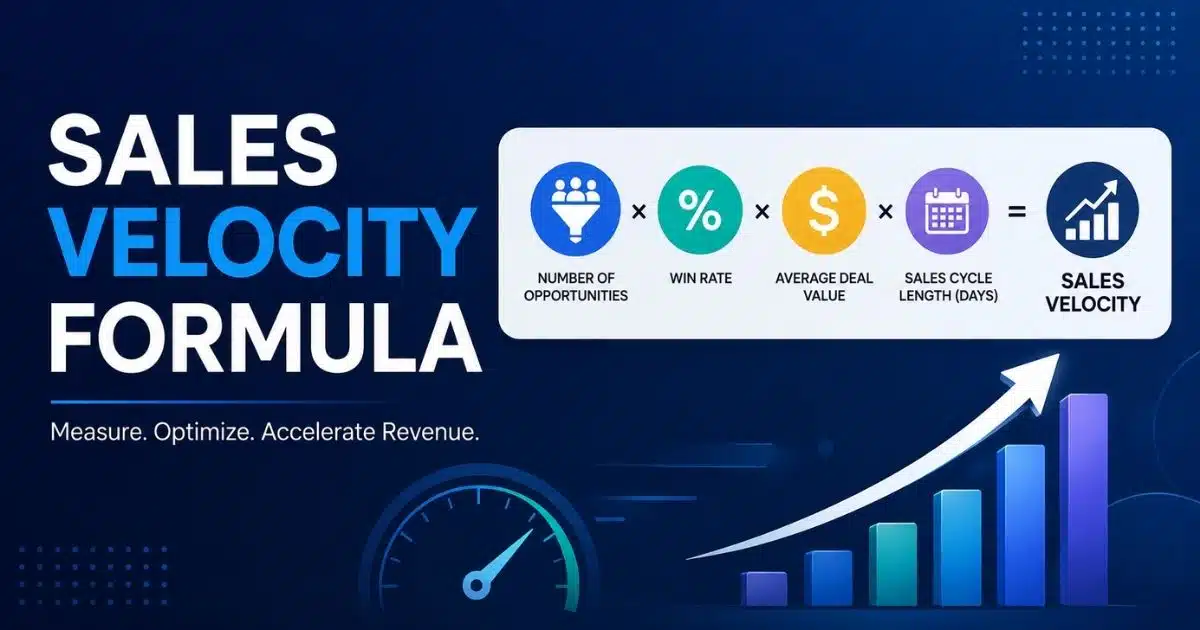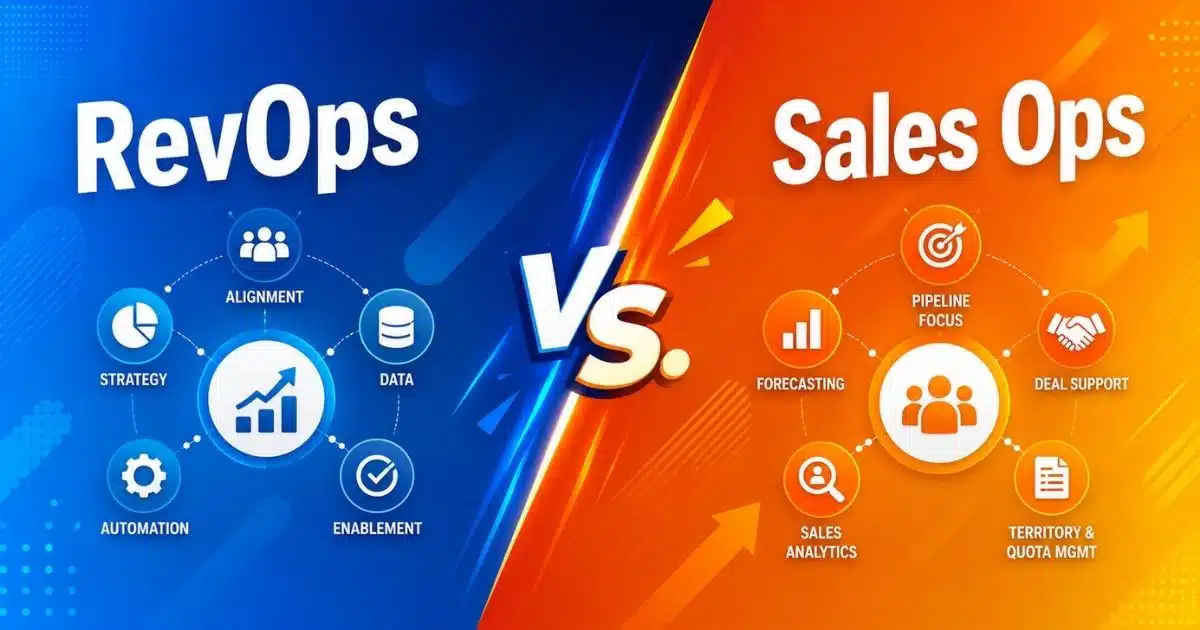
Revenue teams often struggle to decide whether RevOps or Sales Ops is the better approach for growth. While both aim to improve performance, they solve different challenges. Sales Ops focuses on optimizing sales processes, while RevOps aligns marketing, sales, and customer success under a unified strategy. The right choice depends on your business goals, growth stage, and operational complexity.
Companies seeking predictable revenue and better cross-functional collaboration increasingly adopt RevOps, while organizations with mature sales teams may benefit from specialized Sales Ops functions. Understanding the differences between the two models can help businesses eliminate silos, improve efficiency, and create a smoother customer journey from acquisition to retention.
RevOps Vs Sales Ops: Core Differences
The fundamental difference lies in scope and strategic focus.
Sales operations focuses on optimizing sales team performance within the sales department. It handles pipeline hygiene, CRM administration, territory planning, quota design and compensation management. Sales Ops typically reports to the Head of Sales or a Chief Sales Officer, keeping its influence concentrated on the sales function.
Revenue Operations (RevOps) is a broader operating model that unifies operations across sales, marketing and customer success. RevOps manages the entire revenue lifecycle from lead to renewal, creating shared metrics, unified customer data and cross-functional process governance. RevOps typically reports to a Chief Revenue Officer, COO, or CEO, which helps maintain neutrality across revenue-generating teams.
Aspect | Sales Operations | Revenue Operations |
|---|---|---|
Primary Focus | Sales team efficiency and quota attainment | Cross-functional revenue alignment and growth |
Departments Served | Sales only | Sales, Marketing, Customer Success |
Reporting Structure | VP of Sales or Chief Sales Officer | Chief Revenue Officer or CEO |
Implementation Stage | 5-10 sales reps, $1M-$10M ARR | Established teams, $10M+ ARR |
Scope And Organizational Impact
The breadth of influence determines how each function affects company operations.
Sales Operations Scope
Sales operations focuses on optimizing sales team performance and efficiency within departmental boundaries. The sales ops team manages CRM hygiene, pipeline forecasting, territory planning, sales process optimization and handling sales forecasting with precision. Sales ops improves forecast accuracy from plus or minus 25% to plus or minus 10%, giving sales leadership reliable data for planning, provided there is strong CRM adoption to maximize ROI across the team.
This concentrated approach allows deep specialization in sales-specific challenges. Sales ops manages CRM and sales tools for efficiency, and sales operations supports onboarding and training for sales reps, which is critical for overcoming common CRM adoption challenges and best practices. However, it limits visibility into pre-sale marketing activities and post-sale customer success processes, creating blind spots in the entire revenue process.
Revenue Operations Scope
Revenue Operations orchestrates the entire customer lifecycle across marketing, sales and customer success teams. It standardizes data definitions, integrates technology stacks and aligns cross-departmental processes from lead generation through renewal. RevOps drives cross-departmental alignment to maximize revenue potential, treating the organization as one entire revenue engine rather than separate departments, often by implementing custom sales stages aligned to different teams.
A unified RevOps function can lead to a 30% reduction in go-to-market expenses. According to Forrester research, companies with aligned operations across GTM functions experience 36% more overall revenue growth and up to 28% higher profitability versus their non-aligned peers. RevOps is expected to grow in adoption to 75% by 2026, with survey data from 1,200+ B2B firms showing that 78% already have a dedicated RevOps function.
Customer Journey Management
How each function approaches customer interactions reveals fundamental strategic differences.
Sales Operations Customer Focus
Sales Operations concentrates on optimizing customer interactions during active buying phases. It supports relationship building from initial sales contact through contract signature, focusing on conversion rates, closing deals and deal velocity. Sales ops tracks close rate, sales pipeline health metrics and sales cycle length, giving managers clear insight into how sales reps spend their time during the sales cycle.
The customer experience depends heavily on individual rep performance and sales process adherence within this focused timeframe. Sales ops optimizes lead management and pipeline tracking from lead to close to ensure opportunities move through the funnel efficiently. However, what happens before a lead enters the pipeline (marketing) and after a contract is signed (customer success) falls outside the sales operations team's direct control.
Revenue Operations Customer Focus
Revenue Operations manages the entire customer journey across all touchpoints. It coordinates marketing touchpoints, sales interactions, onboarding processes and renewal activities to create seamless transitions between departments. RevOps creates a seamless customer journey by eliminating departmental silos, ensuring that the handoff from marketing to sales and from sales to customer success follows clear SLAs with full visibility.
RevOps improves customer experience by unifying sales, marketing, and customer success into a coordinated system. Companies with strong RevOps frameworks see a 24% improvement in retention. RevOps also reduces customer churn by standardizing onboarding processes, ensuring that promises made during the sales cycle are fulfilled during implementation. A case study from INSIDEA documented a B2B fintech that achieved a 23% increase in SQL-to-opportunity conversion within three quarters after implementing RevOps solutions with integrated tech stack and common definitions.
Data Management And Analytics
Each approach handles data collection, analysis and reporting differently based on organizational scope.
Data Element | Sales Operations | Revenue Operations |
|---|---|---|
Data Sources | CRM, sales tools, pipeline data | CRM, marketing automation, customer success platforms |
Reporting Focus | Sales performance, quota attainment | Cross-functional revenue metrics, customer lifecycle |
Forecasting Scope | Sales pipeline and bookings | New business, renewals, expansions, churn |
Key Metrics | Close rates, sales velocity, pipeline coverage | Annual Recurring Revenue, Net Revenue Retention, Customer Lifetime Value |
RevOps monitors ROI and revenue retention metrics across the entire revenue journey. RevOps improves revenue predictability through better data insights, connecting revenue data from marketing operations, sales and customer success operations into a unified view by leveraging predictive sales analytics. RevOps provides a holistic view of the customer journey to improve revenue retention, tracking key metrics like CAC, CLV, ARR and NRR alongside traditional sales performance indicators.
However, data quality remains the top challenge. A survey of 1,200+ B2B firms found that 71% of RevOps teams cite data quality as their primary obstacle, followed by cross-functional alignment (64%), tool and stack sprawl (58%), hiring talent (53%) and proving ROI (41%), making disciplined sales reporting in a CRM and strong data governance essential.
Revenue Operations provides broader data integration but requires more complex technology infrastructure and cross-team coordination.
Technology Stack Requirements
The tools and systems needed vary significantly between focused and integrated approaches.
Sales Operations Technology
Sales Operations typically manages CRM systems for modern sales teams, sales engagement platforms, CPQ (configure-price-quote) tools, forecasting tools and commission tracking software. The tech stack remains relatively contained within sales-specific applications, giving the sales ops professionals clear ownership.
Implementation is straightforward with fewer integration requirements across departments. For early-stage companies with a simple go-to-market model, choosing the right CRM software for small sales teams and this contained approach keeps costs low and reduces complexity.
Revenue Operations Technology
Revenue Operations requires integrated platforms connecting marketing automation, CRM systems, customer success tools and analytics dashboards. Strategic CRM implementation for scalable growth helps revenue operations professionals orchestrate data flows between tools like HubSpot, Salesforce and Gainsight so that customer success data, marketing engagement and revenue data are accessible in a single system.
According to industry analysis, companies with mature RevOps functions use 25% fewer tools while achieving better data quality through strategic consolidation. Average RevOps tool consolidation takes 6 to 12 months, but the result is a cleaner, more reliable infrastructure. When data is scattered across multiple tools, revenue operations takes ownership of rationalization and integration to create a single source of truth.
Performance Measurement
Success indicators reflect each function's strategic priorities and organizational impact.
Metric Category | Sales Operations Focus | Revenue Operations Focus |
|---|---|---|
Efficiency | Time spent selling, admin task reduction | Cross-team handoff quality, process automation |
Growth | Quota attainment, new bookings | Net new ARR, revenue retention, expansion |
Quality | Forecast accuracy, pipeline health | Customer satisfaction, lifecycle value |
Team Performance | Individual rep productivity | Cross-functional collaboration scores |
A Deloitte Digital study across 650 US B2B sales executives found that companies with robust RevOps are more than twice as likely to invest in sales enablement, and those organizations reported stronger resilience with sustained double-digit growth, largely because they track and optimize sales performance metrics for SaaS teams and similar KPIs consistently.
Implementation Timeline And Costs
Resource requirements and rollout complexity differ substantially between approaches.
Sales Operations Implementation
Sales Operations can be implemented within 3 to 6 months with dedicated sales ops professionals. Initial investment focuses on CRM implementation for successful deployment, process documentation, lead management workflows and sales tool integration.
According to salary benchmarks from the RevOps Report, a Sales Ops Manager earns between $85,000 and $115,000 at mid-level, with Director-level roles reaching approximately $170,000. Combined with technology expenses and investment in a scalable sales process for growing teams, the total annual investment remains accessible for growing companies focused on quick wins in sales performance.
Revenue Operations Implementation
Revenue Operations requires 6 to 12 months for full implementation across marketing, sales and customer success teams. Change management, cross-team training and technology integration demand significant coordination. Many companies mistakenly believe renaming Sales Ops to "RevOps" is sufficient. A structured revenue operations strategy for scalable growth shows that successful revenue operations requires audits of the tech stack, data clean-ups, alignment workshops and negotiation of reporting lines.
RevOps Manager salaries range from $95,000 to $130,000, with RevOps Directors earning $200,000 or more. The salary premium for revenue operations professionals runs 15 to 25% higher than equivalent sales ops roles, reflecting the broader scope and strategic impact. Despite higher upfront investment, RevOps can reduce go-to-market expenses by 30%, and ROI studies show significant revenue growth acceleration within 18 months of implementation.
Implementation Factor | Sales Operations | Revenue Operations |
|---|---|---|
Timeline | 3-6 months | 6-12 months |
Annual Personnel Cost | $80,000-$170,000 per role | $95,000-$200,000+ per role |
Team Composition | 1-5 analysts and CRM admins | Sales Ops, Marketing Ops, CS Ops, BI specialists |
Change Management | Low to moderate | Significant executive sponsorship required |
ROI Timeline | Quick wins within first quarter | Measurable impact over 2-4 quarters |
When To Choose Each Approach
Your company stage, growth challenges and organizational maturity determine the optimal choice.
Business Scenario | Recommended Approach | Key Indicators |
|---|---|---|
Early Growth Stage | Sales Operations | 5-20 sales reps, basic CRM needs, sales process gaps |
Scaling Challenges | Revenue Operations | Cross-team misalignment, customer churn, complex tech stack |
Mature Organization | Both (RevOps with Sales Ops team) | $50M+ ARR, established departments, growth optimization |
Subscription Business | Revenue Operations | Recurring revenue model, retention focus, expansion opportunities |
For growing companies between $10M and $100M ARR, RevOps tends to start as one or two strategic operators, with sales ops making up 60 to 70% of the initial workload, often by introducing sales automation CRM capabilities to handle repetitive tasks at scale. For companies above $100M ARR, RevOps becomes a distinct function with multiple sub-teams (Sales Ops, Marketing Ops, CS Ops) under unified leadership, enabling scalable revenue growth and predictable revenue growth across the entire customer lifecycle.
Sales Ops remains the right starting point when the company is small, the GTM model is simple and the sales department is the dominant revenue-generating function. Starting with a strong sales process definition and structure within the sales operations team gives early wins in pipeline discipline, sales forecasting accuracy and rep productivity before expanding to an effective revenue strategy across all revenue teams.
RevOps Vs Sales Ops: Making The Right Choice
Choose Sales Operations if you need focused sales team optimization, have limited cross-departmental complexity and want quick wins in sales efficiency. Sales Ops delivers immediate value in aligning sales strategies, improving forecast accuracy and driving revenue growth within a single department.
Choose Revenue Operations if you require cross-functional alignment across marketing and customer success, manage complex customer journeys and prioritize sustainable growth over immediate sales improvements. RevOps aligns sales, marketing, and customer success teams into a unified system that drives predictable revenue growth and reduces friction across the entire revenue engine.
Both Sales Operations and Revenue Operations can drive significant business growth when matched with appropriate company needs and implementation strategies. The key is recognizing that Sales Ops is not a lesser version of RevOps. It is a focused function that serves a specific stage and need. As organizations scale, the most effective approach often involves Sales Ops evolving into a specialized team within a broader RevOps framework, combining tactical depth with strategic alignment across every revenue opportunity.
Frequently Asked Questions
Can A Business Use RevOps And Sales Ops Together?
Yes. Many organizations use Sales Ops as a function within a broader RevOps framework. Sales Ops focuses on improving sales performance, while RevOps aligns sales, marketing, and customer success to drive overall revenue growth.
When Should A Company Transition From Sales Ops To RevOps?
Businesses often consider RevOps when growth creates silos between teams or when customer data becomes fragmented. RevOps is particularly valuable for scaling companies that need better alignment across the customer journey.
Which Teams Are Typically Involved In RevOps?
RevOps usually brings together sales, marketing, customer success, and operations teams. By sharing processes, data, and goals, these departments can work more efficiently and create a more consistent customer experience.
Does RevOps Require New Software Or Tools?
Not necessarily. Many companies start by improving processes and integrating existing tools. However, CRM platforms, analytics tools, and automation software can help support a successful RevOps strategy.
How Does RevOps Impact Customer Retention?
RevOps improves visibility across the entire customer lifecycle, allowing teams to deliver more personalized experiences and proactive support. Better alignment often leads to stronger customer relationships, higher retention rates, and increased lifetime value.