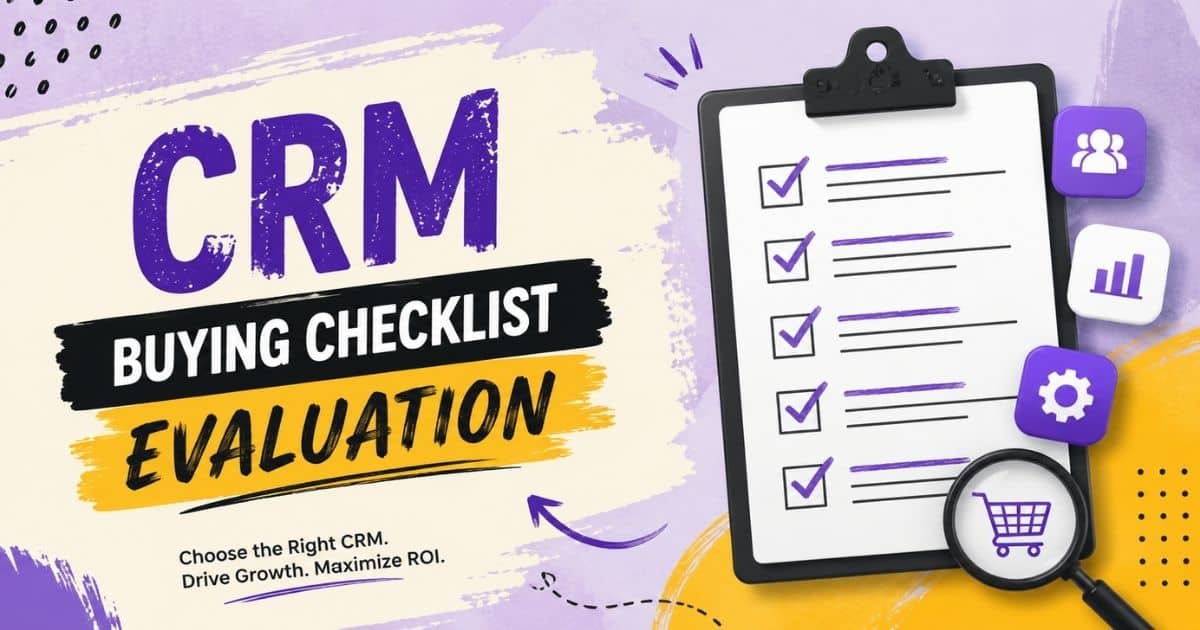
Most teams underestimate how complex picking a new crm actually is. Between feature lists, pricing tiers, and vendor pitches, the real risk is not choosing the wrong product on paper but choosing one that creates workflow friction for the people who use it daily.
Selecting the wrong CRM can create workflow friction that drags on for years. A structured checklist helps avoid costly CRM selection mistakes by connecting every evaluation criterion to concrete business goals like revenue growth, shorter sales cycles, and improved customer management.
This guide walks through a practical, step-by-step crm buying checklist evaluation framework with scoring methods, sample questions, and benchmarks so your sales team can find the right crm solution without wasted budget or stalled adoption.
Understanding CRM Buying Decisions In 2026
CRM systems have moved from optional sales tools to the operational backbone of revenue-generating teams. According to Metrigy's Customer Experience MetriCast 2024, 74.5% of organizations were already using a crm system as of late 2024, up nearly 19 points from the prior year. Among companies with 250 or fewer employees, 75.9% reported using crm tools, while enterprises above 2,500 employees hit 78.9%. Global CRM platform revenue reached approximately $80.5 billion in 2024, with projections pointing toward $98.3 billion by 2029.
Modern crm software does far more than store contact information. It drives lead management through automated capture and scoring, powers contact management with rich customer profiles and account hierarchies, delivers pipeline forecasting through predictive analytics, and handles customer interactions across email, chat, social, and web forms. Integration across channels is now expected, not optional. Marketing automation, sales pipeline tracking, and deal tracking converge inside the crm platform to give teams a single source of truth about every customer relationship.
The consequences of poor CRM selection are well documented. Research indicates that 30 to 40% of CRM implementations fail due to low user adoption. Skipping change management reduces CRM adoption rates significantly. Fragmented contact data is equally damaging: one study found 91% of contact records were incomplete and 18% were duplicated, with 44% of companies estimating they lose over 10% of annual revenue due to data quality issues.
Business Goals And CRM Requirements
Any crm buying checklist evaluation must begin with business goals, not vendor demos or price comparisons. This stage typically takes one to three weeks in real projects, and it produces the foundation every downstream decision rests on.
Primary Business Goals For CRM Investment
Primary CRM goals center on outcomes your leadership team can track against quarterly targets: revenue growth, higher lead-to-opportunity conversion rates, reduced churn, and improved sales productivity. These are not vague aspirations. They need numbers attached. For example, "increase win rate from 18% to 25% in 12 months," "reduce sales cycle length by 20%," or "cut manual data entry time per sales rep by 30% within six months."
These primary goals directly determine which crm features are must-haves. If improving conversion is the priority, pipeline visibility, lead scoring, and workflow automation become non-negotiable. If revenue growth is the focus, forecasting dashboards and analytics depth matter most.
Goal | KPI | CRM Feature Impact |
|---|---|---|
Increase win rate from 18% to 25% | Conversion rate of qualified lead to closed deal | Opportunity tracking, pipeline stages, forecasting |
Reduce manual data entry by 30% | Hours per week spent on data entry per rep | Email integration, automation rules, mobile access |
Cut churn by 15% over one year | Annual customer retention rate | Renewal workflows, customer health dashboards |
Secondary And Qualitative CRM Objectives
Beyond hard revenue targets, secondary goals shape long-term satisfaction and adoption. These include better collaboration between sales and marketing, greater leadership visibility into pipeline data, improved data hygiene, and standardized customer management processes. A CRM needs assessment should include primary and secondary goals because qualitative objectives affect how your team feels about the system every day.
Defining primary and secondary CRM goals fosters stakeholder alignment. Even softer goals can be measured through proxy metrics: active users per month for usability, number of custom dashboards used weekly for visibility, and reduction in duplicate contact records for data quality. Typical secondary goals worth including in your evaluation document are improved interdepartmental alignment, consistent customer profiles, more reliable forecasting, fewer manual hand-offs, and better internal communication of customer history.
Stakeholder Alignment Across Departments
Gather input from stakeholders to define CRM requirements before you ever look at a vendor website. Sales teams prioritize deal tracking and pipeline status. Marketing cares about campaign attribution and marketing tools integration. Finance wants pricing transparency and revenue recognition. IT focuses on data security and integration capabilities. Aligning stakeholders improves CRM adoption and effectiveness because everyone has skin in the decision.
A simple workshop or survey works well here. Ask each group about current pain points (lost leads, duplicate data entry, manual reporting) and desired improvements (faster reporting, mobile access, more automation). A well-built CRM checklist improves stakeholder alignment and clarity by capturing these inputs in one place. Early participation from key stakeholders reduces resistance later and tends to produce active usage rates above 70% one year after launch.
Mapping Business Processes To CRM Capabilities
Document your current workflows for lead capture, qualification, quoting, and renewals before comparing crm tools. Map each step to a corresponding CRM module: lead management, opportunity stages, tasks, automation rules, and account records. For example, a website visitor fills out a form, the crm system captures the lead, triggers assignment to a sales rep, the rep receives a task, outreach happens via email sequence, and the opportunity moves through pipeline stages to close.
This mapping exercise will identify gaps your new crm must close. Maybe there are no SLA alerts. Maybe customer interactions across email and phone live in separate systems. Maybe quotations are built outside the CRM entirely. These gaps define must-have requirements and help you track leads and manage business processes inside one platform.
Prioritizing Requirements Into Must-Haves And Nice-To-Haves
Use a prioritization framework like MoSCoW (Must have, Should have, Could have, Won't have) or a simple 1 to 3 priority scale to categorize crm requirements before vendor evaluation. Using a checklist helps identify must-have CRM features effectively while preventing you from overbuying additional features that are never used.
Must-have capabilities for most sales teams include a centralized contact and account database, sales pipeline visibility, role based access controls, and basic integrations with email and calendar. Nice-to-have items might include advanced AI scoring, social listening, in-app chat, or embedded CPQ. This prioritization drives the scoring model and keeps the evaluation focused on business needs rather than feature count.
Assessing Internal Technical Expertise And Change Capacity
Your team's technical expertise, project management capacity, and admin resources should shape choices around deployment model and customization depth. For small businesses with limited IT support, a simpler cloud based crm with intuitive configuration and strong vendor onboarding works better than a heavily customized or on-premise system. A structured approach reduces confusion in CRM selection when your team knows its own constraints.
Ask yourself: How many people can maintain and administer the CRM? Do we have data migration skills in-house? Have we built integrations before? Can we deliver training internally? Underestimating change management and training is one of the main reasons CRM projects fail within the first 18 months. Rushing data migration can cause missing or inaccurate records, compounding adoption problems.
How To Build A CRM Buying Checklist Framework
With goals defined and requirements prioritized, the next step is turning them into a structured crm evaluation checklist that spans functionality, integration capabilities, data handling, usability, security, and vendor risk. The recommended structure includes sections for core features, workflow fit, analytics, integrations, deployment options, support, pricing, and scalability, each with specific evaluation questions that mirror practical tips for choosing crm tools that fit your workflow.
Core CRM Features And Customer Management Capabilities
A crm should centralize customer data for easy access across your entire sales team. Evaluate contact management (account hierarchy, custom fields, record linking), lead management features that automate lead capture and tracking, pipeline views, activity tracking, and basic automation rules. Sales force automation features help streamline the sales process, so test whether the crm platform supports your specific deal stages and workflows in a way that matches modern crm software for sales teams.
Concrete checklist questions include: How many custom fields are allowed? How many pipelines can be active simultaneously? How does the crm system record interactions across channels? Can one account have sub-accounts? Is there native support for product catalogs or quote generation? Customizable CRMs allow tailoring to specific business processes, and customization capabilities can include no-code or low-code options that keep configuration accessible for non-technical admins, similar to smart crm tools for sales teams.
Analytics, Dashboards, And Reporting Depth
Reporting and analytics tools provide insights into sales performance, making them central to CRM ROI. Key metrics to track include conversion rates, average deal size, sales cycle length, forecast accuracy, and customer lifetime value. Look for customizable dashboards by role, scheduled reports, drill-down capability, and the ability to filter by custom fields or segment contacts by deal stage, region, or product line, especially if you rely on a sales pipeline crm to improve visibility and performance.
For a small business, a simple pipeline status dashboard and closed deals by rep may suffice. A mid-market company might need territory-level custom dashboards, executive forecasting views, revenue by product line, and pipeline data visualizations. The checklist should ask about exporting data to business intelligence tools and how easily non-technical users can build new reports from scratch.
User Experience, Adoption, And Productivity
Ease of use is critical for user adoption of CRM systems. User experience influences CRM adoption rates significantly, so evaluate interface design, navigation, mobile apps for mobile devices, and time-to-task metrics like clicks to log a call, update a deal stage, or create a new contact. Intuitive user interfaces require minimal training for effective use, which directly reduces onboarding time and resistance when your CRM tools fit existing workflows.
CRM systems should provide mobile accessibility for remote work, allowing reps to update sales activities from anywhere. Ask vendors for real adoption metrics or case studies showing percentage of reps logging in daily and any decrease in spreadsheet use after go-live. Training resources matter too: check for in-app guidance, role-based onboarding, and a knowledge base that reps can reference without opening a support ticket so teams can get more from their CRM with a simpler sales workflow.
Security, Compliance, And Data Governance
Data security must comply with regulations like GDPR and CCPA. Robust security measures include encryption and access controls, specifically encryption in transit and at rest, role based access controls, audit logs, SSO support, and granular permissions for sensitive records. Overlooking data security can expose sensitive information and create legal liability.
The checklist should cover compliance requirements relevant to your industry, whether that is SOC 2, ISO 27001, or HIPAA for regulated sectors. Ask vendors about data retention policies, backup frequency, and procedures for data export on contract termination. Access controls should be configurable at the field level so that sensitive crm data stays visible only to authorized roles.
Deployment Models, Scalability, And Performance
Cloud based crm deployments suit most sales teams because they offer easier maintenance, automatic updates, and lower upfront cost. On-premise or private cloud models may be necessary for specific compliance requirements or custom infrastructure needs. Scalability is essential to accommodate growing business needs in CRMs, especially as 2026 crm trends emphasize cloud-first, mobile, and AI-enhanced platforms, so the checklist should ask about user limits, record storage, and the ability to add users without performance degradation.
Include questions about API limits, strategies for archiving historical data, and uptime guarantees. Ask vendors for published SLAs and recent availability statistics covering at least the past 12 months. If your business anticipates sudden increases in leads or transactions, test whether the crm system handles that load without slowing down.
Vendor Stability, Roadmap, And Total Cost Of Ownership
Evaluate each crm vendor's financial health, customer base, release cadence, and product roadmap alignment with your multi-year business objectives. Vendor support is crucial for training and resource availability in CRM systems, so assess the quality and responsiveness of support channels before you sign.
Total cost of ownership extends well beyond the license fee. Implementation, data migration, integrations, training, ongoing admin, and potential add-ons can represent 60 to 70% of total spend. Hidden costs like renewal price escalators, storage overages, and api calls beyond rate limits can surprise buyers after the initial term. Include questions about contract lengths, price increase caps, exit clauses, and the ability to export data if you need to switch, especially when comparing options in a Gain.io vs Pipedrive crm comparison. Key factors for evaluating a CRM system include user adoption and functionality, but commercial terms determine whether you can sustain the investment over three to five years.
Integration Capabilities, Data Quality, And Workflow Fit
CRM rarely operates in isolation. Integration capabilities are now a top-three buying criterion for most revenue teams. In Metrigy's 2024 survey, lack of sufficient integrations ranked as the second-highest reason firms considered replacing their CRM provider. Integrations with existing tools are essential for CRM effectiveness, and this section of the checklist should evaluate both technical depth and practical day-to-day fit.
Evaluating Core Integration Scenarios
The most common integration scenarios to test include email and calendar sync (Outlook, Gmail), marketing platform connections, finance or ERP system links, and connections to other tools your revenue team uses daily. Rather than asking generic questions like "Does it integrate?", formulate testable criteria: "Does the crm system write email engagements back to contact records within minutes?" or "Are bidirectional syncs supported between the CRM and our marketing tools?" A robust CRM with email integration is especially important to streamline communication and keep records accurate.
Ask vendors for detailed integration documentation, reference architectures, and examples from customers in your industry. This helps you assess whether existing tools will connect smoothly or require middleware and custom development.
APIs, Connectors, And Custom Extensions
Look for full API coverage across key objects: contacts, deals, activities, and custom objects. Check rate limits on api calls, authentication methods (OAuth, tokens), and versioning policies. Pre-built connectors and iPaaS tools like Zapier or Make work well for simple automations, but for high-volume or complex logic, native or built-in third-party integrations are preferable.
Webhooks, SDKs, and developer sandboxes matter for teams planning to build custom extensions on top of the crm platform. Even non-technical buyers should ask: Is the API documented publicly? What is the rate limit per minute? Are there additional costs for higher API usage?
Data Quality, Dedupe Rules, And Governance
Poor contact data quality is one of the fastest ways to erode trust in a crm system. Studies show approximately 91% of CRM contact records are incomplete and 18% are duplicated. The checklist should require vendors to demonstrate duplicate prevention, merge workflows, and validation rules on key fields such as email addresses and company domains.
Governance practices like standardized naming conventions, controlled picklists, and periodic data audits keep crm data reliable over time. Test by importing a sample CSV with intentional duplicates and observe how the system handles conflicts. Clean data is the prerequisite for every dashboard, forecast, and automated workflow you build.
Cross-Channel Customer Interaction Visibility
A unified timeline of customer interactions across email, phone, chat, and social channels gives reps the context they need to track interactions without asking the customer to repeat themselves. The checklist should evaluate whether users can see all touchpoints in one place, filtered by date, channel, and team member.
Without this visibility, duplicated outreach becomes common, follow-ups get missed, and customer relationships suffer. Incomplete interaction history also creates blind spots for renewal forecasting and upsell opportunities across your customer base.
Workflow Automation And Process Alignment
Workflow automation improves efficiency by automating repetitive tasks like lead assignment, opportunity advancement, quote follow-ups, and renewal reminders. Evaluate triggers, conditions, actions, and approval flows. The best approach is to rebuild two or three representative workflows from your own sales process during a proof of concept, testing whether the crm solution can handle them without custom code and supports automating sales tasks to stay focused and organized.
Balance flexibility against complexity. Automation should save time without requiring advanced technical expertise for basic changes. Ask who can own automation changes (admins versus developers) and how quickly modifications can be deployed safely. Marketing automation scenarios should also be testable if your marketing team relies on the same platform.
Executing A CRM Evaluation, Shortlist, And Proof Of Concept
With the checklist built, the next phase is turning it into a structured evaluation process. Disciplined evaluation over four to eight weeks can prevent multi-year lock-in to the wrong crm platform.
Creating A Vendor Longlist And Shortlist
Research crm vendors through peer recommendations, analyst reports, user review platforms like G2 and Capterra, and app marketplaces. Use the checklist to remove obvious mismatches early: missing required integrations, wrong deployment model, no regional support, or pricing that exceeds budget before implementation costs are added, especially when evaluating options for a B2B sales crm for revenue teams.
Narrow to a few options, ideally three to five vendors, for deeper evaluation based on alignment with your industry, company size, and must-have features. Document reasons for excluding popular platforms so key stakeholders understand trade-offs and avoid second-guessing later, for example by capturing insights from a Gain.io vs Salesforce crm comparison.
Running Structured Demos Against Real Use Cases
Send vendors a short script of real workflows (lead qualification, quote creation, pipeline review) to follow during demos instead of letting them run generic presentations. Capture feedback from each demo using standardized forms tied back to checklist criteria, not subjective impressions. Involve end users in at least one round so their perspective on usability and workflow fit is represented. Watch for red flags like heavy reliance on slides instead of live configuration or evasive answers about integration depth. Request a free demo environment where your team can explore independently after the presentation.
Designing And Scoring Free Trials Or Proofs Of Concept
Structure free trials of 14 to 30 days with clearly defined objectives: migrate a sample dataset, configure key pipelines, test core automations, and connect at least one integration. Assign trial tasks to different stakeholders (sales, marketing, operations) and collect their ratings on performance and usability, similar to how a sales team in a sales acceleration case study using Gain.io reduced sales cycle time.
Use a simple scoring sheet where each checklist item is scored 1 to 5 and multiplied by its weight to generate a comparable vendor score. Limit proofs of concept to two or three vendors to avoid overwhelming the team and delaying decisions.
Validating References, Support, And Implementation Partners
Speak with two or three current customers of each finalist, ideally in similar industries and company sizes. Prepare a consistent question set covering actual implementation timeline versus estimate, hidden costs, vendor responsiveness, and user satisfaction after 12 months.
Evaluate the availability of certified implementation partners if your in-house resources are limited. Capture reference insights back into the scorecard as qualitative modifiers before making a final decision, particularly when weighing streamlined options highlighted in a Gain.io vs Zoho crm comparison guide.
Negotiating Contracts, Pricing, And Exit Options
Key commercial topics include subscription tiers, user-based pricing, data storage limits, overage fees, onboarding packages, and multi-year discounts. Clarify renewal caps, escalation paths, and support SLAs in writing before signing. Include exit clauses and data export commitments in the contract to reduce vendor lock-in risk.
Compare three-year total cost scenarios using realistic growth assumptions (more users, higher data volume, potential add-ons) rather than focusing solely on year-one sticker price. This is where evaluating crm systems on paper diverges sharply from evaluating them financially.
Checklist Evaluation In Action: Applying Scoring To CRM Selection
This section covers how to run the crm buying checklist evaluation with scoring models, weights, and structured workshops. Structured scoring improves transparency, aligns stakeholders, and often uncovers hidden preferences that informal discussions miss.
Defining Evaluation Categories And Weights
Group checklist items into five to seven major categories: Business Fit, Core Features, Analytics and Reporting, Integration Capabilities, Usability and Adoption, Security and Compliance, and Commercials (TCO). Set weights for each category based on business priorities. For example, a small business focused on fast adoption might weight Usability at 25% and Integrations at 20%, while a larger organization might weight Security at 20% and Analytics at 15%, which aligns with how crm for startups and small sales teams emphasizes simplicity and speed.
Involve leadership in approving weights before scoring vendors to avoid disputes later. The weights should add up to 100%, and every evaluator should use the same framework.
Designing A Practical Scoring Scale
Use a 1 to 5 scale for each checklist item with clear descriptions: 1 means does not meet the requirement, 3 means meets it, and 5 means exceeds it. Objective evidence from demo performance, trial results, and documentation should inform scores rather than vendor marketing promises alone. Treat unknown or unproven areas conservatively to avoid over-rating a crm vendor with limited evidence.
Checklist Item | Vendor A Score | Vendor B Score |
|---|---|---|
Pipeline customization (weighted 20%) | 4 | 3 |
Email integration accuracy | 5 | 4 |
Mobile app usability on mobile devices | 3 | 5 |
Running Vendor Workshops To Complete The Checklist
Organize internal scoring workshops after demos and trials, allowing each stakeholder to score independently before consolidating. Handle disagreements by averaging scores or hosting focused discussions on divergent ratings. Document assumptions behind each score for future reference, especially if leadership revisits the decision later. This collaborative scoring process often uncovers hidden constraints like insufficient technical expertise or underestimated integration work.
Interpreting Results And Making Trade-Offs
When two vendors score closely, revisit must-have categories and test sensitivity to changes in weights. Common trade-offs include stronger integrations but higher cost, or better usability but weaker advanced analytics. Focus on long-term strategic fit and crm evaluation criteria alignment as the tie-breaker rather than marginal differences in secondary features. Capture a short decision rationale document that references the checklist and scores for governance and future audits.
Tracking Post Implementation Outcomes Against The Checklist
Reuse the original evaluation checklist as a post-implementation benchmark. Compare actual adoption, sales performance, and ROI against predicted outcomes at 6, 12, and 24 months. Select leading and lagging indicators like login rates, pipeline coverage, conversion rates, revenue impact, and data cleanliness (duplicates, missing fields) for periodic review.
When expectations are not met, revisit configuration, training, or processes. This feedback loop strengthens future software evaluations beyond CRM and helps the organization make faster, more confident decisions over time. Customer satisfaction scores and crm assessment results should inform whether the best crm choice was the right crm choice.
How Gain.io Supports Your CRM Buying Checklist Evaluation
Gain.io is built for sales teams that want clarity in their CRM buying process, not more complexity. As a sales CRM focused on contact management, visual sales pipelines, task management, email integration, and calendar coordination, Gain.io aligns directly with the checklist framework outlined in this guide. Every feature exists to reduce friction in the sales process and give teams full visibility into their pipeline.
Gain.io helps teams standardize evaluation templates, centralize stakeholder feedback, and keep an auditable record of decisions across departments. Whether you are comparing a few options or running a full proof of concept, Gain.io's approach supports cross-functional collaboration and transparent documentation of why features are prioritized and why vendors are included or excluded, while its dedicated sales pipeline management capabilities keep deal flow visible throughout evaluation and beyond.
If your team is starting a crm evaluation, explore how Gain.io can streamline the process from goal definition through post-selection tracking, without unnecessary complexity or features you will never use. Its focus on helping sales teams manage leads effectively, supporting CRM tools that help retail teams stay organized, and enabling teams to manage contacts better and build stronger relationships makes it adaptable across different go-to-market models and industries.
Frequently Asked Questions
How Long Should A CRM Buying Evaluation Take From Start To Decision?
For a small business, four to six weeks is a realistic timeline. Midsize or enterprise evaluations may run eight to 16 weeks due to more stakeholders, integration complexity, and compliance requirements. Rushing under two weeks often leads to missed crm requirements and higher change costs later. A practical breakdown: one to two weeks for goal definition, one to two weeks for shortlisting and demos, and two to four weeks for trials and contracting.
How Many CRM Vendors Should I Include In My Shortlist?
Narrow to three to five serious contenders to balance breadth and depth of evaluation, especially when running trials or proofs of concept. Starting with a longer longlist is fine, but the checklist should help quickly filter out vendors that clearly miss must-have requirements. Evaluating too many options at depth increases fatigue and makes objective comparison across your sales team difficult.
What If My Team Has Very Limited Technical Expertise?
Prioritize cloud based crm systems with strong onboarding, intuitive configuration, and extensive documentation over highly customizable but complex platforms. Weight "admin friendliness" and vendor implementation support heavily in your checklist. Consider external consultants or partners only after ensuring the ongoing admin workload will remain manageable for your existing team.
How Do I Handle Resistance From Users Who Dislike Changing CRM Systems?
Involve end users early in requirements gathering and vendor demos so they feel ownership of the new crm. Build change management steps into the checklist: communication plans, role-based training, and super-user programs. Including user experience and adoption support as formal crm evaluation criteria signals to the team that their business needs and daily workflows are a priority.
Can I Reuse The Same Checklist For Future Software Evaluations Beyond CRM?
While some criteria are CRM-specific, the overall approach covering goals, requirements, integration capabilities, usability, vendor health, and TCO is reusable for other revenue and customer-facing tools. Save the template and adapt sections for evaluating marketing automation platforms, data tools, or project management systems. Organizations that standardize this evaluation pattern tend to make faster, more confident software decisions over time.