Your sales reps waste time chasing leads that will never close. Industry data shows 60-70% of rep effort goes toward low-fit prospects when lead prioritization is missing. Meanwhile, your best opportunities sit untouched. Smart lead prioritization solves this by directing attention where it matters most.
In 2026, with buying committees averaging 11 stakeholders and 70% of B2B purchases involving self-directed research before sales contact, random outreach costs too much. This guide breaks down practical techniques that high performing sales and marketing teams use to build pipelines that convert.
What Lead Prioritization Means For Modern B2B Pipelines
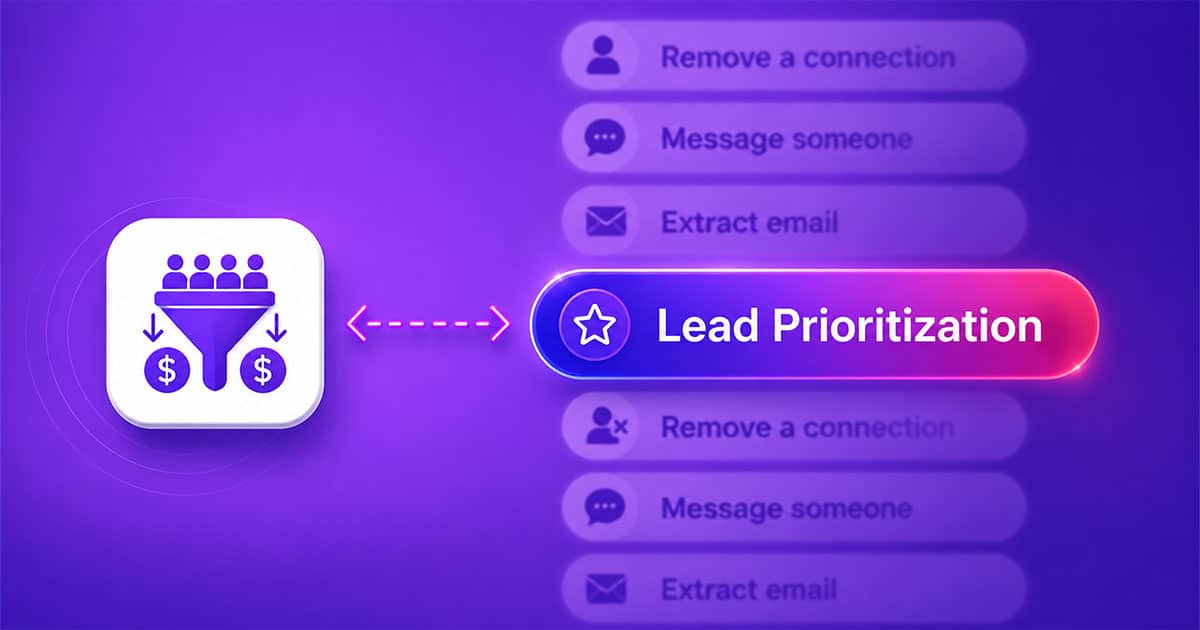
Lead prioritization is the habit of deciding which sales leads get attention first. Instead of working leads in the order they arrived, your team focuses on real likelihood to buy. This means ranking prospects based on fit with your ideal customer profile ICP, behavioral signals like website visits or email opens, and timing indicators like pricing page views within 48 hours.
Why does this matter more now? Longer buying committees and self-serve research make random outreach expensive. A mid-market SaaS team might prioritize leads from companies with 200-2,000 employees using specific tech stacks who recently viewed pricing. This approach yields 3-5x higher conversion rates than cold outreach.
Lead scoring assigns numeric point values, while the lead prioritization process acts as the operational layer. Scoring is the model. Prioritization is who your reps call today.
Smart Lead Prioritization Techniques For High Performing Sales Pipelines
Building an efficient system requires combining multiple data sources and scoring methods. Here are the techniques that separate high performers from the rest.
Behavioral Lead Scoring Based On Buyer Intent
Behavioral lead scoring tracks buyer intent through actions rather than static attributes. When a prospect attends a webinar, downloads implementation guides, or visits your pricing page repeatedly, these behavioral signals reveal purchase intent. Data shows pricing page visits signal 4x higher close rates compared to general browsing.
Firms using behavioral scoring see 20% pipeline growth because reps engage warm leads first. Your scoring system should assign higher point values to high intent signals like demo requests, trial signups, and comparison page views. Track these data points in your CRM to identify leads showing genuine interest versus casual browsers.
Firmographic And Demographic Segmentation Models
Firmographic data like company size, industry, and revenue band helps filter out prospects that do not match your target. Demographic data identifies the right decision makers within those companies. Together, these scoring criteria reduce unqualified pursuits by 42%.
Your lead scoring system should weight these attributes appropriately. A B2B software company might prioritize accounts with revenue above $50M, C-level titles, and tech industry alignment. This segmentation ensures qualified leads reach your pipeline while mismatched prospects receive different treatment.
AI Driven Predictive Lead Scoring Systems
Predictive lead scoring uses machine learning to forecast conversion probability based on historical data and live behavioral data. Mature predictive models achieve 78% accuracy and identify leads 2.5x more likely to convert than average.
AI driven scores analyze data across multiple data sources including CRM records, third party intent data, and engagement patterns. These scoring models continuously learn from closed won data to improve accuracy. Unlike static rules, predictive analytics adapts as customer behavior evolves.
Real Time Lead Routing And Assignment Rules
Speed matters. When high priority leads trigger based on intent signals, routing rules should assign them to reps within 5 minutes. InsideSales research shows this response time lifts conversion rates 9x compared to slower follow-up.
Your lead routing system should connect website activity, form submissions, and product signals to your CRM. When a prospect matches your ICP and shows purchase intent, they appear in the right rep’s queue immediately. Implementing these routing rules cuts sales cycles by 28%.
Engagement Based Lead Ranking Frameworks
Beyond initial scoring, ongoing engagement determines where leads rank in your queue. Track email open rates above 30%, content interactions, and trial usage patterns. Leads demonstrating sustained interest deserve higher priority than those who went quiet.
This engagement framework helps sales reps identify which leads are in market right now versus those requiring more nurture. Dedicated lead management software for sales teams supports this by centralizing activity data, segmenting prospects, and standardizing follow-up workflows so marketing can warm up lower-engagement leads while sales efforts concentrate on active buyers.
CRM Data Enrichment For Better Lead Context
Raw lead data rarely tells the complete story. Data enrichment tools like Clearbit add 50+ data points per lead, including tech stack, company news, and contact verification. This context improves lead qualification accuracy by 35%.
Better data quality means more accurate scoring. When your CRM contains complete firmographic and technographic information, your lead scoring models make smarter decisions. Layering automated sales tasks and workflows on top of this enrichment turns incomplete records into actionable intelligence without adding manual admin work.
Impact Of Lead Prioritization On Revenue Growth
Lead prioritization has a direct influence on revenue performance by helping sales teams focus on the right opportunities at the right time. When combined with a well-implemented CRM that improves sales productivity, strong lead prioritization strategies reduce inefficiencies and create a more predictable pipeline built on data and intent signals.
Focus Sales Efforts On High Intent Prospects
Prioritized leads convert at 2–3x the rate of average prospects. Sales teams that apply structured lead prioritization strategies avoid wasted effort and focus on accounts with real buying intent. Instead of chasing every inquiry, reps engage prospects who are more likely to convert. This becomes critical when managing high lead volumes, where manual filtering turns into a time consuming process.
Increase Conversion Rates Across The Funnel
Teams that use predictive scoring and AI-driven lead scoring consistently boost conversion rates across every funnel stage. MQL to SQL conversion improves significantly because only qualified leads move forward. When teams track conversion rates based on lead quality, they gain visibility into lead generation strategies that drive high-quality leads and which channels perform best. This data-driven approach ensures resources go toward high-impact campaigns.
Reduce Sales Cycle Length And Close Deals Faster
Predictive scoring models use historical data and behavioral signals to identify leads ready to engage. When sales teams connect early with high-intent prospects, deal cycles shorten. Faster response times combined with AI-driven lead scoring reduce delays and increase deal velocity. Reps spend less time qualifying and more time closing, improving overall pipeline efficiency.
Improve Sales And Marketing Alignment
Clear scoring criteria and shared data models align sales teams and marketing teams around the same goals. AI-driven lead scoring provides a unified framework that removes subjectivity. This alignment ensures smoother handoffs and reduces friction between teams. As a result, marketing efforts produce better-qualified leads, and sales teams trust the pipeline quality.
Maximize ROI From Lead Generation Campaigns
Lead prioritization strategies help identify which campaigns deliver the highest value. By analyzing data points and performance metrics, teams can focus budgets on channels that drive real results and avoid common lead generation mistakes that hurt conversions. Advanced systems with key features like predictive scoring and automated insights highlight which sources generate revenue. Businesses using enterprise plan capabilities often scale faster by optimizing lead generation and reducing wasted effort across campaigns.
Common Lead Prioritization Mistakes That Reduce Conversions
Lead prioritization systems fail not because of tools, but because of poor execution. Small gaps in logic or data handling can significantly impact pipeline quality and revenue outcomes. Recognizing these mistakes and reinforcing them with structured lead management software for sales teams helps build a more reliable and efficient prioritization process.
Treat All Leads With The Same Priority
Spreading effort evenly across all incoming leads reduces efficiency and slows pipeline progress. Research shows 42% of sales reps struggle with poor lead quality, often because prioritization is missing. When sales teams treat every lead equally, they waste time on low intent prospects while high value opportunities lose momentum. A structured approach to prioritizing leads ensures that high potential prospects receive timely attention, improving overall conversion probability.
Rely Only On Basic Demographic Data
Relying only on demographic data such as company size or job title limits visibility into real buyer intent. This approach ignores key data points like engagement and intent signals, which represent a large portion of decision making behavior. Without combining firmographic data with behavioral insights, teams miss up to 50% of ready to buy prospects. Effective lead prioritization systems require a balance between fit and intent to identify qualified leads accurately.
Ignore Behavioral Signals And Engagement Data
Behavioral signals such as website visits, content downloads, and email interactions provide real time insight into customer behavior. Ignoring this live behavioral data leads to longer sales cycles and missed opportunities. Prospects actively researching solutions often show high intent signals that indicate purchase readiness. Without tracking and analyzing these signals, sales teams cannot identify who is in market, resulting in delayed engagement and lower conversion rates.
Lack Of Clear Lead Scoring Criteria
Unclear scoring criteria create confusion between sales and marketing teams. When there is no defined lead scoring system, qualification becomes subjective and inconsistent. Studies show that misalignment can lead to 50% disagreement on lead quality. Establishing clear scoring rules with assigned point values ensures that both teams evaluate leads using the same standards. This alignment improves handoff quality and strengthens the overall sales process.
Failure To Update Lead Prioritization Models
Lead prioritization models must evolve with changing market conditions and customer behavior. Static scoring models quickly lose accuracy if not updated regularly. Without using historical data such as closed won data, predictive models become outdated and unreliable. Businesses that fail to recalibrate their scoring systems risk losing high value opportunities and reducing pipeline efficiency. Continuous optimization ensures that predictive scoring remains aligned with real conversion data and business goals.
Step By Step Lead Prioritization Framework
Follow this process to build or improve your lead prioritization system, and pair it with a structured understanding of what a sales pipeline is and how to build one that works so prioritization maps cleanly onto each stage.
Define Ideal Customer Profile And Buyer Personas
Start with closed won data from the last 12-24 months. Identify patterns in deal size, sales cycle length, and retention. Document firmographic traits like industry, employee range between 200-2,000, revenue band, and tech stack. This becomes your ICP. Using a structured CRM to help sales teams manage leads makes it easier to consistently target firms that match 80% of closed wons, improving every downstream metric.
Set Clear Lead Scoring Criteria And Weights
Build a scoring system with three buckets: 40% firmographics, 30% behavior, 30% intent. Assign point values to specific criteria. ICP tier match might earn 10 points. A demo request adds 20. Visiting your pricing page within 48 hours signals high intent. Keep initial scoring rules under 15 criteria and consider whether your CRM includes smart CRM tools for sales teams that can automate and surface these scores inside daily workflows.
Combine Behavioral And Firmographic Data
Neither fit nor intent alone tells the complete story. A perfect ICP match with no engagement is not ready for outreach. An engaged visitor from a bad-fit company wastes time. Your scoring models need both dimensions to identify the lead’s potential accurately.
Align Sales And Marketing On Lead Definitions
Define what MQL, SAL, and SQL mean in concrete terms. Which score threshold qualifies a lead? What data points must be complete? Get both teams to agree, then document these definitions where everyone can access them. This alignment boosts conversion data by 22%.
Continuously Review And Optimize The Model
Schedule monthly checks on performance metrics and quarterly deep reviews. Use conversion data from different score bands to identify what is working. Test adjustments over 30-60 days before making permanent changes. Monthly optimizations improve accuracy 15-20% yearly.
Tools And Technologies That Improve Lead Prioritization
The right technology stack makes sophisticated prioritization possible, especially when you design it around a simpler sales workflow inside your CRM so reps actually use the prioritization rules you define.
CRM Systems With Built In Lead Scoring
CRMs like Salesforce include native scoring capabilities that automate 90% of lead routing based on your rules. These systems track every interaction and update scores in real time. All-in-one platforms such as Gain.io CRM to grow your sales and team bring similar capabilities into a simpler package so your sales process benefits from having prioritization built into the platform reps already use.
Marketing Automation Platforms For Lead Tracking
Marketing automation tools like Marketo track engagement across channels and nurture leads to sales readiness 3x faster. They capture behavioral signals from email opens, content downloads, and event attendance, especially when paired with a CRM with email integration to streamline communication. This data feeds your scoring system with continuous learning about prospect interest.
AI Powered Predictive Analytics Tools
Predictive analytics tools use machine learning to analyze data across your entire database. They identify patterns humans miss and forecast which leads are likely to convert. AI monitors changes in behavior to adjust scores dynamically, especially when built into a dedicated sales pipeline CRM that improves visibility and performance. These tools achieve 80% prediction precision in mature implementations.
Data Enrichment Tools For Better Lead Insights
Enrichment platforms pull data from third party sources to complete lead records. They add context like company news, technology usage, and verified contacts that feed into an integrated contact management system to build stronger relationships. Better data quality means more accurate scoring and fewer missed opportunities from incomplete information.
Lead Routing And Workflow Automation Software
Workflow tools ensure the right leads reach the right reps immediately. They apply routing rules based on territory, segment, or availability. Salesforce Einstein and similar tools cut assignment time to seconds, preventing hot leads from sitting idle, and real-world results like a sales acceleration case study with Gain.io show how faster routing and standardized workflows can materially reduce sales cycle time.
Key Metrics To Track Lead Prioritization Performance
Lead prioritization performance relies on clear, data driven metrics that connect scoring accuracy with revenue outcomes. Tracking the right indicators helps sales teams refine models, reduce wasted effort, and improve overall pipeline efficiency.
Lead To Opportunity Conversion Rate
Lead to opportunity conversion rate is a core metric that shows how effectively your lead prioritization system turns prospects into pipeline opportunities. High performing sales teams often achieve 20–30% conversion rates when their lead scoring aligns with real buyer intent and when they maintain strong sales visibility into pipeline performance. A low rate usually signals poor scoring criteria or weak qualification processes.
Tracking this metric by source, segment, and scoring tier helps teams understand which leads truly convert. It also highlights whether your lead prioritization strategies are working across different campaigns. Consistent monitoring allows teams to adjust scoring models and focus efforts on high quality leads.
Average Sales Cycle Length
Sales cycle length measures the time it takes for a lead to move from initial contact to deal closure. Effective lead prioritization reduces delays by helping sales teams engage prospects who are more likely to convert. Predictive scoring and AI driven lead scoring play a key role in identifying these high intent leads early.
Shorter sales cycles indicate that your prioritization system is accurate and efficient. When sales reps spend less time on unqualified leads, deal progression improves. Monitoring this metric helps teams identify bottlenecks and optimize the overall sales process.
Lead Response Time And Follow Up Speed
Lead response time directly impacts conversion probability. Studies show that faster responses significantly increase the chances of closing deals. Lead prioritization systems use routing rules to ensure high priority leads reach the right sales reps instantly, reducing delays in follow up.
Tracking response time helps teams identify inefficiencies in lead routing and engagement workflows. When response speed improves, missed opportunities decrease. Sales teams can use this metric to ensure timely follow up and maintain consistent engagement with high value prospects.
Pipeline Velocity And Deal Progression
Pipeline velocity measures how quickly deals move through each stage of the sales process. It combines factors like conversion rates, deal size, and cycle length to provide a clear view of pipeline efficiency. Strong lead prioritization ensures that only qualified leads enter the pipeline, improving overall flow.
Higher velocity indicates that sales teams are working on leads with strong conversion potential. Deals progress faster and fewer opportunities get stuck. Tracking this metric helps teams forecast revenue more accurately and identify areas where deal movement slows down.
Revenue Contribution From High Priority Leads
Revenue contribution from high priority leads shows how much of your total revenue comes from top scoring prospects. In many cases, a small percentage of leads drives the majority of revenue. This highlights the importance of accurate lead prioritization and scoring models.
Analyzing this metric helps sales and marketing teams align their strategies around high impact segments. It also supports better lead generation decisions by identifying which channels produce the most valuable leads. Over time, this leads to stronger ROI and more predictable revenue growth.
How Gain.io Improves Lead Prioritization And Sales Efficiency
Gain.io helps sales teams streamline lead prioritization by organizing leads, tracking deal progress, and improving visibility across the sales pipeline. The platform centralizes lead data, making it easier to analyze interactions, update deal status, and maintain accurate records without scattered tools, while its smart CRM tools for sales teams ensure these workflows stay simple enough for everyday use.
With structured workflows and clear pipeline tracking, sales teams can focus on high-value opportunities instead of manual updates. Its approach mirrors best practices from a comprehensive sales deal tracking guide for modern teams, helping Gain.io support better alignment between sales and marketing by keeping all stakeholders informed on deal movement and priorities. This improves follow-up consistency and reduces delays in the sales process.
By simplifying pipeline management and improving data visibility, Gain.io enables teams to work more efficiently, prioritize the right leads, and maintain a steady flow of qualified opportunities, especially when teams lean on a visual sales pipeline to improve deal clarity.
FAQs
How To Balance Lead Volume And Lead Quality In Prioritization Models
Weight quality signals 2:1 over quantity metrics. Maintain roughly 20% of leads as top tier priorities while nurturing the rest. This balance ensures pipeline coverage without diluting rep focus on your best opportunities.
What Role Does Intent Data Play In Advanced Lead Prioritization
Third party intent data from sources like Bombora boosts scoring accuracy by 35% in advanced models. It surfaces in market buyers researching solutions like yours, even before they visit your site. Intent signals complement first-party behavioral data for complete prioritization.
How To Align Lead Prioritization With Account-Based Sales Strategies
Prioritize accounts showing 70% or higher ICP fit combined with intent spikes. This alignment concentrates 50% more resources effectively on accounts that matter. Use account-level scoring alongside contact-level signals.
When Should You Recalibrate Lead Scoring Models Based On Pipeline Data
Recalibrate quarterly or whenever you see a 10% shift in pipeline patterns. Use closed loop data comparing scores to outcomes. Regular updates prevent model drift that erodes accuracy over time.
How To Measure The Accuracy Of Predictive Lead Scoring Systems
Run lift analysis comparing conversion rates for top-decile scored leads against average. Target 75% or higher precision on top-scored leads. If high scores do not correlate with wins, your model needs retraining.