A typical enterprise deal in 2026 does not move from first email to signed contract in a straight line. A prospect may first engage with a LinkedIn post, attend a webinar two months later, join a discovery call, bring in a technical evaluator, request a security review, involve finance, and then enter legal review before procurement signs off. Large b2b sales cycles commonly run 6 to 12 months, while complex enterprise sales cycles can stretch longer.
A multi touch b2b sales strategy is an integrated outreach framework where sales and marketing teams engage target decision-makers across multiple communication channels and repeated interactions throughout the buying cycle. It is not random follow-up. It is a structured plan across multiple touchpoints, multiple channels, and multiple stakeholders.
This article explains how a multi touch b2b sales strategy drives revenue, how attribution data improves sales and marketing decisions, and how Gain.io helps sales teams stay organized across contacts, tasks, notes, email, calendars, and visual pipelines.
What Is Multi Touch B2B Sales
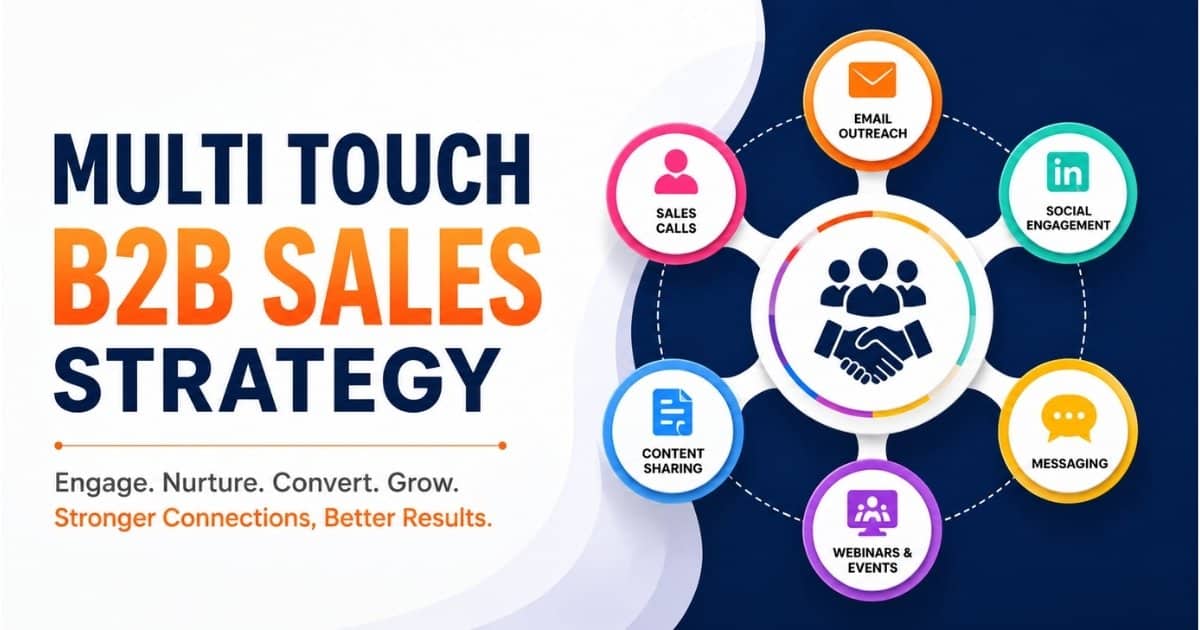
Multi touch B2B sales is a coordinated sales process where SDRs, AEs, and marketing teams plan multiple interactions across the buyer’s journey. These interactions can include personalized email, phone calls, LinkedIn outreach, webinars, case studies, sales calls, demos, calendar follow-ups, and executive check-ins.
It differs from multi touch attribution. Multi touch attribution is a marketing analytics framework that assigns credit to multiple touchpoints in the buyer’s journey, allowing organizations to understand how different interactions contribute to a conversion. Multi touch sales is the execution system, while multi touch attribution works as the measurement system.
It also differs from broad multi touch marketing or a multi touch marketing campaign. Generic multi-channel marketing may push messages across marketing channels, while a revenue-focused multi touch strategy maps each message to a buyer role, stage, and objective. The best programs combine unified marketing, sales rep follow-up, marketing automation, and CRM discipline so customer interactions become measurable.
Why Multi Touch B2B Sales Strategies Drive More Revenue
A strong multi touch b2b sales strategy improves revenue because it compounds familiarity, trust, and urgency across the buying process. Research indicates that omnichannel strategies deliver 250% higher conversion rates compared to single-channel efforts, highlighting the effectiveness of multi-touch attribution in B2B sales. Coordinated interactions across multiple channels helps build trust and close deals in B2B sales.
Impact On Conversion Rates Across The Customer Journey
Multi touch outreach improves conversion because every stage gets a relevant next step. Awareness may come from content marketing or digital marketing. Consideration may come from a webinar, ROI guide, or comparison page. Evaluation may involve a demo, technical call, or buyer-specific follow-up.
The linear attribution model gives equal credit to every touchpoint in the buyer’s journey, making it a balanced approach for understanding the contribution of each interaction. A linear model is useful when teams want to see how early education, lead generation, sales calls, and follow-ups all support movement through the marketing funnel.
Data analysis in multi-touch attribution involves tracking interactions across various channels and touchpoints to understand their influence on customer decisions. Using advanced analytics techniques, such as attribution modeling, allows marketers to evaluate the effectiveness of each touchpoint in driving conversions.
Effects On Deal Size And Expansion Revenue
Multi touch selling uncovers more problems inside an account. A champion may care about productivity, finance may care about payback, IT may care about security, and leadership may care about customer lifetime value. When sales teams engage more roles, they often identify broader use cases and larger contract potential.
Industry benchmarks commonly show that multi-threaded enterprise accounts can generate 20% to 40% higher average contract value than single-threaded deals. HockeyStack research found that high-ACV B2B SaaS deals can involve hundreds of customer interactions, with deals above $100K ACV requiring far more touchpoints than smaller deals, according to HockeyStack Labs.
Attribution data at the account level shows which sequences correlate with larger deals. Executive briefings, ROI calculators, customer stories, and late-stage reference calls often reveal influenced revenue that a single touch attribution view would miss.
Influence On B2B Sales Cycles And Time To Close
A multi touch strategy does not mean adding noise. It means reducing idle time between important buyer interactions. Engaging prospects on their preferred platforms maximizes response rates and shortens sales cycles, especially when supported by an AI sales assistant for pipeline efficiency.
Well-orchestrated cadences, clear next steps, and fast follow-up can shorten b2b sales cycles by 10% to 30% compared with ad-hoc outreach. The time decay attribution model assigns more credit to touchpoints that occur closer to the conversion, reflecting the idea that recent interactions have a greater influence on the final decision. A time decay model helps identify which late-stage sales calls, procurement workshops, and proposal follow-ups accelerate the close.
Sales cycle length should be tracked by stage. If demos happen quickly but proposals sit for two weeks, the issue is not lead quality. It is process friction.
Contribution To Pipeline Quality And Win Rates
Multi touch strategies improve pipeline quality because weak-fit accounts reveal themselves earlier. If a lead ignores multiple value-based emails, skips a webinar, and avoids discovery, the sales rep can deprioritize that opportunity and focus on better-fit accounts.
B2B sales cycles typically involve 6 to 10 stakeholders, making multi-touch attribution essential for accurately measuring performance and optimizing channel investment across multiple interactions. Implementing account-based attribution tracking is essential, as B2B buying decisions typically involve multiple stakeholders, each contributing at different stages of the process.
Integrated B2B sales CRM records, sales notes, calendar activity, and email history make it easier to score engagement depth. Sales teams can prioritize accounts where multiple stakeholders respond across multiple channels.
Role In Sales And Marketing Alignment
Sales and marketing teams often work in silos, but B2B attribution can bridge this gap with a shared view of what drives success. Marketing teams contribute campaigns, content, webinars, and nurture. Sales teams contribute outreach, discovery, demos, objection handling, and negotiation.
Aligning sales and marketing teams around shared metrics derived from multi-touch attribution improves collaboration and reduces channel conflicts. Multi-touch attribution enables closed-loop reporting, allowing both sales and marketing teams to track each customer’s complete journey and identify areas for improvement.
Shared dashboards should connect marketing efforts with sales outcomes. That gives leaders valuable insights into which marketing strategies produce qualified meetings, not just clicks.
Support For Strategic Decision Making And Budget Allocation
Multi touch attribution models help leaders make informed decisions about marketing spend, marketing investments, and resource allocation. Comparing a linear attribution model with a time decay attribution model can reveal whether early education or late-stage sales activity is being undervalued.
To implement B2B marketing attribution effectively, organizations should start by identifying the right attribution model and defining KPIs that reflect both marketing and sales objectives. Quarterly reviews help teams identify trends, stop funding weak programs, and increase investment in plays that create pipeline and revenue.
Segmenting data based on demographic information and consumer behavior provides a multifaceted view of the audience, enabling informed decision-making in marketing strategies. In practice, that means leaders can gain insights by segment, role, deal size, and channel mix instead of relying on blended averages.
Core Elements Of A Multi Touch B2B Sales Playbook
A playbook turns strategy into daily execution. It defines who to contact, when to contact them, what message to use, which content to share, and how to record activity inside the CRM.
Channel Mix For High Impact Multi Touch Outreach
A strong channel mix includes email, phone calls, LinkedIn, webinars, in-person events, social media posts, social media ads, content marketing, retargeting, and demos. The mix should reflect the target audience and deal size.
Enterprise IT buyers may need technical documentation, security conversations, and peer references. SMB operators may respond faster to direct email, short demos, and practical ROI examples. Attribution data can show which marketing channels appear most often in won opportunities.
Design Sequences And Cadences That Respect B2B Buyers
A modern cadence often includes 12 to 18 touches over 25 to 35 days. The goal is not pressure. The goal is relevant progression across the buying journey.
A good sequence might begin with a role-specific email, continue with a LinkedIn view or message, add a useful benchmark report, include a phone call, and then follow with a meeting invitation. Amplemarket data shows that many meetings happen around touch 5 or 6, which supports disciplined follow-up rather than early abandonment.
Multi Thread Across Buying Committees
B2B deals involve multiple stakeholders, meaning outreach must be multi-threaded to address unique concerns of different roles. Mapping out the buying committee within target accounts involves identifying common titles and their specific pain points.
Finance may need cost control. Operations may need process improvement. IT may need integration and security confidence. Executives may need strategic impact. Account-level attribution helps teams see which roles influence lead creation, opportunity creation, and closed revenue.
Content Strategy For Each Stage Of The Customer Journey
Mapping the customer journey involves listing every touchpoint prospects encounter, organizing them in the order they typically occur, and visualizing this journey to identify key moments that influence conversions.
Early-stage content should clarify the problem. Mid-stage content should compare options and prove ROI. Late-stage content should reduce risk with implementation guides, customer stories, references, and security documentation. Digital marketing and sales teams should co-own this content calendar so each touch has a clear purpose.
Measurement, Reporting, And Feedback Loops
Core KPIs include reply rate, meeting rate, opportunity creation, win rate, average deal size, sales cycle length, and customer lifetime value. Measuring success requires both activity metrics and revenue outcomes.
To optimize multi-touch attribution, organizations should tie together every interaction in the customer journey, ensuring that all meaningful touchpoints are tracked and evaluated for their contribution to revenue. Sales pipeline CRM, marketing automation platforms, analytics platforms, CRM records, and sales activity logs should work together as much as possible.
How To Connect Multi Touch Sales With Attribution Models
Multi touch execution and attribution must be designed together. If sales activity, marketing automation, event attendance, and offline meetings are not tracked consistently, attribution accuracy suffers and leaders make decisions from incomplete data.
Choose The Best Attribution Model For Your Motion
The best attribution model depends on sales cycle length, deal size, data maturity, number of channels, and number of buyer roles. Early-stage teams may start with a simple linear attribution model because it is easy to explain.
Larger teams with longer sales cycles often test multiple models to compare patterns. The right attribution model should be accurate enough to guide investment but clear enough for sales leaders to use in planning.
Linear Model Versus Time Decay And Position Based Models
A linear model gives equal credit to each interaction, which helps teams understand the full journey. Time decay models give more credit to recent touches, which is useful when late-stage interactions strongly affect conversion.
The U-shaped attribution model allocates the most credit to the first and last touchpoints in the buyer’s journey, with the remaining credit distributed among the middle interactions, emphasizing the importance of both initial engagement and final conversion. The W-shaped attribution model assigns 30% credit to the first touch, lead creation, and conversion touchpoints, with the remaining 10% distributed among other interactions, making it suitable for B2B organizations with clear marketing funnels.
Custom multi-touch attribution models allow businesses to define how credit is distributed among touchpoints based on their specific needs and buyer behaviors, providing flexibility in measuring marketing effectiveness. This is useful when historical data shows that certain buyer interactions consistently predict outcomes.
Ensure Data Integration Across The Full Customer Journey
Trustworthy attribution requires data integration across CRM, marketing automation platforms, sales engagement tools, webinar tools, and analytics tools. Setting up attribution tracking requires implementing UTM codes for digital interactions and ensuring offline interactions are captured through call tracking software and manual CRM updates.
Investing in attribution software that integrates seamlessly with existing CRM and marketing automation systems is crucial for effectively analyzing multi-touch attribution data. For sales teams, the CRM must still remain the operational record for contacts, notes, pipeline stages, tasks, email conversations, and meetings.
Improve Attribution Accuracy For Complex B2B Sales Cycles
Longer sales cycles create measurement gaps. Buyers talk internally, attend events, ask peers for advice, and return weeks later through a different channel.
Connecting offline touchpoints to attribution is important, as offline marketing activities can significantly impact the buyer’s journey and should be integrated into a unified multi-touch attribution model. Sales reps should record meeting notes, stakeholder roles, event conversations, and partner introductions inside CRM fields where they can later support attribution reporting.
Use Attribution Data To Identify Trends And Optimize Playbooks
Attribution data helps teams identify trends such as webinar topics that create high-value pipeline, content that improves demo conversion, or sales follow-ups that reduce time to close. Marketers gain precise insights when multiple interactions are tied to revenue, not just form fills.
Regularly reviewing attribution model performance is crucial, as changes in sales cycles, new channel adoption, and shifting buyer behaviors may require adjustments to maintain accuracy. Regularly reviewing attribution model performance and making adjustments based on changes in sales cycles, new channel adoption, and shifting buyer behaviors is essential for maintaining accuracy in multi-touch attribution. Regularly reviewing attribution model performance is essential to ensure that the model reflects actual buying patterns and business changes, with quarterly audits recommended.
Operationalizing Multi Touch B2B Sales Across Revenue Teams
Execution requires discipline. A team does not become multi touch because it owns more tools. It becomes multi touch when every rep, manager, and marketer works from shared definitions, shared data, and shared accountability.
Align Leadership Around Multi Touch Objectives And Metrics
CROs, CMOs, and revenue leaders should agree on marketing objectives, pipeline targets, qualified opportunity definitions, and sales cycle goals. Without shared definitions, multi touch reporting becomes political instead of practical.
Leadership dashboards should combine outcome metrics such as revenue and win rate with activity metrics such as touch volume, channel mix, and stakeholder coverage.
Enable Reps With Playbooks, Training, And Tooling
Sales teams need talk tracks, templates, role-based messaging, and clear next steps. Training should include roleplay for email, phone calls, discovery, objection handling, and executive follow-up, alongside guidance from an AI sales automation guide for sales teams.
Gain.io supports the sales side of this motion by helping reps manage lead and customer contacts, track deals in visual pipelines, create sales tasks, store notes, connect email conversations, and schedule follow-ups or demos on the calendar as an all-in-one CRM to grow your sales and team.
Build Cross Functional Collaboration Rituals
Weekly pipeline reviews should inspect stalled opportunities and missing stakeholders. Monthly reviews should compare outreach performance, marketing efforts, and attributed pipeline. Quarterly reviews should assess channel mix and budget shifts.
These rituals keep marketing strategies grounded in real sales conversations. They also help sales teams request the assets they need for each stage of the customer’s buying process.
Test, Iterate, And Scale Successful Plays
Teams should pilot new cadences on focused segments before scaling. A 60 to 90 day test can reveal whether a play improves meetings, opportunity creation, win rate, or average deal size.
Attribution models should evaluate more than first response. A sequence that produces fewer replies but better-fit opportunities may outperform a high-reply play that creates weak pipeline.
Manage Change And Overcome Resistance
Reps may resist structure if they see it as admin work. Marketers may worry attribution will undervalue early brand activity. Leaders can reduce friction by involving top performers, showing quick wins, and making credit rules transparent.
The best change programs combine coaching, clean CRM habits, and visible results. Continuous improvement depends on frontline feedback as much as analytics.
Gain.io Perspective On Multi Touch B2B Sales And Attribution
Gain.io is built for sales teams that need clarity across contacts, opportunities, follow-ups, notes, email conversations, and meetings through dynamic contact management for smarter relationship tracking. In a multi touch b2b sales strategy, that sales CRM foundation matters because reps need one dependable place to manage the relationship history and next action for every deal, supported by smart CRM tools for sales teams.
Gain.io helps teams keep sales activity organized inside visual sales pipelines, so managers can see which opportunities are moving, which ones are stalled, and which accounts need follow-up. Contact management supports the full sales lifecycle, from lead to prospect to customer. Notes and collaboration help capture sales conversations, decision history, and stakeholder context.
For attribution, Gain.io works best as the clean sales system of record alongside marketing automation platforms and analytics tools. When sales activity is captured consistently, revenue teams can compare multi touch attribution models, improve attribution accuracy, and make better decisions about outreach, content, and sales visibility and pipeline focus.
If your team is building a multi touch sales motion, start with the basics: clean contacts, clear stages, reliable follow-ups, useful notes, connected sales emails, and calendar discipline. Gain.io gives sales teams that foundation without unnecessary complexity, especially when you focus on getting more from your CRM with a simpler sales workflow.
FAQs
How Many Touches Are Ideal In A B2B Sales Cadence
Most teams should start with 8 to 15 touches over 3 to 6 weeks, then adjust by segment. Higher-value deals usually need more touches, more stakeholders, and more time between steps. Quality matters more than volume, so each touch should add context, proof, or a clear next action.
How Can Small B2B Teams Implement Multi Touch Strategies Without Large Budgets
Small teams can start with email, LinkedIn, phone calls, shared content, and basic CRM follow-up reminders. Focus on a narrow target audience and create one or two repeatable cadences instead of trying every channel. Even simple single touch attribution models and a basic linear model can help reveal what is working.
What Is The Relationship Between Multi Touch Sales And Account Based Marketing
Account based marketing defines the target accounts, messaging themes, and buying committee strategy. Multi touch B2B sales executes the outreach across those accounts and roles. The strongest results usually come when ABM planning and sales cadences are designed together.
How Often Should We Review And Update Our Attribution Models
Review attribution models at least quarterly, with deeper annual audits. Update sooner if you add new channels, change pricing, enter a new market, or see major shifts in buyer behavior. Attribution should evolve as your sales process, data maturity, and customer journey change.
How Do We Handle Dark Social And Untracked Influences In Attribution
Private communities, peer conversations, podcasts, and direct messages may not appear in standard analytics. Add “How did you hear about us?” fields, run win-loss interviews, and ask reps to log important offline context in the CRM. Not every influence can be tracked perfectly, but combining qualitative insight with attribution data gives a more reliable view.