Referral selling is one of the fastest ways to grow a sales pipeline without burning more budget on cold outreach. Instead of chasing strangers, reps lean on customers who already trust them and use that trust to open doors. Sales referrals convert faster because the prospect walks in with context, not skepticism.
But most teams treat this as a lucky break instead of a repeatable referral process. That's where things fall apart. Without a clear system, referral programs stay informal, inconsistent, and easy to forget. This guide breaks down how to build referral selling into your actual sales motion, ask at the right moment, and deliver on the promised benefit for both the customer and the person they refer.
What Is Referral Selling?
Referral selling means turning an existing customer's trust into new business, instead of starting every conversation from zero. A rep asks a happy customer to introduce them to someone who might need the product, and that introduction carries weight a cold call never will. Referral sales work because the prospect already has context before the first conversation starts. Sales teams that run this well don't treat it as luck. They build a process around it, which is what separates occasional referral business from consistently successful referrals.
Referral Selling Vs. Referral Marketing Vs. Word-Of-Mouth
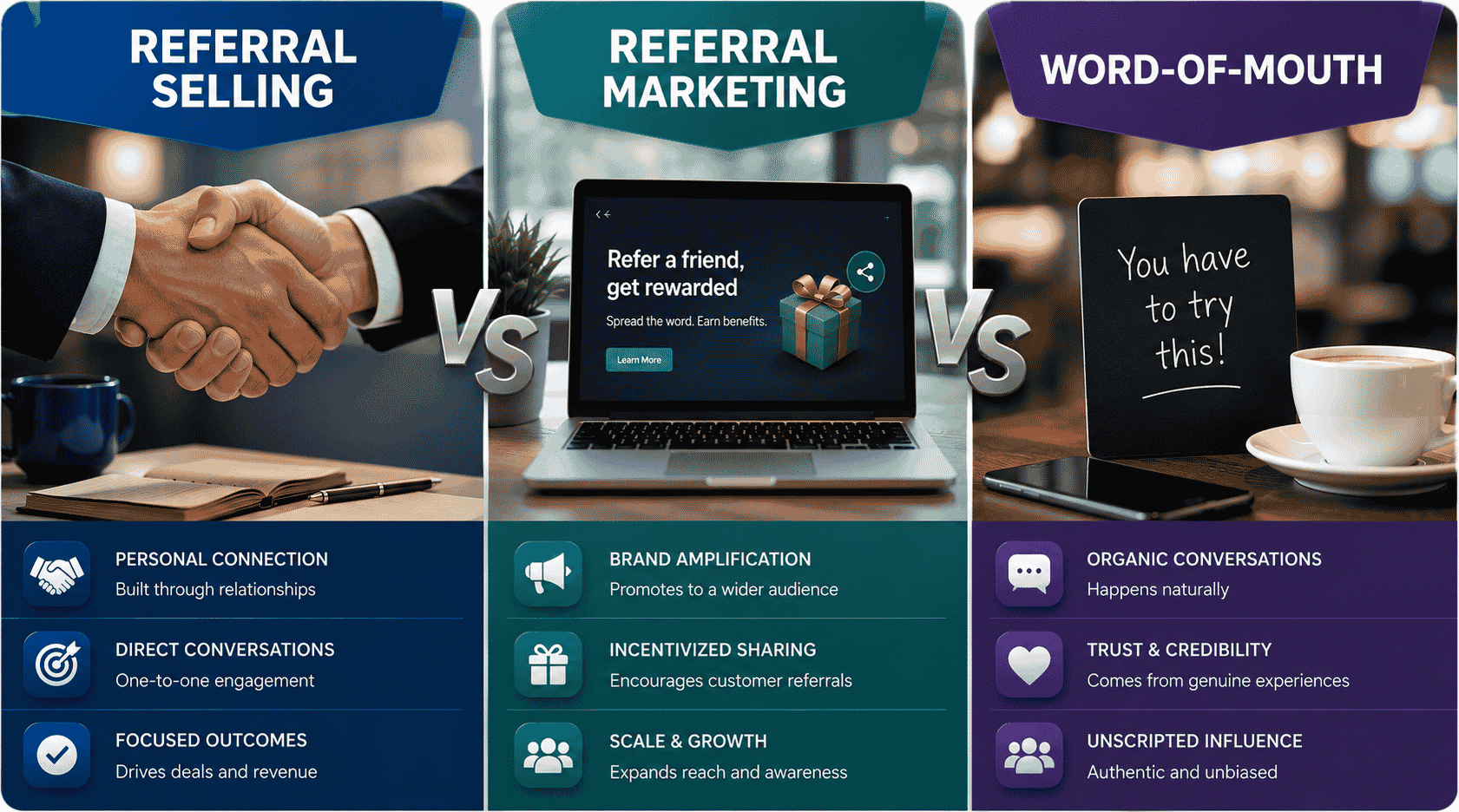
Referral selling, referral marketing, and word-of-mouth are used as if they mean the same thing. They don't, and mixing them up costs you more sales than it should.
The Person Behind The Ask
Referral selling puts a rep in the driver's seat. They pick the current customer, pick the prospect, and make the ask themselves as part of the sales process. Referral marketing hands that job to a program instead of a person. It reaches the entire existing customer base through automated emails or referral links, no rep involved. Word-of-mouth has no one driving it at all. A customer just mentions you, with zero input from your team.
Reach And Scale
This is where the sales tactic you pick either scales or stays personal. Referral marketing casts the widest net, since it's built to hit everyone at once. Referral selling stays narrow on purpose, one rep reaching out to one prospective customer through one real relationship. Word-of-mouth sits somewhere in between and completely outside your control. It might reach one person or twenty, depending on how talkative your customer feels that week.
Tracking And Attribution
Referral selling and referral marketing both leave a paper trail. You know who asked, who got asked, and what happened after, which makes it easy to see how many more referrals came from either one and how they fit into your broader lead management process. Word-of-mouth leaves nothing behind. No record, no attribution, no way to credit the customer who brought you up unless they tell you themselves.
Impact On The Pipeline
Referral selling exists for one purpose: more sales tied to accounts your team is already working. Referral marketing supports customer acquisition at a wider level, filling the top of the funnel instead of closing one specific deal. Word-of-mouth brings an other benefit worth having, brand credibility, but it's not something you can plan a quarter around. For small businesses especially, pairing a simple referral motion with the right small-business CRM choice can make that top-of-funnel much easier to manage.
Knowing where each one fits is why referrals important to your pipeline get the referral approach they actually deserve, not a generic program stretched across all three.
Criteria | Referral Selling | Referral Marketing | Word-of-Mouth |
|---|---|---|---|
Who drives it | Sales rep | Marketing program | Customer, unprompted |
Reach | Narrow, targeted | Wide, automated | Unpredictable |
Trackable | Yes | Yes | No |
Pipeline impact | Direct deal influence | Top-of-funnel growth | Brand trust, no attribution |
Why Sales Reps Avoid Asking For Referrals
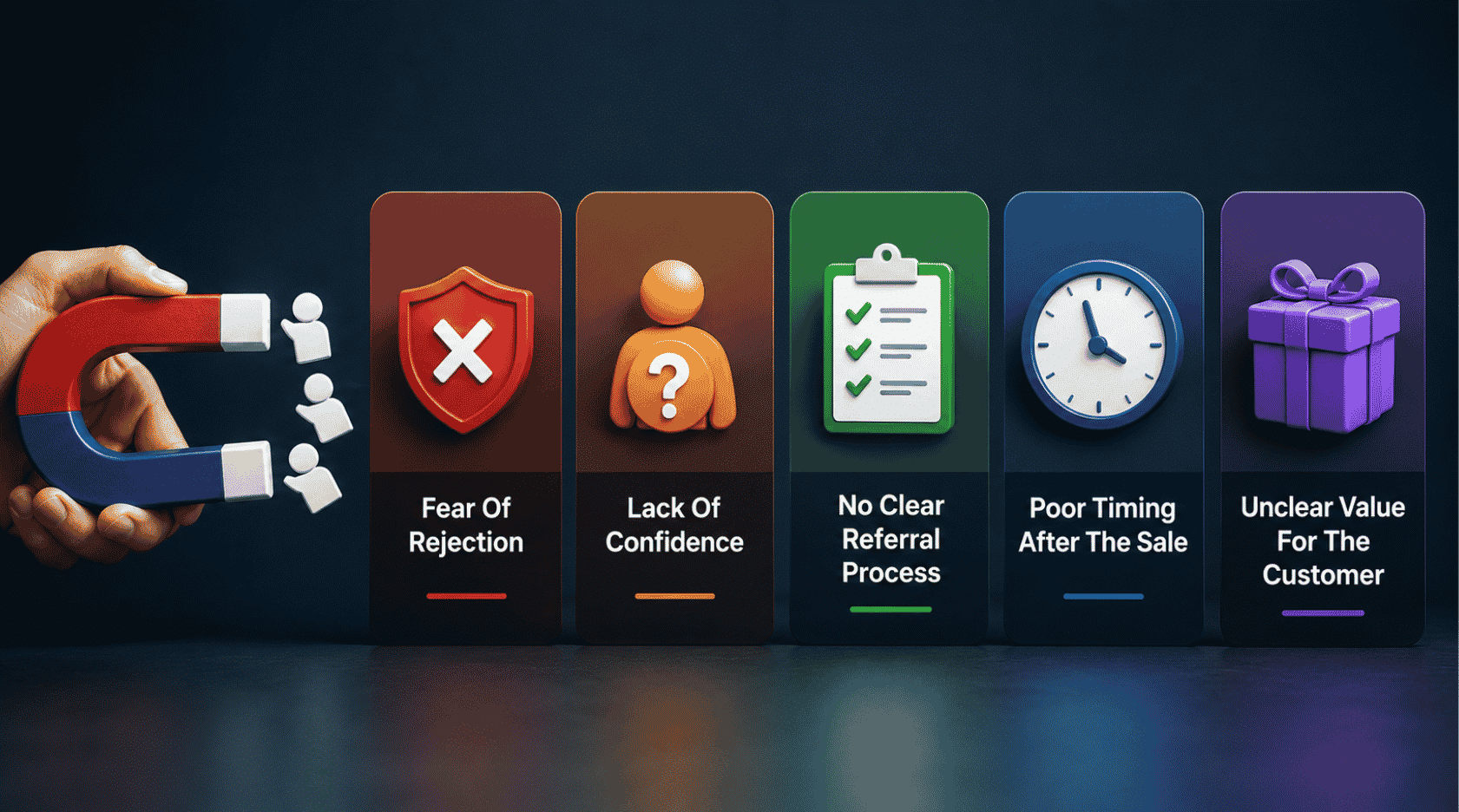
Asking for a referral should feel easier than a cold call, yet most salespeople skip it. The reasons aren't about laziness. They come down to a few real, fixable gaps in how sales teams operate.
Fear Of Rejection
A referral ask puts a rep's ego on the line in a way cold calls don't. Getting turned down by a stranger stings less than a client saying no, since there's an actual relationship at stake. That fear alone stops plenty of good salespeople from ever bringing it up, even when the client would have said yes without hesitation. The irony is that most clients don't experience the ask as a big deal at all, reps just assume they will, and that assumption is enough to keep the conversation from happening.
Lack Of Confidence
Not every rep knows how to phrase the ask without sounding awkward. Without practice, it comes out vague, something like "let me know if you hear of anyone," and vague asks get ignored because there's nothing specific for the customer to act on. Confidence here isn't personality; it's repetition. Reps who ask on a regular basis get better at it fast, sharpening the language until it sounds natural instead of rehearsed. The ones who never start stay stuck at zero, and that gap compounds over time as more confident peers keep closing referral business they never even asked for directly.
No Clear Referral Process
If asking for a referral isn't built into the sales process, it becomes optional. Optional things get forgotten the moment a rep is buried in pipeline work, chasing quota on deals already in motion. Businesses that treat this as a real step, with a clear prompt tied to a specific stage, see it happen consistently across the whole team. Businesses that leave it up to individual memory end up with a handful of reps who ask often and everyone else who barely asks at all.
Poor Timing After The Sale
Timing kills more referral attempts than any other factor on this list. Ask too soon, and the customer hasn't seen real value from your service yet, so the request feels premature. Ask too late, and the moment of excitement has already faded into routine use. The window is narrow, right after a client gets a clear benefit, and most reps either miss it entirely or don't know that the window exists in the first place.
Unclear Value For The Customer
Customers refer people when they understand what's in it for everyone involved, not just for the rep chasing a number. If a salesperson can't explain the benefit clearly, for the client's contact and for the client themselves, the ask feels one-sided and easy to brush off. That hesitation is often less about customers not caring and more about the rep failing to connect the dots.
How The Referral Selling Process Actually Works
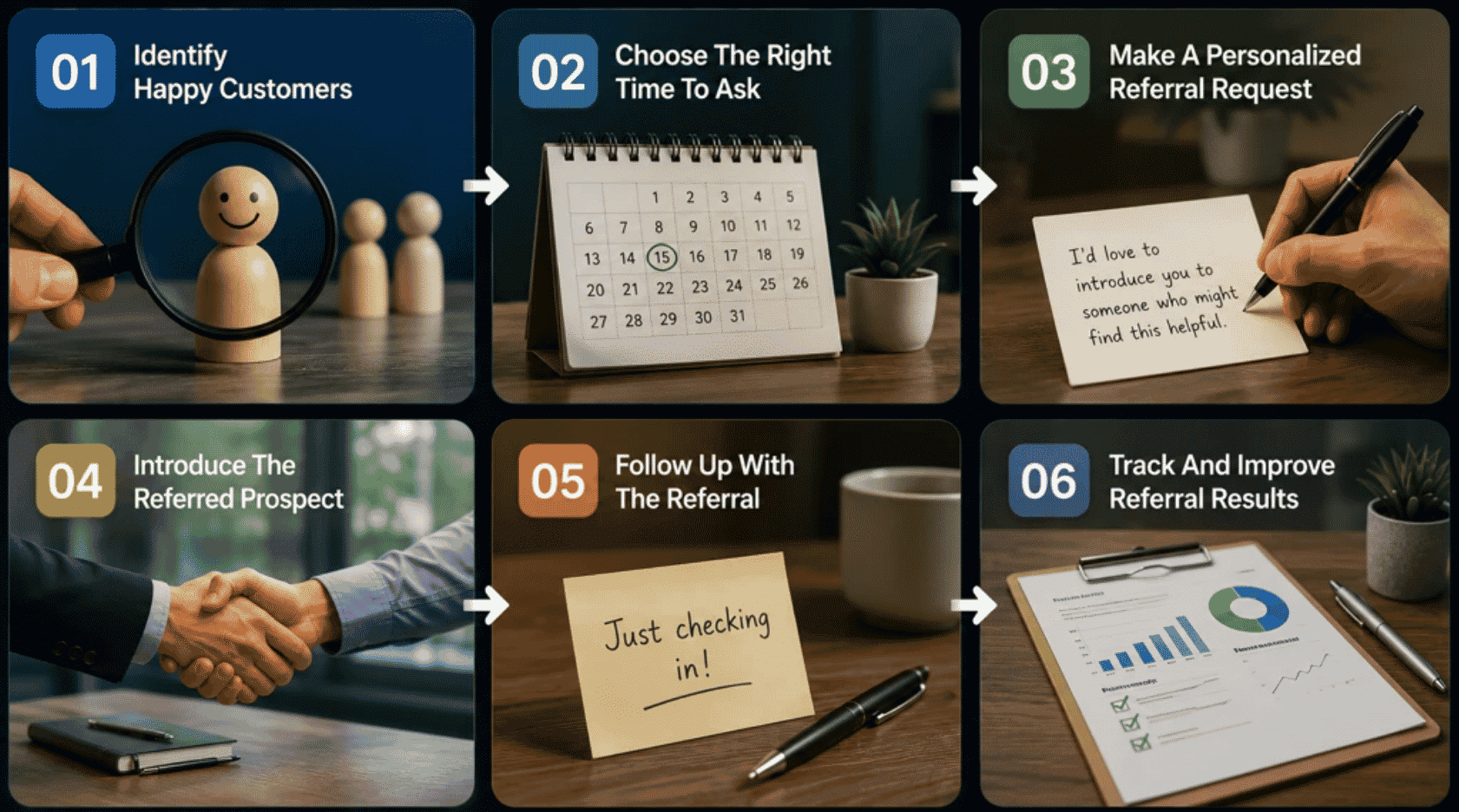
Referral selling doesn't happen by chance. It follows a repeatable process, whether the rep realizes it or not. With a simple CRM for small teams, those steps are easier to run the same way every time. Here's what that process actually looks like, broken into six steps.
Identify Happy Customers
Not every customer is ready to refer. Start with the ones showing real signals: renewed contracts, positive support tickets, or unprompted praise about your company. These people already trust the value they're getting, which makes them the right starting point for the whole process. Reaching out to someone who's lukewarm about your product wastes the ask and risks an awkward conversation neither side wants.
Choose The Right Time To Ask
Timing decides whether the ask lands or falls flat. The best moment usually comes right after a customer hits a milestone or gets a clear result from your service. Wait too long, and the enthusiasm fades into routine. Ask too early, and the person hasn't seen enough value yet to vouch for you. Pay attention to these moments instead of asking on a fixed schedule that ignores where the customer actually stands.
Make A Personalized Referral Request
Generic questions get generic results. Instead of "let me know if you know anyone," name the type of person or company you're looking for, and explain why you thought of them specifically. If incentives or rewards are part of the offer, be upfront about them. Just make sure whatever you're offering matches what's actually allowed in your industry, since some incentive structures can be illegal depending on the field you're selling into. For example, a SaaS referral bonus works fine, but the same structure in an insurance business could break local rules.
Introduce The Referred Prospect
Once the customer agrees, remove as much friction as possible from their side. A short, ready-to-forward email works better than asking them to write one from scratch. Give them a simple form of introduction they can send in under a minute, since the easier you make it, the more likely the referral actually goes through instead of stalling in someone's inbox.
Follow Up With The Referral
Speed matters here. Reach out to the referred prospect quickly and mention the mutual connection early in the conversation. This is one of the key moments in the entire process, since a slow or generic follow-up can undo all the trust the original customer just handed you. Treat the referred lead differently from a cold prospect, because they are different, and they'll notice if you don't.
Track And Improve Referral Results
Log every referral: who gave it, who received it, and what happened next. Over time, this shows which customers refer consistently, which asks convert best, and where the process breaks down. A company that tracks this data can fix weak points fast. One that doesn't end up repeating the same mistakes without ever knowing why referral selling isn't scaling the way it should.
Referral Selling Example: What A Good Ask Sounds Like
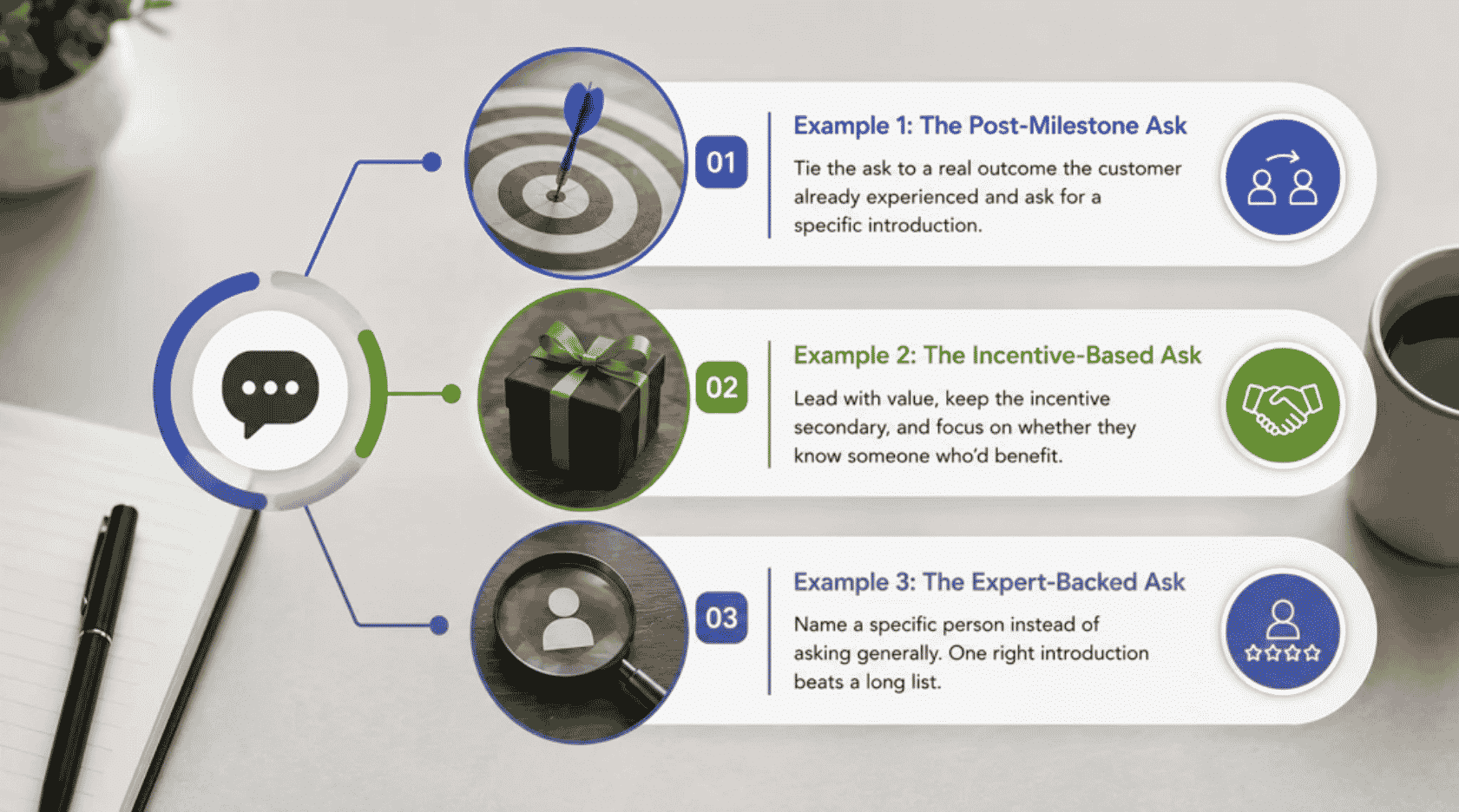
A good referral ask has a direct focus: a specific person, a specific reason, and a clear next step. Here are three examples that show what that looks like in practice.
Example 1: The Post-Milestone Ask
"You mentioned your onboarding time dropped by half since we started working together. I'd love to help another organization hit that same result. Is there anyone on your network you'd feel comfortable introducing me to, maybe someone who's dealt with the same bottleneck you had?"
This works because it's tied to a real outcome the customer already experienced. There's no vague promise attached, just a direct ask based on something the customer already said out loud.
Example 2: The Incentive-Based Ask
"If you refer someone who signs on with us, we'll credit your next invoice. But honestly, I'd rather focus on whether you know someone who'd actually benefit, the credit is just a thank-you, not the reason to refer."
This example leads with value first and incentive second. It keeps the referrer's motivation genuine instead of transactional, which tends to produce stronger, more thoughtful referrals than an ask built entirely around a reward.
Example 3: The Expert-Backed Ask
Sales trainer Joanne Black, known for her work on referral selling, has long argued that the strongest asks name a specific person instead of asking generally. Following that approach, a rep might say: "Is there someone at [Company] you'd trust to make this same decision you did? I'm not looking for a list, just one good introduction."
This mirrors her core principle: specificity beats volume. One well-placed ask to the right referrer outperforms a broad request sent to everyone in a customer's contact list.
Across all three examples, the pattern holds. Name the person you want to reach, connect the ask to something real, and keep any promise of a reward secondary to the actual value being offered. That's what separates an ask that gets a real introduction from one that gets a polite "I'll keep an eye out."
Common Reasons Referral Selling Fails
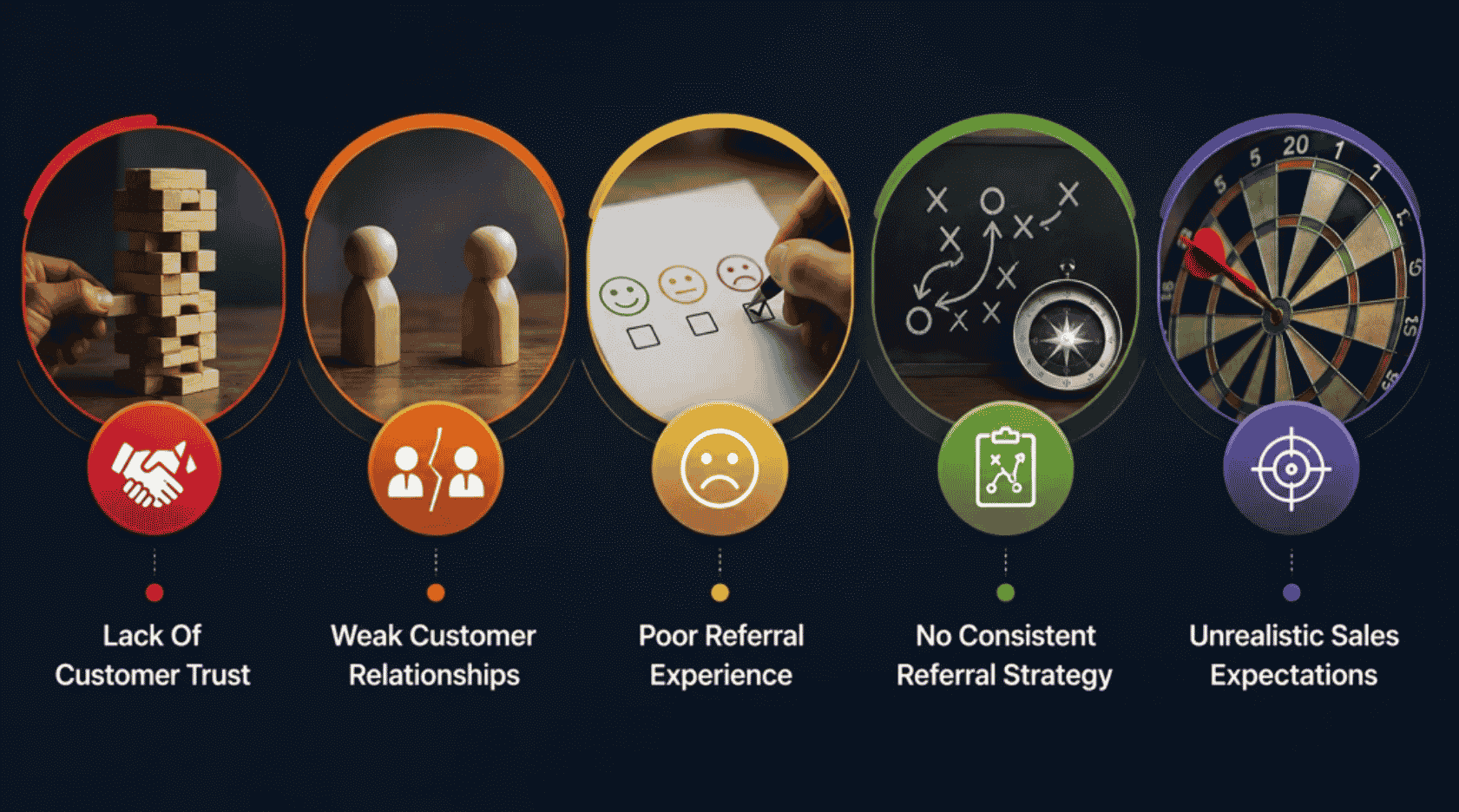
Referral selling looks simple on paper, but plenty of teams run it and still see nothing come from it. Usually, it's one of these five problems working against them, often layered on top of broader lead generation mistakes that weaken the whole funnel.
Lack Of Customer Trust
If a customer isn't fully sold on the value yet, they won't risk their reputation by referring you to a prospect. Trust has to exist before participation makes sense, and no amount of discounts or perks changes that. Rushing the ask before trust is built just wastes the opportunity.
Weak Customer Relationships
Referrals come from relationships, not transactions. If the only contact a customer has with your team happens during renewal calls, there's no foundation to ask for. Reps who invest time outside of pure sales moments end up with customers who actually want to help, not just ones who feel obligated to.
Poor Referral Experience
A referred prospect who gets a slow, generic, or overly pushy follow-up walks away with a bad impression, and that reflects right back on the customer who made the introduction. This is where a lot of programs quietly fail. The cost of a bad referral experience isn't just one lost prospect; it's the referrer deciding never to refer again.
No Consistent Referral Strategy
One-off asks don't build revenue on their own. Without a repeatable sales process built into how the team operates, referral selling turns into something a rep remembers occasionally instead of a real source of pipeline. Marketing and advertising get budgets and consistent execution; referral programs deserve the same structure instead of being treated as a bonus activity.
Unrealistic Sales Expectations
Not every satisfied customer has someone to refer at that exact moment, and treating referral selling like a guaranteed revenue stream sets the whole team up to be disappointed. It works best as one channel among several, not a replacement for the rest of the pipeline. Teams that pay too much attention to referral quotas and not enough to the actual relationship end up chasing a number instead of building something sustainable.
Is Referral Selling Legal? What To Know Before Offering Incentives
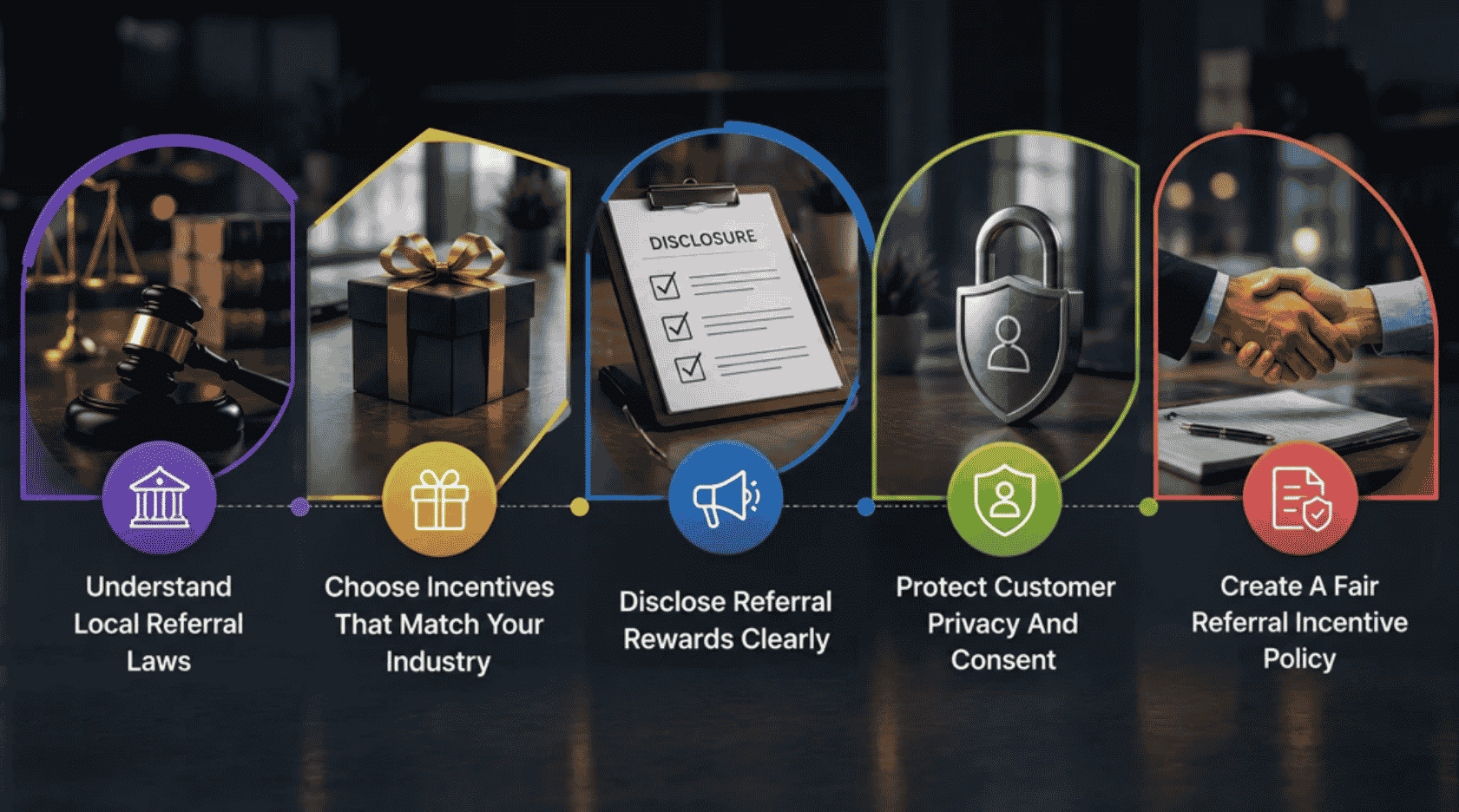
Referral selling itself is completely legal, but the incentives attached to it aren't always so simple. Depending on your industry, certain reward structures can cross into risky territory before you even realize it.
Understand Local Referral Laws
Referral fee rules vary widely depending on where you operate and what you sell. Healthcare, insurance, real estate, and financial services all carry restrictions that a standard SaaS company would never run into. Don't rely on what worked for another business in a different space; check the actual laws that apply to your industry before rolling anything out.
Choose Incentives That Match Your Industry
A cash reward might work fine for a software company, but create real problems in a regulated field. In some cases, a rebate or account credit is a safer alternative to straight cash, since it avoids the appearance of a paid endorsement in industries where that's tightly controlled. The right incentive depends entirely on what your industry actually allows, not what looks most appealing on paper.
Disclose Referral Rewards Clearly
If a customer is being rewarded for referring someone, the consumer on the receiving end should know that upfront. Hiding the incentive, or burying it in fine print, can violate consumer protection rules in several regions. Clear disclosure isn't just a legal safeguard; it also keeps the referral honest instead of feeling like a hidden sales tactic.
Protect Customer Privacy And Consent
Never hand over a customer's contact details to a prospect, or a prospect's information back to the referrer, without clear consent from both sides. Privacy law treats this kind of data sharing seriously, and one careless introduction can turn into a real compliance issue instead of a simple referral.
Create A Fair Referral Incentive Policy
Put the rules in writing before your first referral incentive ever goes out. Define who qualifies, what the reward is, when it gets paid, and what happens if the referred deal never closes. A documented policy protects the success of the program itself, since undefined rules tend to create disputes the moment money or credit is involved.
How To Build A Referral Selling System With A CRM
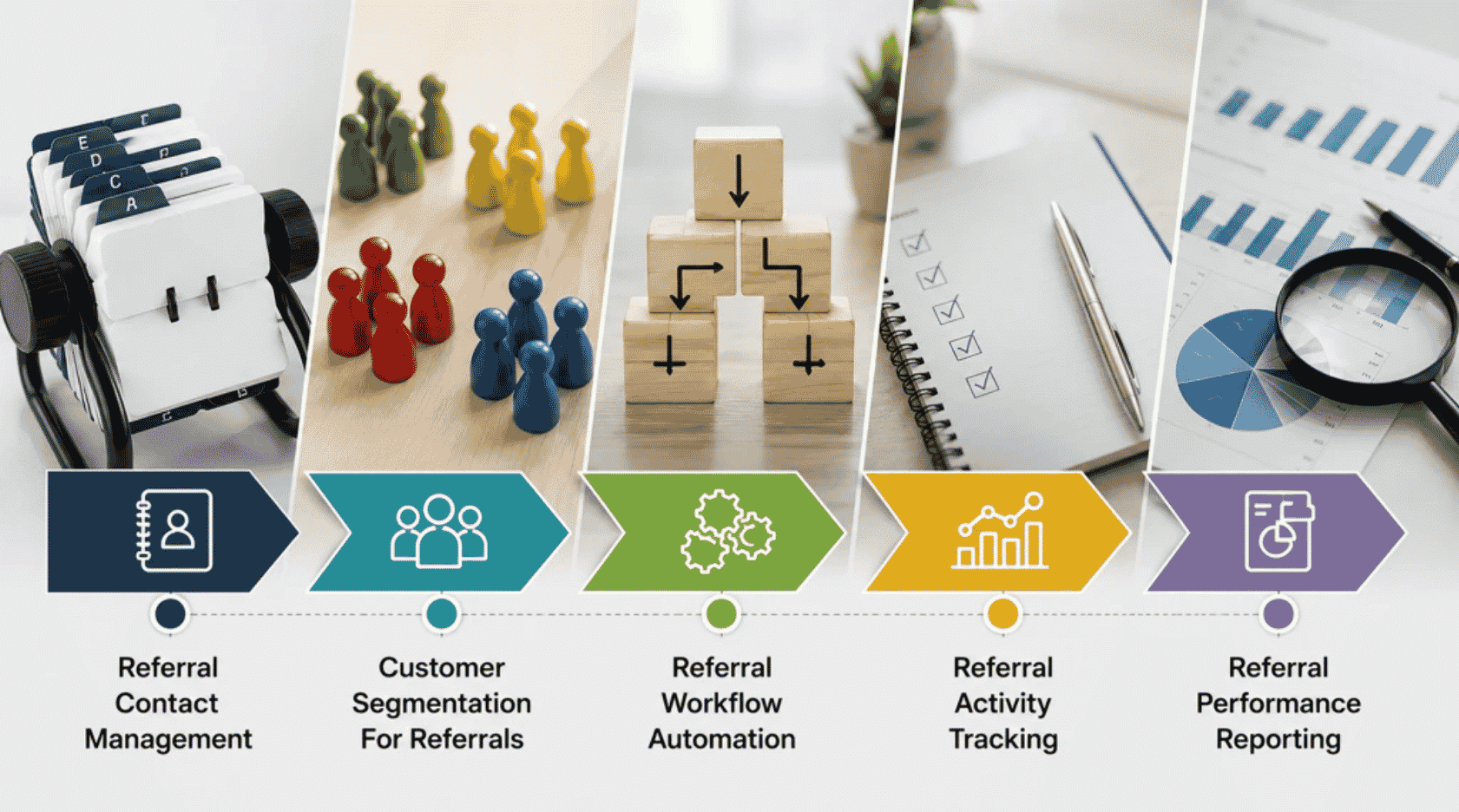
Referral selling only scales when there's a system behind it. A CRM built for modern sales teams turns scattered tasks into a real strategy, one that's easy to run and easy to measure without relying on a handful of reps who happen to be good at it.
Referral Contact Management
Store every referral source, referred contact, and the connection between them in one place instead of scattered across inboxes and sticky notes. This makes it easy to identify who introduced whom and to trace a purchase back to the original referrer without digging through old email threads or relying on someone's memory of how the deal actually started. Over time, this record becomes valuable on its own, since it shows patterns in who tends to bring in strong contacts and who doesn't, which is exactly what contact management CRM tools are designed to surface.
Customer Segmentation For Referrals
Not every customer is equally likely to refer, and treating them all the same wastes effort. Segment your base by satisfaction score, tenure, or product usage to surface the ones most satisfied with what they're getting right now. These are the accounts worth prioritizing, since they're far more likely to say yes than someone still deciding if the purchase was worth the money they spent. CRM-based lead segmentation strategies also help a team expand its referral efforts beyond just the obvious, loudest advocates, surfacing quieter customers who are just as satisfied but have never been asked.
Referral Workflow Automation
Set up triggers that prompt a rep to ask at the right moment, right after a renewal, a strong support interaction, or a usage milestone tied to real value. Sales workflow automation doesn't replace the personal ask; it just makes sure the moment doesn't slip by while a rep is buried in other pipeline work. This is where a referral strategy stops depending on individual memory and starts running as a built-in part of the sales process, consistently, across every account that qualifies.
Referral Activity Tracking
Log every ask, every response, and every outcome tied to each contact in the system. This gives a clear view of who's actually running the process and who's letting it slide, which matters if referral selling is going to expand beyond one or two people who happen to be naturally good at asking. Strong tracking also prevents common sales follow-up mistakes, since it catches poor follow-up before it damages a referred prospect's first impression of the company.
Referral Performance Reporting
Pull reports on referral volume, conversion rate, and deal value broken down by source. This is where the real payoff becomes visible, since it tells leadership whether the time and money spent on the program are actually generating revenue or whether the strategy needs to shift toward a different channel, much like broader sales pipeline CRM reporting does for the rest of your deals. Performance reporting also helps justify future investment in the program, turning referral selling from a nice-to-have into a measurable part of how the business grows.
How To Measure If Your Referral Selling Is Working
A referral program that isn't measured is just a guess dressed up as a strategy. A few numbers tell you the real story.
- Referral rate: What percentage of satisfied customers actually give a referral when asked. Low numbers here usually point back to timing or how the ask is phrased, not a lack of happy customers.
- Referral-to-opportunity conversion: How many referrals turn into an actual sales conversation. This shows whether the introductions coming in are qualified or just names on a list, and should be tracked alongside how you move deals from lead to close.
- Win rate on referred deals: Compare this against your overall win rate. Referred deals should close more often, since they start with built-in trust a cold prospect never has and should show up clearly in your overall sales pipeline performance.
- Average deal size: Referred customers sometimes spend more, since they come in already trusting the recommendation of someone they know, which has a direct impact on the ROI of your broader B2B lead generation strategy.
- Time-to-close: Referred deals typically move faster through the pipeline than deals sourced any other way, especially when they're managed in structured lead management software.
If referred business consistently beats your baseline across these numbers, the program is working and worth scaling. If it doesn't, the process needs fixing before the budget grows.
Final Discussions
Referral selling isn't complicated, but it does require intention. It works because it borrows trust that already exists instead of building it from a cold start every time. The teams that get real results treat it as a habit tied to specific moments, a renewal, a milestone, a genuine compliment, not something they remember to do once a quarter.
Building it into a CRM, tracking outcomes, and being upfront about incentives turns referral selling from an occasional bonus into a dependable part of the pipeline. Using a CRM that’s built to help sales teams manage leads effectively makes this even easier. It won't replace the rest of your sales process, and it isn't meant to. But for the deals it does bring in, they tend to close faster, close bigger, and cost far less to win than anything sourced cold.
FAQs
What Makes A Referral Request More Effective Than A Cold Outreach Message?
A referral opens with borrowed trust from someone the prospect already knows. That context changes how the first conversation feels, since the prospect isn't starting from skepticism. A cold message has to earn that trust from zero, which usually takes longer and gets ignored more often before it ever gets a real reply.
How Many Referrals Should A Sales Rep Realistically Expect Per Customer?
There's no fixed number, since it depends on the customer's network, how satisfied they are, and how specific the ask is. A vague request to a large customer base might produce almost nothing, while a specific ask to the right person can produce one strong introduction that outperforms a dozen weak ones.
Should Referral Selling Be Tied To A Sales Rep's Quota?
Some teams tie it directly to targets; others treat it as a supporting activity outside quota pressure. Tying it too tightly can push reps to ask at the wrong moments just to hit a number, which tends to backfire with customers who notice the shift in tone. Whichever route you choose, make sure your B2B sales CRM setup can track referral-sourced deals separately so you can see whether the incentive structure is actually working.
What Happens If A Referred Prospect Doesn't Convert?
This varies by company policy. Some track it anyway for future opportunities, since a prospect who isn't ready today might be ready later. Others treat a non-conversion as closed and move on, without following up again unless the original customer reopens the door themselves. In both cases, thoughtful CRM follow-up automation can keep the door warm without overwhelming the prospect.
Can Referral Selling Work In Industries With Long Sales Cycles?
It can, though the ask and follow-up timeline usually need to stretch to match the cycle. A referral in a long-cycle industry might take months to convert, which means tracking and patience matter more than speed here compared to faster-moving markets, and well-designed sales automation software becomes key to staying consistently in touch.