Only 54% of sales reps spend most of their day on real selling, and 84% miss their sales quota. Sales activity metrics expose why many sales teams struggle. Tracking different sales metrics without focusing on the right sales metrics creates gaps in the sales pipeline and weakens overall sales performance.
Sales leaders must align activity metrics such as the number of calls made, lead response time, and qualified leads with sales pipeline metrics like win rate, average deal size, and conversion rate. Clear sales performance metrics help sales managers measure sales performance, improve sales productivity, and reduce average sales cycle length.
Accurate sales data, supported by customer relationship management and sales analytics software, connects customer acquisition cost, customer lifetime value CLV, recurring revenue, and churn rate. Strong sales KPIs turn data points into predictable sales growth.
What Are Sales Activity Metrics?
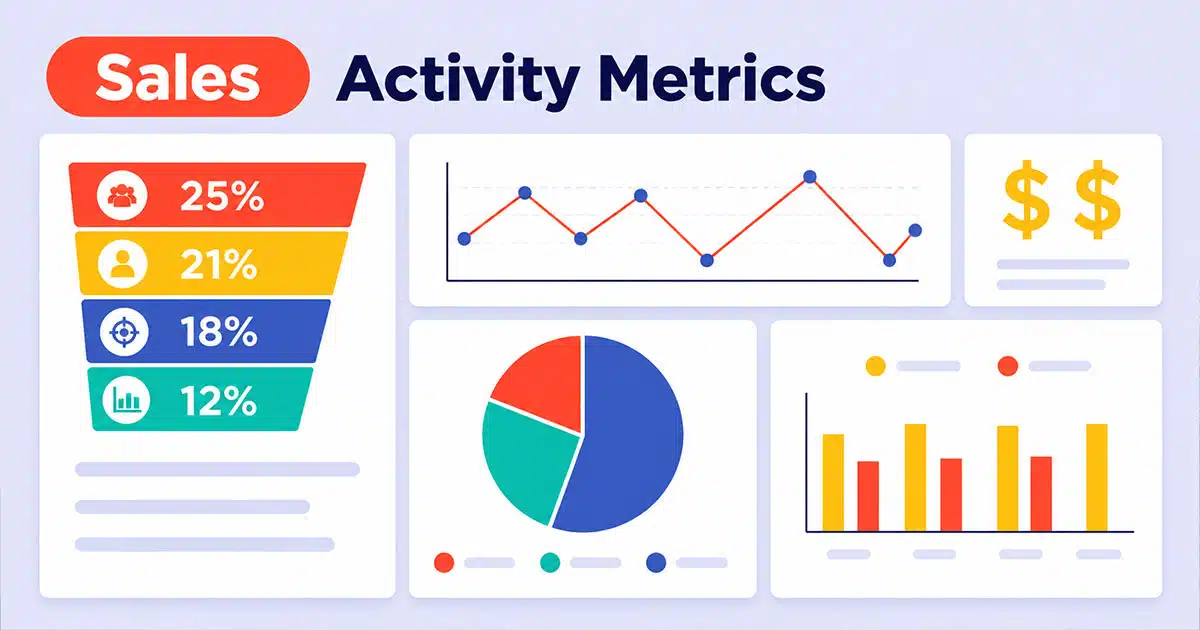
Sales activity metrics are measurable data points that track the specific actions sales reps take throughout the sales process. Every sales call, email, meeting, demo, and follow-up contributes to the health of your sales pipeline. Unlike lagging indicators such as sales revenue or win rate, activity metrics act as leading indicators that show how daily sales efforts influence future sales performance.
Clear sales activity metrics help sales leaders measure sales performance before outcomes appear. When sales managers monitor number of calls made, qualified leads, conversion rate, and average sales cycle length, they gain visibility into overall sales performance. Modern customer relationship management systems and sales analytics software capture accurate sales data, connecting activity metrics to sales KPIs like recurring revenue, customer acquisition cost, and customer lifetime value CLV.
Why Sales Activity Metrics Are Important For Performance
Sales activity metrics shape how a sales organization predicts revenue and improves execution. Sales leaders who rely on accurate sales data gain control over the scalable sales process. Clear activity metrics connect daily sales efforts to measurable sales performance and long-term sales growth.
Predict Future Sales Performance
Sales activity metrics act as leading indicators. They show what will happen before lagging indicators such as sales revenue and win rate appear. High-performing sales teams use sales performance metrics 3.5 times more often than low performers.
Predictive sales analytics powered by sales analytics software reduce forecast errors by 20–50%. Accurate sales forecasting method helps sales managers align sales goals with pipeline capacity. Reliable activity data improves overall sales performance and supports better sales strategy decisions.
Strengthen Sales Pipeline Visibility
Strong sales pipeline metrics create clarity across the sales funnel. When sales reps track number of calls made, qualified leads, and conversion rate, sales pipeline gaps become visible early. A two-week drop in activity often signals future revenue decline.
Organizations that monitor activity metrics identify risks up to 60 days earlier. Sales leaders can redirect sales efforts toward high-intent prospects. Better sales visibility improves win rate and protects recurring revenue.
Improve Forecast Accuracy
Traditional forecasting fails many sales organizations. Less than 25% of executives trust their forecast accuracy. Sales activity metrics solve that problem by linking sales cycle data to outcomes.
When sales data shows that 50 calls create 10 meetings and 3 proposals close 1 deal, sales managers can calculate required activity levels. Accurate ratios shorten average sales cycle length and improve confidence in annual recurring revenue ARR and monthly recurring revenue targets.
Drive Accountability Across Teams
Clear sales KPIs create accountability. Sales reps understand daily expectations tied to sales quota and sales targets. Measurable activity metrics reduce ambiguity inside the sales organization.
Objective dashboards replace opinion-based feedback. A sales manager can reference conversion rate, follow-up time, or average sales cycle instead of vague criticism. Data-backed coaching strengthens sales productivity and builds trust across sales and marketing teams.
Optimize Sales Productivity
Sales productivity improves when teams focus on the right sales performance metrics. Tracking activity metrics highlights wasted effort and low-impact sales tactics. High performers prioritize actions that influence average deal size and number of deals.
Companies that optimize activity metrics report 28% higher win rates. Clear visibility into sales cycle length and lead response time increases efficiency. Better execution supports stronger sales growth and higher average revenue per sales representative.
Connect Activity To Revenue Outcomes
Sales activity metrics connect directly to financial results. Activity data influences customer acquisition cost, customer lifetime value CLV, and net revenue retention. Strong execution increases customer retention and strengthens existing customer relationships.
When sales teams align activity metrics with annual recurring revenue and recurring revenue goals, revenue predictability improves. Clear links between daily actions and sales revenue create a scalable business model built on measurable performance.
Core Sales Activity Metrics To Track
Your sales organization needs specific metrics to measure daily performance. These core sales activity metrics give you visibility into rep behavior and pipeline health.
Number Of Calls Made
Call volume remains one of the most fundamental sales productivity metrics. It measures total outbound calls that reps initiate over a given period to involve prospects, follow up, or advance open opportunities.
This metric shows prospecting effort level. Sales teams must make enough calls to generate leads and move prospects through the sales pipeline. Sales managers can assess whether reps put in the work to be done when they track the number of calls made.
Weekly measures for calls made range from 80 to 120 for SDRs and AEs. A high volume of calls can show that sales reps pursue prospects with energy. Contact volume helps you understand your sales reps' current capacity and set weekly goals.
The quality of these calls matters just as much as quantity. Choose a weekly contact goal for your team based on the average contact volumes in past successful weeks. The goal set too high pressures reps, and conversation quality drops.
Number Of Emails Sent
Email volume tracks the count of emails that reps send in a given period. This metric shows the volume and consistency of communication efforts with prospects.
The number of emails sent shows the level of proactive involvement by sales teams and highlights how well their outreach strategies work in starting contact and keeping communication channels open. Weekly email measures range from 100 to 150 for SDRs and AEs.
Sales teams can track daily or weekly activities using CRM tools or sales task automation software to measure and optimize this metric. Trends in email volumes help identify peak times for involvement and optimize outreach schedules so. Response rates from these communications help you learn about the quality and relevance of messaging.
Number Of Meetings Scheduled
Meetings scheduled measures the count of meetings booked in a given period. This metric represents the number of qualified meetings or demos booked with prospects.
Meetings booked bridge the gap between initial outreach and serious sales conversations. Each meeting brings sales reps closer to a closed deal and represents opportunities to showcase your product, address customer pain points, and move deals forward.
Weekly measures for first meetings booked range from 8 to 12 for SDRs. Getting leads to schedule a meeting is the hardest part of inbound sales for 69% of revenue teams. This metric signals early buyer involvement and shows traction that can move into active pipeline.
Number Of Follow-Ups Completed
Follow-up rates measure the persistence and effectiveness of sales reps in continuing conversations with prospects after initial contact. This metric tracks the count of follow-up interactions in a given period.
Weekly measures for follow-ups completed range from 15 to 25 for account executives. Follow-up rates show the responsiveness of sales efforts and their effect on building relationships and trust with potential customers.
Research shows that 80% of sales require 5 follow-up calls after the meeting, but 44% of salespeople give up after 1 call. The average sales rep makes only 2 attempts to reach a prospect. Sales teams can track the frequency and timeliness of follow-up interactions to measure effectiveness.
Social Media Interactions And Outreach
Social media interactions measure the number of meaningful interactions with prospects on social platforms. This metric builds relationships and credibility before formal sales conversations, since modern buyers research vendors online.
Engagement metrics show how people interact with your content and include likes, comments, shares, direct messages, mentions, and profile visits. More involved customers can affect overall profitability, as they are more likely to buy, become loyal customers, and share their experiences.
Research shows that 76% of consumers will contact brands they follow on social media for customer care. Social media interactions provide valuable tools to prove how effective your strategy is and how it can affect your overall business.
Sales Demos And Presentations Delivered
Sales demos measure sales-led product demonstrations delivered live or asynchronously to qualified buyers in active deals. This metric shows buyer intent signals and displays progress in converting interest into commitment.
Your sales demo can mean the difference between closing a major deal and losing out to the competition. No-show prospects are a top challenge to moving deals forward for 36% of revenue team members surveyed. Successful reps spend 12.7% more time on demo calls discussing next steps.
Demos conducted help you understand conversion patterns and optimize your sales process for better outcomes when you track them.
How To Connect Activity Metrics To Sales Outcomes
Sales activity metrics gain real value when they connect to measurable sales outcomes. Clear ratios between sales activity management and revenue help sales leaders predict results with confidence. Strong alignment between daily actions and sales revenue strengthens the entire sales process.
Define Activity To Revenue Ratios
Sales activity metrics must connect to closed deals and sales revenue. Clear activity-to-outcome ratios show how effort converts into results. A simple pattern may reveal that 50 calls create 10 meetings, 3 proposals, and 1 closed deal.
Such ratios transform sales data into direction. Sales managers can reverse engineer sales goals based on average deal size and win rate. Predictable ratios improve sales forecasting and support stable annual recurring revenue ARR and monthly recurring revenue targets.
Calculate Conversion Rates At Each Stage
Sales conversion rate measures how well the sales process turns leads into paying customers. The basic formula remains simple: number of sales divided by number of leads multiplied by 100. A 27% conversion rate means 27 closed deals from 100 leads.
Sales pipeline metrics should track MQL to SQL, SQL to opportunity, and close-won rates. Stage-level sales performance metrics highlight weaknesses. Better conversion rate control improves overall sales performance and reduces average sales cycle length.
Align Sales And Marketing Metrics
Sales and marketing teams share responsibility for qualified leads. Poor alignment inflates customer acquisition cost and lowers win rate. Strong sales collaboration CRM improves lead quality and protects sales productivity.
Shared sales KPIs such as qualified leads, conversion rate, and customer lifetime value CLV create accountability. High-quality leads produce stronger customer retention and higher net revenue retention. Alignment supports a scalable business model driven by reliable sales metrics.
Use Activity Data For Forecast Accuracy
Activity-based sales forecasting relies on leading indicators instead of lagging indicators. If one deal closes for every 3 proposals, and each proposal requires 4 meetings, clear sales activity targets emerge.
Accurate sales data improves forecast precision by up to 20–50% when supported by sales analytics software. Better forecasting protects sales targets and strengthens sales strategy. Reliable projections increase confidence in recurring revenue and average revenue growth.
Segment Metrics For Deeper Insight
Different sales metrics behave differently across industries and territories. Sales leaders must segment sales pipeline metrics by channel, geography, and campaign source. Granular analysis reveals which data points drive higher conversion rate and average revenue per deal.
Weekly, monthly, and quarterly comparisons highlight trends in sales cycle length and sales productivity metrics. Segmentation sharpens sales operations decisions and strengthens overall sales performance.
Leverage CRM And Predictive Analytics
Modern customer relationship management systems capture detailed sales activity automatically. AI-powered sales analytics software evaluates historical sales data and predicts deal outcomes with up to 90% accuracy in advanced models.
Companies that automate activity tracking report 14.5% higher sales productivity. CRM scoring combined with activity metrics identifies deals at risk and opportunities with strong buyer intent. Data-driven insights improve sales efforts and increase number of deals closed.
Optimize Effort Based On Data
Not all sales activity creates equal value. High call volume without qualified leads rarely improves sales revenue. Sales managers must focus on the right sales metrics that connect to revenue impact.
Precise measurement shows which sales tactics increase win rate and shorten average sales cycle. Data-backed adjustments improve sales growth and maximize average profit margin. Strong activity-to-outcome alignment transforms raw activity metrics into measurable business results.
What Breaks Down Without Activity Visibility
Teams without real activity visibility run into the same five problems, usually in this order. Managers lose insight into what's actually happening with customers between deal stages, since activity only gets logged when someone remembers to do it. Sales workflows drift out of alignment because reps build their own informal habits instead of following a shared process. Nobody can say with confidence where a given deal actually stands, which makes forecasting a guess rather than a calculation. Relationship context gets lost when a rep leaves or a deal changes hands. Decisions on stalled deals get delayed because there's no clear signal that a deal has gone quiet until it's too late to save.
Common Mistakes When Tracking Sales Team Metrics
Most sales organizations make the same tracking errors over and over. These mistakes waste rep time, damage morale and fail to improve sales performance.
Focusing On Volume Over Quality
Connect rates collapsed from 8-10% just a few years ago to as low as 2-4% today. Email deliverability plummeted. LinkedIn started throttling volume to curb automation abuse. Every company uses parallel dialers now. One company had this advantage once, and it worked. Everyone does it now, and it creates noise.
About 80% of your market doesn't answer cold calls. Not because they're busy. They just don't pick up unknown numbers. That's their behavior.
Volume killed quality. Your rep has 40 more calls to make today, so they're not doing deep discovery. They rush. Buyers feel it and disengage. The sales process optimized for "reps are busy" when it should optimize for "reps are effective".
Rep A makes 80 calls a day and needs 300 touches to book a meeting. Rep B makes 40 calls a day and needs 75 touches to book a meeting. Rep A looks more productive in sales activity metrics. But Rep B is more effective. Measure efficiency, not just volume.
Ignoring Activity Outcomes
Stop measuring effort. Start measuring results. Ask how many real conversations we had. Not touches. Not connects. Conversations.
You're having 50 conversations and booking two meetings? You don't have an activity problem. You have a targeting problem, a messaging problem or a qualification problem. This metric shows you if you're talking to the right people about the right things.
Activity metrics can be deceptive when used as the only performance indicator. Sales reps may seem productive by completing 100 calls a day, but the effort isn't profitable if they don't lead to conversions or meaningful conversations.
Measuring Activities That Don't Get Results
70% of rep time goes to activities with 2% conversion rates? That's not a training issue. That's a structural problem with how you've built the system.
Sales leaders miss key elements like the quality of interactions with prospects, the approach to closing deals or the long-term value of customer relationships when they concentrate only on the quantity of activities.
Creating Unrealistic Activity Quotas
A staggering 67% of sales reps fail to hit their quota. Meanwhile, 76% of sales leaders say their quotas are unrealistic.
You cannot ask people to change while paying them for the old behavior. Your comp plan rewards call volume? You'll get call volume, even if it destroys conversion rates. Change compensation toward conversations, meeting conversions and pipeline quality.
High turnover follows unrealistic quotas. 43% of sales reps say excessive pressure to meet unattainable quotas is why they leave their job.
How To Measure And Track Sales Performance Metrics
Effective measurement starts with the right technology stack. Your CRM and sales analytics software determine whether tracking sales performance becomes automated or remains a manual burden.
Choosing The Right Sales Analytics Tools
A CRM uses customer and sales performance data to gage progress toward sales KPIs. Automation and AI-powered CRMs pull data into customized dashboards without manual lift. This capability saves time and improves accuracy.
Sales analytics tools transform raw sales data into applicable information. Traditional CRMs mainly track customer interactions. Sales analytics software goes deeper and pulls data from multiple sources. These tools integrate data from your CRM, marketing automation systems, social media and customer support platforms.
Focus on key features that eliminate administrative friction when selecting sales tracking software. Look for lead tracking to monitor potential customers and manage follow-ups. Sales forecasting predicts future sales based on historical data. Sales automation handles repetitive tasks like data entry and follow-ups. Customizable dashboards allow users to tailor data views to match specific needs.
Integration capabilities matter. Your sales tools should connect easily with existing systems without requiring extensive custom development. Choose platforms with accessible user interfaces that minimize training needs.
Setting Up Sales Dashboards For Activity Tracking
Different roles require different dashboard views. Sales leaders need a home dashboard that provides an overview of year-to-date performance by target KPIs. This includes notable open and closed deals, top sales reps by quota attainment and overall sales performance versus forecast.
Sales managers need pipeline dashboards that show each rep's pipeline with average sales cycles, average deal amounts and conversion rates. Team activities dashboards display total, completed and overdue tasks along with call and email logs. Thus, it's very important to email sync.
Sales operations teams benefit from performance dashboards that drill into closed deals by region, account or product. Stage analysis dashboards show how deals across all reps move through the sales process and reveal bottlenecks and at-risk opportunities.
Sales reps need leaderboard dashboards with individual and team performance data. This includes sales quotas attainment, leads in pipe, closed deals and average sales cycle time.
Establishing Baseline Activity Standards
Baseline KPIs serve as standards to evaluate sales performance. These metrics provide a clear standard for comparison and allow you to measure campaign impact.
Start by gathering existing data on performance levels. Review historical sales data to understand past performance. Use collected data to establish a standard for future activities. This standard acts as the starting line toward your sales goals.
Calculate baseline sales by analyzing data from a period before significant activity and determining the average. Understanding baseline sales helps fine-tune strategies to maximize impact.
Creating Consistent Data Collection Processes
Data without ownership becomes unreliable. Every metric needs a dedicated steward who takes responsibility for accuracy, relevance and timely updates. Data stewards bridge the gap between technical requirements and business understanding.
Standardization begins with documentation that leaves no room for interpretation. Every metric needs a detailed definition that specifies calculation methods, data sources and inclusion criteria.
Automate data collection wherever possible. Dashboards stay current when metrics update automatically. Reports stay accurate, and teams spend time analyzing results instead of chasing spreadsheets. Automated data collection handles the heavy lifting for structured, repeatable metrics such as sales transactions and customer satisfaction scores.
How To Build A Performance-Focused Sales Engine With Activity Data
Activity data becomes powerful when you connect it to revenue outcomes. Your sales engine improves when metrics guide specific behaviors that close deals.
Arranging Activities With Revenue Goals
Your compensation plan shapes sales culture more than any workshop. Reward the right behaviors and your sales team will execute them. Organizations tracking coaching metrics see 28% higher win rates than those that don't. Arrange individual sales activity with team momentum and company performance. Sales reps understand how their actions connect to revenue targets and execution improves. Sales managers must explain what they want from their sales team rather than leaving direction unclear.
Employing Activity Metrics For Sales Coaching
Focus coaching on no more than 2-3 improvement areas at once. Set specific, measurable goals for each area with clear timelines. Provide check-ins and time management coaching for activity metric issues. Compare pre-coaching and post-coaching sales performance metrics to calculate ROI on coaching time. Match interventions to specific deficiencies your sales data reveals.
Optimizing Sales Productivity Based On Data
Using standards uncovers which activities, average duration and cadence separate high and low performers. The type of activities your sales reps do and when they do them guides to success or failure. Then coach reps to ensure they execute the right activities at the right time with proper cadence.
Setting Activity Standards By Role And Experience Level
Each rep should achieve standard activity targets. Determine these standards using your company sales data to show which activities guide closed business. Sales agents spending at least 3 hours on sales-related activities report higher job satisfaction.
How To Turn Activity Metrics Into Actionable Insights
Sales activity metrics only matter when they shape better decisions. Clear analysis converts raw sales data into focused sales strategy adjustments. Strong sales leaders use activity metrics to improve sales performance, increase win rate, and accelerate sales growth.
Study Top Performer Behavior
Top sales reps leave patterns in the data. Yet 45% of sales leaders lack clear insight into what drives their best results. Sales activity metrics reveal those differences.
Deals with at least one executive-level conversation close three times more often. Proposals sent within 48 hours of a discovery call show higher conversion rate. Multiple stakeholder demos shorten average sales cycle length by up to 40%. Such sales performance metrics highlight behaviors that improve sales revenue.
Spot Sales Pipeline Bottlenecks
Sales pipeline metrics expose where deals slow down. Low meeting-to-proposal conversion rate often signals weak discovery. Long follow-up gaps increase churn rate risk.
Sales managers should track sales activity at every sales funnel stage. Data points such as qualified leads, number of deals, and sales cycle length reveal friction. Early detection protects overall sales performance and recurring revenue.
Use Leading Indicators Weekly
Leading indicators guide action before lagging indicators show failure. High-performing sales teams review activity metrics weekly. Quarterly reviews delay correction.
Weekly analysis of number of calls made, demos delivered, and proposals sent sharpens sales forecasting. Faster adjustments protect sales targets and improve average revenue per sales representative. Frequent review strengthens accountability across the sales organization.
Segment Data For Precision
Different sales metrics behave differently across territories and products. Sales leaders must segment sales data by geography, industry, and customer segment. Granular views uncover hidden opportunities.
Segmented analysis improves customer acquisition cost control and increases customer lifetime value CLV. Clear segmentation also strengthens net revenue retention and customer retention across existing customers.
Align Strategy With Data Insights
Sales strategy must reflect real activity metrics. If conversion rate drops in one region, messaging or targeting may require change. Data-driven decisions outperform intuition.
Sales managers should align sales goals with proven activity patterns. Adjusting outreach frequency, sales tactics, or lead qualification criteria improves sales productivity. Strong alignment between sales efforts and data increases sales growth.
Improve Coaching With Metrics
Objective sales performance metrics improve coaching quality. Instead of general feedback, sales managers can reference specific activity data. Clear benchmarks create fair evaluation.
If a sales representative shows lower win rate but strong activity levels, coaching may focus on closing skills. If activity metrics fall short, daily execution needs improvement. Measurable insights strengthen sales KPIs and raise overall sales performance.
Optimize Revenue Impact
Actionable insights must connect to revenue outcomes. Activity metrics influence annual recurring revenue ARR, monthly recurring revenue, and average deal size. Data-backed adjustments increase average profit margin.
Companies that act on structured sales analytics report up to 28% higher win rates. Clear links between activity metrics and sales revenue create predictable growth. Sales operations teams gain confidence in forecasts and long-term business model stability.
How Gain.io Strengthens Sales Activity Metrics And Performance
Gain.io connects sales activity metrics directly to revenue outcomes through unified sales analytics and structured performance tracking. The platform centralizes sales data from customer relationship management systems, sales tools, and marketing channels into one clear dashboard. Sales leaders gain real-time visibility into sales pipeline metrics, conversion rate, win rate, and sales cycle length without manual reporting.
Automated activity tracking captures number of calls made, meetings scheduled, proposals sent, and qualified leads. Gain.io aligns these activity metrics with sales KPIs such as annual recurring revenue ARR, monthly recurring revenue, customer acquisition cost, and customer lifetime value CLV. Sales managers can measure sales performance through both leading indicators and lagging indicators in one view.
Predictive insights help sales teams adjust sales strategy before revenue drops. Clear accountability improves sales productivity and strengthens overall sales performance. Gain.io turns raw sales activity into measurable sales growth. You can enjoy Gain.io at a suitable price.
FAQs
Do Sales Activity Metrics Improve Sales Forecast Accuracy?
Yes. Sales activity metrics act as leading indicators that strengthen sales forecasting accuracy. When sales leaders connect activity metrics with sales pipeline metrics and conversion rate data, forecast errors can drop by 20–50%.
Can Small Sales Teams Benefit From Tracking Sales Metrics?
Yes. Even small sales teams gain visibility into sales performance through structured sales KPIs. Clear tracking improves sales productivity, win rate, and average sales cycle length without requiring a large sales organization.
Are Sales Activity Metrics Useful For B2B And SaaS Business Models?
Yes. B2B and SaaS companies rely on recurring revenue, annual recurring revenue ARR, and customer lifetime value CLV. Sales activity metrics help protect customer retention and improve net revenue retention across existing customers.
Should Sales Activity Metrics Be Tied To Compensation Plans?
Yes. Compensation aligned with the right sales metrics encourages behaviors that support sales goals. When incentives reward conversion rate, qualified leads, and pipeline quality, overall sales performance improves.
What Role Do Sales Operations Play In Tracking Sales Data?
Sales operations ensure accurate sales data collection and dashboard reporting. Clear governance over sales analytics software and customer relationship management systems improves data reliability and performance visibility.
How Often Should Sales Leaders Review Activity Metrics?
Sales leaders should review activity metrics weekly to monitor leading indicators. Frequent reviews allow faster adjustments to sales strategy and protect sales targets before lagging indicators show decline.
Which Sales KPIs Complement Sales Activity Metrics?
Important sales metrics such as win rate, average deal size, customer acquisition cost, churn rate, and customer lifetime value CLV complement activity metrics. Together, they provide a complete view of overall sales performance and sales growth.