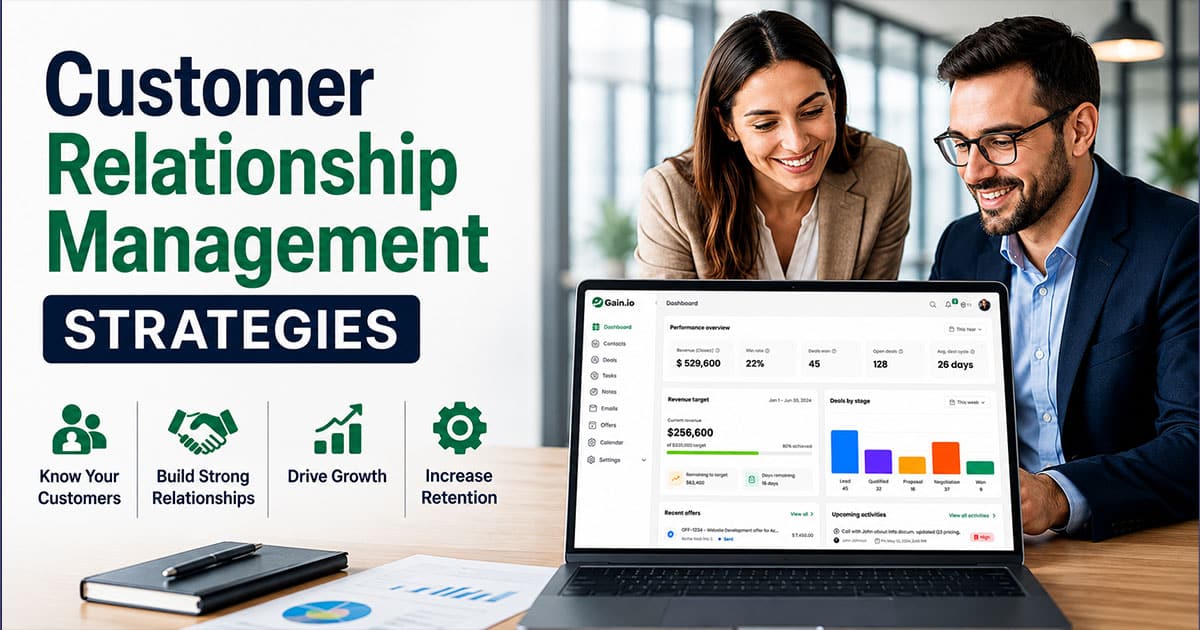
Customer relationship management strategies have evolved from basic contact databases into AI-driven platforms that help B2B companies retain high-value accounts and expand revenue systematically. With enterprise sales cycles averaging 6-9 months and deals involving 6-10 stakeholders, the complexity of managing customer relationships demands a structured approach.
A 2025 Gartner report reveals that companies with mature CRM strategies achieve 29% higher revenue growth than those without. In business markets where customer lifetime value per account can exceed $1 million, the stakes are clear. This article presents seven proven strategies organized into five thematic pillars that blend CRM software capabilities with process discipline and relationship-building skills tailored for B2B environments.
What Is Customer Relationship Management
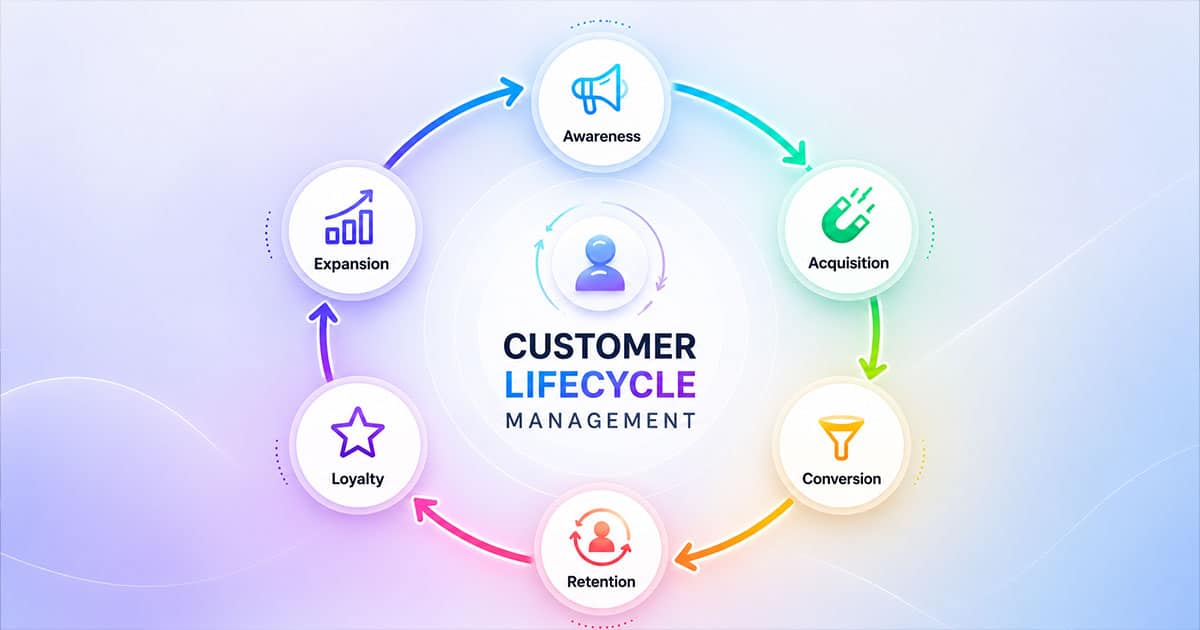
Customer relationship management refers to the strategic coordination of technologies, processes, and people to manage customer interactions across their entire lifecycle. At its core, CRM consolidates customer data into a unified repository that enables personalized engagement, drives customer retention, and improves operational efficiency. A CRM strategy defines goals and practices that a company will use to manage and improve its interactions with customers via a CRM system, focusing on building stronger relationships and generating leads. Modern CRM systems support features like lead scoring, pipeline tracking, and predictive analytics that help sales teams prioritize opportunities and close deals faster, as outlined in this complete guide to CRM software for modern sales teams.
Best Customer Relationship Management Strategies For Business Markets
This section gathers seven evidence-based strategies into five thematic pillars that combine technology, process design, and human relationship skills optimized for B2B markets. Each pillar details specific strategic moves, recommended use of CRM tools, and concrete examples tailored to environments where deals average $100,000 or more and involve extended evaluation periods.
1. Customer Insight And Segmentation Strategy
A foundational customer relationship strategy focuses on building a complete 360-degree customer view by consolidating CRM data from email interactions, product usage metrics, support tickets, and billing records into one source of truth. This approach directly addresses the data silos that persist in 62% of organizations according to Salesforce’s 2025 State of CRM report.
Effective sales, marketing, and customer service teams can tailor their interactions with prospects and customers using data-driven insights on customer behaviors, needs, and preferences. Segment business customers by factors such as annual recurring revenue tiers, product adoption rates, industry vertical, and engagement scores to allocate resources appropriately, supported by robust contact management to build stronger relationships. Using customer research and data analytics can help identify potential challenges before they arise, positioning a business as a proactive partner rather than a reactive vendor.
Teams should revisit customer segments at least quarterly to reflect evolving markets and product lines rather than relying on static demographic splits. Companies that excel at segmentation achieve 2.5x higher email open rates for targeted messaging. However, over-segmentation can create analysis paralysis, which is why AI-driven dynamic grouping helps maintain focus on actionable segments.
2. Omnichannel Customer Engagement Strategy
An omnichannel engagement strategy coordinates email sequences, in-app notifications, video calls, and virtual events to deliver seamless customer experiences across every touchpoint, especially when powered by a CRM with email integration to streamline sales communication. Companies investing in omnichannel customer experiences see significant returns in customer retention and satisfaction, with research indicating that businesses with strong omnichannel engagement retain on average 89% of their customers compared to just 33% for weak performers.
Consider a typical B2B customer journey: a demo request via LinkedIn routes to the CRM, triggering a personalized email with a video recap. Sales call notes sync automatically to the success team for coordinated onboarding. Renewal nudges reach the contact via their preferred channel. This consistency prevents context loss that frustrates buyers and damages client relationships.
Personalization and dynamic content involves delivering customized content, product recommendations, and messaging based on individual customer data, behavior, and preferences. This approach significantly boosts customer engagement and fosters loyalty while avoiding the channel fatigue that occurs when contacts receive more than 12 monthly touches without clear value.
3. Account-Based Relationship Strategy
An account-based approach treats high-value business customers as individual markets, aligning sales, marketing, and success efforts around shared engagement plans for 50-100 target accounts, which is where a dedicated B2B sales CRM for revenue teams becomes essential. Research indicates that 87% of sales and marketing leaders believe collaboration between these two functions enables critical business growth, making this alignment essential for ABM success.
Customer insights and firmographic data help identify strategic accounts, map stakeholders, and track influence networks within large organizations. Customer journey mapping involves creating a visual representation of every interaction a client has with a brand, which helps businesses understand the client experience and identify areas for improvement across complex buying committees.
Understanding the customer journey allows businesses to visualize what customers are thinking, feeling, and doing throughout the purchase process, which is essential for improving customer experience. Personalized assets like custom ROI calculators and quarterly business review agendas track within CRM timelines as part of a structured engagement plan.
4. Predictive Retention And Expansion Strategy
Predictive analytics transforms historical customer behavior into risk and opportunity scores for each business account, enabling proactive intervention before problems escalate. CRM software enriched with product usage metrics can flag customers likely to churn 3-6 months before renewal, giving customer success teams time to intervene with targeted resources.
Predictive analytics and AI-driven insights allow businesses to foresee future customer behaviors, identify at-risk accounts, and uncover new opportunities, transforming how they manage customer relationships and improving sales productivity with CRM. Models can predict expansion potential based on license utilization, feature adoption, and engagement with educational content. Gartner’s 2025 benchmarks show that AI-driven personalization can lift revenue 15-20%, though this requires clean and regularly refreshed CRM data.
Proactive communication and transparency demonstrate that a business cares about its customers, increasing long-term loyalty. Regular check-ins through calls or meetings can help businesses understand current customer needs and challenges before they become churn triggers. Revenue teams should create specific playbooks linked to these predictions, such as success plan workshops for at-risk accounts and tailored upsell offers for high-growth opportunities.
5. Customer Value And Advocacy Strategy
This strategy focuses on consistently proving value to customers, then converting satisfied accounts into advocates who provide references, case studies, and peer reviews that accelerate new business. Use CRM data to track value milestones such as time-to-first-value, key performance indicators achieved, and cost savings realized by each client.
Companies that excel at personalization can generate 40% more revenue from those activities than average players, demonstrating the financial benefits of effective personalization strategies throughout the customer lifecycle. Customer success managers should log success stories, champions, and reference readiness inside CRM tools to support sales cycles and marketing efforts.
Research from TOPO indicates that advocacy and referrals shorten average contract value cycles by 28% and reduce customer acquisition costs by 50%. Strong advocacy also depends on how effectively CRM systems help sales teams manage leads throughout the lifecycle. Loyalty programs are structured initiatives designed to reward repeat customers, encouraging continued engagement and increasing their lifetime value. Research shows that 84% of consumers are more likely to stick with a brand that offers a loyalty program.
How To Build A Data Centric Foundation For CRM Success
None of the seven strategies work without high-quality customer data that is trustworthy, unified, and accessible. A 2025 Forrester study found that data-mature firms are 2.3x more likely to exceed revenue targets than those struggling with fragmented information.
Centralizing customer data from disparate systems into a single CRM platform eliminates the manual exports and inconsistent records that undermine sales teams, especially when supported by dynamic contact management for smarter relationship tracking. Maintaining data integrity requires regularly updating records to ensure accuracy for improved decision-making across every customer touchpoint.
Centralizing Customer Data Across Systems
Integrate marketing, sales, billing, support, and product analytics into one CRM data model using APIs and middleware solutions. A mid-market B2B company reduced reporting time by 60% and improved forecasting accuracy after consolidating its customer information into a unified platform.
Centralized data management through tools can help store purchase history and interaction data to offer personalized service and post-purchase support. Technical fundamentals matter: unique account and contact identifiers ensure every touchpoint ties to the correct client relationships without duplication. Centralized data also supports faster onboarding of new sales representatives because they can see the complete engagement history without searching multiple tools.
Recommend incremental integration starting with the most critical revenue systems. This approach lets teams see early benefits from improved customer insights before committing to full-scale data consolidation.
Maintaining Data Quality And Reliability
Poor data quality undermines customer experience through misrouted emails, duplicate outreach, and inaccurate health scores within CRM software. Establish practical routines including scheduled data cleanup, validation rules, and automated enrichment to keep company and contact records current.
Assign specific ownership roles like sales operations or revenue operations to steward CRM data standards across all teams. Data quality directly affects AI and predictive models since biased or incomplete datasets misidentify churn risks or high-value opportunities. One organization improved campaign response rates by 35% and reduced wasted spend on incorrect contacts simply by improving data hygiene practices, illustrating how strong CRM adoption strategies to improve CRM ROI depend on reliable underlying data.
Translating CRM Data Into Actionable Insights
Move from raw CRM data to practical dashboards and reports that leaders and frontline teams actually use. Using data and analytics, businesses can create targeted marketing campaigns that enhance customer engagement and retention through personalized experiences.
Key B2B metrics to track include net revenue retention (targeting 110-120% for top performers), customer health scores, average deal cycle length, and product adoption benchmarks. Robust CRM systems provide a wealth of data insights that fuel employee productivity, allowing businesses to identify trends or patterns that will help them make better decisions and get more from your CRM with a simpler sales workflow.
Create consistent reporting cadences like quarterly customer business reviews that share outcome metrics back with clients to reinforce value and anticipate customer needs before they arise.
Integrating AI And Automation Responsibly
Modern CRM platforms embed AI for lead scoring, churn prediction, and recommending next-best actions, aligning with emerging future CRM technology trends and tools. Automation can free up team members by handling repetitive tasks like follow-up emails and data entry, allowing focus on genuine human connections that drive business growth.
Human oversight remains essential. Automated decisions should be transparent, and teams must be able to override algorithmic recommendations when relationship context demands it. Start with low-risk automations like follow-up reminders or renewal alerts before advancing to predictive use cases. Pilots that measure uplift in engagement or retention validate AI value before larger rollouts.
Building Cross-Functional Accountability Around Data
Sales, marketing, product, and customer success should co-own definitions of core metrics like churn, expansion, and active usage. Shared scorecards and quarterly planning sessions where teams review the same CRM insights coordinate marketing campaigns and initiatives effectively.
Customer feedback and support ticket data should influence product roadmap priorities, closing the loop between customer experience and development decisions. Leadership must reinforce that data quality is everyone’s responsibility, just as strong leadership is critical in how CRM adoption is changing modern sales teams. Documenting shared data definitions in an internal knowledge base ensures practices persist through hiring and organizational changes.
Ways To Align Teams Around Customer Experience Outcomes
Aligning teams around customer experience rather than internal targets alone is crucial in complex B2B environments where misalignment costs 10-15% of revenue according to SiriusDecisions research. Sales and Marketing Alignment, often referred to as Smarketing, integrates sales and marketing teams to pursue shared goals, breaking down traditional departmental silos.
Effective Sales and Marketing Alignment can enhance lead quality and conversion rates by ensuring both teams work from the same playbook to attract, nurture, and convert leads throughout the sales process, which also reduces many common CRM adoption challenges and mistakes for sales teams.
Defining Shared Customer Journeys And Handovers
Map the B2B customer journey from first touch to renewal, documenting who owns each stage and what constitutes a successful handover. Capture key milestones like marketing-qualified lead, sales-qualified opportunity, go-live date, and first value realization inside CRM software.
Clear handover criteria reduce friction. Success managers should receive complete context before onboarding new customers to increase customer satisfaction and reduce time-to-value. A standardized handover checklist stored within CRM reduces variability by 25% and cuts new hire ramp time by 30%.
Creating Unified Customer Health Metrics
A customer health score blends product usage, support history, customer satisfaction scores, and relationship signals into a single metric that guides action. Cross-functional teams should co-design the weighting of different factors to avoid bias toward one department’s priorities.
These scores appear in CRM views for account managers, success managers, and executives, guiding proactive outreach and quarterly review planning. Recalibrate health scores periodically as historical data reveals which signals truly predict churn or growth, and pair these signals with automated sales tasks to stay focused and organized when risk thresholds are crossed. Create thresholds that trigger specific actions, such as executive check-ins for large accounts that fall below defined levels.
Embedding Customer Feedback Into Everyday Workflows
Structured feedback through NPS, CSAT, and product surveys should flow directly into CRM records rather than isolated tools. Transparent communication establishes clear channels for regular updates and informs clients about progress or potential issues based on their input.
Voice-of-customer programs and social listening insights refine messaging and help resolve customer issues in future sales cycles, especially when captured through smart CRM tools for sales teams that keep feedback tied to accounts and contacts. Share closed-loop updates with customers, notifying them when their suggestions lead to new features. Employee training should emphasize empathy and problem-solving in customer interactions to improve customer engagement and build repeat customers.
Developing Customer Centric Operating Rhythms
Structure weekly, monthly, and quarterly meetings around customer outcomes using CRM dashboards as the primary reference. Joint pipeline and retention reviews where sales and success teams examine upcoming renewals and expansion opportunities together improve coordination.
Regular customer business reviews with key accounts show clients their own progress using metrics captured in CRM. These rhythms support continuous improvement as teams discuss patterns in customer behavior and refine playbooks accordingly. Capture action items directly in CRM tasks so follow-through is visible and traceable.
Equipping Teams With Skills And Playbooks
Ongoing training in consultative selling, active listening, and customer success practices complements technology investments. Build role-specific playbooks stored within or linked from CRM detailing outreach cadences, discovery questions, and escalation paths for managing customer interactions.
Standardized playbooks reduce performance variability across regions and customer segments while allowing room for personalized customer interactions. These operating standards reinforce earlier CRM adoption best practices for sales teams and keep your approach aligned with top CRM trends for 2026. A churn-prevention playbook that triggers when health scores drop correlates with 15% better retention outcomes. Track playbook adoption through CRM logging so leaders identify which practices drive results.
How To Measure And Optimize CRM Strategies Over Time
CRM strategy is never static and must be refined continuously using measurable outcomes and changing customer expectations. Tracking performance metrics lets a business analyze how well its CRM strategies are working and identify those that need improvement, which is crucial for long-term success and business strategy execution.
Well-designed KPIs ensure CRM initiatives contribute to revenue, profitability, and customer satisfaction rather than just activity volume.
Defining CRM Performance Metrics That Matter
Track core metrics including gross and net revenue retention, logo churn, expansion revenue, and customer lifetime value. Marketing metrics like lead-to-opportunity conversion and success metrics like time-to-first-value link back to overall CRM effectiveness.
The first step in any CRM strategy is to define goals based on a clear picture of where the business stands and where it needs to improve, using the SMART criteria: specific, measurable, achievable, relevant, and time-bound. Use cohort analysis by signup quarter or industry to identify trends that simple averages might hide, and ensure you’ve chosen CRM tools that fit your workflow so these insights are easy to access. Limit dashboard metrics to those directly informing decisions.
Establishing Feedback Loops For Continuous Improvement
Build structured feedback loops where frontline teams report which CRM fields, workflows, or automations help them and which create friction. Operations teams use this input to refine configuration and simplify user experiences.
Include customer-facing feedback loops such as regular account reviews where customers share what is working and what needs service improvement. A business audit can help organizations identify gaps in their current workflows, leading to better alignment with customer needs and improved customer experiences once adjustments are implemented.
Using Experiments To Refine Engagement Tactics
Incorporate A/B testing and controlled experiments into outreach sequences, onboarding content, and renewal messaging through CRM marketing automation. Test variations in cadence, messaging, or touchpoint timing and measure impact through CRM analytics.
One mid-market company tested two different follow-up cadences for trials and achieved an 18% lift in conversion rates. Adequate sample sizes and realistic time frames prevent incorrect conclusions. Build an internal library of tested tactics and outcomes so successful approaches scale across teams in a competitive market, which is especially valuable for organizations using CRM for startups and small sales teams that need repeatable playbooks to grow.
Benchmarking Against Industry Standards
External benchmarks help evaluate whether churn rates, NRR, or win rates are competitive within your sector. SaaS benchmarks indicate median NRR around 110% for strong performers. Benchmarks should inform goals but not replace context, as product maturity and pricing models affect realistic targets.
Compare performance across different customer segments internally, not only to external averages, to identify where CRM strategies work best. Revisit benchmarks yearly to reflect market shifts and changes in customer expectations.
Investing In Usability And Adoption
CRM strategy success depends on high user adoption and accurate data entry from every team member. Adoption rates above 90% drive the data completeness that powers predictive models. Intuitive interfaces, mobile access, and embedded guidance reduce friction.
Monitor adoption metrics including login frequency, record updates, and completion rates for key fields. Role-based training, office hours, and champions programs encourage best practices. One organization improved CRM data completeness by 40% through usability enhancements, strengthening retention programs and drive business growth outcomes, similar to results seen with Gain.io — an all-in-one CRM to grow your sales and team.
Future Trends In Customer Relationship Management Strategies
Customer relationship management strategies continue to evolve as businesses focus on automation, personalization, and predictive analytics. Modern CRM platforms now help brands improve customer satisfaction, strengthen customer loyalty, and optimize business processes more effectively.
AI Personalization
Artificial intelligence is transforming customer relationship management crm through predictive recommendations and smarter automation. Businesses now use analyzing customer data to create personalized marketing messages and highly relevant customer communications across multiple channels. AI-driven CRM systems also help segment customers based on customer behavior, purchase history, and engagement patterns. This trend supports increasing customer loyalty while helping brands improve customer satisfaction and increase customer retention through more personalized service experiences, reinforcing broader future CRM technology trends and tools.
Omnichannel Engagement
Modern CRM strategies focus heavily on seamless omnichannel communication. Customers interact with brands through email, live chat, social platforms, mobile apps, and websites, so businesses need unified communication systems. Future CRM platforms will centralize client relationship management data to improve consistency across channels. Businesses that deliver smooth customer journeys across multiple touchpoints often strengthen brand loyalty and encourage repeat purchases from existing customers and potential customers alike.
Predictive Analytics
Predictive analytics will become a major part of implementing crm strategies in future business environments. CRM tools increasingly rely on historical customer data to forecast sales trends, customer churn risks, and buying behavior. Businesses can identify future opportunities, customer lifetime value, and marketing performance through real-time analytics. This allows marketing teams and sales teams to optimize campaigns, improve customer segmentation, and build stronger relationship marketing strategies that support business growth.
Automation Expansion
Automation is reshaping how companies manage customer relationships and internal operations. Businesses now automate workflows for customer service, lead management, follow-ups, and support ticket routing. Advanced CRM systems also reduce repetitive administrative tasks, improving operational efficiency across departments. Automation supports cost reduction while helping businesses maintain consistent customer experiences, especially when designed to improve sales productivity with CRM. Many crm strategy FAQs now focus on workflow automation because it directly improves scalability and operational performance.
Data Privacy Focus
Future CRM strategies will place stronger emphasis on data governance and customer trust. As businesses collect more crm data, companies must maintain transparency around how customer information is stored and used. Secure CRM systems help businesses protect customer information while maintaining compliance with privacy regulations. Organizations that prioritize ethical data practices often build stronger customer trust and long term loyalty. Data quality management will also become essential for accurate analytics and better customer relationship strategy decisions.
How Gain.io Supports Modern Customer Relationship Management Strategies
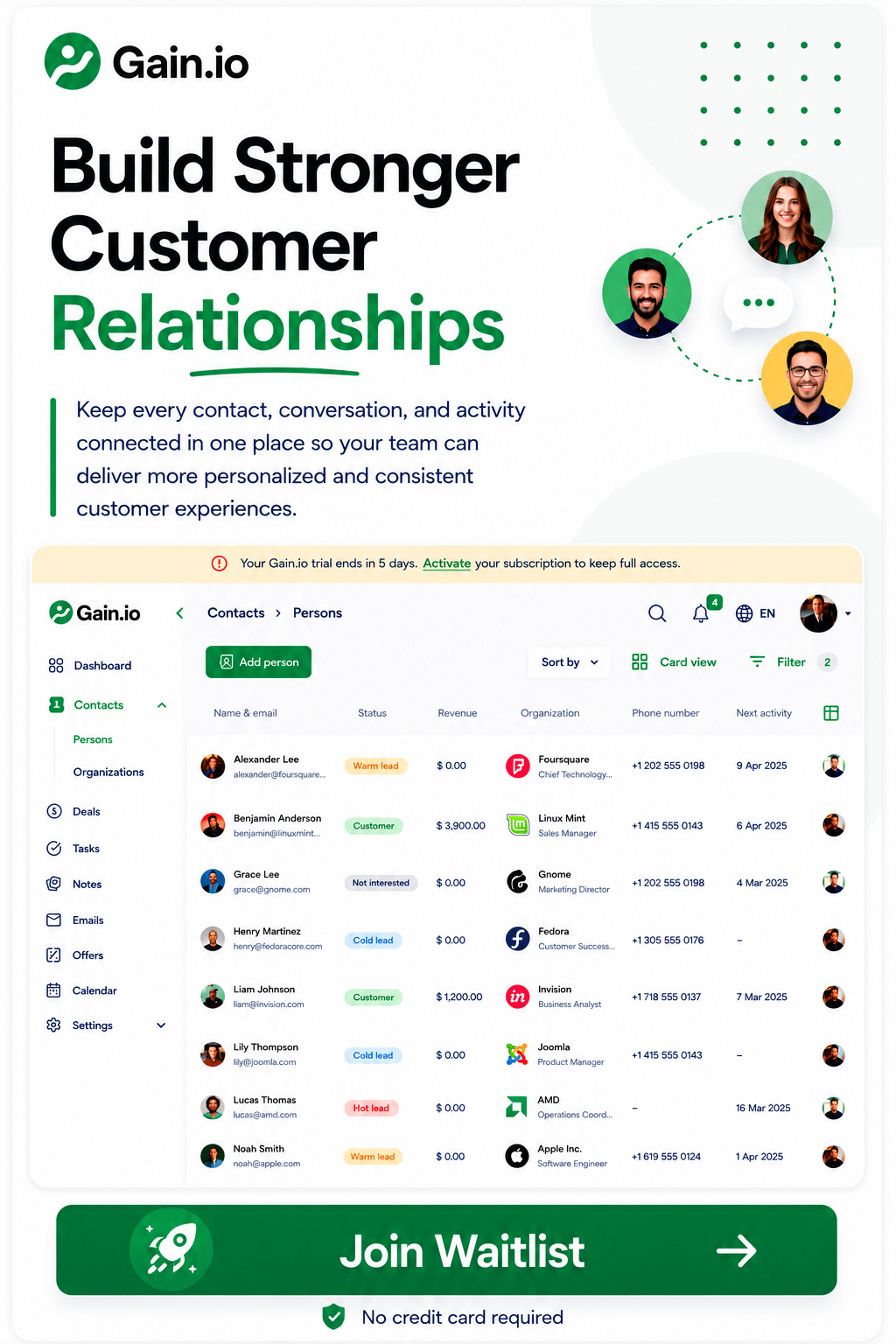
Gain.io provides B2B companies with a unified platform to centralize customer data, orchestrate engagement across channels, and measure CRM strategy performance against revenue outcomes, as shown in a sales acceleration case study where teams closed deals faster with Gain.io. The platform connects sales teams around a unified customer record so every interaction is informed by complete context from first touch through renewal.
Gain.io supports successful CRM implementation through advanced segmentation capabilities, workflow automation for sales follow-ups, and dashboards that track net revenue retention and customer health scores. The platform ingests data from existing CRM systems, reducing silos by up to 70% and enabling the company’s CRM strategy to deliver measurable results. Sales teams can operationalize the seven strategies described in this article with guided onboarding that connects relationship marketing principles to daily pipeline activities.
FAQs
What Is The Most Important CRM Strategy For Small Businesses?
Centralizing customer data in one platform is the foundation everything else builds upon. Without a single source of truth, customer segmentation, personalization, and analytics become impossible. Start by getting all your customer information into one CRM system before layering on automation and advanced features. This foundation enables every other strategy to work effectively.
How Long Does It Take To See Results From A CRM Strategy?
Most businesses see measurable improvements within 60 to 90 days of consistent CRM usage. Initial gains come from better follow-up discipline and reduced administrative time. Larger results like improved customer retention rates and increased sales typically appear within six months as data accumulates and processes mature. Patience and consistency matter more than perfect implementation.
Can CRM Software Improve Customer Retention?
Yes, significantly. CRM software helps you track customer engagement, schedule proactive check-ins, and identify at-risk accounts before they leave. Research shows that improving customer retention by just 5% can increase profits by 25 to 95%. The visibility and automation CRM provides makes retention efforts systematic rather than reactive.
How Much Should A Small Business Invest In CRM?
Start with what you can implement well rather than buying features you won’t use. Many effective CRM platforms offer plans under $50 per user monthly. The real investment is time spent setting up processes and training your team. Focus on ROI rather than upfront cost. A properly used affordable CRM outperforms an expensive one sitting unused.
What Departments Should Use A CRM System?
Sales teams benefit most directly, but marketing and customer success should also have access. Shared visibility eliminates silos and improves handoffs between teams. Even small businesses where one person handles multiple roles benefit from having all customer information in one accessible system. The goal is ensuring anyone who touches customer relationships has the context they need.