Leads come in fast. But without a clear system, teams struggle to assign them on time. Lead routing solves this problem. It sends each lead to the right sales rep based on rules like location, deal size, or expertise. That means faster responses and better chances to close deals.
Many teams still use manual assignment, which slows everything down. A smart lead routing setup keeps your pipeline moving and avoids missed opportunities. It also improves accountability across the team.
In this guide, you will understand how lead routing works and how to use it to grow revenue.
What Is Lead Routing
Lead routing is the process of assigning and distributing incoming leads to the right sales reps based on specific routing rules and criteria. It uses lead data like company size, lead source, and buyer’s journey stage to match leads with the best sales representative. A strong lead routing system helps the sales team handle more leads without delay. It also improves speed to lead and reduces human error. With automated lead routing and lead routing software, teams can route leads based on lead scoring, lead qualification, and team structure.
An effective lead routing process ensures qualified leads reach the right person at the right time. It supports fair lead distribution through methods like round robin routing or lead-to-account matching with an existing account owner. Lead routing tools and sales automation software help automate lead assignment rules, reduce duplicate leads, and monitor lead response times. This way, sales leaders can focus on high-value prospects and avoid lost leads.
How Lead Routing Works Across Sales And Marketing Systems
Leads move across tools like CRM, marketing automation, and routing software. A clear lead routing process keeps everything aligned. It helps route leads fast, reduce delays, and improve speed to lead. Both teams work with the same lead data and goals.
Lead Capture From Multiple Sources
Leads enter from many lead sources like ads, forms, chat, and email. The marketing team collects inbound lead data and sends it into a lead routing system. Around 68% of businesses say lead volume has increased in recent years, which creates pressure on teams.
A proper routing process helps handle too many leads without chaos. Lead routing tools collect and organize lead records in real time. This reduces duplicate leads and human error. Clean lead management, supported by strong sales lead organization, starts here and sets the base for effective lead routing.
Lead Qualification And Scoring System
Each lead goes through lead qualification before assignment. A lead scoring system ranks leads based on behavior, company size, and intent. High-value prospects or hot leads get higher scores. This helps match leads with the right sales reps.
Companies that use lead scoring see up to 77% higher ROI on lead generation. Lead routing automation uses this data to route leads based on priority. Unqualified leads are filtered out early. Sales teams focus only on the most promising leads and avoid wasted effort.
Routing Rules And Assignment Logic
Lead routing rules decide how to assign leads. Rules use routing criteria like location, product interest, or existing account ownership. Complex routing logic can handle advanced cases such as lead-to-account matching or based routing for enterprise deals.
Round robin lead distribution ensures fair workload across the sales team. Assignment rules also support specific sales team structure. Studies show that fast and accurate lead assignment can increase conversion rates by 20%. Routing systems make sure no valuable leads slip through.
Automated Lead Distribution And Handoff
Automated lead routing software helps distribute leads instantly. It sends new leads to sales reps without delay. This improves speed to lead, which is critical. Research shows responding within 5 minutes makes you 21 times more likely to qualify a lead.
Routing software also tracks lead hits and response time. Sales leaders can monitor lead response and fix delays. Tools reduce human error and improve accountability. Smooth handoff between marketing team and sales process leads to more qualified leads.
Continuous Monitoring And Optimization
Lead routing work does not stop after setup. Teams must monitor lead response times and sales visibility and performance. Data shows that companies with strong alignment between sales and marketing achieve 36% higher customer retention.
Advanced lead routing software provides insights into routing strategies and results. Sales leaders can adjust routing rules, refine lead assignment rules, and improve lead distribution. Regular updates help manage growing lead volume and avoid lost leads. This keeps routing systems efficient and scalable.
Types Of Lead Routing Models Used By High-Performing Teams
High-performing teams use clear lead routing strategies to handle growing lead volume. A structured lead routing process helps assign leads faster and match leads with the right sales reps. It also improves speed to lead and supports broader lead management best practices to reduce lost leads.
Round Robin Distribution
Round robin lead distribution assigns leads evenly across sales reps. Each sales representative gets a fair share of incoming leads. This model works well when leads have similar value and complexity.
Teams use round robin routing to avoid overload on one rep. It supports balanced lead assignment and keeps morale stable. Studies show balanced lead distribution can improve response rates by up to 15%. Lead routing tools automate this process and reduce human error. It fits simple sales team structure and high lead volume environments.
Territory-Based Routing
Territory-based routing assigns leads based on location or region. Leads go to sales reps who understand local markets and customer pain points. This improves communication and trust with prospects.
Data shows region-specific selling can increase close rates by 20%. Routing rules use lead data like country, city, or time zone. Lead routing software helps route leads based on geography without delay. This model fits teams with global or regional sales structure and supports effective lead routing across markets.
Lead Scoring-Based Routing
Lead scoring-based routing focuses on lead qualification and intent. A lead scoring system ranks leads using behavior, company size, and engagement. Hot leads go to top reps first.
Companies using lead scoring see up to 77% higher lead conversion ROI. Automated lead routing uses this score to assign leads based on priority. Sales teams spend more time on high-value prospects and less on unqualified leads. This routing process improves efficiency and supports better sales process outcomes.
Account-Based Routing
Account-based routing matches leads to an existing account owner. It uses lead to account matching to keep communication consistent. This avoids confusion and improves customer experience.
Research shows account-based strategies can deliver 171% higher deal size. Routing systems check if a lead belongs to an existing account. Then it assigns leads to the right sales rep. This model works well for B2B teams and complex sales cycles. It also reduces duplicate leads and improves lead management.
Skill-Based Routing
Skill-based routing assigns leads based on expertise or product knowledge. Complex products need specialized sales reps. This model ensures the right person handles each lead.
Companies that match leads with skilled reps see up to 30% higher win rates. Routing criteria include industry, product type, or deal size. Advanced lead routing software uses complex routing logic to automate this. Sales leaders use this model to improve lead response and handle high-value prospects more effectively.
Key Benefits Of Lead Routing For Revenue Growth And Efficiency
A clear lead routing process helps teams move faster and close more deals. It connects lead data with the right sales reps at the right time. Strong lead routing strategies improve lead management, reduce delays, and increase overall revenue performance.
Faster Speed To Lead
Speed to lead plays a critical role in conversion. Studies show that responding within 5 minutes makes teams 21 times more likely to qualify a lead. Lead routing automation ensures incoming leads reach sales reps instantly.
Lead routing software removes manual delays and routes leads based on defined routing rules. Sales teams can act on hot leads before competitors do. Faster lead response improves trust and keeps prospects engaged throughout the buyer’s journey.
Better Lead Qualification And Focus
A structured lead routing system uses lead scoring and lead qualification to filter leads. It separates qualified leads from unqualified leads using clear routing criteria. This helps sales reps focus on the most promising leads.
Companies that use lead scoring systems report up to 77% higher ROI from lead generation. Lead routing tools assign leads based on value, company size, and intent. Sales leaders get more control over lead distribution and reduce time wasted on low quality prospects.
Higher Conversion Rates
Effective lead routing matches leads with the right sales representative. This improves conversations and builds stronger connections with prospects. Routing leads based on expertise or territory increases relevance.
Research shows that proper lead assignment can boost conversion rates by 20% or more. Lead routing strategies ensure high value prospects go to top performers. This increases chances of closing deals and drives consistent revenue growth across the sales process.
Reduced Human Error And Lost Leads
Manual lead assignment often leads to errors and missed opportunities. Duplicate leads, wrong assignments, and delays create friction in the sales process unless you back routing with solid sales lead organization practices. Lead routing systems solve this with automation.
Routing software uses assignment rules and routing logic to distribute leads accurately. Tools reduce human error and prevent lost leads. Automated lead routing also ensures every lead record is tracked and assigned properly, which improves accountability across the team structure.
Scalable Lead Management
Growing teams often struggle with too many leads and complex workflows. A strong lead routing system helps manage rising lead volume without adding chaos, especially when combined with dedicated lead management software for sales teams. It supports smooth lead distribution across sales reps.
Advanced lead routing software handles complex routing logic and adapts to business needs. Teams can assign leads based on multiple conditions and scale operations easily. Companies with mature lead management processes and thoughtful sales workflow optimization for faster deal closures see up to 133% more revenue growth compared to those without structured systems.
Common Challenges Of Lead Routing
Lead routing looks simple, but many teams struggle with execution. Poor routing systems slow down response and create confusion. Without clear routing rules and process, teams lose valuable leads and miss revenue opportunities.
Slow Lead Response Time
Slow speed to lead is a major issue for many teams. Research shows that 78% of customers buy from the first company that responds. Delays happen when teams rely on manual lead assignment.
A weak lead routing process fails to route leads instantly. Sales reps receive leads late and miss hot leads. Lead routing automation solves this by sending incoming leads in real time. Faster lead response improves engagement and increases chances of conversion.
Poor Lead Qualification
Unclear lead qualification creates confusion in the sales process. Sales teams often receive unqualified leads that do not match ideal customer profiles, a common lead generation mistake that hurts conversions. This wastes time and reduces efficiency.
A strong lead scoring system helps filter leads based on intent and value. Without it, routing leads becomes random. Studies show that only 27% of leads are actually sales-ready. Lead routing tools should use lead scoring and routing criteria to ensure better lead distribution and focus on qualified leads.
Unclear Routing Rules
Many teams lack proper lead routing rules and assignment logic. This creates inconsistent lead distribution and frustration among sales reps. Some reps receive too many leads, while others get fewer.
Clear routing rules and assignment rules fix this imbalance. Round robin lead distribution or territory-based routing can help. Routing systems must align with sales team structure and goals. Well-defined routing strategies improve fairness and overall team performance.
Data Quality Issues
Poor lead data affects the entire routing process. Duplicate leads, missing details, or incorrect lead records create errors in lead assignment. This leads to wrong routing decisions.
Research shows that bad data costs companies up to 15% of revenue. Lead routing software must clean and validate lead data before assignment. Accurate data helps match leads correctly and improves effective lead routing. It also reduces human error and avoids lost leads.
Difficulty Scaling With Lead Volume
Growing lead volume creates pressure on routing systems. Many teams struggle to handle too many leads without proper automation. Manual processes break under scale.
Advanced lead routing software supports complex routing logic and automation. It helps distribute leads across sales reps without delay. Companies with automated lead routing see up to 30% improvement in efficiency. Scalable routing tools allow teams to manage more leads and maintain consistent performance.
Best Tools And Software For Automating Lead Routing
The right lead routing software helps teams automate lead assignment and reduce manual work. It connects lead data with routing rules and sends leads to sales reps instantly. Strong routing tools improve speed to lead, accuracy, and overall sales performance, and many teams compare options using guides to the best lead management software in 2026.
CRM Based Routing Systems
CRM platforms act as the core of many lead routing systems. Tools like Salesforce, HubSpot, or purpose-built options that explain how CRM helps sales teams manage leads include built in lead routing features. They use lead data, lead scoring, and routing rules to assign leads automatically.
Around 91% of companies with more than 10 employees use a CRM system. CRM based routing software helps sales teams manage incoming leads and track every lead record. It also supports lead to account matching and existing account ownership. This improves lead management and ensures smooth lead distribution across the sales process.
Advanced Lead Routing Software
Advanced lead routing software handles complex routing logic with ease. These tools support routing criteria like company size, deal value, and buyer’s journey stage. They help match leads with the best sales representative.
Companies that use advanced routing systems report up to 30% higher operational efficiency. Lead routing automation in these tools reduces human error and speeds up lead assignment, especially when paired with a sales pipeline CRM to improve visibility. Sales leaders can define detailed assignment rules and manage high lead volume without delays.
Round Robin And Distribution Tools
Round robin routing tools focus on fair lead distribution. They assign leads evenly across sales reps based on simple assignment rules. This helps maintain balance within the sales team structure.
Balanced lead distribution can improve response rates by up to 15%. These routing tools are ideal when lead volume is high and leads have similar value, and they work best on top of a clearly defined sales pipeline that actually works. Automated lead routing ensures no sales rep gets overloaded. It also keeps lead response times consistent across the team.
AI-Powered Routing Tools
AI-powered routing software uses machine learning to improve lead routing strategies. It analyzes lead data, behavior, and past performance to route leads more accurately. This helps identify the most promising leads.
Research shows AI-driven lead management can increase conversion rates by up to 50%. These tools adjust routing rules based on results. Sales teams can focus on high-value prospects and reduce time spent on unqualified leads. AI also improves speed to lead and overall efficiency.
Integration And Workflow Tools
Integration tools connect marketing team platforms with CRM and routing systems. They ensure smooth data flow across the lead routing process. This helps automate lead capture, lead qualification, and lead assignment.
Companies with strong sales and marketing alignment see up to 36% higher customer retention. Workflow tools reduce duplicate leads and improve data accuracy. They also support routing automation and complex routing logic. This creates a seamless sales process and improves effective lead routing across teams.
How To Set Up Lead Routing Step By Step For Your Business
A structured lead routing process helps teams handle incoming leads with speed and accuracy. Clear steps ensure proper lead assignment, better lead management, and improved conversions. The right setup reduces human error and supports scalable sales growth.
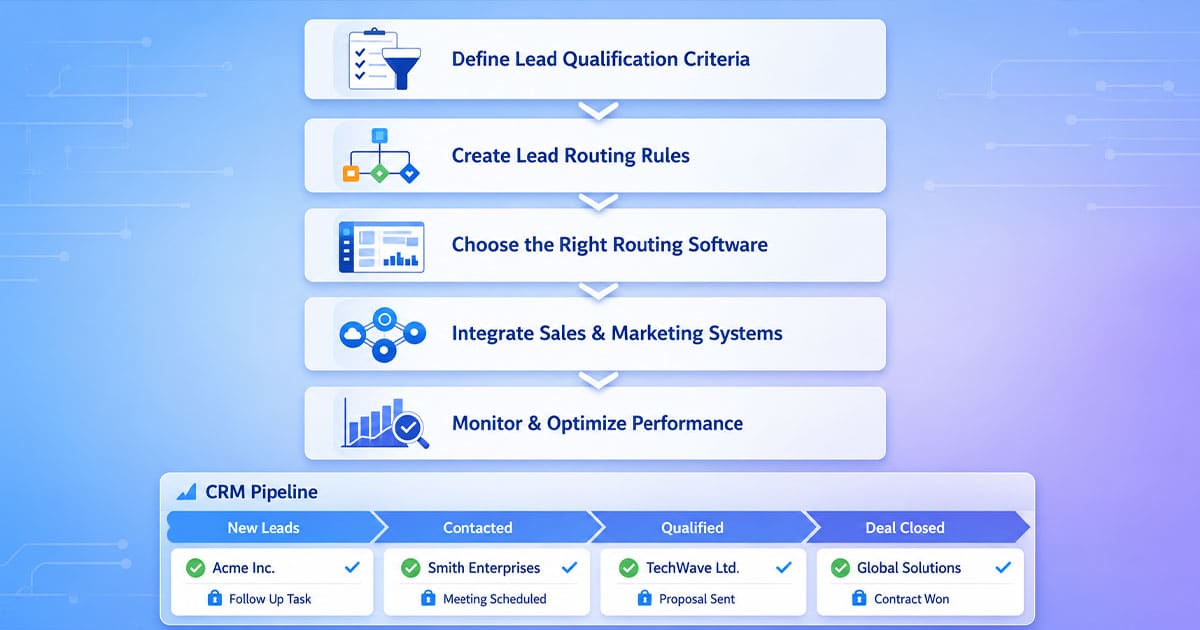
Step 1: Define Lead Qualification Criteria
Lead qualification sets the base for effective lead routing. Teams must define what makes a lead valuable. Use lead data like company size, industry, and buyer’s journey stage. A clear lead scoring system helps identify hot leads and filter unqualified leads.
Studies show that only 27% of leads are sales-ready. Strong lead qualification ensures sales reps focus on qualified leads. This improves lead management and avoids wasted effort. Sales leaders should align criteria with business goals and ideal customer profiles.
Step 2: Create Lead Routing Rules
Lead routing rules decide how to assign leads across the sales team. Use routing criteria like territory, product interest, or existing account ownership. Clear assignment rules help distribute leads fairly and reduce confusion.
Companies with defined routing strategies see up to 20% higher conversion rates. Round robin lead distribution works well for equal workloads. More complex routing logic supports enterprise sales. A structured routing process ensures leads go to the right sales representative every time.
Step 3: Choose The Right Routing Software
Lead routing software helps automate lead assignment and reduce manual work. CRM based routing systems, sales automation software, and advanced lead routing tools handle large lead volume with ease. They also support lead scoring, routing rules, and lead to account matching.
Around 91% of companies use CRM systems to manage sales processes. The right routing software improves speed to lead and reduces human error. It also tracks lead records and ensures smooth lead distribution across teams.
Step 4: Integrate Sales And Marketing Systems
Sales and marketing alignment is critical for effective lead routing. Integration tools connect lead sources, CRM, and routing systems. This ensures smooth flow of incoming leads and accurate lead data, especially when you add CRM email integration for better communication tracking.
Companies with strong alignment see up to 36% higher customer retention. Integration reduces duplicate leads and improves lead management across sales teams. Marketing team and sales team can work with shared data. This supports better routing strategies and faster lead response.
Step 5: Monitor And Optimize Performance
Lead routing work needs regular tracking and improvement. Teams should monitor lead response times, conversion rates, and deal progression using solid sales deal tracking practices, as well as lead distribution. Data helps identify gaps in routing rules and assignment logic.
Research shows that fast lead response improves conversion chances by up to 21 times. Advanced lead routing software provides insights into routing performance. Sales leaders can refine routing strategies and improve results. Continuous updates, along with a simpler CRM-driven sales workflow, ensure scalable and effective lead routing.
How Gain.io Improves Lead Routing And Sales Efficiency
Gain.io helps teams manage the lead routing process with clarity and control as an all-in-one CRM to grow your sales and team. Incoming leads move fast to the right sales reps without delay. This improves speed to lead and reduces human error. Sales teams can route leads based on lead scoring, company size, and buyer’s journey stage.
The platform supports advanced lead routing software with flexible routing criteria and complex routing logic. Teams can use round robin routing, lead to account matching, and custom assignment rules. Gain.io also helps monitor lead response times and optimize lead distribution through its smart CRM features for sales teams. Sales leaders get better visibility into lead management and performance and can draw on real-world results like a case study on closing deals faster with Gain.io. Its flexible design also works well as a CRM for startups and small sales teams, helping them manage contacts better and build stronger relationships. This leads to more qualified leads, fewer lost leads, and stronger sales results.
FAQs
How Do Advanced Routing Systems Handle Duplicate Leads And Lead To Account Matching In Complex Sales Cycles?
Advanced lead routing systems use lead to account matching and lead record validation to detect duplicate leads. They assign leads to the correct account owner and avoid conflicts. This improves lead management and protects valuable leads in long sales cycles.
Can Lead Routing Automation Improve Speed To Lead Without Affecting Lead Quality?
Yes, automated lead routing improves speed to lead while maintaining quality. It uses lead scoring, routing rules, and qualification data to assign leads correctly. Faster lead response helps capture hot leads without sending unqualified leads to sales reps.
What Role Does Team Structure Play In Designing Effective Lead Routing Strategies?
Sales team structure defines how routing rules and assignment rules work. Teams with territory, skill, or account-based models need different routing strategies. A clear structure helps distribute leads fairly and match leads with the right sales representative.
Is Complex Routing Logic Necessary For Handling High Lead Volume And Multiple Lead Sources?
Yes, complex routing logic becomes essential when lead volume grows. It helps route leads based on multiple routing criteria like lead source, company size, and behavior. This ensures accurate lead assignment and reduces human error in large-scale systems.
How Do Sales Leaders Monitor Lead Response Times And Optimize Routing Performance?
Sales leaders use lead routing software and routing tools to track lead response and performance metrics. They analyze lead distribution, response times, and conversion rates. Insights help refine routing rules and improve overall sales efficiency.