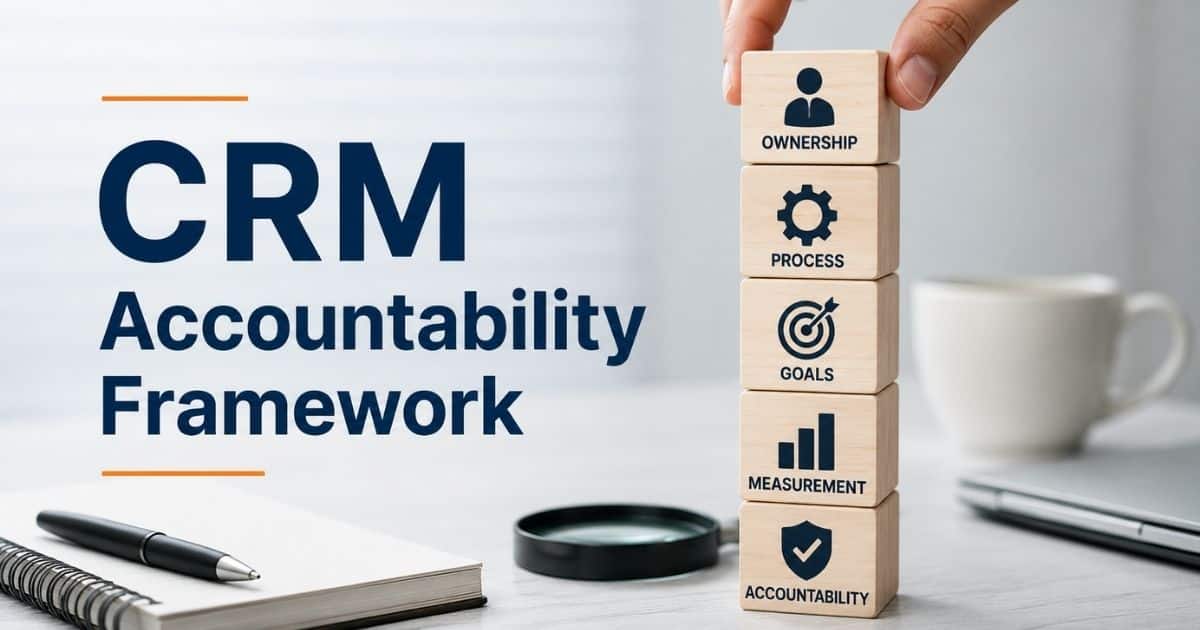
Many companies invest in CRM software but still struggle with poor data, missed follow-ups, and weak sales visibility. The problem is usually not the CRM itself. Lack of accountability creates inconsistent updates, broken workflows, and unreliable reports. Teams start working from assumptions instead of real customer data.
A strong CRM accountability framework fixes that problem. It creates clear ownership, standard processes, and measurable expectations across sales, marketing, and RevOps teams. Managers gain better forecasting. Sales reps follow cleaner workflows. Leadership gets accurate pipeline insights.
This guide explains how CRM accountability works, why it matters, and how to build a framework that improves adoption, data quality, and revenue performance.
What A CRM Accountability Framework Really Means
A CRM accountability framework is a structured accountability system that helps sales teams follow the sales process with consistency. It defines responsibility, expected behavior, and daily actions across the business. Companies use accountability frameworks to improve CRM utilization, manage CRM data quality, and support better business outcomes. Without accountability, CRM systems turn into messy databases with unreliable reports and poor pipeline visibility.
Strong CRM accountability creates clear processes, setting goals, and measurable metrics for every team member. Managers can track performance through real-time dashboards, analytics, and CRM tools. Leadership gains better control over sales, marketing, customer engagement, and compliance. Salespeople stay accountable for leads, follow-ups, and data updates.
Successful organizations establish this framework as a foundation for continuous improvement, coaching, training, and growth. Consistent execution matters because small gaps in CRM management can affect outcomes, cost, and long-term success across the enterprise.
Key Components Of A High-Performance CRM Accountability Framework
A high-performance CRM accountability framework creates structure across sales, marketing, and customer management. It helps teams follow the sales process with consistency and accuracy. Clear accountability improves CRM utilization, strengthens data quality, and supports better business outcomes. Companies with strong CRM management often achieve faster growth, cleaner pipelines, and more reliable forecasting.
Clear Roles And Ownership
Every accountability framework needs defined responsibility. Sales teams must know who manages leads, updates crm data, and handles customer follow-ups. Without ownership, crm systems quickly become disorganized. Reports lose accuracy, and managers struggle to track performance.
Clear accountability also improves team behavior and compliance. According to Salesforce, high-performing sales organizations are 2.3 times more likely to maintain structured sales processes. Strong ownership creates better execution across the business. Employees stay accountable because expectations are clear from day one.
Standard Sales Processes
Consistent sales processes create better control across the pipeline. Every salesperson should follow the same steps for lead qualification, follow-ups, and customer updates. A structured process reduces confusion and supports predictable business outcomes.
HubSpot reports that companies with defined sales processes see up to 28% higher revenue growth. Standard workflows also improve crm utilization because teams use crm tools the same way. Managers can coach more effectively when daily actions follow a repeatable framework. Better consistency leads to stronger sales performance over time.
Real-Time Metrics And Dashboards
Real-time dashboards help organizations track key metrics without delays. Managers can monitor sales activity, pipeline health, crm data quality, and customer engagement from one platform. Fast access to data supports faster decisions and better accountability.
Modern crm systems now depend heavily on analytics and dashboards. Gartner states that data-driven organizations are three times more likely to improve decision-making success. Accurate reports also help leadership establish realistic goals and identify challenges early. Strong visibility keeps sales teams focused on expected outcomes instead of assumptions.
Regular Coaching And Feedback
Strong accountability systems need regular feedback and coaching. Managers should review performance, discuss challenges, and support continuous improvement. Short coaching sessions often work better than long monthly reviews because problems get solved faster.
Sales enablement research shows ongoing coaching can improve win rates by nearly 20%. Feedback also improves crm utilization because salespeople understand how their daily actions affect business results. Effective coaching builds responsibility across the team. Employees stay engaged when leadership provides support, direction, and measurable expectations.
CRM Training And Adoption
CRM technology only works when teams use it consistently. Proper training helps employees understand processes, dashboards, analytics, and reporting standards. Many companies invest heavily in crm tools but still struggle with low adoption.
Forrester reports that poor crm adoption remains one of the biggest challenges in enterprise sales management. Training creates confidence and reduces resistance across teams. Successful organizations treat crm accountability as part of company culture, not just software implementation. Better adoption improves data quality, customer management, and long-term business success.
CRM Roles And Responsibilities That Prevent Data Chaos
Clear roles inside a crm accountability framework prevent confusion, duplicate records, and missing updates. Every team member should understand their responsibility inside the sales process. Strong ownership improves crm data quality, pipeline visibility, and customer management. Structured accountability also helps organizations maintain consistent execution across sales, marketing, and leadership teams.
Sales Reps Own Data Accuracy
Salespeople create most of the crm data inside the system. Their daily actions affect reports, dashboards, forecasts, and customer records. Poor updates often create data chaos across the business. Missing lead details and outdated pipeline stages reduce crm utilization and weaken decision-making.
LinkedIn research shows sales reps spend nearly 20% of their time searching for incomplete information. Accurate updates improve accountability and support better business outcomes. Managers can track performance more effectively when data stays current. Strong habits from sales teams build a cleaner and more reliable crm framework.
Managers Enforce CRM Standards
Managers play a critical role in crm accountability. They establish processes, review dashboards, and coach employees on expected behavior. Without management support, teams often ignore workflows and compliance standards. Accountability systems lose structure when leaders fail to monitor execution.
Salesforce reports that high-performing sales organizations are 2.1 times more likely to use consistent pipeline reviews. Regular oversight improves crm data quality and strengthens sales performance. Managers also help teams solve challenges before they affect customers or revenue growth. Clear leadership creates stronger accountability across the enterprise.
Marketing Teams Control Lead Quality
Marketing teams manage lead sources, campaign tracking, and customer engagement data. Poor lead management creates duplicate contacts, incorrect records, and weak reporting. A strong accountability framework defines how marketing transfers leads into crm systems.
HubSpot found that companies with aligned sales and marketing teams generate 208% more revenue from marketing efforts. Clean handoffs improve pipeline accuracy and reduce confusion for salespeople. Shared responsibility between departments supports better collaboration and business success. Consistent lead management also improves analytics and long-term customer relationships.
RevOps Teams Maintain System Structure
RevOps teams help organizations manage crm tools, workflows, dashboards, and reporting standards. They create the framework that keeps processes consistent across teams. Without structure, companies struggle with disconnected systems and poor visibility.
Gartner states that organizations with mature RevOps functions achieve higher forecast accuracy and faster revenue growth. RevOps teams also track metrics, monitor compliance, and improve crm utilization. Their work supports continuous improvement across sales management and customer operations. Strong system governance reduces costly data problems before they spread.
Leadership Drives Accountability Culture
Leadership sets the tone for crm accountability across the business. Executives must treat crm management as a business priority, not just a technology task. Employees follow standards more consistently when leadership stays involved and visible.
Research from McKinsey shows companies with strong accountability cultures outperform competitors in operational performance. Leaders should review reports, support training, and reinforce expected outcomes regularly. Clear direction helps teams stay focused on goals, customer experience, and business growth. A strong accountability culture creates better behavior across every level of the organization.
CRM Adoption Challenges And How Accountability Solves Them
Many companies invest heavily in CRM systems but still struggle with poor adoption. Employees skip updates, avoid workflows, and create incomplete customer records. Weak accountability often causes the problem. A strong CRM accountability framework combined with clear CRM adoption strategies to improve CRM ROI creates structure, improves behavior, and helps teams follow processes consistently across the business.
Low User Adoption
Many sales teams resist CRM tools because they see them as extra work. Salespeople often focus only on closing deals instead of updating CRM data. Poor adoption affects reports, dashboards, and pipeline visibility across the organization.
Freshworks research shows nearly 43% of CRM customers use fewer than half of their system features. Clear accountability changes that behavior. Managers can track CRM utilization through simpler sales workflows in their CRM, dashboards and performance metrics. Teams become more accountable when leadership connects CRM usage to business outcomes and sales success.
Poor Data Quality
Incomplete customer records create major business challenges. Missing emails, outdated leads, and duplicate contacts reduce trust in CRM systems. Sales and marketing teams struggle when reports contain inaccurate data.
Experian reports that poor data quality costs organizations millions every year through lost productivity and weak decision-making. Accountability systems help establish clear responsibility for CRM data updates and can be reinforced with integrated contact management to organize customer information. Managers can review compliance regularly and coach employees when problems appear. Consistent execution improves data quality and supports stronger customer management across the enterprise.
Weak Process Compliance
Many organizations create sales processes but fail to enforce them. Teams start using different workflows, which creates confusion across the pipeline. Inconsistent processes reduce forecasting accuracy and hurt customer experience, especially in complex B2B sales CRM environments for revenue teams.
Salesforce data shows high-performing companies are far more likely to enforce standardized CRM processes. Accountability frameworks create structure and control around expected daily actions. Leaders can track process compliance through analytics and real-time dashboards. Clear standards help sales teams manage leads more effectively and improve long-term business growth.
Limited Manager Oversight
Managers often lack visibility into CRM activity. Without proper oversight, teams miss follow-ups, delay updates, and ignore sales goals. Weak management support creates accountability gaps across the business.
Gartner states that organizations with strong sales management practices achieve better forecast accuracy and higher revenue performance. Regular sales pipeline CRM reviews and coaching sessions help managers identify problems faster. Better oversight also improves employee engagement and accountability. Teams perform more consistently when leadership actively supports CRM management and process discipline.
Lack Of Training And Support
Many companies implement CRM technology without proper training. Employees struggle to understand dashboards, reports, workflows, and system expectations. Confusion reduces confidence and slows CRM adoption across sales and marketing teams.
Forrester research shows poor user training remains one of the biggest barriers to CRM success. Structured onboarding, choosing CRM tools that fit your workflow, and continuous improvement programs help employees use CRM tools more effectively. Strong support also improves accountability because teams understand their responsibilities clearly. Better training creates stronger adoption, cleaner data, and more successful CRM outcomes over time.
KPI Metrics That Measure CRM Accountability Success
A CRM accountability framework needs measurable results. Clear KPI metrics help organizations track CRM utilization, sales performance, data quality, and process compliance. Strong reporting also helps leadership identify gaps early. Companies that monitor the right CRM metrics usually achieve better business outcomes and stronger customer management, especially when paired with CRM adoption best practices for sales teams.
CRM Data Completion Rate
CRM data completion rate measures how consistently teams update customer records, leads, and pipeline details. Incomplete data creates reporting issues and weak forecasting. Accurate records help sales teams make better decisions and improve customer engagement.
Research from Validity found that poor CRM data quality affects nearly 44% of business revenue projections. Strong accountability systems and dynamic contact management for smarter relationship tracking establish clear expectations for data updates. Managers can track completion rates through dashboards and analytics. Better data quality improves CRM management, reporting accuracy, and overall business performance.
Sales Activity Consistency
Sales activity metrics track calls, follow-ups, meetings, and pipeline updates inside CRM systems. Consistent execution helps organizations maintain visibility across the sales process, and automating sales tasks to stay focused and organized can support that consistency. Low activity often signals weak accountability or poor CRM adoption.
HubSpot reports that companies with structured sales tracking achieve higher win rates and stronger pipeline accuracy. Managers can use dashboards to monitor daily actions and coach employees more effectively. Regular activity tracking also improves employee accountability and customer communication. Strong consistency creates better long-term sales outcomes.
Pipeline Update Accuracy
Pipeline accuracy measures how well salespeople maintain deal stages, close dates, and revenue forecasts inside CRM tools. Outdated opportunities create confusion for leadership and reduce trust in reports.
Salesforce research shows high-performing sales organizations are far more likely to maintain accurate pipeline management practices. Accountability frameworks help teams follow standard processes for opportunity updates, as shown in case studies where teams close deals faster with Gain.io. Managers gain better visibility into business growth and forecast reliability. Accurate pipelines also support stronger decision-making across sales, marketing, and revenue operations teams.
CRM Adoption Rate
CRM adoption rate tracks how actively employees use CRM technology during daily operations. Low utilization often means teams rely on spreadsheets, notes, or disconnected systems instead of the official platform, which is why CRM for startups and small sales teams should emphasize simplicity and fit to everyday workflows.
Forrester states that low CRM adoption remains one of the biggest barriers to CRM success. Accountability systems improve adoption by creating clear responsibility and measurable expectations. Leadership can track login activity, workflow usage, and reporting behavior through real-time dashboards. Better CRM utilization strengthens collaboration, customer management, and operational efficiency across the business.
Response Time Performance
Response time metrics measure how quickly sales teams follow up with leads and customer inquiries. Slow responses reduce engagement and hurt conversion rates. Fast communication improves trust and customer experience, especially when supported by CRM with email integration to streamline communication.
Lead response studies from InsideSales found that contacting leads within five minutes can increase conversion chances significantly. Accountability frameworks help organizations establish response standards and monitor performance consistently. Managers can identify delays through CRM reports and coaching sessions. Faster follow-ups improve pipeline movement, customer satisfaction, and overall sales success.
CRM Governance Best Practices For Sales And RevOps Teams
Strong CRM governance helps sales and RevOps teams maintain clean data, consistent processes, and reliable reporting. Without structure, CRM systems become difficult to manage. Governance creates accountability across the business and supports better customer management, forecasting, compliance, and long-term operational success, especially when backed by smart CRM tools for sales teams.
Clear CRM Access Rules
Every organization needs clear rules for CRM access and permissions. Employees should only access the data and tools required for their roles. Poor access control increases the risk of data errors, duplicate records, and compliance problems.
IBM reports that data breaches caused by internal errors remain one of the biggest business security risks. CRM governance frameworks help managers establish secure processes and accountability standards. Controlled access also improves data quality and system reliability. Sales and RevOps teams can work more effectively when responsibilities stay clearly defined.
Standard Data Entry Policies
Consistent data entry policies improve CRM data quality and reporting accuracy. Teams should follow the same rules for customer records, lead updates, deal stages, and pipeline management. Inconsistent formats create confusion across sales and marketing operations, whether in B2B, services, or retail teams using CRM tools to stay organized.
Research from Gartner shows poor data quality costs organizations an average of millions every year. Standard policies help teams maintain better compliance and execution. Managers can track data consistency through dashboards and analytics. Strong governance creates cleaner reports, better forecasting, and more accurate business outcomes across the enterprise.
Regular CRM Audits
CRM audits help organizations identify outdated records, duplicate contacts, and broken workflows before they create larger problems. Regular reviews also improve accountability because teams know leadership monitors system quality closely.
Salesforce recommends routine CRM audits to improve performance and maintain long-term CRM utilization. RevOps teams can use reports and dashboards to track system health and employee activity, which is especially valuable for real estate agents using CRM tools to save time. Audits also support continuous improvement across customer management and sales operations. Better visibility helps businesses solve challenges faster and maintain stronger CRM performance.
Shared Sales And RevOps Goals
Sales and RevOps teams work better when they share common goals and metrics. Misaligned priorities often create reporting gaps, process confusion, and pipeline issues. Governance frameworks help establish unified accountability across departments.
HubSpot research shows aligned sales and operations teams generate stronger revenue performance and better customer engagement. Shared KPIs improve communication and create more consistent execution across the business. Leadership can also manage performance more effectively when teams follow the same framework for how CRM helps sales teams manage leads. Better alignment supports growth, forecasting accuracy, and operational efficiency.
Continuous Training And Reviews
CRM governance requires ongoing training and performance reviews. Employees need regular updates on workflows, compliance standards, dashboards, and CRM tools. One-time onboarding rarely supports long-term CRM success.
Forrester states that continuous training improves CRM adoption and employee engagement significantly. Regular reviews help managers coach teams and identify process gaps early. Better support also strengthens accountability and encourages consistent behavior across the organization, especially when combined with CRM tools that help startups grow smarter. Companies that invest in training usually achieve stronger CRM utilization, cleaner data, and better business outcomes.
Common CRM Accountability Mistakes That Hurt Revenue Growth
Many businesses invest in CRM systems but still struggle with weak revenue growth and poor pipeline visibility. Small accountability mistakes often create bigger operational problems over time. Clear CRM management, consistent execution, and strong leadership support help organizations avoid costly gaps in performance and customer management.
Unclear Team Responsibilities
Unclear responsibility creates confusion across sales and marketing teams. Employees may assume someone else updates CRM data, follows up with leads, or manages pipeline stages. Important customer information often gets missed when ownership stays undefined.
Gallup research shows employees perform better when role expectations remain clear. Strong accountability frameworks establish who manages each process inside the CRM system. Managers can track execution more effectively through dashboards and reports. Better ownership also improves collaboration, data quality, and customer experience across the business.
Poor CRM Data Habits
Weak data habits damage forecasting, analytics, and customer management. Salespeople may skip updates, enter incomplete records, or leave outdated opportunities inside the pipeline. Over time, poor CRM data reduces trust in reports and dashboards.
Validity research found that poor CRM data quality affects sales productivity and business performance significantly. Accountability systems help organizations create better compliance around data updates. Regular reviews and coaching improve consistency across sales teams. Clean data also supports stronger decision-making and long-term revenue growth.
Lack Of Process Enforcement
Many companies establish sales processes but fail to enforce them consistently. Teams start using personal workflows instead of standard CRM procedures. Inconsistent execution creates reporting gaps and weakens pipeline visibility.
Salesforce states that high-performing organizations rely heavily on structured sales management practices. Managers should monitor CRM utilization and process compliance regularly. Clear accountability improves employee behavior and supports predictable business outcomes. Strong enforcement also helps teams manage customer interactions more effectively across the sales cycle.
Limited Leadership Involvement
CRM accountability often fails when leadership treats CRM as only a technology tool. Employees usually follow standards more consistently when executives stay involved in reviews, reporting, and performance discussions.
McKinsey research shows organizations with strong leadership accountability achieve higher operational success. Leaders should review dashboards, monitor metrics, and support continuous improvement across departments. Active leadership creates stronger accountability culture and better employee engagement. Consistent support also improves CRM adoption and long-term business growth.
Weak Training And Coaching
Employees cannot follow CRM processes effectively without proper training and support. Many businesses focus on software implementation but ignore coaching and skill development. Poor onboarding often creates low CRM utilization and weak accountability.
Forrester reports that ongoing CRM training improves adoption and employee performance significantly. Managers should provide regular feedback, process reviews, and coaching sessions. Better support helps teams manage customer data and sales activities more accurately. Strong training also improves consistency, pipeline management, and overall CRM success.
Steps To Build A CRM Accountability Framework That Scales
A scalable CRM accountability framework helps businesses maintain consistent execution as teams grow. Clear processes, measurable goals, and strong leadership support improve CRM utilization and customer management. Companies that build structured accountability systems usually achieve better sales performance, cleaner data, and stronger business outcomes over time, especially when their CRM platform fits existing workflows and scales with the team.
Step 1: Define Clear Team Responsibilities
Every accountability framework starts with role clarity. Sales teams, managers, marketing staff, and RevOps teams should understand their responsibilities inside CRM systems. Clear ownership prevents confusion around leads, customer updates, and pipeline management.
Gallup research shows employees perform better when expectations stay clearly defined. Managers should establish who handles CRM data updates, reporting, and customer communication. Defined accountability also improves compliance and team collaboration. Strong ownership creates a better foundation for consistent CRM management and long-term business growth.
Step 2: Create Standard CRM Processes
Standard processes help organizations maintain consistency across sales activities and customer interactions. Every employee should follow the same workflow for lead qualification, follow ups, deal stages, and reporting, all grounded in a clearly defined sales process with steps and benefits. Consistent execution improves visibility and forecasting accuracy.
Salesforce reports that companies with structured sales processes achieve stronger revenue performance than businesses without process discipline. Standard workflows also improve CRM utilization because teams use the platform consistently. Clear processes reduce operational challenges and help managers coach employees more effectively through measurable actions and metrics.
Step 3: Set Measurable KPI Metrics
Strong accountability depends on measurable performance metrics. Businesses should track CRM adoption, pipeline updates, response times, and CRM data quality through real-time dashboards. Clear KPIs help leadership monitor outcomes and identify gaps quickly, and tools that emphasize usability—like those compared in Gain.io vs Salesforce CRM—can make those KPIs easier to track and act on.
Gartner research shows that data-driven organizations make faster and more accurate business decisions. Measurable goals also improve employee accountability because expectations stay visible across the team. Managers can use reports and analytics to track progress consistently. Better KPI tracking supports continuous improvement and stronger customer management across the organization.
Step 4: Train Teams Consistently
CRM technology alone cannot create accountability. Employees need regular training, coaching, and support to follow processes correctly. Many organizations fail because teams never fully understand CRM tools, dashboards, or reporting standards.
Forrester states that continuous CRM training improves adoption and operational efficiency significantly. Managers should provide feedback sessions and process reviews regularly. Better support helps employees manage customer data and pipeline activities more accurately. Consistent training also improves engagement, compliance, and long-term CRM success across growing teams.
Step 5: Review Performance Regularly
Regular performance reviews help businesses maintain accountability as operations scale. Managers should monitor dashboards, reports, and sales metrics weekly or monthly. Early reviews help organizations identify process gaps before they affect revenue growth.
McKinsey research shows companies with strong performance management practices outperform competitors operationally. Leadership should focus on coaching, feedback, and continuous improvement instead of only tracking numbers. Consistent reviews also strengthen accountability culture across sales, marketing, and RevOps teams. Better oversight supports stronger execution and long-term business success.
How Gain.io Supports CRM Accountability And Sales Execution
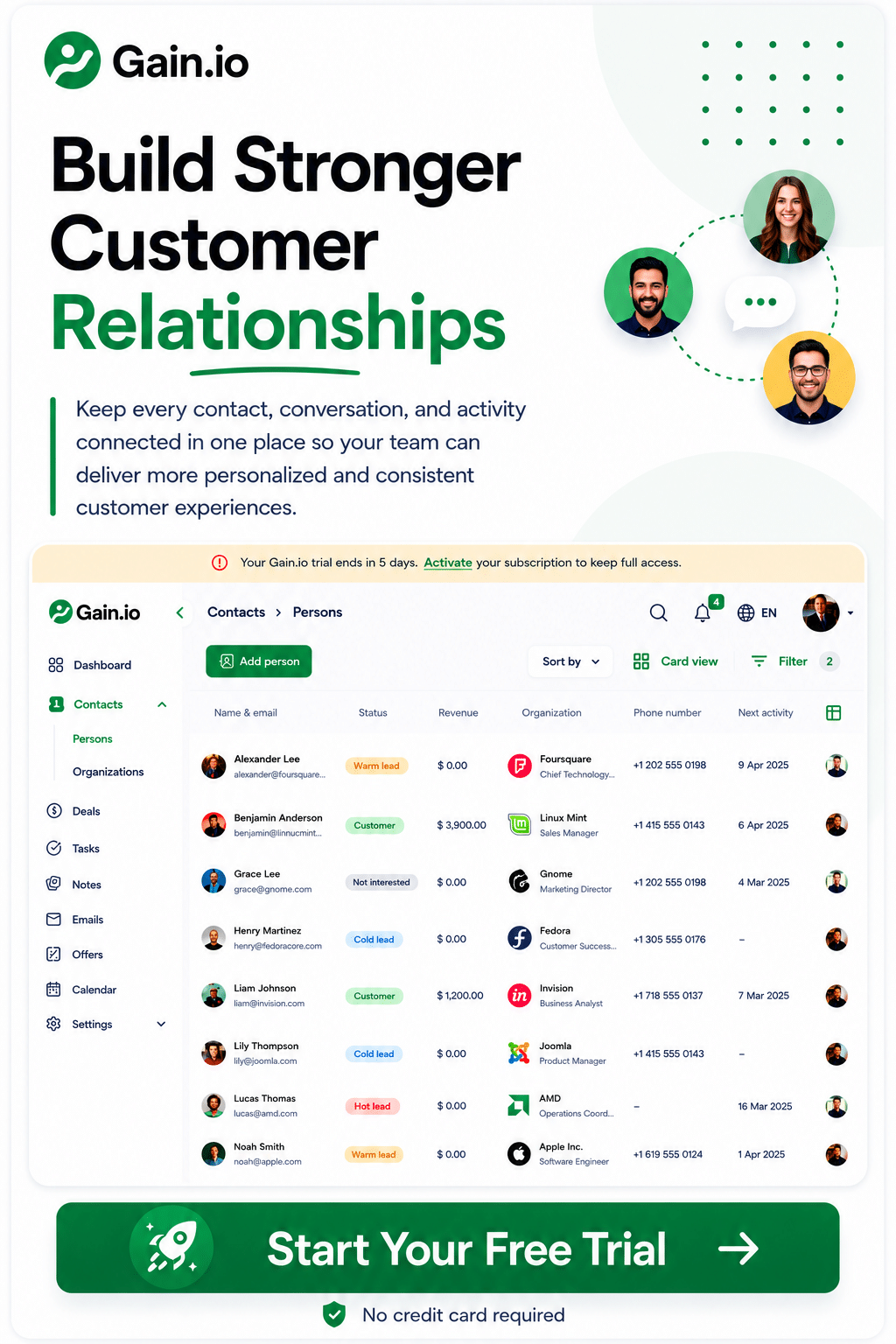
A strong CRM accountability framework depends on visibility, consistency, and clear ownership. Gain.io — all-in-one CRM to grow your sales and team helps sales and RevOps teams manage leads, track deals, automate follow-ups, and maintain accurate CRM data from one centralized platform. The system combines contact management, task tracking, visual sales pipelines, and real-time dashboards to improve CRM utilization and sales execution.
Teams can monitor pipeline progress, assign responsibilities, and track daily actions without scattered spreadsheets or disconnected tools. Automation features also reduce missed follow-ups and repetitive manual work. Managers gain better visibility into performance, forecasting, and customer engagement through structured workflows and reporting tools. Gain.io focuses on operational simplicity, which helps growing businesses improve accountability, maintain cleaner CRM processes, and support long-term revenue growth.
FAQs
Why Does CRM Accountability Matter For Revenue Growth?
CRM accountability helps sales teams maintain accurate CRM data, follow consistent sales processes, and manage customer relationships more effectively. Strong accountability improves forecasting, pipeline visibility, and business outcomes. Companies with structured CRM frameworks often achieve better sales performance and operational control.
Can Small Businesses Build A CRM Accountability Framework?
Yes. Small businesses can create a simple accountability framework with clear responsibilities, KPI metrics, and standardized CRM processes. Even basic CRM tools and dashboards help teams track leads, customer interactions, and sales activities more consistently. Strong accountability supports long-term business growth and cleaner CRM management.
Does CRM Accountability Improve Customer Experience?
Yes. Better CRM accountability improves customer response times, follow-ups, and data accuracy across sales and marketing teams. Consistent execution helps organizations deliver smoother customer experiences and stronger engagement throughout the sales process.
Which Teams Should Participate In CRM Accountability?
Sales, marketing, RevOps, leadership, and customer support teams should all participate in CRM accountability. Shared responsibility improves CRM utilization, data quality, and reporting accuracy. Cross-functional alignment also reduces process gaps and supports stronger business performance across the organization.
Can CRM Automation Reduce Accountability Problems?
Yes. CRM automation helps teams manage follow-ups, task reminders, reporting, and pipeline updates more effectively. Automated workflows reduce manual effort and improve process compliance across the business. Better automation also strengthens accountability because managers can track performance and customer activities in real time.