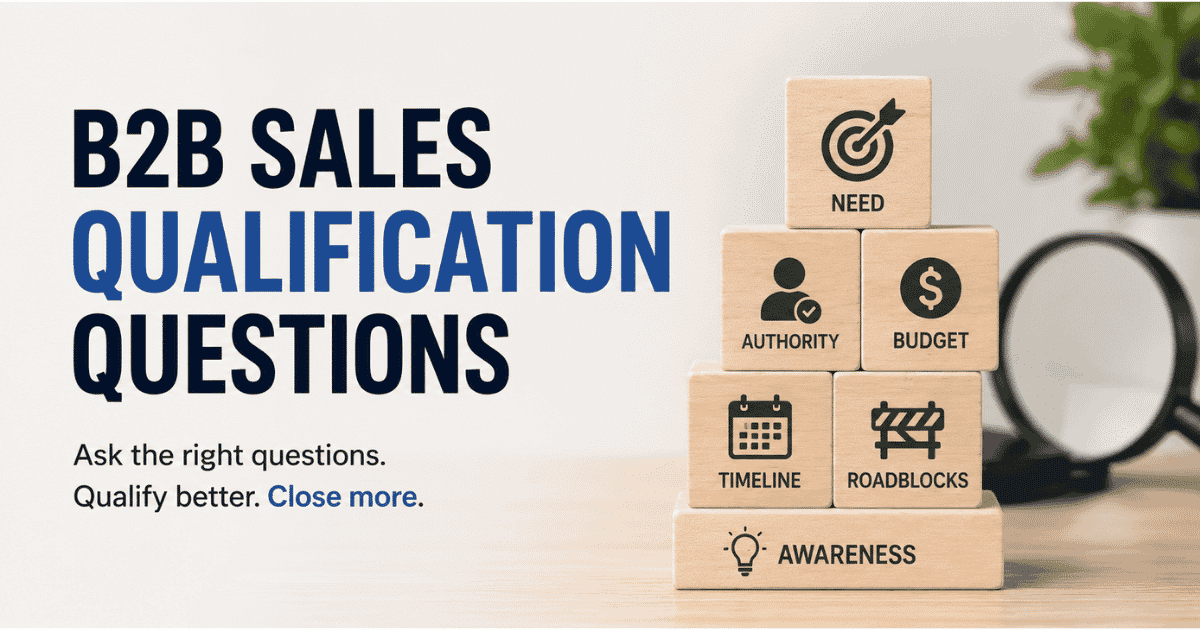
Every B2B deal starts with understanding whether a prospect is truly the right fit. Successful sales teams know that qualification goes beyond collecting information. It helps uncover pain points, business goals, and purchase readiness at an early stage.
By using the right sales qualification questions, sales reps can identify serious buyers and avoid spending time on leads that are unlikely to convert. A well-defined sales process also shortens the sales cycle and creates more productive conversations. The best sales qualification questions reveal how prospects manage their buying process, who influences the decision process, and what challenges need immediate attention.
Effective qualifying questions strengthen every sales strategy by helping teams prioritize high-value opportunities. When teams ask better questions, they build stronger relationships, improve conversions, and drive long-term business growth.
What Is B2B Sales Qualification
B2B sales qualification is the process of evaluating whether a prospect is a good fit for your product or service. It helps businesses prioritize high-quality sales leads and focus sales efforts on opportunities with the greatest potential. During qualification, teams assess business needs, budgets, timelines, and decision makers involved in the purchase decision.
The process also uncovers valuable insights about challenges, goals, and the current solution a prospect uses. Understanding the current solution's financial impact helps determine urgency and potential ROI. Since many B2B deals involve multiple stakeholders, qualification creates realistic expectations and identifies whether prospects are considering other solutions before moving forward.
Sales Qualification Process
A structured sales process helps teams identify the right buyers and improve conversions. It allows businesses to focus on qualified lead opportunities, understand customer needs, and move prospects through the sales funnel more efficiently.
Define Your Target Market
Every qualification process starts with a clear target market. Sales teams should identify industries, company sizes, and buyer profiles that match their offerings. Focusing on the right audience improves B2B lead generation efforts and makes qualifying prospects easier. It also helps teams avoid spending time on leads that are unlikely to convert.
Identify Key Stakeholders And Decision Makers
B2B purchases often involve multiple stakeholders across different departments. Sales teams must identify key stakeholders and determine who has decision-making authority. Knowing who influences the final decision helps create better engagement strategies. A team-focused approach ensures everyone involved receives relevant information and strengthens sales team collaboration.
Ask Discovery Questions
Strong discovery questions uncover business goals, key challenges, and desired outcomes. The best sales qualifying questions help sales teams provide valuable insights while understanding customer priorities. Effective sales conversations also reveal whether prospects use similar solutions or are searching for potential solutions to existing problems.
Evaluate Fit And Disqualify Prospects
Not every lead is a qualified lead. Sales teams should assess budgets, timelines, and business needs during qualifying prospects. When there is no fit, it is better to disqualify prospects early. This approach saves resources and keeps sales efforts focused on high-value opportunities.
Align Solutions With Buyer Goals
Successful solution selling connects customer needs with business outcomes. Sales reps should tailor the sales pitch around desired outcomes and measurable value. Clear communication helps set realistic expectations and supports the buyer throughout the sales funnel. As trust grows, prospects move closer to the purchase decision and final decision.
27 B2B Sales Qualification Questions
The right questions help sales teams identify high-value buyers and improve conversions. Effective qualification creates a deeper understanding of customer needs, uncovers priorities, and ensures sales reps focus on the right prospects throughout the buying journey.
1. What Business Challenges Are You Trying To Solve?
This question uncovers pain points and reveals whether your solution addresses the prospect's needs. It also helps sales teams understand business priorities and identify potential customers with urgent requirements.
2. What Goals Do You Want To Achieve In The Next 12 Months?
Understanding objectives helps align your offering with business outcomes. The answer provides a deeper understanding of expectations and shows whether the prospect fits your target audience.
3. How Are You Currently Solving This Problem?
Learning about the current provider or internal process reveals gaps in performance. It also helps sales reps position their value against existing methods or similar solutions.
4. What Do You Like And Dislike About Your Current Provider?
This question highlights strengths and weaknesses in the current relationship. It also reveals opportunities where your solution addresses unmet needs better than competing options.
5. Have You Evaluated Other Similar Solutions?
Prospects often compare multiple vendors before making decisions. Understanding the competitive landscape helps sales teams tailor conversations, apply a Challenger sales model approach, and differentiate their offering effectively.
6. Who Will Be Involved In The Purchase Decision?
B2B buying often includes several stakeholders. Identifying decision-makers early helps sales teams engage the right people and avoid delays during the sales cycle.
7. What Does Your Decision Making Process Look Like?
Every company follows a unique process before selecting a vendor. Understanding the decision making process helps sales teams predict timelines and prepare for future discussions.
8. Has A Budget Been Allocated For This Project?
Budget discussions help determine purchasing readiness. Knowing whether a budget allocated already exists allows teams to prioritize qualified opportunities and forecast revenue more accurately.
9. What Happens If This Problem Remains Unsolved?
This question uncovers business impact and urgency. It also helps sales teams understand risk, prioritize right prospects, and prepare stronger discovery calls that resonate with buyers as part of a structured lead qualification process.
10. What Does Your Current Process Look Like Today?
This question helps sales teams understand workflows, bottlenecks, and inefficiencies. A clear view of the current process reveals gaps that your product can improve. It also creates opportunities to show value during discovery calls. Understanding existing workflows often leads to more relevant conversations. Open-ended questions like this encourage prospects to share details that matter. Research shows that strong discovery questions help sales reps uncover buyer priorities and qualify opportunities more effectively.
11. What Are The Biggest Obstacles Preventing Growth?
Every business faces challenges that slow progress. Asking about obstacles uncovers key pain points and their business impact. It also helps determine whether your solution aligns with urgent needs. Sales teams gain a deeper understanding of what motivates change. Prospects who face costly problems are often more likely to move forward with a purchase. This insight allows reps to tailor their sales approach to the situation.
12. Who Else Will Influence The Buying Decision?
B2B purchases rarely involve one person. Hidden stakeholders often shape requirements, approvals, and timelines. Identifying them early prevents surprises later in the sales cycle. It also helps sales teams build relationships across departments. Research shows that B2B buying commonly involves multiple participants and decision layers.
13. What Criteria Will You Use To Evaluate Vendors?
Understanding decision criteria allows sales teams to align their messaging with buyer expectations. Prospects may prioritize pricing, integration, security, or customer support. When reps know evaluation standards, they can focus on what matters most. This creates stronger conversations and reduces friction during the selection process.
14. Are You Under A Current Contract With Another Provider?
Existing agreements can affect timelines and budgets. Asking about a current contract reveals renewal dates and switching barriers. It also shows whether prospects are actively seeking alternatives or simply exploring options. This information helps sales teams forecast opportunities more accurately.
15. How Do You Typically Make Major Purchasing Decisions?
Every company follows a unique buying decision process. Some organizations require executive approval, while others rely on committees. Understanding the process helps sales teams plan follow-ups and avoid delays. It also ensures resources reach the right people at the right time.
16. What Would Success Look Like After Implementation?
This question helps define measurable goals and expected outcomes. Buyers often have different ideas of success. Clear expectations allow sales teams to position value effectively. It also creates alignment between business objectives and product capabilities.
17. How Has Your Team Addressed This Issue In The Past?
Past experiences reveal what worked and what failed. Prospects may have tested other approaches with limited results. Learning about previous attempts helps refine your sales approach and avoid repeating mistakes. It also uncovers gaps that your solution can fill.
18. What Concerns Do You Have About Adopting A New Solution?
Buyers often hesitate because of risk, cost, or implementation challenges. Thoughtful questions help uncover objections before they become deal blockers. Sales reps who actively listen can address concerns with relevant examples and data. Building rapport through honest conversations creates trust and improves long-term relationships. Research shows that active listening and discovery calls play a major role in successful qualification.
19. What Potential Obstacles Could Delay This Project?
Every deal faces challenges along the way. Asking about potential obstacles helps sales teams prepare for delays before they happen. Buyers may mention internal approvals, budget concerns, or resource limitations. Addressing issues early makes it easier to move forward with confidence.
20. Who Else Should Be Involved In This Discussion?
Many B2B deals include other stakeholders beyond the primary contact. Identifying them early prevents surprises later in the process. It also helps sales teams create alignment across departments. Research shows that business purchases often involve groups rather than individuals.
21. What Is Your Current Budget For Solving This Problem?
Budget discussions reveal purchasing readiness and priorities. Understanding the current budget helps determine whether expectations align with available resources. It also allows sales teams to recommend solutions that fit business needs without creating friction.
22. Which Tools Are Part Of Your Existing Tech Stack?
A prospect's tech stack can affect implementation and integration. Learning about current systems helps identify compatibility issues early. It also ensures your solution fits into existing workflows and reduces future disruptions.
23. How Will You Measure Success After Implementation?
Success metrics vary from one company to another. Some focus on revenue growth, while others prioritize efficiency or customer experience. Understanding success criteria helps buyers make an informed decision and creates stronger alignment throughout the sales cycle.
24. What Would Prevent Your Team From Moving Forward?
This question uncovers hidden concerns and potential roadblocks. Buyers may hesitate because of risk, timing, or internal priorities. Open discussions allow sales teams to address objections before they affect progress.
25. What Additional Information Do You Need To Decide?
Prospects often require case studies, demos, or technical details before making a choice. Asking thoughtful, open ended questions helps uncover missing information. Sales teams can then provide relevant resources that support the buying process.
26. Would More Meetings With Other Teams Be Helpful?
Complex deals often require conversations with finance, operations, or IT teams. Additional discussions can clarify requirements and build internal support. Early collaboration also strengthens sales lead qualification and improves deal momentum.
27. What Happens If You Keep Your Current Approach?
This question encourages prospects to evaluate the cost of inaction. It helps them dig deeper into existing challenges and compare your offering with other providers. Great sales conversations ask questions early, actively listen to responses, and pay attention to body language. Those insights reveal urgency and help buyers make informed decisions. Research shows that open-ended discovery and active listening improve qualification outcomes and customer trust.
B2B Buyer Readiness Checklist For High-Quality Leads: P.R.I.M.E.S. Qualification Model
Not every lead is ready to buy. The P.R.I.M.E.S. Qualification Model helps sales teams evaluate buyer readiness, prioritize opportunities, and focus on prospects that are more likely to convert into long-term customers by clarifying the difference between MQL vs SQL.
P – Problem Recognition
A buyer must first recognize a clear business problem. Prospects who understand the cost of their challenges are more likely to seek solutions actively. Sales teams should ask whether the problem affects revenue, productivity, or customer satisfaction. When buyers acknowledge the impact, urgency increases and deals move faster. Research shows that effective qualification begins with understanding business pain and buying intent.
R – Resource Availability
Even interested buyers need resources to move forward. Sales teams should confirm budget, staff availability, and technical readiness. A prospect without resources may delay implementation despite strong interest. Resource checks also help set realistic expectations and improve sales forecasting accuracy. Traditional qualification frameworks consistently use budget and readiness as core buying signals.
I – Influence & Authority
B2B purchases rarely depend on one person. Teams must identify decision-makers, champions, and influencers early in the process. A contact may support the solution but lack purchasing authority. Understanding internal dynamics reduces delays and strengthens account strategies. Enterprise deals often involve multiple stakeholders and buying committees, making authority mapping essential.
M – Market Need
A prospect may have authority and budget but still lack a strong need. Sales teams should evaluate whether the solution aligns with business priorities and market demands. Buyers with urgent needs are more likely to act quickly. Strong qualification focuses on fit, intent, and timing rather than interest alone. Matching solutions to real business challenges across clear sales pipeline stages improves conversion rates and sales efficiency.
E – Execution Barriers
Many deals fail because of hidden obstacles. Procurement rules, integration issues, legal reviews, or internal resistance can slow progress. Sales teams should uncover barriers early and create plans to address them. Identifying risks before they become problems helps maintain momentum and improves close rates. Modern frameworks emphasize spotting deal risks during discovery rather than late in the sales cycle, especially when using a visual sales pipeline.
S – Sales Timeline
Timing is a critical indicator of readiness. Prospects with defined deadlines often have stronger intent to buy. Sales teams should understand implementation goals, renewal dates, and purchase schedules. A clear timeline helps prioritize opportunities and allocate resources effectively. Most qualification models include timing because it directly influences deal velocity and forecasting accuracy.
The P.R.I.M.E.S. framework gives sales teams a practical method for identifying high-quality leads. By evaluating problems, resources, authority, market need, execution barriers, and timelines, businesses can focus on buyers who are truly ready to move forward.
Why Do You Need A Sales Qualification?
Sales qualification is not just a filtering exercise. In modern B2B sales, it determines forecast accuracy, resource allocation, and deal velocity. Without qualification, teams risk pursuing opportunities that never reach a buying decision or distort core sales pipeline health metrics.
Prevent Pipeline Inflation
Many sales pipelines look healthy on paper but contain low-probability deals. Poor qualification creates inflated forecasts and unrealistic revenue expectations. Frameworks like MEDDIC were designed specifically to solve this problem by identifying buyer intent, authority, and decision paths early. Companies that apply structured qualification and use a dedicated sales pipeline CRM often achieve more predictable pipelines and stronger forecast accuracy. Research consistently links qualification frameworks with improved pipeline quality and revenue predictability.
Navigate Complex Buying Committees
B2B purchases rarely involve a single buyer. Modern deals often include finance, procurement, IT, and executive teams. Missing one stakeholder can stall a deal for months. Sales qualification helps uncover economic buyers, champions, and hidden influencers before they become obstacles and is essential for an effective account-based selling strategy. Studies show that enterprise deals increasingly involve multiple decision-makers and complex approval processes.
Reduce Wasted Sales Effort
Sales teams often spend valuable time on opportunities that were never viable. Qualification reveals whether a prospect has budget, urgency, authority, and business need. Early disqualification is just as important as qualification because it frees resources for high-value accounts and prevents common lead generation mistakes. High-performing teams use qualification frameworks to focus only on winnable deals rather than relying on intuition.
Improve Deal Velocity And Close Rates
Long sales cycles often result from unclear buying processes and missing information. Qualification identifies decision criteria, approval steps, and purchase timelines early in the cycle. This allows sales teams to remove friction before it delays progress and to align with upstream lead generation strategies. Organizations using structured qualification methods frequently report faster sales cycles and higher win rates.
Build Data-Driven Revenue Forecasts
Revenue forecasting fails when pipelines contain unqualified opportunities. Accurate qualification creates cleaner CRM data and stronger predictions. Research in B2B predictive modeling and predictive sales analytics shows that data-driven opportunity evaluation improves decision-making and increases monetary outcomes. Sales leaders can allocate resources more effectively when forecasts reflect actual deal quality rather than optimism.
Open-Ended vs. Closed Questions in B2B Sales
Great sales conversations rely on asking the right question at the right time. Open-ended and closed questions serve different purposes. Top-performing sales reps use both strategically to uncover needs, qualify buyers, and advance deals, supported by modern sales communication tools.
Aspect | Open-Ended Questions | Closed Questions |
|---|---|---|
Purpose | Explore context and challenges | Confirm facts and details |
Response Length | Detailed answers | Short answers |
Best Stage | Discovery and qualification | Validation and closing |
Buyer Insight | High | Limited |
Example | "What challenges are affecting growth?" | "Do you have a budget?" |
Main Benefit | Reveals motivations | Speeds up decisions |
Use Open-Ended Questions To Discover Buyer Needs
Open-ended questions encourage prospects to share experiences, priorities, and challenges. They usually begin with "what," "how," or "tell me about." Such questions help sales reps uncover hidden pain points and understand the business context behind a purchase. Research shows that open-ended questions reveal decision criteria and buyer motivations that closed questions often miss. They also support stronger discovery calls and consultative selling.
Use Closed Questions To Confirm Key Information
Closed questions typically require a yes, no, or short response. They are useful for verifying budgets, timelines, and decision-making authority. Sales teams use them to confirm facts before moving deals forward. While they provide less context, they create clarity and reduce ambiguity during qualification. Research on survey methods consistently finds that closed questions are easier to analyze but offer less detailed insight.
Match Question Types To The Sales Stage
Open-ended questions work best during discovery because they encourage buyers to explain challenges and goals. Closed questions become more valuable later when confirming next steps or securing commitments. High-performing sales teams shift between both styles throughout the sales cycle. Research suggests that effective discovery balances exploration with validation rather than relying on one approach alone.
Build Trust Through Better Conversations
Buyers prefer conversations that focus on their business rather than product features. Open-ended questions allow prospects to speak more and help reps listen actively. Studies suggest successful reps often let buyers do most of the talking during discovery calls. This approach creates trust and improves qualification quality. Closed questions then help summarize agreements and maintain momentum.
Combine Both For Better Qualification
The best sales professionals do not choose between open and closed questions. They combine both to gather insights and validate information. An open question may uncover a challenge, while a closed question confirms urgency or budget. Using both methods creates a complete picture of buyer readiness and leads to stronger sales outcomes. Research consistently shows that balanced questioning improves qualification and conversion rates, which are core sales KPIs for most B2B teams.
Finally, How to Spot Poor-Fit Prospects Before They Drain Your Pipeline
Not every prospect deserves a place in your pipeline. Poor-fit leads consume time, delay forecasts, and reduce sales productivity. Watch for warning signs early in the qualification process. Prospects without a clear business problem, budget, or decision-making authority rarely move forward. Frequent delays, vague timelines, and low engagement often signal weak buying intent.
Be cautious when stakeholders avoid meetings or cannot explain their purchase criteria. A lack of urgency or measurable goals is another red flag. Great sales teams are not afraid to disqualify leads that do not match their ideal customer profile. By focusing on high-intent buyers and learning how to organize sales leads, businesses improve win rates, shorten sales cycles, and build a healthier pipeline with stronger revenue potential.
FAQs
What Criteria Define A Qualified Prospect In B2B Sales?
A qualified prospect typically has a clear business need, budget, decision-making authority, and a realistic purchase timeline. They also fit the ideal customer profile and demonstrate genuine interest. Strong prospects show urgency, involve key stakeholders, and have challenges that your solution can effectively address.
Why Is Lead Qualification Essential For Sales Success?
Lead qualification helps sales teams focus on high-value opportunities instead of unqualified leads. It improves forecast accuracy, shortens sales cycles, and increases win rates. By prioritizing the right buyers and using robust sales reporting in a CRM, businesses use resources more efficiently and create stronger customer relationships that drive long-term revenue growth.
Which Sales Qualification Framework Works Best For B2B?
There is no universal framework for every business. BANT works well for simple sales, while MEDDIC suits complex enterprise deals. CHAMP emphasizes customer challenges, and GPCT focuses on goals. The best framework depends on deal size, sales complexity, and target market requirements and should integrate with a structured lead management process.
When Should Sales Teams Disqualify A Prospect?
Sales teams should disqualify prospects when there is no clear business need, budget, authority, or timeline. Consistent delays, lack of engagement, and poor fit with the ideal customer profile are also warning signs. Early disqualification protects pipeline quality and improves sales productivity.
How Often Should Businesses Requalify Sales Opportunities?
Sales opportunities should be requalified at major stages of the sales cycle. Buyer priorities, budgets, and stakeholders can change over time. Regular requalification ensures deal data remains accurate, reduces forecasting errors, and helps sales teams focus on opportunities that remain viable.
For more on this topic, see our guide on 5 Best Simple CRMs For Small Businesses In 2026 (Ranked).
For more on this topic, see our guide on Customer Interaction Tracking In CRM For Long-Term Business Growth.
For more on this topic, see our guide on Sales Time Management Ideas To Improve Sales Workflows.