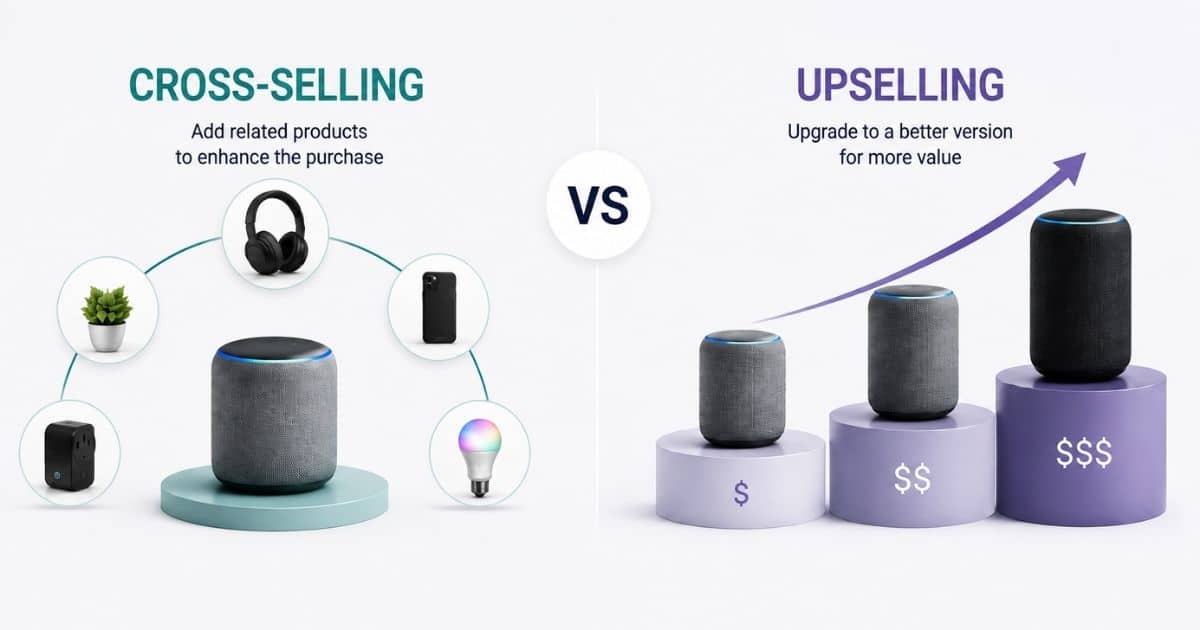
Cross-selling and upselling both grow revenue from customers you already have, but they work in different ways. Cross-selling adds a related product to the sale. Upselling moves the customer to a higher-tier version of what they already picked. Mixing up the two costs you deals. A rep who pitches an upgrade when the customer just needs an add-on sounds pushy.
A rep who suggests an add-on when the customer is ready to upgrade leaves money on the table. Sales teams that get this right time each pitch to the moment in the deal, not just the highest price tag. Below, you'll find the exact differences between cross-selling and upselling, plus the signals that tell you which one to use next.
Cross Selling Vs Upselling: At A Glance
Dimension | Cross-Selling | Upselling |
|---|---|---|
Sales Intent And Goal | Adds related or complementary products to widen the purchase | Moves the customer to a higher-priced version of the same product |
Timing In The Sales Cycle | Usually offered right after the initial purchase | Usually surfaces later, once usage hits a ceiling |
Impact On Revenue And Deal Size | Increases revenue through smaller add-on line items | Boosts revenue faster through a single higher-value upgrade |
Customer Experience And Perception | Feels helpful when tied to real usage and builds strong customer relationships | Feels like a natural fit when it solves a limit the customer has actually hit |
Pricing And Value Proposition | Stays low-cost relative to the original order | Carries a bigger price jump tied to added capability |
What Is Cross-Selling?
Cross-selling means offering existing customers a related product alongside what they're already buying. A CRM buyer might get a suggestion for a reporting add-on or an integration that fits their workflow. The goal is added value, not a bigger bill.
Good cross selling techniques rely on timing and relevance, not guesswork. Recommendations that match real usage build customer satisfaction instead of annoyance. Satisfied customers buy more over time, which raises customer lifetime value without adding new leads to the pipeline, especially when supported by CRM automation benefits for sales and growth.
What Is Upselling?
Upselling means moving a customer to a higher tier of the product they already picked. A CRM buyer on a starter plan gets pointed toward a plan with more automation or higher usage limits. The upgrade should solve a real limit they've hit, not just add cost.
As a sales technique, upselling works best when it's tied to genuine need. Encouraging customers to upgrade at the right moment builds customer loyalty instead of resistance. Most teams run upselling and cross selling opportunities together, since a bigger plan often opens the door to add-ons too, lifting average order value across the deal. Well-structured upselling strategies to boost customer lifetime value make those upgrades feel like a natural next step instead of a hard sell.
Cross-Selling Vs Upselling: Key Differences

Cross-selling and upselling both grow deal size, but they pull different levers. Five dimensions set them apart: intent, timing, revenue impact, customer experience, and pricing. Knowing each helps reps quickly pick the right pitch next, especially when they rely on a solid foundation in how CRM helps sales teams manage leads.
Sales Intent And Goal
Cross selling aims to widen what a customer buys in one sitting. A rep suggests related or complementary products that pair naturally with the item already in the cart, instead of pushing something unrelated just to raise the invoice.
Upselling chases a different target. It points the customer toward higher priced alternatives inside the same product line, betting that more capacity or extra features solve a problem the base plan can't.
Cross selling refers to breadth across a purchase, while upselling narrows in on depth within one decision. Cross selling focuses on variety, upselling on scale. Both end at the same place: a bigger deal without a new lead.
Timing In The Sales Cycle
Timing separates these two tactics more than most reps realize. Cross-selling usually shows up right after the initial purchase, when the customer journey has already produced enough data to know what fits next.
Upselling tends to surface later, once usage patterns reveal a ceiling. A customer who outgrows a plan a few months after they purchase gives the rep a natural, low-pressure opening.
Effective cross selling requires paying attention to signals inside the existing customer base rather than guessing at launch. Reps who wait for the right moment close more often than reps who pitch everything before value has even landed, and CRM follow-up automation for better sales conversions helps surface those signals at the right time.
Impact On Revenue And Deal Size
Revenue impact is where the two tactics start to look similar on a spreadsheet but behave differently in practice. Cross-selling can increase revenue by adding smaller line items, which lifts total transaction value without changing the core deal.
Upselling moves the number differently. A single upgrade can boost revenue faster than several small add-ons, since the price jump applies to the whole contract instead of one accessory.
Both tactics build toward higher customer lifetime value over time. Customers who stay longer and buy more consistently produce a higher customer lifetime value than one-time buyers ever will, regardless of which tactic got them there first.
Customer Experience And Perception
How a customer feels about the pitch matters as much as the pitch itself. A well-timed suggestion for complementary products reads as helpful, while a mistimed upgrade offer can feel like a sales push.
Reps who identify complementary products based on actual usage build strong customer relationships instead of eroding them. That trust compounds, turning one-time buyers into repeat customers who return without a new campaign pulling them back.
Customer acquisition gets the first sale through the door, but perception decides what happens after. A customer who feels understood during a cross-sell or upsell conversation sticks around long after the invoice is paid, especially when teams use a sales collaboration CRM to align around the customer.
Pricing And Value Proposition
Pricing tells its own story about intent. Cross-selling usually stays cheap relative to the original order, since the goal is to round out a purchase, not double its cost.
Upselling carries a bigger price jump because it replaces the original item with a stronger version, asking the customer to pay more for more capability rather than more stuff.
Successful cross selling and effective cross selling strategies both suggest relevant products based on real usage data, not a generic script. Get the value proposition right, and the price difference stops feeling like a cost and starts feeling like an upgrade worth paying for, especially when backed by strong CRM adoption strategies to improve CRM ROI.
Cross-Selling Vs Upselling Examples
A CRM buyer signs up for the core plan, and a few weeks later gets a suggestion for a call-logging add-on that fits how their team already works. That's cross-selling in action, often delivered through post purchase follow ups once usage data shows what the customer actually needs. Sales representatives who wait for this signal, instead of pitching everything on day one, avoid the sales follow-up mistakes growing teams face and close more add-ons without feeling pushy.
Upselling shows up differently. A support team maxes out its ticket volume on a basic plan and gets moved to a tier built for that load. The upgrade solves a real limit, which is why it lands well instead of feeling like a hard sell.
This is why cross selling important to any growth motion built around new customers as well as an existing base. Done well, it lifts average order without needing a fresh marketing strategy. Done poorly, it can overwhelm customers with offers that don't fit their stage. Get the timing right, and both tactics strengthen brand loyalty and the broader business relationship, not just the invoice.
When To Cross-Sell Vs When To Upsell

Timing decides whether a cross-sell or upsell lands well or falls flat. These six moments show exactly when each move fits naturally into the deal cycle, not just where the price tag sits.
Right After A Deal Closes
The moment a deal closes is the best time to introduce a complementary product, while purchase history is still fresh and the customer remembers exactly why they bought.
A rep who offers a package deal here, instead of pushing an unrelated upgrade, builds repeat business early. This is also where multiple products naturally fit together, since the customer's short-term needs are still top of mind, and reps rarely need a hard sales pitch to make it land.
Usage Data Hits A Ceiling
When usage data shows a customer bumping against plan limits every week, upselling aims squarely at that pain instead of guessing at a generic sales pitch.
Moving that account to a premium plan solves a problem they already feel, which is why the offer rarely needs convincing. It also supports steady revenue growth, since the upgrade reflects real usage rather than a forecast built on hope. Teams that watch this signal convert more of these moments into an easy yes.
A Renewal Or Contract Review Is Coming Up
A renewal date puts both sides back at the table, which makes it a natural point to revisit the plan instead of waiting for the customer to raise it first. It also gives leaders a clean checkpoint for tracking deals from lead to close in a complete sales process.
Handled well, this conversation protects a company's reputation for fair pricing while opening the door to a higher tier. Customers who feel heard at renewal tend to become the ones driving repeat purchases for years, not just the next quarter.
A Support Ticket Reveals A Gap
A support ticket often surfaces a need the account team never pitched, since the customer is describing a real problem rather than reacting to a sales offer they didn't ask for.
Solving it with a complementary tool, instead of a workaround, protects a business's reputation for actually listening. Customers remember which vendor fixed the gap without turning the ticket into a sales conversation, and that memory outlasts the invoice long after it's paid.
The Customer Asks For More
Sometimes the customer just asks outright, wondering what else the plan can do or whether a bigger version exists. That's about as direct a signal as any rep will get, and it deserves a fast, specific answer.
Walking through the multiple benefits of the next tier, instead of just quoting a price, helps the customer decide with confidence. Answering directly here tends to shorten the whole conversation instead of stretching it into another call.
Budget Or Buying Season Lines Up
Budget cycles and seasonal buying windows create a narrow window when customers already have money set aside to spend. Catching that window beats waiting for them to come back later with a smaller budget.
A well-timed package deal or upgrade offer here rarely feels like a push, since the timing matches the customer's own planning cycle. Reps who track these windows close more without ever sounding like they're chasing a quota.
How A CRM Helps You Run Both

A CRM turns cross-sell and upsell timing into something reps can see instead of guess. The right signals sit right inside deal and usage data, waiting to be read, which is why CRM software for modern sales teams focuses so heavily on centralizing this information.
Spotting Cross-Sell Signals In Deal Data
Deal records show exactly what current customers already own, which makes it easy to spot complementary items they haven't added yet. A rep scanning a closed-won deal can purchase products into the conversation naturally, especially when they use smart CRM features to organize sales better that flag what pairs well with the original order.
This works best with a deep understanding of the account, not a generic add-on list. CRMs that surface usage alongside purchase history turn a cold guess into a relevant, well-timed suggestion the customer actually wants.
Spotting Upsell Signals In Deal Data
Usage fields tell a different story than purchase history alone. When an account keeps brushing against its limits, that pattern is the clearest cue to upsell before the customer starts shopping competitors for advanced features.
A CRM that tracks this across the customer base lets reps prioritize accounts closest to outgrowing their plan. Instead of pitching premium products at random, the rep works from a shortlist the data already built, significantly improving how CRM improves sales productivity for the team.
Cross-Selling And Upselling Best Practices

Good timing and a fitting offer matter more than any script. These three habits separate reps who close naturally from reps who chase a number.
Timing The Offer
The best moment to nudge customers rarely lines up with a quarterly quota push. It lines up with a signal in the data, such as a renewal date or a recent usage spike.
Take a previous example: an account that hit its ticket limit two weeks before renewal took the upgrade without hesitation, because the timing matched a problem they were already feeling. That's a good deal for both sides, not a forced one.
Personalizing The Pitch
A pitch built on a deep understanding of how the account actually works lands better than one built on a template. Referencing a wireless mouse add-on to a hardware reseller means nothing if their real gap lies elsewhere entirely.
Positive testimonials from similar accounts help here too, giving the pitch proof instead of just a claim. The more specific the reference, the less it sounds like a script, and it also supports smoother CRM adoption by sales teams because reps see clear, relevant examples in their own workflow.
Avoiding A Pushy Pitch
Upselling strategies that chase profit margins over fit tend to backfire fast, especially when the customer feels rushed into an expensive version they didn't ask for. That short-term win rarely survives the next renewal conversation.
The better approach is patient enough to foster long-term loyalty instead. An e-commerce site that waits for the right cart signal, rather than upselling on every checkout, keeps the pitch feeling like help instead of pressure, mirroring how CRM adoption is changing modern sales teams to prioritize relevance over volume.
Using Customer Data Instead Of Guesswork
Guesswork is where most weak pitches start. A rep working off memory or a hunch usually reaches for the same three add-ons regardless of what the account actually needs, instead of using email tracking CRM benefits and features to see which messages and offers actually land.
Deal and usage data remove that guesswork entirely. Purchase history, support tickets, and login frequency all point toward the same answer: what this specific account is close to needing next, not what sold well to someone else last quarter, and robust sales reporting in a CRM makes those patterns visible.
Reps who build the pitch from that data close faster, since the offer already matches a problem the customer recognizes. The conversation feels like a diagnosis, not a script, especially when teams rely on clear CRM notes and mentions best practices to keep context intact across every touch.
Training Reps On Both Techniques
Most reps default to whichever tactic they learned first, which means half the opportunities in their pipeline go untouched. A rep comfortable with upselling but shaky on cross-selling will miss add-on revenue sitting in plain sight.
Training that covers both, side by side, fixes this gap early. Reps learn to read the same signal two ways: a usage ceiling points toward an upgrade, while a workflow gap points toward a complementary tool.
Teams that train on both consistently see steadier results, since reps stop defaulting to one play and start matching the offer to the account in front of them, freeing up more time for selling through better sales time management tips for sales teams.
Conclusion
Cross-selling and upselling both grow revenue from customers you already have, but they solve different problems. Cross-selling rounds out a purchase with something that fits. Upselling moves the customer to a version built for where they're headed next. Neither works well as a script recited on every call.
The teams that get this right treat timing as the real skill, not the pitch itself. A renewal date, a usage ceiling, a support ticket, a customer asking outright; each moment points toward one tactic over the other. Read the signal correctly, and the offer stops feeling like a sell. It starts feeling like the CRM, and the rep behind it, actually paying attention.
FAQ
Can You Use Cross-Selling And Upselling Together?
Yes, and most strong revenue motions run both at once. A renewal conversation might include an upgrade to a higher tier alongside a complementary add-on that rounds out the account's setup. The two tactics don't compete for the same moment; they solve different problems side by side. Reps just need to read which signal is stronger before deciding which one leads the conversation.
Does Cross-Selling Work Better In B2B Or B2C?
Cross-selling works in both, but the mechanics differ. B2C leans on fast, low-stakes add-ons at checkout, driven by habit and convenience. B2B cross-selling moves slower and depends on account data, since the buyer needs a clear reason tied to their workflow. Neither is better outright, but B2B cross-selling typically requires more context before the pitch lands well.
How Do You Measure Cross-Sell And Upsell Success?
Track attach rate for cross-sells and upgrade rate for upsells, then follow both against retention over the next few renewal cycles. Revenue lift alone can be misleading if it comes with higher churn. The clearest signal is whether accounts that took the offer stick around longer and expand further than accounts that didn't.
What Is A Good Cross-Sell Or Upsell Acceptance Rate?
This varies heavily by industry and price point, so there's no single benchmark worth quoting as universal. What matters more is the trend within your own account base over time. A rate that climbs quarter over quarter usually means the timing and targeting are improving, while a flat or falling rate is worth investigating before pushing harder on volume.
Do Customers Get Annoyed By Cross-Sell Or Upsell Offers?
Only when the offer ignores context. A relevant suggestion tied to real usage rarely irritates anyone, since it reads as helpful rather than salesy. The annoyance shows up when timing is off or the pitch repeats after a clear no. Most complaints trace back to frequency and relevance, not the tactic itself.