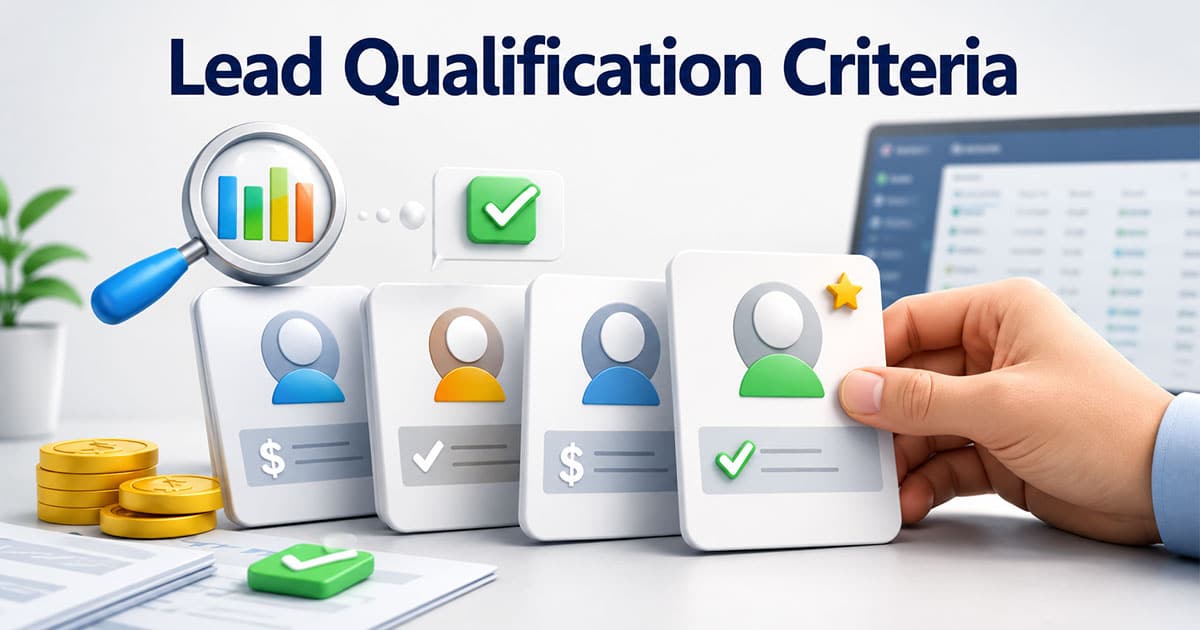
Lead qualification criteria help sales teams focus on the right prospects. Not every lead is ready to buy. Some need more time. Some are not a fit at all. Clear criteria remove guesswork and keep your pipeline clean.
Strong qualifications improve conversion rates and shorten sales cycles. Sales teams spend less time chasing low-quality leads. Instead, they prioritize buyers with real intent and budget.
This guide breaks down how lead qualification criteria work. It also covers frameworks, key data points, and practical steps. You will learn how to qualify leads with clarity and confidence.
What Is Lead Qualification Criteria In Sales
Lead qualification criteria define how sales teams evaluate leads before moving them through the sales funnel. It helps sales and marketing teams separate high-quality leads from unqualified leads. A clear lead qualification process looks at factors like company size, job title, budget, and the lead’s pain points. It also checks the decision criteria and the decision-making process. This ensures only sales-qualified leads move forward, while marketing-qualified leads stay in nurturing.
Strong lead qualification frameworks like BANT (budget, authority, need) or MEDDIC (metrics, economic buyer) guide the process. Many teams also use a lead scoring model or predictive lead scoring to automate lead qualification. This helps sales reps prioritize leads and focus on the most promising leads. With proper lead qualification and scoring leads, teams shorten the sales cycle and improve sales success.
Essential Components Of Effective Lead Qualification Criteria
Clear lead qualification criteria help sales teams focus on quality leads instead of chasing every opportunity. It creates alignment between marketing and sales teams and improves the lead qualification process. A structured approach helps prioritize leads, reduce longer sales cycles, and convert qualified leads faster.
Define Ideal Customer Profile Clearly
A strong lead qualification strategy starts with a clear Ideal Customer Profile. Sales and marketing teams must align on company size, job title, and industry. This helps filter out unqualified leads early in the lead generation process. Without this clarity, sales reps waste time on poor-fit prospects.
Data shows that companies with a defined ICP see up to 68% higher win rates. A good ICP also improves lead scoring criteria and supports predictive lead scoring. It ensures marketing efforts attract high-quality leads that match your product or service.
Align Marketing And Sales Teams Goals
Sales success depends on alignment between marketing and sales teams. Both sides must agree on what qualifies as marketing qualified leads and sales qualified leads. This alignment reduces friction and improves the lead qualification system.
Research shows aligned sales and marketing efforts can increase revenue by up to 20%. Shared goals help teams prioritize leads and move sales-accepted leads faster through the sales pipeline. It also ensures better scoring and lead qualification across the funnel.
Use Lead Scoring System Effectively
A lead scoring system ranks leads based on behavior and profile data. It helps sales teams focus on the most promising leads instead of guessing. A strong lead scoring model uses firmographic and behavioral signals.
Modern teams use marketing automation to automate lead scoring. Comparing AI lead scoring vs manual scoring helps teams understand where automation adds the most value. Integrating lead scoring with CRM improves the lead scoring process and supports automated lead qualification across the sales funnel.
Ask The Right Qualification Questions
A proper lead qualifying process depends on asking the right questions. Sales reps should identify pain points, decision criteria, and the economic buyer early. Frameworks like BANT and CHAMP help structure these conversations.
Clear lead qualification questions uncover the lead’s pain points and the decision process. It also helps understand multiple stakeholders involved. This reduces delays in the sales cycle and ensures better quality leads enter the pipeline.
Apply Proven Lead Qualification Frameworks
Lead qualification frameworks bring structure to the sales process. Models like BANT (budget, authority, need) and MEDDIC (metrics, economic buyer, decision criteria) are widely used. They help evaluate leads with consistency.
Studies show teams using structured frameworks see up to 30% shorter sales cycles. These frameworks help sales operations standardize the lead qualification checklist. They also ensure sales reps focus on qualified leads and avoid wasting time on low-value opportunities.
Lead Qualification Frameworks And How Sales Teams Use Them
Sales teams rely on proven lead qualification frameworks to evaluate leads with clarity. BANT, CHAMP, and MEDDIC help structure the lead qualification process and improve consistency. Each framework supports better decisions, stronger pipelines, and faster movement through the sales funnel.
BANT Framework
BANT stands for budget, authority, need, and timeline. It helps sales reps qualify leads early in the sales process. This framework focuses on key qualification criteria like the economic buyer and decision criteria. It works well for short sales cycles and high-volume sales leads.
Recent sales data shows that teams using BANT improve lead qualification efficiency by up to 25%. It supports faster sales calls and helps prioritize leads. BANT also reduces unqualified leads and keeps the sales pipeline clean. It is a simple but effective lead qualification checklist for many sales teams.
CHAMP Framework
CHAMP focuses on challenges, authority, money, and prioritization. It starts with identifying pain points before budget or authority. This makes it ideal for complex sales where customer problems drive the decision-making process. It aligns well with modern sales and marketing goals.
Studies suggest that customer-focused qualification can increase conversion rates by 20% or more. CHAMP helps sales teams uncover deeper insights into the lead’s pain points. It also improves collaboration between marketing and sales teams and supports a more effective lead qualifying process.
MEDDIC Framework
MEDDIC stands for metrics, economic buyer, decision criteria, decision process, identify pain, and champion. It is widely used in enterprise sales and longer sales cycles. This framework helps evaluate leads with precision and reduces risk in large deals.
Research shows that companies using MEDDIC see up to 30% higher forecast accuracy. It helps sales operations track multiple stakeholders and align with the decision process. MEDDIC also supports high-quality leads and improves the chances to convert qualified leads in complex sales environments.
How To Define An Ideal Customer Profile For Qualification
A clear Ideal Customer Profile helps sales teams focus on the right potential customers. It strengthens the lead qualification process and improves lead scoring accuracy. A strong ICP aligns marketing and sales teams and drives better results across the sales funnel.
Firmographic Data Fit
A solid ICP starts with firmographic data like company size, industry, and revenue. Sales and marketing teams use this data to filter qualified leads early. It ensures that marketing qualified leads match real business potential before reaching sales reps.
Reports show that companies using firmographic targeting improve lead quality by over 50%. This data also supports lead scoring criteria and predictive lead scoring. It helps prioritize leads and reduce unqualified leads in the sales pipeline.
Decision Makers And Roles
A strong lead qualification strategy focuses on the right job title and role. Sales reps must identify the economic buyer and key stakeholders in the decision-making process. This improves the lead qualifying process and reduces delays in the sales cycle.
Studies show that deals with direct access to decision makers close 2x faster. Clear insight into authority helps sales teams avoid wasted sales calls. It also supports better scoring leads and ensures focus on high-quality leads.
Pain Points And Needs
An effective ICP highlights the lead’s pain points and core challenges. Sales teams must identify pain and align it with the product or service. This improves qualification criteria and ensures better fit for the solution.
Data suggests that 70% of buyers choose vendors who understand their challenges well. Strong alignment between pain points and solutions improves sales success. It also helps convert qualified leads faster within the sales funnel.
Past Wins Analysis
Past deals provide valuable insights for defining ICP. Sales operations should review sales accepted leads and closed deals. This helps identify patterns in high-quality leads and the most promising leads.
Companies that analyze past sales data improve win rates by up to 30%. It strengthens the lead scoring model and supports automated lead qualification. This approach also aligns marketing efforts with real sales outcomes.
ICP And Lead Scoring Alignment
A strong ICP must connect with the lead scoring system and lead qualification checklist. Integrating lead scoring with ICP improves the lead scoring process and scoring and lead qualification accuracy.
Research shows that businesses using integrated lead scoring and ICP see up to 20% higher conversion rates. It helps sales teams focus on quality leads and shorten longer sales cycles. This alignment also improves overall sales and marketing goals.
Key Data Points That Strengthen Lead Qualification Criteria
Strong lead qualification criteria rely on accurate and relevant data. Sales and marketing teams need clear signals to evaluate leads and prioritize the most promising leads. The right data improves your lead scoring model, reduces unqualified leads, and strengthens the overall sales process.
Firmographic And Company Data
Firmographic data includes company size, industry, revenue, and location. It helps sales teams match leads with the Ideal Customer Profile. This is a core part of the lead qualification process and supports better lead scoring criteria.
Studies show that companies using firmographic filters see up to 50% improvement in lead quality. This data helps marketing teams refine lead generation efforts. It also ensures sales reps focus on high-quality leads instead of wasting time on poor-fit prospects.
Behavioral Engagement Signals
Behavioral data tracks how leads interact with your product or service. It includes website visits, email clicks, and demo requests. This data plays a key role in the lead scoring process and automated lead qualification.
Research shows that behavior-based lead scoring can improve conversion rates by 20%. It helps sales teams identify the most promising leads early. It also supports predictive lead scoring and improves accuracy in the sales funnel.
Demographic And Role Insights
Demographic data focuses on job title, seniority, and department. It helps identify the economic buyer and key stakeholders in the decision-making process. This improves the lead qualifying process and supports better qualification criteria.
Data suggests that targeting the right roles can double conversion rates. It helps sales reps prepare better for each sales call. It also ensures alignment with sales and marketing goals and improves overall sales success.
Pain Points And Intent Data
Intent data reveals the lead’s pain points and buying interest. It shows what problems the lead wants to solve. Sales teams use this data to identify pain and align solutions with real needs.
Reports show that intent-driven lead qualification efforts can increase pipeline efficiency by 30%. It helps prioritize leads and reduces longer sales cycles. It also improves the chances of converting qualified leads faster.
Lead Scoring And Predictive Data
Lead scoring data combines multiple signals into a clear score. A strong lead scoring model uses both historical and real-time data. Predictive lead scoring adds AI to identify patterns in high-quality leads.
Companies using predictive lead scoring report up to 25% higher sales productivity. It helps automate lead scoring and supports a strong lead qualification system. This ensures better scoring and lead qualification across the sales pipeline.
Lead Qualification Criteria Vs Lead Scoring Differences
Lead qualification criteria and lead scoring both help evaluate leads, but they serve different roles in the sales process. One defines fit and readiness. The other ranks leads using data. Together, they improve sales and marketing alignment and pipeline efficiency.
| Aspect | Lead Qualification Criteria | Lead Scoring |
|---|---|---|
| Purpose | Defines whether a lead is a good fit based on clear qualification criteria | Ranks leads based on likelihood to convert using a lead scoring model |
| Focus | Looks at factors like budget, authority, need, and pain points | Uses behavioral and demographic data for scoring leads |
| Approach | Often manual or checklist-based using lead qualification frameworks | Data-driven and automated with predictive lead scoring |
| Key Users | Sales teams and sales reps during the lead qualifying process | Marketing teams and sales operations for prioritizing leads |
| Timing | Applied during sales calls and early sales process stages | Applied continuously across the lead generation process |
| Tools Used | CRM notes, lead qualification checklist, sales conversations | Marketing automation, lead scoring system, analytics tools |
| Outcome | Identifies sales-qualified leads and filters unqualified leads | Highlights the most promising leads for follow-up |
| Impact On Sales Cycle | Helps reduce longer sales cycles by filtering early | Speeds up response time and improves sales pipeline flow |
| Role In Alignment | Aligns sales and marketing teams on qualification standards | Supports shared sales and marketing goals through data |
| Best Use Case | Useful for deep evaluation and decision process clarity | Useful for scaling and automating lead qualification efforts |
Common Mistakes That Reduce Qualification Accuracy
Lead qualification accuracy often drops due to gaps in process, data, or alignment. Small mistakes can push unqualified leads into the sales pipeline and slow down sales teams. Fixing these issues improves lead qualification efforts and boosts overall sales success.
Unclear Qualification Criteria
Clear lead qualification criteria are the foundation of a strong lead qualification process. Many sales and marketing teams operate without defined standards. This leads to confusion between marketing qualified leads and sales qualified leads. It also creates inconsistency in the lead qualifying process.
Research shows that 61% of B2B marketers send all leads directly to sales without proper filtering. This increases unqualified leads and wastes time. A clear lead qualification checklist helps sales reps evaluate leads with confidence and improve pipeline quality.
Poor Sales And Marketing Alignment
Sales and marketing alignment plays a key role in successful lead qualification. Misalignment creates gaps in sales and marketing efforts. It leads to disagreement on qualification criteria and delays in the sales process.
Studies show that misaligned teams can lose up to 10% of annual revenue. Shared sales and marketing goals improve collaboration. A robust, shared lead qualification process ensures better scoring and lead qualification and helps prioritize leads more effectively across the sales funnel.
Weak Lead Scoring Model
A weak lead scoring model reduces the accuracy of evaluating leads. Many teams rely on outdated lead scoring criteria or ignore behavioral data. This limits the effectiveness of the lead scoring process and predictive lead scoring.
Data shows that companies using advanced lead scoring systems see up to 20% higher conversion rates. Integrating lead scoring with CRM and marketing automation improves automated lead qualification and demonstrates how CRM improves sales productivity. It also helps sales teams focus on the most promising leads.
Ignoring Pain Points And Intent Data
A strong lead qualification strategy must identify pain points and buyer intent. Many sales reps skip this step during a sales call. This results in poor understanding of the decision process and weak qualification criteria.
Reports show that 70% of buyers choose vendors who understand their needs. Identifying the lead’s pain points improves lead qualification accuracy. It also helps convert qualified leads faster and reduces longer sales cycles in the sales pipeline.
Lack Of Structured Qualification Frameworks
Lead qualification frameworks like BANT, CHAMP, and MEDDIC provide structure to the sales process. Many teams ignore these frameworks or use them inconsistently. This creates gaps in evaluating leads and impacts sales operations.
Studies show that structured frameworks can shorten sales cycles by up to 30%. A consistent lead qualification system helps sales teams focus on high-quality leads. It also improves decision-criterion analysis and supports better sales success.
How To Optimize Lead Qualification Criteria For Better Conversions
Optimized lead qualification criteria help sales teams convert more qualified leads without wasting effort. A refined approach improves lead scoring, aligns sales and marketing teams, and shortens the sales cycle. It ensures focus stays on the most promising leads.
Refine Qualification Criteria Regularly
Clear lead qualification criteria should evolve with market changes and customer behavior. Sales and marketing teams must review qualification criteria often. This helps remove outdated assumptions and improve the lead qualification process.
Research shows that companies updating qualification criteria quarterly see up to 15% higher conversion rates. Regular updates improve lead qualification strategy and reduce unqualified leads. It also keeps the sales pipeline filled with high-quality leads.
Integrate Lead Scoring With CRM
A connected lead scoring system improves visibility across the sales funnel. Integrating lead scoring with CRM allows sales reps to access real-time data and shows how CRM helps sales teams manage leads. This supports better scoring leads and faster decisions during the sales process.
Data suggests that CRM-integrated lead scoring can increase sales productivity by 20%. It also supports predictive lead scoring and automated lead qualification. This helps prioritize leads and move sales-accepted leads faster through the pipeline.
Align Sales And Marketing Efforts
Strong alignment between marketing and sales teams improves lead qualification accuracy. Both teams must agree on sales-qualified leads and marketing-qualified leads. This ensures consistent scoring and lead qualification across the funnel.
Studies show aligned sales and marketing efforts can drive up to 20% revenue growth. Shared goals improve collaboration and reduce friction. Clear rules for MQL vs SQL lead definitions also help sales teams focus on quality leads and achieve better sales success.
Use Data-Driven Qualification Frameworks
Lead qualification frameworks like BANT, CHAMP, and MEDDIC improve decision-making. These frameworks help evaluate leads based on budget, authority, and pain points. They bring structure to the lead qualifying process.
Companies using structured frameworks report up to 30% shorter sales cycles. Data-driven frameworks improve qualification criteria and support better sales operations. They also help convert qualified leads more efficiently.
Leverage Automation And Predictive Insights
Modern tools like marketing automation and predictive lead scoring enhance the lead qualification system. These tools analyze behavior, intent, and firmographic data. They help automate lead scoring and deliver sales automation benefits.
Reports show predictive lead scoring can increase conversion rates by 10–20%. Automated lead qualification reduces manual work and speeds up the sales cycle. Using dedicated sales automation software ensures sales reps focus on the most promising leads and improve overall performance.
Final Thoughts
Lead qualification criteria shape how efficiently sales teams convert opportunities into revenue. Clear qualification criteria, strong lead scoring, and proven frameworks help filter out unqualified leads and highlight the most promising leads. This keeps the sales pipeline focused and improves overall sales success.
Alignment between sales and marketing teams plays a critical role. Shared goals, accurate data, and a structured lead qualification process ensure better decisions at every stage of the sales funnel. When teams work together, they reduce friction and improve conversion rates.
FAQs
How Does Lead Qualification Criteria Adapt To Multi-Product Sales Models?
Lead qualification criteria must adjust based on product-qualified leads and use cases. Sales teams refine qualification criteria for each product or service. This improves lead scoring and ensures the right leads enter the correct sales pipeline.
Can Predictive Lead Scoring Replace Manual Lead Qualification Completely?
No, predictive lead scoring cannot fully replace manual lead qualification. Automated lead qualification improves efficiency, but sales reps still need to validate decision criteria and the economic buyer during the sales process.
Does Lead Qualification Criteria Impact Customer Retention And Expansion?
Yes, strong lead qualification criteria improve long-term customer value. When sales and marketing teams focus on high-quality leads, it leads to better-fit customers and smoother post-sale growth across the sales funnel.
How Do Multiple Stakeholders Affect The Lead Qualifying Process?
Multiple stakeholders complicate the decision-making process and require deeper lead qualification efforts. Sales reps must identify authority, map decision criteria, and align with each stakeholder to convert qualified leads effectively.
Can Integrating Lead Scoring With Sales Operations Improve Forecast Accuracy?
Yes, integrating lead scoring with sales operations improves forecast accuracy. A strong lead scoring system and scoring and lead qualification process help prioritize leads and give better visibility into the sales pipeline.