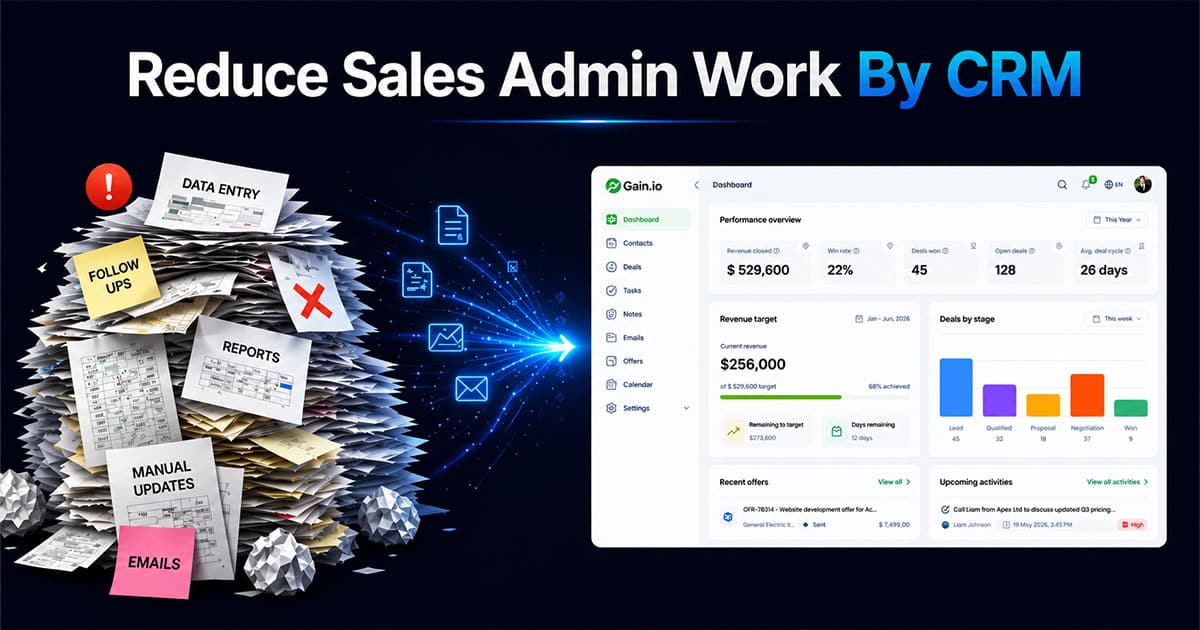
TL;DR: Salesforce's own research puts non-selling admin work at roughly 60% of a rep's week. Modern CRMs cut that by automating data entry, follow-ups, and activity logging — this guide covers why admin work piles up, what a modern CRM automates away, and a step-by-step process to cut it.
Sales teams spend too much time on admin work. Updating CRM records. Logging calls. Writing follow-ups. Creating reports. All of it eats into selling time. Deals slow down. Opportunities slip away. Teams feel busy, but results do not match the effort.
Modern CRM systems change that. They remove repetitive tasks and bring everything into one place. Sales reps focus more on conversations and closing deals. Less admin. More selling. In this guide, learn how modern CRMs help reduce sales admin work effectively and improve team performance.
Sales Admin Work Explained
Sales admin work includes all the small tasks that support the sales process. Think manual data entry, crm data entry, and updating deal stages. Sales reps also manage contact records, meeting notes, and report generation. They jump between multiple tools, communication platforms like slack or Microsoft Teams, and calendar systems. Constant tool switching and back and forth slow the sales team. Admin tasks grow fast and reduce selling time.
Admin work affects sales productivity and revenue growth. Reps spend hours on data entry, manual spreadsheet work, and handling administrative tasks. Data formats vary, and data accuracy drops. Sales managers struggle with pipeline visibility, performance metrics, and pipeline analysis. Deal cycles get longer, and closing deals becomes harder.
Modern systems use intelligent automation and automation tools to reduce sales admin work. Automated workflows handle routine tasks, data enrichment, and updating existing records. Teams gain measurable time savings and efficiency gains. Sales representatives focus on revenue-generating activities, building relationships, and revenue generation.
Reasons Sales Teams Struggle With Excessive Admin Tasks
Sales teams deal with more admin work than ever. Tools promise efficiency, but reality looks different. Reps spend large parts of the day on admin tasks instead of actual selling activities. This gap slows revenue generation and affects performance across the sales organization.
Too Many Tools Create Constant Switching
Sales teams rely on multiple tools for daily work. CRM, email, calendar systems, and communication platforms like slack or Microsoft Teams all run together. Reps move back and forth between multiple platforms all day. Constant tool switching breaks focus and reduces selling time.
Data from Salesforce shows sales reps spend only about 28% of their time on actual selling activities. The rest goes to admin tasks and internal work. Poor integration affects pipeline visibility and slows deal cycles.
Manual Data Entry Slows Down The Sales Process
Manual data entry remains one of the biggest challenges. Sales reps update crm data entry, contact records, deal records, and meeting notes after every interaction. Manual effort increases quickly across the sales process.
Research from HubSpot shows reps spend up to 17% of their time on data entry. Manual data reduces data accuracy and creates errors. Poor crm data impacts pipeline analysis, pricing decisions, and performance metrics.
Lack Of Automation In Routine Tasks
Many sales teams still depend on manual workflows for routine tasks. Tasks like follow-ups, updating deal stages, and report generation take time. Without automated workflows, reps repeat the same admin work daily.
Automation tools bring measurable time savings and efficiency gains. Intelligent automation helps reduce sales admin work and supports revenue generation. When powered by AI, AI sales automation also improves lead scoring, personalization, and forecast accuracy. Without it, reps spend less time on revenue generating activities and more on admin time.
Poor Data Management And Fragmented Records
Customer data often sits across multiple tools and systems. Contact details, existing records, and customer data may not match. A modern platform for managing contacts prevents different data formats from creating confusion and errors across the sales organization.
According to Forrester, poor data quality can cost businesses up to 12% of revenue. Weak data integrity and missing data enrichment reduce trust in reports. Sales managers struggle with pipeline visibility and deal size accuracy.
Too Much Internal Communication And Meetings
Sales teams spend hours on internal meetings, updates, and coordination. Sales leaders and revenue leaders ask for constant updates on sales activities and deal stages. Communication tools increase collaboration but also create noise.
Reps spend less time on closing deals and building relationships. Back-and-forth communication increases admin work and reduces selling time. Less focus on revenue-generating work impacts sales productivity and slows revenue growth.
Role Of Modern CRM Systems In Reducing Sales Admin Work
Modern CRM systems change how sales teams handle admin work. They replace manual effort with automation and structured workflows. Sales reps spend less time on admin tasks and more time on revenue-generating activities. That shift improves sales productivity and shortens deal cycles.
Centralize Customer Data And Contact Records
Modern CRM systems store all customer data in one place. Contact records, deal records, meeting notes, and communication history stay connected. With a simpler sales workflow in your CRM, sales reps no longer jump across multiple tools to find information. That improves pipeline visibility and reduces admin time.
Data from Salesforce shows teams with a unified CRM improve productivity by up to 34%. Centralized crm data also improves data accuracy and data integrity. Sales managers get better pipeline analysis and clearer performance metrics.
Automate Data Entry And Activity Tracking
Automation removes the need for manual data entry. CRM systems capture emails, calls, and meeting notes automatically. Sales reps do not need to update crm data entry after every interaction. That saves time and reduces manual effort.
Research from HubSpot shows automation can reduce time spent on data entry by up to 30%. Automated workflows keep customer data updated and accurate. Sales representatives focus more on actual selling activities and revenue generation.
Streamline Sales Process With Automated Workflows
Modern CRM systems use automated workflows to manage routine tasks. Follow-ups, updating deal stages, and report generation run automatically. A dedicated sales automation CRM helps sales teams follow a structured sales process without extra admin work.
Here's the practical difference automation makes on a rep's week:
Task | Manual Process | Automated With CRM |
|---|---|---|
Logging a call or email | Rep manually types notes into the CRM after each interaction | Interaction is captured and attached to the contact automatically |
Qualifying a lead (BANT / MEDDIC) | Rep fills out qualification fields by hand mid-call | Key fields are pre-populated from captured call and email data |
Follow-up reminders | Rep tracks follow-ups in a notebook, spreadsheet, or memory | CRM triggers the next follow-up automatically based on pipeline stage |
Pipeline reporting | Manager requests a manual pipeline export before every forecast call | Live dashboard reflects pipeline status in real time |
Frameworks like BANT, MEDDIC, and SPICED all depend on capturing the same underlying data — budget, authority, need, timeline, pain, and next steps. A modern CRM doesn't replace the framework; it removes the manual re-typing that happens every time a rep tries to apply one.
Automation tools create measurable time savings and efficiency gains. Intelligent automation reduces back and forth between systems. Sales reps spend more time selling and less time handling administrative tasks. That improves deal cycles and supports revenue growth.
Improve Pipeline Visibility And Reporting Accuracy
CRM dashboards show real-time pipeline data. Sales managers track deal stages, deal size, and sales cycle length without manual spreadsheet work. Custom reports and performance metrics update automatically.
According to Forrester, data-driven organizations are 58% more likely to exceed revenue goals. Accurate crm data improves pricing decisions and revenue systems. Comparing options like Gain.io vs Salesforce CRM helps sales leaders get better insights for revenue operations and planning.
Reduce Communication Gaps Across Sales Teams
Modern CRM systems integrate with communication tools like Slack or Microsoft Teams. Sales teams share updates, collect feedback, and track sales activities in one system. That reduces unnecessary internal meetings and back and forth.
Better communication improves collaboration across the sales organization. Sales managers and revenue leaders stay aligned without extra admin tasks. Reps spend more time building relationships and less time on admin work. That drives efficiency gains and supports revenue-generating work.
Key CRM Features That Eliminate Manual Sales Tasks
Modern CRM platforms come with features that directly reduce sales admin work. They replace manual effort with automation and smart systems. Sales reps save time on admin tasks and focus more on revenue generating activities. That improves sales productivity and pipeline performance.
Workflow Automation For Routine Sales Tasks
Workflow automation handles repetitive admin tasks across the sales process. Tasks like follow-ups, updating deal stages, and task assignments run automatically. Applying proven sales workflow automation strategies means sales reps do not need to track every step manually.
Data from Salesforce shows automation can increase productivity by up to 30%. Automated workflows reduce manual effort and improve consistency. Sales teams gain measurable time savings and focus more on closing deals and revenue generation.
Automatic Data Capture And CRM Data Entry
Modern CRM systems capture customer data from emails, calls, and forms. Contact details, meeting notes, and deal records update without manual data entry. This reduces crm data entry work for sales representatives.
Research from HubSpot shows automated data capture improves data accuracy and saves hours each week. Clean crm data improves pipeline visibility and reporting. Sales reps spend more time on actual selling activities.
Integrated Communication And Activity Tracking
CRM platforms connect with modern sales communication tools. All sales activities, emails, and conversations stay linked to contact records. Sales teams avoid switching between multiple tools.
This integration reduces back-and-forth communication and admin time. Sales managers track activity without asking for updates. Better tracking improves performance metrics and supports revenue generating work across the sales organization.
Real Time Reporting And Custom Dashboards
CRM systems provide real-time reports and custom dashboards. Sales automation software helps sales managers track deal size, deal stages, and sales cycle length without manual spreadsheet work. Report generation becomes instant.
According to Forrester, data-driven teams are more likely to improve revenue growth and efficiency gains. Accurate reports support pipeline analysis and pricing decisions. Sales leaders get clear insights for revenue operations.
Data Enrichment And Smart Record Management
CRM tools use data enrichment to improve customer data quality. Missing contact details update automatically. Existing records stay clean and consistent across systems.
Strong data integrity reduces errors in crm data. Access controls protect sensitive information. Sales teams avoid confusion from multiple platforms and data formats. Better data helps sales reps build relationships and focus on revenue generating activities.
Impact Of CRM Automation On Sales Productivity And Revenue
CRM automation changes how sales teams work every day. It removes manual effort and speeds up the sales process. Sales reps spend more time on revenue-generating activities and less on admin tasks. As a result, the benefits of CRM automation include higher efficiency, better customer experiences, and more scalable revenue operations.
More Selling Time For Sales Reps
Automation reduces time spent on admin work like manual data entry, crm data entry, and updating deal records. Sales reps no longer handle repetitive admin tasks after every interaction. A structured approach to automating sales admin tasks ensures automated workflows capture customer data and update contact records in real time.
Data from Salesforce shows reps spend only about 28% of their time on actual selling activities. CRM automation helps increase that number. More time selling leads to better revenue generation and stronger pipeline performance.
Faster Deal Cycles And Shorter Sales Process
Automation speeds up deal cycles by removing delays in routine tasks. Follow-ups, task assignments, and updating deal stages happen automatically. These sales automation benefits help sales teams move deals faster across deal stages without manual effort.
Research from HubSpot shows companies using automation see shorter sales cycle length and higher win rates. Faster deal cycles improve pipeline velocity. Real-world results, like teams that close deals faster with Gain.io, show how sales reps close deals quicker and increase overall deal size.
Higher Data Accuracy And Better Decisions
Automated systems improve data accuracy by reducing manual data entry errors. CRM data stays consistent across multiple tools and platforms. Data enrichment fills missing contact details and keeps existing records updated.
According to Forrester, better data quality leads to stronger performance metrics and improved revenue outcomes. Accurate data supports pipeline analysis and pricing decisions. Sales managers and revenue leaders make better decisions.
Improved Pipeline Visibility And Forecasting
CRM automation provides real-time pipeline visibility. Sales managers track deal stages, deal size, and sales activities without manual spreadsheet work. Custom reports update automatically with current data.
Better visibility helps sales leaders manage revenue systems more effectively. Forecasts become more reliable with accurate crm data. An AI sales assistant can further enhance visibility so sales organizations gain control over revenue operations and reduce uncertainty in revenue growth planning.
Increased Efficiency Gains Across Sales Teams
Automation tools reduce routine tasks and admin time across the sales organization. Sales representatives avoid constant tool switching between communication tools, calendar systems, and multiple platforms. That improves workflow efficiency.
Measurable time savings allow reps to focus on building relationships and revenue-generating work. Teams achieve significant productivity gains and better sales productivity. More efficiency leads to stronger revenue generation and long-term growth.
Common CRM Mistakes That Increase Admin Work Instead
CRM systems should reduce sales admin work, but poor setup can do the opposite. Many sales teams face more admin tasks after adoption. Bad processes, weak automation, and messy data increase manual effort and slow the sales process.
Overcomplicated CRM Setup And Too Many Fields
Many sales teams add too many fields and steps in the CRM. Sales reps must fill long forms for every deal record and contact record. That increases crm data entry and slows down daily sales activities.
Data from Salesforce shows poor CRM usability reduces adoption and sales productivity. Complex systems increase admin time and manual data entry. Sales representatives spend less time on revenue generating activities and more on admin work.
Lack Of Automation In Key Sales Tasks
Some teams fail to use automation tools inside the CRM. Routine tasks like follow-ups, updating deal stages, and report generation remain manual. That adds repetitive admin tasks across the sales process.
Research from HubSpot shows automation can save hours each week per sales rep. Without automated workflows, reps spend more time handling administrative tasks. Less time goes to closing deals and revenue generation.
Poor Data Management And Low Data Accuracy
CRM data often becomes messy without clear rules. Customer data, contact details, and existing records may not match across multiple platforms. Different data formats reduce data integrity and create confusion.
According to Forrester, poor data quality can cost companies up to 12% of revenue. Sales managers struggle with pipeline visibility and performance metrics. Poor data also affects pipeline analysis and pricing decisions.
Too Many Tools Without Proper Integration
Sales teams use multiple tools for communication, reporting, and tracking. CRM, email, Slack, Microsoft Teams, and calendar systems often do not sync well. The right sales task automation tools reduce how often reps move back and forth between systems.
Constant tool switching increases admin work and wastes time. Sales reps spend more time updating data than selling. Lack of integration reduces efficiency gains and impacts sales productivity across the sales organization.
Weak Adoption And Lack Of Training
Many sales teams do not use the CRM properly. Sales leaders fail to train reps on workflows, automation, and data entry best practices. These CRM adoption challenges and mistakes lead to inconsistent usage and poor crm data quality.
Studies from Gartner show low CRM adoption reduces ROI and efficiency. Sales representatives create manual workarounds like spreadsheets. Manual spreadsheet work increases admin time and reduces measurable time savings.
Step-by-Step Process To Reduce Sales Admin Work Using CRM
A clear process helps sales teams reduce sales admin work fast. CRM alone is not enough. Teams need the right setup, clean data, and smart automation. The right sales automation software ensures each step removes manual effort and improves sales productivity and revenue generation.
Step 1: Audit Current Sales Admin Tasks And Tools
Start with a full audit of sales admin tasks. List manual data entry, crm data entry, report generation, and updating deal stages. Track time spent using time tracking tools. Identify where reps spend admin time instead of actual selling activities.
Data from Salesforce shows reps spend less than one-third of their time selling. This audit highlights gaps in the sales process. A clear view of how CRM helps sales teams manage leads also helps sales managers spot bottlenecks, constant tool switching, and manual effort across multiple tools.
Step 2: Clean And Standardize CRM Data
Fix data quality issues before automation. Review customer data, contact records, and existing records. Align data formats and ensure data accuracy across the CRM. Remove duplicate deal records and incomplete contact details.
According to Forrester, poor data quality can cost up to 12% of revenue. Strong data integrity improves pipeline visibility and performance metrics. Clean crm data supports better pipeline analysis and pricing decisions.
Step 3: Set Up Automated Workflows For Routine Tasks
Build automated workflows for routine tasks. Automate follow-ups, updating deal stages, and task assignments. Reduce manual data entry and repetitive admin tasks across the sales process.
Research from HubSpot shows automation saves hours each week per sales rep. Intelligent automation reduces admin work and increases selling time. Sales representatives focus more on revenue generating activities and closing deals.
Step 4: Integrate CRM With Communication And Calendar Systems
Connect CRM with communication tools like slack or Microsoft Teams and calendar systems. Sync emails, meetings, and sales activities into one platform. Avoid back and forth across multiple platforms.
Integration reduces constant tool switching and improves efficiency gains. Sales teams access crm data, meeting notes, and contact details in one place. Better integration supports smoother deal cycles and improves sales productivity across the sales organization.
Step 5: Track Performance And Optimize Continuously
Monitor performance metrics and pipeline visibility using CRM dashboards. Track deal size, sales cycle length, and revenue growth. A dedicated sales pipeline CRM makes it easier to use custom reports for pipeline analysis and revenue operations.
Studies from Gartner show that data-driven teams achieve better efficiency gains and measurable time savings. Sales leaders collect feedback and refine workflows. Continuous improvement reduces admin work and increases revenue generating work.
How Gain.io Helps Reduce Sales Admin Work And Improve Sales Productivity
Gain.io helps sales teams reduce sales admin work with smart automation and a clean workflow. Sales reps spend less time on manual data entry, crm data entry, and updating deal stages. The platform centralizes customer data, contact records, and deal records in one place. That improves data accuracy and pipeline visibility across the sales process.
Automation tools handle routine tasks like follow-ups, report generation, and activity tracking. Purpose-built platforms help you automate sales tasks. Sales teams avoid constant tool switching across multiple tools and communication platforms. Reps focus more on actual selling activities, not admin tasks.
Sales managers track performance metrics, deal size, and sales cycle length in real time. This leads to measurable time savings, efficiency gains, and better revenue generation.
FAQs
What Is The Real Cost Of Sales Admin Work On Revenue?
Sales admin work reduces revenue generation by taking time away from selling. Sales reps spend only about 28–30% of their time on actual selling activities.
Can Automation Tools Fully Eliminate Manual Data Entry?
Yes, automation tools can remove most manual data entry and crm data entry tasks. They capture customer data, meeting notes, and deal records automatically.
Does Reducing Admin Work Improve Deal Size And Conversion Rates?
Yes, less admin work gives sales reps more time for actual selling activities and building relationships. That improves deal size and conversion rates.
How Do Time Tracking Tools Help Reduce Sales Admin Work?
Time tracking tools show where reps spend time across admin tasks, meetings, and sales activities. Sales managers identify gaps in the sales process.
Is CRM Data Quality More Important Than Automation?
No, both matter equally for reducing sales admin work. Poor data accuracy and weak data integrity create more admin tasks even with automation.