AI CRM software is revolutionizing how businesses manage customer relationships. Traditional CRM systems store data, but AI-powered CRM actively predicts customer behavior and automates critical tasks. AI-driven CRMs can predict customer retention with up to 90% accuracy. This helps your team focus on at-risk accounts before churn happens.
Organizations that use AI are already seeing increases in productivity, close rates, and average deal size. In this article, we will go through everything you need to know about choosing and implementing the best AI CRM software for your business.
What Is AI CRM Software
AI CRM software refers to customer relationship management software enhanced with ai technology. An ai powered crm helps sales teams manage customer data, track customer interactions, and organize the sales pipeline more efficiently. Unlike traditional crm systems, ai powered crm software uses predictive analytics, data analysis, and ai driven lead scoring to analyze customer behavior and improve customer engagement. Many ai crm software platforms also automate routine tasks like data entry, lead management, and follow-ups for sales reps.
Modern ai crm solutions combine ai powered tools, automated workflows, and ai assistants to support sales and service teams. Tools such as Gain.io and other ai powered crm systems can analyze historical data and sales data to provide actionable insights and improve sales forecasting. Features like ai powered chatbots, sentiment analysis, and generative ai also help businesses deliver personalized customer interactions and timely and relevant communication.
Businesses use the best ai crm software to automate tasks, improve customer relationships, and support data-driven decision-making across sales operations. Many platforms also include ai powered workflows and advanced ai capabilities that help analyze customer data, forecast customer behavior, and optimize business processes. As a result, companies can improve customer satisfaction, increase sales performance, and deliver personalized customer experiences.
Key Benefits of AI-Powered CRM
Businesses adopting AI powered CRM see measurable improvements in every customer-facing function. The technology delivers advantages that affect revenue, operational efficiency and customer satisfaction directly. These benefits extend beyond simple automation to create fundamental moves in how teams work and make decisions.
Improved Customer Insights And Personalization
AI powered CRM systems analyze vast amounts of customer data to uncover patterns and priorities that manual analysis would miss. Machine learning algorithms process purchase history, browsing behavior, engagement metrics and interaction records to build detailed customer profiles. This analysis happens continuously and updates insights as new data arrives.
Personalization matters because 76% of customers expect companies to understand their needs and tailor interactions so. AI based CRM makes this possible at scale by analyzing historical data and behaviors to predict what customers want or need next. The system creates better upsell and cross-sell opportunities by identifying patterns in successful past deals.
Automated Workflow And Task Management
AI CRM tools eliminate repetitive administrative work that consumes team capacity. Automation handles data entry, appointment scheduling, follow-up reminders and routine customer inquiries without human intervention. This move frees employees to focus on relationship building and strategic activities that require human judgment.
Sales teams benefit from automated follow-ups, client meeting management and activity tracking. Marketing teams gain tools to track campaign tasks, content creation deadlines and project milestones. Customer support teams receive automated ticket routing, resolution time tracking and priority assignment for critical issues.
Improved Sales Forecasting And Lead Scoring
AI lead scoring uses machine learning to rank prospects by conversion probability and analyzes hundreds of data points at once. Companies using AI in sales increase leads and appointments by more than 50%. The technology eliminates human error, emotion and bias from lead evaluation.
Dynamic scoring adjusts in real time as new information arrives. Scores update right away when leads visit pricing pages or engage with content. Organizations using predictive analytics are 2.5 times more apt to experience major improvements in customer satisfaction and retention.
Sales forecasting moves from spreadsheet estimates to analytical predictions. AI analyzes past sales cycles, conversion timelines and current engagement trends to forecast deal progression. These predictions help teams allocate resources well and set realistic targets backed by historical patterns rather than assumptions.
Better Customer Service And Support
AI chatbots handle up to 85% of customer inquiries and reduce workload for human agents by a lot. These systems operate continuously and provide instant responses to routine questions at any time. Chatbots access customer profiles to recommend products, suggest troubleshooting steps and guide purchase trips.
Natural language processing helps systems understand query meaning and context. Sentiment analysis identifies whether customers feel frustrated, happy or neutral during interactions. This emotional intelligence allows agents to tailor responses as needed. Companies using sentiment analysis see 25% increases in customer satisfaction.
Analytical Decision Making
AI transforms raw data into useful business strategy. Organizations highly driven by data are three times more apt to report major decision-making improvements compared to those relying less on data. AI CRM gets detailed reports and analytics that guide campaign evaluation, sales productivity improvements, customer satisfaction assessment and strategic planning.
Predictive models forecast customer churn, purchase intentions and key growth metrics. These forecasts allow proactive measures to drive retention and revenue. Companies using predictive analytics experience 62% improved customer retention rates. Knowing how to anticipate needs rather than simply react to them creates sustainable competitive advantages.
Essential Features to Look for in Best AI CRM Software
Selecting the right AI CRM software requires you to review specific capabilities that separate simple systems from intelligent platforms. The features below determine whether your investment delivers measurable returns or becomes another underutilized tool.
Predictive Analytics And Intelligence
Predictive AI analyzes historical data through machine learning to identify patterns and forecast future behaviors. The system gets into past sales cycles, conversion timelines and engagement trends to generate forecasts. Look for platforms that provide sales forecasting, customer churn prediction and customer lifetime value estimates.
Strong predictive capabilities review prospects based on multiple signals continuously. They weigh demographic fit, behavioral engagement and interaction patterns. Scores update as prospects take actions. The best AI CRM software delivers lead scoring models that become more reliable over time as better data feeds into predictive tools.
Demand forecasting helps you optimize supply chains and reduce excess inventory. Organizations using predictive analytics and CRM tools for customer retention report improvements in operational efficiency. They mitigate risk before crises develop.
Natural Language Processing Capabilities
NLP makes AI CRM tools understand context and recognize user intent in natural language interactions. The system analyzes syntax, semantics and context clues to interpret customer requests. This goes beyond keyword matching to genuine comprehension of tone and meaning.
Sentiment analysis determines whether text input categorizes as positive, negative or neutral. The technology processes emails, chat messages, call transcripts and social media posts to detect emotional tone. Organizations using sentiment analysis see 25% increases in customer satisfaction by tailoring responses.
Multilingual support lets businesses involve diverse customer bases worldwide. NLP translates and interprets multiple languages while maintaining context. Text summarization condenses large volumes of communication into concise insights that accelerate decision-making.
Automated Data Entry And Enrichment
AI driven CRM contact management and enrichment agents enhance customer records by pulling data from trusted external sources. The system scans CRM entries, identifies missing or outdated information and fills gaps using current details like job titles, firmographics and social links.
These updates happen in the background without manual research. The agent can find LinkedIn profiles, confirm job titles, update company industry classifications or flag contacts who have changed roles. Records get enriched with company size, technology stack details, recent news mentions and funding announcements.
AI standardizes company names, verifies email addresses, appends missing details and merges duplicate records. Smart matching uses natural language understanding to identify duplicates even when fields don't match. Validation checks working email addresses, proper phone number formats and whether companies remain active.
Smart Recommendations And Next Best Actions
Next best action capabilities recommend optimal steps based on customer data and predictive analytics. The system analyzes successful past deals to suggest actions for encouraging purchases. Recommendations include confidence scores and clear rationale that explains why specific actions matter.
Organizations adopting AI driven CRM automation report up to 30% higher win rates through standardized best practices. The technology helps sales reps spot perfect opportunities for follow-ups and guides service agents with recommended solutions.
Integration Capabilities With Existing Tools
Pre-built integrations and open APIs eliminate data silos across your technology stack. AI integration platforms and CRM with email integration handle authentication, API rate limiting, error handling and data mapping between different system formats. The platform must connect with marketing automation, customer support tools and ERP systems.
Customization And Scalability Options
No-code tools enable sales managers and operations teams to build and adapt workflows without technical expertise. Drag-and-drop functionality allows visual workflow mapping in minutes and supports sales task automation at scale. The platform should expand alongside your business and add new teams, product lines or territories without painful migrations.
How to Choose the Best AI CRM for Your Business
Choosing the best AI CRM software requires a structured evaluation process that matches technology capabilities to your specific operational needs. Businesses rush into vendor demos without proper groundwork, and I've seen this lead to poor adoption and wasted investment.
Assess Your Business Needs And Goals
Start by assessing your existing CRM system and identifying specific pain points. Manual processes slow your team down in certain areas. You're missing which customer insights? What opportunities slip through the cracks? Document current workflows, data quality issues, and integration requirements. This assessment creates a baseline to measure implementation success and aligns with tips for choosing CRM tools that fit your workflow.
Set concrete targets rather than vague aspirations. "Improve customer relationships" is too broad. Establish specific goals such as "increase lead conversion rates by 20%" or "reduce customer churn by 15%". Establish key performance indicators for each AI use case you plan to implement.
Your business size matters when selecting AI CRM tools. Startups and small sales teams need simple CRM solutions with economical pricing and essential features. Large enterprises require robust capabilities with advanced AI, analytics tools, and scalability for teams exceeding 250 users. Industry-specific requirements matter a lot. Retail businesses need point-of-sale integration. Healthcare organizations require compliant security features.
Assess AI Capabilities And Use Cases
Assess AI CRM solutions based on your specific use cases, technical requirements, and budget constraints. Leading platforms include Salesforce Einstein, Microsoft Dynamics 365 AI, HubSpot AI, and Zoho Zia. Each offers different strengths. Request demonstrations focused on your priority use cases and ask for customer references from similar organizations.
Modern AI powered CRM platforms are designed to be user-friendly. The platform has AI tools built directly into it, which makes them available and easy to adopt. The AI works in the background to provide insights and automation. This makes the user experience simpler.
Think Over Budget And Pricing Models
Small businesses typically spend between USD 30,000 and USD 50,000 per year on AI and often benefit from cost-effective cloud CRM software. Entry-level CRM plans average USD 23. Mid-tier and high-tier plans jump to USD 102 and USD 403.
Different pricing structures exist. Per-user pricing charges a fixed fee for each individual accessing the CRM. Flat-fee pricing involves paying a fixed amount whatever the user count. Tiered pricing offers packages with varying features and functionality. Many vendors now include AI feature access or credits per user, which can increase costs for larger teams.
Factor in additional expenses beyond the base price. CRM implementation fees and phases, data migration costs, ongoing support, and customization expenses affect total cost of ownership by a lot.
Check Integration Requirements
Prioritize AI based CRM platforms with pre-built integrations for your existing technology stack and simpler sales workflows. Work with experienced implementation partners who understand both your business processes and technical architecture. A CRM that connects naturally with marketing automation tools, e-commerce platforms, and customer support software unites customer data into a unified profile.
Review Vendor Support And Training
Assess the CRM provider's customer support team availability, responsiveness, and expertise. Pay special attention to service quality during the free trial phase. The software provider won't impress you to win your business? They likely won't after you've signed a contract.
Invest in training that helps your team understand not just how to use AI CRM features but why they matter and how they make jobs easier. Address concerns about AI replacing human roles by emphasizing how the technology increases human capabilities.
How to Implement AI CRM Successfully
Implementation success depends on systematic execution rather than rushing into full deployment. Most AI CRM projects fail due to poor data quality and inadequate change management.
Prepare Your Data And Systems
You need to conduct a full data audit to review quality, completeness and accessibility before you integrate AI into your CRM. Companies that maintain high-quality data experience 20-30% revenue increases. Remove duplicates, correct inaccuracies and standardize formats for all data types. Critical fields like email and purchase history should have less than 5% missing values. Poor data integrity causes a 20-30% reduction in AI-driven campaign performance.
Train Your Team On AI Features
Treat your AI agent like a new team member you're onboarding, not software you're installing. Set aside 4-6 hours weekly for focused AI training that uses real-life data. Build feedback loops to coach your AI as it learns. Address concerns about AI replacing roles. Emphasize how technology increases human capabilities.
Start With High-Impact Use Cases
Start with straightforward AI features like email summaries or conversational search. You can expand into advanced automation later. Run small-scale pilots to assess functionality in real scenarios. Focus on repetitive tasks such as data entry and follow-up and sales task automation where AI delivers immediate time savings.
Monitor Performance And Optimize
Track measurable results that include faster data entry, reduced manual logging and improved forecast accuracy powered by sales activity tracking software. Monitor time saved, prediction accuracy and CRM adoption rates as key performance indicators.
Scale AI Adoption Across Teams
Develop a multi-phase scaling roadmap with clear timelines. Standardize AI tools across departments to maintain consistency. Strong data governance for regulatory compliance becomes essential as you expand.
How Gain.io Supports Sales Teams With AI CRM Software
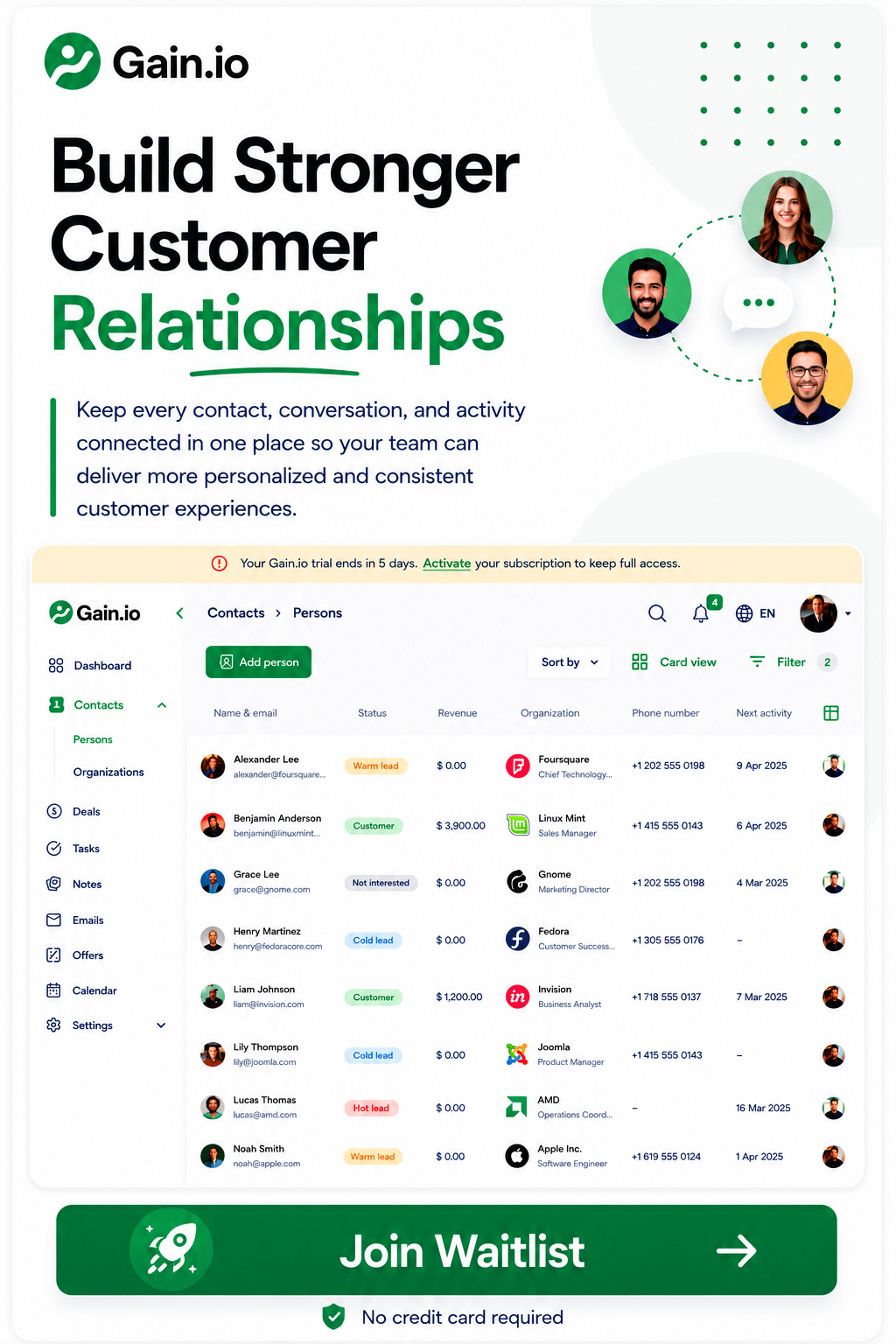
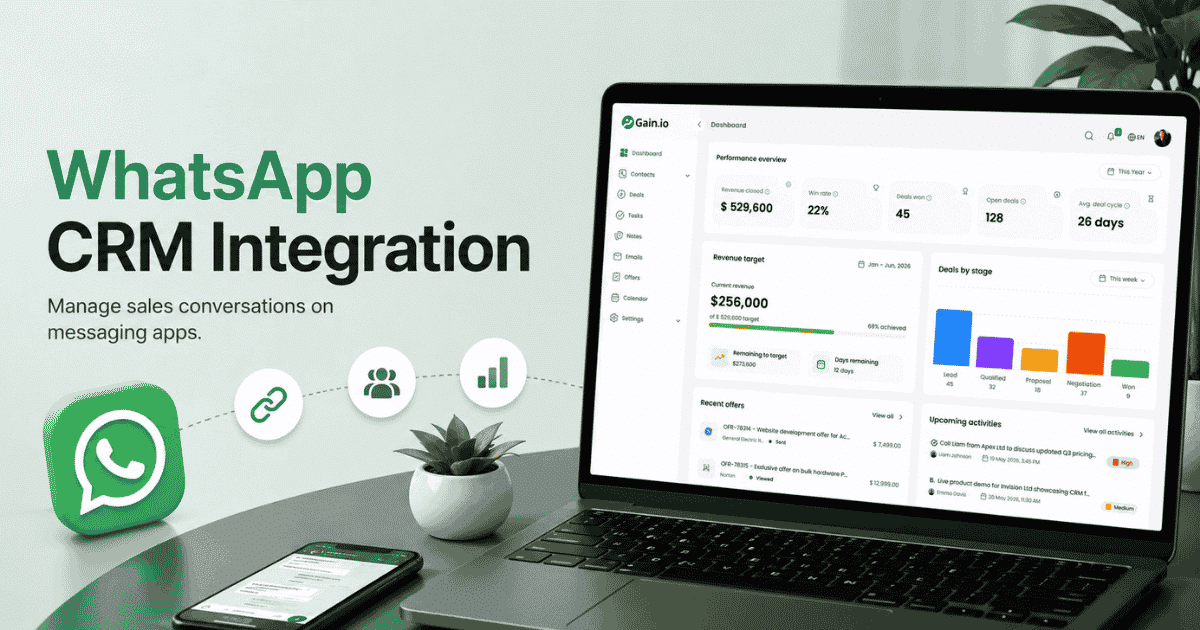
Gain.io helps businesses manage customer relationships with modern ai crm software. The platform supports sales teams with smart tools that organize customer data, track customer interactions, and manage the sales pipeline in one crm platform. With ai powered features and predictive analytics, teams can analyze customer behavior and forecast future sales trends. Sales reps also receive actionable insights that improve lead management and customer engagement.
The platform works as a sales focused crm that simplifies sales operations and routine tasks with smart CRM tools for sales teams. Ai powered workflows reduce manual data entry and automate tasks across business processes. AI-driven lead scoring and data analysis help teams analyze historical data, crm data, and sales data for better data-driven decision-making.
Gain.io also supports personalized customer experiences through timely and relevant communication, helping sales teams close deals faster with a streamlined CRM. Ai powered tools and automated workflows help sales and service teams improve customer satisfaction and build stronger customer relationships.
FAQs
Is AI CRM Software Suitable For Small Businesses?
Yes, ai crm software can work well for small businesses that want better customer relationship management. Many ai crm software platforms include affordable plans and scalable ai powered features, similar to dedicated CRM for startups and small sales teams, that help sales teams manage customer data, automate routine tasks, and improve customer engagement without complex crm systems.
Can AI CRM Software Improve Lead Management And Conversion Rates?
Yes, ai crm solutions improve lead management through ai driven lead scoring and predictive analytics. The system analyzes customer behavior, crm data, and historical data to identify high-value prospects in the sales pipeline, helping sales reps manage leads more effectively with CRM, prioritize opportunities and improve conversion rates.
Does AI CRM Software Help Personalize Customer Communications?
Yes, ai powered crm systems analyze customer interactions and social media posts to understand customer behavior and sentiment analysis results. Businesses can use actionable insights and CRM-powered retention strategies to deliver timely and relevant communication and create personalized customer interactions that improve customer satisfaction.
Is Data Entry Still Required In AI Powered CRM Platforms?
No, most ai powered crm software reduces manual data entry through sales task automation tools and ai powered workflows. The system can analyze customer interactions, update crm data automatically, and automate routine tasks so sales and service teams focus more on customer relationships.
What Makes The Best AI CRM Software Different From Traditional CRM Software?
The best ai crm software uses advanced ai capabilities such as predictive analytics, ai agents, and ai assistants. These ai features analyze customer data, forecast customer behavior, and provide actionable insights that help businesses improve sales operations and data-driven decision-making.