A B2B sales CRM is a system built to track and manage business-to-business relationships across long, complex sales cycles. Instead of juggling spreadsheets and inboxes, your team gets one place to see every account, every deal, and every stakeholder involved.
B2B sales teams need this kind of structure because the process just isn't simple. Deals take months to close, several people are involved in every decision, and losing track of one conversation can cost you the deal. A good CRM keeps sales reps and managers on the same page and gives everyone visibility into the whole pipeline, not just their own piece of it.
Beyond day-to-day tracking, a well-used CRM also helps you spot patterns over time. You start to see which deals move fast, which stall, and why. That kind of insight makes it easier to plan ahead, forecast accurately, and build the long-term customer relationships that actually drive growth.
What Is B2B Sales CRM
B2B sales CRM refers to customer relationship management systems designed to support business-to-business sales operations. Unlike tools built for individual consumer transactions, a B2B sales CRM focuses on managing relationships with business clients across longer and more complex sales cycles. These platforms store customer data, track communication history, and support lead management and lead and deal management across the entire sales process.
Sales teams use B2B CRM software to organize contact management records, monitor sales pipelines, and coordinate activities with marketing and sales teams. The system helps companies handle multiple stakeholders involved in business purchases while maintaining clear visibility across business operations.
Sales data and interaction records help teams forecast future sales opportunities and improve decision-making. A well-implemented B2B CRM also helps businesses enhance customer relationships and manage leads more effectively across the entire funnel, building strategies that support revenue growth through stronger long-term partnerships with other businesses.
How B2B Sales CRM Fits Into The B2B Sales Process
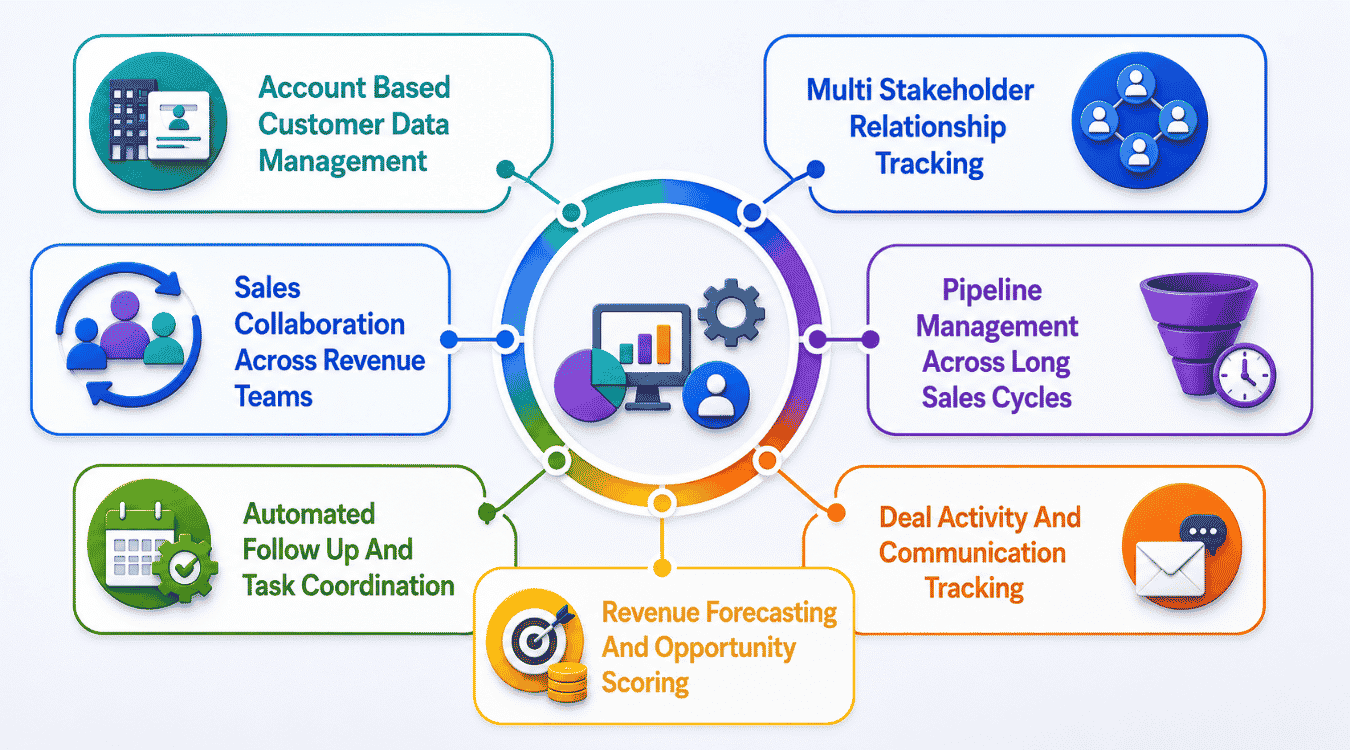
CRM acts as the backbone of modern B2B selling. It provides the 360-degree visibility that helps teams win more deals and build stronger customer relationships. Research shows companies with proper CRM implementation see win rates improve by 28% compared to those without centralized systems.
The B2B sales process involves unique challenges. Sales cycles average 84 days according to HubSpot 2025 data, with some enterprise deals stretching beyond 12 months. Each opportunity might involve 6 to 10 decision makers. Contract values regularly exceed $100,000. Without a structured system to track every touchpoint, details fall through cracks and revenue disappears.
Modern CRM platforms address these challenges by connecting every stage from lead generation through close and beyond. They give sales teams, marketing teams, and customer service teams access to the same real-time data. This alignment transforms how organizations manage leads, nurture prospects, and maintain business accounts over time.
Account-Based Customer Data Management
Account-based management changes how B2B CRM software organizes information. Instead of treating contacts as isolated individuals, the system structures data around target accounts. You see the complete picture of each business relationship.
This approach maps organizational hierarchies and buying committees. When you open an account record, you find firmographic details like company revenue, employee count, and technology stack. You see every contact associated with that business and their role in purchasing decisions. The communication history shows all interactions across your team.
Research from ITSMA indicates 78% of B2B marketers now prioritize account-based strategies. CRM tools support this shift by enriching profiles with intent signals and industry news. A technology company targeting enterprise accounts can segment by industry vertical, tailoring content for healthcare versus financial services prospects.
The payoff is significant. Teams using account-based data structures report 20% higher engagement rates. Sales reps spend 40% less time researching prospects because the information they need sits right in front of them.
Multi-Stakeholder Relationship Tracking
B2B deals rarely involve just one decision maker. Dealfront 2024 data shows the average B2B purchase includes 6.8 stakeholders. Your CRM needs to track relationships with every person who influences the buying decision.
Effective CRM tools create influence maps showing who holds power in each opportunity. They log every email, phone call, and meeting tied to specific contacts. Sentiment analysis helps reps understand who champions their solution and who might block the deal.
Consider enterprise software sales. The CRM might reveal that procurement focuses heavily on pricing while the CEO cares about strategic fit. Armed with this insight, your team tailors messaging for each audience. Reps address budget concerns in procurement meetings and emphasize long-term value when speaking with executives.
This targeted approach to customer engagement produces results. Companies tracking multi-stakeholder relationships see close rates improve by 15% to 20%. The customer experience also improves because prospects receive relevant information rather than generic pitches.
Pipeline Management Across Long Sales Cycles
Managing sales pipelines across months-long deals requires visual tools and proactive alerts. A visual sales pipeline within B2B CRM platforms delivers both through kanban-style boards that show every opportunity, its stage, owner, and expected value.
Stage progression alerts notify reps when deals need attention. If an opportunity sits in the same stage too long, the system flags it. Bottleneck detection identifies where deals consistently stall, allowing managers to adjust sales strategies or provide additional coaching.
AI capabilities enhance pipeline management further. Modern systems predict which deals risk stalling based on engagement patterns and historical outcomes. Case studies show that adopting tools like Gain.io can close deals faster with disciplined, data-driven workflows, with teams using AI-powered pipeline tools seeing 50% faster deal velocity.
For manufacturing companies tracking multi-month RFP processes, this visibility proves invaluable. Managers review pipeline health scores daily, adjusting resource allocation based on real-time data rather than gut feelings.
Deal Activity And Communication Tracking
Every customer interaction generates valuable insights. B2B CRM systems log all touchpoints automatically, creating complete audit trails for each opportunity. Emails sync without manual entry. Calendar events link to relevant accounts and deals.
AI now transcribes meetings and suggests follow-up actions. After a discovery call, the system might prompt your rep to send pricing information discussed during the conversation. This structured tracking raises win rates because nothing falls through the cracks, especially when paired with an integrated CRM calendar for modern sales and support teams that keeps schedules and customer data aligned.
Calendar integration deserves special mention. When your sales calendar CRM connects to scheduling tools, it prevents double-bookings and sends automatic reminders. Some organizations report 30% fewer no-shows for sales meetings after implementing proper calendar sync.
The cumulative effect of comprehensive tracking is powerful. Reps spend less time on data entry and more time selling. Managers gain complete visibility into team activities without requesting status updates.
Revenue Forecasting And Opportunity Scoring
Sales forecasting separates successful revenue teams from struggling ones. B2B CRM platforms use AI-driven scoring to predict which opportunities will close and when revenue will arrive.
Opportunity scoring weighs multiple factors. Engagement level, decision maker involvement, competitive positioning, and historical patterns all contribute to each deal’s score. This analysis identifies which prospects deserve immediate attention and which need additional nurturing.
Forecasting dashboards aggregate pipeline data into quarterly and annual projections. They factor in close probabilities, average cycle lengths, and seasonal patterns. According to Forrester research, teams using CRM-based forecasting achieve 42% better accuracy than those relying on spreadsheets.
These capabilities support data-driven decisions at every level. Sales managers allocate resources effectively. Executives plan hiring and investment with confidence. Finance teams budget based on realistic revenue expectations.
Automated Follow-Up And Task Coordination
Repetitive tasks consume hours that reps should spend selling, which is why many teams automate sales tasks to stay focused and organized. Automation features within B2B CRM handle these activities systematically, ensuring nothing gets missed, especially when you automate sales tasks to stay focused and organized.
Drip campaigns send sequenced emails to prospects based on their behavior and deal stage. Task assignments happen automatically when opportunities progress. Reminders fire before important deadlines like contract renewals or proposal due dates.
The productivity impact is substantial. Zendesk reports that automation reduces manual entry time significantly, boosting overall sales efficiency by 34%. Reps handle larger pipelines without sacrificing quality because the system manages routine coordination, and modern platforms make it easier to manage leads throughout the sales process.
For organizations running complex, long-cycle deals, automated lead nurturing keeps prospects engaged during quiet periods. Instead of going silent for weeks, your company maintains consistent presence through relevant content and check-ins.
Sales Collaboration Across Revenue Teams
B2B selling involves more than the sales department. Marketing generates and qualifies leads. Customer success ensures smooth onboarding. Support handles issues that arise during evaluation. Everyone needs access to the same customer data.
Centralized CRM platforms break down silos between teams. Shared dashboards show pipeline health, recent interactions, and account status. When a support ticket comes in from a prospect during evaluation, the sales rep sees it immediately and can address concerns.
This alignment cuts miscommunication by up to 50% according to Salesforce research. Handoffs between teams happen smoothly because everyone works from one system. Marketing efforts connect directly to revenue outcomes through proper attribution.
Real-time updates ensure information stays current. When marketing qualifies a new lead, sales sees it instantly. When sales closes a deal, customer success begins onboarding preparation before the ink dries.
B2B CRM Vs B2C CRM Key Differences
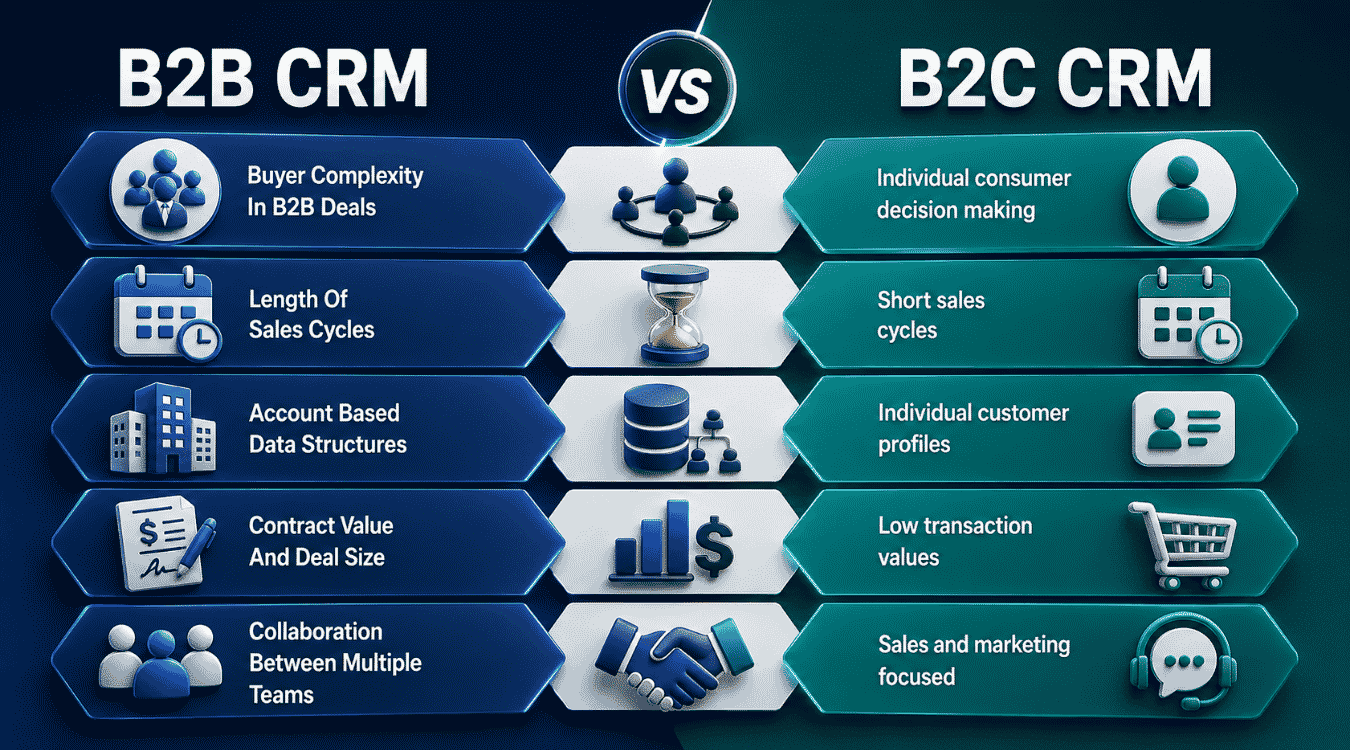
Understanding the distinction between B2B and B2C CRM systems helps you choose the right tool. While both manage customer relationships, their design priorities differ significantly based on how transactions happen.
Gartner 2025 research shows B2B sales cycles run four times longer than B2C cycles and involve three times more stakeholders per deal. These fundamental differences shape every aspect of CRM functionality, from data structures to reporting capabilities.
Buyer Complexity In B2B Deals
B2B purchases require consensus among multiple decision makers. A single deal might need approval from technical evaluators, financial reviewers, legal teams, and executive sponsors. Each person brings different criteria and concerns.
B2C transactions involve individual consumers making quick personal decisions. One person researches, evaluates, and purchases. The buying journey is linear and relatively simple, and many industries such as retail rely on CRM tools that help retail teams stay organized around these faster cycles.
B2B CRM must map these complex buying committees and track sentiment across all stakeholders. B2C tools focus on understanding individual preferences and purchase history.
Length Of Sales Cycles
B2B cycles stretch from three months to over a year for enterprise deals. The median sits around 84 days per HubSpot data. Complex evaluations, procurement processes, and budget approvals all extend timelines.
B2C sales happen in days or weeks. Someone shops for new software, reads reviews, and purchases within a few sessions. Quick checkout and immediate delivery are priorities.
This difference explains why B2B CRM emphasizes pipeline stages and forecasting while B2C systems optimize cart abandonment recovery and quick conversion paths.
Account-Based Data Structures
B2B CRM organizes data hierarchically. Parent companies connect to subsidiaries. Multiple contacts link to single accounts. Deal history, support tickets, and engagement metrics roll up to the account level.
B2C CRM uses flat individual profiles. Each customer stands alone with their purchase history, preferences, and interaction log. The relationship is one company to one person.
AI capabilities in B2B CRM enrich account intelligence with firmographic data and intent signals. B2C AI personalizes offers based on individual browsing and buying patterns.
Contract Value And Deal Size
B2B average contract values reach $94,000 according to ProfitWell data. Enterprise software, manufacturing equipment, and professional services command significant investments requiring custom quotes and negotiation.
B2C transactions average around $140. High volume at low margins defines the model. Standardized pricing and quick checkout matter more than complex quoting workflows.
B2B CRM includes proposal generation, approval workflows, and contract management. B2C tools optimize payment processing and order fulfillment.
Collaboration Between Multiple Teams
B2B deals require coordination across sales, marketing, customer success, legal, and finance. Multiple internal stakeholders support each opportunity through its lifecycle.
B2C operations center on sales and marketing with support handling post-purchase issues. Fewer handoffs occur because simpler transactions need less coordination.
Factor | B2B CRM | B2C CRM |
|---|---|---|
Average Sales Cycle | 84+ days | 7-14 days |
Stakeholders Per Deal | 6-10 people | 1 person |
Average Contract Value | $94,000 | $140 |
Data Structure | Account hierarchies | Individual profiles |
Primary Focus | Relationship tracking | Transaction volume |
Key Features | Pipeline stages, forecasting | Cart management, quick checkout |
Team Involvement | Cross-functional | Sales and marketing-centric |
Core Capabilities Of B2B Sales CRM Platforms
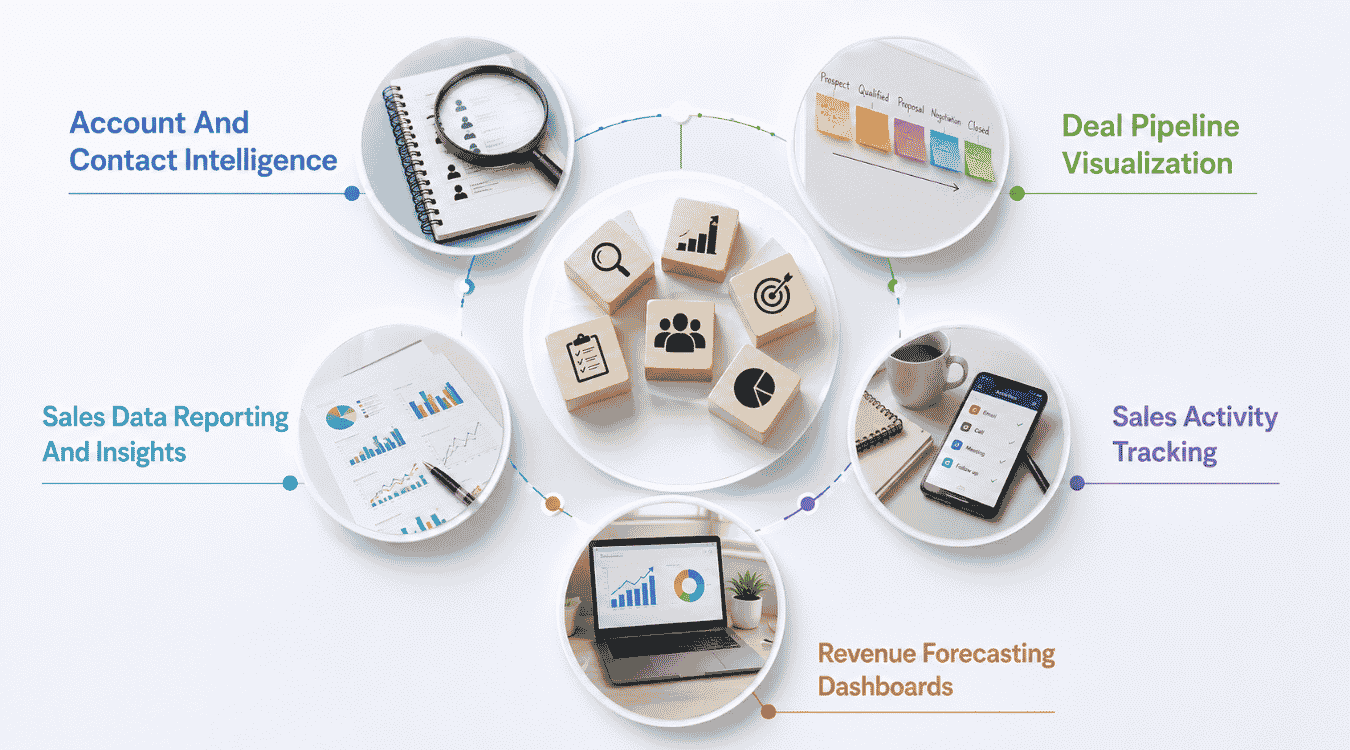
Modern B2B CRM platforms combine AI, integrations, and analytics into comprehensive revenue systems. The global CRM market reaches $80 billion by 2026 according to Statista, reflecting how essential these tools have become for organizations aiming to improve sales productivity.
Effective platforms deliver intelligence, visualization, tracking, forecasting, and reporting in unified packages. Each capability addresses specific challenges that B2B sales teams face daily, and smart CRM tools like Gain.io features for sales teams bundle these into one system.
Account And Contact Intelligence
AI enriches customer profiles with data from multiple sources. Intent signals reveal which accounts actively research solutions. News alerts flag organizational changes that create opportunities.
Lead scoring assigns values based on fit and engagement, helping reps prioritize outreach. According to 6sense research, 91% of B2B firms now use some form of intent data in their prospecting.
Contact details stay current through automated updates. When someone changes roles or companies, the system captures that information before reps discover outdated records manually.
Deal Pipeline Visualization
Visual pipelines show every opportunity at a glance. Drag and drop interfaces let reps move deals between stages quickly. Color coding highlights deals at risk or approaching close dates.
Health metrics quantify pipeline status. Coverage ratios show whether you have enough opportunities to hit quota. Velocity metrics reveal how quickly deals progress through stages.
Teams using visual sales pipeline software report 30% faster deal progression. Managers spot bottlenecks immediately instead of discovering problems during forecast calls.
Sales Activity Tracking
Automatic logging captures activities without manual entry. Emails sync bidirectionally. Calendar events link to relevant records. Call notes attach to contacts and opportunities.
AI analyzes activity patterns and suggests next actions. If engagement drops on a deal, the system recommends reaching out. If a stakeholder goes quiet, you get an alert.
This comprehensive tracking creates audit trails that support coaching and process improvement. Managers see exactly what happened on every deal, win or lose.
Revenue Forecasting Dashboards
Real-time forecasting aggregates pipeline data into revenue projections. Weighted forecasts factor in close probabilities for each opportunity. Commit forecasts show deals your team expects to close.
Customizable views let different stakeholders see relevant information. Reps focus on their individual forecasts. Managers review team performance. Executives monitor company-wide projections.
Historical comparisons reveal trends. You see how this quarter’s pipeline compares to the same period last year. Seasonal patterns become visible, supporting better planning.
Sales Data Reporting And Insights
Standard reports cover essential metrics. Win rates, average deal size, cycle length, and activity levels appear in ready-to-use dashboards. No setup required to access baseline performance data.
Custom reports address specific questions. You might analyze win rates by industry segment, compare performance across regions, or identify which lead sources produce the best customers.
Data quality reports highlight problems. Missing fields, stale opportunities, and duplicate records surface automatically. Keeping your CRM data clean becomes manageable rather than overwhelming.
How B2B CRM Platforms Stack Up by Company Stage
Not every B2B revenue team needs the same CRM. The right platform depends less on brand name and more on where your team actually is in its growth. A five-person sales team picking its first CRM has almost nothing in common with a two-hundred-rep enterprise org migrating off a legacy system. Comparing platforms by company stage, instead of by feature checklist alone, gives you a much clearer picture of what actually matters.
Early Stage And SMB Teams
At this stage, speed and cost matter more than customization. Most teams end up looking for:
- Fast setup with little to no implementation help needed
- Simple, per seat pricing that won't surprise you later with hidden tiers
- Pipeline and contact management that works out of the box, no admin required
- Native integrations with the few tools you already use, like email and calendar
The real risk here isn't picking a CRM that's missing features. It's picking one so complicated that your team never actually adopts it.
Mid Market And Growth Stage Teams
Once your team grows past a single sales motion, the requirements shift toward coordination. At this stage, teams usually need:
- Account based structuring that supports multiple contacts and stakeholders per deal
- Reporting you can customize without pulling in an engineer
- Workflow automation for follow-ups, task assignment, and handoffs between reps and customer success
- Integration that actually syncs both ways with your marketing, support, and finance tools
This is also the point where forecasting accuracy starts to matter to leadership. Deal volume gets high enough that manual forecasting just breaks down.
Enterprise Teams
Enterprise buyers judge CRM platforms on a different set of criteria altogether. The big ones are:
- Role-based permissions and data governance across large, spread-out teams
- Data residency and compliance support, especially in regulated industries
- API depth that supports the custom-built internal tools you already rely on
- Performance that holds up at scale, so reporting and pipeline views don't slow down with millions of records
A Simpler Way To Compare
Instead of starting from a list of vendor names, start from three questions.
Does the platform match how your team actually sells today, not how a sales process works in theory? Can your team reach full adoption in weeks instead of quarters? CRM rollouts fail to gain adoption 74% of the time, so a powerful platform that's slow to adopt is a bigger risk than a simpler one people actually use. And will it grow with you, or will you be migrating again in eighteen months? Switching CRM platforms costs real time in lost data and retraining, so it's worth thinking about runway up front.
Gain.io is built around this stage-based reality instead of a one size fits all feature list. You can see how the account-based pipeline and forecasting tools apply to your team's stage in the section below.
Challenges B2B Teams Face Without CRM
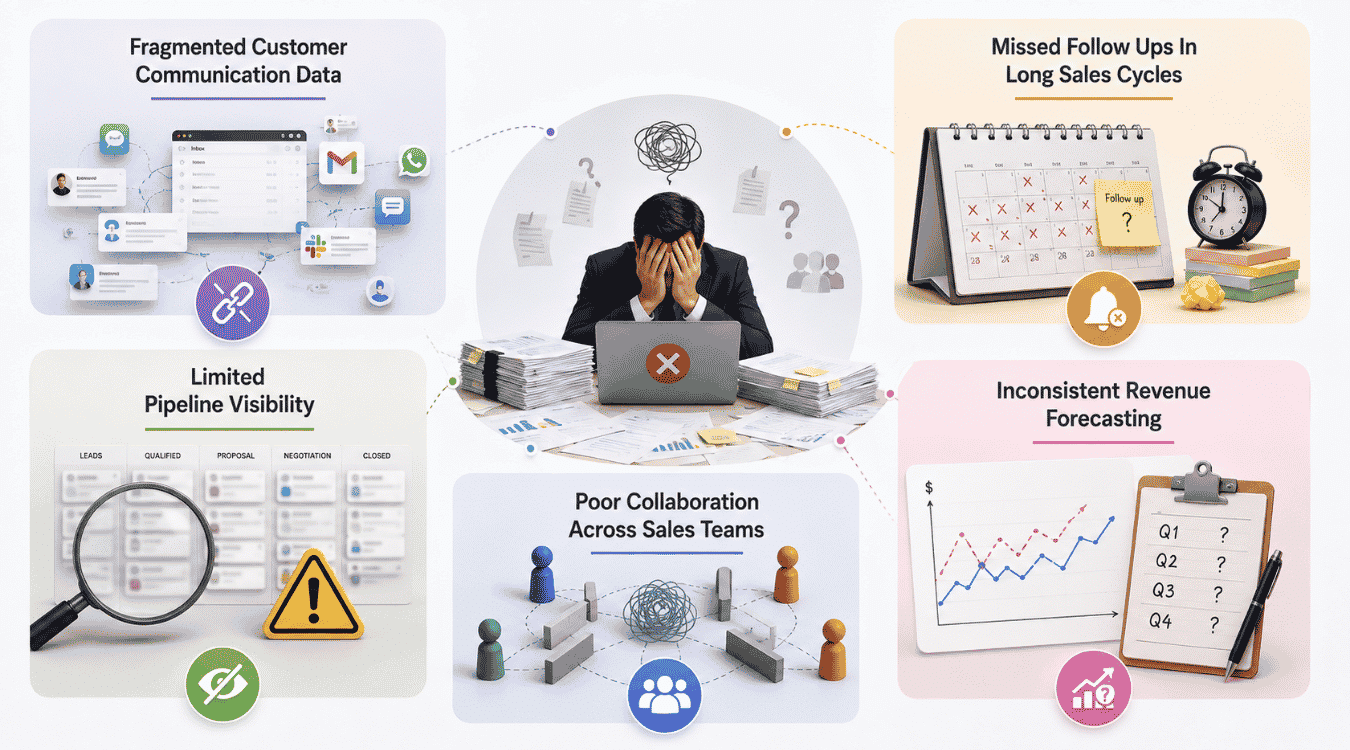
Operating without proper CRM tools costs B2B organizations significantly. Nucleus Research estimates teams lose 30% of potential revenue due to poor visibility and fragmented processes.
These challenges compound over time. What starts as minor inconvenience grows into systemic dysfunction that undermines sales performance and customer experience alike.
Fragmented Customer Communication Data
Without centralized CRM, customer communication scatters across inboxes, chat apps, and phone logs. Each rep maintains their own records using different methods and formats.
Finding complete interaction history becomes impossible. When a colleague takes over an account, they start from scratch. Important context disappears because it lives in someone’s personal email.
Research shows 65% of sales reps lack access to the customer data they need when not using proper CRM. Duplicate records multiply. Contact details grow stale. The business loses institutional knowledge every time someone leaves.
Missed Follow-Ups In Long Sales Cycles
Manual tracking fails across complex sales cycles. Reps rely on memory and personal reminders that compete with dozens of other tasks. Important touchpoints get forgotten.
Prospects expect consistent communication throughout their buying journey. When follow-ups arrive late or not at all, trust erodes. Competitors who maintain better contact gain advantage.
Organizations without CRM miss approximately 50% of follow-up opportunities according to industry research. Each missed touchpoint represents potential revenue left on the table.
Limited Pipeline Visibility
Spreadsheet-based pipeline tracking provides snapshots at best. By the time someone consolidates data from multiple sources, the information is already outdated. Real-time visibility does not exist.
Managers cannot identify stalled deals proactively. Problems surface only when opportunities are already lost. Coaching happens too late to change outcomes.
Forecasting accuracy suffers dramatically. Without reliable pipeline data, revenue predictions become educated guesses. Leadership makes strategic decisions based on incomplete information.
Poor Collaboration Across Sales Teams
Disconnected tools create silos between team members. One rep might have critical information about an account that others never see. Handoffs between roles lose essential context.
Marketing generates leads without visibility into what happens next. Sales closes deals without sharing insights that would help retention. Customer success inherits accounts with incomplete histories.
This fragmentation reduces team productivity by up to 25%. People duplicate efforts, work at cross purposes, and frustrate customers who repeat themselves to different contacts.
Inconsistent Revenue Forecasting
Gut-feel forecasting produces unreliable projections. Without systematic data collection and analysis, predictions vary wildly based on who makes them and when.
Finance and leadership cannot plan effectively with inconsistent forecasts. Hiring happens too late or too early. Investment decisions rest on shaky foundations. Quarterly targets feel arbitrary rather than achievable.
Research indicates manual forecasting methods miss the mark by 40% on average. CRM-based forecasting dramatically improves accuracy by aggregating real pipeline data and analyzing past sales data to predict outcomes.
How Sales Teams Choose The Right B2B CRM
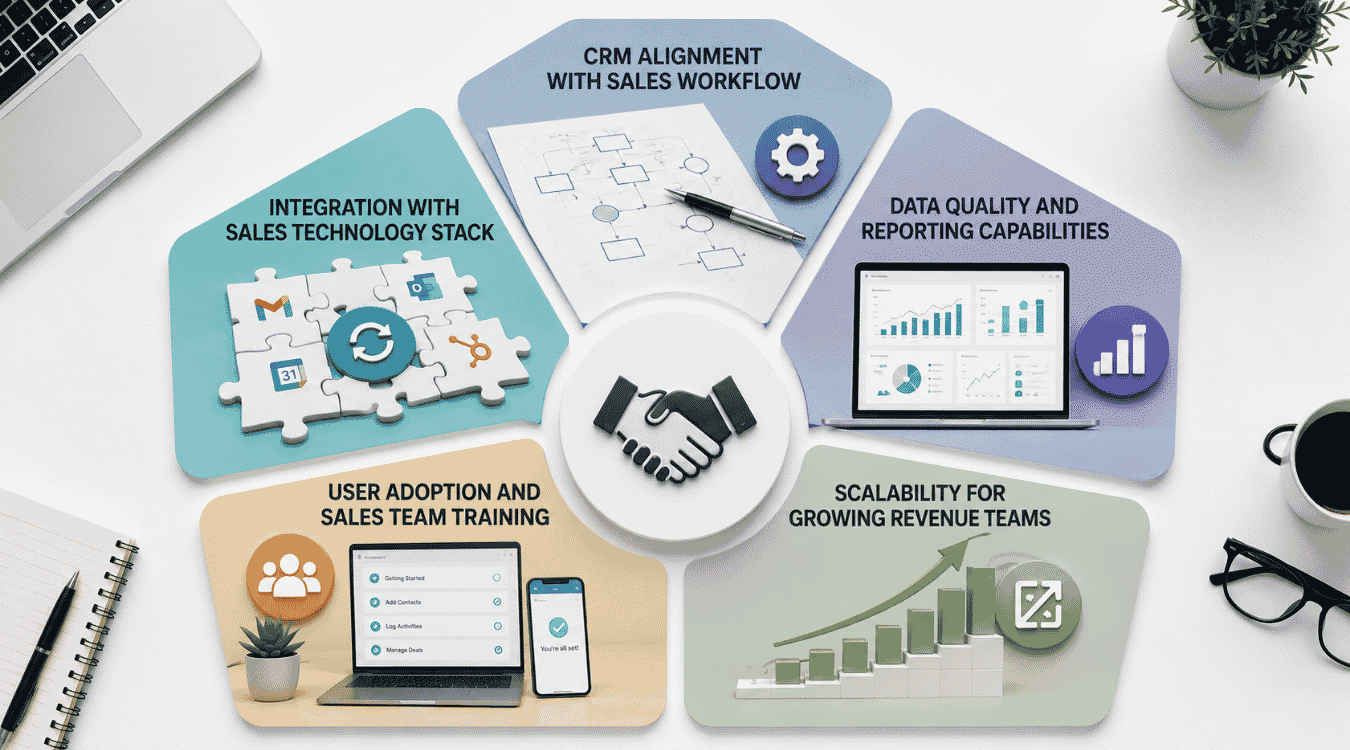
Selecting B2B CRM software deserves careful consideration. Gartner reports 74% of CRM implementations fail due to poor adoption, making the choice of platform critical to success and underscoring the need to understand CRM adoption challenges, mistakes, and best practices.
The right CRM fits your specific workflows, integrates with existing tools, delivers quality data, encourages adoption, and scales with growth so you can get more from your CRM with a simpler sales workflow. Evaluating candidates against these criteria prevents costly mistakes, especially when you follow practical tips for choosing CRM tools that fit your workflow.
CRM Alignment With Sales Workflow
Your CRM should mirror how your team already sells. Custom pipeline stages match your actual process rather than forcing generic frameworks. Fields capture the information your reps need, and a simpler workflow helps you get more from your CRM.
Before shopping for tools, map your current sales process in detail. Document each stage, the criteria for progression, and the activities that typically happen. Use this map to evaluate whether candidates support your specific motions.
Whether you run inbound, outbound, channel, or account-based marketing strategies, the platform must accommodate your approach. Running at least one real opportunity through trial accounts reveals how well different systems fit daily workflows, as outlined in comprehensive guides to CRM software for modern sales teams.
Integration With Sales Technology Stack
Modern sales operations rely on multiple tools. Email platforms, calendar apps, marketing automation systems, and other business tools all generate valuable data that should flow into your CRM, making a CRM with email integration especially valuable.
Look for native connectors with your critical applications. APIs enable custom integrations when needed. The goal is eliminating manual data entry and keeping information synchronized across systems.
Third-party apps extend CRM functionality without requiring custom development. Evaluate the integration ecosystem for each platform you consider. Strong integration capabilities save countless hours and prevent the data silos that undermine CRM value.
Data Quality And Reporting Capabilities
CRM only delivers value when data is accurate and accessible. Evaluate how each platform handles data cleansing, duplicate detection, and field validation. AI-powered enrichment keeps records current automatically.
Reporting capabilities should match your analytical needs. Standard dashboards cover baseline metrics. Custom report builders let you answer specific questions. Export options support deeper data analysis in external tools.
Consider how the platform handles growing data volumes. Performance should remain stable as your database expands. Query speed matters when managers need quick answers during pipeline reviews.
User Adoption And Sales Team Training
The most powerful CRM fails if reps avoid using it. Intuitive interfaces encourage adoption. Clear navigation, minimal clicks, and fast load times make daily use painless rather than frustrating.
Mobile access matters for field reps and managers who review data outside the office. Responsive design or dedicated apps keep everyone connected regardless of location.
Training resources accelerate onboarding. Templates, in-app guidance, and available support help new users become productive quickly. Research shows 80% adoption rates correlate strongly with CRM success.
Scalability For Growing Revenue Teams
Your CRM needs to support growth without requiring replacement. Role-based permissions accommodate expanding team structures. Additional regions or product lines should not overwhelm the system.
Consider data residency requirements if you operate in regulated industries or multiple countries. Security standards and compliance certifications matter more as your organization grows.
Ask vendors about performance with larger deployments. Request references from customers of similar size and complexity. A platform that handles 10x your current data volume provides room to scale confidently.
Common Mistakes B2B Teams Make When Rolling Out A CRM
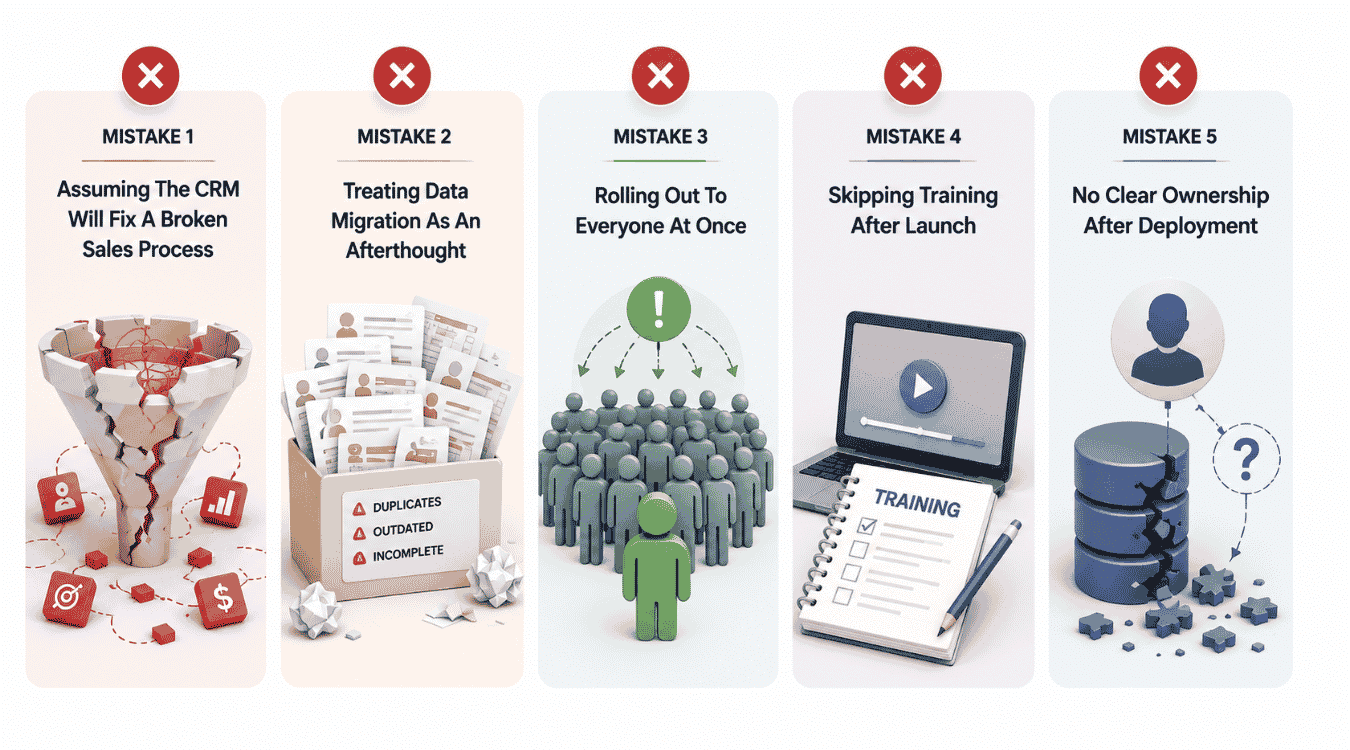
Picking the right platform is only half the battle. Most CRM failures actually happen after the contract gets signed, during rollout. Here are the mistakes that most often derail a B2B CRM implementation, and how to avoid them.
Mistake 1: Assuming The CRM Will Fix A Broken Sales Process
A CRM organizes and surfaces data about your sales process. It doesn't create one for you. Teams that roll out a CRM without first mapping their actual sales stages, handoff points, and what counts as a qualified deal end up with a system that just digitizes the same confusion they had in spreadsheets. Map the process on paper first, then configure the CRM to match it.
Mistake 2: Treating Data Migration As An Afterthought
Fragmented, duplicate, or stale contact and account data is one of the biggest reasons CRM adoption stalls. Reps stop trusting a system the moment they spot records that are obviously wrong. Before going live, clean up and standardize your account and contact data, and put someone in charge of fixing data issues going forward. This matters even more for manufacturers and complex B2B teams coordinating pre sales engineering, commercial, and support activity on the same account. One fragmented record breaks that coordination fast.
Mistake 3: Rolling Out To Everyone At Once
Company wide rollouts with no pilot phase tend to surface every workflow gap at the same time, which overwhelms the team and whoever is supporting the rollout. A phased approach works better. Pilot with one team or region, fix what breaks, then expand. It consistently leads to smoother adoption than an all at once cutover.
Mistake 4: Skipping Training After Launch
Adoption doesn't stop on launch day. Teams that treat training as a one time event during onboarding, instead of an ongoing part of ramping new hires and rolling out new features, see usage drop off within a few months. Sales teams that get structured, continued training see noticeably higher adoption than teams that only get one onboarding session.
Mistake 5: No Clear Ownership After Deployment
Once a CRM goes live, someone needs to own data quality, workflow updates, and integration health going forward. Otherwise the same fragmentation problems the CRM was supposed to solve creep back in within a year. This is especially true for the account data teams rely on daily after deployment. Without a named owner, that data quietly gets worse until forecasting and reporting become unreliable again.
The thread running through all five mistakes is the same one. A CRM is an ongoing habit, not a one time purchase. Teams that plan for rollout and ownership with the same care they put into picking a platform end up with meaningfully better results.
How Gain.io Supports B2B Sales CRM Workflows
Gain.io delivers a modern all-in-one CRM to grow your sales and team built specifically for revenue teams managing complex B2B deals. The platform centralizes contacts, pipelines, and activities in one clear interface, giving every rep and manager access to the same live data.
Visual pipelines show opportunities from first touch through close. Dedicated sales pipeline CRM tools help reps track deals without switching between applications. Managers monitor team performance through customizable dashboards.
Automation handles routine tasks like follow-up reminders and task creation. Your team spends more time selling and less time on data entry. Email and calendar integration keeps touchpoints logged automatically.
Gain.io connects with the tools your team already uses, eliminating data silos and manual imports. The platform scales with your business, supporting growing teams without sacrificing performance. For revenue teams ready to streamline their sales process and close more deals, Gain.io offers a practical path forward.
Frequently Asked Questions
Why B2B Sales Pipelines Need CRM Visibility?
Pipeline visibility identifies problems before they cost revenue. Without clear views into deal stages, values, and progression rates, managers cannot spot stalled opportunities or allocate resources effectively. According to Salesforce research, 50% of deals stall without intervention when teams lack proper visibility. CRM dashboards enable prioritization based on data rather than guesswork, helping reps focus energy where it matters most.
How CRM Data Improves Deal Forecast Accuracy?
CRM aggregates historical patterns with current pipeline data to generate realistic projections. AI models analyze which deal characteristics correlate with success, weighting factors like stakeholder engagement, competitive positioning, and timeline adherence. Forrester research shows CRM-based forecasting improves accuracy by 42% compared to manual methods. Better forecasts support confident decision-making about hiring, investment, and resource allocation.
What Metrics B2B Sales CRM Should Track?
Essential metrics include win rate, average deal size, sales cycle length, and pipeline coverage ratio. Activity metrics like meetings held, emails sent, and opportunities created reveal leading indicators of future results. For subscription businesses, track renewal rate and expansion revenue alongside new business. The best CRM implementations customize metric tracking to match specific business models and goals.
How CRM Supports Account-Based Sales?
Account based selling requires viewing customers as organizations rather than isolated contacts. CRM enables hierarchy mapping that connects subsidiaries to parent companies and tracks all stakeholders within target accounts. Scoring models identify high-potential accounts based on fit criteria and engagement signals. ITSMA research indicates account based strategies deliver 208% better marketing ROI, making strong CRM support essential for this approach.
When B2B Sales Teams Should Adopt CRM?
Consider CRM adoption when you have more than five active reps, generate over $1 million in annual revenue, or run sales cycles exceeding 30 days, or when you are a growing startup that needs CRM for startups and small sales teams. Warning signs include lost deals from poor follow-up, difficulty forecasting accurately, and scattered data across multiple spreadsheets. Starting early builds clean data foundations before complexity overwhelms manual tracking methods.
How Do B2B Manufacturers Use CRM To Coordinate Pre-Sales Engineering With The Commercial Pipeline?
Manufacturers with technical, engineered to order sales processes use CRM to link pre sales engineering tasks, like spec reviews, feasibility checks, and custom quoting, directly to the commercial deal record. That way engineering and sales see the same account timeline instead of working from separate systems. It keeps technical scoping and commercial negotiation in sync on long, multi touch deals.
How Do B2B Manufacturers Use CRM To Coordinate Sales When Direct And Indirect Channel Teams Cover The Same Accounts?
CRM platforms handle this with account ownership rules and shared activity visibility across direct reps and channel or distributor teams. That means overlapping coverage on the same account is visible instead of hidden, which cuts down on duplicate outreach and channel conflict.
What Account Data Do Sales Teams Rely On Daily After Initial Deployment And Onboarding?
After deployment, reps lean most on up to date contact and stakeholder records, deal stage and activity history, and account health signals like engagement, open tasks, and forecast status. That's why owning data quality after go live matters just as much as getting the initial setup right.