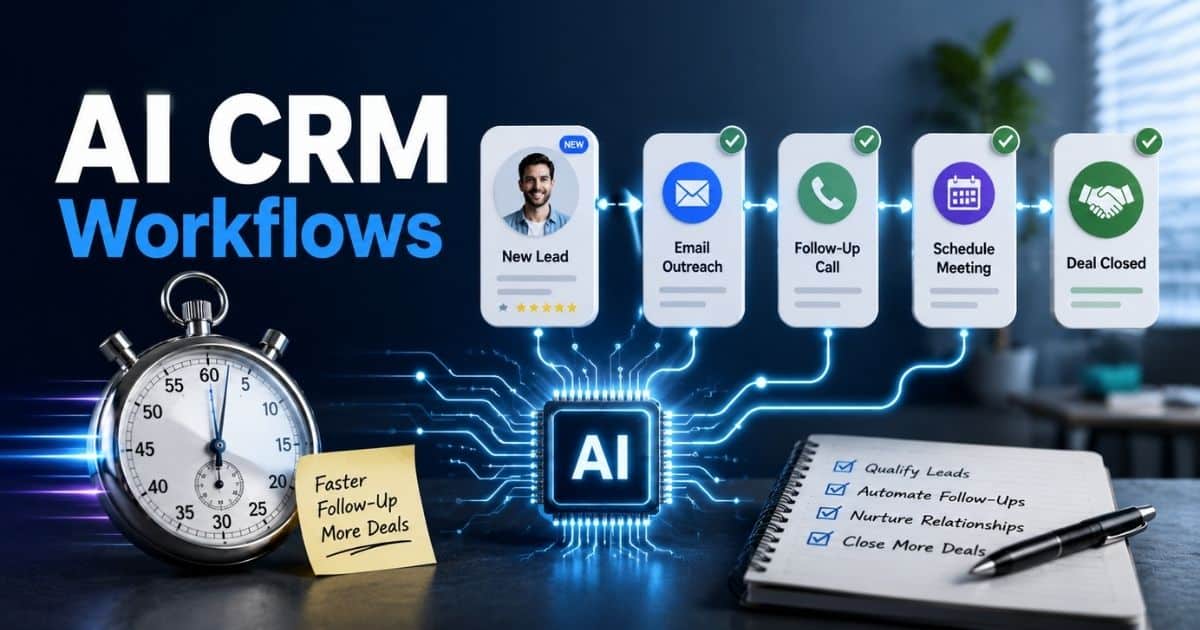
AI CRM systems have come a long way from simple contact databases. Modern businesses now use AI CRM workflows to automate follow-ups, score leads, personalize customer interactions, and streamline everyday operations. Instead of spending hours on manual tasks, teams can focus on building relationships and closing deals.
The real value goes beyond automation. AI can analyze customer behavior, identify sales opportunities, predict future outcomes, and trigger actions at the right moment. It can even summarize conversations, generate personalized content, and provide real-time insights that help teams make faster decisions. Research shows that AI-powered automation can significantly improve productivity, operational efficiency, and customer experiences when combined with quality data and proper human oversight.
This guide covers everything you need to know about AI CRM workflows, from core components and real-world use cases to implementation strategies, best practices, challenges, and future trends. Whether you want to automate sales, marketing, or customer service processes, you will learn how to build smarter workflows that drive measurable business results.
What Are AI CRM Workflows And How Do They Work?
AI CRM workflows are automated business workflows that use artificial intelligence to manage customer-related tasks and decisions. Unlike traditional workflow automation that follows fixed predefined rules, AI-powered workflows can learn from data, recognize patterns, and adapt to different situations. They help businesses automate repetitive tasks such as data entry, lead qualification, follow-ups, and customer support while keeping CRM data accurate and up to date. AI systems can also analyze information, make recommendations, and trigger actions automatically based on customer behavior.
AI workflow automation works by combining machine learning, natural language processing, and other AI capabilities with a CRM platform. The system collects customer data, analyzes historical data, and uses workflow logic to decide what should happen next. For example, AI can score leads, route inquiries, generate email responses, or notify sales teams when an opportunity needs attention.
As a result, AI CRM workflows help automate routine tasks, streamline business processes, and improve operational efficiency across sales, marketing, and customer service teams.
Key Components Of An Effective AI CRM Workflow
A successful AI CRM workflow depends on more than automation. It needs accurate data, smart decision-making, seamless connections, and clear governance. Each component plays a role in helping teams automate tasks, improve customer experiences, and make faster decisions. When those elements work together, businesses can create AI-powered workflows that deliver measurable results.
Reliable CRM Data
Every AI CRM workflow starts with quality data. AI systems depend on accurate customer information to make the right decisions. Poor CRM data often leads to weak lead scoring, incorrect recommendations, and missed opportunities.
A recent IBM analysis highlights that AI models perform best when they have access to clean and structured data. Customer profiles, interaction history, purchase records, and engagement metrics all help AI workflow automation produce better outcomes. Strong data quality also reduces manual tasks and improves workflow performance across sales, marketing, and service teams.
Intelligent Decision Engines
Traditional automation follows fixed rules. AI-driven workflow automation goes further. It uses machine learning models and AI algorithms to evaluate data, identify patterns, and choose the next action automatically.
For example, AI can analyze historical data to score leads, prioritize opportunities, and recommend follow-up actions. It can also detect customer behavior changes in real time. This allows sales teams to focus on prospects with the highest conversion potential using a well-designed lead scoring model for high-conversion funnels. Intelligent workflows help businesses respond faster and make more data-driven decisions.
Connected Systems And Tools
Disconnected tools create gaps in customer information. A strong workflow automation platform connects CRM software with email, marketing, support, and analytics systems.
Seamless integration allows AI workflow tools to access data from multiple sources. A lead can move from a marketing campaign to a sales pipeline without manual data entry. Customer service teams can also view complete interaction histories in one place. Connected business processes improve efficiency and create a more consistent customer experience across departments.
Automated Workflow Actions
Workflow execution is where AI automation creates value. AI can automatically trigger workflows when customer data changes. It can send emails, assign leads, update records, create tasks, or notify team members.
Many AI workflow automation tools also support document processing and natural language processing. This allows them to handle unstructured data such as emails, chat messages, and support tickets. Automated workflows reduce repetitive tasks, speed up response times, and help teams focus on higher-value work.
Governance And Human Oversight
Human oversight remains essential, even in advanced AI-powered workflow automation. AI can automate routine tasks and support complex processes, but important business decisions still need human review.
Clear access controls, compliance policies, and security measures protect customer data and business operations. Employee training is equally important. Teams need to understand how AI workflow automation works and when human intervention is necessary. Coordinating tasks in a sales calendar CRM built for high-performance teams can also make it easier for reps to adapt to new workflows. Research continues to show that organizations achieve better results when intelligent automation supports people rather than replacing them entirely.
Top AI CRM Workflows For Sales, Marketing, And Customer Support
Modern businesses use AI CRM workflows to automate work that once required hours of manual effort. From lead management to customer support, sales automation that boosts conversion rates helps teams move faster and make better decisions. The most effective workflows combine automation, data analysis, and real-time actions to improve both productivity and customer experience.
Lead Scoring
Lead scoring is one of the most valuable AI workflows for sales teams. Instead of reviewing every prospect manually, AI analyzes CRM data, customer behavior, and historical data to identify which leads are most likely to convert, making AI lead scoring far more efficient than manual scoring.
AI workflow automation tools can update lead scores in real time as new information enters the system. A prospect who opens emails, visits pricing pages, or requests a demo may receive a higher score automatically. This helps sales teams focus on high-value opportunities and improve conversion rates through data-driven decisions.
Personalized Outreach
Customers expect relevant communication. AI-powered workflows help businesses deliver personalized messages at scale without adding more manual tasks.
AI tools can generate email responses, sales emails, and marketing content based on customer interests and previous interactions. McKinsey reports that companies that excel at personalization can generate 40% more revenue from those activities than average competitors. AI automation makes that level of personalization easier across marketing workflows and customer engagement efforts.
Customer Support Automation
Fast support often determines whether customers stay loyal. AI-powered chatbots and virtual assistants help businesses provide assistance around the clock.
Chatbots can answer common questions, update account details, and guide customers through simple issues. Complex tasks move to human agents when needed. AI also analyzes customer sentiment and summarizes interactions for support teams. This reduces response times and helps deliver a more consistent customer experience while automating routine tasks.
Pipeline Management
Sales pipelines change every day. AI CRM workflows help teams stay informed without constantly reviewing records and reports, especially when paired with dedicated sales pipeline software to visualize and track deals.
AI systems monitor customer activity, deal progress, and engagement signals. When an important change occurs, the workflow automation platform can notify sales teams automatically. Predictive analytics can also forecast revenue and flag at-risk opportunities, especially when combined with an AI sales assistant for pipeline efficiency. This allows teams to act earlier and improve sales outcomes through intelligent automation and real-time insights.
Customer Onboarding
The customer journey does not end after a sale. A strong onboarding process helps customers see value quickly and reduces churn.
AI workflow automation can automatically trigger onboarding workflows after a contract is signed. The system can send welcome emails, assign tasks, schedule training sessions, and provide helpful resources using CRM follow-up automation for better sales conversions. Automated workflows ensure every customer follows a consistent path. This streamlines business processes and creates a smoother experience for both customers and internal teams.
How To Build AI CRM Workflows Step By Step
A successful AI CRM workflow does not start with technology. It starts with a clear business goal. The best workflows solve real problems, automate high-impact tasks, and support better customer experiences. A step-by-step approach helps businesses avoid complexity and achieve faster results, especially when paired with a simpler sales workflow inside your CRM.
Step 1: Identify High-Impact Processes
Every business has processes that consume too much time. Look for repetitive tasks, manual data entry, delayed follow-ups, or slow customer response times. Those areas often deliver the fastest returns from AI workflow automation.
A 2024 McKinsey report found that employees spend a large portion of their workweek on routine activities that can be automated. Start with business workflows that affect revenue, customer satisfaction, or operational efficiency. Applying proven sales workflow automation strategies as you go can make these early projects more impactful. Simple wins create momentum and help teams gain confidence in AI-powered workflow automation.
Step 2: Prepare Quality CRM Data
AI systems depend on data quality. Even the best AI workflow automation tools cannot deliver accurate results if CRM data is incomplete or outdated.
Customer profiles, purchase history, support records, and interaction data should be organized before workflow execution begins. AI uses historical data and customer behavior patterns to make decisions. Reliable data also improves lead scoring, customer segmentation, and predictive insights. Strong data management reduces errors and helps intelligent workflows perform more effectively.
Step 3: Select The Right AI Tools
The next step is choosing workflow automation tools that fit your business needs. Some AI workflow automation platforms focus on AI sales automation for end-to-end sales processes, while others support marketing workflows, customer service, or business process automation.
Look for seamless integration with existing systems and existing tools. The platform should support natural language processing, automation tools, analytics, and workflow logic, just like a modern CRM software platform built for sales teams. Many modern AI workflow tools can also process unstructured data such as emails, chat conversations, and support tickets. This allows businesses to automate more complex tasks without building separate systems.
Step 4: Build And Test Workflows
After selecting a workflow automation platform, create automated workflows based on business rules and goals. Define triggers, actions, approval paths, and expected outcomes.
For example, AI can automatically score a lead, assign it to a sales representative, and generate a personalized email. Test each workflow carefully before full deployment. Gartner research shows that organizations that regularly test automation processes achieve stronger workflow performance and fewer operational issues. Small adjustments during testing often prevent larger problems later.
Step 5: Monitor And Improve Results
An AI CRM workflow should never remain static. Customer behavior changes. Market conditions change. Business operations evolve over time.
Real-time analytics help businesses track workflow performance and identify improvement opportunities. AI can analyze operational processes, detect bottlenecks, and suggest real-time improvements. Human oversight remains important, especially for complex workflows and customer-facing decisions. Regular reviews, employee training, and performance monitoring help businesses transform business operations while maintaining accuracy, compliance, and customer trust.
Real-World AI CRM Workflow Examples Across Different Industries
AI CRM workflows are no longer limited to one department or industry. Businesses now use AI-powered workflow automation across sales, marketing, customer service, finance, and operations. Each workflow solves a specific problem while helping teams save time, improve accuracy, and deliver better customer experiences.
Sales Lead Management
Sales teams deal with hundreds of leads every month. AI workflow automation helps identify which prospects deserve immediate attention. AI analyzes CRM data, historical data, and customer interactions to prioritize leads based on their likelihood to convert, especially when combined with sales activity tracking software for better visibility.
Many AI workflow automation tools also notify sales teams when important pipeline changes occur. Real-time lead scoring allows teams to focus on opportunities with the highest revenue potential. According to Salesforce, high-performing sales teams are far more likely to use AI and automation tools than underperforming teams, helping improve productivity and sales outcomes.
Marketing Campaign Automation
Marketing workflows often involve multiple channels and repetitive tasks. AI automation helps manage those activities from one workflow automation platform. The system can segment audiences, personalize messages, and automate campaign delivery.
AI tools can generate personalized marketing emails and content based on customer behavior. Customer responses help AI models refine future campaigns. This creates more relevant communication and stronger engagement. Businesses also gain real-time analytics that support faster and more accurate decision-making across marketing operations.
Customer Support Operations
Customer support teams need fast and consistent responses. AI-powered chatbots and virtual assistants help businesses provide support around the clock without increasing workload.
AI systems can answer common questions, route complex tasks to the right agent, and summarize previous conversations. Natural language processing helps AI understand customer requests, even when unstructured data comes from emails or chat messages. Faster responses often lead to higher customer satisfaction and improved service quality.
Finance Process Automation
Finance departments manage large amounts of transactional data every day. AI-driven workflow automation helps automate invoice generation, payment processing, and fraud detection tasks.
AI workflow tools can review transactions, identify unusual activity, and flag potential risks for review. Automated workflows reduce manual tasks and lower the chance of human-related errors. Deloitte research shows that organizations continue to expand intelligent automation in finance because it improves accuracy, efficiency, and compliance across operational processes.
Inventory And Operations Management
Inventory management requires accurate forecasting and quick responses to demand changes. AI-powered workflows help businesses maintain stock levels and reduce operational costs.
AI analyzes sales trends, customer demand patterns, and historical data to predict inventory needs. When stock levels change, the workflow automation software can automatically trigger purchase orders or inventory alerts. This type of business process automation helps streamline business processes, improve operational efficiency, and prevent costly supply chain disruptions.
Common Challenges In AI CRM Workflow Automation And How To Solve Them
AI CRM workflows can improve efficiency, automate routine tasks, and support better customer experiences. However, success is not automatic. Many businesses face challenges related to data quality, adoption, integration, and governance. Understanding these obstacles early helps teams build stronger and more reliable AI-powered workflows.
Poor Data Quality
AI workflow automation depends on accurate CRM data. If customer records contain errors, duplicates, or missing details, AI systems can make poor decisions. Weak data quality often affects lead scoring, customer segmentation, and workflow execution.
A Gartner study found that poor data quality costs organizations millions of dollars every year through lost productivity and poor decision-making. Regular data audits, validation rules, and automated cleanup processes help maintain reliable information. High-quality data gives AI models a stronger foundation for data analysis and business process automation.
Disconnected Business Systems
Many companies still use disconnected tools across sales, marketing, and customer service. When systems do not communicate properly, AI workflow automation tools cannot access the complete customer picture.
Seamless integration between CRM platforms, marketing software, support systems, and analytics tools is essential. A connected sales automation CRM platform allows data to move smoothly between existing systems. This reduces manual tasks and creates more accurate business workflows. Businesses that unify their technology stack often achieve better operational efficiency and workflow performance.
Limited Employee Adoption
Technology alone does not guarantee success. Employees need to trust and understand AI automation tools before they become part of daily operations. Resistance often appears when teams fear complexity or job disruption.
Employee training plays a critical role in adopting AI workflow automation. Team members should understand how AI-powered workflow automation works and where it provides value. Research from McKinsey shows organizations achieve better results when they combine technology investments with workforce development initiatives. Clear communication and practical training help increase adoption rates.
Complex Workflow Decisions
AI can automate repetitive tasks and many rule-based tasks. However, some complex workflows still require human judgment. Customer disputes, contract negotiations, and sensitive account decisions often need human intervention.
A balanced approach works best. AI workflow tools can handle workflow logic, recommendations, and process automation while employees manage exceptions. Human oversight reduces risks and improves decision quality. This combination allows businesses to automate routine tasks with targeted sales task automation tools that boost productivity without losing control over important customer interactions and operational processes.
Compliance And Security Risks
Customer data is one of a company's most valuable assets. AI-powered workflows often process large amounts of sensitive information. Weak security practices can create compliance and privacy concerns.
Strong access controls, data governance policies, and regular security reviews help reduce risk. Businesses should also ensure compliance with industry regulations before deploying AI workflow automation platforms. According to IBM's Cost of a Data Breach Report, organizations with strong security and governance practices can significantly reduce breach-related costs. Security should remain a core part of every AI CRM workflow strategy.
Key Metrics To Measure The Success Of AI CRM Workflows
Launching AI CRM workflows is only the first step. The real value comes from measuring results and improving performance over time. The right metrics show whether your AI workflow automation efforts are reducing costs, increasing productivity, and helping teams deliver better customer experiences.
Lead Conversion Rate
Lead conversion rate is one of the most important metrics for sales teams. It measures how many qualified leads become paying customers. A higher conversion rate often indicates that AI-powered workflows are identifying and prioritizing the right prospects, aligning closely with best practices from a dedicated sales conversion rate guide for B2B teams.
AI workflow automation can analyze historical data, customer behavior, and CRM data to improve lead scoring accuracy. Real-time lead score updates help sales teams focus on opportunities with stronger buying intent. When lead conversion rates increase, businesses gain clear evidence that their AI workflows are improving sales performance.
Workflow Completion Time
Workflow completion time measures how quickly business processes move from start to finish. This metric helps organizations understand whether workflow automation is actually improving operational efficiency.
AI automation tools can automate repetitive tasks, route requests instantly, and reduce delays caused by manual approvals. Deloitte research shows that organizations using intelligent automation often achieve faster process execution and lower operational costs. Shorter completion times allow teams to respond faster to customers and improve overall workflow performance.
Customer Satisfaction Score
Customer satisfaction reflects how customers feel about their experience with your business. AI CRM workflows can influence this metric through faster responses, personalized communication, and improved service quality.
AI-powered chatbots, virtual assistants, and automated workflows help resolve customer issues more quickly. AI can also analyze customer sentiment and identify areas that need attention. Higher satisfaction scores often indicate that AI workflow automation is enhancing customer interactions and supporting better customer experiences across multiple touchpoints.
Employee Productivity
One of the biggest goals of AI workflow automation is helping employees focus on meaningful work. Productivity metrics help measure whether that goal is being achieved.
AI systems automate routine tasks such as data entry, follow-ups, document processing, and customer updates. Research from Accenture suggests that AI can significantly improve worker productivity by reducing time spent on repetitive work. Productivity gains often appear as faster task completion, higher output, and better use of employee expertise.
Cost Savings And Error Reduction
Cost savings provide a direct measure of business value. AI-driven workflow automation helps reduce operational costs by minimizing delays, manual work, and human-related errors.
Businesses should track error rates, processing costs, and resource utilization before and after workflow automation deployment. AI workflow tools can automate complex processes while maintaining consistent workflow logic and business rules. Lower costs and fewer mistakes show that AI-powered workflow automation is helping streamline business processes and create more efficient business operations.
Future Trends Shaping AI CRM Workflows And Intelligent Customer Engagement
AI CRM workflows continue to evolve at a rapid pace. Businesses no longer use AI only for automation. Modern AI-powered workflows now support decision-making, personalization, customer insights, and autonomous actions. Several emerging trends are shaping how organizations manage customer relationships and streamline business operations.
AI Agents Take On More Tasks
AI agents are becoming a major part of modern business workflows. Unlike traditional automation tools, AI agents can handle multi-step tasks, analyze context, and make decisions with minimal human intervention.
Gartner predicts that agentic AI will become a key technology trend as organizations seek more autonomous systems. In CRM environments, AI agents can qualify leads, schedule meetings, summarize customer interactions, and manage workflow execution. This shift helps teams automate complex tasks while improving operational efficiency.
Hyper-Personalized Customer Experiences
Customer expectations continue to rise. Generic communication no longer delivers strong results. AI-powered workflow automation allows businesses to create highly personalized experiences based on customer behavior, preferences, and engagement history.
AI models can generate personalized content, recommend products, and tailor customer interactions across multiple channels. Real-time data analysis also helps businesses respond to customer needs faster. Companies that invest in personalization often achieve stronger customer loyalty and higher revenue growth because communication feels more relevant and timely.
Generative AI In CRM Operations
Generative AI is changing how sales, marketing, and service teams work. AI tools can now create emails, sales proposals, campaign content, and customer responses within seconds.
Many workflow automation platforms already integrate large language models to support everyday business processes. Teams can automate repetitive tasks while maintaining consistency across customer communications. Generative AI also helps reduce workload by producing first drafts, summaries, and recommendations that employees can review before delivery. This improves both productivity and response speed.
Predictive And Prescriptive Analytics
Predictive analytics has become a standard feature in many AI CRM workflows. The next stage is prescriptive analytics. Instead of simply forecasting outcomes, AI systems can recommend the best actions to achieve desired results.
AI analyzes historical data, CRM data, and customer behavior patterns to identify risks and opportunities. The system may flag at-risk accounts, forecast revenue, or suggest follow-up actions. Real-time analytics provide actionable insights that help businesses make more informed decisions and improve workflow performance.
Unified Intelligent Automation
Businesses often rely on multiple disconnected tools for sales, marketing, service, and operations. Future AI workflow automation platforms will bring those functions together through unified intelligent automation, reflecting broader future CRM technology trends and tools.
AI-powered workflows will connect existing systems, automate routine tasks, process unstructured data, and coordinate business logic across departments. Deloitte research shows organizations are increasingly combining robotic process automation (RPA), machine learning, and AI capabilities into a single automation strategy. This approach helps streamline business processes, reduce operational costs, and transform business operations at scale.
Conclusion
AI CRM workflows are changing how businesses manage customer relationships, automate work, and make decisions. From lead scoring and personalized outreach to customer support and predictive analytics, AI helps teams work smarter and respond faster. Modern AI workflow automation can reduce repetitive tasks, improve operational efficiency, and deliver real-time insights that support better outcomes across sales, marketing, and service.
Success, however, depends on more than technology. High-quality CRM data, seamless integration, employee training, and proper human oversight remain essential. Businesses should start with high-impact processes, measure performance regularly, and refine workflows over time. Comparing platforms such as Gain.io vs Pipedrive CRM can also help teams choose the right foundation for these workflows. As AI agents, generative AI, and intelligent automation continue to evolve, organizations that build strong AI CRM workflows today will be better positioned to improve customer engagement, increase productivity, and create long-term business growth in an increasingly competitive market.
FAQs
Can Small Businesses Benefit From AI CRM Workflows?
Yes. AI CRM workflows are not limited to large enterprises. Small businesses can use AI workflow automation to automate repetitive tasks, improve customer follow-ups, and manage business processes more efficiently without expanding their teams.
Do AI CRM Workflows Replace Human Employees?
No. AI-powered workflows are designed to support employees, not replace them. AI automation handles routine tasks, while people focus on customer relationships, complex workflows, and strategic decisions that require human judgment.
Can AI CRM Workflows Work With Existing CRM Systems?
Yes. Most AI workflow automation platforms offer seamless integration with existing systems and business tools. This allows businesses to add intelligent automation, data analysis, and workflow automation capabilities without replacing their current CRM software.
What Role Does Unstructured Data Play In AI CRM Workflows?
Unstructured data such as emails, chat messages, support tickets, and call transcripts contains valuable customer insights. AI workflow tools use natural language processing and machine learning to analyze this information and improve workflow execution, customer engagement, and decision-making.
How Long Does It Take To See Results From AI CRM Workflow Automation?
Results depend on workflow complexity and data quality. Many businesses notice improvements in operational efficiency, lead management, and customer response times within a few weeks after deploying AI-driven workflow automation and optimizing their business workflows.
For more on this topic, see our guide on Key Benefits Of CRM Task Automation.