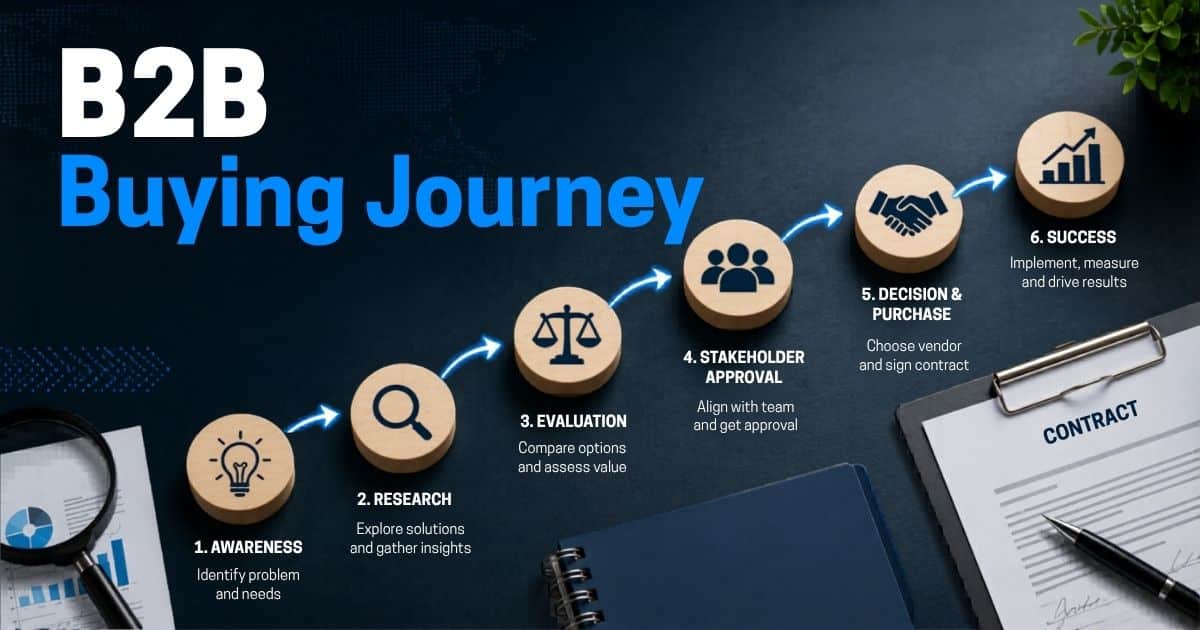
Most B2B purchases do not happen after a single meeting or demo. Buyers spend months researching, comparing options, and building internal agreement before making a decision. In fact, the average B2B buying cycle lasts between 6 and 12 months, and most buyers complete nearly two-thirds of their journey online before speaking with a sales representative, which is why having clear long sales cycle strategies and metrics is so important.
That is why understanding the B2B buying journey matters. A modern buying process involves multiple stakeholders, independent research, vendor evaluations, and risk assessments. Buyers move back and forth between stages rather than following a straight path.
This guide breaks down the B2B buying journey explained from start to finish. You will learn the key stages, the people involved, common challenges buyers face, and how businesses can align sales pipeline stages with the buyer journey to create a smoother path from initial interest to final purchase.
What Is The B2B Buying Journey?
The B2B buying journey explained is the process business buyers follow from identifying a problem to selecting a solution and making a purchase. Unlike a simple consumer purchase, the B2B buying process often involves multiple stakeholders, longer sales cycles, and a more complex decision-making process. Most buyers spend significant time conducting their own research, exploring potential solutions, and comparing potential vendors before speaking with sales reps. Modern buyer behavior is also shaped by digital channels, referrals, reviews, and supplier-provided digital tools.
A typical B2B buyer journey involves awareness, consideration, and decision stages, although many organizations break the purchasing journey into five broader stages. During this process, buying groups, end users, department leaders, and an executive buyer may all influence purchasing decisions. Because multiple people are involved, the journey rarely follows a straight path. Buyers interact with content, social media platforms, interactive tools, free trials, and sales representatives across multiple channels while evaluating vendor capabilities and fit.
Understanding the customer journey helps marketing teams and sales teams create awareness, support buyers, and engage prospects more effectively. A clear customer lifecycle framework allows companies to identify pain points, target decision makers, leverage data, and improve customer engagement. As a result, businesses can attract high-value prospects, generate high-quality deals, strengthen customer success, and drive long-term revenue growth.
Why The Modern B2B Buying Journey Is More Complex Than Ever
The modern B2B buying journey looks very different from what it did a few years ago. Buyers now complete most of their research before talking to a vendor. Multiple stakeholders take part in the purchase process, and decisions often take months. As a result, the path from problem awareness to supplier selection has become longer, more digital, and far less predictable, which is why many revenue teams are turning to an account-based selling strategy to focus on their highest-value accounts.
More Stakeholders Join Every Decision
A B2B purchase rarely depends on one person. Most buying groups include people from different departments. End users, managers, finance teams, procurement teams, and an executive buyer often have different priorities.
Research shows the average purchasing group includes 10 to 11 stakeholders. Many buying committees involve between 6 and 12 decision-makers. Each person evaluates risks, costs, and expected outcomes differently. This makes the decision-making process much more complex than a typical consumer purchase.
Buyers Complete Research Before Contacting Sales
Most buyers no longer depend on sales reps for early information. They use digital channels to research potential solutions, compare vendors, and understand vendor capabilities on their own.
Studies show that 67% of the B2B buyer journey is completed digitally before buyers engage with sales representatives. During the research phase, buyers read reviews, explore case studies, watch demos, and visit social media platforms. A rep-free experience has become a normal part of the modern customer journey.
The Journey No Longer Follows A Straight Line
The traditional buying process moved from awareness to consideration and then to a decision. Today, buyers move back and forth between stages. New information often changes priorities and supplier preferences.
A buying team may shortlist vendors, restart research, request more information, and revisit previous options. Budget constraints, internal feedback, and changing business needs can reshape the purchasing journey at any point. This non-linear path makes buyer behavior harder to predict and manage.
Information Overload Creates New Challenges
Business buyers have access to more information than ever before. While that sounds helpful, it often creates confusion. Buyers must sort through reviews, reports, competitor comparisons, and marketing messages from multiple channels.
Research shows that 66% of buyers find the amount of organizational change overwhelming during major purchases. Information overload adds another layer of complexity. Buyers want clear, useful content that solves pain points rather than large amounts of promotional material.
Risk Reduction Matters More Than Ever
B2B purchases often affect operations, budgets, and customer success. A poor decision can lead to wasted resources and purchase regret. Because of that, buyers spend more time validating potential vendors.
Many buyers prioritize hands-on product experiences before attending sales meetings. Free trials, product sandboxes, digital sales rooms, and interactive tools help support buyers during evaluation. In fact, 48% of high-performing teams invest in digital sales rooms to help potential customers assess solutions with confidence. Businesses that reduce risk and build trust are more likely to win high-quality deals and drive revenue growth.
Key Stages Of The B2B Buying Journey Explained
Every B2B purchase follows a series of steps, but the path is rarely straight. Buyers move between research, evaluation, and internal discussions before making a decision. Understanding each stage helps sales and marketing teams create better experiences, optimize sales workflows for faster deal closures, address buyer concerns, and support purchasing decisions more effectively.
Problem Recognition
Every B2B buying journey starts when a business identifies a challenge or opportunity. A team may face rising costs, slow processes, poor productivity, or customer service issues. At this point, buyers are not searching for vendors. They are trying to understand the problem.
Many organizations begin by gathering internal feedback and reviewing business performance. Decision-makers look for the root cause of the issue. This stage creates awareness and sets the foundation for the rest of the buying process. Without a clear understanding of the problem, buyers often struggle to evaluate solutions later.
Solution Research
After defining the problem, buyers begin researching possible ways to solve it. They explore articles, industry reports, case studies, videos, and expert recommendations. Referrals also play a major role at this stage.
Research shows that 84% of B2B customers start their purchasing journey with referrals. Modern buyers also complete about 67% of their research digitally before speaking with vendors, making it critical to use lead generation strategies that attract high-quality prospects. During this phase, buying groups focus on learning about potential solutions rather than comparing specific suppliers.
Requirements Definition
Once buyers understand available options, they create a list of requirements. The buying organization establishes objective criteria for vendor selection. This helps teams evaluate solutions fairly and avoid decisions based only on sales presentations.
Requirements may include budget limits, integration needs, security standards, scalability, support quality, and expected outcomes. Since multiple stakeholders are involved, every department may contribute different priorities. A clear set of requirements helps align the buying committee and reduces confusion later in the decision-making process.
Vendor Evaluation
At this stage, buyers begin comparing potential vendors. They review product capabilities, customer reviews, case studies, pricing structures, and implementation support. Many organizations request demos, consultations, or proof-of-concept projects.
Research shows that 78% of B2B buyers shortlist only three vendors for demonstrations. This makes vendor evaluation highly competitive in long, complex sales cycles. Buyers often prefer hands-on experiences, free trials, and product sandboxes because they provide direct insight into how a solution performs in a real business environment.
Purchase Decision
The decision stage focuses on selecting a supplier and finalizing the purchase. Buyers compare risks, costs, expected results, and long-term value. Procurement teams may negotiate contracts while executives review final approvals.
This stage often takes longer than expected because several stakeholders must agree on the final choice. Budget reviews, legal requirements, and internal discussions can delay approval. A smooth buying process and clear communication from vendors help buyers move forward with confidence.
Implementation And Expansion
The journey does not end after the contract is signed. Successful implementation plays a major role in customer satisfaction and long-term customer success. Buyers want quick results and a smooth transition from purchase to adoption.
Strong onboarding, training, and support help organizations achieve their goals faster. Positive experiences also create opportunities for repeat business, renewals, and account expansion that can be supported by a structured lead nurturing strategy for B2B growth. Many companies view this stage as part of the overall customer journey because long-term value often determines whether the investment was worthwhile.
Who Influences A B2B Buying Decision?
Very few B2B purchases are made by one person. Modern buying groups include people from different departments, each with unique goals and concerns. Research shows that most B2B buying committees include between 6 and 12 decision-makers, making collaboration a major part of the purchasing process.
Executive Sponsors
Executive leaders often approve the final budget and business case. They focus on company goals, return on investment, and long-term impact. Their role is to ensure the purchase aligns with broader business priorities.
An executive buyer usually looks beyond product features. Revenue growth, operational efficiency, and risk reduction often carry more weight. If a solution cannot demonstrate clear business value, it may never move forward. For this reason, sales teams often tailor conversations around measurable outcomes rather than technical details.
Department Managers
Department managers play a major role in supplier selection. They understand daily challenges and often help identify pain points that trigger the buyer journey. Their feedback helps shape the requirements for a new solution.
These stakeholders evaluate whether a product can solve operational problems. They also assess how well it fits current workflows. During the consideration stage, managers often compare vendors, review case studies, and participate in product demonstrations. Their recommendations can strongly influence purchasing decisions.
End Users
End users are the people who will use the product every day. Their opinions matter because they understand practical needs better than anyone else. A solution that looks good on paper may fail if employees struggle to use it.
Many organizations now involve end users earlier in the B2B buying process. Product trials, sandboxes, and interactive demos help gather feedback before a final decision. Buyers increasingly prioritize hands-on experiences because they reduce uncertainty and lower the risk of purchase regret after implementation.
Procurement And Finance Teams
Procurement and finance teams focus on costs, contracts, and compliance. Their responsibility is to ensure the company receives value while managing financial risk. They often become heavily involved during vendor evaluation and final negotiations.
These teams review pricing models, payment terms, security requirements, and legal obligations. Budget constraints frequently shape the final outcome. Even when a buying committee prefers a specific solution, financial concerns can lead buyers to reassess potential vendors before making a commitment.
Technical Evaluators
Technical stakeholders assess whether a solution can work within the organization's existing systems. IT leaders, security teams, and technical specialists often review integrations, data protection, and scalability requirements.
Modern software purchases require careful technical validation. Buyers want confidence that a platform can support future growth and connect with existing tools. Technical evaluators often participate in demos, proof-of-concept projects, and security reviews. Their approval helps reduce implementation risks and gives buying groups confidence in the final purchase decision.
How B2B Buyers Research Solutions Before Contacting Vendors
Today's B2B buyers do not wait for sales calls to gather information. Most of the research happens long before vendors know a buyer exists. Buyers use multiple sources to evaluate options, understand risks, and build confidence before entering the vendor selection process.
Referrals Shape Early Research
Most B2B purchases begin with a recommendation. Buyers trust advice from colleagues, industry peers, and professional networks more than marketing messages. A referral often determines which vendors enter the initial shortlist.
Research shows that 84% of B2B customers start their purchasing journey with referrals. This gives referred vendors an early advantage. Before exploring websites or requesting demos, buyers often ask for real-world experiences from existing customers. Trust plays a major role during the early stages of the buyer journey.
Search Engines Drive Discovery
Search engines remain one of the first places buyers look for answers. Business buyers search for solutions to specific pain points rather than products. They want educational content that helps them understand available options.
During the research phase, buyers read blogs, reports, comparison pages, and expert articles. Marketing teams that create useful content can attract potential buyers before competitors do. Strong SEO and a clear marketing strategy help companies create awareness and connect with ideal customers at the right time.
Review Platforms Build Confidence
Independent review sites have become essential in the B2B buying process. Buyers use reviews to validate vendor claims and learn from the experiences of other businesses. Honest feedback often influences purchasing decisions.
Potential customers compare ratings, customer experiences, support quality, and product performance. Review platforms also help buyers compare vendors without scheduling sales meetings. This self-service approach fits modern buyer behavior and supports the growing demand for a rep-free experience.
Product Experiences Reduce Risk
Many buyers want direct experience before speaking with sales representatives. Product tours, interactive tools, free trials, and sandboxes help them evaluate vendor capabilities without pressure. Buyers often trust firsthand experience more than marketing materials, especially when sales teams apply a Challenger sales model to guide buying decisions.
Hands-on evaluation helps end users determine whether a solution fits their needs. It also reduces uncertainty within the buying committee. As B2B purchases involve multiple stakeholders, product experiences help build internal support before formal discussions with potential suppliers begin and can significantly improve overall sales win rates for B2B growth.
Digital Content Supports Decisions
Modern buyers consume information across multiple channels. Blogs, webinars, videos, case studies, and social media platforms all contribute to the customer journey. Buyers move between digital and human interactions as they gather information.
Research shows that buyers complete about 67% of the B2B buyer journey digitally before contacting vendors. This means marketing efforts play a major role in shaping supplier selection. Companies that leverage digital channels effectively can engage prospects earlier, support decision-makers, and generate more high-quality deals throughout the purchasing journey.
AI Tools Accelerate Research
AI tools are changing how business buyers evaluate solutions. Buyers now use AI assistants, search tools, and automated research platforms to gather information faster. This helps them review more options in less time.
AI can summarize industry reports, compare potential vendors, and highlight key factors that influence purchasing decisions. While human input remains important, technology helps buyers organize information and avoid research overload. Companies that provide clear, structured content are more likely to stand out as buyers increasingly rely on AI-assisted research.
Content And Touchpoints Across The B2B Buying Journey
Every interaction influences how buyers view a solution. Throughout the B2B buying journey, decision-makers consume different types of content across multiple channels. Each touchpoint helps buyers learn, compare options, reduce risk, and move closer to a purchase decision.
Educational Content Builds Awareness
Most buyers start with a problem, not a product. They search for answers, industry insights, and practical advice before looking at specific vendors. Educational content helps buyers understand their challenges and possible solutions.
Blog articles, industry reports, guides, and research studies are common touchpoints during the awareness stage. Buyers want useful information that helps solve pain points. Companies that track email engagement for deeper customer insights and provide valuable content early can create trust and attract potential customers before competitors enter the conversation.
Case Studies Build Credibility
Business buyers want proof that a solution works. Case studies provide real examples of how companies solved similar challenges. They help buyers evaluate outcomes before investing time in vendor discussions.
A strong case study highlights measurable results, customer success, and implementation experiences. Buyers often use these stories to justify recommendations internally. Since multiple stakeholders influence purchasing decisions, evidence from existing customers can strengthen confidence across the entire buying committee.
Product Demos Support Evaluation
As buyers enter the consideration stage, they want a closer look at potential solutions. Product demos help them understand features, workflows, and overall usability. They also provide opportunities to compare vendors side by side.
Research shows that 78% of B2B buyers shortlist only three vendors for demos. This means every demonstration matters. Buyers often evaluate vendor capabilities, ease of use, and business fit during this stage. A well-structured demo can move a vendor higher on the shortlist.
Interactive Experiences Reduce Risk
Modern buyers prefer hands-on experiences before making major commitments. Interactive tools, free trials, product sandboxes, and digital sales rooms help buyers evaluate solutions independently. These experiences provide practical insights that traditional sales materials cannot match.
Hands-on evaluation supports end users and technical teams during vendor assessment. It also helps buyers validate claims before purchase. Research shows that 48% of high-performing sales teams invest in digital sales rooms because buyers increasingly expect self-guided product exploration.
Human Interactions Drive Final Decisions
Digital content plays a major role throughout the buyer journey, but human interactions still matter. Sales meetings, consultations, and stakeholder discussions become more important as buyers approach a final decision.
The most successful buying experiences combine digital and human touchpoints powered by modern sales communication tools for internal and external collaboration. Buyers often move between online research, product experiences, and conversations with sales representatives. This balance helps address concerns, answer complex questions, and build trust. Companies that align marketing efforts and sales outreach across every touchpoint are more likely to win high-quality deals and long-term customers.
Common Challenges Buyers Face During The Decision Process
The final stages of the B2B buying journey often create the most pressure. Buyers must balance budgets, evaluate risks, satisfy stakeholders, and justify investments. Even when a preferred solution exists, several obstacles can slow down or complicate the purchase process.
Stakeholder Alignment Issues
One of the biggest challenges in complex decision-making is getting everyone to agree. Different departments often have different goals. End users may focus on usability, while finance teams focus on costs and executives focus on business outcomes.
Research shows that the average B2B buying group includes between 6 and 10 decision-makers. Larger purchasing groups often make decisions more slowly because each stakeholder brings unique concerns. A lack of alignment can delay supplier selection and force buyers to revisit earlier discussions.
Information Overload
Modern buyers have access to more information than ever before. Industry reports, review sites, webinars, case studies, social media content, and vendor materials compete for attention. Too many choices can make evaluation harder rather than easier.
Many buyers struggle to separate useful insights from marketing noise. Conflicting information often creates uncertainty during the customer journey. Clear, bite-sized product insights help simplify research and support faster purchasing decisions. Buyers usually prefer concise information that directly addresses business challenges.
Fear Of Organizational Change
New software or business systems often require major changes across an organization. Employees may need training, teams may need new workflows, and managers may need to adjust existing processes. Change can create resistance even when a solution offers clear benefits.
Research shows that 66% of buyers find the amount of organizational change overwhelming during major purchases. Concerns about adoption and implementation frequently affect the decision-making process. Buyers often evaluate how easily a solution can fit into existing operations before approving a purchase.
Budget And ROI Concerns
Budget approval remains a common obstacle in the B2B buying process. Buyers must justify costs and prove that the investment will deliver measurable value. A strong solution can still lose momentum if the financial case is unclear, especially when managers lack sales visibility CRM insights to support their recommendations.
Decision-makers often compare expected returns against budget constraints and competing priorities. Procurement teams may request additional reviews before approval. Vendors that clearly demonstrate business impact, cost savings, and customer success outcomes usually have an advantage during final evaluations.
Vendor Risk Assessment
A purchase decision involves more than product features. Buyers also assess vendor stability, support quality, security standards, and long-term reliability. A poor vendor choice can create operational issues and increase the risk of purchase regret.
Most buyers carefully compare potential suppliers before making a commitment. Customer reviews, client references, security documentation, and service agreements often influence the final decision. Strong proof of reliability helps buyers reduce risk and move forward with greater confidence in their chosen vendor.
B2B Buying Journey Vs B2C Buying Journey
Although both journeys lead to a purchase, the path buyers take is very different. B2B purchases involve longer sales cycles, multiple stakeholders, higher risk, and larger budgets. B2C purchases are usually faster, more emotional, and often involve only one decision-maker.
Factor | B2B Buying Journey | B2C Buying Journey |
|---|---|---|
Decision Makers | Multiple stakeholders, buying committees, executives, procurement teams, and end users | Usually one person or a small family unit |
Buying Cycle | Typically lasts 6 to 12 months or longer | Often completed within minutes, days, or weeks |
Purchase Value | High-value purchases with significant business impact | Lower-cost purchases with personal impact |
Decision Process | Complex decision making with multiple approvals | Simple and fast decision-making process |
Research Process | Extensive research, vendor comparisons, and internal discussions | Limited research for most purchases |
Buyer Motivation | Business goals, efficiency, revenue growth, and risk reduction | Personal needs, convenience, or emotional benefits |
Stakeholder Involvement | Buying groups often include 5 to 11 stakeholders | Rarely involves multiple people |
Content Consumption | Case studies, white papers, demos, ROI calculators, and industry reports | Reviews, product descriptions, videos, and social media content |
Vendor Evaluation | Detailed assessment of vendor capabilities, support, security, and scalability | Product-focused evaluation with less scrutiny |
Sales Interaction | Frequent interactions with sales representatives and account teams | Minimal contact with sales staff |
Purchase Risk | High due to budget, implementation, and operational impact | Generally lower risk |
Customer Journey | Non-linear with multiple touchpoints and approvals | More direct and predictable |
Success Metrics | ROI, productivity, cost savings, and business outcomes | Satisfaction, convenience, and personal value |
Post-Purchase Focus | Customer success, onboarding, adoption, and renewals | Product satisfaction and occasional repeat purchases |
Primary Goal | Solving business problems and achieving organizational objectives | Meeting personal wants or needs |
How Businesses Can Optimize Every Stage Of The B2B Buying Journey
Businesses that understand how buyers make decisions can create a smoother path to purchase. Every stage presents different needs and expectations. The most successful companies align content, sales, and customer experiences to help buyers move forward with confidence.
Create Content For Every Stage
Different buyers need different information at different points in the customer journey. Early-stage buyers want educational content, while decision-stage buyers need proof, comparisons, and vendor information. A single piece of content cannot support the entire buying process.
Marketing teams should build content around buyer personas, pain points, and common questions. Blogs, guides, case studies, comparison pages, and customer stories help buyers progress naturally. Businesses that match content to buyer intent often generate more qualified leads and stronger engagement.
Offer Self-Service Experiences
Modern buyers prefer to learn at their own pace. Research shows that buyers complete about 67% of their journey digitally before contacting vendors. Many potential customers want answers without scheduling a sales call.
Free trials, product tours, interactive tools, and digital sales rooms support this preference. Self-service experiences allow buyers to explore solutions independently. Companies that reduce friction during research and evaluation often attract more high-value prospects and shorten sales cycles.
Align Sales And Marketing Teams
Buyers expect a consistent experience across all touchpoints. Problems often arise when marketing and sales teams operate separately. Mixed messaging can create confusion and weaken trust.
Strong alignment helps teams share data, track buyer interactions, and respond more effectively. Marketing efforts can generate awareness while sales representatives address specific concerns. When both teams work toward common goals and apply effective sales team collaboration techniques, businesses often improve conversion rates and close more high-quality deals.
Use Data To Improve Buyer Experiences
Data helps businesses understand how buyers move through the purchasing journey. Analytics tools reveal which content performs best, where buyers drop off, and what actions lead to conversions.
Platforms such as Google Analytics, sales visibility CRM systems, and customer journey mapping tools provide valuable insights. Businesses can leverage data to identify trends, improve messaging, and refine touchpoints. Better visibility helps companies support buyers more effectively throughout the decision-making process.
Reduce Risk And Build Trust
Trust plays a major role in supplier selection. Buyers want confidence that a solution will deliver results and support long-term business goals. Uncertainty often slows purchasing decisions and extends evaluation periods.
Customer reviews, testimonials, case studies, free trials, and transparent pricing help reduce perceived risk. Clear communication also strengthens buyer confidence. Companies that systematically track customer interactions in their CRM and focus on trust, customer success, and long-term value are more likely to win new business, increase repeat business, and drive sustainable revenue growth.
Future Trends Shaping The B2B Buying Journey
The B2B buying journey continues to evolve as buyer expectations, technology, and digital experiences change. Future buyers will expect faster research, more personalized interactions, and easier decision-making. Businesses that adapt early will have a stronger chance of attracting and converting qualified buyers.
AI Will Guide Buyer Research
AI tools are already changing how business buyers evaluate products and services. Instead of reading dozens of websites, buyers can use AI to summarize information, compare vendors, and identify potential solutions more quickly.
Future buyers will rely on AI during the solution exploration stage. AI platforms will help buyers analyze vendor capabilities, compare pricing models, and review industry reports. This shift will make researching solutions faster while helping buying groups make more informed purchasing decisions.
Self-Service Buying Will Expand
Many buyers prefer to control their own purchasing journey. They want access to information without waiting for sales representatives. This trend will continue as more companies invest in self-service experiences.
Free trials, interactive tools, product tours, and supplier-provided digital tools will become standard. Buyers will expect a rep-free experience during much of the evaluation process. Businesses that support independent research with a strong customer engagement CRM strategy can reduce friction and improve customer engagement throughout the buyer journey.
Personalization Will Become Essential
Generic content is becoming less effective. Future buyers will expect personalized experiences based on their industry, company size, business goals, and challenges. Businesses will need deeper insights into buyer behavior to stay competitive.
Marketing teams will use buyer personas, customer journey maps, and behavioral data to target decision makers more effectively. Companies that implement a structured B2B lead generation framework for high-quality leads and leverage data successfully can create more relevant experiences, engage prospects earlier, and generate more high-quality deals from potential leads.
Digital Touchpoints Will Multiply
Digital channels already play a major role in the B2B buying process. Future buyers will interact with brands through even more platforms. Buyers will move between websites, AI assistants, webinars, communities, and social networks before making decisions.
More than half of buyer interactions may happen across new digital environments in the coming years. Businesses must create consistent experiences across multiple channels. A seamless mix of digital and human interactions will help support buyers throughout every stage of the customer journey.
Data-Driven Decisions Will Grow
Future buying committees will rely more heavily on data than intuition. Organizations will use analytics platforms to evaluate outcomes, compare suppliers, and reduce uncertainty before making investments.
Tools such as Google Analytics, B2B sales CRM platforms, and customer intelligence systems will help businesses understand how visitors interact with content. Companies can identify where customers find information, how potential buyers move through the buying process, and what influences supplier selection. A typical buying group will increasingly depend on measurable insights rather than assumptions, especially when multiple people involved must approve a purchase.
Final Thoughts
The modern B2B buying journey is no longer a simple path from awareness to purchase. Buyers conduct extensive research, compare vendors, consult multiple stakeholders, and evaluate risks long before speaking with a sales team. Most purchasing decisions involve a buying committee, months of evaluation, and a mix of digital and human interactions.
As buyer expectations continue to evolve, businesses must focus on delivering helpful content, personalized experiences, and frictionless buying processes. Companies that understand buyer behavior, support decision-makers at every stage, and build trust through every touchpoint will be better positioned to win high-quality deals, improve customer success, and drive long-term revenue growth. Recent research also shows that buyers increasingly prefer self-directed and digitally supported experiences, making buyer-centric strategies more important than ever.
FAQs
Can A Small Business Have A Complex B2B Buying Journey?
Yes. Company size can affect the length of the buying process, but even smaller organizations often involve multiple stakeholders in purchasing decisions. Budget reviews, supplier selection, and risk assessment can make the buyer journey more complex than expected.
Do B2B Buyers Always Contact Vendors Before Making A Shortlist?
No. Most buyers complete a large portion of their own research before contacting vendors. They often compare vendors, read industry reports, explore social media platforms, and evaluate potential solutions before speaking with sales reps.
What Role Does A Customer Journey Map Play In B2B Marketing?
A customer journey map helps businesses understand buyer behavior across every touchpoint. It allows marketing teams and sales teams to identify pain points, improve customer engagement, and support buyers more effectively throughout the purchasing journey.
Can Digital Experiences Influence Supplier Selection?
Yes. Buyers increasingly rely on free trials, interactive tools, AI tools, and supplier-provided digital tools during the evaluation process. Strong digital experiences help buyers assess vendor capabilities and reduce uncertainty before making a final decision.
How Can Businesses Generate More Qualified B2B Opportunities?
Businesses can attract potential leads by creating valuable content, leveraging digital channels, and targeting the ideal customer with a clear marketing strategy. When customers find relevant information at the right time, companies can create awareness and generate more high-quality deals.