A customer success playbook is a documented, repeatable process your team follows when a specific customer event happens. A new deal closes. Usage drops. A renewal window opens. Instead of every CSM handling that moment differently, a playbook gives them the same trigger, the same steps, and the same owner every time.
Most guides on this topic assume your CS team works from a separate system than sales and support. That assumption breaks down fast for small B2B teams, where the person managing the renewal is often the same person who saw the original deal, or the same person who just closed a support ticket for that account.
What Is A Customer Success Playbook
A customer success playbook is a documented, step-by-step process that tells your team what to do when a specific customer event happens. It defines the trigger, the actions, the owner, and the outcome.
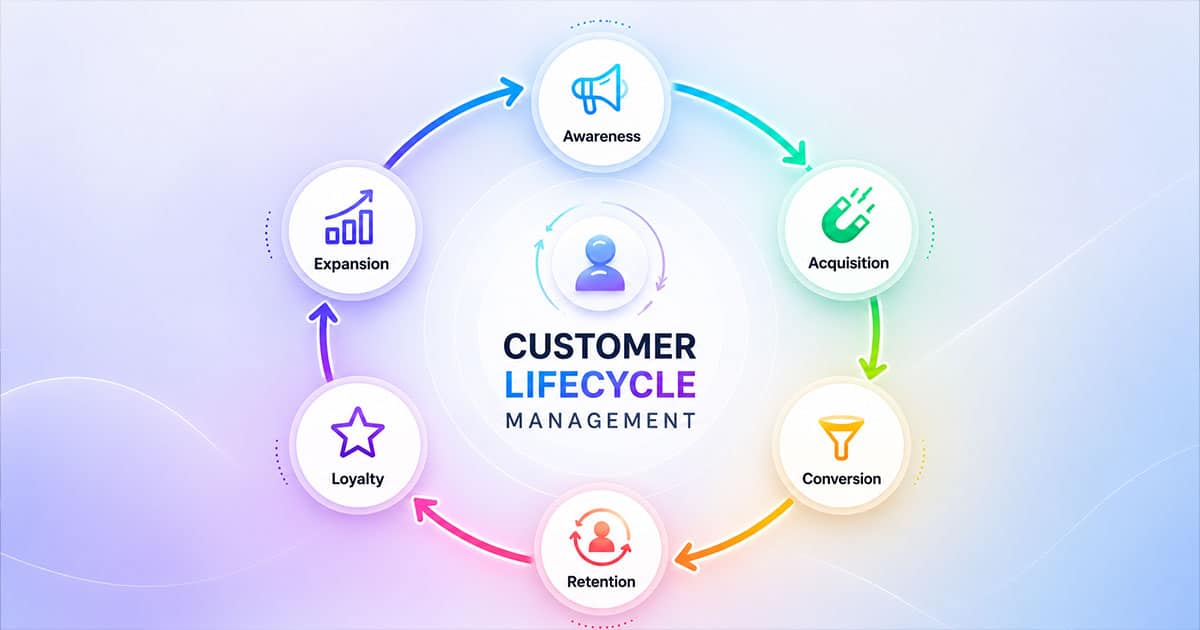
Playbooks map to the customer lifecycle. A new signup, a usage drop, a renewal date approaching, each moment gets its own playbook.
For customer success teams, this drives consistency. A solid customer success strategy needs playbooks as its operating layer, turning direction into repeatable action across every account and CSM.
What Should A Customer Success Playbook Include
Every essential customer success playbook needs the same five building blocks to work in practice, not just in theory. Goals, segments, triggers, actions, and metrics turn a vague idea into something a CSM can actually follow.
Customer Goals And Desired Outcomes
A playbook without a stated goal is just a checklist with no destination. Every customer success playbook should open with the specific outcome the customer needs, tied to their stage in the customer journey rather than a generic company target.
Success plans give that goal a home outside the playbook itself. A CSM references the plan during check-ins, ties each playbook action back to it, and shows the customer exactly how each step moves them toward the outcome they defined at the very start of the relationship.
Customer Segments And Lifecycle Stages
Not every account needs the same playbook at the same time. Segmenting by size, plan tier, or complexity determines which customer success onboarding playbook fits a new account and which lifecycle stage triggers it next, well before the account ever asks for help.
A brand-new logo and an account three renewals in are on completely different paths. The first needs structured setup and early wins. The second needs a renewal playbook built around usage data and contract timing, not a repeat of onboarding steps that no longer apply.
Triggers And Customer Signals
A trigger is the specific event that starts a playbook running, and it needs to be measurable, not a feeling. Customer health scores dropping below a threshold, a support ticket volume spike, or a usage decline are all concrete triggers a system can detect automatically.
Customer feedback adds a qualitative layer scores alone miss. A low NPS response or a pointed comment in a support ticket can trigger the same escalation playbook as a hard usage number, catching risk that pure data sometimes surfaces too late to matter.
Actions, Owners, And Timelines
A trigger without an owner just sits there unresolved. Teams that create customer success playbooks well assign a specific person to each step, not a department, so nobody assumes someone else already handled it, and nothing falls through during a handoff.
Timelines turn actions into something trackable instead of open-ended. A customer success renewal playbook might set a 60-day countdown with key milestones at day 45, day 20, and day 5, each one flagging whether the account is on track or needs a different move.
Success Metrics And Exit Criteria
A success playbook needs a clear finish line, not just a start. Success metrics tied to each playbook, deal size retained, expansion revenue, customer satisfaction scores, tell you whether the process actually worked or just kept everyone busy without moving a single number.
Exit criteria close the loop and protect customer lifetime value over the long run. When a playbook consistently produces a strong outcome, document it. Wins like that become customer success stories your team can reuse in QBRs, case studies, and onboarding for the next new hire.
Which Customer Success Plays Should A Small B2B Team Build First?
Small teams cannot run every playbook at once, so the order matters. Five plays cover the moments most likely to affect retention and customer value, from the first login through the renewal conversation and the advocacy ask that follows it.
Customer Onboarding Play
A new customer needs a clear path to first value, and the onboarding playbook covers exactly that stretch. Assign an owner the day the deal closes, set specific customer goals for the first 30 days, and map the setup steps CSMs already know but rarely write down anywhere shared.
Track onboarding completion as an actual metric, not a vague sense of being done. A defined completion point, first login, first key feature used, first milestone hit, tells the team when to move the account into steady-state support and stop treating it as brand new.
Product Adoption Play
Adoption picks up where onboarding ends, focused on turning setup into regular use. The play should identify critical touchpoints, the specific features or workflows that predict long-term retention, and push the account toward using them before usage naturally flattens out.
Customer engagement here means proactive nudges, not a dashboard nobody checks. A CSM reviews feature usage weekly, flags accounts stalling below expected activity, and sends a short, specific message pointing to the one action likely to unlock the most value next.
At-Risk Customer Play
At-risk status kicks in when a health score drops, a champion leaves, or usage falls off sharply. Customer success operations should define the exact threshold that triggers this play, so nobody debates whether an account qualifies while the window to actually help closes.
The response needs to reinforce customer value fast, not just apologize for a rough patch. A CSM reviews what the account originally bought, reconnects that promise to current usage, and proposes one concrete fix instead of a generic check-in call with no clear ask.
Renewal Play
A renewal play starts well before the contract date, not the week of it. Build it around a quarterly business review that measures customer outcomes against what was promised at signing, so the renewal conversation plays out as a recap rather than a surprise.
Pull usage data, support history, and original goals into one view ahead of that review. An account that hit its targets moves into an expansion conversation. An account that fell short gets a plan to close the gap well before the renewal date arrives.
Expansion And Advocacy Play
Expansion and advocacy playbooks target accounts already getting strong value, not accounts recovering from a problem. The playbook outlines when to raise a new plan, seat count, or feature tier, timed to a recent win rather than an arbitrary end-of-quarter sales deadline.
Advocacy runs alongside expansion, not after it. Ask a satisfied account for a reference call, a review, or a quote once a clear result lands, and route the request through whoever has the closest relationship, not a generic outreach template sent to everyone.
Steps For Building A Customer Success Playbook
Building a playbook is a repeatable system, not a one-time writing exercise. These six steps turn a recurring customer scenario into a documented play your CS teams can run the same way every time, for every account.
Identify Recurring Customer Scenarios
Start by looking for patterns, not one-off situations. Pull performance data from past renewal conversations, support tickets, and onboarding calls, and where possible from your B2B sales CRM, to find the scenarios that keep repeating across accounts, since those are the moments worth documenting first.
A scenario worth a playbook shows up often enough to matter and follows a similar shape each time. If three accounts stalled at the same onboarding step last quarter, that is a critical touchpoint worth building a play around, not a coincidence worth ignoring.
Define The Desired Customer Outcome
Every play needs a specific outcome attached to it, not a vague sense of "helping the customer." Tie the outcome directly to time to value or first value, or to a concrete customer retention CRM strategy, so the play has something concrete to aim for from the moment it triggers.
This step borrows a principle digital marketing teams already use for campaigns: define the result before building the steps that lead to it. A playbook without a stated outcome tends to drift into busywork that feels productive but never actually gets measured.
Set Clear Triggers And Entry Criteria
A trigger has to be based on customer signals a system can actually detect, not a hunch. Usage metrics dropping, a contract signature landing, or a support ticket volume spike are all specific enough to fire a play automatically and consistently, and they mirror the kinds of behaviors that drive or block CRM adoption for sales teams.
Entry criteria narrow the trigger further so the right accounts qualify. A usage drop might only matter for accounts past their first 90 days, for example, since new accounts still ramping up shouldn't trip an at-risk play meant for established ones, just as clear rules for which records qualify as leads or opportunities help CRM lead management stay clean.
Map Actions, Owners, And Timelines
Each play needs a named owner and a deadline attached to every action, not a general team responsible for it. This is where support execution actually happens, and vague ownership is the most common reason playbooks fall apart in practice, much like unclear ownership derails many CRM implementation projects.
Sequence the actions in the order they need to happen, with a timeline attached to each one. Proactive guidance works best delivered early, so a play with actions bunched at the end usually means the trigger fired later than it should have, similar to how effective sales workflow automation strategies spread tasks across the entire cycle.
Add Escalation And Exit Rules
Every play needs a rule for what happens when the standard steps do not work. Escalation rules define when an account moves from a CSM to a manager, or when a churn risk gets flagged for leadership before it becomes unrecoverable.
Exit rules matter just as much and get skipped more often. Completion criteria should state exactly what "done" looks like, whether that means the account renewed, expansion revenue got booked, or the play simply did not apply once conditions changed.
Test, Measure, And Improve Each Play
A new play is a draft until it has run on real accounts. Track whether it actually improved outcomes compared to accounts handled without it, using the same performance data pulled together back in step one.
Playbooks that never get revisited go stale fast. Review each one quarterly, adjust triggers or actions that consistently underperform, and retire plays that no longer match how customers actually behave once the product or market shifts under them, just as you would periodically reassess your open source CRM platform configuration as your needs evolve.
Customer Signals That Trigger The Right Success Play
Structured playbooks only work if the signal firing them is real. Five signal categories cover most lifecycle moments a small team needs to catch, from early product usage through the account changes that shift a play from routine to urgent.
Product Usage And Adoption Signals
Feature usage is the clearest signal available, since it shows what customers actually do instead of what they say. A drop in login frequency or a key feature going untouched for two weeks both point to a play worth triggering immediately.
These signals work best wired into automated workflows rather than checked manually. A CSM covering forty accounts cannot review usage dashboards daily, but a system flagging product usage drops against a threshold turns that into consistent execution without added headcount.
Engagement And Communication Signals
Engagement signals track whether a customer is still responsive, not just active in the product. Unanswered emails, skipped training sessions, or a champion going quiet on calls all suggest the relationship needs attention before usage data even shifts, much like email engagement tracking reveals when prospects quietly disengage.
These signals often show up earlier than product data does. A customer who stops replying but keeps using the product might just be busy, but that pattern combined with silence at key stages of the relationship is worth a proactive check-in, especially if your CRM with email integration makes those gaps visible in one place.
Customer Health And Satisfaction Signals
Health scores combine multiple inputs into one measurable outcome, giving CS teams a single number instead of a dozen separate signals. A score sliding into a risk band should trigger the same at-risk play every time, not a judgment call per account, and should align with your broader CRM-based customer retention strategy.
Satisfaction data adds a layer scores alone miss. A low CSAT response or a pointed comment during a support interaction can trigger the same play a health score would, catching frustration static documents and dashboards sometimes surface too late.
Account And Stakeholder Changes
A champion leaving is one of the strongest risk signals in customer success, and it needs its own trigger separate from usage or health data. Internal handoffs on the customer's side often precede a usage drop, not the other way around, and they may also reset expectations for how your team should challenge and teach stakeholders in B2B sales conversations.
Watch for new stakeholders joining calls, title changes on LinkedIn, or a sudden shift in who replies to emails. Each of these marks a lifecycle moment worth a specific play, since a new contact rarely has the same context the departing one had.
Renewal, Risk, And Expansion Signals
Renewal dates approaching is the most predictable signal a team gets, which makes it the easiest to standardize workflows around. A fixed countdown, say 90 days out, should trigger the renewal play automatically, no manual tracking required.
The same account can surface risk and expansion opportunities at once. Strong usage in one product area alongside a stalled rollout elsewhere means the renewal conversation needs both a save plan and an upsell pitch, not just one or the other.
The Sales-To-Customer Success Handoff
A broken handoff is where most customer success problems actually start, not in onboarding itself. Six steps turn the sales-to-CS transition into structured workflows instead of a Slack message and a hope that nothing important got lost along the way.
Capture Customer Goals And Expectations
Sales conversations reveal business goals a CSM rarely hears firsthand. Whatever the customer said they wanted to achieve, cost savings, faster reporting, fewer manual steps, needs to travel with the account instead of getting reconstructed from memory weeks later.
A structured intake form works better than a free-text summary here. Specific fields for the problem being solved, the success definition, and the timeline keep every handoff following the same process, regardless of which rep closed the deal or how detailed their notes happen to be.
Share Stakeholder And Account Information
A CSM starting cold on stakeholders wastes the first call figuring out who actually matters. Names, titles, decision-making roles, and who championed the deal internally all need to transfer over before that first conversation, not get pieced together during it.
Missing this information tends to mitigate risks later, not just cause an awkward introduction. A CSM who does not know the economic buyer from the daily user often pitches the wrong message to the wrong person at exactly the moment first impressions matter most.
Document Sales Commitments And Promises
Whatever a rep promised during the sale becomes the customer's baseline expectation, whether or not it made it into the contract. A custom integration timeline, a feature roadmap item, a pricing exception, all of it needs a written record CS can actually reference.
Undocumented promises are one of the fastest ways to damage customer experience early. A customer reminding a new CSM about something nobody wrote down reads as the company not paying attention, even when the disconnect is really just a handoff gap.
Transfer Deal And Conversation History
Deal history gives a CSM real context instead of a blank slate. Call notes, objections raised during the sale, and the specific reasons the customer chose this product over a competitor all shape how that first onboarding conversation should actually go.
This is where a shared system beats a forwarded email thread. When sales and CS work from the same record, especially in a CRM with strong email integration capabilities, a CSM opens the account and sees the full conversation history already there, instead of chasing down a rep for context on a deal closed two months earlier.
Define Immediate Post-Sale Actions
The first 48 hours after a contract signs set the tone for everything that follows. A defined action list, welcome email sent, kickoff call scheduled, account provisioned, keeps that window from slipping into manual tracking and inconsistent follow-through, just like clearly defined early stages do in a deal-tracking sales process.
A clear owner for each action matters as much as the action itself. The playbook defines who sends the welcome message, who books the kickoff, and who confirms provisioning is complete, so nothing sits waiting on an assumption that someone else already handled it.
Keep Customer Context Accessible Across Teams
A handoff is not a one-time event if the account later touches support, renewals, or expansion. Whoever picks up a ticket or a renewal conversation six months later needs the same original context the first CSM had on day one, which is where a well-implemented cloud CRM for customer success becomes critical.
Value delivery gets easier to prove when that context stays attached to the account permanently. A support agent seeing the original deal terms, or a renewal rep seeing early wins already logged, can pick up mid-story instead of starting the relationship over from scratch, especially when the team works from a simple CRM built for small teams.
Customer Success Playbooks Without A Dedicated CS Platform
A dedicated CS platform is not a requirement for running structured playbooks well. Most small teams already have the tool they need sitting in their cloud CRM software, just not configured to support customer success work yet.
Start With Your Existing CRM
A CRM already holds deal history, contact records, and communication logs, which covers most of what a playbook needs to trigger correctly. Adding pipeline stages for onboarding, adoption, and renewal turns a CRM software setup for modern sales teams into something CS can run plays from too.
This approach skips the cost and setup time of a separate system entirely. A team already paying for a CRM gets customer success functionality without a second subscription, a second login, or a second place for information to eventually go stale, especially if they choose the right fit in a simple CRM vs all-in-one CRM tradeoff.
Centralize Customer Information
Scattered customer needs are hard to act on when they live across five different tools. Centralized contact management helps by pulling support tickets in one system, deal notes in another, and renewal dates tracked in a spreadsheet somewhere into a single view, instead of making it nearly impossible to spot a churn risk before it's too late.
One shared record fixes that by design, not by discipline. When usage data, support history, and deal terms sit on the same account, especially inside customer retention-focused CRM strategies, a CSM reviewing a renewal window sees the full picture in one place instead of pulling reports from three systems first.
Create Repeatable Tasks And Workflows
A playbook only works if its steps turn into actual tasks someone completes. Sales workflow automation and automated task creation tied to a trigger, a deal closing, a ticket opening, removes the need to remember which account needs which action on which day.
Templates make this repeatable across the whole team, not just for whoever wrote the original playbook. A new CSM inherits the same onboarding checklist and the same task sequence a tenured teammate uses, keeping execution consistent regardless of who's running the account, much like strong CRM adoption in modern sales teams keeps processes consistent across reps.
Use Segmentation To Guide Customer Actions
Not every account should get the same playbook at the same time. Segmenting by plan tier, account size, or usage pattern determines which onboarding checklist applies and which accounts get a lighter-touch version versus a hands-on one, mirroring how CRM-based retention strategies use segmentation to focus effort where it matters most.
Segmentation also sharpens how a team prioritizes limited time. A small CS team cannot give every account equal attention, so grouping accounts by risk level or expansion potential makes it clear which ones need proactive outreach first, similar to how smart CRM features organize sales work around priority deals.
Track Playbook Performance And Outcomes
A playbook needs to prove it's working, not just exist. Tracking outcomes like renewal rate, time to first value, or reduction in churn risk by segment shows whether a specific play is actually changing results or just adding process for its own sake, the same way a well-defined sales process from lead to close relies on clear stages and metrics.
Performance data also flags which plays need revisiting. A renewal play with a weak save rate compared to others points to a specific step worth rewriting, just as low sales win rate performance points to specific stages in the funnel to fix, rather than assuming the whole playbook approach needs to be scrapped and rebuilt from scratch.
A Practical Customer Success Playbook Template
Copy this structure for any play, onboarding, at-risk, renewal, or expansion. Fill in each field, keep it to one page, and share it with the whole team so every CSM runs the same play the same way.
Play Name
[e.g., At-Risk Account Play, 90-Day Renewal Play, New Customer Onboarding Play]
Trigger
What specific event or signal starts this play?
[e.g., Health score drops below 60 / Contract renewal is 90 days out / Deal closes in CRM]
Entry Criteria
Which accounts qualify, and which don't?
[e.g., Applies to accounts past day 90. Excludes trial or pilot accounts.]
Goal
What outcome does this play need to produce?
[e.g., Restore usage above baseline within 30 days / Secure signed renewal / Complete onboarding checklist]
Owner
Who is responsible for running this play end to end?
[e.g., Assigned CSM, with Support looped in for technical escalations]
Steps
Step | Action | Owner | Timeline |
|---|---|---|---|
1 | |||
2 | |||
3 | |||
4 |
Escalation Rule
When does this move to a manager or a different team?
[e.g., If no response after 2 outreach attempts, escalate to CS lead]
Exit Criteria
What does "done" look like for this play?
[e.g., Renewal signed / Usage back above threshold for 2 consecutive weeks / Account churned]
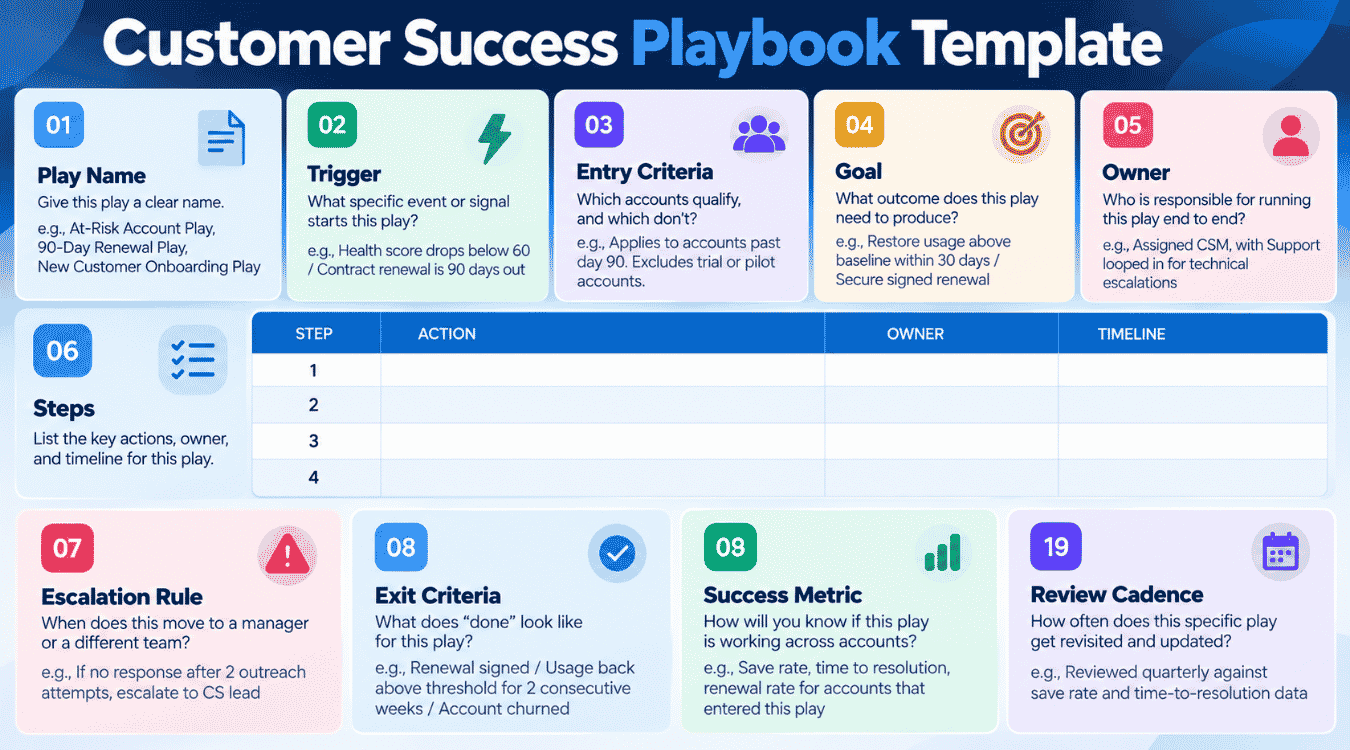
Success Metric
How will you know if this play is working across accounts?
[e.g., Save rate, time to resolution, renewal rate for accounts that entered this play]
Review Cadence
How often does this specific play get revisited and updated?
[e.g., Reviewed quarterly against save rate and time-to-resolution data]
Example: At-Risk Account Play, filled in
- Trigger: Health score drops below 60, or usage falls 40%+ over 2 weeks
- Entry Criteria: Accounts past day 90, active contract, not already in an open escalation
- Goal: Restore usage above baseline within 30 days
- Owner: Assigned CSM, Support looped in if the drop ties to an open ticket
Step | Action | Owner | Timeline |
|---|---|---|---|
1 | CSM reviews account history and recent tickets | CSM | Day 1 |
2 | CSM sends a specific, non-generic check-in referencing the drop | CSM | Day 2 |
3 | Schedule a call to identify the blocker | CSM | Day 5 |
4 | Propose a concrete fix tied to original deal goals | CSM | Day 10 |
- Escalation Rule: No response after 2 attempts, escalate to CS lead by day 7
- Exit Criteria: Usage back above threshold for 2 consecutive weeks, or account moves to formal churn risk
- Success Metric: Save rate for accounts entering this play
- Review Cadence: Quarterly
Why Customer Success Playbooks Fail And How To Fix Them
Most playbooks do not fail because the idea was wrong. They fail because one specific piece was skipped during setup. Five recurring problems account for most breakdowns, and each one has a fix that takes less effort than starting over.
Playbooks Are Too Generic
A playbook meant to guide customers through every possible scenario ends up guiding no one through any of them well. Generic steps like "check in with the customer" give a CSM nothing specific to act on, so execution ends up depending on individual judgment instead of the process itself.
The fix is specificity, not more content. Write the exact message to send, the exact question to ask, and the exact resource to share for that one scenario. A narrow, precise play for at risk accounts will always outperform a broad one trying to cover every situation at once.
Triggers Are Not Clearly Defined
A playbook without a measurable trigger relies on someone remembering to start it manually. That works for a week, then quietly stops working once the team gets busy, and accounts that should have entered a play never do.
Fix this by tying every trigger to a number or a date, not a feeling. A usage threshold, a specific day before renewal, a ticket volume spike, each one should be concrete enough that a system could flag it automatically, even before that automation actually exists.
Ownership Is Unclear
When a play lists a team as the owner instead of a person, every step depends on manual effort someone eventually forgets to put in. Escalation paths get skipped entirely because nobody was ever clearly on the hook for triggering them.
Assign one name to each step, not a department. If key stakeholders on the account need visibility, loop them in as a notification, not as a shared owner. Shared ownership is functionally the same as no ownership once an account actually needs help.
Teams Do Not Track Outcomes
A playbook running for months with no data attached is a process nobody can improve. Without tracking renewal rate, time to first value, or save rate by play, there is no way to tell if a specific play is working or just keeping people occupied.
Fix this by attaching one metric to every play before it launches, not after. Even a simple before-and-after comparison, accounts that went through the play versus accounts that didn't, gives a team enough signal to know whether to keep running it as written.
Playbooks Become Outdated
A playbook built for last year's product or last year's customer base quietly stops matching reality. Steps that guide customers toward a feature that changed, or a pricing tier that no longer exists, erode trust the moment a customer notices the mismatch.
Set a fixed review date for every play, not an open-ended "revisit someday." A quarterly check against current product changes and recent outcomes keeps a playbook accurate instead of letting it fail silently while everyone assumes it still works.
Final Discussion
A customer success playbook only works when it accounts for how small teams actually operate. Most guides on this topic assume a dedicated CS platform and a team large enough to staff every role separately. Neither is true for most B2B teams under 200 people.
The real fix starts earlier than most teams expect: at the sales handoff, where deal context either transfers cleanly or gets lost. Playbooks built on clear triggers, named owners, and tracked outcomes hold up. Playbooks built on good intentions do not.
Start with one play, the one solving your biggest current problem, not five plays launched at once. Get that one working, prove it moves a real number, then build the next.