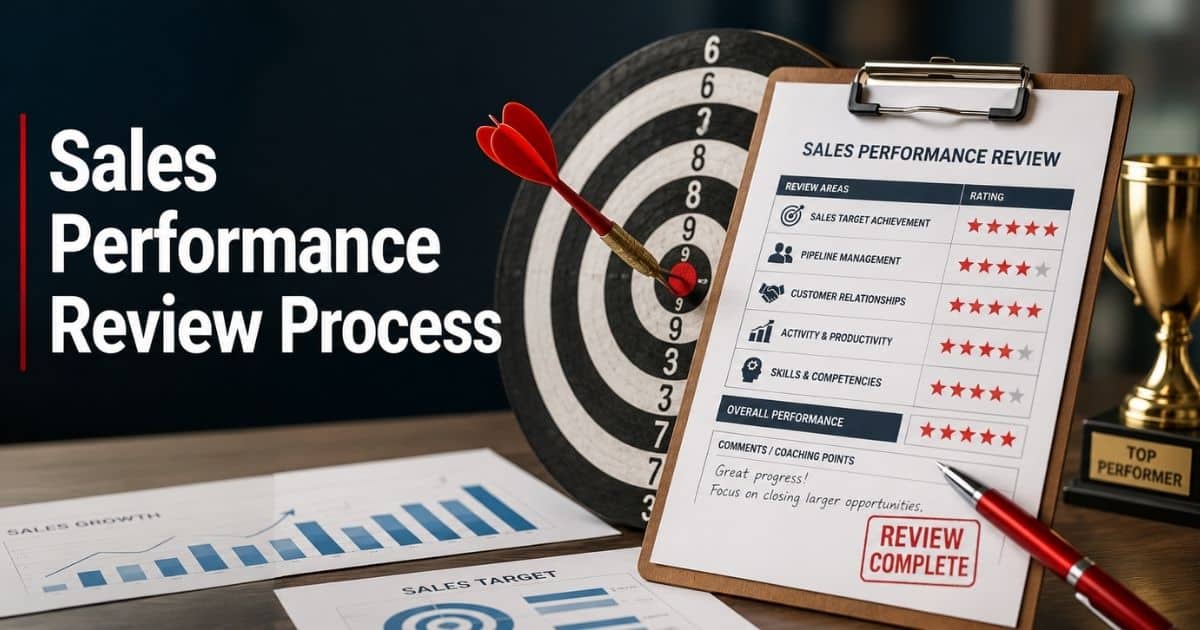
TL;DR: A fair sales performance review combines hard numbers (quota attainment, win rate) with coaching feedback. This guide gives a 6-step process, a sample scorecard, and how to turn reviews into a coaching habit instead of an annual formality.
Sales teams live and die by numbers. Quotas, revenue targets, conversion rates, and pipeline growth often dominate every conversation. But numbers alone rarely tell the full story. A top performer may hit every target while struggling with teamwork or customer relationships. Another rep may miss quota but show strong progress and long-term potential. That is why a structured sales performance review process matters.
A strong review process combines data with context. It helps managers evaluate results, identify coaching opportunities, and align individual performance with business goals. Regular reviews also create space for meaningful feedback, which plays a major role in employee engagement and development. In fact, employees who receive meaningful feedback are far more likely to stay engaged in their work.
With nearly 90% of sellers reporting burnout in Gartner research, effective performance reviews have become more important than ever. When done correctly, they provide clarity, motivation, and a clear path for growth instead of feeling like another routine evaluation.
What Is A Sales Performance Review Process
A sales performance review process is a structured way to evaluate how well sales reps contribute to business goals. It goes beyond a simple annual evaluation. A strong sales performance review combines performance metrics, customer feedback, and qualitative observations to create a complete picture of individual performance and team performance. The goal is to measure sales success, identify improvement plans, and align sales efforts with company objectives. Effective reviews also help sales managers and sales leaders track progress against key performance indicators and performance expectations.
A well-designed performance review process looks at more than sales quota attainment review results. It evaluates sales activities, communication skills, customer relationship building, product knowledge, sales tactics, and how each rep's performance supports team objectives. Key metrics often include sales volume, average deal size, sales cycle length, conversion rates, and sales pipeline health. Sales performance review examples usually include both positive feedback and critical feedback supported by specific data and real examples.
Regular performance reviews matter because they improve employee performance, support professional development, and keep the sales team motivated. Whether you conduct sales performance reviews quarterly or annually, each review cycle should end with clear performance feedback, improvement feedback, SMART goals, and actionable next steps. When sales professionals understand their strengths, challenges, and path forward, they are better equipped for future success, revenue growth, and long-term sales success.
Key Components Of An Effective Sales Performance Review Process
A successful sales performance review process does more than measure results. It helps sales managers understand what drives performance and where improvement is needed. Strong reviews combine data, feedback, and clear expectations. They also support professional development and long-term sales success.
Clear KPIs And Performance Expectations
Every sales performance review should start with clear key performance indicators. Sales reps need to know how success is measured before the review cycle begins. Without clear goals, even strong performers may feel confused about expectations.
Common performance metrics include revenue growth, conversion rates, sales quota attainment, average deal size, and sales cycle length. When sales leaders align KPIs with business goals, the review process becomes fair and objective. Team members can also track progress more confidently throughout the year.
Quantitative Sales Performance Metrics
Numbers provide the foundation for any sales performance evaluation. Sales managers need reliable data to understand a rep's performance and overall team performance. A data-driven approach reduces bias and keeps reviews focused on facts.
Key metrics often include sales volume, win rates, pipeline value, sales funnel movement, and new opportunities created. CRM systems make it easier to visualize performance trends and sales activities. Reviews anchored in measurable results help identify both top performers and areas that need support.
Qualitative Assessment And Behavior Review
Strong sales performance is not only about hitting targets. A review should also examine how results were achieved. Customer relationship building, communication skills, teamwork, and problem-solving all affect long-term success.
Customer feedback can reveal strengths that numbers may miss. Sales leaders should also evaluate product knowledge, sales tactics, and collaboration with cross-functional teams. This balanced view creates a more complete picture of individual performance and future potential.
Specific Feedback And Coaching Insights
Feedback works best when it is clear and supported by examples. A positive feedback example should explain what worked and why it mattered. Critical feedback should focus on actions that can improve future results.
Research from Gallup shows that 80% of employees who receive meaningful feedback are fully engaged at work. That makes performance feedback one of the most powerful tools in sales management. Specific examples help sales professionals understand their impact and take action with confidence.
Action Plans And Growth Opportunities
A formal review should never end with a score alone. Every sales review needs a practical action plan. Clear next steps help improve employee performance and keep the sales team motivated.
SMART goals work well because they provide direction and accountability. Improvement plans may focus on prospecting, client relationships, communication skills, or sales processes. Career development discussions should also be part of the conversation. When sales representatives leave with a roadmap for growth, performance reviews become a tool for future success rather than a simple annual evaluation.
Sales Performance Metrics And KPIs To Evaluate During Reviews
A sales performance review is only as good as the metrics behind it. The right KPIs help sales managers evaluate results fairly and identify areas for growth. A balanced review process should combine outcome-based metrics with activity data and customer insights. That approach creates a complete view of sales performance and supports better coaching decisions.
Quota Attainment
Sales quota attainment is one of the most important metrics in any sales performance evaluation. It shows whether sales reps meet the revenue targets assigned to them. A rep who consistently reaches quota often demonstrates strong sales execution and discipline.
This metric should never stand alone. Sales leaders should compare quota attainment with market conditions, territory size, and available opportunities. Recent sales research shows that many reps still struggle to hit targets, making this metric a useful benchmark for individual performance and team performance.
Conversion And Win Rates
Conversion rates reveal how effectively sales professionals move prospects through the sales funnel. Strong conversion numbers often indicate effective sales tactics, product knowledge, and communication skills. Low rates may signal gaps that require improvement feedback.
Win rate is equally valuable. It measures how often opportunities become closed deals. During a sales review, sales managers should look at conversion rates across each stage of the sales pipeline. This helps uncover performance patterns that may not appear in revenue numbers alone.
Sales Cycle And Deal Size
A rep's performance is not only about how much they sell. The speed and value of deals also matter. Sales cycle length measures the time needed to move a prospect from first contact to close. A shorter sales cycle often reflects stronger qualification and follow-up.
Average deal size shows the revenue value of each sale. Together, these metrics help evaluate operational efficiency and sales effectiveness. Large deals with a healthy sales cycle often contribute more to long-term revenue growth than a high volume of small transactions.
Pipeline Health And Activity Levels
A healthy sales pipeline creates future success, and incorporating AI sales assistants for pipeline efficiency can further strengthen visibility and early risk detection. Sales performance reviews should examine key metrics such as opportunities created, pipeline coverage, meetings booked, and sales activities completed. Activity data often serves as an early warning signal before performance drops.
Sales management teams use pipeline metrics to understand future revenue potential, especially when they build a simpler sales workflow that gets more from the CRM. Reviews should assess whether individual sales reps maintain enough opportunities to support their sales goals. Consistent activity usually leads to more predictable sales success over time.
Customer And Team Impact
Numbers tell part of the story. Customer feedback and team contributions provide valuable context for a sales performance review process. Strong client relationships often lead to repeat business, referrals, and better long-term results.
Sales leaders should also evaluate how team members support cross-functional teams and contribute to team objectives. A salesperson who helps others succeed can have a positive impact beyond personal results. Effective performance reviews balance hard data with qualitative insights to create a complete assessment of overall performance.
How To Conduct A Sales Performance Review Process Step By Step
A successful sales performance review process needs structure. Without a clear review process, feedback can feel subjective and inconsistent. A step-by-step approach helps sales managers evaluate performance fairly, identify growth opportunities, and align sales efforts with business goals. It also makes performance reviews more productive for both managers and sales reps.
Here's a simple scorecard format you can adapt for your own review conversations:
Metric | Target | Actual | Coaching Note |
|---|---|---|---|
Quota Attainment | 100% | [Fill in] | [e.g., strong close rate, needs more pipeline volume] |
Win Rate | [Team benchmark] | [Fill in] | [e.g., losing mid-funnel, tighten qualification] |
Sales Cycle Length | [Team benchmark] | [Fill in] | [e.g., slow at negotiation stage] |
Activity (calls/emails/demos) | [Team benchmark] | [Fill in] | [e.g., strong volume, work on quality] |
Step 1: Gather Performance Data
Every sales performance review should begin with reliable data. Sales managers need a complete view of a rep's performance before the conversation starts. A review based on assumptions can lead to poor decisions and frustration.
Key metrics often include sales quota attainment, conversion rates, sales cycle length, average deal size, and pipeline growth, all of which become easier to monitor with CRM-powered lead and pipeline management. CRM platforms, especially dedicated sales pipeline CRM systems, make it easier to collect this information, and teams that use them effectively can significantly boost sales productivity through centralized data and automation. A data-driven review process helps sales leaders spot performance trends and evaluate overall performance with confidence. Reviews anchored in facts also reduce bias and improve trust.
Step 2: Review Goals And KPIs
The next step is to compare results against established goals. Every sales representative should know the key performance indicators used during the review cycle. Clear expectations create a fair sales performance evaluation.
Sales goals may include revenue targets, customer retention, opportunities created, or sales funnel movement, and even small organizations can track these effectively with a CRM for startups and small sales teams. Reviews should also assess progress toward team objectives. Research shows that employees perform better when goals are clear and measurable. A structured comparison between expectations and results creates a stronger foundation for performance feedback.
Step 3: Complete A Self-Assessment
A self-assessment gives sales professionals a voice in the review process. It encourages reflection on past performance, successes, and challenges. This step often reveals insights that numbers alone cannot provide.
Sales reps can evaluate their sales activities, communication skills, contact management and customer relationship building efforts, and progress toward personal goals, especially when they have access to dynamic contact management for smarter relationship tracking. Self-assessments also help uncover alignment gaps between managers and team members. When both sides come prepared, challenging reviews become more collaborative and productive rather than defensive.
Step 4: Discuss Results And Feedback
A formal review should include both positive feedback and improvement feedback. Strong conversations focus on specific examples instead of vague opinions. Sales managers should explain what worked well and where improvement is needed.
A positive feedback example might highlight excellent client relationships or consistent quota attainment. Critical feedback should address issues with clear evidence and practical solutions. Gallup research shows employees who receive meaningful feedback are much more engaged at work. Productive conversations also require managers to practice active listening throughout the discussion.
Step 5: Create An Action Plan
Every sales review should end with a clear path forward. Feedback without action rarely improves employee performance. Sales leaders and team members should agree on priorities before the meeting ends, ensuring those priorities align with how the team actually works in their chosen CRM tools that fit existing workflows.
SMART goals work well because they provide measurable targets and accountability. Improvement plans may focus on sales strategy, product knowledge, sales tactics, or operational efficiency. The action plan should include timelines, support resources, and follow-up dates, ideally mapped into a B2B sales CRM built for complex revenue teams. A clear roadmap helps sales reps track progress and stay focused on future success throughout the next review cycle.
Common Challenges In The Sales Performance Review Process And How To Overcome Them
Even the best sales performance review process can run into problems. Bias, poor communication, unclear expectations, and inconsistent feedback often reduce the value of performance reviews. Recognizing these obstacles early helps sales managers create a fairer review process and improve employee performance over time.
Unclear Performance Expectations
Many sales performance reviews fail before they even begin. Sales reps cannot hit goals they do not fully understand. Unclear key performance indicators often create confusion and frustration during a formal review.
Sales leaders should define sales goals, performance metrics, and team objectives at the start of every review cycle. Each team member should know how success will be measured. Clear expectations make sales performance evaluation more accurate and reduce disagreements during challenging reviews. Regular check-ins also help track progress before the annual evaluation arrives.
Bias And Subjective Evaluations
Subjective opinions can weaken a sales performance review. Personal preferences sometimes influence ratings more than actual performance data. Research shows that 51% of workers believe their performance reviews contain bias, while 61% feel their last review was unfair.
A data-driven approach helps solve this problem. Sales managers should use performance metrics such as sales quota attainment, sales cycle length, average deal size, and customer feedback. Objective data creates a fair review process and gives sales professionals more confidence in the outcome.
Limited Feedback Throughout The Year
Many organizations rely too heavily on a single annual evaluation. Months can pass without meaningful performance feedback. As a result, problems grow unnoticed and successes receive little recognition.
Regular sales review conversations help keep the sales team motivated. Frequent discussions allow sales leaders to provide positive feedback, critical feedback, and coaching when it matters most, especially when paired with sales activity tracking software that gives everyone clear visibility into daily work and a CRM with email integration to streamline sales communication. Experts increasingly recommend ongoing check-ins rather than waiting for one large review at the end of the year.
Defensive Reactions During Reviews
A review meeting can become uncomfortable when feedback feels unexpected. Employees often react defensively if they hear concerns for the first time during a performance appraisal. Trust can quickly decline when communication breaks down.
Sales managers should practice active listening and use specific examples during the conversation. A strong improvement feedback example focuses on behaviors and results rather than personal traits. Self-assessment exercises can also help sales representatives reflect on their own performance before the meeting. This creates a more productive discussion and encourages professional development.
Burnout And Low Engagement
Burnout remains a major challenge for sales management teams. Gartner research found that nearly 90% of sellers report feeling burned out at work. High pressure, aggressive targets, and constant performance demands often affect team performance and employee engagement.
Sales performance reviews should address more than revenue growth. Sales leaders should discuss workload, career development, customer relationship building, and support needs, including how modern CRM adoption is reshaping sales team workflows and expectations. A balanced review process helps identify performance patterns before they become larger problems. When team members feel supported, they are more likely to stay engaged and achieve long-term success.
Sales Coaching And Feedback Strategies After Performance Reviews
A sales performance review should never be the end of the conversation. Real improvement happens after the review meeting. Effective coaching and feedback help sales reps build new skills, fix performance gaps, and stay focused on sales goals. Consistent support also strengthens team performance and long-term sales success.
Provide Timely Feedback
Feedback has the greatest impact when it arrives close to the event. Waiting until the next formal review often reduces its value. Sales reps need clear guidance while situations are still fresh and easy to remember.
Regular feedback helps improve employee performance and keeps team members aligned with performance expectations. Gallup research found that employees who receive meaningful feedback are far more likely to be engaged at work. Frequent conversations also help sales managers address small issues before they become larger performance problems.
Use Specific Examples
Vague feedback creates confusion. Sales professionals need clear examples to understand what worked and what needs improvement. Strong feedback should connect directly to sales activities, customer interactions, and measurable outcomes.
A positive feedback example might highlight strong client relationships that led to a larger average deal size. An improvement feedback example could focus on missed follow-up opportunities that extended the sales cycle. Specific examples make feedback easier to understand and easier to act on during the next review cycle.
Focus On Coaching Instead Of Criticism
A sales performance review should help people grow, not discourage them. Critical feedback is necessary at times, but it should be paired with practical coaching. Sales managers should focus on solutions rather than mistakes alone.
Coaching conversations can address product knowledge, communication skills, sales tactics, automated sales task workflows, or customer relationship building. This approach helps sales representatives build confidence while improving performance. A supportive coaching style also strengthens trust between managers and team members, which can improve overall performance across the sales team.
Set SMART Development Goals
Clear goals turn feedback into action. Without a plan, even valuable insights often lead nowhere. SMART goals help sales reps understand exactly what success looks like and how progress will be measured.
Goals may focus on quota attainment, conversion rates, structured sales deal tracking and pipeline growth, or customer retention. Each objective should include a timeline and measurable outcome. Sales leaders can then track progress through regular sales review meetings. Structured goals also create accountability and support professional development throughout the year.
Schedule Ongoing Coaching Sessions
One review meeting is rarely enough to create lasting change. Ongoing coaching keeps performance discussions active and helps sales professionals stay focused on team objectives. Consistent support also reduces surprises during the next annual evaluation.
Research from Gartner shows that seller burnout remains a major challenge across sales organizations. Regular coaching sessions help managers identify performance patterns, workload concerns, and development needs early. Continuous conversations create a stronger review process and help sales teams stay motivated, productive, and prepared for future success.
Best Practices To Make The Sales Performance Review Process Fair And Data Driven
A sales performance review process works best when it is consistent, objective, and backed by reliable data. Fair reviews build trust across the sales team and create better outcomes for everyone. A structured approach also helps sales managers make decisions based on evidence rather than assumptions or personal opinions.
Align KPIs Before Reviews
Clear expectations are the foundation of a fair review process. Sales reps should know which key performance indicators will be evaluated long before the formal review takes place. Surprises often create frustration and reduce trust.
Sales leaders should align sales goals with business goals at the start of each review cycle. Metrics such as quota attainment, conversion rates, sales cycle length, and customer retention should be clearly defined. When team members understand how success is measured, sales performance evaluations become more transparent and effective.
Use Data Over Opinions
A strong sales performance review should rely on facts, which is much easier when sales activity and customer interactions are centralized in CRM tools that help real estate and other field teams stay organized. Personal opinions can create bias and lead to inconsistent evaluations. Data helps sales managers focus on actual performance rather than assumptions.
Performance metrics such as revenue growth, average deal size, sales pipeline health, and customer feedback provide a balanced view of results and reinforce why sales visibility matters more than ever. Research shows that employees are more likely to trust reviews when evaluations are tied to measurable outcomes. Data-driven reviews also make it easier to identify performance patterns and support improvement plans.
Combine Metrics With Context
Numbers matter, but they do not tell the full story. A sales representative may miss a target because of territory changes, market shifts, or complex client situations. Context helps explain what performance metrics cannot.
Effective performance reviews blend quantitative data with qualitative insights. Sales managers should assess customer relationship building, communication skills, teamwork, and innovation in sales efforts. This balanced approach creates a more accurate picture of individual performance and team performance. It also leads to more meaningful performance feedback.
Document Performance Consistently
Consistent documentation improves fairness across the sales team. Reviews based only on recent events often overlook important achievements and challenges from earlier in the year. This can create inaccurate performance appraisals.
Sales management teams should keep records of sales activities, customer feedback, coaching conversations, and progress toward goals, often by consolidating them in CRM tools that help retail and other frontline teams stay organized. Notes and activity tracking software for sales teams can help track performance trends over time. Good documentation gives sales leaders stronger evidence and helps support both positive feedback and critical feedback during reviews.
Maintain A Regular Review Cadence
A fair sales performance review process should not depend on one annual evaluation. Regular performance discussions create better visibility into employee performance and allow faster course correction when needed.
Quarterly reviews, monthly check-ins, and coaching sessions help sales professionals stay aligned with performance expectations. Frequent conversations also support professional development and career growth. Gartner research highlights that burnout remains a challenge across sales organizations, making regular support more important than ever. A predictable review cadence helps keep the sales team motivated and focused on long-term success.
How To Turn Sales Performance Reviews Into Continuous Improvement And Revenue Growth
A sales performance review process creates the most value when it leads to action. Reviews should not end with ratings and feedback alone. The best sales organizations use review insights to improve skills, strengthen sales efforts, and drive revenue growth. Continuous improvement helps both individual sales reps and the entire sales team perform at a higher level.
Create Action Plans After Every Review
A review without a plan rarely changes performance. Sales managers should end every sales performance review with clear next steps. Action plans help sales professionals focus on priorities and understand what success looks like before the next review cycle.
Strong plans include measurable goals, timelines, and accountability. Areas may include sales tactics, customer relationship building, product knowledge, or sales pipeline management. Clear action items help team members track progress and turn performance feedback into measurable business results.
Use Continuous Coaching
One annual evaluation cannot support year-round growth. Sales leaders should provide coaching throughout the year rather than waiting for the next formal review. Frequent conversations help address issues before they affect sales goals.
Research from Gartner shows that seller burnout remains widespread across sales organizations. Regular coaching helps sales reps stay motivated, improve communication skills, and build confidence. Ongoing support also strengthens professional development and creates a culture of continuous improvement rather than one-time correction.
Track Performance Trends Over Time
Individual results only tell part of the story. Sales managers should monitor performance trends across multiple review cycles. Long-term data reveals patterns that may not appear in a single sales review.
CRM platforms and sales pipeline management tools make this process easier, as shown in case studies where teams close deals faster with a streamlined Gain.io setup. Teams can evaluate sales cycle length, conversion rates, average deal size, and revenue growth over time. Trend analysis helps sales management identify opportunities, improve operational efficiency, and make better decisions about coaching and resource allocation.
Reward Progress And Success
Recognition plays an important role in employee performance. Sales professionals are more likely to stay engaged when their efforts are noticed and appreciated. Positive feedback should highlight both results and behaviors that contribute to sales success.
Recognition does not always require financial rewards. Public acknowledgment, career development opportunities, clear task ownership and responsibility, and leadership responsibilities can also motivate team members. Gallup research consistently shows that meaningful recognition improves engagement and workplace performance. A motivated sales team is more likely to achieve ambitious business goals.
Use Review Data To Improve Strategy
Sales performance reviews generate valuable business insights. Sales leaders should use review findings to refine sales strategy, improve sales processes, and strengthen team objectives. Review data often reveals gaps that affect overall performance.
For example, repeated issues with customer objections may indicate a need for product training. Long sales cycles may suggest process inefficiencies. AI sales automation and analytics and CRM systems can also help uncover performance patterns across the sales funnel. Organizations that use review data effectively can improve future sales efforts and create sustainable long-term revenue growth, especially when they choose a CRM that prioritizes usability, such as a Gain.io vs Salesforce CRM option focused on simpler pipelines.
How Gain.io Supports Better Sales Performance Reviews And Team Growth
A strong sales performance review process depends on accurate data, clear communication, and consistent follow-through. Gain.io’s all-in-one CRM helps bring those elements together in one place. Instead of relying on scattered spreadsheets, emails, and manual updates, sales managers can organize performance-related information more efficiently and create a structured review process. This helps reduce subjectivity and keeps performance discussions focused on facts.
Gain.io also supports collaboration across teams, making it easier to document feedback, track progress, and maintain a complete history of performance conversations, and many teams evaluate it through a Gain.io vs HubSpot CRM comparison. Its smart CRM features for sales teams help sales leaders monitor performance trends, identify coaching opportunities, and align sales efforts with business goals, often outperforming alternatives in a Gain.io vs Pipedrive CRM comparison. As a result, sales reps receive clearer guidance, managers make better decisions, and organizations create a culture of continuous improvement that supports long-term sales success and revenue growth, which is reinforced when teams select streamlined platforms after a Gain.io vs Zoho CRM comparison.
FAQs
Can A Sales Performance Review Process Improve Employee Retention?
Yes. A well-structured sales performance review process helps employees feel valued and supported. Regular performance feedback, career development discussions, and clear improvement plans increase engagement and encourage sales professionals to stay with the organization longer.
Should Sales Performance Reviews Include Peer Or Customer Input?
Yes. Customer feedback and peer insights can provide valuable context that sales performance metrics alone may miss. This approach helps sales managers evaluate communication skills, customer relationship building, and overall performance more accurately.
What Is The Difference Between A Sales Performance Review And A Sales Audit?
A sales performance review focuses on evaluating individual sales reps and team performance against key performance indicators. A sales audit examines sales processes, sales strategy, operational efficiency, and overall business performance at a broader level.
Can Small Sales Teams Benefit From A Formal Review Process?
No team is too small for performance reviews. Even a small sales team benefits from clear performance expectations, regular coaching, and structured feedback. A formal review process helps track progress, improve accountability, and support future sales success.
How Often Should Sales Performance Metrics Be Reviewed Between Formal Evaluations?
Quarterly formal reviews with brief monthly check-ins work well for most teams. Quarterly is close enough to catch a slump before it compounds, and far enough apart that reps aren't reviewed before they've had a fair runway to hit a number.