Most sales leaders know their revenue target. Far fewer know whether their current team has the capacity to achieve it. That gap often leads to missed quotas, hiring mistakes, and revenue forecasts that never become reality.
A sales capacity planning model helps answer one critical question: how much revenue can your sales team realistically produce with the people, time, and resources available? Instead of relying on assumptions, companies use capacity planning to forecast hiring needs, set achievable quotas, account for ramp time and attrition, and align sales investments with growth goals.
Whether you are scaling a fast-growing SaaS company or optimizing an established sales organization, a well-built sales capacity planning model provides a clear path from revenue targets to execution. This guide covers everything you need to know, from key metrics and forecasting methods to headcount planning, capacity calculations, and common mistakes that can limit growth.
What Is A Sales Capacity Planning Model
A sales capacity planning model helps businesses understand how much revenue their sales team can realistically generate with available resources. It combines sales data, historical performance, sales quotas, ramp time, and sales productivity to estimate future results. Instead of guessing how many sales reps are needed, companies use sales capacity planning to make informed hiring plans and support consistent revenue growth. The model also helps sales leaders calculate sales capacity, evaluate the current team structure, and align sales resources with future revenue goals.
A strong sales capacity model looks beyond the number of sales representatives on the team. It considers average deal size, average sales cycle length, quota attainment, sales efficiency, and the performance of existing sales reps. Capacity planning also accounts for new hires, fully ramped reps, attrition, and administrative tasks that reduce actual selling time. Since sales reps spend only part of their day selling, accurate resource allocation becomes essential.
Sales capacity planning is important because it connects sales strategy, sales operations, finance teams, demand generation, customer success, and the marketing team around shared revenue targets. Whether you need to determine how many reps to hire, assess revenue potential, or build a financial model for annual recurring revenue, an effective sales capacity planning process provides the accurate data needed to make better decisions in changing market conditions.
Key Components Of A Sales Capacity Planning Model
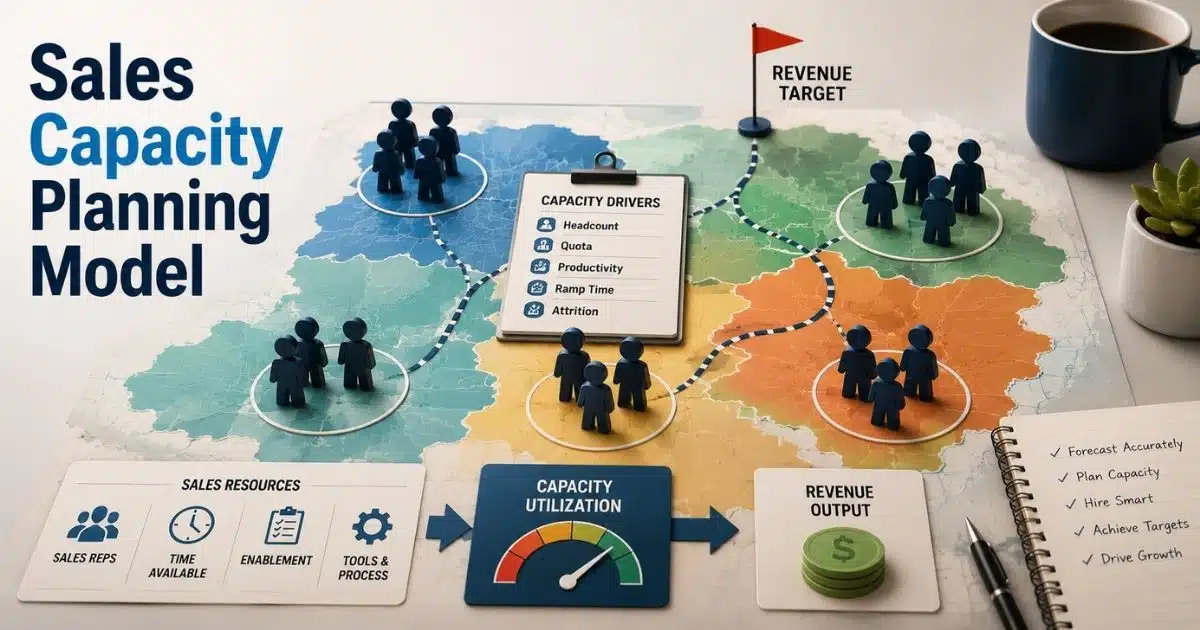
A sales capacity planning model relies on several connected components. Each one affects how much revenue a sales team can generate. When sales leaders understand these elements, they can make better hiring plans, set realistic sales quotas, and align sales resources with future revenue goals.
Revenue Targets
Every sales capacity planning process starts with revenue targets. A company must know how much revenue it wants to generate before deciding how many sales representatives it needs. Clear goals help sales operations calculate sales capacity and build a realistic hiring strategy.
Revenue targets are usually divided by quarter, territory, product line, or customer segments. Many sales organizations also break goals into individual sales quotas. This approach helps sales leaders connect revenue expectations with actual sales performance and resource allocation across the business.
Sales Headcount
The number of sales reps directly affects revenue potential. A sales capacity model helps determine how many sales reps are needed to support future growth. It also helps finance teams forecast compensation costs and hiring budgets.
Headcount planning goes beyond simple staffing numbers. Companies must account for new hires, fully ramped reps, attrition, and internal promotions. A team with the right mix of experienced account executives and new sales reps, supported by a scalable sales process for growing teams, can maintain stronger sales productivity and consistent revenue growth.
Rep Productivity
Sales productivity measures how much revenue each sales rep can realistically generate. Historical data plays a major role here. Sales leaders often review average revenue per rep, quota attainment, and historical performance, alongside proven sales productivity tips for B2B sales teams, before making capacity decisions.
Productivity calculations should also reflect real-world conditions. Research shows sales reps spend only about 28% of their time actively selling. Administrative tasks, meetings, CRM updates, and internal collaboration reduce available selling time. Accurate capacity models account for those limitations rather than assuming full availability.
Ramp Time And Attrition
Ramp time has a major impact on sales capacity planning. New reps rarely reach full productivity immediately. Industry data shows the average ramp-up time for new B2B sales reps is around seven months before they become fully productive.
Attrition creates another challenge. Sales organizations lose revenue when experienced sales representatives leave. Many companies experience annual sales rep attrition rates near 30%. A strong sales capacity model includes both ramp time and attrition assumptions to avoid gaps in territory coverage and quota achievement.
Capacity Utilization
Capacity utilization measures how effectively a sales team uses its available resources. It compares actual selling capacity against the maximum capacity a team could achieve. This metric helps sales leaders identify whether teams are overextended or underutilized.
Most successful B2B sales organizations operate at a sales capacity utilization rate between 65% and 75%. Rates below that range may indicate unused resources. Rates above it can increase burnout risk and reduce sales efficiency. A balanced utilization rate supports sustainable growth and more predictable revenue outcomes.
How To Build A Sales Capacity Planning Model Step By Step
A sales capacity planning model helps connect revenue goals with the people needed to achieve them. A structured process reduces guesswork and improves forecasting accuracy. Each step builds on the previous one, creating a clear roadmap for hiring, quota planning, and revenue growth.
Step 1: Define Revenue Goals
Every sales capacity planning process starts with revenue targets. Before calculating headcount, you need a clear picture of future revenue goals. Most companies break targets into quarters, territories, products, or customer segments.
A revenue goal should connect directly to the overall business plan. Finance teams, sales operations, and sales leaders must agree on the target. A clear number creates the foundation for every hiring decision, sales quota, and resource allocation plan that follows.
Step 2: Review Historical Performance
Historical data provides the baseline for accurate forecasting. A strong sales capacity model uses historical performance to understand average productivity, average deal size, quota attainment, and sales cycle length.
Past results often reveal patterns that are easy to miss. Historical sales data can show which territories perform best, how many reps hit quota, and where sales efficiency drops. Clean CRM and HRIS data make the forecast more reliable and help eliminate costly assumptions, especially when you apply structured sales forecasting methods for accurate revenue planning.
Step 3: Measure Rep Productivity
A capacity model should estimate how much revenue one sales rep can generate. This calculation requires average revenue per rep, average quota attainment, and actual selling time.
Research shows sales reps spend only about 28% of their work hours on selling activities. Administrative tasks, meetings, and internal communication consume the rest, which is why many teams adopt sales task automation tools to boost productivity. For that reason, sales productivity should reflect real working conditions rather than ideal scenarios. Accurate productivity estimates produce more realistic forecasts.
Step 4: Account For Ramp Time And Attrition
New hires do not contribute at full capacity right away. Most B2B sales organizations report a ramp-up time of roughly seven months before new sales reps reach full productivity.
Attrition also affects sales capacity. A sales rep departure can reduce territory coverage and delay revenue generation. Many sales organizations experience annual attrition rates near 30%. A strong sales capacity planning model includes both factors to avoid understaffing and missed revenue opportunities.
Step 5: Calculate Headcount Needs
The final step is converting revenue targets into hiring requirements. Sales operations teams often work backward from revenue goals to determine the number of sales representatives required.
A good model considers average productivity, quota attainment, ramp time, attrition, and capacity utilization. Successful B2B teams often operate between 65% and 75% utilization rather than full capacity. This approach helps sales leaders build realistic hiring plans, support consistent revenue growth, and create a stronger path toward long-term sales targets.
Sales Capacity Planning Model Formula And Key Metrics
A sales capacity planning model depends on more than revenue goals and headcount. The right formula and metrics help sales leaders understand team performance, forecast growth, and make smarter hiring decisions. When measured correctly, these numbers create a realistic view of future revenue potential.
Revenue Capacity Formula
A sales capacity model starts with a simple formula. Most sales organizations calculate sales capacity by multiplying the number of fully ramped reps by average quota attainment and expected revenue per rep.
For example, if 20 sales representatives each carry a $1 million quota and achieve 70% quota attainment, total sales capacity equals $14 million. This formula helps sales leaders estimate how much revenue the current team can realistically generate. It also helps finance teams compare revenue targets against actual sales resources.
Quota Attainment Rate
Quota attainment measures how often sales reps hit quota. It is one of the most important metrics in sales capacity planning. A team with low attainment may struggle to reach future revenue goals even if headcount increases.
Historical performance data often reveals a different story than quota plans. In many B2B sales organizations, average quota attainment falls below 60%. That gap makes it important to use actual performance data instead of ideal targets when forecasting future revenue and sales productivity.
Capacity Utilization Rate
Capacity utilization shows how efficiently a sales team uses available resources. Successful B2B teams typically operate between 65% and 75% utilization. A higher percentage may create burnout, while a lower percentage can signal unused capacity.
A strong sales capacity planning process uses utilization rates to balance workload and performance. This metric also helps sales operations teams understand whether additional hiring is necessary and how it connects to broader sales performance metrics for SaaS teams. Capacity models that ignore utilization often overestimate revenue potential and create unrealistic sales targets.
Ramp Time And Attrition
Ramp time affects how quickly new hires contribute revenue. Research shows new B2B sales reps need about seven months to reach full productivity. During that period, revenue output remains lower than that of experienced sales representatives.
Attrition creates another challenge. Many sales organizations face annual sales rep turnover rates close to 30%. A sales capacity planning model should include both ramp-up time and attrition assumptions. Without them, hiring plans may underestimate the number of reps needed to achieve revenue targets.
Revenue Per Rep
Revenue per rep measures average productivity across the sales team. The calculation divides total revenue by the number of sales reps. Sales leaders use this metric to evaluate sales efficiency and compare performance across territories and customer segments.
Historical data helps determine realistic benchmarks. Revenue per rep should also account for factors such as sales cycle length, average deal size, market conditions, and administrative tasks. When combined with quota attainment and utilization metrics, revenue per rep becomes a powerful indicator of long-term sales capacity and future growth potential.
Sales Forecasting And Demand Planning In Capacity Modeling
Sales capacity planning depends on accurate forecasts. A business cannot decide how many sales reps to hire without understanding future demand. Sales forecasting methods for accurate revenue planning and demand planning help sales leaders estimate future bookings, identify resource gaps, and align hiring plans with revenue targets.
Historical Trends
Historical data is the foundation of every reliable forecast. Past sales performance helps businesses identify patterns in revenue, quota attainment, sales cycle length, and average deal size. A strong sales capacity planning model uses those insights to predict future outcomes.
Historical performance also reveals trends across customer segments and territories. Sales operations teams can compare top-performing reps with team averages. This process helps create realistic forecasts instead of relying on assumptions, and can be strengthened further with predictive sales analytics for revenue teams. Better forecasts lead to stronger sales planning and more accurate capacity models.
Market Demand Signals
Market demand can shift quickly. Economic trends, customer behavior, competitor activity, and industry growth all affect sales capacity requirements. A forecast that ignores market conditions can become outdated within a few months.
Sales leaders should track demand generation metrics, sales pipeline health metrics for revenue planning, pipeline growth, and market dynamics regularly. Seasonal buying patterns also influence demand in many industries. A sales capacity model that reflects real market signals can adapt faster and support better resource allocation decisions.
Pipeline Forecast Accuracy
A healthy sales pipeline provides valuable forecasting data. Sales teams often use pipeline value, conversion rates, and deal stages to estimate future revenue, which becomes far easier with a dedicated sales pipeline CRM to improve visibility and performance. This information helps determine whether current capacity can support future demand.
Forecast accuracy improves when sales organizations use clean CRM data. Poor data quality often creates unrealistic revenue expectations, but strong CRM adoption that is changing modern sales teams can significantly improve data reliability. A strong forecast should include average sales cycle length, average deal size, and win rates. Those metrics provide a more complete picture of future revenue potential.
Territory Demand Planning
Not every territory generates the same level of demand. Some regions require additional account executives, while others may have unused capacity. Territory planning helps businesses distribute resources where opportunities are strongest.
Sales capacity planning becomes more effective when demand forecasts are broken down by region and customer segment. This approach helps sales leaders determine the right number of reps for each market and design custom sales stages for different teams. It also prevents territory overload and improves overall sales efficiency.
Revenue Scenario Analysis
A good sales capacity planning process should prepare for multiple outcomes. Revenue forecasts rarely unfold exactly as expected. Scenario planning helps businesses evaluate best-case, expected, and worst-case situations.
Many sales organizations use scenario analysis to test hiring delays, attrition spikes, and market downturns. Finance teams also rely on these forecasts when building budgets and hiring plans. A flexible sales capacity model allows companies to adjust quickly while staying aligned with future revenue goals.
Headcount Planning And Hiring Decisions Based On Sales Capacity
Headcount decisions have a direct impact on revenue growth. Hire too few sales reps and opportunities get missed. Hire too many and costs rise faster than revenue. A sales capacity planning model helps businesses find the right balance between growth, productivity, and profitability.
Revenue Goals First
Every hiring plan should start with revenue targets. Sales capacity planning forecasts how many sales representatives are needed to support future revenue goals. This approach helps companies avoid hiring based on assumptions.
Sales operations teams often work backward from revenue objectives. They use historical performance, average revenue per rep, and quota attainment data to calculate the number of reps required. A clear revenue target creates a stronger foundation for headcount planning and resource allocation.
Capacity Gap Analysis
A sales capacity model compares current sales capacity with future demand. This process helps sales leaders identify whether the existing sales team can support upcoming growth targets.
Capacity gaps often appear when demand grows faster than headcount. Understaffing during growth periods can lead to lost opportunities and slower revenue growth. A gap analysis highlights those risks early and gives businesses enough time to adjust hiring plans before performance suffers.
Ramp Time Planning
New sales reps need time before they contribute at full capacity. Most B2B sales organizations report an average ramp-up time of about seven months before new hires become fully productive.
A hiring plan should account for this delay. Companies that wait until demand spikes often face revenue shortfalls because new reps are still learning the sales process. Early hiring decisions help maintain territory coverage and improve sales productivity during growth periods.
Attrition And Replacement Needs
Sales rep turnover affects every sales organization. Industry benchmarks show average sales attrition rates can reach 30% annually. Each departure reduces sales capacity and creates additional pressure on existing sales reps.
A strong sales capacity planning process includes attrition forecasts. Replacement hiring should happen before capacity declines become a problem. Companies that ignore turnover often struggle with missed quotas, reduced customer coverage, and lower sales efficiency.
Budget And Profitability Checks
Headcount planning is not only a sales decision. Finance teams use sales capacity models to forecast compensation costs, hiring expenses, and future profitability. Every new hire should support long-term revenue growth.
Overstaffing during market slowdowns can reduce profit margins and increase operating costs. A balanced hiring strategy considers market conditions, revenue potential, and sales productivity. This approach helps businesses build a sales team that supports sustainable growth without creating unnecessary financial risk.
Quota Allocation And Territory Planning Within A Sales Capacity Planning Model
A sales capacity planning model does more than forecast headcount. It also helps businesses distribute revenue targets fairly across territories and sales reps. Effective quota allocation and territory planning improve sales productivity, increase quota attainment, and create a more predictable path toward revenue growth.
Balanced Quota Setting
Sales quotas should reflect reality, not wishful thinking. A strong sales capacity model uses historical performance, average deal size, sales cycle length, and market demand to set achievable targets.
Many sales organizations struggle with quota attainment because targets are too aggressive. Historical data often shows that only a portion of sales reps consistently hit quota. Balanced quotas help improve motivation, reduce turnover risk, and create a healthier sales environment while supporting future revenue goals.
Territory Potential Assessment
Not all territories offer the same revenue opportunity. Some regions have larger markets, stronger demand, and shorter sales cycles. Others may require more effort to generate results.
Sales leaders should evaluate customer segments, market conditions, and historical sales data before assigning quotas. Territory potential plays a major role in sales planning. Equal quotas across unequal territories often lead to poor performance measurements and inaccurate sales capacity forecasts.
Rep Capacity Alignment
Quota allocation should match the capacity of each sales rep. Experienced account executives can often manage larger territories and higher revenue targets than new hires who are still in ramp time.
A sales capacity planning process should account for sales productivity, historical performance, and current workload. This approach helps prevent burnout among top performers while giving new reps a realistic path toward full productivity. Better alignment supports stronger sales efficiency across the entire sales team.
Territory Coverage Strategy
Territory planning helps ensure every opportunity receives proper attention. Poor territory design can create gaps in customer coverage or overload certain sales representatives with too many accounts.
A strong coverage strategy balances account volume, geographic reach, and revenue potential. Sales operations teams often review territory performance regularly to identify imbalances. Proper territory distribution helps businesses improve customer relationships, increase sales performance, and maximize revenue potential.
Quota Reviews And Adjustments
Market conditions can change quickly. Economic shifts, seasonal buying patterns, and changes in customer demand can affect quota achievement. For that reason, quota allocation should not remain fixed for long periods.
Regular reviews help sales leaders adjust quotas based on current performance data and market dynamics. Quarterly assessments are common in many sales organizations. This practice helps maintain fair expectations, improve forecast accuracy, and keep sales capacity planning aligned with changing business goals and revenue targets.
Common Sales Capacity Planning Model Challenges And How To Avoid Them
Even the best sales capacity planning model can produce poor results when key assumptions are wrong. Market shifts, bad data, and unrealistic expectations often create forecasting errors. Understanding common challenges helps sales leaders build a stronger sales capacity model and make better decisions.
Poor Data Quality
A sales capacity model is only as reliable as the data behind it. Missing CRM records, outdated HR information, and inaccurate performance data can distort forecasts. Poor data often leads to incorrect hiring plans and unrealistic revenue targets.
Accurate data should come from trusted sources across sales operations, finance teams, and the marketing team. Historical data, quota attainment, and sales productivity metrics should be reviewed regularly. Sales capacity planning is important because even small data errors can affect long-term revenue forecasts and resource allocation decisions.
Ignoring Ramp Time
Many sales leaders assume new hires will contribute revenue quickly. In reality, most B2B sales reps require about seven months to reach full productivity. A forecast that ignores ramp-up time often overestimates short-term sales capacity.
A strong sales capacity planning process accounts for both ramp time and fully ramped performance. Sales enablement programs can help shorten onboarding periods and improve readiness. Experienced sales leaders typically build capacity buffers into hiring plans to avoid revenue gaps during growth periods.
Unrealistic Capacity Assumptions
Some sales organizations assume every sales rep will hit quota and operate at maximum output. Real-world conditions rarely work that way. Administrative tasks, customer meetings, and internal collaboration reduce available selling time, making sales automation software for repetitive tasks a key lever for reclaiming capacity.
Successful B2B teams usually maintain a capacity utilization rate between 65% and 75%. Capacity models should reflect average productivity rather than ideal performance. A realistic approach produces more accurate forecasts and supports consistent revenue growth across the sales team.
Failure To Adapt To Market Changes
Market conditions can shift quickly. Economic uncertainty, changing buyer behavior, and new competitors often affect demand. Longer sales cycles can also reduce forecast accuracy and delay revenue generation.
A sales capacity planning model should adjust for market dynamics and seasonal demand patterns. The tech industry is a good example. Demand can rise or fall rapidly based on economic trends and technology adoption. Regular reviews help sales leaders respond faster and maintain realistic future revenue goals.
Weak Scenario Planning
Many sales leaders build forecasts around a single outcome. That approach increases risk when actual conditions differ from expectations. A strong sales capacity model should evaluate multiple possibilities before decisions are made.
Scenario planning helps businesses test hiring delays, attrition increases, and shifts in demand generation. Different sales motion strategies may also require different staffing levels and quota structures. A sales capacity planning template can make this process easier by creating a consistent framework for evaluating key factors and future revenue scenarios.
Tools And Software Used For Sales Capacity Planning
Modern sales capacity planning relies on more than spreadsheets. Businesses need accurate data, reliable forecasts, and visibility across teams. The right tools help sales leaders track performance, forecast hiring needs, improve resource allocation, and build a stronger sales capacity model for long-term growth.
CRM Platforms
A customer relationship management platform is the foundation of most sales capacity planning efforts. CRM systems store sales data, track pipeline activity, and provide visibility into sales performance across the organization, as outlined in the complete guide to CRM software for modern sales teams.
A strong sales capacity model depends on accurate historical data. B2B sales CRM systems for revenue teams like Gain.io help sales operations teams monitor quota attainment, average deal size, sales cycle length, and revenue trends. Better visibility allows sales leaders to calculate sales capacity with greater confidence and improve forecasting accuracy.
Sales Performance Tools
Sales performance software helps businesses track productivity, quota achievement, and rep effectiveness. These tools provide detailed insights into how sales representatives perform across different territories and customer segments, especially when combined with sales activity tracking software for smarter teams.
Performance platforms also help identify top performers and coaching opportunities. Many sales organizations use this data to evaluate sales efficiency and average productivity. Better performance tracking supports stronger hiring plans and helps determine how many sales reps are needed to achieve future revenue goals.
Workforce Planning Software
Workforce planning tools help businesses forecast headcount requirements and labor costs. These platforms support capacity planning by connecting hiring plans with revenue targets and business growth projections, and can integrate with top sales pipeline software to improve visibility.
Finance teams often use workforce planning software to evaluate future staffing scenarios. The tools can estimate the impact of attrition, ramp time, and new hires on revenue generation. This visibility helps organizations build a more accurate financial model and reduce forecasting risks.
Revenue Forecasting Platforms
Revenue forecasting software uses historical performance and pipeline data to predict future results. These platforms help sales leaders understand revenue potential and identify possible capacity gaps before they affect business performance, especially when paired with strong sales visibility across deals and activities.
Advanced forecasting tools can model different market conditions and growth scenarios. Many sales organizations use them to assess demand generation outcomes, territory performance, and sales productivity trends, often incorporating predictive sales analytics for revenue teams. Better forecasting leads to stronger sales planning and more informed resource allocation decisions.
Business Intelligence Solutions
Business intelligence tools combine data from CRM, HRIS, finance, and customer success systems. This creates a single source of truth for sales capacity planning and decision-making, particularly when they are integrated with smart CRM tools for sales teams.
Many sales leaders rely on dashboards and analytics reports to monitor key metrics. These tools help track capacity utilization, average quota attainment, revenue targets, and sales performance, and can surface insights from a simpler sales workflow inside your CRM. A centralized reporting system also helps teams respond faster to changing market conditions and maintain a strong sales capacity model over time.
Sales Capacity Planning Model Examples And Best Practices
Theory is useful, but real examples make sales capacity planning easier to understand. A practical sales capacity planning model shows how revenue targets translate into headcount, quotas, and hiring plans. Best practices help businesses avoid common mistakes and improve forecasting accuracy over time.
Simple SaaS Example
A SaaS company wants to generate $10 million in annual recurring revenue. Historical performance shows each fully ramped sales rep produces $800,000 per year. The average quota attainment rate is 75%.
The company would need roughly 17 sales reps to support its revenue target. However, the sales capacity model should also account for attrition and ramp time. Since new hires often require seven months to reach full productivity, additional capacity may be needed to support growth throughout the year.
Territory Planning Example
A company operates across five sales territories. Historical sales data shows that two territories generate nearly 60% of total revenue. Equal quota allocation would create an imbalance between opportunity and expectations.
A better approach uses territory potential and customer segments to assign sales quotas. Sales leaders can then match the number of reps to actual demand. This method improves quota attainment and creates a more realistic path toward future revenue goals.
Quarterly Review Practice
A sales capacity planning process should not remain unchanged for an entire year. Market conditions, sales performance, and customer demand can shift quickly. Quarterly reviews help businesses identify problems before they affect revenue.
Many sales organizations review capacity models every quarter. Teams examine average deal size, sales cycle length, pipeline growth, and hiring progress. Regular reviews help maintain accurate forecasts and improve resource allocation decisions across the business.
Scenario Planning Practice
Strong forecasts prepare for more than one outcome. A company may face hiring delays, higher attrition, or slower demand growth. Scenario planning helps businesses understand how those events affect sales capacity.
Many sales leaders build best-case, expected, and worst-case forecasts. Finance teams often use the same approach when evaluating budgets and hiring plans. A flexible sales capacity model helps organizations respond faster to uncertainty while protecting revenue potential. On-target earnings represent total compensation for achieving 100% of quotas.
Data Driven Planning Practice
The best sales capacity planning models rely on facts rather than assumptions. Historical data, quota attainment, sales productivity, and performance data should guide every major decision. Reliable inputs create more dependable forecasts.
Sales organizations should also connect CRM, HRIS, and financial systems whenever possible. Better visibility improves forecast accuracy and supports stronger decision-making, while modern platforms show clearly how CRM improves sales productivity. A data-driven approach helps businesses build a strong sales capacity model that supports consistent revenue growth and long-term business success.
Final Thoughts
A sales capacity planning model helps businesses turn revenue goals into a realistic action plan. It shows how many sales reps are needed, how much revenue the team can generate, and where potential gaps may exist. When built with accurate data, historical performance, ramp time, attrition rates, and market conditions, the model becomes a valuable tool for smarter decision-making.
Sales leaders can improve hiring plans, set achievable quotas, allocate resources more effectively, and create a stronger path to consistent revenue growth. As markets evolve and customer demand shifts, regular capacity reviews help keep forecasts accurate and ensure the sales team remains aligned with long-term business objectives.
FAQs
How Often Should A Sales Capacity Planning Model Be Updated?
Yes, a sales capacity planning model should be reviewed regularly. Most sales organizations update capacity planning quarterly to reflect changes in sales performance, market conditions, hiring plans, and future revenue goals.
Can Small Businesses Benefit From Sales Capacity Planning?
Yes, sales capacity planning is valuable for businesses of any size. It helps small teams calculate sales capacity, allocate resources effectively, and determine how many sales reps are needed to support consistent revenue growth.
What Role Does Sales Enablement Play In Sales Capacity Planning?
Sales enablement helps improve sales productivity and reduce ramp time for new hires. Better training, content, and coaching allow sales representatives to reach full productivity faster and contribute more revenue.
How Do Economic Changes Affect Sales Capacity Forecasts?
Economic shifts can influence customer demand, average deal size, and sales cycle length. Strong capacity models account for market dynamics and adjust hiring plans, sales quotas, and revenue targets when conditions change.
Why Should Capacity Planning Include Customer Success Teams?
Customer success teams help improve retention, expansion revenue, and customer satisfaction. A sales capacity model becomes more accurate when it considers how customer success supports long-term revenue potential and overall business growth.