Revenue teams have more data than ever. CRM records, emails, calls, meetings, and customer interactions create a constant flow of information. Yet many companies still struggle with inaccurate forecasts, missed opportunities, and deals that stall without warning. The problem is not a lack of data. The problem is knowing what the data actually means.
Revenue intelligence solves that challenge. It brings sales, marketing, and customer data together, then uses AI and analytics to uncover risks, opportunities, and patterns that drive revenue growth. Instead of relying on assumptions, teams can make decisions based on real customer signals and pipeline activity.
In this guide, you will learn how revenue intelligence works, why it matters, the key metrics to track, common use cases, implementation best practices, and how leading organizations use it to improve forecasting, pipeline visibility, and revenue performance.
What Is Revenue Intelligence
Revenue intelligence is the process of turning sales data, customer data, and business data into actionable insights that help revenue teams make smarter decisions. Unlike traditional sales intelligence, revenue intelligence combines CRM data, customer interactions, customer engagement, and performance data into a single data layer. Revenue intelligence platforms use AI, predictive analytics, and advanced analytics to analyze data from across the entire customer lifecycle. The result is better pipeline visibility, stronger customer intelligence, and more accurate forecasting.
For sales teams, sales reps, sales managers, and sales leaders, the benefits of revenue intelligence go far beyond reporting. Revenue intelligence systems help identify sales trends, monitor pipeline health, track important revenue intelligence metrics, and uncover high-value opportunities. Real-time insights make it easier to improve sales efficiency, shorten sales cycle length, and enhance customer relationships.
By integrating data from sales, marketing, customer success, and revenue operations, revenue intelligence tools break down data silos and create a single source of truth. That helps the entire team align sales strategies, optimize resource allocation, improve forecasting accuracy, and drive predictable growth through data-driven insights and efficient processes.
How Revenue Intelligence Works Across The Revenue Lifecycle
Revenue intelligence connects customer data, sales data, and revenue metrics across the entire customer lifecycle. It helps revenue teams understand what is happening in the pipeline and what actions to take next. Instead of relying on guesswork, sales leaders can use data-driven insights to make better decisions and drive predictable growth.
Collect Data From Every Customer Touchpoint
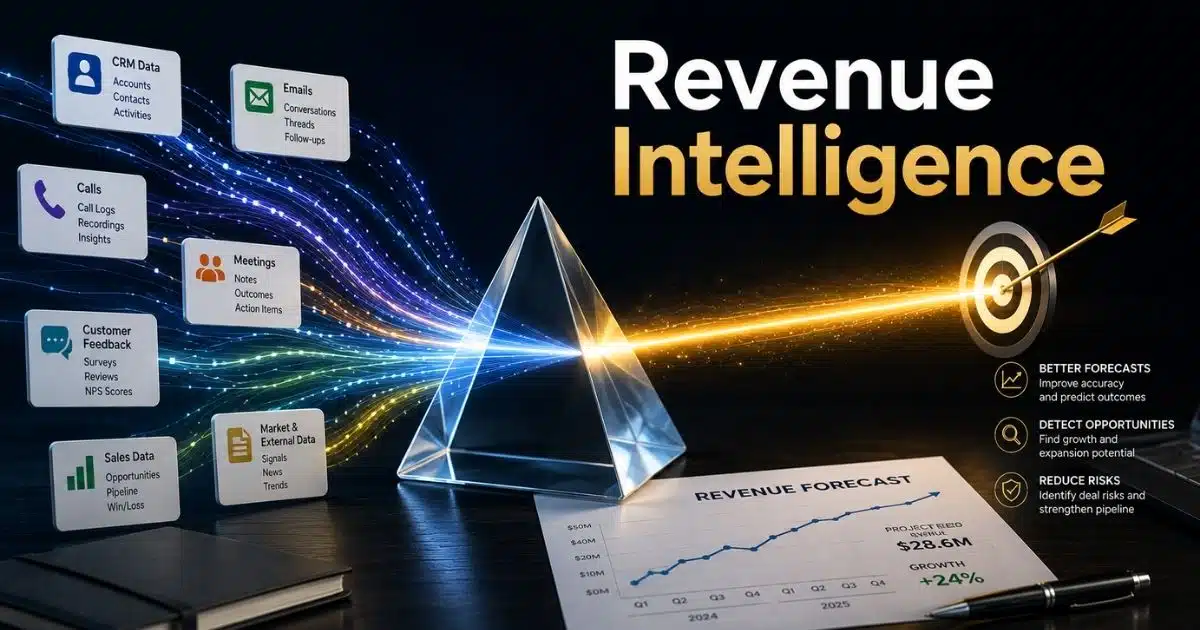
Revenue intelligence starts with data collection. Revenue intelligence platforms pull information from CRM data, emails, calls, meetings, customer feedback, and sales interactions. This creates a complete view of customer behavior across the sales process.
A centralized data layer helps eliminate data silos. Sales teams, customer success teams, and revenue operations can work from the same information. That creates better alignment and stronger collaboration across the entire team.
Turn Data Into Actionable Insights
After data collection, revenue intelligence software uses AI and advanced analytics to analyze data in real time. The system identifies patterns, tracks sales trends, and highlights changes in pipeline health.
Sales managers no longer need to search through reports. Revenue intelligence systems surface actionable insights automatically. That helps teams react faster and improve decision-making across sales operations.
Identify Risks And Revenue Opportunities
Pipeline visibility is one of the biggest benefits of revenue intelligence. Teams can identify stalled deals, declining customer engagement, and gaps in the pipeline before they affect revenue growth.
At the same time, revenue intelligence tools uncover high-value opportunities. Sales reps can focus on existing accounts with expansion potential and prioritize deals with the highest likelihood of closing. This improves sales efficiency and resource allocation.
Improve Forecast Accuracy With AI
Accurate forecasts depend on reliable sales data and historical data. Revenue intelligence uses predictive analytics to evaluate deal metrics, pipeline metrics, average deal size, and market trends.
Organizations that use AI-powered forecasting often report stronger forecasting accuracy and better revenue planning. More accurate forecasting helps businesses allocate resources effectively and support sustainable growth.
Guide Teams Toward Better Decisions
Revenue intelligence does more than report results. It provides deal guidance and sales coaching throughout the sales cycle. Sales leaders can identify winning behaviors and share them across the team.
Real-time insights help sales reps spend less time on research and administrative work. More time goes toward customer relationships and closing deals. That leads to stronger sales performance, efficient processes, and predictable growth.
Core Components Of A Revenue Intelligence Framework
A successful revenue intelligence framework turns scattered business data into clear, actionable insights. It connects people, processes, and technology across revenue operations. When the right components work together, sales teams gain better visibility, stronger forecasting accuracy, and a clearer path to sustainable growth powered by predictive sales analytics.
Unified Data Hub
Every revenue intelligence system starts with a central data layer. Revenue intelligence platforms collect CRM data, customer interactions, sales activities, and customer feedback from multiple sources. This creates a single source of truth for revenue teams.
Without a unified data hub, data silos can limit visibility and slow decisions. Centralized business data helps sales managers and sales leaders view the same revenue metrics and pipeline metrics. Better alignment leads to stronger collaboration across sales marketing, customer success, and revenue operations teams.
Real-Time Analytics
Data alone does not improve sales performance. Revenue intelligence tools must analyze data and deliver real time insights. Analytics help teams understand customer behavior, pipeline health, and sales trends as they happen.
Real-time visibility allows revenue teams to react faster. Sales reps can spot deal risks early and focus on opportunities that matter most using a visual sales pipeline. Research shows that real-time analytics supports better decision-making and helps organizations respond quickly to market changes.
Predictive Intelligence
Predictive analytics is a core part of modern revenue intelligence software. It uses historical data, customer engagement signals, and deal metrics to forecast outcomes. The goal is not only to explain what happened but also what may happen next.
More accurate forecasting helps companies allocate resources effectively. Sales forecasting becomes more reliable when AI identifies patterns across the entire customer lifecycle. Predictive models also help revenue teams uncover risks and high-value opportunities before they affect revenue growth.
Workflow Automation
Manual work often slows the sales process. Revenue intelligence systems solve this problem through automation. They collect data, update records, surface deal guidance, and distribute actionable insights without constant human effort, similar to dedicated sales task automation tools.
Sales reps spend less time on administrative tasks and more time building customer relationships. Automated workflows also improve sales efficiency by keeping data current and helping teams act faster. Many organizations use automation to streamline operations and shorten sales cycle length.
Revenue Visibility And Reporting
Strong reporting capabilities help organizations measure what matters. Revenue intelligence metrics track pipeline visibility, average deal size, forecasting accuracy, customer engagement, and overall sales performance, aligning closely with key sales KPIs for smarter revenue decisions.
Sales leaders need more than static reports. Modern revenue intelligence platforms provide dynamic dashboards and advanced analytics that reveal trends across existing accounts and new opportunities. This visibility helps the entire team align sales strategies, improve resource allocation, and drive predictable growth. Some organizations report forecast accuracy improvements of 30% or more after building a mature revenue intelligence framework.
Key Benefits Of Revenue Intelligence For Sales, RevOps And Leadership Teams
Revenue intelligence helps sales teams, revenue operations, and leadership teams make better decisions with less guesswork. It turns customer data, sales data, and pipeline metrics into actionable insights. As a result, organizations gain stronger visibility, better forecasting accuracy, and a clearer path to revenue growth across the entire customer lifecycle.
Higher Sales Productivity
Sales reps often spend too much time searching for information and updating records. Revenue intelligence software automates data collection, analysis, and reporting. This reduces manual work and gives teams more time to focus on customers.
Research from Salesforce shows that sales reps spend only about 28% of their week actively selling. Automation helps recover valuable time that can be used for customer engagement and deal progression by applying targeted sales workflow automation strategies. Better use of time leads to stronger sales performance and improved sales efficiency.
Better Forecast Accuracy
Reliable sales forecasting depends on accurate data and clear pipeline visibility. Revenue intelligence platforms use predictive analytics, historical data, and real-time insights to identify patterns that affect future revenue, often combining several sales forecasting methods for accurate revenue planning.
This helps sales managers and sales leaders make informed decisions about resource allocation and growth plans. Many organizations report forecast accuracy improvements after implementing revenue intelligence systems because they can track revenue metrics and pipeline health more effectively. More accurate forecasting also helps drive predictable growth.
Stronger Team Alignment
Data silos often create confusion between sales marketing, customer success, and revenue operations teams. Revenue intelligence tools solve this problem by integrating data from multiple sources into a shared data layer.
Everyone works from the same customer intelligence and performance data. That improves communication and creates consistent goals across the entire team. Better alignment also helps organizations respond faster to market trends and customer behavior changes.
Faster Decision Making
Revenue intelligence systems analyze data in real time and surface actionable insights when teams need them most. Sales leaders do not have to wait for manual reports to understand what is happening in the pipeline.
Real-time visibility helps identify risks, stalled deals, and new opportunities earlier. Deal guidance and advanced analytics support faster responses to changing conditions. This allows revenue teams to make confident decisions and improve outcomes throughout the sales process.
More Revenue Opportunities
One of the biggest benefits of revenue intelligence is the ability to uncover opportunities that might otherwise go unnoticed. Revenue intelligence takes data from customer interactions, customer touchpoints, and existing accounts to reveal buying signals and expansion potential.
Sales teams can prioritize accounts with the highest chance of success. They can also track key metrics such as average deal size, sales cycle length, and customer satisfaction. Better visibility into customer relationships helps businesses drive revenue growth and support sustainable growth over time.
Revenue Intelligence Use Cases: Forecasting, Pipeline Management And Deal Execution
Revenue intelligence delivers value far beyond reporting. It helps revenue teams make smarter decisions at every stage of the sales process. From sales forecasting to deal execution, revenue intelligence platforms use customer data, predictive analytics, and real-time insights to improve sales performance, strengthen pipeline health, and drive revenue growth.
Revenue Forecasting
Sales forecasting becomes more accurate when teams use real-time data instead of assumptions. Revenue intelligence systems analyze historical data, customer behavior, deal metrics, and market trends to predict future outcomes. This gives sales leaders a clearer picture of expected revenue.
Accurate forecasts support better resource allocation and planning. Revenue intelligence software can also identify gaps between projected and actual performance. Many organizations report significant gains in forecasting accuracy after adopting predictive analytics and centralized revenue intelligence tools.
Pipeline Health Monitoring
A healthy pipeline is critical for predictable growth. Revenue intelligence platforms track pipeline metrics across every stage of the sales cycle, much like a dedicated sales pipeline CRM. Teams can quickly identify stalled deals, weak customer engagement, and areas where opportunities are slowing down.
Real-time insights help sales managers take action before problems affect revenue growth. Better pipeline visibility also improves collaboration across sales operations and revenue operations. Teams gain a clearer understanding of where deals stand and what support is needed to move them forward.
Opportunity Prioritization
Not every opportunity deserves the same level of attention. Revenue intelligence helps sales reps focus on deals with the highest likelihood of success. AI analyzes customer interactions, customer touchpoints, and sales trends to identify high-value opportunities.
This allows teams to spend more time selling and less time researching. Revenue intelligence takes large amounts of business data and turns it into actionable insights. As a result, sales efficiency improves and revenue teams can focus their efforts where they will have the greatest impact.
Deal Execution Support
Successful deal execution requires good timing and clear next steps. Revenue intelligence systems provide deal guidance based on customer intelligence, sales interactions, and past performance data. This helps sales reps make informed decisions throughout the sales process.
Sales leaders can also use conversation intelligence and customer engagement data to coach teams more effectively. Better guidance reduces delays, shortens sales cycle length, and improves overall sales performance. Teams gain confidence because decisions are supported by data-driven insights rather than guesswork.
Customer Growth And Retention
Revenue intelligence is not limited to new business. It also helps teams strengthen customer relationships and grow existing accounts. Revenue intelligence software tracks customer satisfaction, customer feedback, and engagement patterns across the entire customer lifecycle.
This visibility helps customer success and sales teams identify expansion opportunities before competitors do. It also highlights accounts that may be at risk. By acting early, businesses can improve retention, increase average deal size, and create sustainable growth through stronger customer relationships supported by dynamic contact management.
Revenue Intelligence Vs Sales Intelligence Vs Conversation Intelligence
Revenue intelligence, sales intelligence, and conversation intelligence are closely related, but they serve different purposes. Each one helps revenue teams make better decisions, yet they focus on different types of data and outcomes. Understanding the differences helps businesses choose the right tools, improve sales performance, and build a stronger revenue strategy.
Feature | Revenue Intelligence | Sales Intelligence | Conversation Intelligence |
|---|---|---|---|
Primary Focus | Drive revenue growth and forecasting accuracy | Identify prospects and sales opportunities | Analyze customer conversations and interactions |
Main Data Sources | CRM data, sales data, customer data, revenue metrics, customer success data | Prospect databases, firmographic data, market trends | Calls, meetings, emails, chats, and sales interactions |
Key Purpose | Improve pipeline health, forecasting, and revenue operations | Help sales teams find and qualify leads | Improve communication and customer engagement |
Users | Revenue teams, sales leaders, sales managers, RevOps teams | Sales reps, business development teams | Sales reps, sales managers, customer success teams |
AI Capabilities | Predictive analytics, deal guidance, revenue forecasting | Lead scoring, account research, prospect recommendations | Speech analysis, sentiment analysis, keyword detection |
Business Impact | More accurate forecasting and predictable growth | Faster prospecting and pipeline creation | Better coaching and higher-quality customer conversations |
Customer Lifecycle Coverage | Entire customer lifecycle | Mostly early-stage sales process | Active customer interactions during the sales cycle |
Key Metrics | Revenue metrics, pipeline metrics, forecasting accuracy, average deal size | Lead quality, conversion rates, opportunity creation | Talk-to-listen ratio, sentiment, objection handling, call outcomes |
Common Examples | Forecasting, pipeline management, resource allocation, revenue growth | Prospect discovery, account intelligence, market research | Call reviews, sales coaching, customer feedback analysis |
Best For | Organizations seeking a complete view of revenue performance | Teams focused on finding and converting new opportunities | Teams looking to improve customer conversations and deal execution |
Revenue Intelligence Metrics And KPIs That Matter Most
Revenue intelligence is only valuable when teams track the right metrics. Strong revenue intelligence metrics reveal what is happening across the sales process and why it matters. They help sales leaders improve forecasting accuracy, monitor pipeline health, optimize sales performance, and make smarter decisions that support predictable revenue growth.
Forecast Accuracy
Forecast accuracy measures how close projected revenue is to actual results. It is one of the most important revenue intelligence metrics because it affects planning, hiring, budgeting, and resource allocation.
Revenue intelligence platforms improve forecasting by combining historical data, customer behavior, pipeline metrics, and predictive analytics. Better forecasting helps revenue teams spot risks earlier and make adjustments before targets are missed, especially when supported by structured sales pipeline management. Organizations with mature forecasting processes often achieve significantly higher forecast reliability than those relying on manual estimates.
Pipeline Health
Pipeline health shows the strength and quality of sales opportunities moving through the sales process. Revenue intelligence systems track deal progression, customer engagement, sales cycle length, and pipeline coverage to identify potential issues.
A healthy pipeline contains enough qualified opportunities to support future revenue goals. Real-time insights help sales managers identify stalled deals and bottlenecks before they impact revenue growth. Strong pipeline visibility also helps teams improve sales efficiency and maintain consistent performance.
Win Rate
Win rate measures the percentage of opportunities that turn into closed deals. It is a direct indicator of sales performance and the effectiveness of sales strategies. Higher win rates often signal strong customer relationships and effective deal execution.
Revenue intelligence software helps improve win rates by analyzing customer interactions, conversation intelligence data, and deal metrics. Sales leaders can identify patterns among successful opportunities and apply those lessons across the entire team. Small improvements in win rate can create a major impact on revenue growth.
Average Deal Size
Average deal size tracks the typical revenue generated from closed opportunities. This metric helps revenue operations teams understand customer value and evaluate growth opportunities across existing accounts.
Revenue intelligence tools analyze customer data, customer touchpoints, and sales trends to identify factors that influence deal value. Teams can use those insights to focus on high-value opportunities and improve customer intelligence. Growth in average deal size often leads to stronger revenue metrics without increasing sales volume.
Sales Cycle Length
Sales cycle length measures the time it takes to move a prospect from first contact to closed deal. Shorter sales cycles usually indicate efficient processes and better alignment between teams.
Revenue intelligence systems help reduce delays by providing actionable insights, deal guidance, and pipeline visibility. Sales reps can quickly identify next steps and address customer concerns before opportunities stall. Tracking sales cycle length also helps businesses improve customer engagement, accelerate revenue generation, and drive predictable growth.
How To Implement Revenue Intelligence Successfully And Choose The Right Platform
A successful revenue intelligence strategy requires more than software. It needs clean data, team alignment, and the right technology stack. When implementation is done correctly, businesses gain stronger forecasting accuracy, better pipeline visibility, and more actionable insights that support long-term revenue growth.
Unify Data Sources
Revenue intelligence depends on complete and accurate business data. The first step is to bring customer data, CRM data, sales interactions, marketing activities, and customer success information into one central platform with a simpler sales workflow in your CRM.
Many organizations struggle with disconnected systems and data silos. Revenue intelligence platforms solve this challenge by integrating data from multiple tools. A unified data layer creates a single source of truth that improves collaboration across revenue operations, sales operations, and leadership teams.
Build A Reliable Data Foundation
Accurate forecasts and actionable insights require high-quality data. Revenue teams should review data quality, remove duplicate records, and standardize information across systems before launching a revenue intelligence program.
Research consistently shows that poor data quality affects revenue performance and decision-making. Clean customer intelligence and performance data in a well-implemented CRM that helps sales teams manage leads help revenue intelligence systems deliver more accurate forecasting, stronger pipeline metrics, and better visibility into customer behavior throughout the sales process.
Use AI And Predictive Analytics
Modern revenue intelligence software uses AI to analyze data in real time. It identifies sales trends, highlights risks, and predicts future outcomes based on historical data and customer interactions.
Predictive analytics helps sales leaders make faster decisions with greater confidence. Revenue intelligence tools can uncover opportunities, improve deal guidance, and support more accurate forecasting. Some organizations report forecasting accuracy improvements of up to 45% after implementing revenue intelligence with predictive analytics and centralized data practices.
Train Teams And Build Adoption
Technology alone does not create results. Sales reps, sales managers, and revenue leaders must understand how to use the platform and apply insights in daily workflows, starting with a clear B2B sales CRM guide for revenue teams.
Comprehensive training programs increase adoption and improve outcomes. Teams that understand revenue intelligence metrics, pipeline visibility, and reporting capabilities are more likely to trust the system. Strong adoption also helps align sales strategies and improve sales efficiency across the entire team.
Choose The Right Platform
Not all revenue intelligence platforms offer the same capabilities. Look for revenue intelligence software that integrates easily with existing systems, supports predictive analytics, and provides strong reporting capabilities.
The best platforms combine customer intelligence, conversation intelligence, sales forecasting, and workflow automation in one solution. Prioritize tools that deliver real-time insights, flexible dashboards, and scalable features, such as an all-in-one CRM to grow your sales and team with robust smart CRM tools for sales teams. A platform that fits your sales process today and supports future growth will provide the greatest long-term value.
How Gain.io Supports Revenue Intelligence And Revenue Execution
Revenue intelligence works best when teams can turn insights into action. Gain.io helps revenue teams organize account intelligence, customer relationships, and strategic plans in one place. This creates better visibility across the sales process and helps teams make faster, more informed decisions.
With Gain.io, sales reps, sales managers, and customer success teams can access critical customer data, stakeholder information, and account plans without searching across multiple systems. That reduces data silos and improves collaboration across revenue operations through centralized contact management to build stronger relationships.
The platform also helps teams strengthen account planning, identify growth opportunities, and maintain alignment around key customer objectives. By combining structured account intelligence with CRM data and revenue intelligence tools, Gain.io enables better pipeline visibility, stronger customer engagement, and more predictable revenue growth, as shown in a sales acceleration case study on closing deals faster with Gain.io. Teams spend less time managing information and more time building relationships that drive long-term business value, supported by best practices in sales pipeline CRM and guidance on what a sales pipeline is and how to build one that works.
FAQs
Can Small Businesses Benefit From Revenue Intelligence?
Yes. Revenue intelligence is not only for large enterprises. Small businesses can use revenue intelligence tools and a focused CRM for startups and small sales teams to improve sales forecasting, track customer behavior, monitor pipeline health, and make data-driven decisions without building large revenue operations teams.
Does Revenue Intelligence Replace CRM Software?
No. Revenue intelligence software works alongside CRM systems rather than replacing them. It uses CRM data, customer interactions, and performance data to generate actionable insights, improve forecasting accuracy, and support better sales performance, especially when paired with a CRM with email integration to streamline communication or CRM tools that help retail teams stay organized.
Can Revenue Intelligence Help Reduce Revenue Leakage?
Yes. Revenue intelligence systems can identify stalled deals, weak customer engagement, pipeline gaps, and at-risk accounts. Early visibility helps revenue teams take action before opportunities are lost and revenue growth is affected.
What Features Should Businesses Look For In Revenue Intelligence Software?
Businesses should look for predictive analytics, real-time insights, pipeline visibility, reporting capabilities, workflow automation, and seamless data integration. Strong revenue intelligence platforms should also support customer intelligence and advanced analytics across the entire customer lifecycle.
How Long Does It Take To See Results From Revenue Intelligence?
Results vary based on data quality, adoption, and implementation. Many organizations begin seeing improvements in sales efficiency, forecasting accuracy, and decision-making within a few months after deploying revenue intelligence tools and training their teams effectively.