Quick Answer: BANT and CHAMP suit fast, transactional deals. MEDDIC fits complex, multi-stakeholder sales. Most teams pick a primary framework by deal size, then let their CRM auto-capture the fields so qualification stops eating rep time.
Strong sales pipelines depend on how well teams identify leads and qualify them early. Without a clear lead qualification framework, sales teams often waste time on unqualified leads that never convert. Effective sales lead qualification helps teams focus on high-quality leads that match real buying intent.
A structured lead qualification process aligns sales and marketing efforts and improves lead quality across the pipeline. Teams can use scoring lead models, targeted lead qualification questions, and clear qualification criteria to identify leads that matter. A strong sales development strategy also ensures better collaboration between marketing strategy and sales execution.
When teams understand plans, challenges, timeline, budget, and buyer intent, they reduce low-value opportunities and prioritize sales leads with higher conversion potential, improving pipeline performance and revenue outcomes.
What Lead Qualification Means In Sales Pipelines
Lead qualification evaluates prospects based on fit with your ideal customer profile, demonstrated interest, and buying readiness. It prioritizes those most likely to convert into customers. In contemporary pipelines, this process integrates firmographic data like company revenue and industry with behavioral signals such as repeated website visits or content downloads.
Modern sales teams distinguish marketing qualified leads from sales qualified leads confirmed through discovery calls. A Gong study of 100,000 calls found that qualified leads shorten sales cycles by 28 percent. This qualification process maps criteria to CRM fields for automation. Teams with structured qualification achieve 2.5 times higher revenue per lead compared to those without defined processes.
Why Is Lead Qualification Framework Important For Revenue Teams
Structured frameworks align teams on lead worthiness, driving pipeline efficiency and revenue predictability. When everyone agrees on what makes a lead worth pursuing, the entire sales funnel moves faster.
Improving Pipeline Quality
A solid qualification framework excludes unfit leads early in the lead generation process. According to Salesforce State of Sales data, qualified pipelines show 3x higher velocity than unvetted ones. Sales teams using ICP matched qualification reduce junk leads by 40 percent. This allows sales reps to focus their energy on high fit accounts rather than wasting time on leads that will never close. Quality leads create quality pipelines.
Reducing Sales Cycle Length
Qualified leads compress longer sales cycles significantly. Forrester research shows a 30 percent reduction in cycle length when leads are properly vetted. Since intent confirmed prospects advance faster without requiring rediscovery conversations, sales professionals can close more deals in less time. A 2024 Gong analysis revealed that reps close deals 21 percent quicker with pre qualified handoffs from marketing teams.
Increasing Win Rates
Your opportunity win rate climbs when you focus on the right prospects. Gartner data shows frameworks boost wins by 20 percent through better fit matching. BANT qualified deals win at 45 percent versus 25 percent for unvetted leads. Teams using MEDDIC report 15 to 25 percent lifts in complex sales processes where multiple stakeholders influence the decision making process.
Supporting Accurate Forecasting
Revenue forecasting depends on knowing which opportunities will close. Strong qualification ties pipeline to close probability, improving forecast accuracy by 42 percent according to CSO Insights. Without proper vetting, only 50 percent of unqualified opportunities reach the proposal stage. This creates false predictions that damage planning and resource allocation for sales operations teams.
Enhancing Sales Efficiency
Sales reps save 27 percent of their time on non selling tasks when automated lead scoring handles initial vetting. This efficiency allows focus on 2.9x more qualified opportunities annually, especially when combined with CRM follow-up automation for better sales conversions. RevOps leaders gain optimization levers through data audits that reveal which qualification criteria correlate with closed won revenue.
Components Of A Lead Qualification Framework
Core elements form a scalable system for assessing fit and readiness. These components must work together to create a consistent, repeatable qualification process that every sales representative can follow, similar to the principles outlined in a comprehensive lead qualification guide for sales teams.
Ideal Customer Profile Definition
Your ICP specifies firmographics like company size, revenue thresholds, and target industries. It also includes demographics such as job title and decision maker seniority. Demand Gen Report finds that ICP aligned leads convert 68 percent better than random prospects. Without a clear ICP, 64 percent of leads will mismatch according to SiriusDecisions research. Document your ICP with specific criteria around industries served, revenue ranges, tech stack requirements, and buying triggers.
Lead Scoring Models
A lead scoring model assigns points based on fit and engagement signals. High value actions like C suite website visits might earn 10 points while content downloads earn 5. HubSpot reports that teams using scored leads yield 20 percent more revenue. The lead scoring process should tier leads by warmth, with top tiers closing 5x faster than cold contacts. Keep your scoring system simple at first with only high value actions, then refine monthly based on conversion data.
Qualification Criteria And Signals
Lead qualification criteria cover dimensions like lead’s budget, authority, need, and timeline through established frameworks. Your default checklist should require ICP match plus intent signals like demo requests or pricing page visits. Marketing Dive research shows 71 percent of leads lack confirmed budget information. This makes discovery calls essential for validating qualification criteria before moving leads to SQL stage.
Buyer Intent And Engagement Tracking
Track buyer intent signals through tools that monitor behavioral patterns. High intent leads buy 3x faster according to 6sense data. Behavioral tracking spots patterns like repeated pricing page views, which correlate to 2x conversion rates per Marketo benchmarks. Sales teams need visibility into which content prospects consume and how frequently they engage with your marketing efforts, underscoring why sales visibility matters more than ever.
Sales Readiness Assessment
Assess readiness through discovery questions that confirm pain points and urgency. Sales qualified leads show 4x progression rates per Outreach benchmarks compared to leads pushed forward prematurely. This assessment identifies whether the economic buyer is engaged, whether decision criteria are clear, and whether timeline aligns with your sales process requirements.
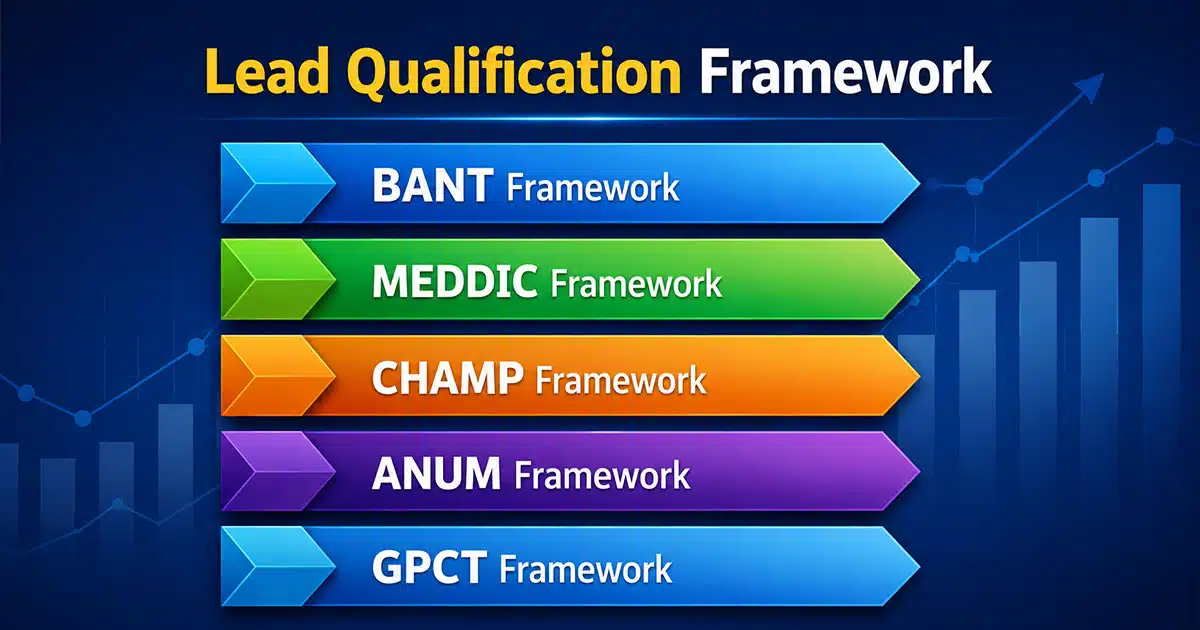
Popular Lead Qualification Frameworks Used By Sales Teams
Frameworks provide scripted criteria for sales reps, with adoption varying by sales complexity and deal size. Choosing the right lead qualification framework depends on your sales motion and buyer journey.
BANT Framework
BANT covers Budget, Authority, Need, and Timeline. IBM originated this approach in the 1960s. PTC reports a 30 percent sales cycle reduction when using BANT qualification. This framework works well for transactional sales with shorter cycles. The weakness is that BANT assumes prospects know their budget upfront, which misses early stage nurtures. About 42 percent of sales teams use some version of BANT, according to Showpad data. BANT budget authority need assessment remains popular because it covers essential buying signals efficiently.
MEDDIC Framework
MEDDIC stands for Metrics, Economic Buyer, Decision Criteria, Decision Process, Identify Pain, and Champion. This framework suits enterprise sales where complex sales processes require deeper discovery. Gainsight users see 25 percent win rate with MEDDIC implementation. The framework probes pain points more thoroughly than BANT and maps the full decision-making process. About 23 percent of teams adopt MEDDIC per LinkedIn polls. Economic buyer decision criteria mapping excels in SaaS deals with 18 percent higher average contract values.
CHAMP Framework
CHAMP prioritizes Challenges, Authority, Money, and Prioritization. This flips the traditional order to lead with pain discovery rather than budget questions. CHAMP challenges authority money sequencing works well for consultative selling. HubSpot champions this approach for inbound teams, reporting 15 percent faster cycles versus BANT. The framework builds rapport by focusing on prospect challenges before discussing financial constraints.
ANUM Framework
ANUM sequences Authority, Need, Urgency, and Money. Placing authority first ensures early identification of the decision maker. HubSpot data shows 22 percent better alignment between sales and marketing when using ANUM. The urgency component helps accelerate stalled deals by surfacing timeline pressures early in conversations.
GPCT Framework
GPCT covers Goals, Plans, Challenges, and Timeline. HubSpot developed this approach to reframe qualification around the buyer journey. Teams report 28 percent pipeline velocity increases with GPCT adoption. The framework excels in consultative sales where understanding prospect goals matters more than budget confirmation. Challenges timeline budget authority discussions flow naturally from goals exploration.
Picking The Right Framework
Sales teams rarely need just one framework. Deal size and sales motion decide which model fits best, and many teams run a light framework early and a heavier one once a deal reaches procurement.
Framework | Best Fit | Sales Motion |
|---|---|---|
BANT | Fast, transactional deals | Inside sales, SMB |
CHAMP | Discovery-first teams | Product-led and SMB |
MEDDIC | Complex, multi-stakeholder deals | Enterprise and mid-market |
ANUM | Deals stalling on authority | Mid-market |
GPCT | Consultative, goal-driven sales | Enterprise and strategic |
Many teams start a deal on BANT or CHAMP, then layer in MEDDIC once a real opportunity forms. Running two frameworks sounds like extra work, but a CRM that auto-captures the underlying fields removes most of the manual overhead.
Key Lead Qualification Metrics That Impact Pipeline Health
Tracking the right metrics reveals how well your qualification framework performs. These indicators help sales operations teams identify bottlenecks and optimize conversion rates.
Lead To Opportunity Conversion Rate
This metric benchmarks at 13 percent across industries according to Salesforce data. Top quartile teams hit 20 percent with strong qualification in place. Low conversion rates typically signal ICP mismatch or premature handoffs from marketing teams. Track this weekly to spot trends before they damage quarterly results, supported by disciplined sales deal tracking for modern sales teams.
Sales Qualified Lead Rate
The percentage of marketing qualified leads becoming sales accepted leads averages 37 percent per Demand Gen research. Mature teams with refined lead scoring reach 50 percent SQL rates. This metric shows how well marketing and sales teams align on lead definitions and qualification standards.
Pipeline Conversion By Stage
Stage win rates reveal where leads stall in your sales funnel. Without proper qualification, rates drop from 40 percent early stage to 25 percent late stage per Forrester. Balanced pipelines with qualified leads convert at 28 percent overall. Track conversion between each lead stage to identify friction points and ensure your sales pipeline is built to actually work.
Lead Response Time
Speed matters enormously in lead follow up. First response under 5 minutes boosts conversions 9x according to InsideSales research. Delays over 1 hour cut odds by 80 percent. This metric directly impacts whether promising leads become opportunities or go to competitors.
Opportunity Win Rate
Qualified opportunities win at 47 percent compared to 22 percent for unqualified per Marketo data. This metric tracks framework ROI directly. Sales performance improves when reps focus on properly vetted prospects rather than chasing every inbound lead.
Common Lead Qualification Mistakes That Hurt Pipeline Health
Even experienced sales teams make qualification errors that damage pipeline health. Recognizing these mistakes helps you avoid the traps that waste resources and hurt conversion rates.
Over Qualifying Or Under Qualifying Leads
Over qualifying misses 25 percent of viable leads according to SiriusDecisions. Reps become too picky and reject prospects who would have converted. Under qualifying lets 50 percent junk through, bloating cycles by 44 percent and wasting rep time. Finding the balance requires data analysis of past closed won and closed lost deals to calibrate your qualification criteria properly.
Ignoring Buyer Intent Signals
Overlooking buyer intent drops conversions by 40 percent. Teams that track intent through behavioral data close leads 2.5x faster per 6sense research. Prospects visiting pricing pages or downloading case studies signal readiness. Effective lead qualification incorporates these signals rather than relying solely on form fills and demographic data.
Misalignment Between Sales And Marketing
Disconnects between marketing and sales cause 79 percent of lead failure according to MarketingSherpa. Aligned teams convert 2x better. This misalignment often stems from different definitions of qualified leads. Sales reps reject leads that marketing considers ready. Joint SLA agreements and regular review meetings fix this problem.
Poor Lead Scoring Models
Outdated lead scoring models waste 27 percent of rep time per Nucleus Research. Scores that worked two years ago no longer reflect current buyer behavior. Data driven models that refresh quarterly lift revenue 20 percent. Review your scoring weights against recent conversion data to ensure accuracy.
Delayed Lead Follow Up
Response speed determines outcomes. Five minute responses convert 21x better than 30 minute delays per Harvard Business Review. Slow follow up kills 60 percent of potential customers who go elsewhere. Automated alerts and clear ownership rules for sales outreach prevent this costly mistake, especially when supported by a modern CRM that helps sales teams manage leads.
How Sales Teams Build A Strong Lead Qualification Process
Building a successful lead qualification strategy requires systematic effort and cross team collaboration. Teams that invest in process development see 1.8x pipeline growth according to TOPO research, especially when they prioritize sales workflow optimization for faster deal closures.
Standardizing Qualification Criteria
Document shared rules in accessible playbooks that any new sales representative can reference. Quarterly reviews prevent criteria drift as your product and market evolve. Teams with standardized qualification criteria improve handoff quality by 35 percent. Allow sales teams to rank leads based on consistent factors rather than individual interpretation.
Using Data Driven Lead Scoring
Audit conversions to weight behavioral signals appropriately. Teams that refresh scoring quarterly see 15 percent accuracy gains per Evergreen research. Score leads based on both demographic fit and engagement patterns. Automated lead scoring removes subjective judgment and ensures consistent treatment across all inbound and outbound leads, particularly when supported by a modern CRM that improves sales productivity and helps you get more from your CRM with a simpler sales workflow.
Aligning Sales And Marketing Teams
SLA agreements lift SQL rates by 24 percent. Joint workshops build trust between marketing and sales teams. Define lead stages clearly so everyone knows when a marketing qualified lead becomes a sales accepted lead. Regular feedback loops where sales reps share which leads converted help marketing refine targeting and avoid recurring lead generation mistakes that hurt conversions.
Monitoring Qualification Performance
Build dashboards that track metrics like SQL rate and stage velocity. Anomalies trigger immediate reviews before problems compound. Sales development team leaders need visibility into which lead sources produce quality leads versus low quality leads, supported by robust sales performance metrics for SaaS teams. This monitoring enables rapid course correction.
Continuously Optimizing The Framework
A/B test qualification criteria against win rates. Adaptive models improve 18 percent yearly per Clari benchmarks. What works today may not work next quarter as your product qualified leads mix changes. Treat your lead qualifying process as a living system that evolves with market conditions and buyer behavior and is guided by relevant sales activity metrics for a performance-focused sales engine.
How Gain.io Helps Improve Lead Qualification And Pipeline Health
Gain.io delivers pipeline visibility through real-time dashboards that track lead progression from MQL to close as a dedicated sales pipeline CRM to improve sales visibility and performance and enhance overall sales visibility, all within an all-in-one CRM to grow your sales and team. You spot qualification gaps instantly rather than discovering problems at quarter-end. Lead tracking captures behavioral signals and engagement data, allowing sales teams to score leads based on demonstrated interest rather than assumptions.
Sales performance insights analyze rep win rates by lead source, identifying which frameworks and criteria produce the most promising leads. Forecasting support models close probabilities from qualified opportunities, giving revenue leaders confidence in predictions, especially when supported by a visual sales pipeline that improves deal clarity.
Conversion tracking measures stage velocity and alerts teams when leads stall. Teams using Gain.io report significant pipeline efficiency gains because reps focus on high-intent prospects that match their ideal customer profile, similar to the results in a sales acceleration case study on closing deals faster with Gain.io, powered by its smart CRM tools for sales teams.
FAQs
How Do Sales Teams Define Qualified Leads In Complex Pipelines
Sales teams define qualified leads through ICP fit combined with confirmed BANT or MEDDIC signals. Complex pipelines require discovery calls to validate pain points, decision criteria, and budget authority. Teams layer behavioral scoring with explicit qualification questions to achieve 45 percent progression rates, especially when they consistently track deals from lead to close with a complete sales process.
Which Qualification Framework Works Best For B2B Sales Teams
MEDDIC excels for enterprise B2B with 25 percent win rate improvements in complex deals. CHAMP suits inbound focused teams at 15 percent cycle reduction. Transactional sales benefit from BANT simplicity. Choose based on your average deal size and number of stakeholders involved, and ensure you organize sales leads effectively so the chosen framework can be applied consistently.
How Does Lead Qualification Impact Revenue Forecast Accuracy
Strong qualification lifts forecast accuracy by 42 percent by excluding false positives from pipeline counts. When sales reps only count genuinely qualified opportunities, predictions align with reality. Poor qualification creates bloated pipelines where half the deals never close.
What Metrics Indicate Poor Lead Qualification
SQL rate under 30 percent signals marketing and sales misalignment. Win rates below 25 percent suggest ICP mismatch. Sales cycles exceeding 90 days often indicate premature qualification where leads needed more nurturing before handoff.
How Do Revenue Teams Improve Lead Qualification Over Time
Audit conversion data quarterly to refine scoring weights. Align teams through SLA agreements with clear lead definitions. Test new qualification criteria against historical win rates. Continuous improvement yields 20 percent annual gains in qualification accuracy.