Sales teams make decisions every day based on forecasts. They plan inventory, allocate budgets, hire staff, and set revenue targets. But what happens when those forecasts are wrong? Even a small forecasting mistake can create stock shortages, excess inventory, missed opportunities, or unexpected costs. That is why understanding forecast accuracy metrics sales teams use is more important than ever.
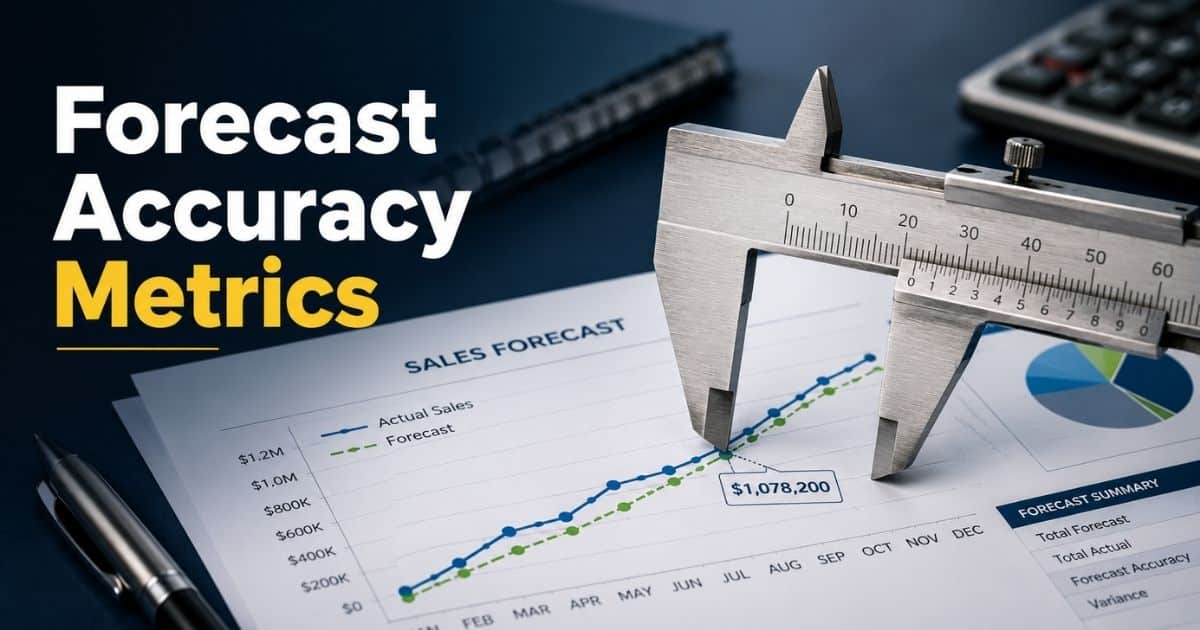
Forecast accuracy measures how closely your predicted numbers match actual sales. It helps sales leaders evaluate forecast performance, identify forecast errors, and improve future forecasts. A reliable forecasting process does more than predict future sales. It supports better planning across sales operations, inventory management, and the entire supply chain.
In this guide, you will learn how to calculate forecast accuracy, understand the most important forecast accuracy metrics, detect forecast bias, and improve sales forecasting accuracy with proven methods and real-world examples.
What Are Forecast Accuracy Metrics In Sales Forecasting?
Forecast accuracy metrics sales teams use are measurements that show how closely sales forecasts match actual sales. In simple terms, they help businesses understand whether their predictions were accurate or missed the mark. Sales forecasting accuracy refers to the ability of a forecast to reflect actual results with minimal forecast errors. The closer the forecasted and actual sales numbers are, the higher the forecast accuracy.
Businesses use different forecast accuracy measures to evaluate forecast performance and improve future forecasts. Metrics such as mean absolute percentage error (MAPE), weighted absolute percentage error (WAPE), and root mean squared error (RMSE) help measure forecast accuracy from different angles. Each metric highlights specific types of forecast errors and provides valuable insights into forecast quality, especially when combined with core sales pipeline health metrics for revenue planning.
Accurate forecasts support better inventory management, demand forecasting, resource allocation, and supply chain planning. By using predictive sales analytics and tracking forecast accuracy metrics regularly, sales leaders can identify patterns, strengthen forecasting models, and make more confident decisions about future sales.
Why Forecast Accuracy Matters For Revenue, Inventory, And Business Planning
Forecast accuracy affects much more than sales targets. It influences inventory levels, budgets, hiring plans, and supply chain decisions. When sales forecasts closely match actual results, businesses can plan with confidence and respond faster to market changes. Strong forecast accuracy also reduces costly mistakes and supports sustainable growth.
Revenue Planning
Accurate sales forecasts help companies set realistic revenue goals. Sales leaders can allocate resources more effectively when they have reliable forecasts. Better visibility into future sales also improves financial planning and budgeting.
Poor forecast accuracy creates uncertainty. Teams may miss growth opportunities or overcommit resources. Research shows companies with accurate forecasts achieve up to 15% higher sales performance than those with unreliable forecasting processes. Strong forecast performance supports smarter business decisions and long-term growth.
Inventory Control
Inventory management depends heavily on forecast accuracy. When forecasted and actual sales align closely, businesses can maintain the right stock levels. High forecast accuracy helps prevent stockouts and excess inventory.
Even small forecast errors can create major challenges. A forecast bias of only 2% can tie up capital in unnecessary inventory. Consistently over forecasting by 5% often leads to inventory imbalances across warehouses and locations. Accurate forecasts help businesses match actual demand more effectively and improve overall supply chain efficiency.
Supply Chain Efficiency
Supply chain planning becomes easier when demand forecasting is reliable. Suppliers, manufacturers, and distributors all depend on accurate forecasts to coordinate operations. Better forecast accuracy supports smoother product flow across the entire supply chain, and retail teams that adopt modern CRM tools that help retail teams stay organized often see even stronger execution.
Inaccurate forecasts often create disruptions. Excess inventory increases storage costs, while under forecasting can cause shortages and delayed deliveries. Forecast accuracy matters because every supply chain decision relies on future forecasts. Reliable forecasts improve resource allocation and help businesses react faster to market trends and external factors.
Workforce And Resource Planning
Hiring decisions often depend on expected sales volume. Accurate sales forecasting allows businesses to build staffing plans that match future demand. Sales operations teams can also manage budgets and workloads more effectively.
Poor forecast accuracy can create staffing problems. A business may hire too many employees or struggle with labor shortages during busy periods. Accurate forecasts provide better visibility into future sales and help organizations allocate resources where they create the most value. This improves productivity across the sales process.
Strategic Business Growth
Forecast accuracy metrics sales teams track play a major role in long-term planning. Leaders use forecast accuracy measures to evaluate market opportunities, expansion plans, and investment decisions. Better forecasting capabilities lead to greater confidence in strategic choices.
Many organizations still struggle with forecast reliability. Studies show fewer than half of sales leaders have high confidence in their sales forecasts. Businesses that consistently improve forecast accuracy metrics gain a competitive advantage. They can identify patterns earlier, respond to market shifts faster, and make decisions based on reliable data rather than assumptions.
Key Forecast Accuracy Metrics Sales Teams Must Track
No single metric can tell the full story of forecast performance. Some metrics focus on percentage error, while others highlight unit differences or large forecasting mistakes. A combination of forecast accuracy metrics helps sales teams evaluate forecast quality, identify forecast errors, and improve future forecasts with greater confidence, especially when paired with the right sales performance metrics for SaaS teams.
MAPE
Mean Absolute Percentage Error (MAPE) is one of the most widely used forecast accuracy measures. It shows the average percentage difference between forecasted and actual sales. Many organizations use MAPE because it is easy to understand and compare across forecast categories.
A lower MAPE means better sales forecasting accuracy. For example, a MAPE of 10% means forecasts were off by an average of 10%. Since it uses percentages, MAPE works well when comparing products with different sales volumes. It remains a standard metric in demand forecasting and sales operations.
MAD
Mean Absolute Deviation (MAD) measures the average absolute difference between forecasted and actual values. Unlike percentage-based metrics, MAD uses the original units of measurement. This makes it easier to understand the real impact of forecast errors.
For example, if a product forecast misses by 50 units each month, MAD reflects that gap directly. Sales teams often use MAD alongside other forecast accuracy metrics. It helps measure forecast accuracy in terms that inventory management and supply chain planning teams can easily apply to daily decisions.
WAPE
Weighted Absolute Percentage Error (WAPE) improves on traditional percentage metrics. It gives greater weight to products with larger sales volumes. This creates a more realistic picture of overall forecast accuracy across the business.
A forecasting process may look accurate when low-volume products perform well. However, large forecast errors in high-volume products can hurt revenue and inventory planning. WAPE helps uncover those issues. Many companies use weighted absolute percentage error to evaluate demand forecasting performance across product portfolios and business units, especially when they’ve defined custom sales stages for different teams to keep the pipeline aligned with reality.
RMSE
Root Mean Squared Error (RMSE) focuses on larger forecast errors. It squares each error before calculating the average. As a result, bigger mistakes have a stronger effect on the final score.
RMSE is useful when large forecasting mistakes carry significant business risk. A major error in future sales projections can affect budgets, resource allocation, and supply chain decisions. Forecasting models with lower RMSE values generally produce more reliable forecasts. Sales leaders often use this metric when evaluating advanced forecasting capabilities and different sales forecasting methods for accurate revenue planning.
Forecast Bias
Forecast bias measures whether forecasts consistently miss in one direction. It reveals patterns of over forecasting or under forecasting over time. Unlike other accuracy metrics, forecast bias focuses on systematic errors rather than average error size.
A forecast bias of just 2% can tie up capital in excess inventory. Consistently over forecasting by 5% may create inventory imbalances across locations. Tracking forecast bias helps sales teams identify patterns that traditional forecast accuracy measures may miss. Strong forecast reliability depends on controlling both forecast accuracy and bias throughout the forecasting process.
How To Calculate Forecast Accuracy Metrics With Formulas And Examples
Forecast accuracy metrics help sales teams understand how close their predictions are to actual results. Each metric measures forecast performance differently. Some focus on percentage error, while others highlight unit differences or large forecast errors. Knowing how to calculate forecast accuracy helps businesses make better decisions and improve forecast reliability over time.
Forecast Accuracy Formula
The most common forecast accuracy formula compares forecasted and actual sales. It shows how closely a prediction matched the final outcome.
Forecast Accuracy = (1 − |Actual Sales − Forecasted Sales| ÷ Actual Sales) × 100
For example, suppose forecasted sales were 1,000 units and actual sales reached 900 units. The absolute error is 100 units. Forecast accuracy would be 88.9%. Many sales teams use this method because it is simple and provides a quick view of overall forecast accuracy.
MAPE Formula
Mean Absolute Percentage Error, or MAPE, measures the average percentage difference between actual values and forecasts. It is one of the most popular forecast accuracy measures in demand forecasting and sales operations.
Absolute Percentage Error = |Actual Sales − Forecasted Sales| ÷ Actual Sales × 100
If three products have percentage errors of 5%, 10%, and 15%, the MAPE mean absolute percentage error equals 10%. Businesses use absolute percentage error MAPE because it makes forecast performance easy to compare across different products and forecast categories.
MAD Formula
Mean Absolute Deviation (MAD) calculates the average absolute difference between forecasted and actual sales. Unlike percentage metrics, MAD uses original units. This helps teams understand the practical impact of forecast errors.
Suppose actual demand for three months differs from forecasts by 20, 30, and 40 units. The average absolute difference would be 30 units. Inventory management teams often prefer MAD because it clearly shows how many units were missed. It works well alongside other forecast accuracy metrics.
WAPE Formula
Weighted Absolute Percentage Error (WAPE) gives more importance to products with higher sales volumes. A small error on a best-selling product often matters more than a large error on a low-volume item.
WAPE = Total Absolute Error ÷ Total Actual Sales × 100
For example, a forecast error of 100 units on a product that sells 10,000 units has less impact than the same error on a product that sells only 500 units. Weighted absolute percentage error helps businesses measure accuracy across large product portfolios and supply chain planning activities.
RMSE Formula
Root Mean Squared Error (RMSE) places extra weight on large forecast errors. It squares each error before calculating the average. This makes major forecasting mistakes stand out more clearly.
Imagine forecast errors of 10, 20, and 100 units. RMSE will emphasize the 100-unit miss far more than MAPE or MAD. Companies often use root mean squared error when evaluating forecasting models and automated forecasting systems. It helps identify forecast quality issues that could affect future sales, resource allocation, and overall forecast performance.
MAPE Vs WAPE Vs WMAPE Vs MAE Vs RMSE Which Metric Should You Use?
Each forecast accuracy metric measures forecast performance differently. A metric that works well for one business may not work for another. The right choice depends on your sales data, forecast horizon, product mix, and business goals. Understanding the strengths and limits of each metric helps sales teams measure accuracy more effectively and improve forecast quality.
When To Use MAPE
Mean Absolute Percentage Error (MAPE) works best when actual values are stable and rarely close to zero. It measures the average percentage error between forecasted and actual sales. Many organizations use MAPE because it is simple to calculate and easy to explain.
MAPE helps compare forecast accuracy across different products and forecast categories. A product with a MAPE of 8% is generally more predictable than one with a MAPE of 20%. Sales leaders often rely on absolute percentage error MAPE to evaluate sales forecasting accuracy and monitor forecast improvement over time.
When To Use WAPE
Weighted Absolute Percentage Error (WAPE) is useful when sales volumes vary across products. It gives more weight to high-volume items that have a greater impact on revenue and inventory management.
A business may sell thousands of units of one product and only a few of another. In that case, WAPE provides a more realistic view of overall forecast accuracy. High-volume products often reach 75% to 85% forecast accuracy, making weighted absolute percentage error a valuable metric for demand forecasting and supply chain planning.
When To Use WMAPE
Weighted Mean Absolute Percentage Error (WMAPE) is similar to WAPE but is often preferred in retail, manufacturing, and supply chain environments. It focuses on forecast errors while accounting for the importance of different products.
WMAPE works well when businesses want to prioritize forecast accuracy for products that drive the most revenue. It helps identify forecast performance issues that simple percentage metrics may overlook. Many forecasting models use WMAPE to evaluate forecast reliability across large product portfolios and multiple locations.
When To Use MAE
Mean Absolute Error (MAE) measures the average absolute error in actual units rather than percentages. It shows how far forecasts are from actual demand on average. This makes the metric practical and easy to interpret.
For example, an MAE of 50 means forecasts miss actual sales by about 50 units. Inventory management teams often prefer MAE because it directly reflects operational impact. MAE helps businesses measure forecast accuracy without the distortion that percentage-based metrics can sometimes create.
When To Use RMSE
Root Mean Squared Error (RMSE) is best when large forecast errors create serious business risks. The metric gives extra weight to bigger mistakes, making them easier to detect. A few large misses can significantly increase the RMSE score.
RMSE is valuable for evaluating forecasting methods, automated forecasting systems, and advanced forecasting capabilities. Sales operations teams often use it to identify weaknesses in forecasting models. Businesses that depend on reliable forecasts for resource allocation, supply chain efficiency, and future sales planning can benefit from tracking RMSE alongside other forecast accuracy metrics.
Forecast Bias Analysis And How To Detect Overforecasting Or Underforecasting
Forecast accuracy alone does not tell the full story. A forecast can look accurate on average while still showing a consistent pattern of over forecasting or under forecasting. Forecast bias helps uncover those patterns. By tracking bias alongside forecast accuracy metrics, sales teams can identify hidden issues and improve forecast reliability.
What Forecast Bias Means
Forecast bias measures whether sales forecasts consistently miss actual results in one direction. It shows if a business regularly predicts sales too high or too low. Unlike average error metrics, forecast bias focuses on patterns rather than overall accuracy.
A forecast may show strong forecast accuracy results while still containing systematic bias. For example, forecasts that repeatedly exceed actual sales indicate consistently over forecasting. Forecasts that regularly fall below actual demand point to under forecasting. Both situations can weaken forecast quality and affect business decisions.
Signs Of Over Forecasting
Over forecasting happens when predicted sales are consistently higher than actual sales. This often creates excess inventory, wasted resources, and inflated revenue expectations. Many companies struggle with this issue during periods of market uncertainty.
Even a small forecast bias can create problems. Research shows a 2% bias can tie up significant working capital in excess stock. A consistent 5% over forecast can create inventory imbalances across multiple locations. Sales operations teams should monitor forecast performance regularly to detect these trends before they grow.
Signs Of Under Forecasting
Under forecasting occurs when actual sales repeatedly exceed forecasts. At first, strong sales may seem positive. However, poor forecast accuracy can create supply chain challenges and missed opportunities.
Businesses may run out of inventory, miss revenue targets, or struggle to meet customer demand. Supply chain planning becomes more difficult when future forecasts underestimate actual demand. Reliable forecasts help companies prepare for growth and allocate resources more effectively. Early detection of under forecasting protects both revenue and customer satisfaction.
How To Measure Bias
Forecast bias is often measured by comparing forecast errors over time. Positive values usually indicate over forecasting, while negative values suggest under forecasting. Looking at a single period is not enough. Trends across multiple forecast cycles provide a clearer picture.
Sales leaders should analyze both percentage and unit deviation between forecasted and actual sales. A combination of forecast accuracy measures and bias analysis provides stronger insights than any single metric alone. This approach helps identify patterns that may remain hidden within aggregated metrics.
How To Reduce Forecast Bias
Better data leads to better forecasts. Data quality issues can reduce forecast accuracy by as much as 30%. Regular reviews of CRM records, pipeline management processes, and sales data help improve forecast reliability.
Teams should also compare historical forecasts against actual results and adjust forecasting methods when needed. Automated forecasting tools and AI sales automation models can improve forecast accuracy by 20% to 30% compared with traditional approaches. Continuous improvement helps businesses reduce forecast bias, improve forecast accuracy metrics, and build more reliable forecasts for future sales.
Sales Forecast Accuracy Benchmarks And KPI Targets By Business Type
Forecast accuracy benchmarks vary by industry, product type, and forecast horizon. A target that works for a retail business may not fit a SaaS company or manufacturer. Understanding common KPI targets helps sales leaders evaluate forecast performance, identify gaps, and set realistic goals for continuous improvement.
Retail And Ecommerce
Retail and ecommerce businesses often deal with changing customer demand, promotions, and seasonal trends. Because of this, forecast accuracy can vary across products and categories. High-volume products usually produce more reliable forecasts than slow-moving items.
Many retailers consider 75% to 85% forecast accuracy a strong result for high-volume products. Demand forecasting becomes more challenging for new products with limited historical data. Businesses that regularly analyze sales data and actual demand, and invest in CRM tools that improve sales productivity, often achieve better accuracy and stronger inventory management outcomes.
Manufacturing And Supply Chain
Manufacturers rely heavily on forecast accuracy for production planning and supply chain efficiency. Accurate forecasts help companies order materials, schedule production, and avoid costly delays. Poor forecast accuracy can affect the entire supply chain.
Many manufacturing firms target forecast accuracy above 80% for core product lines. Forecast bias receives close attention because systematic errors can create inventory imbalances across multiple facilities. Strong forecasting capabilities help organizations align supply chain planning with actual market demand and resource allocation goals.
SaaS And Subscription Businesses
SaaS companies often focus on revenue forecasting rather than physical inventory. Sales forecasts support hiring plans, marketing budgets, and growth strategies. Forecast accuracy matters because recurring revenue models depend on predictable customer behavior, and modern AI sales assistants for pipeline efficiency can make those forecasts far more reliable.
Many SaaS businesses aim for forecast accuracy between 80% and 90% for short-term forecasts. Revenue intelligence platforms and visual sales pipelines that improve deal clarity help improve forecast reliability. Companies that closely track sales performance and historical forecasts usually achieve more accurate sales forecasts and better strategic planning.
B2B Sales Organizations
B2B sales cycles are often longer and more complex. Large deals, lengthy negotiations, and changing buyer behavior can increase forecast errors. Sales leaders frequently use multiple forecast accuracy metrics to evaluate forecast quality, often supported by a purpose-built B2B sales CRM for revenue teams.
Industry surveys show fewer than 50% of sales leaders report high confidence in their forecasts. Organizations that combine forecasting methods, CRM data reviews, and forecast bias analysis often achieve better accuracy. Strong sales operations processes help improve forecast accuracy metrics and reduce uncertainty around future sales.
Short-Term Vs Long-Term Targets
Forecast horizon plays a major role in forecast accuracy results. Short-term forecasts generally perform better because fewer external factors can influence outcomes. Long-term predictions face greater uncertainty from market trends, economic changes, and customer behavior shifts.
Many businesses target 85% to 95% forecast accuracy for monthly forecasts. Quarterly and annual forecasts often produce lower accuracy levels. Good forecast accuracy should always be evaluated within the context of the forecast horizon. Reliable forecasts become more difficult as businesses project further into the future, making regular forecast improvement essential and tightly connected to building a clear, structured sales pipeline that actually works.
Proven Ways To Improve Forecast Accuracy Metrics In Sales Forecasting
Forecast accuracy does not improve by chance. Strong forecasting results come from better data, smarter processes, and continuous review. Small improvements can have a major impact on revenue planning, inventory management, and sales performance. Strong CRM-based lead management is one of those improvements. The following strategies help sales teams improve forecast accuracy metrics and build more reliable forecasts.
Audit Sales Data Regularly
Sales forecasts are only as good as the data behind them. Missing records, duplicate entries, and outdated opportunities can distort forecast accuracy results. Poor data quality remains one of the biggest causes of forecast errors.
Research shows that data quality issues can reduce forecast accuracy by up to 30%. Regular CRM audits help keep sales data accurate and current. Sales leaders should review historical data, deal stages, and sales deal tracking records frequently. Better data creates stronger forecasting models and more accurate sales forecasts.
Track Forecast Bias Closely
Forecast bias often hides beneath acceptable forecast accuracy scores. A team may achieve good forecast accuracy while consistently over forecasting or under forecasting. Bias can create long-term planning problems if left unchecked.
Regular bias analysis helps identify patterns early. A forecast bias of only 2% can tie up capital in excess inventory. Consistently over forecasting by 5% may create inventory imbalances across locations. Sales operations teams should monitor both forecast accuracy measures and forecast bias to improve forecast reliability.
Use Multiple Metrics
No single metric provides a complete view of forecast performance. MAPE, WAPE, MAE, RMSE, and forecast bias each highlight different aspects of forecast quality. Relying on one metric can create blind spots.
A combination of accuracy metrics helps businesses measure forecast accuracy more effectively. Percentage-based metrics reveal relative error, while unit-based metrics show actual business impact. Multiple forecast accuracy metrics sales teams track, combined with strong sales visibility, can uncover issues that remain hidden when using only one forecasting method.
Adopt AI Forecasting Tools
Traditional forecasting methods often struggle with large datasets and rapidly changing market conditions. AI-powered systems can analyze demand data, sales trends, and external factors much faster than manual approaches.
Recent industry studies show AI-driven forecasting can improve forecast accuracy by 20% to 30% compared to traditional methods. Automated forecasting tools also help identify patterns that humans may overlook. Many businesses now use sales visibility CRM platforms and revenue intelligence tools to improve forecasting capabilities and support better future forecasts.
Review Forecasts Continuously
Forecast accuracy is not a one-time project. Market trends, customer behavior, and economic conditions change constantly. Forecasts that worked six months ago may no longer produce reliable results today.
Regular forecast reviews support continuous improvement. Teams should compare historical forecasts against actual results and adjust forecasting models when needed. Short-term forecasts generally achieve better accuracy than long-term forecasts, so frequent updates are essential. Consistent review helps businesses improve forecast accuracy, strengthen forecast performance, and make better decisions about future sales.
How Gain.io Improves Forecast Accuracy Across Your Sales Organization
Gain.io’s all-in-one CRM helps sales teams improve forecast accuracy by turning scattered sales data into clear, actionable insights. Instead of relying on spreadsheets and manual updates, teams gain a centralized view of pipeline health, deal progress, and forecast performance. This makes it easier to compare forecasted and actual sales and spot forecast errors before they become costly problems.
The platform also helps sales leaders identify forecast bias, monitor forecast accuracy metrics, and evaluate forecast reliability across teams and territories. By combining historical data, pipeline management, and revenue intelligence, Gain.io’s smart CRM tools for sales teams support more accurate sales forecasts and stronger forecasting capabilities.
With better visibility into future sales, teams can improve resource allocation, strengthen sales operations, and make smarter business decisions. A dedicated sales pipeline CRM to improve sales visibility and performance and robust sales pipeline management further support higher forecast accuracy, better forecast quality, and greater confidence in every forecast cycle.
FAQs
What Is Considered A Good Forecast Accuracy Score?
A good forecast accuracy score depends on the industry, product type, and forecast horizon. In many businesses, forecast accuracy above 80% is considered strong. High-volume products often achieve 75% to 85% forecast accuracy, while short-term sales forecasts usually deliver better accuracy than long-term predictions.
Can Forecast Accuracy Be Too High?
Yes. Extremely high forecast accuracy may sometimes indicate over-aggregation or a forecast that is too conservative. Aggregated metrics can mask forecast errors at the product or territory level, so sales leaders should review forecast quality alongside detailed sales data.
Does Forecast Accuracy Affect Customer Satisfaction?
Yes. Poor forecast accuracy can lead to stockouts, delayed deliveries, and inventory shortages. Accurate forecasts help businesses align actual demand with inventory management and supply chain planning, which improves the customer experience.
Which Forecast Horizon Produces The Most Reliable Forecasts?
Short-term future forecasts are generally more reliable than long-term forecasts. Fewer external factors affect near-term demand, making it easier for forecasting models to predict future sales and maintain strong forecast performance, especially when teams standardize their pipeline and processes as shown in our sales acceleration case study on closing deals faster with Gain.io.
Should Businesses Track Forecast Accuracy By Product Category?
Yes. Different forecast categories often perform differently. Tracking forecast accuracy metrics sales teams use at the product, region, and category levels helps identify patterns, improve forecast accuracy measures, and support continuous improvement across the forecasting process.